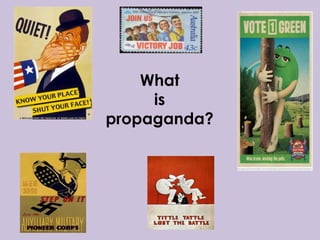
What
is
propaganda?
Definition….
 Comes from propagate: to spread
 Involves the systematic spread of information to influence
people’s behaviour, beliefs and attitudes, often
deliberately promoting a one-sided view in order to gain
support for the viewpoint or belief.
 Is essentially ideology (values, attitudes and beliefs): may
be political, gender; class; race; ethnicity.
 The word has negative connotations as it is often involved
with the distortion of the truth.
 Employs main tools and devices: persuasive language
and appeals, propaganda devices.
 Involves strong emotional appeals.
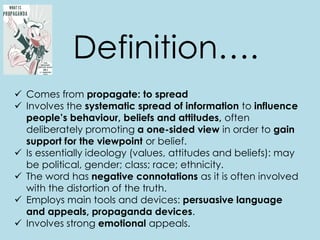
Where is it found?
 Everywhere!
 In may be presented in a range of mediums: posters, stamps,
shirts, slogans, brochures, papers, speeches, autobiographies,
costume, symbols.
 Is very prevalent in war.
 Is behind any form of communication that has an agenda of
changing people’s beliefs or attitudes – public health
announcements, advertisements for beauty products, political
campaigns, school websites, although we tend to associate
propaganda with the political arena.
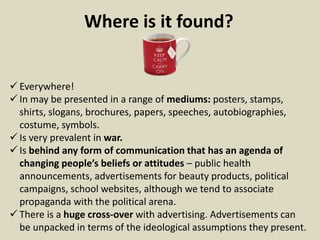
 There is a huge cross-over with advertising. Advertisements can
be unpacked in terms of the ideological assumptions they present.
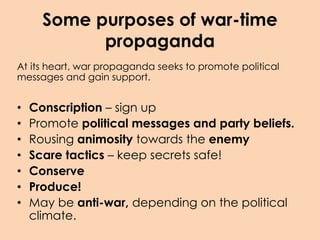
Some purposes of war-time
propaganda
At its heart, war propaganda seeks to promote political
messages and gain support.
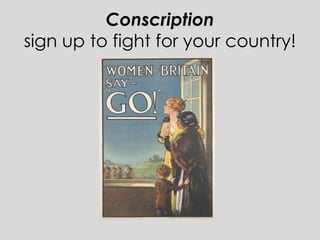
• Conscription – sign up
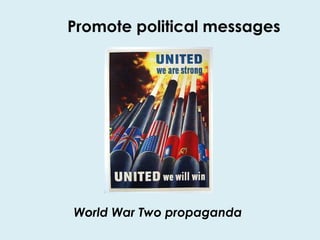
• Promote political messages and party beliefs.
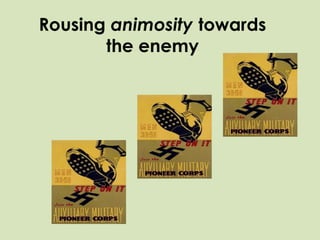
• Rousing animosity towards the enemy
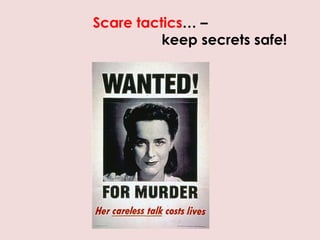
• Scare tactics – keep secrets safe!
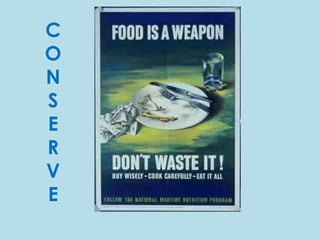
• Conserve
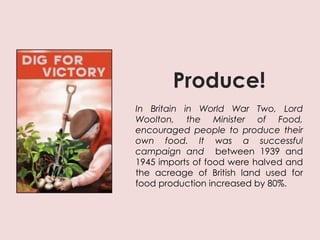
• Produce!
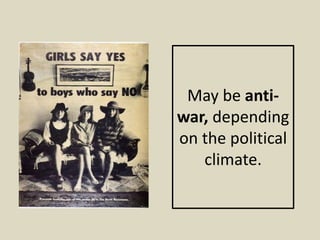
• May be anti-war, depending on the political
climate.
Conscription
sign up to fight for your country!
Promote political messages
World War Two propaganda
Rousing animosity towards
the enemy
Scare tactics… –
keep secrets safe!
C
O
N
S
E
R
V
E
Produce!
In Britain in World War Two, Lord
Woolton, the Minister of Food,
encouraged people to produce their
own food. It was a successful
campaign and between 1939 and
1945 imports of food were halved and
the acreage of British land used for
food production increased by 80%.
May be anti-
war, depending
on the political
climate.
Ideology behind war propaganda
Just a start! Examine the political leadership and what they stand for…
Values of:
Unity: working for the collective good
Strength: national pride, morale, physical strength
required for war,
Hope: looking forward to the future or victory
Patriotism: love of one’s country; national pride
Parsimony (thrift)
Anger: towards the enemy or traitors.
Fear: uses scare-tactics and scaremongering.
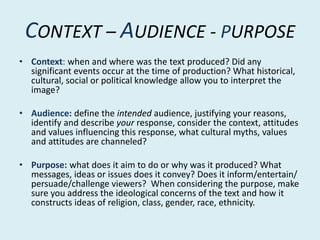
CONTEXT – AUDIENCE - PURPOSE
• Context: when and where was the text produced? Did any
significant events occur at the time of production? What historical,
cultural, social or political knowledge allow you to interpret the
image?
• Audience: define the intended audience, justifying your reasons,
identify and describe your response, consider the context, attitudes
and values influencing this response, what cultural myths, values
and attitudes are channeled?
• Purpose: what does it aim to do or why was it produced? What
messages, ideas or issues does it convey? Does it inform/entertain/
persuade/challenge viewers? When considering the purpose, make
sure you address the ideological concerns of the text and how it
constructs ideas of religion, class, gender, race, ethnicity.
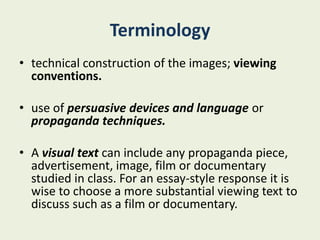
Terminology
• technical construction of the images; viewing
conventions.
• use of persuasive devices and language or
propaganda techniques.
• A visual text can include any propaganda piece,
advertisement, image, film or documentary
studied in class. For an essay-style response it is
wise to choose a more substantial viewing text to
discuss such as a film or documentary.
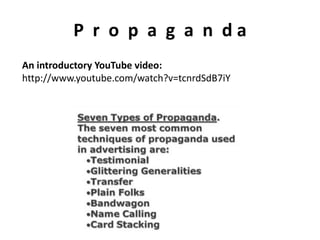
P r o p a g a n d a
An introductory YouTube video:
http://www.youtube.com/watch?v=tcnrdSdB7iY

Propaganda power point

  • 1.
  • 2.
    Definition….  Comes frompropagate: to spread  Involves the systematic spread of information to influence people’s behaviour, beliefs and attitudes, often deliberately promoting a one-sided view in order to gain support for the viewpoint or belief.  Is essentially ideology (values, attitudes and beliefs): may be political, gender; class; race; ethnicity.  The word has negative connotations as it is often involved with the distortion of the truth.  Employs main tools and devices: persuasive language and appeals, propaganda devices.  Involves strong emotional appeals.
  • 3.
    Where is itfound?  Everywhere!  In may be presented in a range of mediums: posters, stamps, shirts, slogans, brochures, papers, speeches, autobiographies, costume, symbols.  Is very prevalent in war.  Is behind any form of communication that has an agenda of changing people’s beliefs or attitudes – public health announcements, advertisements for beauty products, political campaigns, school websites, although we tend to associate propaganda with the political arena.  There is a huge cross-over with advertising. Advertisements can be unpacked in terms of the ideological assumptions they present.
  • 4.
    Some purposes ofwar-time propaganda At its heart, war propaganda seeks to promote political messages and gain support. • Conscription – sign up • Promote political messages and party beliefs. • Rousing animosity towards the enemy • Scare tactics – keep secrets safe! • Conserve • Produce! • May be anti-war, depending on the political climate.
  • 5.
    Conscription sign up tofight for your country!
  • 6.
  • 7.
  • 8.
  • 9.
  • 10.
    Produce! In Britain inWorld War Two, Lord Woolton, the Minister of Food, encouraged people to produce their own food. It was a successful campaign and between 1939 and 1945 imports of food were halved and the acreage of British land used for food production increased by 80%.
  • 11.
    May be anti- war,depending on the political climate.
  • 12.
    Ideology behind warpropaganda Just a start! Examine the political leadership and what they stand for… Values of: Unity: working for the collective good Strength: national pride, morale, physical strength required for war, Hope: looking forward to the future or victory Patriotism: love of one’s country; national pride Parsimony (thrift) Anger: towards the enemy or traitors. Fear: uses scare-tactics and scaremongering.
  • 13.
    CONTEXT – AUDIENCE- PURPOSE • Context: when and where was the text produced? Did any significant events occur at the time of production? What historical, cultural, social or political knowledge allow you to interpret the image? • Audience: define the intended audience, justifying your reasons, identify and describe your response, consider the context, attitudes and values influencing this response, what cultural myths, values and attitudes are channeled? • Purpose: what does it aim to do or why was it produced? What messages, ideas or issues does it convey? Does it inform/entertain/ persuade/challenge viewers? When considering the purpose, make sure you address the ideological concerns of the text and how it constructs ideas of religion, class, gender, race, ethnicity.
  • 14.
    Terminology • technical constructionof the images; viewing conventions. • use of persuasive devices and language or propaganda techniques. • A visual text can include any propaganda piece, advertisement, image, film or documentary studied in class. For an essay-style response it is wise to choose a more substantial viewing text to discuss such as a film or documentary.
  • 15.
    P r op a g a n d a An introductory YouTube video: http://www.youtube.com/watch?v=tcnrdSdB7iY