Normative
Theories Of Mass
Communication
Contents:
 Definition Of Normative Theories
 The Origin Of Normative Theories Of Media
 The Origin Of Libertarian Thought On Communication
 The Marketplace Of Ideas: A New Form Of Radical
Libertarianism
 Government Regulation Of Media
 Professionalization & Limitations Of Journalism
 Social Responsibility Theory of the Press: A Postwar
Compromise
 Dual Responsibility Model
 The Public Interest In The Internet Era
 Non-Profit Journalism
 Other Normative Theories
Normative Theory:
• A type of theory that describes an ideal way for a media
system to be structured and operated.
Normative theories are different from most of the theories:
They don’t describe things as they are, nor do they provide scientific
explanations or predictions. Instead, they describe the way things
should be if some ideal values or principles are to be realized.
Normative theories come from many sources:
• Sometimes media practitioners themselves develop them.
• Sometimes social critics or academics do.
The Origin Of Normative Theories
Of Media:
• Radical Libertarian
• Technocratic control
Propaganda and Mass Society Theories are used to justify
media regulation.
Radical Libertarian:
They believe that there should be no laws governing media
operations.
They are First Amendment absolutists who take the notion of “free
press” quite literally to mean that all forms of media must be
totally unregulated.
These people accept as gospel that the First Amendment dictate
“Congress shall make no law … abridging the freedom of speech
or of the press”
means exactly what it says. As Supreme Court Justice Hugo Black
succinctly stated,
“No law means no law.”
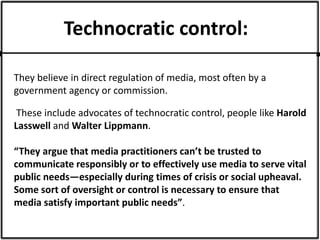
Technocratic control:
They believe in direct regulation of media, most often by a
government agency or commission.
These include advocates of technocratic control, people like Harold
Lasswell and Walter Lippmann.
“They argue that media practitioners can’t be trusted to
communicate responsibly or to effectively use media to serve vital
public needs—especially during times of crisis or social upheaval.
Some sort of oversight or control is necessary to ensure that
media satisfy important public needs”.
Propaganda and Mass Society Theories are
used to justify media regulation:
Social responsibility theory emerged from this debate.
It represents a compromise between views favoring government
control of media and those favoring total press freedom.
This didn’t satisfy everyone, but it did have broad appeal,
especially within the media industries.
Even today, most mainstream media practitioners use some variant
of social responsibility theory to justify their actions.
The Origin Of Libertarian Thought
On Communication:
Libertarian communication theory arose in opposition to
Authoritarian Theory.
An idea that placed all forms of communication under the control of
a governing elite or authorities.
(Siebert, Peterson, and Schramm, 1956)
Media must respect What Authorities want and work according to
the wishes of the authorities.
Major Features of Authoritarian
Theory:
• Absolute power of Monarchy.
• Press Support the Monarchy and can’t criticize Monarchy.
• Press must be Licensed.
Publishers could be jailed for violating their charters, and charters
or licenses could be revoked. Censorship of all types, therefore,
was easily possible.
Siebert
if individuals could be freed from the arbitrary limits on
communication imposed by church and state, they would “naturally”
follow the dictates of their conscience, seek truth, engage in public
debate, and ultimately create a better life for themselves
and others.
Libertarian Theory:
Peterson
(McQuail, 1987; Siebert, Peterson, and Schramm, 1956).
One Man
=
One Vote
According to John Milton: “Every man has the ability to make a
decision”.
Major Features:
• Press should serve the people, not the government.
• Press helps discover the truth.
• Free marked place of ideas.
• Check the government activities.
As such, the newly formed United States was one of the first nations
to explicitly adopt Libertarian principles, as it did in the Declaration of
Independence and the Bill of Rights.
John Keane (1991) identified 3 fundamental concepts underpinning
the Founders’ belief in press freedom:
1. Theology: Media should serve as a forum allowing people to
deduce between good and evil.
2. Individual rights: Press freedom is the strongest, if not the only,
guarantee of liberty from political elites.
3. Attainment of truth: Falsehoods must be
countered; ideas must be
challenged and tested or they
will become dogma.
 Marketplace of ideas In Libertarianism, the notion that all ideas
should be put before the public, and the public will choose the
best from that “marketplace”. ( Baran & Davis, pg 104)
The Marketplace Of Ideas: A New
Form Of Radical Libertarianism:
 The rise of Penny Press & Yellow Journalism.
 Progressive & Populist Movements.
 In response against Progressive & Populist, media Practitioners
solution was known as Marked Place of Ideas.
 Laissez-faire doctrine: The idea that government shall allow
business to operate freely and without official intrusion.
 How the markedplace of ideas work ( Communication Process).
Sender + Idea + Medium + Receiver
Government Regulation Of
Media:
 During the 1920s and 1930s, a new normative
theory of mass communication began to emerge that rejected
both radical Libertarianism and technocratic control. One source
of this theory was congressional hearings over government
regulation of radio.
 Establishment of government commissions to oversee their
operations.
 FRC ( Federal Radio Commission).
 FCC ( Federal Communication Commission).
Professionalization & Limitations Of
Journalism:
A call for Professionalization in media.
 Professional schools
 The Canons of Journalism
 Muckrakers
 Fourth Estate
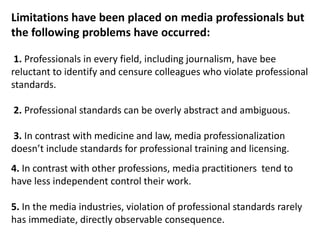
Limitations have been placed on media professionals but
the following problems have occurred:
1. Professionals in every field, including journalism, have bee
reluctant to identify and censure colleagues who violate professional
standards.
2. Professional standards can be overly abstract and ambiguous.
3. In contrast with medicine and law, media professionalization
doesn’t include standards for professional training and licensing.
4. In contrast with other professions, media practitioners tend to
have less independent control their work.
5. In the media industries, violation of professional standards rarely
has immediate, directly observable consequence.
Social Responsibility Theory of the Press:
A Postwar Compromise:
Throughout WWII and during the anti-communist agitation that
followed, there was pressure for greater government regulation of
media.
 The Hutchins Commission on Freedom of the Press was
established in 1942. Members consisted of leaders from many areas
of society, including academics, politicians, and heads of social
groups.
 The members where divided in 2 views:
1. Libertarian views
2. View that some form of press regulation was necessary
 Chicago School: Envisioned modern cities as “Great
Communities” composed of hundreds of small groups.
 Pluralistic Groups: In a Great Community, the various
segments defined by specific unifying characteristics.
The Chicago School believe that with unregulated mass media, the
small, weak, pluralistic groups would be neglected.
The Social Theory Of The Press: the need for an independent
press that scrutinizes other social institutions and provides
objective, accurate news reports.
Denis McQuail (1987) summarized the basic
principles of social responsibility theory as follows:
 Media should accept and fulfill certain obligations to society.
 These obligations are mainly to be met by setting high or professional
standards of informativeness, truth, accuracy, objectivity, and balance.
 In accepting and applying these obligations, media should be self-regulating
within the framework of law and established institutions
 The media should avoid whatever might lead to crime, violence, or civil
disorder or give offense to minority groups.
 The media as a whole should be pluralist and reflect the diversity of their
society, giving access to various points of view and to rights of reply.
 Society and the public have a right to expect high standards of performance,
and intervention can be justified to secure the, or a, public good.
 Journalists and media professionals should be accountable to society as well as
to employers and the market.
Dual Responsibility Model:
Dual responsibility theory:
Revision of social responsibility theory delineating a role for fiscal,
as well as social, responsibility in news decision making.
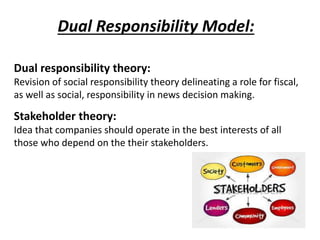
Stakeholder theory:
Idea that companies should operate in the best interests of all
those who depend on the their stakeholders.
Traditional Model of Social Responsibility:
Media
Responsibility
to public
(Social)
Editorial
Decisions
Dual Responsibility Model:
Media
Responsibility
to audience
( Social )
Responsibility to
Shareholders
(Fiscal)
Editorial
decisions
The Public Interest In The Internet Era:
Sphere of consensus:
• Media coverage of issues or matters like
Iraq war or the military interventions.
Reporters don’t feel cowed in such
coverage.
Sphere of legitimate controversy:
• Press gives full coverage to the issues fall in
this categories. For instance, such as election
campaigns, shortcomings or gaffes of political
candidates.
Sphere of deviation
• This is the area where reporters or media
outlets hesitate. They don’t give due coverage
like the issue of AIDS, Race or Holocaust.
Non-Profit Journalism:
community-funded (or crowd-funded) journalism:
Journalists propose projects online to people who then contribute to
those they deem worthy.
Knight and the Sandler Foundations.
GrossePointToday.com
MinnPost.com
NewJerseyNewsroom.com.
Other Normative Theories:
William Hachten (1992) provided the now-classic perspective on
normative theories guiding the media systems of different
countries and political systems.
He identified five “concepts”:
(1) Western
(2) development
(3) revolutionary
(4) Authoritarian
(5) communism.
Other
Normative
Theories
Western concept: A normative theory combining aspects of
Libertarianism and social responsibility theory.
Development Concept: A normative theory describing systems in
which government and media work in
concert to ensure that the media aid the
planned, beneficial development of a given
nation.
Revolutionary Concept: A normative theory describing a system in
which media are used in the service of
revolution.
Authoritarian concept: A normative theory advocating the
complete domination of media by a
government for the purpose of forcing
those media to serve the government.
Communism concept: A normative theory advocating the
complete domination of media by a
Communist government for the purpose
of forcing those media to serve the
Communist Party
Transitional media Approach: A less category based, more
flexible approach to evaluating
media system than traditional
normative theory.
Normative theories
Normative theories

Normative theories

  • 2.
  • 3.
    Contents:  Definition OfNormative Theories  The Origin Of Normative Theories Of Media  The Origin Of Libertarian Thought On Communication  The Marketplace Of Ideas: A New Form Of Radical Libertarianism  Government Regulation Of Media  Professionalization & Limitations Of Journalism  Social Responsibility Theory of the Press: A Postwar Compromise  Dual Responsibility Model  The Public Interest In The Internet Era  Non-Profit Journalism  Other Normative Theories
  • 4.
    Normative Theory: • Atype of theory that describes an ideal way for a media system to be structured and operated. Normative theories are different from most of the theories: They don’t describe things as they are, nor do they provide scientific explanations or predictions. Instead, they describe the way things should be if some ideal values or principles are to be realized. Normative theories come from many sources: • Sometimes media practitioners themselves develop them. • Sometimes social critics or academics do.
  • 5.
    The Origin OfNormative Theories Of Media: • Radical Libertarian • Technocratic control Propaganda and Mass Society Theories are used to justify media regulation.
  • 6.
    Radical Libertarian: They believethat there should be no laws governing media operations. They are First Amendment absolutists who take the notion of “free press” quite literally to mean that all forms of media must be totally unregulated. These people accept as gospel that the First Amendment dictate “Congress shall make no law … abridging the freedom of speech or of the press” means exactly what it says. As Supreme Court Justice Hugo Black succinctly stated, “No law means no law.”
  • 7.
    Technocratic control: They believein direct regulation of media, most often by a government agency or commission. These include advocates of technocratic control, people like Harold Lasswell and Walter Lippmann. “They argue that media practitioners can’t be trusted to communicate responsibly or to effectively use media to serve vital public needs—especially during times of crisis or social upheaval. Some sort of oversight or control is necessary to ensure that media satisfy important public needs”.
  • 8.
    Propaganda and MassSociety Theories are used to justify media regulation: Social responsibility theory emerged from this debate. It represents a compromise between views favoring government control of media and those favoring total press freedom. This didn’t satisfy everyone, but it did have broad appeal, especially within the media industries. Even today, most mainstream media practitioners use some variant of social responsibility theory to justify their actions.
  • 9.
    The Origin OfLibertarian Thought On Communication: Libertarian communication theory arose in opposition to Authoritarian Theory. An idea that placed all forms of communication under the control of a governing elite or authorities. (Siebert, Peterson, and Schramm, 1956) Media must respect What Authorities want and work according to the wishes of the authorities.
  • 10.
    Major Features ofAuthoritarian Theory: • Absolute power of Monarchy. • Press Support the Monarchy and can’t criticize Monarchy. • Press must be Licensed. Publishers could be jailed for violating their charters, and charters or licenses could be revoked. Censorship of all types, therefore, was easily possible.
  • 11.
    Siebert if individuals couldbe freed from the arbitrary limits on communication imposed by church and state, they would “naturally” follow the dictates of their conscience, seek truth, engage in public debate, and ultimately create a better life for themselves and others. Libertarian Theory: Peterson (McQuail, 1987; Siebert, Peterson, and Schramm, 1956). One Man = One Vote
  • 12.
    According to JohnMilton: “Every man has the ability to make a decision”. Major Features: • Press should serve the people, not the government. • Press helps discover the truth. • Free marked place of ideas. • Check the government activities. As such, the newly formed United States was one of the first nations to explicitly adopt Libertarian principles, as it did in the Declaration of Independence and the Bill of Rights.
  • 13.
    John Keane (1991)identified 3 fundamental concepts underpinning the Founders’ belief in press freedom: 1. Theology: Media should serve as a forum allowing people to deduce between good and evil. 2. Individual rights: Press freedom is the strongest, if not the only, guarantee of liberty from political elites. 3. Attainment of truth: Falsehoods must be countered; ideas must be challenged and tested or they will become dogma.
  • 14.
     Marketplace ofideas In Libertarianism, the notion that all ideas should be put before the public, and the public will choose the best from that “marketplace”. ( Baran & Davis, pg 104) The Marketplace Of Ideas: A New Form Of Radical Libertarianism:  The rise of Penny Press & Yellow Journalism.  Progressive & Populist Movements.  In response against Progressive & Populist, media Practitioners solution was known as Marked Place of Ideas.  Laissez-faire doctrine: The idea that government shall allow business to operate freely and without official intrusion.  How the markedplace of ideas work ( Communication Process). Sender + Idea + Medium + Receiver
  • 15.
    Government Regulation Of Media: During the 1920s and 1930s, a new normative theory of mass communication began to emerge that rejected both radical Libertarianism and technocratic control. One source of this theory was congressional hearings over government regulation of radio.  Establishment of government commissions to oversee their operations.  FRC ( Federal Radio Commission).  FCC ( Federal Communication Commission).
  • 16.
    Professionalization & LimitationsOf Journalism: A call for Professionalization in media.  Professional schools  The Canons of Journalism  Muckrakers  Fourth Estate
  • 17.
    Limitations have beenplaced on media professionals but the following problems have occurred: 1. Professionals in every field, including journalism, have bee reluctant to identify and censure colleagues who violate professional standards. 2. Professional standards can be overly abstract and ambiguous. 3. In contrast with medicine and law, media professionalization doesn’t include standards for professional training and licensing. 4. In contrast with other professions, media practitioners tend to have less independent control their work. 5. In the media industries, violation of professional standards rarely has immediate, directly observable consequence.
  • 18.
    Social Responsibility Theoryof the Press: A Postwar Compromise: Throughout WWII and during the anti-communist agitation that followed, there was pressure for greater government regulation of media.  The Hutchins Commission on Freedom of the Press was established in 1942. Members consisted of leaders from many areas of society, including academics, politicians, and heads of social groups.  The members where divided in 2 views: 1. Libertarian views 2. View that some form of press regulation was necessary
  • 19.
     Chicago School:Envisioned modern cities as “Great Communities” composed of hundreds of small groups.  Pluralistic Groups: In a Great Community, the various segments defined by specific unifying characteristics. The Chicago School believe that with unregulated mass media, the small, weak, pluralistic groups would be neglected. The Social Theory Of The Press: the need for an independent press that scrutinizes other social institutions and provides objective, accurate news reports.
  • 20.
    Denis McQuail (1987)summarized the basic principles of social responsibility theory as follows:  Media should accept and fulfill certain obligations to society.  These obligations are mainly to be met by setting high or professional standards of informativeness, truth, accuracy, objectivity, and balance.  In accepting and applying these obligations, media should be self-regulating within the framework of law and established institutions  The media should avoid whatever might lead to crime, violence, or civil disorder or give offense to minority groups.  The media as a whole should be pluralist and reflect the diversity of their society, giving access to various points of view and to rights of reply.  Society and the public have a right to expect high standards of performance, and intervention can be justified to secure the, or a, public good.  Journalists and media professionals should be accountable to society as well as to employers and the market.
  • 21.
    Dual Responsibility Model: Dualresponsibility theory: Revision of social responsibility theory delineating a role for fiscal, as well as social, responsibility in news decision making. Stakeholder theory: Idea that companies should operate in the best interests of all those who depend on the their stakeholders.
  • 22.
    Traditional Model ofSocial Responsibility: Media Responsibility to public (Social) Editorial Decisions Dual Responsibility Model: Media Responsibility to audience ( Social ) Responsibility to Shareholders (Fiscal) Editorial decisions
  • 23.
    The Public InterestIn The Internet Era:
  • 24.
    Sphere of consensus: •Media coverage of issues or matters like Iraq war or the military interventions. Reporters don’t feel cowed in such coverage.
  • 25.
    Sphere of legitimatecontroversy: • Press gives full coverage to the issues fall in this categories. For instance, such as election campaigns, shortcomings or gaffes of political candidates.
  • 26.
    Sphere of deviation •This is the area where reporters or media outlets hesitate. They don’t give due coverage like the issue of AIDS, Race or Holocaust.
  • 27.
    Non-Profit Journalism: community-funded (orcrowd-funded) journalism: Journalists propose projects online to people who then contribute to those they deem worthy. Knight and the Sandler Foundations. GrossePointToday.com MinnPost.com NewJerseyNewsroom.com.
  • 28.
    Other Normative Theories: WilliamHachten (1992) provided the now-classic perspective on normative theories guiding the media systems of different countries and political systems. He identified five “concepts”: (1) Western (2) development (3) revolutionary (4) Authoritarian (5) communism. Other Normative Theories
  • 29.
    Western concept: Anormative theory combining aspects of Libertarianism and social responsibility theory. Development Concept: A normative theory describing systems in which government and media work in concert to ensure that the media aid the planned, beneficial development of a given nation. Revolutionary Concept: A normative theory describing a system in which media are used in the service of revolution.
  • 30.
    Authoritarian concept: Anormative theory advocating the complete domination of media by a government for the purpose of forcing those media to serve the government. Communism concept: A normative theory advocating the complete domination of media by a Communist government for the purpose of forcing those media to serve the Communist Party Transitional media Approach: A less category based, more flexible approach to evaluating media system than traditional normative theory.