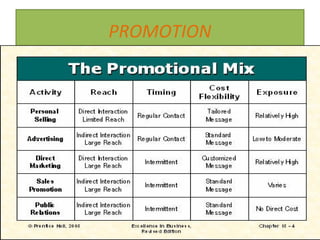
PROMOTION
Chapter Questions
• What steps are involved in developing an advertising
  program?
• How should sales promotion decisions be made?
• What are the guidelines for effective brand-building
  events and experiences?
• How can companies exploit the potential of public
  relations and publicity?
What is Advertising?
Advertising is any paid form of nonpersonal
presentation and promotion of ideas, goods,
    or services by an identified sponsor.
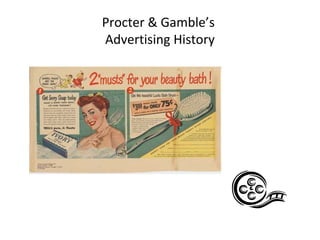
Procter & Gamble’s
Advertising History
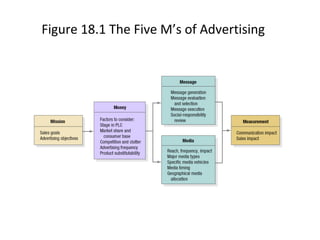
Figure 18.1 The Five M’s of Advertising
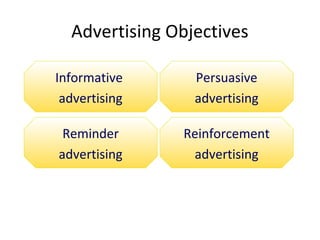
Advertising Objectives

Informative      Persuasive
 advertising     advertising

 Reminder      Reinforcement
advertising     advertising
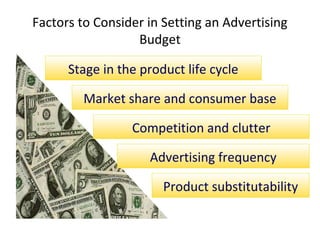
Factors to Consider in Setting an Advertising
                  Budget

      Stage in the product life cycle

         Market share and consumer base

                 Competition and clutter

                    Advertising frequency

                       Product substitutability
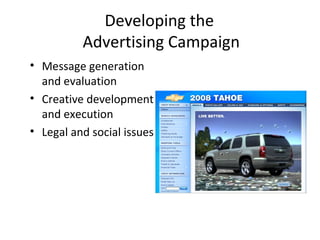
Developing the
          Advertising Campaign
• Message generation
  and evaluation
• Creative development
  and execution
• Legal and social issues
Television
Advantages                       Disadvantages
• Reaches broad spectrum of      • Brief
  consumers                      • Clutter
• Low cost per exposure          • High cost of production
• Ability to demonstrate         • High cost of placement
  product use                    • Lack of attention by viewers
• Ability to portray image and
  brand personality
Print Ads
Advantages             Disadvantages
• Detailed product     • Passive medium
  information          • Clutter
• Ability to           • Unable to
  communicate user       demonstrate product
  imagery                use
• Flexibility
• Ability to segment
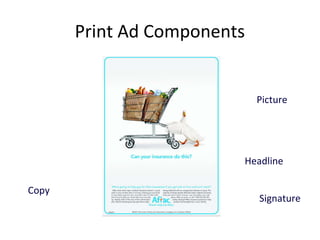
Print Ad Components


                             Picture


                         Headline

Copy
                             Signature
Print Ad Evaluation Criteria
• Is the message clear at a glance?
• Is the benefit in the headline?
• Does the illustration support the headline?
• Does the first line of the copy support or explain the
  headline and illustration?
• Is the ad easy to read and follow?
• Is the product easily identified?
• Is the brand or sponsor clearly identified?
Communicating to the Rural
                  Audience
• Large variations in language and culture
• Campaigns have to be tailor made for product
  and region
• Product demonstrations in haats, mandis, and
  melas (fairs) are useful
• TV and print media do not reach all villages and
  all customers
• Wall paintings and signboards very popular
• Folk theatre, magic shows and puppet shows are
  also used as a media vehicle
Media Selection

•   Reach
•   Frequency
•   Impact
•   Exposure
Choosing Among Major Media Types

•   Target audience and media habits
•   Product characteristics
•   Message characteristics
•   Cost
Major Media Types
•   Newspapers      •   Outdoor
•   Television      •   Yellow Pages
•   Direct mail     •   Newsletters
•   Radio           •   Brochures
•   Magazines       •   Telephone
                    •   Internet
Table 18.2 Advertising Research
                Techniques
•   For Print Ads
•   For Broadcast Ads
•   In-house tests
•   Trailer tests
•   Theater tests
•   On-air tests
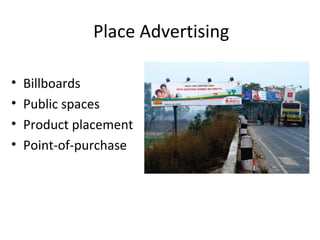
Place Advertising

•   Billboards
•   Public spaces
•   Product placement
•   Point-of-purchase
Measures of Audience Size
•   Circulation
•   Audience
•   Effective audience
•   Effective ad-exposed audience
Factors Affecting Timing Patterns


• Buyer turnover
• Purchase frequency
• Forgetting rate
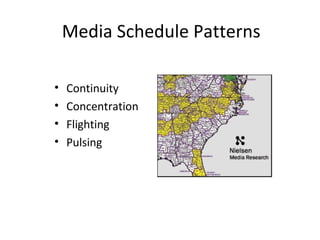
Media Schedule Patterns

•   Continuity
•   Concentration
•   Flighting
•   Pulsing
Evaluating Advertising Effectiveness

• Communication-Effect Research
   – Consumer feedback method
   – Portfolio tests
   – Laboratory tests
• Sales-Effect Research
What is Sales Promotion?
  Sales promotions consist of a collection of
incentive tools, mostly short term, designed to
   stimulate quicker or greater purchase of
 particular products or services by consumers
                  or the trade.
Sales Promotion Tactics
Consumer-directed      Trade-directed
• Samples              • Price offs
• Coupons              • Allowances
• Cash refund offers   • Free goods
• Price offs
                       • Sales contests
• Premiums
• Prizes               • Spiffs
• Patronage rewards    • Trade shows
• Free trials          • Specialty advertising
• Tie-in promotions
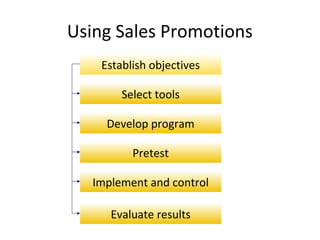
Using Sales Promotions
    Establish objectives

        Select tools

     Develop program

          Pretest

   Implement and control

      Evaluate results
Why Sponsor Events?
• To identify with a particular target market or life
  style
• To increase brand awareness
• To create or reinforce consumer perceptions of
  key brand image associations
• To enhance corporate image
• To create experiences and evoke feelings
• To express commitment to community
• To entertain key clients or reward employees
• To permit merchandising or promotional
  opportunities
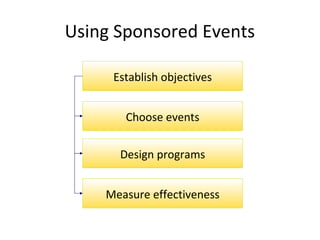
Using Sponsored Events

     Establish objectives


       Choose events


      Design programs


    Measure effectiveness
Tasks Aided by Public Relations
• Launching new products
• Repositioning a mature product
• Building interest in a product category
• Influencing specific target groups
• Defending products that have encountered
  public problems
• Building the corporate image in a way that
  reflects favorable on products
Public Relations Functions
•   Press relations
•   Product publicity
•   Corporate communications
•   Lobbying
•   Counseling
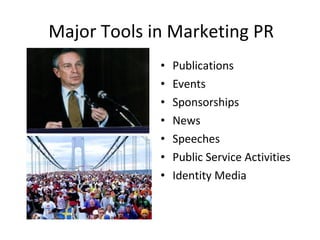
Major Tools in Marketing PR
             •   Publications
             •   Events
             •   Sponsorships
             •   News
             •   Speeches
             •   Public Service Activities
             •   Identity Media
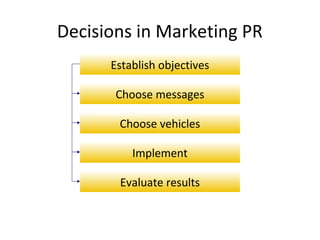
Decisions in Marketing PR
      Establish objectives

       Choose messages

       Choose vehicles

          Implement

       Evaluate results
What is Direct Marketing?
   Direct marketing is the use of consumer-
direct channels to reach and deliver goods and
 services to customers without using market
                  middlemen.
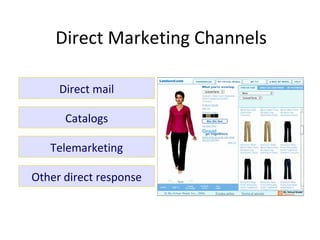
Direct Marketing Channels

     Direct mail

      Catalogs

   Telemarketing

Other direct response
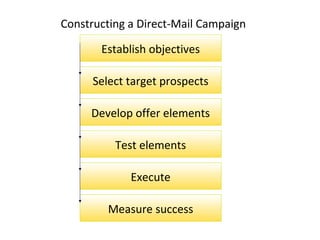
Constructing a Direct-Mail Campaign

       Establish objectives

      Select target prospects

     Develop offer elements

          Test elements

             Execute

         Measure success
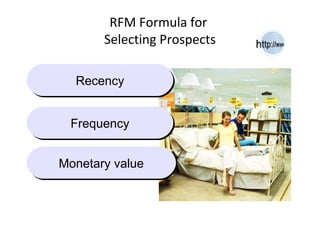
RFM Formula for
       Selecting Prospects

  Recency
  Recency


 Frequency
 Frequency


Monetary value
Monetary value
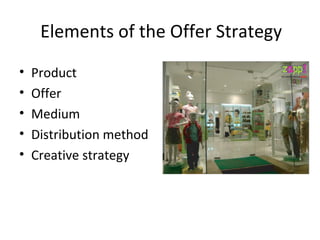
Elements of the Offer Strategy
•   Product
•   Offer
•   Medium
•   Distribution method
•   Creative strategy
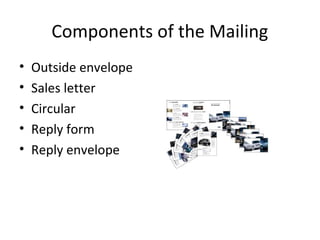
Components of the Mailing
•   Outside envelope
•   Sales letter
•   Circular
•   Reply form
•   Reply envelope
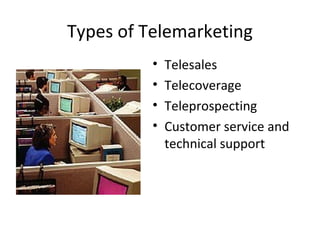
Types of Telemarketing
          •   Telesales
          •   Telecoverage
          •   Teleprospecting
          •   Customer service and
              technical support
Other Media for Direct Response

Television
• Direct Response Advertising
• At-home shopping channels
• Videotext
Kiosks
Interactive Marketing
•   Tailored messages possible
•   Easy to track responsiveness
•   Contextual ad placement possible
•   Search engine advertising possible
•   Subject to click fraud
•   Consumers develop selective attention
Online Promotional Opportunities
•   Websites                • Sponsorships
•   Microsites              • Alliances and affiliate
•   Search ads                programs
•   Display ads             • Online communities
•   Interstitials           • Email
•   Internet-specific ads   • Mobile marketing
    and videos
e-Marketing Guidelines
• Give the customer a reason to respond
• Personalize the content of your emails
• Offer something the customer could not get
  via direct mail
• Make it easy for customers to unsubscribe
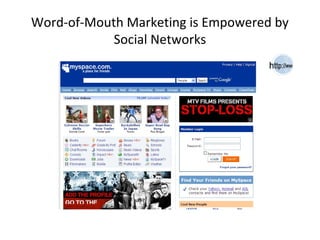
Word-of-Mouth Marketing is Empowered by
            Social Networks
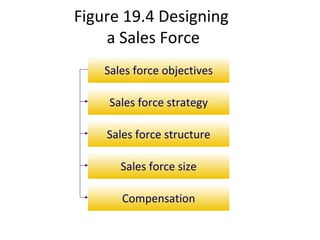
Figure 19.4 Designing
    a Sales Force
    Sales force objectives

     Sales force strategy

    Sales force structure

       Sales force size

       Compensation
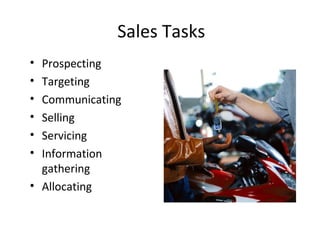
Sales Tasks
• Prospecting
• Targeting
• Communicating
• Selling
• Servicing
• Information
  gathering
• Allocating
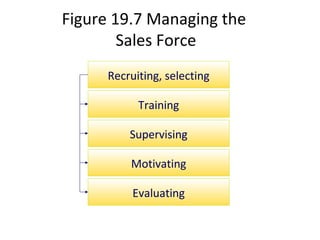
Figure 19.7 Managing the
        Sales Force
     Recruiting, selecting

           Training

         Supervising

         Motivating

          Evaluating
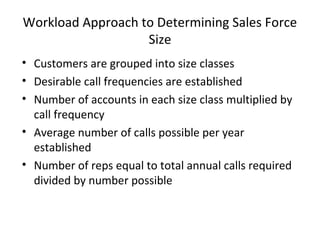
Workload Approach to Determining Sales Force
                   Size
• Customers are grouped into size classes
• Desirable call frequencies are established
• Number of accounts in each size class multiplied by
  call frequency
• Average number of calls possible per year
  established
• Number of reps equal to total annual calls required
  divided by number possible
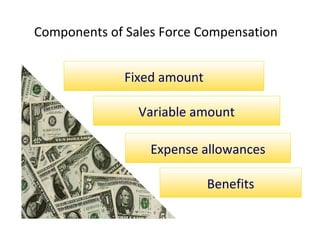
Components of Sales Force Compensation


              Fixed amount

                Variable amount

                  Expense allowances

                             Benefits
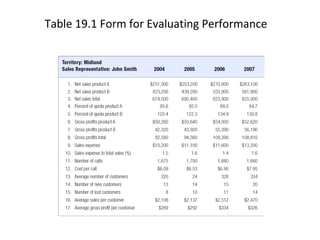
Table 19.1 Form for Evaluating Performance
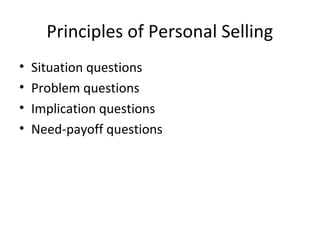
Principles of Personal Selling
•   Situation questions
•   Problem questions
•   Implication questions
•   Need-payoff questions
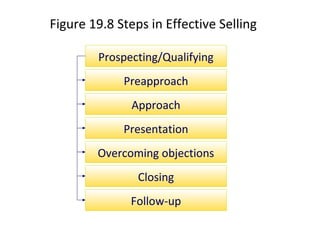
Figure 19.8 Steps in Effective Selling

        Prospecting/Qualifying
             Preapproach
               Approach
             Presentation
        Overcoming objections
                Closing
              Follow-up

Promotion

  • 1.
  • 2.
    Chapter Questions • Whatsteps are involved in developing an advertising program? • How should sales promotion decisions be made? • What are the guidelines for effective brand-building events and experiences? • How can companies exploit the potential of public relations and publicity?
  • 3.
    What is Advertising? Advertisingis any paid form of nonpersonal presentation and promotion of ideas, goods, or services by an identified sponsor.
  • 4.
  • 5.
    Figure 18.1 TheFive M’s of Advertising
  • 6.
    Advertising Objectives Informative Persuasive advertising advertising Reminder Reinforcement advertising advertising
  • 7.
    Factors to Considerin Setting an Advertising Budget Stage in the product life cycle Market share and consumer base Competition and clutter Advertising frequency Product substitutability
  • 8.
    Developing the Advertising Campaign • Message generation and evaluation • Creative development and execution • Legal and social issues
  • 9.
    Television Advantages Disadvantages • Reaches broad spectrum of • Brief consumers • Clutter • Low cost per exposure • High cost of production • Ability to demonstrate • High cost of placement product use • Lack of attention by viewers • Ability to portray image and brand personality
  • 10.
    Print Ads Advantages Disadvantages • Detailed product • Passive medium information • Clutter • Ability to • Unable to communicate user demonstrate product imagery use • Flexibility • Ability to segment
  • 11.
    Print Ad Components Picture Headline Copy Signature
  • 12.
    Print Ad EvaluationCriteria • Is the message clear at a glance? • Is the benefit in the headline? • Does the illustration support the headline? • Does the first line of the copy support or explain the headline and illustration? • Is the ad easy to read and follow? • Is the product easily identified? • Is the brand or sponsor clearly identified?
  • 13.
    Communicating to theRural Audience • Large variations in language and culture • Campaigns have to be tailor made for product and region • Product demonstrations in haats, mandis, and melas (fairs) are useful • TV and print media do not reach all villages and all customers • Wall paintings and signboards very popular • Folk theatre, magic shows and puppet shows are also used as a media vehicle
  • 14.
    Media Selection • Reach • Frequency • Impact • Exposure
  • 15.
    Choosing Among MajorMedia Types • Target audience and media habits • Product characteristics • Message characteristics • Cost
  • 16.
    Major Media Types • Newspapers • Outdoor • Television • Yellow Pages • Direct mail • Newsletters • Radio • Brochures • Magazines • Telephone • Internet
  • 17.
    Table 18.2 AdvertisingResearch Techniques • For Print Ads • For Broadcast Ads • In-house tests • Trailer tests • Theater tests • On-air tests
  • 18.
    Place Advertising • Billboards • Public spaces • Product placement • Point-of-purchase
  • 19.
    Measures of AudienceSize • Circulation • Audience • Effective audience • Effective ad-exposed audience
  • 20.
    Factors Affecting TimingPatterns • Buyer turnover • Purchase frequency • Forgetting rate
  • 21.
    Media Schedule Patterns • Continuity • Concentration • Flighting • Pulsing
  • 22.
    Evaluating Advertising Effectiveness •Communication-Effect Research – Consumer feedback method – Portfolio tests – Laboratory tests • Sales-Effect Research
  • 23.
    What is SalesPromotion? Sales promotions consist of a collection of incentive tools, mostly short term, designed to stimulate quicker or greater purchase of particular products or services by consumers or the trade.
  • 24.
    Sales Promotion Tactics Consumer-directed Trade-directed • Samples • Price offs • Coupons • Allowances • Cash refund offers • Free goods • Price offs • Sales contests • Premiums • Prizes • Spiffs • Patronage rewards • Trade shows • Free trials • Specialty advertising • Tie-in promotions
  • 25.
    Using Sales Promotions Establish objectives Select tools Develop program Pretest Implement and control Evaluate results
  • 26.
    Why Sponsor Events? •To identify with a particular target market or life style • To increase brand awareness • To create or reinforce consumer perceptions of key brand image associations • To enhance corporate image • To create experiences and evoke feelings • To express commitment to community • To entertain key clients or reward employees • To permit merchandising or promotional opportunities
  • 27.
    Using Sponsored Events Establish objectives Choose events Design programs Measure effectiveness
  • 28.
    Tasks Aided byPublic Relations • Launching new products • Repositioning a mature product • Building interest in a product category • Influencing specific target groups • Defending products that have encountered public problems • Building the corporate image in a way that reflects favorable on products
  • 29.
    Public Relations Functions • Press relations • Product publicity • Corporate communications • Lobbying • Counseling
  • 30.
    Major Tools inMarketing PR • Publications • Events • Sponsorships • News • Speeches • Public Service Activities • Identity Media
  • 31.
    Decisions in MarketingPR Establish objectives Choose messages Choose vehicles Implement Evaluate results
  • 32.
    What is DirectMarketing? Direct marketing is the use of consumer- direct channels to reach and deliver goods and services to customers without using market middlemen.
  • 33.
    Direct Marketing Channels Direct mail Catalogs Telemarketing Other direct response
  • 34.
    Constructing a Direct-MailCampaign Establish objectives Select target prospects Develop offer elements Test elements Execute Measure success
  • 35.
    RFM Formula for Selecting Prospects Recency Recency Frequency Frequency Monetary value Monetary value
  • 36.
    Elements of theOffer Strategy • Product • Offer • Medium • Distribution method • Creative strategy
  • 37.
    Components of theMailing • Outside envelope • Sales letter • Circular • Reply form • Reply envelope
  • 38.
    Types of Telemarketing • Telesales • Telecoverage • Teleprospecting • Customer service and technical support
  • 39.
    Other Media forDirect Response Television • Direct Response Advertising • At-home shopping channels • Videotext Kiosks
  • 40.
    Interactive Marketing • Tailored messages possible • Easy to track responsiveness • Contextual ad placement possible • Search engine advertising possible • Subject to click fraud • Consumers develop selective attention
  • 41.
    Online Promotional Opportunities • Websites • Sponsorships • Microsites • Alliances and affiliate • Search ads programs • Display ads • Online communities • Interstitials • Email • Internet-specific ads • Mobile marketing and videos
  • 42.
    e-Marketing Guidelines • Givethe customer a reason to respond • Personalize the content of your emails • Offer something the customer could not get via direct mail • Make it easy for customers to unsubscribe
  • 43.
    Word-of-Mouth Marketing isEmpowered by Social Networks
  • 44.
    Figure 19.4 Designing a Sales Force Sales force objectives Sales force strategy Sales force structure Sales force size Compensation
  • 45.
    Sales Tasks • Prospecting •Targeting • Communicating • Selling • Servicing • Information gathering • Allocating
  • 46.
    Figure 19.7 Managingthe Sales Force Recruiting, selecting Training Supervising Motivating Evaluating
  • 47.
    Workload Approach toDetermining Sales Force Size • Customers are grouped into size classes • Desirable call frequencies are established • Number of accounts in each size class multiplied by call frequency • Average number of calls possible per year established • Number of reps equal to total annual calls required divided by number possible
  • 48.
    Components of SalesForce Compensation Fixed amount Variable amount Expense allowances Benefits
  • 49.
    Table 19.1 Formfor Evaluating Performance
  • 50.
    Principles of PersonalSelling • Situation questions • Problem questions • Implication questions • Need-payoff questions
  • 51.
    Figure 19.8 Stepsin Effective Selling Prospecting/Qualifying Preapproach Approach Presentation Overcoming objections Closing Follow-up

Editor's Notes

  • #5 Click on the video icon to launch a video clip about Procter & Gamble’s advertising history.