Chapter 9
TABLE OF CONTENTS
• Summary
• Developing and Managing an Advertising Program
• Sales Promotion
• Events and Experiences
• Public Relations
SUMMARY
3
SUMMARY
• Advertising is any paid form of nonpersonal presentation and
promotion of ideas, goods, or services by an identified
sponsor. Advertisers include not only business firms but also
charitable, nonprofit, and government agencies.
• Developing an advertising program is a five-step process:
(1) set advertising objectives,
(2) establish a budget,
(3) choose the advertising message and creative strategy,
(4) decide on the media, and
(5) evaluate communication and sales effects.
• Sales promotion consists of mostly short-term incentive tools,
designed to stimulate quicker or greater purchase of particular
products or services by consumers or the trade.
SUMMARY
• Events and experiences are a means to become part of special
and more personally relevant moments in consumers’ lives.
Events can broaden and deepen the sponsor’s relationship
with its target market, but only if managed properly.
• Public relations (PR) includes a variety of programs designed
to promote or protect a company’s image or its individual
products. Marketing public relations (MPR), to support the
marketing department in corporate or product promotion and
image making, can affect public awareness at a fraction of the
cost of advertising and is often much more credible. The main
tools of PR are publications, events, news, community affairs,
identification media, lobbying, and social responsibility.
LEARNING OBJECTIVES
In this chapter we will address the following questions:
• What steps are required in developing an advertising
program?
• How should marketers choose advertising media and measure
their effectiveness?
• How should sales promotion decisions be made?
• What are the guidelines for effective brand-building events
and experiences?
• How can companies exploit the potential of public relations?
DEVELOPING AND MANAGING AN
ADVERTISING PROGRAM
Section 1
DEVELOPING AND MANAGING AN ADVERTISING PROGRAM
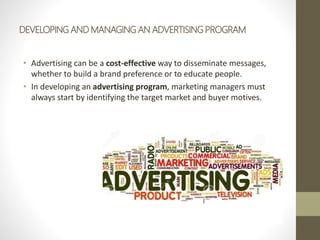
• Advertising can be a cost-effective way to disseminate messages,
whether to build a brand preference or to educate people.
• In developing an advertising program, marketing managers must
always start by identifying the target market and buyer motives.
THE FIVE M’S OF ADVERTISING
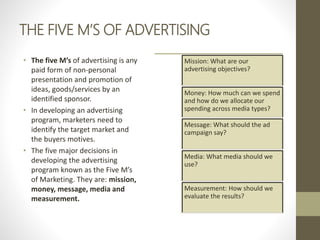
• The five M’s of advertising is any
paid form of non-personal
presentation and promotion of
ideas, goods/services by an
identified sponsor.
• In developing an advertising
program, marketers need to
identify the target market and
the buyers motives.
• The five major decisions in
developing the advertising
program known as the Five M’s
of Marketing. They are: mission,
money, message, media and
measurement.
Mission: What are our
advertising objectives?
Money: How much can we spend
and how do we allocate our
spending across media types?
Message: What should the ad
campaign say?
Media: What media should we
use?
Measurement: How should we
evaluate the results?
SETTING THE ADVERTISINGOBJECTIVES
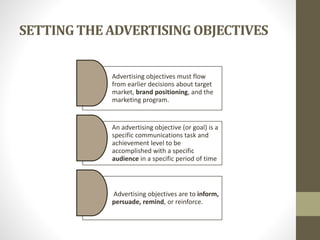
Advertising objectives must flow
from earlier decisions about target
market, brand positioning, and the
marketing program.
An advertising objective (or goal) is a
specific communications task and
achievement level to be
accomplished with a specific
audience in a specific period of time
Advertising objectives are to inform,
persuade, remind, or reinforce.
TYPES OF ADVERTISING
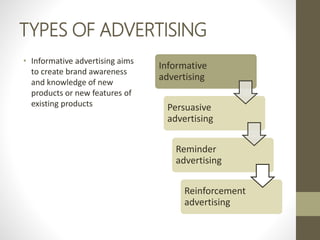
• Informative advertising aims
to create brand awareness
and knowledge of new
products or new features of
existing products
Informative
advertising
Persuasive
advertising
Reminder
advertising
Reinforcement
advertising
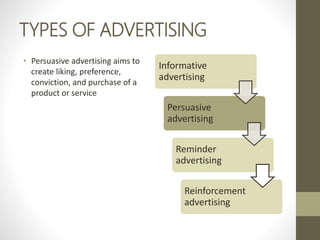
TYPES OF ADVERTISING
• Persuasive advertising aims to
create liking, preference,
conviction, and purchase of a
product or service
Informative
advertising
Persuasive
advertising
Reminder
advertising
Reinforcement
advertising
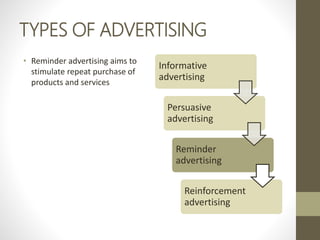
TYPES OF ADVERTISING
• Reminder advertising aims to
stimulate repeat purchase of
products and services
Informative
advertising
Persuasive
advertising
Reminder
advertising
Reinforcement
advertising
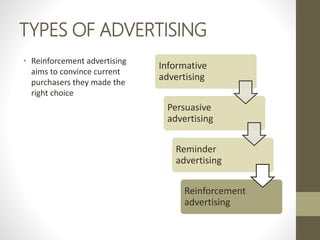
TYPES OF ADVERTISING
• Reinforcement advertising
aims to convince current
purchasers they made the
right choice
Informative
advertising
Persuasive
advertising
Reminder
advertising
Reinforcement
advertising
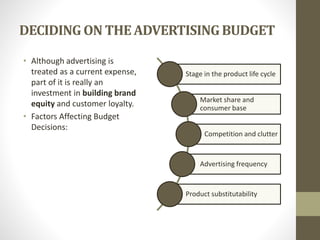
DECIDING ON THEADVERTISINGBUDGET
• Although advertising is
treated as a current expense,
part of it is really an
investment in building brand
equity and customer loyalty.
• Factors Affecting Budget
Decisions:
Stage in the product life cycle
Market share and
consumer base
Competition and clutter
Advertising frequency
Product substitutability
DEVELOPING THE ADVERTISING CAMPAIGN
Advertisers employ both art and science to develop the message strategy or
positioning of an ad, what it attempts to convey about the brand, its creative
strategy and how it expresses the brand claims.
They use three steps:
1)message generation and evaluation
2)creative development and execution
3)social-responsibility review.
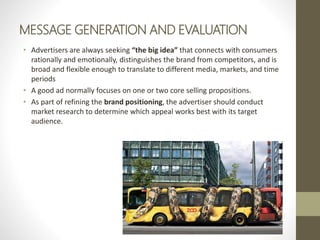
MESSAGE GENERATION AND EVALUATION
• Advertisers are always seeking “the big idea” that connects with consumers
rationally and emotionally, distinguishes the brand from competitors, and is
broad and flexible enough to translate to different media, markets, and time
periods
• A good ad normally focuses on one or two core selling propositions.
• As part of refining the brand positioning, the advertiser should conduct
market research to determine which appeal works best with its target
audience.
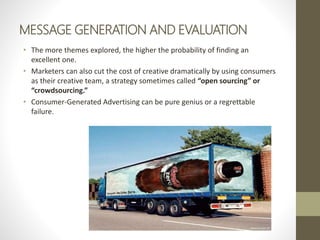
MESSAGE GENERATION AND EVALUATION
• The more themes explored, the higher the probability of finding an
excellent one.
• Marketers can also cut the cost of creative dramatically by using consumers
as their creative team, a strategy sometimes called “open sourcing” or
“crowdsourcing.”
• Consumer-Generated Advertising can be pure genius or a regrettable
failure.
CREATIVE DEVELOPMENT AND EXECUTION
Television is the most powerful
advertising medium and reaches a
broad spectrum of consumers at low
cost per exposure.
• TV demonstrate product attributes
and persuasively explain consumer
benefits.
• TV portray user and usage imagery,
brand personality, and other
intangibles.
• Product-related messages and the
brand itself can be overlooked.
• High volume of nonprogramming
material on TV creates clutter that
makes it easy for consumers to ignore
or forget ads.
Television
Print Media
Radio
CREATIVE DEVELOPMENT AND EXECUTION
Print media provides detailed product
information and effectively
communicate user and usage imagery.
• The visual images in print media
makes dynamic demonstrations
difficult, and print media can be fairly
passive.
• Newspapers are timely and
pervasive, magazines are typically
more effective at building user and
usage imagery.
• Print advertising has steadily declined
in recent years.
• Newspaper ads, relatively poor
reproduction quality and short shelf
life can diminish the impact.
Television
Print Media
Radio
CREATIVE DEVELOPMENT AND EXECUTION
Radio’s main advantage is flexibility—
stations are very targeted, ads are
relatively inexpensive to produce and
place, and short closings for scheduling
them allow for quick response.
• Radio can engage listeners through a
combination of popular brands, local
presence, and strong personalities.
• It is a particularly effective medium
in the morning; it can also let
companies achieve a balance
between broad and localized market
coverage.
• Radio’s obvious disadvantages are its
lack of visual images and the
relatively passive nature of the
consumer processing that results.
Television
Print Media
Radio
LEGAL AND SOCIAL ISSUES
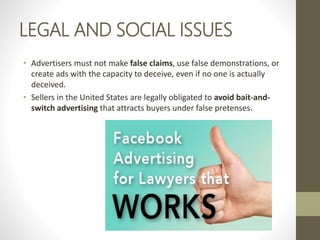
• Advertisers must not make false claims, use false demonstrations, or
create ads with the capacity to deceive, even if no one is actually
deceived.
• Sellers in the United States are legally obligated to avoid bait-and-
switch advertising that attracts buyers under false pretenses.
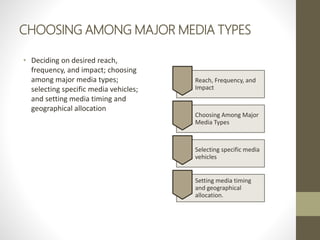
CHOOSING AMONG MAJOR MEDIA TYPES
• Deciding on desired reach,
frequency, and impact; choosing
among major media types;
selecting specific media vehicles;
and setting media timing and
geographical allocation
Reach, Frequency, and
Impact
Choosing Among Major
Media Types
Selecting specific media
vehicles
Setting media timing
and geographical
allocation.
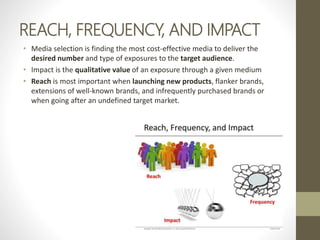
REACH, FREQUENCY, AND IMPACT
• Media selection is finding the most cost-effective media to deliver the
desired number and type of exposures to the target audience.
• Impact is the qualitative value of an exposure through a given medium
• Reach is most important when launching new products, flanker brands,
extensions of well-known brands, and infrequently purchased brands or
when going after an undefined target market.
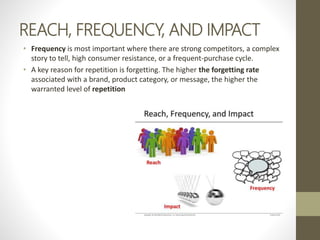
REACH, FREQUENCY, AND IMPACT
• Frequency is most important where there are strong competitors, a complex
story to tell, high consumer resistance, or a frequent-purchase cycle.
• A key reason for repetition is forgetting. The higher the forgetting rate
associated with a brand, product category, or message, the higher the
warranted level of repetition
CHOOSING AMONG MAJOR MEDIA TYPES-
NEWSPAPERS
Advantages
High reach
Credible
Regional
Large amount of information
Disadvantages
Limited selectivity
Low quality of reproduction
Short life span
CHOOSING AMONG MAJOR MEDIA TYPES-
MAGAZINES
Advantages
High reach and credible
Selectivity and long life span
High quality of reproduction
High involvement
Large amount of information
Disadvantages
Slow medium
Less flexible
High clutter
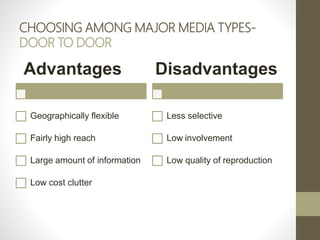
CHOOSING AMONG MAJOR MEDIA TYPES-
DOOR TO DOOR
Advantages
Geographically flexible
Fairly high reach
Large amount of information
Low cost clutter
Disadvantages
Less selective
Low involvement
Low quality of reproduction
CHOOSING AMONG MAJOR MEDIA TYPES-
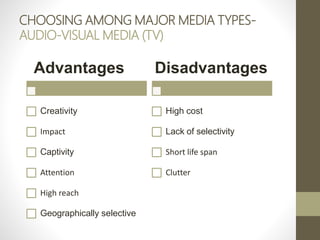
AUDIO-VISUAL MEDIA (TV)
Advantages
Creativity
Impact
Captivity
Attention
High reach
Geographically selective
Disadvantages
High cost
Lack of selectivity
Short life span
Clutter
CHOOSING AMONG MAJOR MEDIA TYPES-
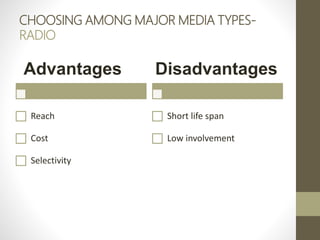
RADIO
Advantages
Reach
Cost
Selectivity
Disadvantages
Short life span
Low involvement
CHOOSING AMONG MAJOR MEDIA TYPES
• Media planners make their choices by considering factors such as target
audience media habits, product characteristics, message requirements, and
cost.
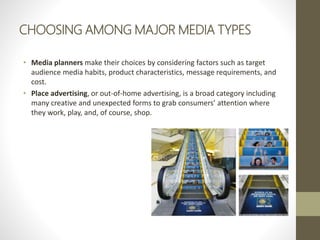
• Place advertising, or out-of-home advertising, is a broad category including
many creative and unexpected forms to grab consumers’ attention where
they work, play, and, of course, shop.
PLACE ADVERTISING
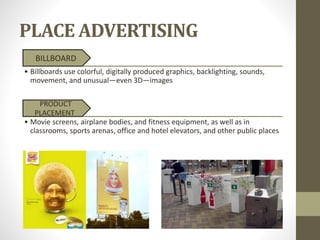
BILLBOARD
• Billboards use colorful, digitally produced graphics, backlighting, sounds,
movement, and unusual—even 3D—images
PRODUCT
PLACEMENT
• Movie screens, airplane bodies, and fitness equipment, as well as in
classrooms, sports arenas, office and hotel elevators, and other public places
PLACE ADVERTISING
PRODUCT
PLACEMENT
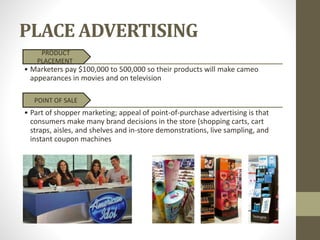
• Marketers pay $100,000 to 500,000 so their products will make cameo
appearances in movies and on television
POINT OF SALE
• Part of shopper marketing; appeal of point-of-purchase advertising is that
consumers make many brand decisions in the store (shopping carts, cart
straps, aisles, and shelves and in-store demonstrations, live sampling, and
instant coupon machines
EVALUATING ALTERNATE MEDIA
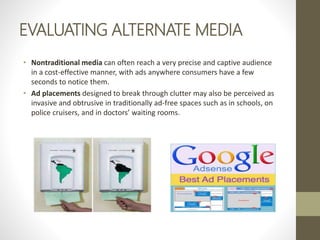
• Nontraditional media can often reach a very precise and captive audience
in a cost-effective manner, with ads anywhere consumers have a few
seconds to notice them.
• Ad placements designed to break through clutter may also be perceived as
invasive and obtrusive in traditionally ad-free spaces such as in schools, on
police cruisers, and in doctors’ waiting rooms.
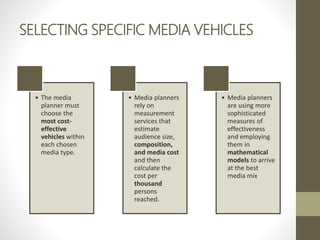
SELECTING SPECIFIC MEDIA VEHICLES
• The media
planner must
choose the
most cost-
effective
vehicles within
each chosen
media type.
• Media planners
rely on
measurement
services that
estimate
audience size,
composition,
and media cost
and then
calculate the
cost per
thousand
persons
reached.
• Media planners
are using more
sophisticated
measures of
effectiveness
and employing
them in
mathematical
models to arrive
at the best
media mix
MEDIA TIMING AND ALLOCATION
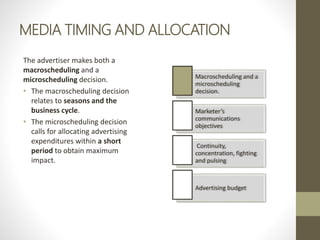
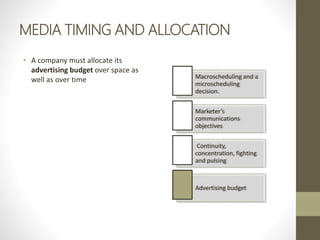
The advertiser makes both a
macroscheduling and a
microscheduling decision.
• The macroscheduling decision
relates to seasons and the
business cycle.
• The microscheduling decision
calls for allocating advertising
expenditures within a short
period to obtain maximum
impact.
Macroscheduling and a
microscheduling
decision.
Marketer’s
communications
objectives
Continuity,
concentration, fighting
and pulsing
Advertising budget
MEDIA TIMING AND ALLOCATION
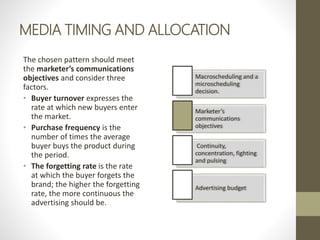
The chosen pattern should meet
the marketer’s communications
objectives and consider three
factors.
• Buyer turnover expresses the
rate at which new buyers enter
the market.
• Purchase frequency is the
number of times the average
buyer buys the product during
the period.
• The forgetting rate is the rate
at which the buyer forgets the
brand; the higher the forgetting
rate, the more continuous the
advertising should be.
Macroscheduling and a
microscheduling
decision.
Marketer’s
communications
objectives
Continuity,
concentration, fighting
and pulsing
Advertising budget
MEDIA TIMING AND ALLOCATION
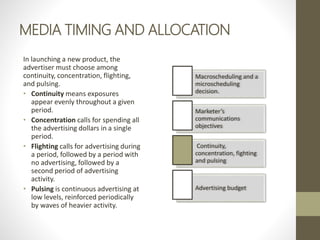
In launching a new product, the
advertiser must choose among
continuity, concentration, flighting,
and pulsing.
• Continuity means exposures
appear evenly throughout a given
period.
• Concentration calls for spending all
the advertising dollars in a single
period.
• Flighting calls for advertising during
a period, followed by a period with
no advertising, followed by a
second period of advertising
activity.
• Pulsing is continuous advertising at
low levels, reinforced periodically
by waves of heavier activity.
Macroscheduling and a
microscheduling
decision.
Marketer’s
communications
objectives
Continuity,
concentration, fighting
and pulsing
Advertising budget
MEDIA TIMING AND ALLOCATION
• A company must allocate its
advertising budget over space as
well as over time Macroscheduling and a
microscheduling
decision.
Marketer’s
communications
objectives
Continuity,
concentration, fighting
and pulsing
Advertising budget
EVALUATINGADVERTISINGEFFECTIVENESS
• Communication-effect research, called copy testing, seeks to
determine whether an ad is communicating effectively.
• Sales-Effect Research- features and price are, the easier it is to
measure advertising’s effect on sales. The sales impact is
easiest to measure in direct marketing situations and hardest
in brand or corporate image-building advertising.
Developing and Managing an Advertising Program
Coca Cola - Questions
1. What does Coca-Cola stand for? Does it mean the same
thing to everyone? Explain.
2. Coca-Cola has successfully marketed to billions of people
around the world. Why is it so successful?
3. Can Pepsi or any other company ever surpass Coca-Cola?
Why or why not? What are Coca-Cola’s greatest risks?
Developing and Managing an Advertising Program
Coca Cola - Answers
1. What does Coca-Cola stand for? Does it mean the same thing to
everyone? Explain.
• Because Coke believed early on that to gain worldwide acceptance, it
needed to connect emotionally and socially with the masses and be “at
arm’s length” with everyone. Coco-Cola must understand and recognize
that “refreshment” means different things to different people around the
world. One of Coke’s strengths is how well it weaves the soft drink, Coke,
into people’s definitions of refreshment no matter where in the world they
live.
2. Coca-Cola has successfully marketed to billions of people around the
world. Why is it so successful?
• Coke has created a culturally relevant, uplifting global campaign that
translates well into different countries, languages, and cultures. Coke’s
advertising has primarily focused on the product’s ability to quench thirst.
Developing and Managing an Advertising Program
Coca Cola - Answers
3. Can Pepsi or any other company ever surpass Coca-Cola? Why or why
not? What are Coca-Cola’s greatest risks?
• Student answers will vary based on their personal opinions and “tastes.”
Coke’s greatest risks have to be the managing of its mass communications
strategy and reaching the brand’s target market—it is so massive that the
right media and marketing message is critical. Concerns about obesity,
which have been associated with a general decline in soda consumption,
are a major risk. Coca-Cola also needs to be able to execute in emerging
markets, where water (a critical ingredient in its products) may be limited
and distribution logistics may be a challenge.
SALES PROMOTION
Section 2
WHAT IS SALES PROMOTION?
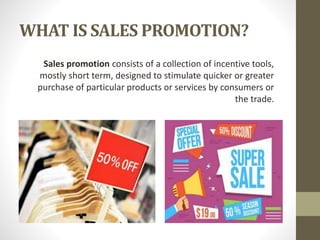
Sales promotion consists of a collection of incentive tools,
mostly short term, designed to stimulate quicker or greater
purchase of particular products or services by consumers or
the trade.
SALES PROMOTION
Some sales promotion tools are consumer
franchise building. They impart a selling message
along with the deal, such as free samples,
frequency awards, coupons and premiums.
Sales promotion tools that are typically not brand
building include price-off packs, consumer
premiums, contests and sweepstakes, consumer
refund offers, and trade allowances
SALES PROMOTION
Sales promotions in markets of high brand
similarity can produce a high sales response in
the short run but little permanent gain over the
longer term.
In addition to brand switching, consumers may
engage in stockpiling—purchasing earlier than
usual (purchase acceleration) or buying extra
quantities.
SALES PROMOTION
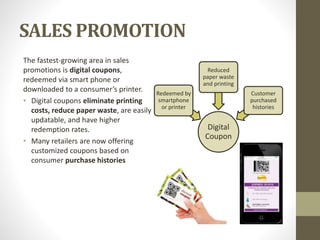
The fastest-growing area in sales
promotions is digital coupons,
redeemed via smart phone or
downloaded to a consumer’s printer.
• Digital coupons eliminate printing
costs, reduce paper waste, are easily
updatable, and have higher
redemption rates.
• Many retailers are now offering
customized coupons based on
consumer purchase histories
Digital
Coupon
Redeemed by
smartphone
or printer
Reduced
paper waste
and printing
Customer
purchased
histories
USING SALES PROMOTIONS
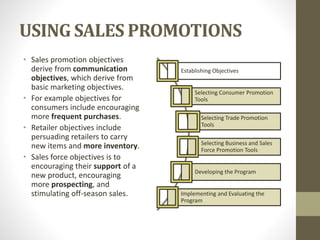
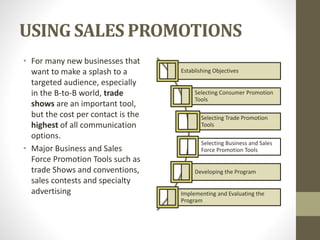
• Sales promotion objectives
derive from communication
objectives, which derive from
basic marketing objectives.
• For example objectives for
consumers include encouraging
more frequent purchases.
• Retailer objectives include
persuading retailers to carry
new items and more inventory.
• Sales force objectives is to
encouraging their support of a
new product, encouraging
more prospecting, and
stimulating off-season sales.
Establishing Objectives
Selecting Consumer Promotion
Tools
Selecting Trade Promotion
Tools
Selecting Business and Sales
Force Promotion Tools
Developing the Program
Implementing and Evaluating the
Program
USING SALES PROMOTIONS
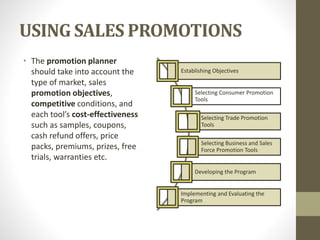
• The promotion planner
should take into account the
type of market, sales
promotion objectives,
competitive conditions, and
each tool’s cost-effectiveness
such as samples, coupons,
cash refund offers, price
packs, premiums, prizes, free
trials, warranties etc.
Establishing Objectives
Selecting Consumer Promotion
Tools
Selecting Trade Promotion
Tools
Selecting Business and Sales
Force Promotion Tools
Developing the Program
Implementing and Evaluating the
Program
USING SALES PROMOTIONS
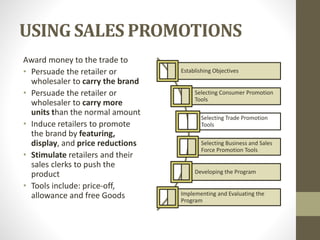
Award money to the trade to
• Persuade the retailer or
wholesaler to carry the brand
• Persuade the retailer or
wholesaler to carry more
units than the normal amount
• Induce retailers to promote
the brand by featuring,
display, and price reductions
• Stimulate retailers and their
sales clerks to push the
product
• Tools include: price-off,
allowance and free Goods
Establishing Objectives
Selecting Consumer Promotion
Tools
Selecting Trade Promotion
Tools
Selecting Business and Sales
Force Promotion Tools
Developing the Program
Implementing and Evaluating the
Program
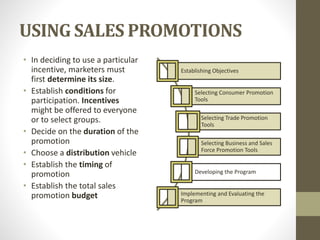
USING SALES PROMOTIONS
• For many new businesses that
want to make a splash to a
targeted audience, especially
in the B-to-B world, trade
shows are an important tool,
but the cost per contact is the
highest of all communication
options.
• Major Business and Sales
Force Promotion Tools such as
trade Shows and conventions,
sales contests and specialty
advertising
Establishing Objectives
Selecting Consumer Promotion
Tools
Selecting Trade Promotion
Tools
Selecting Business and Sales
Force Promotion Tools
Developing the Program
Implementing and Evaluating the
Program
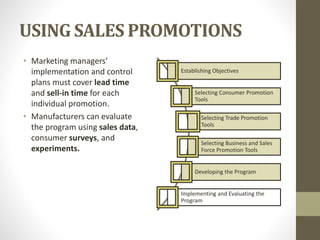
USING SALES PROMOTIONS
• In deciding to use a particular
incentive, marketers must
first determine its size.
• Establish conditions for
participation. Incentives
might be offered to everyone
or to select groups.
• Decide on the duration of the
promotion
• Choose a distribution vehicle
• Establish the timing of
promotion
• Establish the total sales
promotion budget
Establishing Objectives
Selecting Consumer Promotion
Tools
Selecting Trade Promotion
Tools
Selecting Business and Sales
Force Promotion Tools
Developing the Program
Implementing and Evaluating the
Program
USING SALES PROMOTIONS
• Marketing managers’
implementation and control
plans must cover lead time
and sell-in time for each
individual promotion.
• Manufacturers can evaluate
the program using sales data,
consumer surveys, and
experiments.
Establishing Objectives
Selecting Consumer Promotion
Tools
Selecting Trade Promotion
Tools
Selecting Business and Sales
Force Promotion Tools
Developing the Program
Implementing and Evaluating the
Program
SALES PROMOTION
VideoTime–“Howtogetyourideastospread”
 “In a world of too many options and
too little time, our obvious choice is to
just ignore the ordinary stuff.
Marketing guru Seth Godin spells out
why, when it comes to getting our
attention, bad or bizarre ideas are
more successful than boring ones”
 Seth Godin is the author of nineteen
international bestsellers that have
been translated into over 35
languages, and have changed the way
people think about marketing and
work.
 https://www.youtube.com/watch?v=
xBIVlM435Zg&list=PLtt5bLoEmL1vUn
CFdTrLKaXt0wEvYpL0p
EVENTS AND EXPERIENCES
Section 3
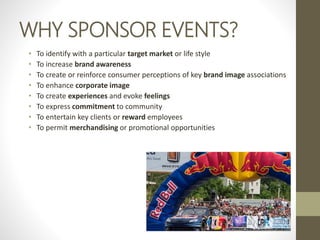
WHY SPONSOR EVENTS?
• To identify with a particular target market or life style
• To increase brand awareness
• To create or reinforce consumer perceptions of key brand image associations
• To enhance corporate image
• To create experiences and evoke feelings
• To express commitment to community
• To entertain key clients or reward employees
• To permit merchandising or promotional opportunities
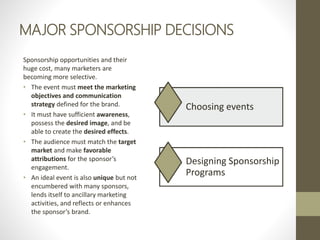
MAJOR SPONSORSHIP DECISIONS
Sponsorship opportunities and their
huge cost, many marketers are
becoming more selective.
• The event must meet the marketing
objectives and communication
strategy defined for the brand.
• It must have sufficient awareness,
possess the desired image, and be
able to create the desired effects.
• The audience must match the target
market and make favorable
attributions for the sponsor’s
engagement.
• An ideal event is also unique but not
encumbered with many sponsors,
lends itself to ancillary marketing
activities, and reflects or enhances
the sponsor’s brand.
Choosing events
Designing Sponsorship
Programs
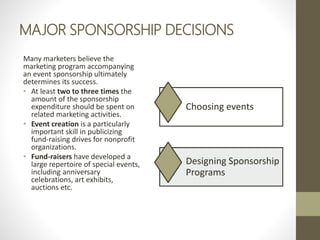
MAJOR SPONSORSHIP DECISIONS
Many marketers believe the
marketing program accompanying
an event sponsorship ultimately
determines its success.
• At least two to three times the
amount of the sponsorship
expenditure should be spent on
related marketing activities.
• Event creation is a particularly
important skill in publicizing
fund-raising drives for nonprofit
organizations.
• Fund-raisers have developed a
large repertoire of special events,
including anniversary
celebrations, art exhibits,
auctions etc.
Choosing events
Designing Sponsorship
Programs
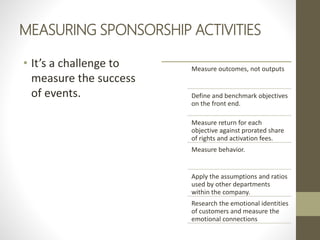
MEASURING SPONSORSHIP ACTIVITIES
• It’s a challenge to
measure the success
of events.
Measure outcomes, not outputs
Define and benchmark objectives
on the front end.
Measure return for each
objective against prorated share
of rights and activation fees.
Measure behavior.
Apply the assumptions and ratios
used by other departments
within the company.
Research the emotional identities
of customers and measure the
emotional connections
MEASURING SPONSORSHIP ACTIVITIES
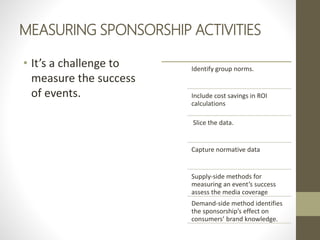
• It’s a challenge to
measure the success
of events.
Identify group norms.
Include cost savings in ROI
calculations
Slice the data.
Capture normative data
Supply-side methods for
measuring an event’s success
assess the media coverage
Demand-side method identifies
the sponsorship’s effect on
consumers’ brand knowledge.
CREATING EXPERIENCES
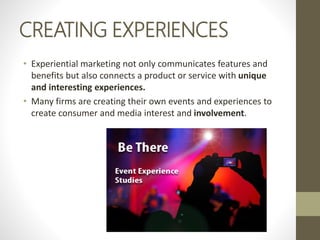
• Experiential marketing not only communicates features and
benefits but also connects a product or service with unique
and interesting experiences.
• Many firms are creating their own events and experiences to
create consumer and media interest and involvement.
PUBLIC RELATIONS
Section 4
PUBLIC RELATIONS
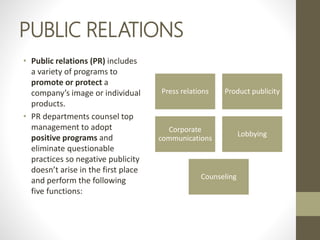
• Public relations (PR) includes
a variety of programs to
promote or protect a
company’s image or individual
products.
• PR departments counsel top
management to adopt
positive programs and
eliminate questionable
practices so negative publicity
doesn’t arise in the first place
and perform the following
five functions:
Press relations Product publicity
Corporate
communications
Lobbying
Counseling
MARKETING PUBLIC RELATIONS
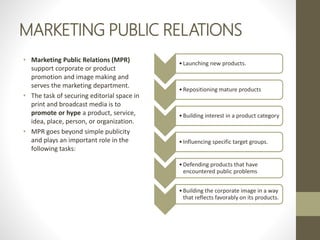
• Marketing Public Relations (MPR)
support corporate or product
promotion and image making and
serves the marketing department.
• The task of securing editorial space in
print and broadcast media is to
promote or hype a product, service,
idea, place, person, or organization.
• MPR goes beyond simple publicity
and plays an important role in the
following tasks:
•Launching new products.
•Repositioning mature products
•Building interest in a product category
•Influencing specific target groups.
•Defending products that have
encountered public problems
•Building the corporate image in a way
that reflects favorably on its products.
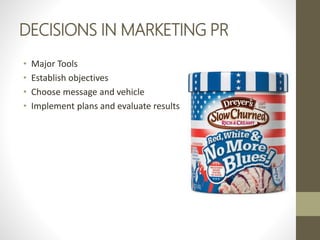
DECISIONS IN MARKETING PR
• Major Tools
• Establish objectives
• Choose message and vehicle
• Implement plans and evaluate results
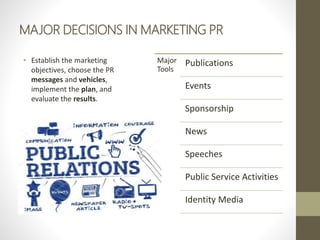
MAJOR DECISIONS IN MARKETING PR
• Establish the marketing
objectives, choose the PR
messages and vehicles,
implement the plan, and
evaluate the results.
Major
Tools
Publications
Events
Sponsorship
News
Speeches
Public Service Activities
Identity Media
MAJOR DECISIONS IN MARKETING PR
• Establishing Objectives: Build awareness by placing
stories in the media to bring
attention to a product, service,
person, organization, or idea
Build credibility by
communicating the message in
an editorial context
Boost sales force and dealer
enthusiasm with stories about
a new product before it is
launched.
Hold down promotion cost
because MPR costs less than
direct-mail and media
advertising
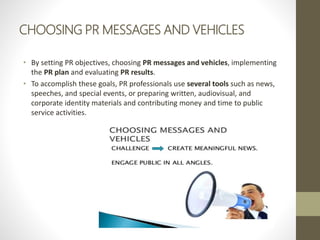
CHOOSING PR MESSAGES AND VEHICLES
• By setting PR objectives, choosing PR messages and vehicles, implementing
the PR plan and evaluating PR results.
• To accomplish these goals, PR professionals use several tools such as news,
speeches, and special events, or preparing written, audiovisual, and
corporate identity materials and contributing money and time to public
service activities.
IMPLEMENTING THE PLAN AND EVALUATING RESULTS
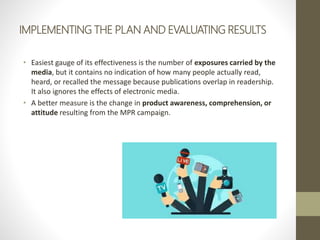
• Easiest gauge of its effectiveness is the number of exposures carried by the
media, but it contains no indication of how many people actually read,
heard, or recalled the message because publications overlap in readership.
It also ignores the effects of electronic media.
• A better measure is the change in product awareness, comprehension, or
attitude resulting from the MPR campaign.
PUBLICRELATIONS
VideoTime–“ARecipeforPRSuccess”
 “How do you scale social
relationships in business? Online spin
doctor and PR expert Jerry Silver
explains why relationships are key for
growing your business and why
brands must target a stupid majority
to attract the active support of a
smart minority”
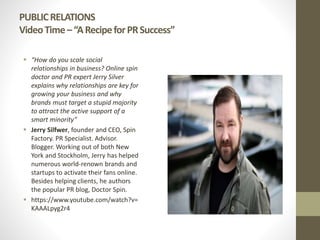
 Jerry Silfwer, founder and CEO, Spin
Factory. PR Specialist. Advisor.
Blogger. Working out of both New
York and Stockholm, Jerry has helped
numerous world-renown brands and
startups to activate their fans online.
Besides helping clients, he authors
the popular PR blog, Doctor Spin.
 https://www.youtube.com/watch?v=
KAAALpyg2r4

Chapter 9 Identifying Market Segments and Targets

  • 1.
  • 2.
    TABLE OF CONTENTS •Summary • Developing and Managing an Advertising Program • Sales Promotion • Events and Experiences • Public Relations
  • 3.
  • 4.
    SUMMARY • Advertising isany paid form of nonpersonal presentation and promotion of ideas, goods, or services by an identified sponsor. Advertisers include not only business firms but also charitable, nonprofit, and government agencies. • Developing an advertising program is a five-step process: (1) set advertising objectives, (2) establish a budget, (3) choose the advertising message and creative strategy, (4) decide on the media, and (5) evaluate communication and sales effects. • Sales promotion consists of mostly short-term incentive tools, designed to stimulate quicker or greater purchase of particular products or services by consumers or the trade.
  • 5.
    SUMMARY • Events andexperiences are a means to become part of special and more personally relevant moments in consumers’ lives. Events can broaden and deepen the sponsor’s relationship with its target market, but only if managed properly. • Public relations (PR) includes a variety of programs designed to promote or protect a company’s image or its individual products. Marketing public relations (MPR), to support the marketing department in corporate or product promotion and image making, can affect public awareness at a fraction of the cost of advertising and is often much more credible. The main tools of PR are publications, events, news, community affairs, identification media, lobbying, and social responsibility.
  • 6.
    LEARNING OBJECTIVES In thischapter we will address the following questions: • What steps are required in developing an advertising program? • How should marketers choose advertising media and measure their effectiveness? • How should sales promotion decisions be made? • What are the guidelines for effective brand-building events and experiences? • How can companies exploit the potential of public relations?
  • 7.
    DEVELOPING AND MANAGINGAN ADVERTISING PROGRAM Section 1
  • 8.
    DEVELOPING AND MANAGINGAN ADVERTISING PROGRAM • Advertising can be a cost-effective way to disseminate messages, whether to build a brand preference or to educate people. • In developing an advertising program, marketing managers must always start by identifying the target market and buyer motives.
  • 9.
    THE FIVE M’SOF ADVERTISING • The five M’s of advertising is any paid form of non-personal presentation and promotion of ideas, goods/services by an identified sponsor. • In developing an advertising program, marketers need to identify the target market and the buyers motives. • The five major decisions in developing the advertising program known as the Five M’s of Marketing. They are: mission, money, message, media and measurement. Mission: What are our advertising objectives? Money: How much can we spend and how do we allocate our spending across media types? Message: What should the ad campaign say? Media: What media should we use? Measurement: How should we evaluate the results?
  • 10.
    SETTING THE ADVERTISINGOBJECTIVES Advertisingobjectives must flow from earlier decisions about target market, brand positioning, and the marketing program. An advertising objective (or goal) is a specific communications task and achievement level to be accomplished with a specific audience in a specific period of time Advertising objectives are to inform, persuade, remind, or reinforce.
  • 11.
    TYPES OF ADVERTISING •Informative advertising aims to create brand awareness and knowledge of new products or new features of existing products Informative advertising Persuasive advertising Reminder advertising Reinforcement advertising
  • 12.
    TYPES OF ADVERTISING •Persuasive advertising aims to create liking, preference, conviction, and purchase of a product or service Informative advertising Persuasive advertising Reminder advertising Reinforcement advertising
  • 13.
    TYPES OF ADVERTISING •Reminder advertising aims to stimulate repeat purchase of products and services Informative advertising Persuasive advertising Reminder advertising Reinforcement advertising
  • 14.
    TYPES OF ADVERTISING •Reinforcement advertising aims to convince current purchasers they made the right choice Informative advertising Persuasive advertising Reminder advertising Reinforcement advertising
  • 15.
    DECIDING ON THEADVERTISINGBUDGET •Although advertising is treated as a current expense, part of it is really an investment in building brand equity and customer loyalty. • Factors Affecting Budget Decisions: Stage in the product life cycle Market share and consumer base Competition and clutter Advertising frequency Product substitutability
  • 16.
    DEVELOPING THE ADVERTISINGCAMPAIGN Advertisers employ both art and science to develop the message strategy or positioning of an ad, what it attempts to convey about the brand, its creative strategy and how it expresses the brand claims. They use three steps: 1)message generation and evaluation 2)creative development and execution 3)social-responsibility review.
  • 17.
    MESSAGE GENERATION ANDEVALUATION • Advertisers are always seeking “the big idea” that connects with consumers rationally and emotionally, distinguishes the brand from competitors, and is broad and flexible enough to translate to different media, markets, and time periods • A good ad normally focuses on one or two core selling propositions. • As part of refining the brand positioning, the advertiser should conduct market research to determine which appeal works best with its target audience.
  • 18.
    MESSAGE GENERATION ANDEVALUATION • The more themes explored, the higher the probability of finding an excellent one. • Marketers can also cut the cost of creative dramatically by using consumers as their creative team, a strategy sometimes called “open sourcing” or “crowdsourcing.” • Consumer-Generated Advertising can be pure genius or a regrettable failure.
  • 19.
    CREATIVE DEVELOPMENT ANDEXECUTION Television is the most powerful advertising medium and reaches a broad spectrum of consumers at low cost per exposure. • TV demonstrate product attributes and persuasively explain consumer benefits. • TV portray user and usage imagery, brand personality, and other intangibles. • Product-related messages and the brand itself can be overlooked. • High volume of nonprogramming material on TV creates clutter that makes it easy for consumers to ignore or forget ads. Television Print Media Radio
  • 20.
    CREATIVE DEVELOPMENT ANDEXECUTION Print media provides detailed product information and effectively communicate user and usage imagery. • The visual images in print media makes dynamic demonstrations difficult, and print media can be fairly passive. • Newspapers are timely and pervasive, magazines are typically more effective at building user and usage imagery. • Print advertising has steadily declined in recent years. • Newspaper ads, relatively poor reproduction quality and short shelf life can diminish the impact. Television Print Media Radio
  • 21.
    CREATIVE DEVELOPMENT ANDEXECUTION Radio’s main advantage is flexibility— stations are very targeted, ads are relatively inexpensive to produce and place, and short closings for scheduling them allow for quick response. • Radio can engage listeners through a combination of popular brands, local presence, and strong personalities. • It is a particularly effective medium in the morning; it can also let companies achieve a balance between broad and localized market coverage. • Radio’s obvious disadvantages are its lack of visual images and the relatively passive nature of the consumer processing that results. Television Print Media Radio
  • 22.
    LEGAL AND SOCIALISSUES • Advertisers must not make false claims, use false demonstrations, or create ads with the capacity to deceive, even if no one is actually deceived. • Sellers in the United States are legally obligated to avoid bait-and- switch advertising that attracts buyers under false pretenses.
  • 23.
    CHOOSING AMONG MAJORMEDIA TYPES • Deciding on desired reach, frequency, and impact; choosing among major media types; selecting specific media vehicles; and setting media timing and geographical allocation Reach, Frequency, and Impact Choosing Among Major Media Types Selecting specific media vehicles Setting media timing and geographical allocation.
  • 24.
    REACH, FREQUENCY, ANDIMPACT • Media selection is finding the most cost-effective media to deliver the desired number and type of exposures to the target audience. • Impact is the qualitative value of an exposure through a given medium • Reach is most important when launching new products, flanker brands, extensions of well-known brands, and infrequently purchased brands or when going after an undefined target market.
  • 25.
    REACH, FREQUENCY, ANDIMPACT • Frequency is most important where there are strong competitors, a complex story to tell, high consumer resistance, or a frequent-purchase cycle. • A key reason for repetition is forgetting. The higher the forgetting rate associated with a brand, product category, or message, the higher the warranted level of repetition
  • 26.
    CHOOSING AMONG MAJORMEDIA TYPES- NEWSPAPERS Advantages High reach Credible Regional Large amount of information Disadvantages Limited selectivity Low quality of reproduction Short life span
  • 27.
    CHOOSING AMONG MAJORMEDIA TYPES- MAGAZINES Advantages High reach and credible Selectivity and long life span High quality of reproduction High involvement Large amount of information Disadvantages Slow medium Less flexible High clutter
  • 28.
    CHOOSING AMONG MAJORMEDIA TYPES- DOOR TO DOOR Advantages Geographically flexible Fairly high reach Large amount of information Low cost clutter Disadvantages Less selective Low involvement Low quality of reproduction
  • 29.
    CHOOSING AMONG MAJORMEDIA TYPES- AUDIO-VISUAL MEDIA (TV) Advantages Creativity Impact Captivity Attention High reach Geographically selective Disadvantages High cost Lack of selectivity Short life span Clutter
  • 30.
    CHOOSING AMONG MAJORMEDIA TYPES- RADIO Advantages Reach Cost Selectivity Disadvantages Short life span Low involvement
  • 31.
    CHOOSING AMONG MAJORMEDIA TYPES • Media planners make their choices by considering factors such as target audience media habits, product characteristics, message requirements, and cost. • Place advertising, or out-of-home advertising, is a broad category including many creative and unexpected forms to grab consumers’ attention where they work, play, and, of course, shop.
  • 32.
    PLACE ADVERTISING BILLBOARD • Billboardsuse colorful, digitally produced graphics, backlighting, sounds, movement, and unusual—even 3D—images PRODUCT PLACEMENT • Movie screens, airplane bodies, and fitness equipment, as well as in classrooms, sports arenas, office and hotel elevators, and other public places
  • 33.
    PLACE ADVERTISING PRODUCT PLACEMENT • Marketerspay $100,000 to 500,000 so their products will make cameo appearances in movies and on television POINT OF SALE • Part of shopper marketing; appeal of point-of-purchase advertising is that consumers make many brand decisions in the store (shopping carts, cart straps, aisles, and shelves and in-store demonstrations, live sampling, and instant coupon machines
  • 34.
    EVALUATING ALTERNATE MEDIA •Nontraditional media can often reach a very precise and captive audience in a cost-effective manner, with ads anywhere consumers have a few seconds to notice them. • Ad placements designed to break through clutter may also be perceived as invasive and obtrusive in traditionally ad-free spaces such as in schools, on police cruisers, and in doctors’ waiting rooms.
  • 35.
    SELECTING SPECIFIC MEDIAVEHICLES • The media planner must choose the most cost- effective vehicles within each chosen media type. • Media planners rely on measurement services that estimate audience size, composition, and media cost and then calculate the cost per thousand persons reached. • Media planners are using more sophisticated measures of effectiveness and employing them in mathematical models to arrive at the best media mix
  • 36.
    MEDIA TIMING ANDALLOCATION The advertiser makes both a macroscheduling and a microscheduling decision. • The macroscheduling decision relates to seasons and the business cycle. • The microscheduling decision calls for allocating advertising expenditures within a short period to obtain maximum impact. Macroscheduling and a microscheduling decision. Marketer’s communications objectives Continuity, concentration, fighting and pulsing Advertising budget
  • 37.
    MEDIA TIMING ANDALLOCATION The chosen pattern should meet the marketer’s communications objectives and consider three factors. • Buyer turnover expresses the rate at which new buyers enter the market. • Purchase frequency is the number of times the average buyer buys the product during the period. • The forgetting rate is the rate at which the buyer forgets the brand; the higher the forgetting rate, the more continuous the advertising should be. Macroscheduling and a microscheduling decision. Marketer’s communications objectives Continuity, concentration, fighting and pulsing Advertising budget
  • 38.
    MEDIA TIMING ANDALLOCATION In launching a new product, the advertiser must choose among continuity, concentration, flighting, and pulsing. • Continuity means exposures appear evenly throughout a given period. • Concentration calls for spending all the advertising dollars in a single period. • Flighting calls for advertising during a period, followed by a period with no advertising, followed by a second period of advertising activity. • Pulsing is continuous advertising at low levels, reinforced periodically by waves of heavier activity. Macroscheduling and a microscheduling decision. Marketer’s communications objectives Continuity, concentration, fighting and pulsing Advertising budget
  • 39.
    MEDIA TIMING ANDALLOCATION • A company must allocate its advertising budget over space as well as over time Macroscheduling and a microscheduling decision. Marketer’s communications objectives Continuity, concentration, fighting and pulsing Advertising budget
  • 40.
    EVALUATINGADVERTISINGEFFECTIVENESS • Communication-effect research,called copy testing, seeks to determine whether an ad is communicating effectively. • Sales-Effect Research- features and price are, the easier it is to measure advertising’s effect on sales. The sales impact is easiest to measure in direct marketing situations and hardest in brand or corporate image-building advertising.
  • 41.
    Developing and Managingan Advertising Program Coca Cola - Questions 1. What does Coca-Cola stand for? Does it mean the same thing to everyone? Explain. 2. Coca-Cola has successfully marketed to billions of people around the world. Why is it so successful? 3. Can Pepsi or any other company ever surpass Coca-Cola? Why or why not? What are Coca-Cola’s greatest risks?
  • 42.
    Developing and Managingan Advertising Program Coca Cola - Answers 1. What does Coca-Cola stand for? Does it mean the same thing to everyone? Explain. • Because Coke believed early on that to gain worldwide acceptance, it needed to connect emotionally and socially with the masses and be “at arm’s length” with everyone. Coco-Cola must understand and recognize that “refreshment” means different things to different people around the world. One of Coke’s strengths is how well it weaves the soft drink, Coke, into people’s definitions of refreshment no matter where in the world they live. 2. Coca-Cola has successfully marketed to billions of people around the world. Why is it so successful? • Coke has created a culturally relevant, uplifting global campaign that translates well into different countries, languages, and cultures. Coke’s advertising has primarily focused on the product’s ability to quench thirst.
  • 43.
    Developing and Managingan Advertising Program Coca Cola - Answers 3. Can Pepsi or any other company ever surpass Coca-Cola? Why or why not? What are Coca-Cola’s greatest risks? • Student answers will vary based on their personal opinions and “tastes.” Coke’s greatest risks have to be the managing of its mass communications strategy and reaching the brand’s target market—it is so massive that the right media and marketing message is critical. Concerns about obesity, which have been associated with a general decline in soda consumption, are a major risk. Coca-Cola also needs to be able to execute in emerging markets, where water (a critical ingredient in its products) may be limited and distribution logistics may be a challenge.
  • 44.
  • 45.
    WHAT IS SALESPROMOTION? Sales promotion consists of a collection of incentive tools, mostly short term, designed to stimulate quicker or greater purchase of particular products or services by consumers or the trade.
  • 46.
    SALES PROMOTION Some salespromotion tools are consumer franchise building. They impart a selling message along with the deal, such as free samples, frequency awards, coupons and premiums. Sales promotion tools that are typically not brand building include price-off packs, consumer premiums, contests and sweepstakes, consumer refund offers, and trade allowances
  • 47.
    SALES PROMOTION Sales promotionsin markets of high brand similarity can produce a high sales response in the short run but little permanent gain over the longer term. In addition to brand switching, consumers may engage in stockpiling—purchasing earlier than usual (purchase acceleration) or buying extra quantities.
  • 48.
    SALES PROMOTION The fastest-growingarea in sales promotions is digital coupons, redeemed via smart phone or downloaded to a consumer’s printer. • Digital coupons eliminate printing costs, reduce paper waste, are easily updatable, and have higher redemption rates. • Many retailers are now offering customized coupons based on consumer purchase histories Digital Coupon Redeemed by smartphone or printer Reduced paper waste and printing Customer purchased histories
  • 49.
    USING SALES PROMOTIONS •Sales promotion objectives derive from communication objectives, which derive from basic marketing objectives. • For example objectives for consumers include encouraging more frequent purchases. • Retailer objectives include persuading retailers to carry new items and more inventory. • Sales force objectives is to encouraging their support of a new product, encouraging more prospecting, and stimulating off-season sales. Establishing Objectives Selecting Consumer Promotion Tools Selecting Trade Promotion Tools Selecting Business and Sales Force Promotion Tools Developing the Program Implementing and Evaluating the Program
  • 50.
    USING SALES PROMOTIONS •The promotion planner should take into account the type of market, sales promotion objectives, competitive conditions, and each tool’s cost-effectiveness such as samples, coupons, cash refund offers, price packs, premiums, prizes, free trials, warranties etc. Establishing Objectives Selecting Consumer Promotion Tools Selecting Trade Promotion Tools Selecting Business and Sales Force Promotion Tools Developing the Program Implementing and Evaluating the Program
  • 51.
    USING SALES PROMOTIONS Awardmoney to the trade to • Persuade the retailer or wholesaler to carry the brand • Persuade the retailer or wholesaler to carry more units than the normal amount • Induce retailers to promote the brand by featuring, display, and price reductions • Stimulate retailers and their sales clerks to push the product • Tools include: price-off, allowance and free Goods Establishing Objectives Selecting Consumer Promotion Tools Selecting Trade Promotion Tools Selecting Business and Sales Force Promotion Tools Developing the Program Implementing and Evaluating the Program
  • 52.
    USING SALES PROMOTIONS •For many new businesses that want to make a splash to a targeted audience, especially in the B-to-B world, trade shows are an important tool, but the cost per contact is the highest of all communication options. • Major Business and Sales Force Promotion Tools such as trade Shows and conventions, sales contests and specialty advertising Establishing Objectives Selecting Consumer Promotion Tools Selecting Trade Promotion Tools Selecting Business and Sales Force Promotion Tools Developing the Program Implementing and Evaluating the Program
  • 53.
    USING SALES PROMOTIONS •In deciding to use a particular incentive, marketers must first determine its size. • Establish conditions for participation. Incentives might be offered to everyone or to select groups. • Decide on the duration of the promotion • Choose a distribution vehicle • Establish the timing of promotion • Establish the total sales promotion budget Establishing Objectives Selecting Consumer Promotion Tools Selecting Trade Promotion Tools Selecting Business and Sales Force Promotion Tools Developing the Program Implementing and Evaluating the Program
  • 54.
    USING SALES PROMOTIONS •Marketing managers’ implementation and control plans must cover lead time and sell-in time for each individual promotion. • Manufacturers can evaluate the program using sales data, consumer surveys, and experiments. Establishing Objectives Selecting Consumer Promotion Tools Selecting Trade Promotion Tools Selecting Business and Sales Force Promotion Tools Developing the Program Implementing and Evaluating the Program
  • 55.
    SALES PROMOTION VideoTime–“Howtogetyourideastospread”  “Ina world of too many options and too little time, our obvious choice is to just ignore the ordinary stuff. Marketing guru Seth Godin spells out why, when it comes to getting our attention, bad or bizarre ideas are more successful than boring ones”  Seth Godin is the author of nineteen international bestsellers that have been translated into over 35 languages, and have changed the way people think about marketing and work.  https://www.youtube.com/watch?v= xBIVlM435Zg&list=PLtt5bLoEmL1vUn CFdTrLKaXt0wEvYpL0p
  • 56.
  • 57.
    WHY SPONSOR EVENTS? •To identify with a particular target market or life style • To increase brand awareness • To create or reinforce consumer perceptions of key brand image associations • To enhance corporate image • To create experiences and evoke feelings • To express commitment to community • To entertain key clients or reward employees • To permit merchandising or promotional opportunities
  • 58.
    MAJOR SPONSORSHIP DECISIONS Sponsorshipopportunities and their huge cost, many marketers are becoming more selective. • The event must meet the marketing objectives and communication strategy defined for the brand. • It must have sufficient awareness, possess the desired image, and be able to create the desired effects. • The audience must match the target market and make favorable attributions for the sponsor’s engagement. • An ideal event is also unique but not encumbered with many sponsors, lends itself to ancillary marketing activities, and reflects or enhances the sponsor’s brand. Choosing events Designing Sponsorship Programs
  • 59.
    MAJOR SPONSORSHIP DECISIONS Manymarketers believe the marketing program accompanying an event sponsorship ultimately determines its success. • At least two to three times the amount of the sponsorship expenditure should be spent on related marketing activities. • Event creation is a particularly important skill in publicizing fund-raising drives for nonprofit organizations. • Fund-raisers have developed a large repertoire of special events, including anniversary celebrations, art exhibits, auctions etc. Choosing events Designing Sponsorship Programs
  • 60.
    MEASURING SPONSORSHIP ACTIVITIES •It’s a challenge to measure the success of events. Measure outcomes, not outputs Define and benchmark objectives on the front end. Measure return for each objective against prorated share of rights and activation fees. Measure behavior. Apply the assumptions and ratios used by other departments within the company. Research the emotional identities of customers and measure the emotional connections
  • 61.
    MEASURING SPONSORSHIP ACTIVITIES •It’s a challenge to measure the success of events. Identify group norms. Include cost savings in ROI calculations Slice the data. Capture normative data Supply-side methods for measuring an event’s success assess the media coverage Demand-side method identifies the sponsorship’s effect on consumers’ brand knowledge.
  • 62.
    CREATING EXPERIENCES • Experientialmarketing not only communicates features and benefits but also connects a product or service with unique and interesting experiences. • Many firms are creating their own events and experiences to create consumer and media interest and involvement.
  • 63.
  • 64.
    PUBLIC RELATIONS • Publicrelations (PR) includes a variety of programs to promote or protect a company’s image or individual products. • PR departments counsel top management to adopt positive programs and eliminate questionable practices so negative publicity doesn’t arise in the first place and perform the following five functions: Press relations Product publicity Corporate communications Lobbying Counseling
  • 65.
    MARKETING PUBLIC RELATIONS •Marketing Public Relations (MPR) support corporate or product promotion and image making and serves the marketing department. • The task of securing editorial space in print and broadcast media is to promote or hype a product, service, idea, place, person, or organization. • MPR goes beyond simple publicity and plays an important role in the following tasks: •Launching new products. •Repositioning mature products •Building interest in a product category •Influencing specific target groups. •Defending products that have encountered public problems •Building the corporate image in a way that reflects favorably on its products.
  • 66.
    DECISIONS IN MARKETINGPR • Major Tools • Establish objectives • Choose message and vehicle • Implement plans and evaluate results
  • 67.
    MAJOR DECISIONS INMARKETING PR • Establish the marketing objectives, choose the PR messages and vehicles, implement the plan, and evaluate the results. Major Tools Publications Events Sponsorship News Speeches Public Service Activities Identity Media
  • 68.
    MAJOR DECISIONS INMARKETING PR • Establishing Objectives: Build awareness by placing stories in the media to bring attention to a product, service, person, organization, or idea Build credibility by communicating the message in an editorial context Boost sales force and dealer enthusiasm with stories about a new product before it is launched. Hold down promotion cost because MPR costs less than direct-mail and media advertising
  • 69.
    CHOOSING PR MESSAGESAND VEHICLES • By setting PR objectives, choosing PR messages and vehicles, implementing the PR plan and evaluating PR results. • To accomplish these goals, PR professionals use several tools such as news, speeches, and special events, or preparing written, audiovisual, and corporate identity materials and contributing money and time to public service activities.
  • 70.
    IMPLEMENTING THE PLANAND EVALUATING RESULTS • Easiest gauge of its effectiveness is the number of exposures carried by the media, but it contains no indication of how many people actually read, heard, or recalled the message because publications overlap in readership. It also ignores the effects of electronic media. • A better measure is the change in product awareness, comprehension, or attitude resulting from the MPR campaign.
  • 71.
    PUBLICRELATIONS VideoTime–“ARecipeforPRSuccess”  “How doyou scale social relationships in business? Online spin doctor and PR expert Jerry Silver explains why relationships are key for growing your business and why brands must target a stupid majority to attract the active support of a smart minority”  Jerry Silfwer, founder and CEO, Spin Factory. PR Specialist. Advisor. Blogger. Working out of both New York and Stockholm, Jerry has helped numerous world-renown brands and startups to activate their fans online. Besides helping clients, he authors the popular PR blog, Doctor Spin.  https://www.youtube.com/watch?v= KAAALpyg2r4