Marketing Management
UNIT-9
MANAGING MASS AND PERSONAL
COMMUNICATION
LECTURE BY
PROF. VENKATESHWAR RAO MBA(Marketing), Ph.D.
Professor, Dept. of Business Management
Dilla University
What is Advertising?
Advertising is any paid form of non-
personal presentation and promotion of
ideas, goods, or services by an identified
sponsor.

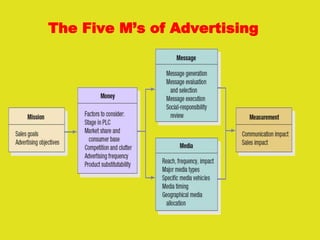
“The Five Ms” Of Advertising:
Mission: What are our advertising objectives?
Money: How much can we spend and how do we
allocate our spending across media types?
Message: What message should we send?
Media: What media should we use?
Measurement: How should we evaluate the results?
Procter & Gamble’s
Advertising History
The Five M’s of Advertising
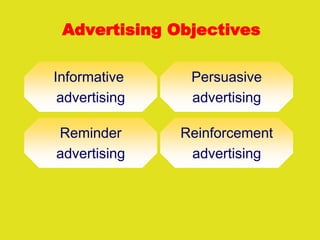
Advertising Objectives
Informative
advertising
Reminder
advertising
Reinforcement
advertising
Persuasive
advertising
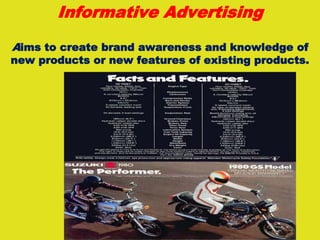
Informative Advertising
Aims to create brand awareness and knowledge of
new products or new features of existing products.
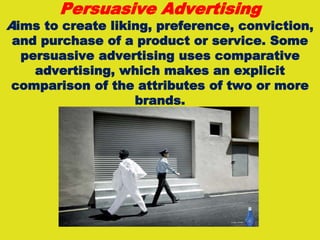
Persuasive Advertising
Aims to create liking, preference, conviction,
and purchase of a product or service. Some
persuasive advertising uses comparative
advertising, which makes an explicit
comparison of the attributes of two or more
brands.
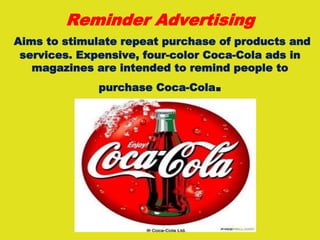
Reminder Advertising
Aims to stimulate repeat purchase of products and
services. Expensive, four-color Coca-Cola ads in
magazines are intended to remind people to
purchase Coca-Cola.
Reinforcement Advertising
Aims to convince current purchasers
that they made the right choice.
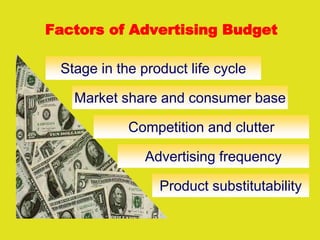
Factors of Advertising Budget
Stage in the product life cycle
Market share and consumer base
Competition and clutter
Advertising frequency
Product substitutability
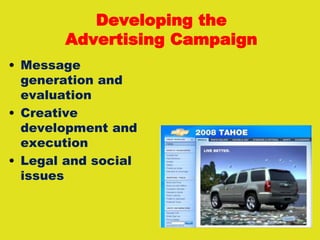
Developing the
Advertising Campaign
• Message
generation and
evaluation
• Creative
development and
execution
• Legal and social
issues
Television
Advantages
• Reaches broad
spectrum of consumers
• Low cost per exposure
• Ability to demonstrate
product use
• Ability to portray image
and brand personality
Disadvantages
• Brief
• Clutter
• High cost of production
• High cost of placement
• Lack of attention by
viewers
Print Ads
Advantages
• Detailed product
information
• Ability to
communicate user
imagery
• Flexibility
• Ability to segment
Disadvantages
• Passive medium
• Unable to
demonstrate
product use
Print Ad Evaluation Criteria
• Is the message clear at a glance?
• Is the benefit in the headline?
• Does the illustration support the headline?
• Does the first line of the copy support or
explain the headline and illustration?
• Is the ad easy to read and follow?
• Is the product easily identified?
• Is the brand or sponsor clearly identified?
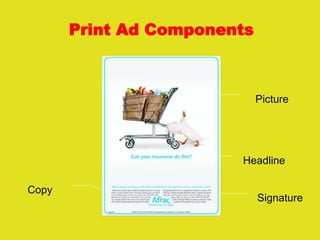
Print Ad Components
Headline
Picture
Signature
Copy
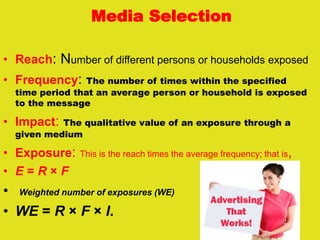
Media Selection
• Reach: Number of different persons or households exposed
• Frequency: The number of times within the specified
time period that an average person or household is exposed
to the message
• Impact: The qualitative value of an exposure through a
given medium
• Exposure: This is the reach times the average frequency; that is,
• E = R × F
• Weighted number of exposures (WE)
• WE = R × F × I.
Choosing Among Major Media Types
• Target audience and media habits
• Product characteristics
• Message characteristics
• Cost
Major Media Types
• Newspapers
• Television
• Direct mail
• Radio
• Magazines
• Outdoor
• Yellow Pages
• Newsletters
• Brochures
• Telephone
• Internet
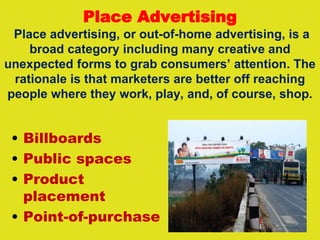
Place Advertising
Place advertising, or out-of-home advertising, is a
broad category including many creative and
unexpected forms to grab consumers’ attention. The
rationale is that marketers are better off reaching
people where they work, play, and, of course, shop.
• Billboards
• Public spaces
• Product
placement
• Point-of-purchase
EVALUATING ALTERNATE MEDIA
• Ads now can appear virtually anywhere
consumers have a few spare minutes or
even seconds to notice them.
• Outdoor advertising, for example, is often called
the “15-second sell.” It’s more effective at
enhancing brand awareness or brand image
• Consumer backlash often results when
people see ads in traditionally ad-free
spaces, such as in schools, on police
cruisers, and in doctors’ waiting rooms.
Nevertheless, perhaps because of its sheer
pervasiveness, some consumers seem to
be less bothered by nontraditional media
now than in the past.
Selecting Specific Media Vehicles
• planner must rely on measurement
services that estimate audience size,
composition, and media cost. Media
planners then calculate the cost per
thousand persons reached by a vehicle.
• Circulation
• Audience
• Effective audience
• Effective ad-exposed audience
• cost
Deciding on Media Timing and Allocation
• In choosing media, the advertiser has both a
macro scheduling and micro scheduling
The micro scheduling decision calls for
allocating advertising expenditures within
a short period to obtain maximum impact.
Suppose the firm decides to buy 30 radio
spots in the month.
Factors Affecting Timing Patterns
The timing pattern should consider following
three factors.
• Buyer turnover: expresses the rate at which new
buyers enter the market; the higher this rate, the
more continuous the advertising should be.
• Purchase frequency: is the number of times the
average buyer buys the product during the period;
the higher the purchase frequency, the more
continuous the advertising should be.
• Forgetting rate: is the rate at which the buyer forgets
the brand; the higher the forgetting rate, the more
continuous the advertising should be.
Media Schedule Patterns
Continuity: exposures appear evenly throughout a given
period, advertisers use continuous advertising in expanding
market situations, with frequently purchased items, and in
tightly defined buyer categories.
Concentration : spending all the advertising dollars in a
single period. This makes sense for products with one selling
season or related holiday
• Flighting: calls for advertising during a period, followed
by a period with no advertising, followed by a second period
of advertising activity. It is useful when funding is limited, the
purchase cycle is relatively infrequent, or items are seasonal.
• Pulsing: is continuous advertising at low-weight levels,
reinforced periodically by waves of heavier activity. It draws
on the strength of continuous advertising and flights to
create a compromise scheduling strategy
Evaluating Advertising Effectiveness
Communication-Effect Research:
called copy testing, seeks to determine whether an
ad is communicating effectively. Marketers should
perform this test both before an ad is put into
media and after it is printed or broadcast.
Sales-Effect Research
What sales are generated by an ad that
increases brand awareness by 20 percent
and brand preference by 10 percent?
The fewer or more controllable other factors
such as features and price are, the easier it
is to measure advertising’s effect on sales.
What is Sales Promotion?
Sales promotions consist of a collection of
incentive tools, mostly short term, designed to
stimulate quicker or greater purchase of
particular products or services by consumers or
the trade.
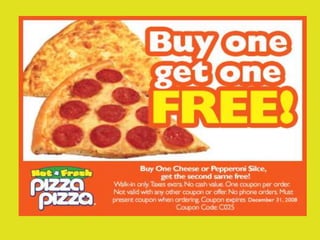
consumer promotion (samples, coupons, cash
refund offers, prices off, premiums, prizes,
patronage rewards, free trials, warranties, tie-in
promotions, cross-promotions, point-of purchase
displays, and demonstrations),
trade promotion (prices off, advertising and
display allowances, and free goods)
sales force promotion (trade shows and
conventions, contests for sales reps, and
specialty advertising).
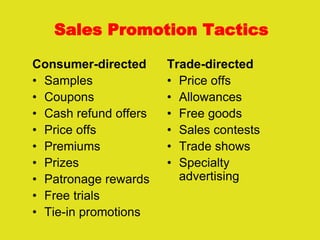
Sales Promotion Tactics
Consumer-directed
• Samples
• Coupons
• Cash refund offers
• Price offs
• Premiums
• Prizes
• Patronage rewards
• Free trials
• Tie-in promotions
Trade-directed
• Price offs
• Allowances
• Free goods
• Sales contests
• Trade shows
• Specialty
advertising
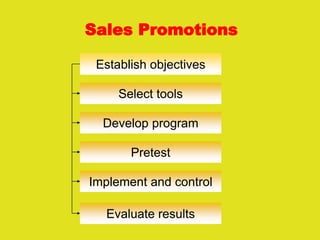
Sales Promotions
Establish objectives
Select tools
Develop program
Pretest
Implement and control
Evaluate results
Why Sponsor Events?
• To increase brand awareness
• To create or reinforce consumer
perceptions of key brand image
associations
• To enhance corporate image
• To create experiences and evoke feelings
• To express commitment to community
• To entertain key clients or reward
employees
• To permit merchandising or promotional
opportunities
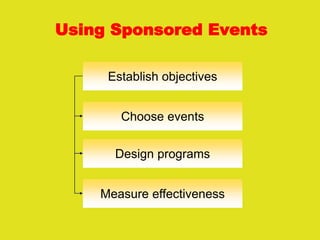
Using Sponsored Events
Establish objectives
Choose events
Design programs
Measure effectiveness
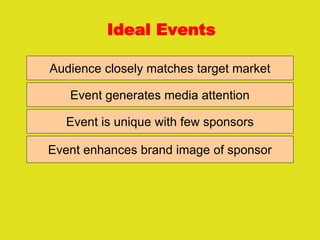
Ideal Events
Audience closely matches target market
Event generates media attention
Event is unique with few sponsors
Event enhances brand image of sponsor
PUBLIC RELATIONS
A public is any group that has an actual or
potential interest in or impact on a
company’s ability to achieve its objectives.
Public relations (PR) include a variety of
programs to promote or protect a
company’s image or individual products
Tasks Aided by Public Relations
• Launching new products
• Repositioning a mature product
• Building interest in a product category
• Influencing specific target groups
• Defending products that have encountered
public problems
• Building the corporate image in a way that
reflects favorable on products
Public Relations Functions
• Press relations
• Product publicity
• Corporate communications
• Lobbying
• Counseling
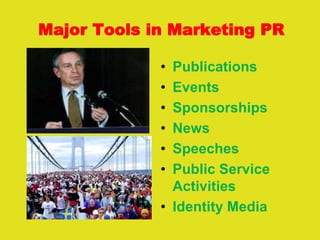
Major Tools in Marketing PR
• Publications
• Events
• Sponsorships
• News
• Speeches
• Public Service
Activities
• Identity Media
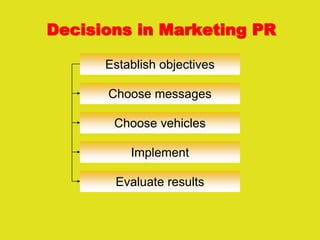
Decisions in Marketing PR
Establish objectives
Choose messages
Choose vehicles
Implement
Evaluate results
DIRECT MARKETING
• Direct marketing is the use of consumer-
direct (CD) channels to reach and deliver
goods and services to customers without
using marketing middlemen.
• TYPES OF DIRECT MARKETING CHANNELS:
• Direct Mail
• Catalog Marketing
• Telemarketing
INTERACTIVE MARKETING
The newest and fastest-growing channels for
communicating and selling directly to
customers are electronic. The Internet
provides marketers and consumers with
opportunities for much greater interaction
and individualization.
Interactive Marketing Types:
• (1) Web sites
• (2) search ads
• (3) display ads
• (4) e-mails.
WORD OF MOUTH
• Consumers use word of mouth to talk about dozens
of brands each day, from media and entertainment
products such as movies, TV shows, and
publications to food products, travel services, and
retail stores and companies are acutely aware of
the power of word of mouth.
• SOCIAL MEDIA
• ONLINE COMMUNITIES AND FORUMS
• BLOGS
• SOCIAL NETWORKS
PERSONAL SELLING
• Most sales training programs agree on the
six 6 major steps in any effective sales
process.
• 1. Prospecting and qualifying
• 2. Preapproach
• 3. Presentation and demonstration
• 4. Overcoming objections
• 5. Closing:
• 6. Follow-up and maintenance:
THE END
THANK YOU

UNIT-9-MANAGING MASS AND PERSONAL COMMUNICATION.ppt

  • 1.
    Marketing Management UNIT-9 MANAGING MASSAND PERSONAL COMMUNICATION LECTURE BY PROF. VENKATESHWAR RAO MBA(Marketing), Ph.D. Professor, Dept. of Business Management Dilla University
  • 2.
    What is Advertising? Advertisingis any paid form of non- personal presentation and promotion of ideas, goods, or services by an identified sponsor. “The Five Ms” Of Advertising: Mission: What are our advertising objectives? Money: How much can we spend and how do we allocate our spending across media types? Message: What message should we send? Media: What media should we use? Measurement: How should we evaluate the results?
  • 3.
  • 4.
    The Five M’sof Advertising
  • 5.
  • 6.
    Informative Advertising Aims tocreate brand awareness and knowledge of new products or new features of existing products.
  • 7.
    Persuasive Advertising Aims tocreate liking, preference, conviction, and purchase of a product or service. Some persuasive advertising uses comparative advertising, which makes an explicit comparison of the attributes of two or more brands.
  • 8.
    Reminder Advertising Aims tostimulate repeat purchase of products and services. Expensive, four-color Coca-Cola ads in magazines are intended to remind people to purchase Coca-Cola.
  • 9.
    Reinforcement Advertising Aims toconvince current purchasers that they made the right choice.
  • 10.
    Factors of AdvertisingBudget Stage in the product life cycle Market share and consumer base Competition and clutter Advertising frequency Product substitutability
  • 11.
    Developing the Advertising Campaign •Message generation and evaluation • Creative development and execution • Legal and social issues
  • 12.
    Television Advantages • Reaches broad spectrumof consumers • Low cost per exposure • Ability to demonstrate product use • Ability to portray image and brand personality Disadvantages • Brief • Clutter • High cost of production • High cost of placement • Lack of attention by viewers
  • 13.
    Print Ads Advantages • Detailedproduct information • Ability to communicate user imagery • Flexibility • Ability to segment Disadvantages • Passive medium • Unable to demonstrate product use
  • 14.
    Print Ad EvaluationCriteria • Is the message clear at a glance? • Is the benefit in the headline? • Does the illustration support the headline? • Does the first line of the copy support or explain the headline and illustration? • Is the ad easy to read and follow? • Is the product easily identified? • Is the brand or sponsor clearly identified?
  • 15.
  • 20.
    Media Selection • Reach:Number of different persons or households exposed • Frequency: The number of times within the specified time period that an average person or household is exposed to the message • Impact: The qualitative value of an exposure through a given medium • Exposure: This is the reach times the average frequency; that is, • E = R × F • Weighted number of exposures (WE) • WE = R × F × I.
  • 21.
    Choosing Among MajorMedia Types • Target audience and media habits • Product characteristics • Message characteristics • Cost
  • 22.
    Major Media Types •Newspapers • Television • Direct mail • Radio • Magazines • Outdoor • Yellow Pages • Newsletters • Brochures • Telephone • Internet
  • 23.
    Place Advertising Place advertising,or out-of-home advertising, is a broad category including many creative and unexpected forms to grab consumers’ attention. The rationale is that marketers are better off reaching people where they work, play, and, of course, shop. • Billboards • Public spaces • Product placement • Point-of-purchase
  • 24.
    EVALUATING ALTERNATE MEDIA •Ads now can appear virtually anywhere consumers have a few spare minutes or even seconds to notice them. • Outdoor advertising, for example, is often called the “15-second sell.” It’s more effective at enhancing brand awareness or brand image • Consumer backlash often results when people see ads in traditionally ad-free spaces, such as in schools, on police cruisers, and in doctors’ waiting rooms. Nevertheless, perhaps because of its sheer pervasiveness, some consumers seem to be less bothered by nontraditional media now than in the past.
  • 25.
    Selecting Specific MediaVehicles • planner must rely on measurement services that estimate audience size, composition, and media cost. Media planners then calculate the cost per thousand persons reached by a vehicle. • Circulation • Audience • Effective audience • Effective ad-exposed audience • cost
  • 26.
    Deciding on MediaTiming and Allocation • In choosing media, the advertiser has both a macro scheduling and micro scheduling The micro scheduling decision calls for allocating advertising expenditures within a short period to obtain maximum impact. Suppose the firm decides to buy 30 radio spots in the month.
  • 27.
    Factors Affecting TimingPatterns The timing pattern should consider following three factors. • Buyer turnover: expresses the rate at which new buyers enter the market; the higher this rate, the more continuous the advertising should be. • Purchase frequency: is the number of times the average buyer buys the product during the period; the higher the purchase frequency, the more continuous the advertising should be. • Forgetting rate: is the rate at which the buyer forgets the brand; the higher the forgetting rate, the more continuous the advertising should be.
  • 28.
    Media Schedule Patterns Continuity:exposures appear evenly throughout a given period, advertisers use continuous advertising in expanding market situations, with frequently purchased items, and in tightly defined buyer categories. Concentration : spending all the advertising dollars in a single period. This makes sense for products with one selling season or related holiday • Flighting: calls for advertising during a period, followed by a period with no advertising, followed by a second period of advertising activity. It is useful when funding is limited, the purchase cycle is relatively infrequent, or items are seasonal. • Pulsing: is continuous advertising at low-weight levels, reinforced periodically by waves of heavier activity. It draws on the strength of continuous advertising and flights to create a compromise scheduling strategy
  • 29.
    Evaluating Advertising Effectiveness Communication-EffectResearch: called copy testing, seeks to determine whether an ad is communicating effectively. Marketers should perform this test both before an ad is put into media and after it is printed or broadcast. Sales-Effect Research What sales are generated by an ad that increases brand awareness by 20 percent and brand preference by 10 percent? The fewer or more controllable other factors such as features and price are, the easier it is to measure advertising’s effect on sales.
  • 30.
    What is SalesPromotion? Sales promotions consist of a collection of incentive tools, mostly short term, designed to stimulate quicker or greater purchase of particular products or services by consumers or the trade. consumer promotion (samples, coupons, cash refund offers, prices off, premiums, prizes, patronage rewards, free trials, warranties, tie-in promotions, cross-promotions, point-of purchase displays, and demonstrations), trade promotion (prices off, advertising and display allowances, and free goods) sales force promotion (trade shows and conventions, contests for sales reps, and specialty advertising).
  • 35.
    Sales Promotion Tactics Consumer-directed •Samples • Coupons • Cash refund offers • Price offs • Premiums • Prizes • Patronage rewards • Free trials • Tie-in promotions Trade-directed • Price offs • Allowances • Free goods • Sales contests • Trade shows • Specialty advertising
  • 36.
    Sales Promotions Establish objectives Selecttools Develop program Pretest Implement and control Evaluate results
  • 37.
    Why Sponsor Events? •To increase brand awareness • To create or reinforce consumer perceptions of key brand image associations • To enhance corporate image • To create experiences and evoke feelings • To express commitment to community • To entertain key clients or reward employees • To permit merchandising or promotional opportunities
  • 43.
    Using Sponsored Events Establishobjectives Choose events Design programs Measure effectiveness
  • 44.
    Ideal Events Audience closelymatches target market Event generates media attention Event is unique with few sponsors Event enhances brand image of sponsor
  • 45.
    PUBLIC RELATIONS A publicis any group that has an actual or potential interest in or impact on a company’s ability to achieve its objectives. Public relations (PR) include a variety of programs to promote or protect a company’s image or individual products
  • 46.
    Tasks Aided byPublic Relations • Launching new products • Repositioning a mature product • Building interest in a product category • Influencing specific target groups • Defending products that have encountered public problems • Building the corporate image in a way that reflects favorable on products
  • 47.
    Public Relations Functions •Press relations • Product publicity • Corporate communications • Lobbying • Counseling
  • 48.
    Major Tools inMarketing PR • Publications • Events • Sponsorships • News • Speeches • Public Service Activities • Identity Media
  • 49.
    Decisions in MarketingPR Establish objectives Choose messages Choose vehicles Implement Evaluate results
  • 50.
    DIRECT MARKETING • Directmarketing is the use of consumer- direct (CD) channels to reach and deliver goods and services to customers without using marketing middlemen. • TYPES OF DIRECT MARKETING CHANNELS: • Direct Mail • Catalog Marketing • Telemarketing
  • 51.
    INTERACTIVE MARKETING The newestand fastest-growing channels for communicating and selling directly to customers are electronic. The Internet provides marketers and consumers with opportunities for much greater interaction and individualization. Interactive Marketing Types: • (1) Web sites • (2) search ads • (3) display ads • (4) e-mails.
  • 52.
    WORD OF MOUTH •Consumers use word of mouth to talk about dozens of brands each day, from media and entertainment products such as movies, TV shows, and publications to food products, travel services, and retail stores and companies are acutely aware of the power of word of mouth. • SOCIAL MEDIA • ONLINE COMMUNITIES AND FORUMS • BLOGS • SOCIAL NETWORKS
  • 53.
    PERSONAL SELLING • Mostsales training programs agree on the six 6 major steps in any effective sales process. • 1. Prospecting and qualifying • 2. Preapproach • 3. Presentation and demonstration • 4. Overcoming objections • 5. Closing: • 6. Follow-up and maintenance:
  • 54.