Promote Student Reading by Administering
Quizzes via i>clicker
• We will start promptly at 2:00 EST.
• For Audio: you will need a telephone line to connect.
    –   If you do not have one available, you will receive a recording of
        this webinar. We apologize for any inconvenience.
    –   The WebEx system will ask you for your phone number and call
        you directly.
•   If you can’t receive incoming calls, dial
    – 1-866-469-3239
    – Access Code: 632-491-150
    – Attendee ID Number: If you don’t know, press #
•   Please use the Chat Window to communicate
    –   Chat with the Host for Tech Issues
        •   John may not see Chat, but will respond during Q&A
    –   Chat with “All Attendees” for Discussion Questions
Our presenter
JOHN DATTILO
Professor of Recreation, Park, and Tourism
Management at Penn State University.

Education
Ph.D. in Leisure Studies from University of
Illinois.
Research
Effects of interventions on self-determination
of people with disabilities and older adults
relative to their leisure involvement
Publications
John and colleagues have published their
work in refereed journals as well as books at
Venture Publishing http://venturepublish.com/
Promote Student Reading by
Administering Quizzes via i<clicker
   John Dattilo
   Penn State University
   jxd8@psu.edu
Session Purpose
• Describe conversion of daily 5-question multiple-choice
  written quizzes to i<clicker questions in PowerPoint
  slides
• Highlight considerations for administration of the quizzes
• Provide details on positive influence on class and
  interaction with students.

Session Outline
1.    Set the stage
     – course  structure
     – class structure
2.    Do things differently
     – plan
     – design
  – conduct
3. Take stock
  – advantages
     – testimonies.
1. Set the stage

• course structure
• class structure.
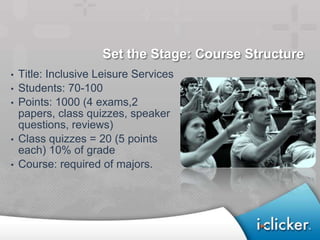
Set the Stage: Course Structure
•   Title: Inclusive Leisure Services
•   Students: 70-100
•   Points: 1000 (4 exams,2
    papers, class quizzes, speaker
    questions, reviews)
•   Class quizzes = 20 (5 points
    each) 10% of grade
•   Course: required of majors.
Set the Stage: Class Structure
•   10-15 min: pre-class music videos
•   5 min: review key points from previous class
•   15 min: 5 question quiz (3 min/question)
•   1-5 min: outline for class, discussion of assignments
•   35 min: Course content:
    – Slides with words and picture examples
    – Brief videos for examples
•   15 min: Check in with students:
    –   Divide students into working groups and report back
    –   Students write brief action papers
    –   Ask students questions using i<clicker
•   1-5 min: outline for class.
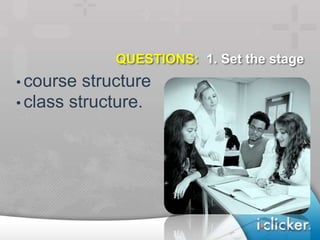
QUESTIONS: 1. Set the stage
• course structure
• class structure.
2. Do things differently
A.   plan
B.   design
C.   conduct
A. Plan Differently

• Consider   knowledge questions for
  quiz
• Allow time for quiz and feedback
• Incorporate application questions
  later.
Example

Topic: Provide Leisure Education
Example
Quiz. As the leisure coach works
with participants involved in
community leisure experiences, the
coach does the following, EXCEPT:
 a.   Assesses participant skills
 b.   Continues ongoing intensive assistance
 c.   Determines activity requirements
 d.   Helps find supportive services
 e.   Identifies needed accommodations
Example
Quiz. As the leisure coach works
with participants involved in
community leisure experiences, the
coach does the following, EXCEPT:
 a.   Assesses participant skills
 b.   Continues ongoing intensive assistance
 c.   Determines activity requirements
 d.   Helps find supportive services
 e.   Identifies needed accommodations
Example
Application. When working with Javier, the
following is the MOST effective method to have
him develop his self-awareness related to his
leisure preferences:
a. Suggest Javier ask friends what activities they like to
   do so he can participate with people he knows.
b. Take Javier to a high school basketball game and
   have him identify positions he would like to play.
c. Take Javier to the indoor pool. Tell him how much
   you enjoy swimming and you think he will enjoy it.
d. Take Javier on a virtual tour of activities using the
   Internet. Have him identify those he wants to try.
e. Tell Javier that independently he needs to generate a
   list of 20 leisure activities he would like to pursue.
Example
Application. When working with Javier, the
following is the MOST effective method to have
him develop his self-awareness related to his
leisure preferences:
a. Suggest Javier ask friends what activities they like to
   do so he can participate with people he knows.
b. Take Javier to a high school basketball game and
   have him identify positions he would like to play.
c. Take Javier to the indoor pool. Tell him how much
   you enjoy swimming and you think he will enjoy it.
d. Take Javier on a virtual tour of activities using the
   Internet. Have him identify those he wants to try.
e. Tell Javier that independently he needs to generate a
   list of 20 leisure activities he would like to pursue.
QUESTIONS: A. Plan Differently

• Consider   knowledge questions for
  quiz
• Allow time for quiz and feedback
• Incorporate application questions
  later.
B. Design Slides Differently

• Leave space at top of slide
• Be concise on questions and
  selections
• Make double slides with correct
  answer identified in red.
Example

Topic: Promote Universal Design
Example
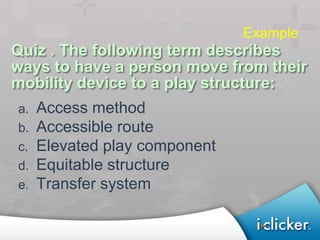
Quiz . The following term describes
ways to have a person move from their
mobility device to a play structure:
a.   Access method
b.   Accessible route
c.   Elevated play component
d.   Equitable structure
e.   Transfer system
Example
Quiz . The following term describes
ways to have a person move from their
mobility device to a play structure:
a.   Access method
b.   Accessible route
c.   Elevated play component
d.   Equitable structure
e.   Transfer system
QUESTIONS: B. Design Slides
                      Differently
• Leave space at top of slide
• Be concise on questions and
  selections
• Make double slides with correct
  answer identified in red.
C. Conduct Class Differently
• View quiz as immediate-feedback
  – promote student learning
  – reduce student confusion
  – Identify teachable moments
• Have students answer quiz question
• Show student distribution
• Show answer highlighted in red
• Return to material addressed in quiz.
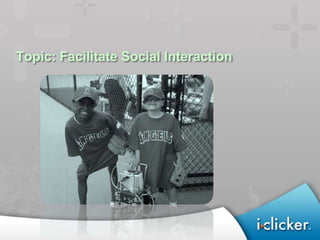
Topic: Facilitate Social Interaction
Example
Quiz. The word that describes those who
have been deprived of certain privileges or
rights:
a.   disenfranchised
b.   over-exaggerated
c.   stereotyped
d.   stigmatized
e.   socially rejected
Example
Quiz. The word that describes those who
have been deprived of certain privileges or
rights:
a.   disenfranchised
b.   over-exaggerated
c.   stereotyped
d.   stigmatized
e.   socially rejected
Example
Application: Meyong does not know any
of the children at camp and spends most
of her time alone. The BEST action you
can take is:
a.   Give Meyong a chance to talk to the group about herself and
     dispel any myths.
b.   Have an adult spend time with Meyong and play cooperative
     games with her.
c.   Have Meyong tell you about her interests and then introduce her
     to children with similar interests.
d.   In a large group meeting, introduce Meyong to all the children at
     camp.
e.   Provide Meyong with an extensive list of activities from which to
     choose to participate.
Example
Application: Meyong does not know any
of the children at camp and spends most
of her time alone. The BEST action you
can take is:
a.   Give Meyong a chance to talk to the group about herself and
     dispel any myths.
b.   Have an adult spend time with Meyong and play cooperative
     games with her.
c.   Have Meyong tell you about her interests and then introduce her
     to children with similar interests.
d.   In a large group meeting, introduce Meyong to all the children at
     camp.
e.   Provide Meyong with an extensive list of activities from which to
     choose to participate.
QUESTIONS: C. Conduct Class Differently
• View quiz as immediate-feedback
  – promote student learning
  – reduce student confusion
  – Identify teachable moments
• Have students answer quiz question
• Show student distribution
• Show answer highlighted in red
• Return to material addressed in quiz.
3. Take Stock

•   advantages
•   testimonies
Take Stock: Advantages
•   encourage students to read material before class
•   immediate feedback on students’ understanding of readings
•   allows me to interact more with students in relaxed manner
•   provides context for me to be more playful and have fun
•   encourages students to have more fun
•   helps me make the course GREEN
•   results in less time to course administrative duties.
Take Stock: Student Testimonies
                     (underlines added for emphasis)
• The quizzes in class were often challenging, but they
  helped me to understand the material and definitely
  improved my exam scores.
• Even if I was ticked that you made me read before I came
  to class because of those quizzes, I am glad cause I
  actually read and then learned more!
• I liked the in-class quizzes because it made you come to
  class but the material we were quizzed on was fair.
• (I liked) the required quizzes every day of class. It makes
  me go to it, and prompts me to learn prior to it. Genius!
Take Stock: My Testimony
Overall, this new approach designed to encourage student
reading has helped me to breathe new life into my class,
increase my ability to connect with students, and create a
more playful learning environment all the while reducing my
work load; clearly a win-win situation.
QUESTIONS: Session Outline
1.    Set the stage
     – course  structure
     – class structure
2.    Do things differently
     – plan
     – design
  – conduct
3. Take stock
  – advantages
     – testimonies.
Promote Student Reading by
Administering Quizzes via i<clicker
   John Dattilo
   Penn State University
   jxd8@psu.edu

Promote student reading dattilo

  • 1.
    Promote Student Readingby Administering Quizzes via i>clicker • We will start promptly at 2:00 EST. • For Audio: you will need a telephone line to connect. – If you do not have one available, you will receive a recording of this webinar. We apologize for any inconvenience. – The WebEx system will ask you for your phone number and call you directly. • If you can’t receive incoming calls, dial – 1-866-469-3239 – Access Code: 632-491-150 – Attendee ID Number: If you don’t know, press # • Please use the Chat Window to communicate – Chat with the Host for Tech Issues • John may not see Chat, but will respond during Q&A – Chat with “All Attendees” for Discussion Questions
  • 2.
    Our presenter JOHN DATTILO Professorof Recreation, Park, and Tourism Management at Penn State University. Education Ph.D. in Leisure Studies from University of Illinois. Research Effects of interventions on self-determination of people with disabilities and older adults relative to their leisure involvement Publications John and colleagues have published their work in refereed journals as well as books at Venture Publishing http://venturepublish.com/
  • 3.
    Promote Student Readingby Administering Quizzes via i<clicker John Dattilo Penn State University jxd8@psu.edu
  • 4.
    Session Purpose • Describeconversion of daily 5-question multiple-choice written quizzes to i<clicker questions in PowerPoint slides • Highlight considerations for administration of the quizzes • Provide details on positive influence on class and interaction with students.
  • 5.
    Session Outline 1. Set the stage – course structure – class structure 2. Do things differently – plan – design – conduct 3. Take stock – advantages – testimonies.
  • 6.
    1. Set thestage • course structure • class structure.
  • 7.
    Set the Stage:Course Structure • Title: Inclusive Leisure Services • Students: 70-100 • Points: 1000 (4 exams,2 papers, class quizzes, speaker questions, reviews) • Class quizzes = 20 (5 points each) 10% of grade • Course: required of majors.
  • 8.
    Set the Stage:Class Structure • 10-15 min: pre-class music videos • 5 min: review key points from previous class • 15 min: 5 question quiz (3 min/question) • 1-5 min: outline for class, discussion of assignments • 35 min: Course content: – Slides with words and picture examples – Brief videos for examples • 15 min: Check in with students: – Divide students into working groups and report back – Students write brief action papers – Ask students questions using i<clicker • 1-5 min: outline for class.
  • 9.
    QUESTIONS: 1. Setthe stage • course structure • class structure.
  • 10.
    2. Do thingsdifferently A. plan B. design C. conduct
  • 11.
    A. Plan Differently •Consider knowledge questions for quiz • Allow time for quiz and feedback • Incorporate application questions later.
  • 12.
  • 13.
    Example Quiz. As theleisure coach works with participants involved in community leisure experiences, the coach does the following, EXCEPT: a. Assesses participant skills b. Continues ongoing intensive assistance c. Determines activity requirements d. Helps find supportive services e. Identifies needed accommodations
  • 14.
    Example Quiz. As theleisure coach works with participants involved in community leisure experiences, the coach does the following, EXCEPT: a. Assesses participant skills b. Continues ongoing intensive assistance c. Determines activity requirements d. Helps find supportive services e. Identifies needed accommodations
  • 15.
    Example Application. When workingwith Javier, the following is the MOST effective method to have him develop his self-awareness related to his leisure preferences: a. Suggest Javier ask friends what activities they like to do so he can participate with people he knows. b. Take Javier to a high school basketball game and have him identify positions he would like to play. c. Take Javier to the indoor pool. Tell him how much you enjoy swimming and you think he will enjoy it. d. Take Javier on a virtual tour of activities using the Internet. Have him identify those he wants to try. e. Tell Javier that independently he needs to generate a list of 20 leisure activities he would like to pursue.
  • 16.
    Example Application. When workingwith Javier, the following is the MOST effective method to have him develop his self-awareness related to his leisure preferences: a. Suggest Javier ask friends what activities they like to do so he can participate with people he knows. b. Take Javier to a high school basketball game and have him identify positions he would like to play. c. Take Javier to the indoor pool. Tell him how much you enjoy swimming and you think he will enjoy it. d. Take Javier on a virtual tour of activities using the Internet. Have him identify those he wants to try. e. Tell Javier that independently he needs to generate a list of 20 leisure activities he would like to pursue.
  • 17.
    QUESTIONS: A. PlanDifferently • Consider knowledge questions for quiz • Allow time for quiz and feedback • Incorporate application questions later.
  • 18.
    B. Design SlidesDifferently • Leave space at top of slide • Be concise on questions and selections • Make double slides with correct answer identified in red.
  • 19.
  • 20.
    Example Quiz . Thefollowing term describes ways to have a person move from their mobility device to a play structure: a. Access method b. Accessible route c. Elevated play component d. Equitable structure e. Transfer system
  • 21.
    Example Quiz . Thefollowing term describes ways to have a person move from their mobility device to a play structure: a. Access method b. Accessible route c. Elevated play component d. Equitable structure e. Transfer system
  • 22.
    QUESTIONS: B. DesignSlides Differently • Leave space at top of slide • Be concise on questions and selections • Make double slides with correct answer identified in red.
  • 23.
    C. Conduct ClassDifferently • View quiz as immediate-feedback – promote student learning – reduce student confusion – Identify teachable moments • Have students answer quiz question • Show student distribution • Show answer highlighted in red • Return to material addressed in quiz.
  • 24.
  • 25.
    Example Quiz. The wordthat describes those who have been deprived of certain privileges or rights: a. disenfranchised b. over-exaggerated c. stereotyped d. stigmatized e. socially rejected
  • 26.
    Example Quiz. The wordthat describes those who have been deprived of certain privileges or rights: a. disenfranchised b. over-exaggerated c. stereotyped d. stigmatized e. socially rejected
  • 27.
    Example Application: Meyong doesnot know any of the children at camp and spends most of her time alone. The BEST action you can take is: a. Give Meyong a chance to talk to the group about herself and dispel any myths. b. Have an adult spend time with Meyong and play cooperative games with her. c. Have Meyong tell you about her interests and then introduce her to children with similar interests. d. In a large group meeting, introduce Meyong to all the children at camp. e. Provide Meyong with an extensive list of activities from which to choose to participate.
  • 28.
    Example Application: Meyong doesnot know any of the children at camp and spends most of her time alone. The BEST action you can take is: a. Give Meyong a chance to talk to the group about herself and dispel any myths. b. Have an adult spend time with Meyong and play cooperative games with her. c. Have Meyong tell you about her interests and then introduce her to children with similar interests. d. In a large group meeting, introduce Meyong to all the children at camp. e. Provide Meyong with an extensive list of activities from which to choose to participate.
  • 29.
    QUESTIONS: C. ConductClass Differently • View quiz as immediate-feedback – promote student learning – reduce student confusion – Identify teachable moments • Have students answer quiz question • Show student distribution • Show answer highlighted in red • Return to material addressed in quiz.
  • 30.
    3. Take Stock • advantages • testimonies
  • 31.
    Take Stock: Advantages • encourage students to read material before class • immediate feedback on students’ understanding of readings • allows me to interact more with students in relaxed manner • provides context for me to be more playful and have fun • encourages students to have more fun • helps me make the course GREEN • results in less time to course administrative duties.
  • 32.
    Take Stock: StudentTestimonies (underlines added for emphasis) • The quizzes in class were often challenging, but they helped me to understand the material and definitely improved my exam scores. • Even if I was ticked that you made me read before I came to class because of those quizzes, I am glad cause I actually read and then learned more! • I liked the in-class quizzes because it made you come to class but the material we were quizzed on was fair. • (I liked) the required quizzes every day of class. It makes me go to it, and prompts me to learn prior to it. Genius!
  • 33.
    Take Stock: MyTestimony Overall, this new approach designed to encourage student reading has helped me to breathe new life into my class, increase my ability to connect with students, and create a more playful learning environment all the while reducing my work load; clearly a win-win situation.
  • 34.
    QUESTIONS: Session Outline 1. Set the stage – course structure – class structure 2. Do things differently – plan – design – conduct 3. Take stock – advantages – testimonies.
  • 35.
    Promote Student Readingby Administering Quizzes via i<clicker John Dattilo Penn State University jxd8@psu.edu