Gary N. Siperstein, Ph.D.
Center for Social Development and Education
          University of Massachusetts Boston
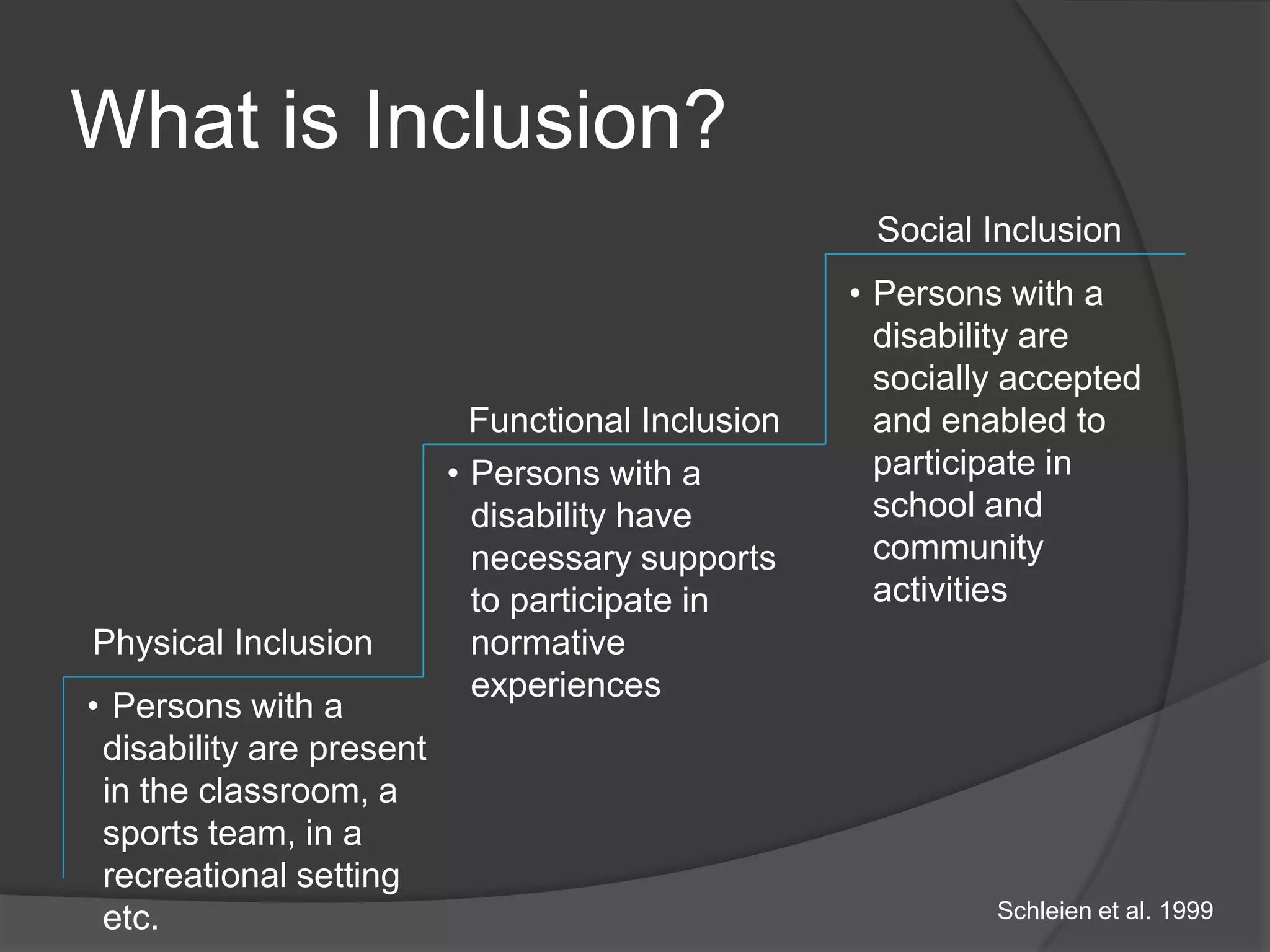
What is Inclusion?
                                                    Social Inclusion
                                                   • Persons with a
                                                     disability are
                                                     socially accepted
                            Functional Inclusion     and enabled to
                          • Persons with a           participate in
                            disability have          school and
                            necessary supports       community
                            to participate in        activities
Physical Inclusion          normative
                            experiences
• Persons with a
 disability are present
 in the classroom, a
 sports team, in a
 recreational setting
 etc.                                                       Schleien et al. 1999
Inclusion in
       Classroom vs. Recreational
                Settings
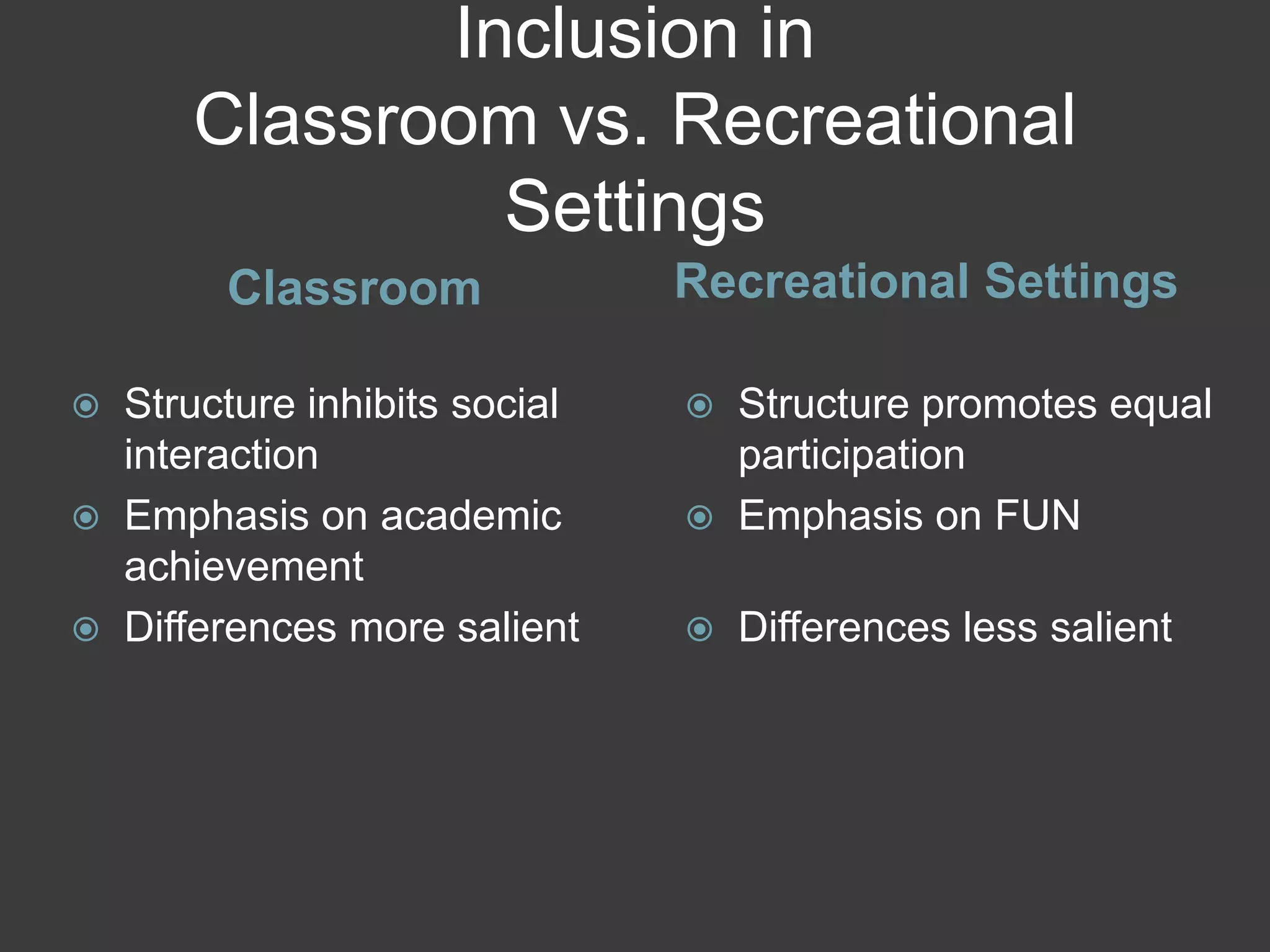
         Classroom              Recreational Settings

   Structure inhibits social      Structure promotes equal
    interaction                     participation
   Emphasis on academic           Emphasis on FUN
    achievement
   Differences more salient       Differences less salient
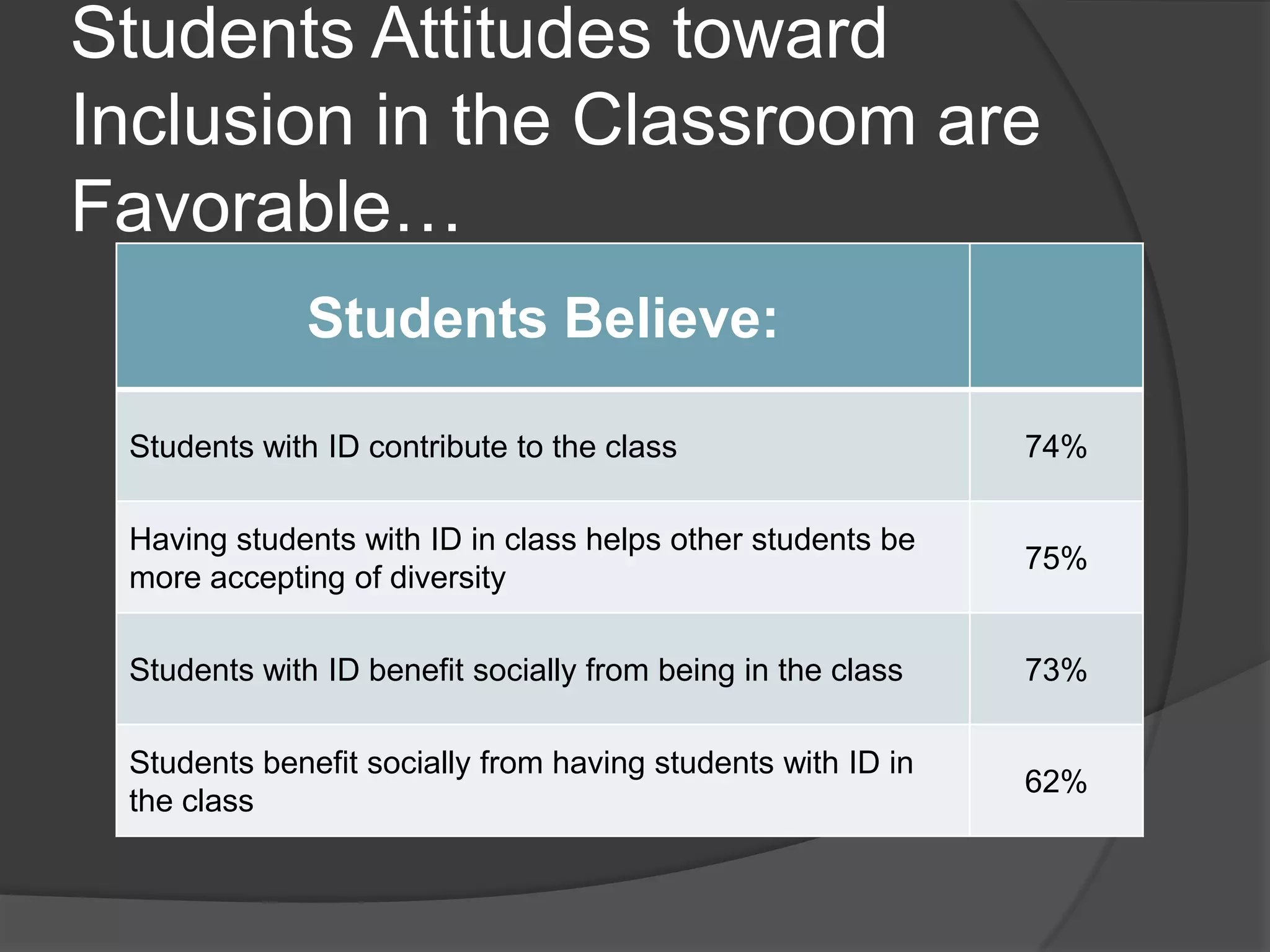
Students Attitudes toward
Inclusion in the Classroom are
Favorable…
              Students Believe:

 Students with ID contribute to the class                    74%

 Having students with ID in class helps other students be
                                                             75%
 more accepting of diversity

 Students with ID benefit socially from being in the class   73%

 Students benefit socially from having students with ID in
                                                             62%
 the class
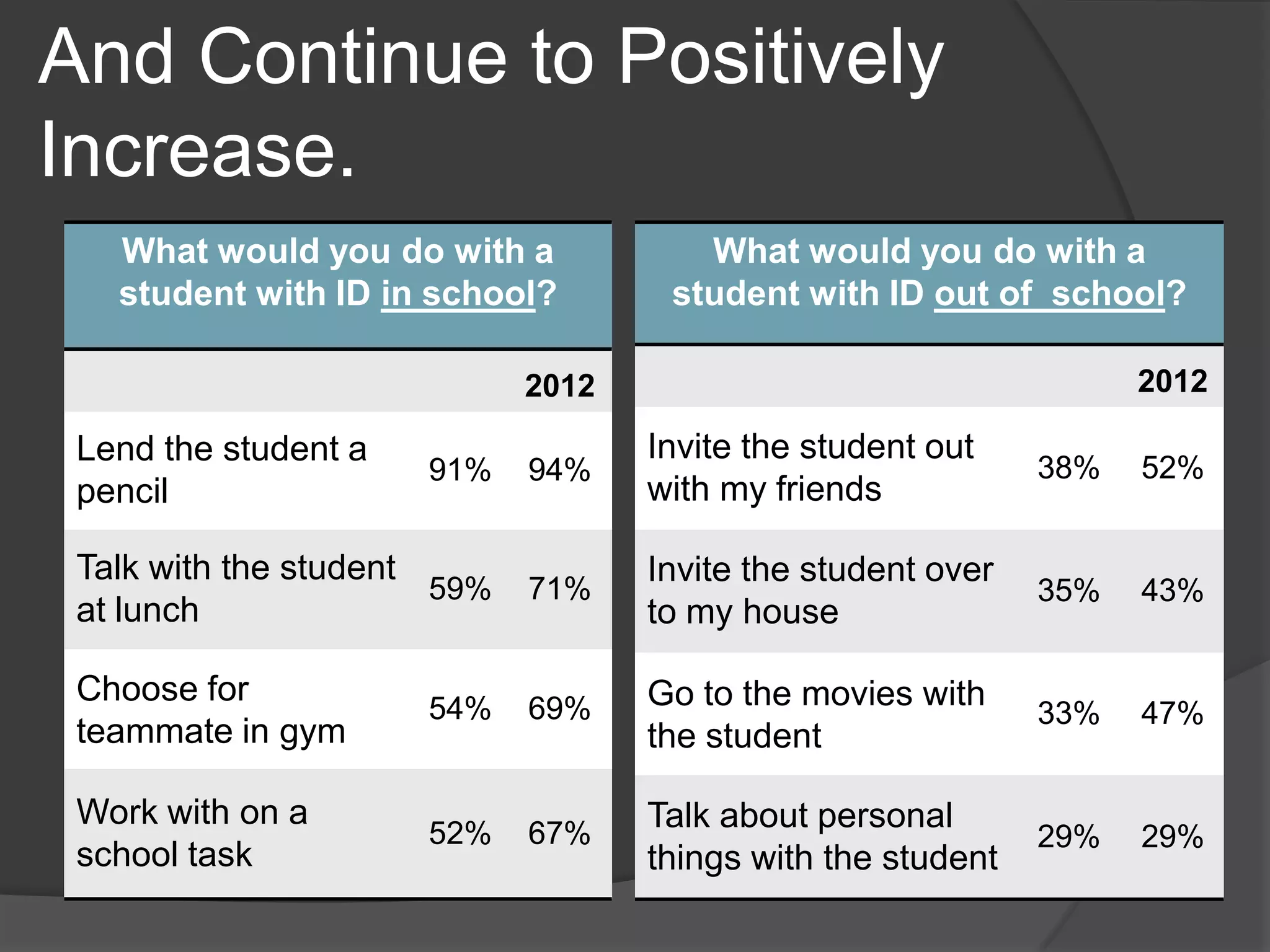
And Continue to Positively
Increase.
   What would you do with a            What would you do with a
   student with ID in school?        student with ID out of school?

                             2012                                   2012

 Lend the student a                 Invite the student out
                      91%    94%                              38%   52%
 pencil                             with my friends

 Talk with the student              Invite the student over
                       59%   71%                              35%   43%
 at lunch                           to my house

 Choose for                         Go to the movies with
                      54%    69%                              33%   47%
 teammate in gym                    the student

 Work with on a                     Talk about personal
                      52%    67%                              29%   29%
 school task                        things with the student
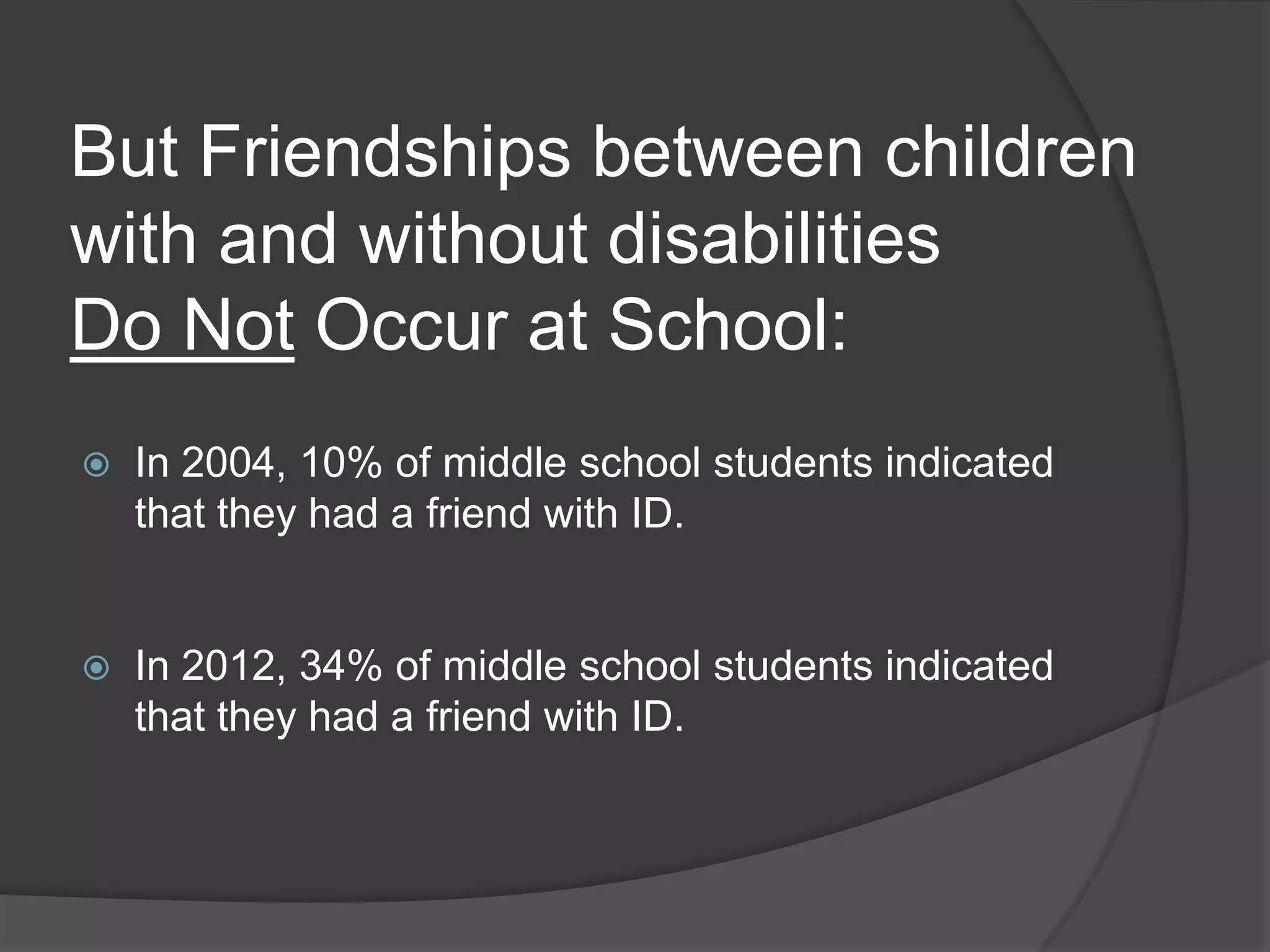
But Friendships between children
with and without disabilities
Do Not Occur at School:
   In 2004, 10% of middle school students indicated
    that they had a friend with ID.


   In 2012, 34% of middle school students indicated
    that they had a friend with ID.
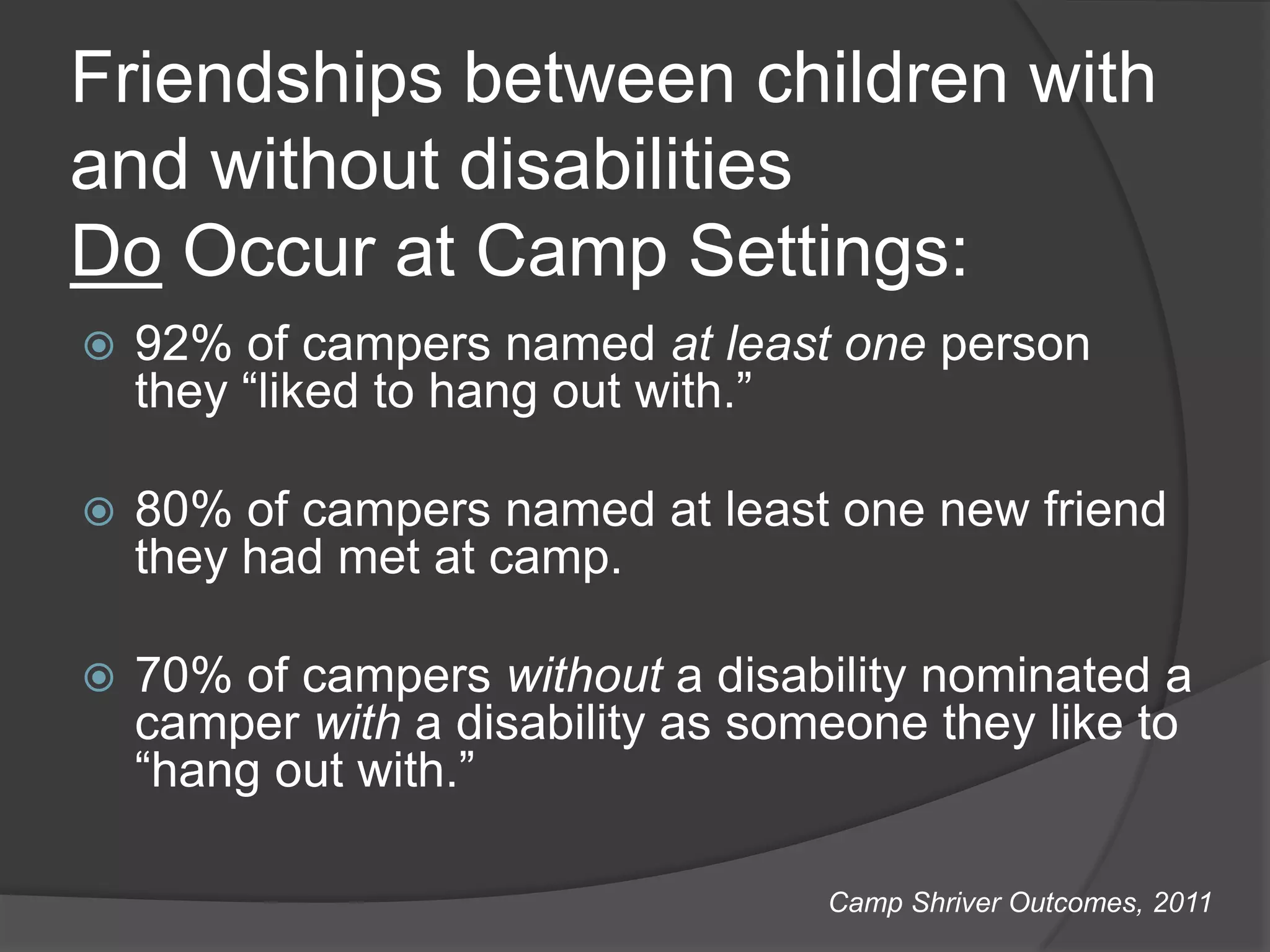
Friendships between children with
and without disabilities
Do Occur at Camp Settings:
   92% of campers named at least one person
    they “liked to hang out with.”

   80% of campers named at least one new friend
    they had met at camp.

   70% of campers without a disability nominated a
    camper with a disability as someone they like to
    “hang out with.”

                                   Camp Shriver Outcomes, 2011
In fact, Camp Directors Identified
Friendship as a Primary Goal in the
      Let’s All Play Evaluation
   Most common goals for all campers
       Make friends
       Have fun
       Learn new skills
       Improve self-esteem and self-confidence
   Most common goal for campers with
    disabilities
     Experience social inclusion
   Most common goal for campers without
    disabilities
     Gain an understanding of disabilities
By Friendship, We Mean…
 For   young children:
   Shared play/common activities


 For   school-aged children:
   Shared play/common activities
   Understanding and trust
   Self-disclosure
By Friendship, We Mean…
   For adolescents:
     Engaging in shared activities
     Intimacy
      ○ Trust
      ○ Communication of ideas and feelings
      ○ Emotional support


   For adults:
     Instrumental support (e.g., helping, doing
      favors)
     Shared affection
     Mutual respect
…but few Camp Settings are
Inclusive.
    More than 12,000 day and overnight
     camps in US
      7,000 overnight camps
      5,000 day camps
    Of 2,400 camps registered with the
     American Camp Association:
      Only 7% are dedicated to the inclusion of
      campers with disabilities (listed as
      “inclusion/mainstreaming” camps).

                            American Camp Association, February 2012
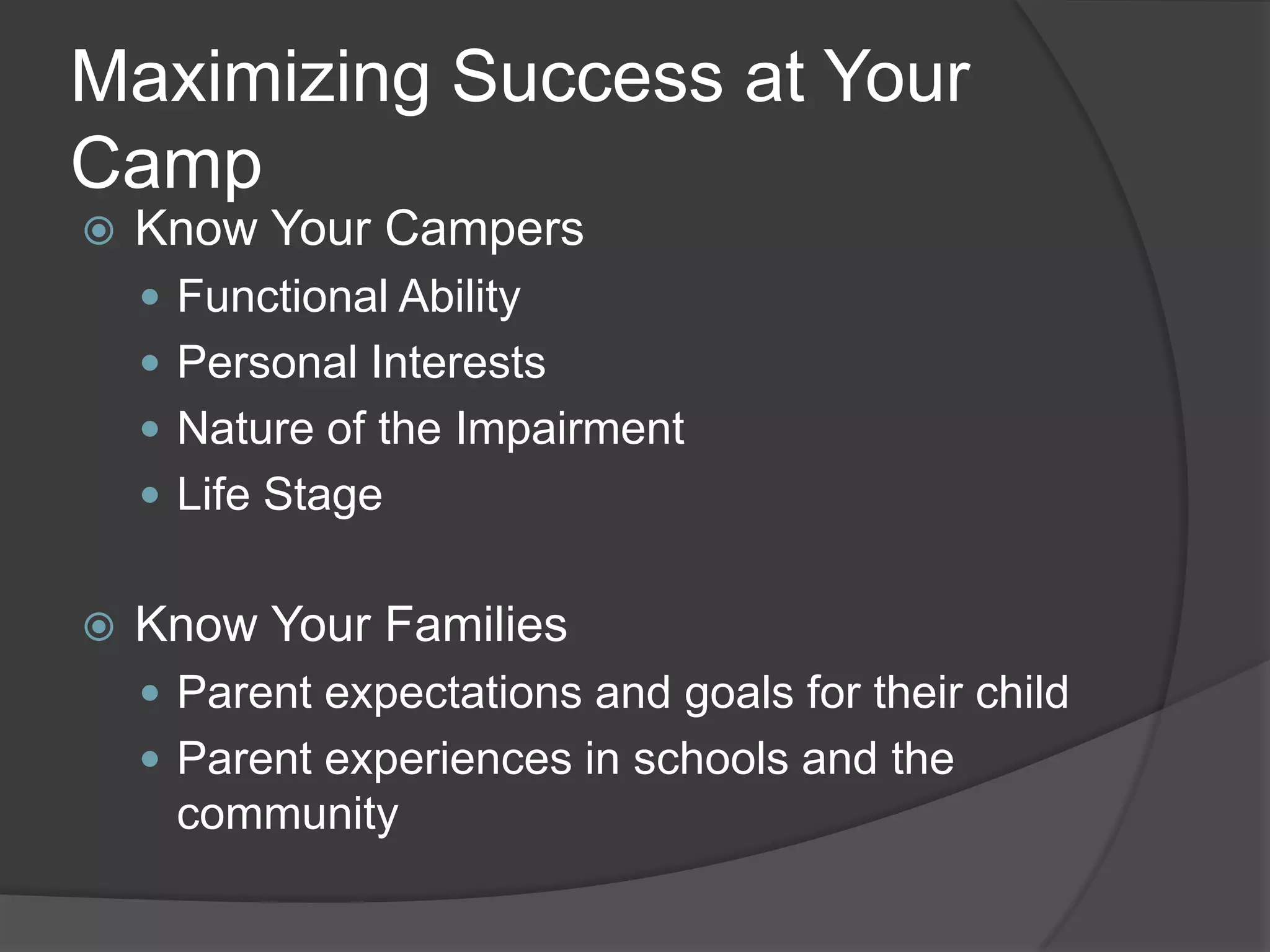
Maximizing Success at Your
Camp
   Know Your Campers
     Functional Ability
     Personal Interests
     Nature of the Impairment
     Life Stage


   Know Your Families
     Parent expectations and goals for their child
     Parent experiences in schools and the
     community
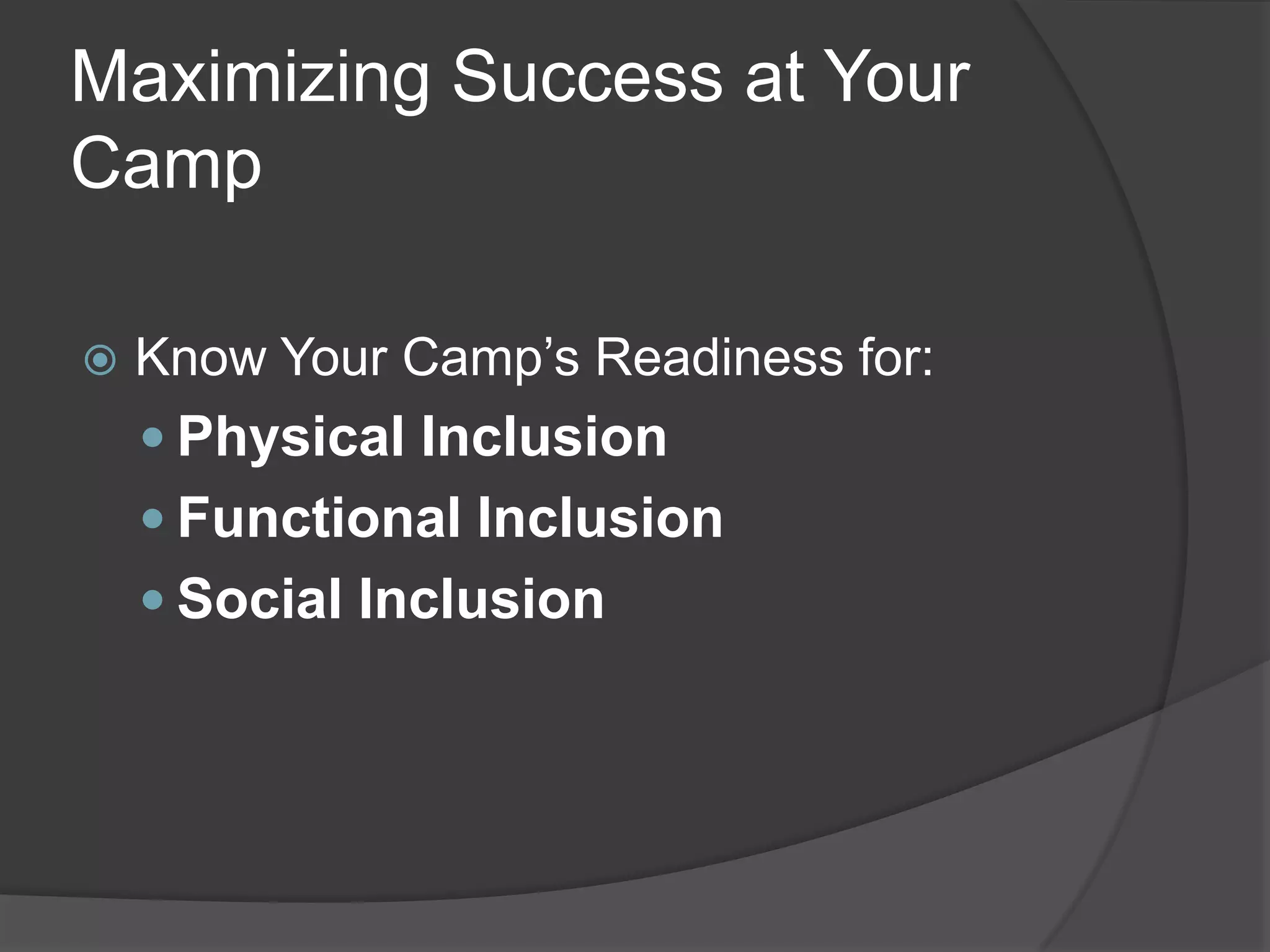
Maximizing Success at Your
Camp

   Know Your Camp’s Readiness for:
     Physical Inclusion
     Functional Inclusion
     Social Inclusion
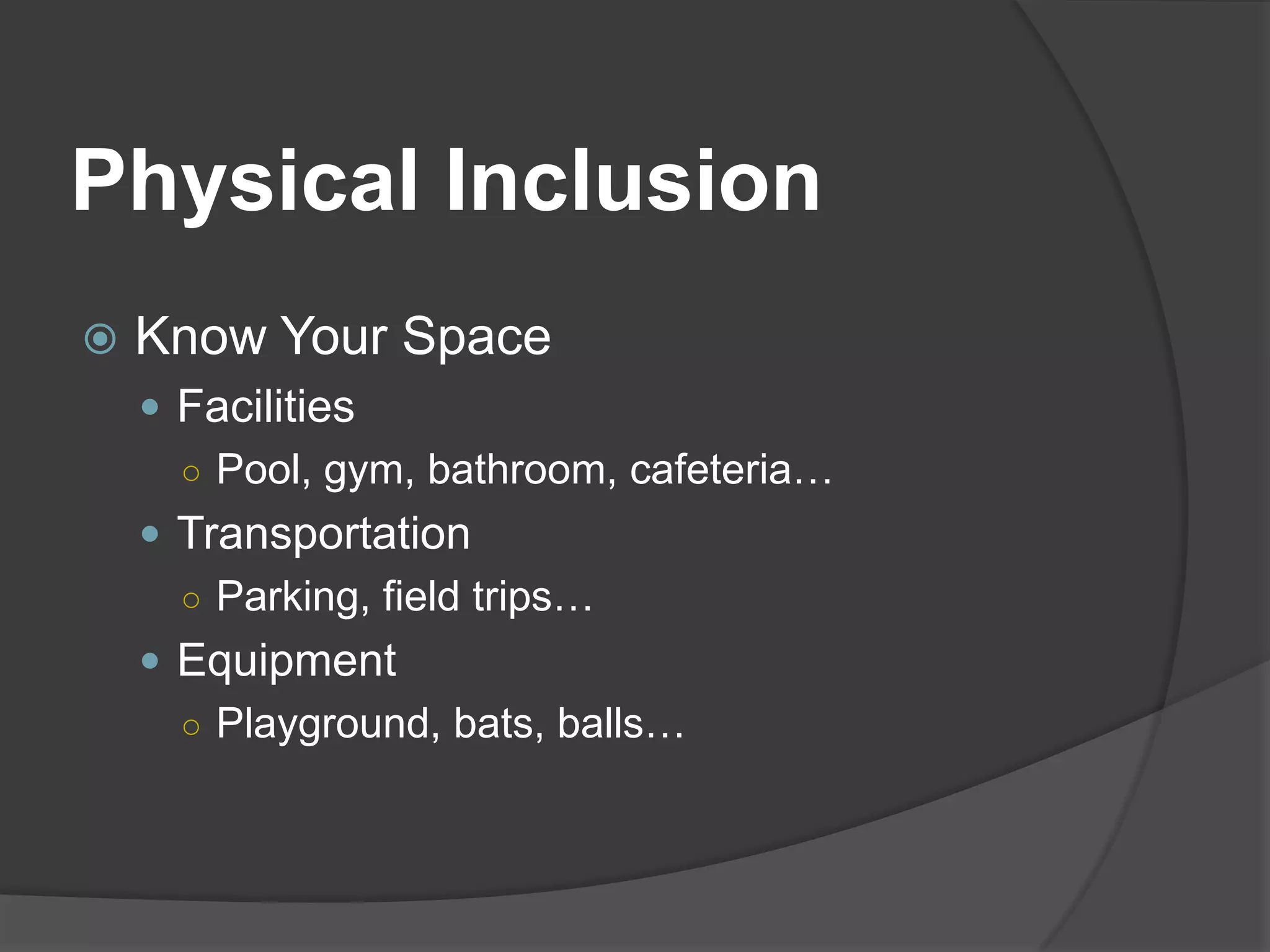
Physical Inclusion
   Know Your Space
     Facilities
      ○ Pool, gym, bathroom, cafeteria…
     Transportation
      ○ Parking, field trips…
     Equipment
      ○ Playground, bats, balls…
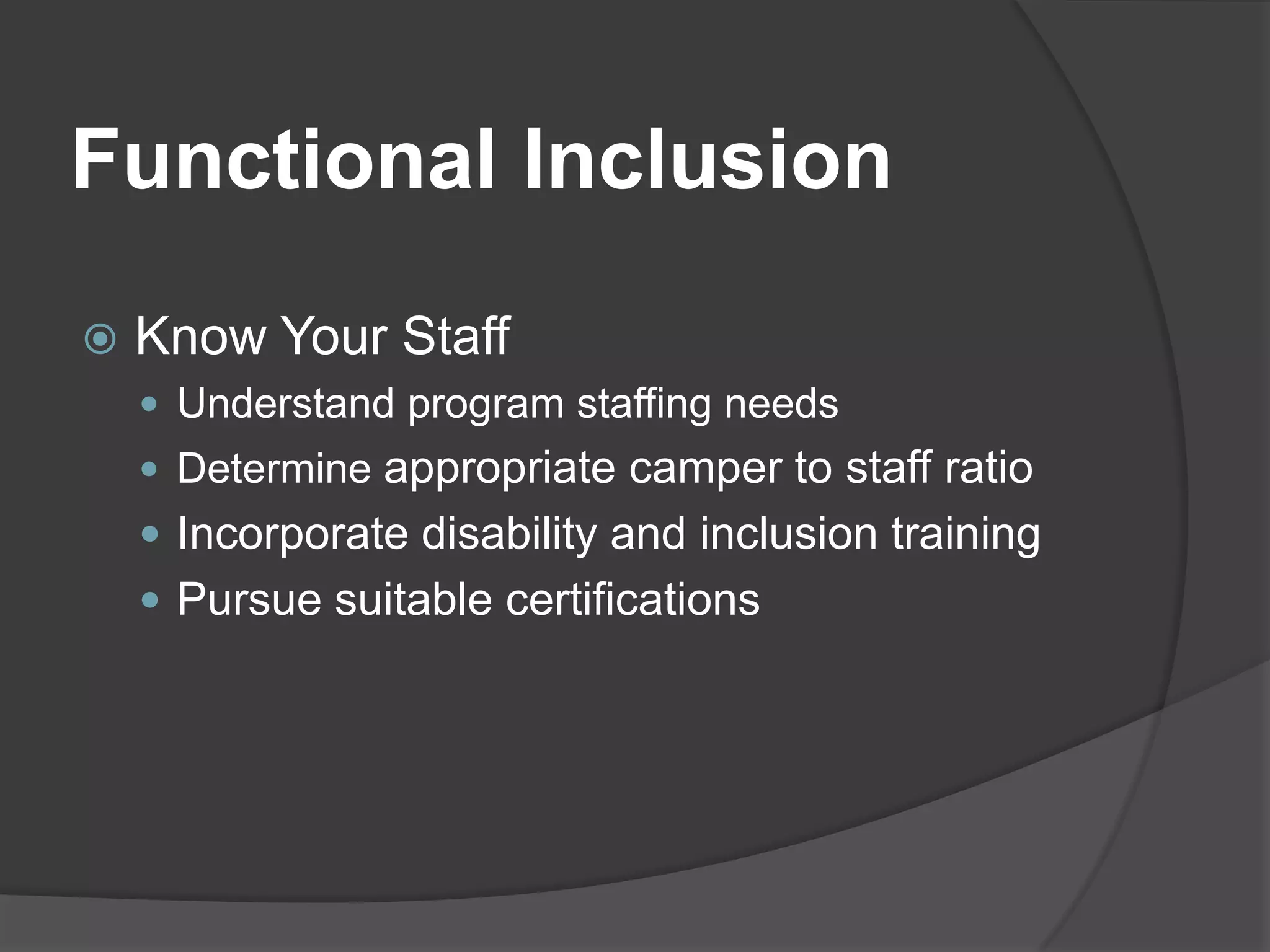
Functional Inclusion
   Know Your Staff
     Understand program staffing needs
     Determine appropriate camper to staff ratio
     Incorporate disability and inclusion training
     Pursue suitable certifications
Functional Inclusion

   Know What Adaptations Are Needed
     Programming
     Materials and Equipment
     Coaching / Instructional Techniques
     Scheduling
     Disciplinary Action Plan
     Behavioral Supports
Functional Inclusion
   Know Specific Activity Adaptations
     Slowing down games
     Shorter duration of games
     Extending time limit
     Increasing counselor-camper ratio for support
     Playing games sitting
     Reducing the playing field
     Modifying the equipment e.g. balloon for balls
Social Inclusion
   Know how to create opportunities for
     Structured contact between children with
        and without disabilities
       Cooperative learning
       Equal status interactions
       Perceived similarity
       Positive role models
   Know Your Evaluation Plan
     Set objectives
     Identify / implement specific measures
     Involve counselors, coaches and parents
Inclusive Recreational Programming
     Benefits Everyone Involved
 Allows children and adults to gain a
  realistic understanding of people with
  disabilities
 Creates opportunities for positive social
  interactions and friendship
 Builds social skills and self-esteem
 Teaches kindness, patience and respect
 Develops tolerance and appreciation for
  those different from ourselves
Inclusive Recreational Programming:
          Why We Do It
   What we are doing matters.
     We make a difference in kids’ lives.
     Recreational programming is beginning to
      lead the way in inclusion
     Yet still, there are too few inclusive camps

   Successful social inclusion is not easy.
     It is not something that just happens when
      you bring two kids together
     It is a structured process that takes time and
      effort
Inclusive Recreational
Programming:
Let’s ALL Make a Difference
 We   are in this together.

 Contact   me anytime:
  gary.siperstein@umb.edu
  (617) 287-7250
National Inclusion Project Conference Keynote

National Inclusion Project Conference Keynote

  • 2.
    Gary N. Siperstein,Ph.D. Center for Social Development and Education University of Massachusetts Boston
  • 3.
    What is Inclusion? Social Inclusion • Persons with a disability are socially accepted Functional Inclusion and enabled to • Persons with a participate in disability have school and necessary supports community to participate in activities Physical Inclusion normative experiences • Persons with a disability are present in the classroom, a sports team, in a recreational setting etc. Schleien et al. 1999
  • 4.
    Inclusion in Classroom vs. Recreational Settings Classroom Recreational Settings  Structure inhibits social  Structure promotes equal interaction participation  Emphasis on academic  Emphasis on FUN achievement  Differences more salient  Differences less salient
  • 5.
    Students Attitudes toward Inclusionin the Classroom are Favorable… Students Believe: Students with ID contribute to the class 74% Having students with ID in class helps other students be 75% more accepting of diversity Students with ID benefit socially from being in the class 73% Students benefit socially from having students with ID in 62% the class
  • 6.
    And Continue toPositively Increase. What would you do with a What would you do with a student with ID in school? student with ID out of school? 2012 2012 Lend the student a Invite the student out 91% 94% 38% 52% pencil with my friends Talk with the student Invite the student over 59% 71% 35% 43% at lunch to my house Choose for Go to the movies with 54% 69% 33% 47% teammate in gym the student Work with on a Talk about personal 52% 67% 29% 29% school task things with the student
  • 7.
    But Friendships betweenchildren with and without disabilities Do Not Occur at School:  In 2004, 10% of middle school students indicated that they had a friend with ID.  In 2012, 34% of middle school students indicated that they had a friend with ID.
  • 8.
    Friendships between childrenwith and without disabilities Do Occur at Camp Settings:  92% of campers named at least one person they “liked to hang out with.”  80% of campers named at least one new friend they had met at camp.  70% of campers without a disability nominated a camper with a disability as someone they like to “hang out with.” Camp Shriver Outcomes, 2011
  • 9.
    In fact, CampDirectors Identified Friendship as a Primary Goal in the Let’s All Play Evaluation  Most common goals for all campers  Make friends  Have fun  Learn new skills  Improve self-esteem and self-confidence  Most common goal for campers with disabilities  Experience social inclusion  Most common goal for campers without disabilities  Gain an understanding of disabilities
  • 10.
    By Friendship, WeMean…  For young children:  Shared play/common activities  For school-aged children:  Shared play/common activities  Understanding and trust  Self-disclosure
  • 11.
    By Friendship, WeMean…  For adolescents:  Engaging in shared activities  Intimacy ○ Trust ○ Communication of ideas and feelings ○ Emotional support  For adults:  Instrumental support (e.g., helping, doing favors)  Shared affection  Mutual respect
  • 12.
    …but few CampSettings are Inclusive.  More than 12,000 day and overnight camps in US  7,000 overnight camps  5,000 day camps  Of 2,400 camps registered with the American Camp Association:  Only 7% are dedicated to the inclusion of campers with disabilities (listed as “inclusion/mainstreaming” camps). American Camp Association, February 2012
  • 13.
    Maximizing Success atYour Camp  Know Your Campers  Functional Ability  Personal Interests  Nature of the Impairment  Life Stage  Know Your Families  Parent expectations and goals for their child  Parent experiences in schools and the community
  • 14.
    Maximizing Success atYour Camp  Know Your Camp’s Readiness for:  Physical Inclusion  Functional Inclusion  Social Inclusion
  • 15.
    Physical Inclusion  Know Your Space  Facilities ○ Pool, gym, bathroom, cafeteria…  Transportation ○ Parking, field trips…  Equipment ○ Playground, bats, balls…
  • 16.
    Functional Inclusion  Know Your Staff  Understand program staffing needs  Determine appropriate camper to staff ratio  Incorporate disability and inclusion training  Pursue suitable certifications
  • 17.
    Functional Inclusion  Know What Adaptations Are Needed  Programming  Materials and Equipment  Coaching / Instructional Techniques  Scheduling  Disciplinary Action Plan  Behavioral Supports
  • 18.
    Functional Inclusion  Know Specific Activity Adaptations  Slowing down games  Shorter duration of games  Extending time limit  Increasing counselor-camper ratio for support  Playing games sitting  Reducing the playing field  Modifying the equipment e.g. balloon for balls
  • 19.
    Social Inclusion  Know how to create opportunities for  Structured contact between children with and without disabilities  Cooperative learning  Equal status interactions  Perceived similarity  Positive role models
  • 20.
    Know Your Evaluation Plan  Set objectives  Identify / implement specific measures  Involve counselors, coaches and parents
  • 21.
    Inclusive Recreational Programming Benefits Everyone Involved  Allows children and adults to gain a realistic understanding of people with disabilities  Creates opportunities for positive social interactions and friendship  Builds social skills and self-esteem  Teaches kindness, patience and respect  Develops tolerance and appreciation for those different from ourselves
  • 22.
    Inclusive Recreational Programming: Why We Do It  What we are doing matters.  We make a difference in kids’ lives.  Recreational programming is beginning to lead the way in inclusion  Yet still, there are too few inclusive camps  Successful social inclusion is not easy.  It is not something that just happens when you bring two kids together  It is a structured process that takes time and effort
  • 23.
    Inclusive Recreational Programming: Let’s ALLMake a Difference  We are in this together.  Contact me anytime: gary.siperstein@umb.edu (617) 287-7250

Editor's Notes

  • #4 Defining InclusionInclusion is based on the idea that people with disabilities should be allowed to participate equally alongside their peers without disabilities When we talk about inclusion, we need to think about three levels of inclusion. At the most basic level, there is physical inclusion – where people with disabilities are physically placed in the classroom or in the community. Physical inclusion often involves making adaptations to the physical environment that would make it possible for a person with a disability to be in that environment. Functional inclusion is the next level. It recognizes that in addition to adaptations to the physical environment, people with a disability may need other supports that will enable them to participate in activities. In the classroom, this is often referred to as instructional inclusion. Social Inclusion is the final level of inclusion. People often assume that if people with disabilities are in the classroom, or on the sports team, they will automatically become a part of the social environment. However, as will show later – this is not the case. Social Inclusion occurs when people are social accepted by their peers and are enabled by others to participate fully in community activities.
  • #5 Now that we know what inclusion is – why is it important to promote inclusion in recreational settings?There are certain barriers in academic / classroom settings that are not present in recreational settings.Non-academic settings are more conducive to promoting positive outcomes like improved social skills, self-esteem, social acceptance
  • #6 Student attitudes concur with previous slide: that academically, students with ID can contribute class.Additionally, students believe: including students with ID will help other students become more accepting, that students with ID socially benefit from classroom inclusion, and that they themselves socially benefit from classroom inclusion.
  • #8 Even though students are sure that there is a social benefit in including students with ID inside the classroom (as the previous slides show), there is no friendship development there.Note: 93% of adults in a Multinational Survey of Attitudes toward individuals with Intellectual Disabilities believe that adults with ID are capable of sustaining friendships2004 is the date of the of the MACRO contract
  • #9 However…The average camper named 2-3 friends at camp they liked to hang out with.
  • #11 Friendships are characterized by high levels of reciprocity and perceived equality, as well as mutual liking and positive interactions in which there exist expectations from both members of a dyad of companionship, security, instrumental help, and emotional support (Bukowski et al., 2008).Note from Joanne/Laura:“Shared” implies reciprocity.“Friendship is a two-way street" i.e., If it's not reciprocated, it can't really be considered a friendshipDeep vs. surface structure of friendship:Deep structure refers to the ‘essence’ of friendship, reciprocity, which exists in friendships throughout development. Surface structure refers to the specific interactions of friendship, which change throughout the lifespan, depending on the needs of the friends.(Hartup & Stevens, 1997)NOTES: From Let’s ALL Play Conference, 2011For Young Children Friendship is also whomever they are playing with at the timeFor School-Aged Someone who is “fun to play with” Easily Started and Terminated
  • #12 For Adults (From Joanne)“Doing Favors” applies to adults, such as: watching your kids, driving your kids to school or after-school activities, picking up your mail and feeding your dog when you are on vacation, etc
  • #13 Why is it important to continue advocating for inclusion in camp? There is a clear lack in the amount of camps who are welcoming to children with and without disabilities.There is clearly a need and the “demand outweighs the supply” (if you will).Traditionally, three types of camp settingsCamps that are segregated in nature and designed to provide medical and social support for campers with specific disabilities, most particularly health problemsCamps that are segregated in nature - designed for campers with disabilities within barrier free environmentCamps that are inclusive in nature Examples:YMCA, YWCA, Boy and Girls Scouts of America, Woodman of the World, and religious organizationsFor-profits versus not-for-profits  
  • #14 Who you select is dependent on what services/accessibility you can provide.Campers Also:DemographicsAgeGenderGeographic LocationEconomic StatusIndividual camper strengths and challengesFamilies- how to answer their questions, make them feel secure about sending their child with special needs to your camp. How to assure them that their children will not be isolated at camp but will be able to form friendships.
  • #16 Campus safety, playground, sleeping, quarters bathroom, cafeteria – ACA Accreditation Standards (2012)Parking, entrance, restrooms, lockeroom, pool, gym, activity areas – Institute for Community Inclusion Packet, compiled by Maria Paiewonsky and Susan Tufts (1999) Inclusion Assessment Tools, compiled NY State Inclusive Recreation Resource Center (2011) ACA Accreditation Standards (2012)
  • #17 Camp Shriver operates with a 4:1 ratioCertifications such as First Aid, CPR, AED (automated external defibrillator), Lifeguarding, etc.
  • #18 From:Institute for Community Inclusion Packet, compiled by Maria Paiewonsky and Susan Tufts (1999)Inclusion Assessment Tools, compiled NY State Inclusive Recreation Resource Center (2011)ACA Accreditation Standards (2012)
  • #19 From Let’s ALL Play
  • #20 Also from the friendship chapter:Peer buddy programs“Interventions are often successful in increasing social interactions and fostering positive attitude change among children without disabilities, but most do not result in the formation of true friendships (as defined above).”Also:Make sure you plan ahead and have alternate activitiesDisability awareness trainingCommunication: people-first language Institute for Community Inclusion Packet, compiled by Maria Paiewonsky and Susan Tufts (1999) Inclusion Assessment Tools, compiled NY State Inclusive Recreation Resource Center (2011) ACA Accreditation Standards (2012)Also:Well-planned structured contact in crucialCooperative learningPositive role models Social Acceptance and Attitude Change: 50 Years of Research, by Gary et al, (2006)
  • #21 Show that what you do worksTell everyone you knowParents, teachers, funders, etc.
  • #22 NIP is building from the grassroots up – a movement to focus society's attention, not just to the fact that inclusion is mandated in our schools….
  • #24 Thanks to organizations such as the National Inclusion Project, we can build this community of support and knowledge((alternative title: Inclusive Recreational Programming: Together, We are making a difference))  Together, we are on the right trackWe’ve come a long wayThe work can be hard, but we are sticking with it.  There is a lot be shared and learned, today and tomorrow, from the presenters and from each other.We are in this together. Thank you for the work you do, and enjoy the rest of the conference.