slides and resources: http://tinyurl.com/AlternativesToLecture

   CTD WEEKLY WORKSHOPS:
   ALTERNATIVES TO LECTURE

                Peter Newbury
                Center for Teaching Development,
                University of California, San Diego
                pnewbury@ucsd.edu              @polarisdotca
                ctd.ucsd.edu                   #ctducsd


                Thursday, January 10, 2013 12:30 – 1:30 pm
                Center Hall, Room 316
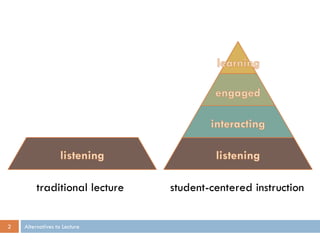
traditional lecture   student-centered instruction


2   Alternatives to Lecture
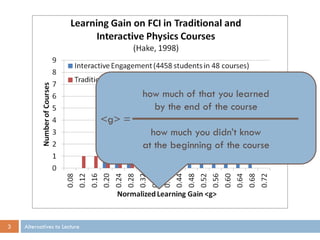
how much of that you learned
                                        by the end of the course
                              <g> =
                                        how much you didn’t know
                                      at the beginning of the course


3   Alternatives to Lecture
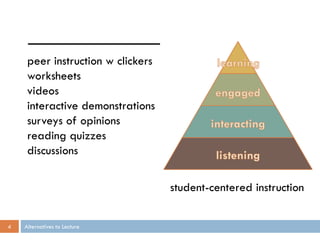
peer instruction w clickers
     worksheets
     videos
     interactive demonstrations
     surveys of opinions
     reading quizzes
     discussions

                                   student-centered instruction


4   Alternatives to Lecture
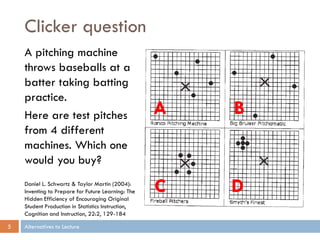
Clicker question
    A pitching machine
    throws baseballs at a
    batter taking batting
    practice.
    Here are test pitches                           A   B
    from 4 different
    machines. Which one
    would you buy?
    Daniel L. Schwartz & Taylor Martin (2004):
    Inventing to Prepare for Future Learning: The
    Hidden Efficiency of Encouraging Original
                                                    C   D
    Student Production in Statistics Instruction,
    Cognition and Instruction, 22:2, 129-184

5   Alternatives to Lecture
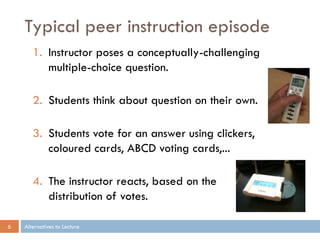
Typical peer instruction episode
       1. Instructor poses a conceptually-challenging
          multiple-choice question.

       2. Students think about question on their own.

       3. Students vote for an answer using clickers,
          coloured cards, ABCD voting cards,...

       4. The instructor reacts, based on the
          distribution of votes.

6   Alternatives to Lecture
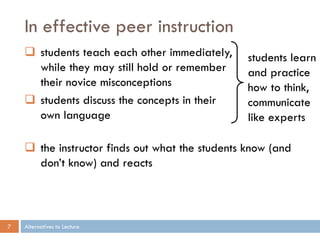
In effective peer instruction
     students teach each other immediately,     students learn
      while they may still hold or remember      and practice
      their novice misconceptions                how to think,
     students discuss the concepts in their     communicate
      own language                               like experts

     the instructor finds out what the students know (and
      don’t know) and reacts


7   Alternatives to Lecture
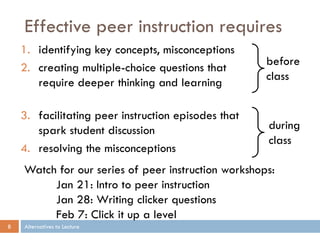
Effective peer instruction requires
    1. identifying key concepts, misconceptions
                                                     before
    2. creating multiple-choice questions that
                                                     class
       require deeper thinking and learning

    3. facilitating peer instruction episodes that
       spark student discussion                      during
                                                     class
    4. resolving the misconceptions
    Watch for our series of peer instruction workshops:
         Jan 21: Intro to peer instruction
         Jan 28: Writing clicker questions
         Feb 7: Click it up a level
8   Alternatives to Lecture
In-class worksheets
                     Looking at Distant Objects
    Recall that a light-year (ly) is a distance, the distance
    light travels in one year.
    In groups of 2 or 3, work on the worksheet. Make sure
    everyone in your group agrees on the answer to each
    question before you write it down.


9   Alternatives to Lecture
Clicker question
     Imagine that you simultaneously receive the satellite transmission
     of two pictures of two people that live on planets orbiting two
     different stars. Each image shows the people at their 21st
     birthday parties. Consider the following possible interpretations
     that could be made from your observations. Which do you think is
     the most plausible interpretation?

     A) Both people are the same age but at different distances
        from you.
     B) The people are actually different ages but at the same
        distance from you.
     C) The person that is closer to you is actually the older of the
        two people.
     D) The person that is farther from you is actually the older of
        the two people.
10   Alternatives to Lecture
In-class worksheets
      Worksheets guide students through a concept
                they can learn from the worksheet, not just practice
                 a skill
      Do not “go over” the worksheet afterwards
                encourages students to not do the work and just wait for
                 the answers
      Assess their work by, for example, asking a follow-up
       clicker question
                successful on worksheet        successful on clicker question
                 (not successful on clicker q    not successful on worksheet)

11   Alternatives to Lecture
In-class worksheets: structure
      Worksheet is “stand-alone” and complete.
                students can complete it later, do it again when studying
                easier to integrate into lessons
      First questions are “trivial”
                check that student read intro
                gives them confidence to proceed
      Last question is the “zinger”
                questions build towards the deep question, each one
                 building the skill needed to answer next question
      Plenty of opportunity for formative feedback
12   Alternatives to Lecture
In-class worksheet: resources
                                 Washington Tutorials (physics)
                               www.phys.washington.edu/groups/peg/tut.html


                  Lecture-Tutorials for Introductory Astronomy
     astronomy101.jpl.nasa.gov/teachingstrategies/teachingdetails/?StrategyID=9


     Format and structure can be adapted to other fields:
     use the astronomy LT’s as a template


13   Alternatives to Lecture
In-class video
     There are times when a video is the perfect resource.

     Paul Hewitt demonstrates Archimedes’ Principle:

            http://www.youtube.com/watch?v=g6aErhwFXsg


14   Alternatives to Lecture
In-class video
     Was the Paul Hewitt demo
      engaging?
      entertaining?
      interactive?
      deep or surface learning?


15   Alternatives to Lecture
In-class video
     Our expert eyes know
      what details or events to look for
      when to start watching carefully – we can anticipate
        the key event
      what to ignore
     Students don’t know what to look for. Before showing a
     video, prime them, prepare them:
                  “In this video, pay particular attention to the…”
                  “I want you to count how many times she says…”


16   Alternatives to Lecture
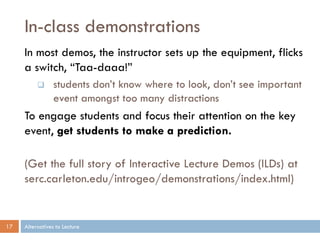
In-class demonstrations
     In most demos, the instructor sets up the equipment, flicks
     a switch, “Taa-daaa!”
                students don’t know where to look, don’t see important
                 event amongst too many distractions
     To engage students and focus their attention on the key
     event, get students to make a prediction.

     (Get the full story of Interactive Lecture Demos (ILDs) at
     serc.carleton.edu/introgeo/demonstrations/index.html)


17   Alternatives to Lecture
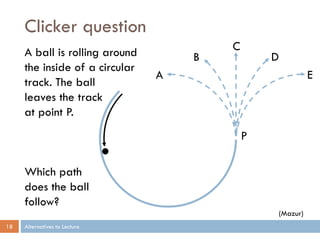
Clicker question
     A ball is rolling around           C
                                    B           D
     the inside of a circular
                                A                             E
     track. The ball
     leaves the track
     at point P.
                                            P

     Which path
     does the ball
     follow?
                                                    (Mazur)
18   Alternatives to Lecture
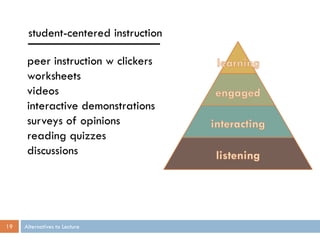
student-centered instruction

      peer instruction w clickers
      worksheets
      videos
      interactive demonstrations
      surveys of opinions
      reading quizzes
      discussions


19   Alternatives to Lecture
slides and resources: http://tinyurl.com/AlternativesToLecture

   CTD WEEKLY WORKSHOPS:
   ALTERNATIVES TO LECTURE

                Peter Newbury
                Center for Teaching Development,
                University of California, San Diego
                pnewbury@ucsd.edu              @polarisdotca
                ctd.ucsd.edu                   #ctducsd


                Thursday, January 10, 2013
                12:30 – 1:30 pm

Wi13 Workshop - Alternatives to Lecture

  • 1.
    slides and resources:http://tinyurl.com/AlternativesToLecture CTD WEEKLY WORKSHOPS: ALTERNATIVES TO LECTURE Peter Newbury Center for Teaching Development, University of California, San Diego pnewbury@ucsd.edu @polarisdotca ctd.ucsd.edu #ctducsd Thursday, January 10, 2013 12:30 – 1:30 pm Center Hall, Room 316
  • 2.
    traditional lecture student-centered instruction 2 Alternatives to Lecture
  • 3.
    how much ofthat you learned by the end of the course <g> = how much you didn’t know at the beginning of the course 3 Alternatives to Lecture
  • 4.
    peer instruction wclickers worksheets videos interactive demonstrations surveys of opinions reading quizzes discussions student-centered instruction 4 Alternatives to Lecture
  • 5.
    Clicker question A pitching machine throws baseballs at a batter taking batting practice. Here are test pitches A B from 4 different machines. Which one would you buy? Daniel L. Schwartz & Taylor Martin (2004): Inventing to Prepare for Future Learning: The Hidden Efficiency of Encouraging Original C D Student Production in Statistics Instruction, Cognition and Instruction, 22:2, 129-184 5 Alternatives to Lecture
  • 6.
    Typical peer instructionepisode 1. Instructor poses a conceptually-challenging multiple-choice question. 2. Students think about question on their own. 3. Students vote for an answer using clickers, coloured cards, ABCD voting cards,... 4. The instructor reacts, based on the distribution of votes. 6 Alternatives to Lecture
  • 7.
    In effective peerinstruction  students teach each other immediately, students learn while they may still hold or remember and practice their novice misconceptions how to think,  students discuss the concepts in their communicate own language like experts  the instructor finds out what the students know (and don’t know) and reacts 7 Alternatives to Lecture
  • 8.
    Effective peer instructionrequires 1. identifying key concepts, misconceptions before 2. creating multiple-choice questions that class require deeper thinking and learning 3. facilitating peer instruction episodes that spark student discussion during class 4. resolving the misconceptions Watch for our series of peer instruction workshops: Jan 21: Intro to peer instruction Jan 28: Writing clicker questions Feb 7: Click it up a level 8 Alternatives to Lecture
  • 9.
    In-class worksheets Looking at Distant Objects Recall that a light-year (ly) is a distance, the distance light travels in one year. In groups of 2 or 3, work on the worksheet. Make sure everyone in your group agrees on the answer to each question before you write it down. 9 Alternatives to Lecture
  • 10.
    Clicker question Imagine that you simultaneously receive the satellite transmission of two pictures of two people that live on planets orbiting two different stars. Each image shows the people at their 21st birthday parties. Consider the following possible interpretations that could be made from your observations. Which do you think is the most plausible interpretation? A) Both people are the same age but at different distances from you. B) The people are actually different ages but at the same distance from you. C) The person that is closer to you is actually the older of the two people. D) The person that is farther from you is actually the older of the two people. 10 Alternatives to Lecture
  • 11.
    In-class worksheets  Worksheets guide students through a concept  they can learn from the worksheet, not just practice a skill  Do not “go over” the worksheet afterwards  encourages students to not do the work and just wait for the answers  Assess their work by, for example, asking a follow-up clicker question  successful on worksheet successful on clicker question (not successful on clicker q not successful on worksheet) 11 Alternatives to Lecture
  • 12.
    In-class worksheets: structure  Worksheet is “stand-alone” and complete.  students can complete it later, do it again when studying  easier to integrate into lessons  First questions are “trivial”  check that student read intro  gives them confidence to proceed  Last question is the “zinger”  questions build towards the deep question, each one building the skill needed to answer next question  Plenty of opportunity for formative feedback 12 Alternatives to Lecture
  • 13.
    In-class worksheet: resources Washington Tutorials (physics) www.phys.washington.edu/groups/peg/tut.html Lecture-Tutorials for Introductory Astronomy astronomy101.jpl.nasa.gov/teachingstrategies/teachingdetails/?StrategyID=9 Format and structure can be adapted to other fields: use the astronomy LT’s as a template 13 Alternatives to Lecture
  • 14.
    In-class video There are times when a video is the perfect resource. Paul Hewitt demonstrates Archimedes’ Principle: http://www.youtube.com/watch?v=g6aErhwFXsg 14 Alternatives to Lecture
  • 15.
    In-class video Was the Paul Hewitt demo  engaging?  entertaining?  interactive?  deep or surface learning? 15 Alternatives to Lecture
  • 16.
    In-class video Our expert eyes know  what details or events to look for  when to start watching carefully – we can anticipate the key event  what to ignore Students don’t know what to look for. Before showing a video, prime them, prepare them: “In this video, pay particular attention to the…” “I want you to count how many times she says…” 16 Alternatives to Lecture
  • 17.
    In-class demonstrations In most demos, the instructor sets up the equipment, flicks a switch, “Taa-daaa!”  students don’t know where to look, don’t see important event amongst too many distractions To engage students and focus their attention on the key event, get students to make a prediction. (Get the full story of Interactive Lecture Demos (ILDs) at serc.carleton.edu/introgeo/demonstrations/index.html) 17 Alternatives to Lecture
  • 18.
    Clicker question A ball is rolling around C B D the inside of a circular A E track. The ball leaves the track at point P. P Which path does the ball follow? (Mazur) 18 Alternatives to Lecture
  • 19.
    student-centered instruction peer instruction w clickers worksheets videos interactive demonstrations surveys of opinions reading quizzes discussions 19 Alternatives to Lecture
  • 20.
    slides and resources:http://tinyurl.com/AlternativesToLecture CTD WEEKLY WORKSHOPS: ALTERNATIVES TO LECTURE Peter Newbury Center for Teaching Development, University of California, San Diego pnewbury@ucsd.edu @polarisdotca ctd.ucsd.edu #ctducsd Thursday, January 10, 2013 12:30 – 1:30 pm