Using Online Discussion Forums with Adolescents to Promote Recreational Reading Rebecca Bennett and Kim PlatnickEDIT 6900Fall 2010
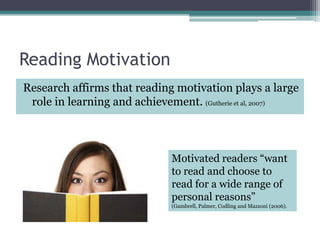
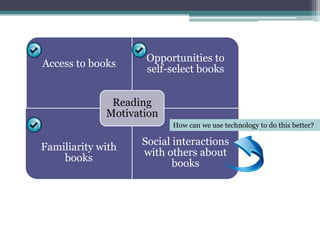
Reading MotivationResearch affirms that reading motivation plays a large role in learning and achievement. (Gutherie et al, 2007)Motivated readers “want to read and choose to read for a wide range of personal reasons” (Gambrell, Palmer, Codling and Mazzoni (2006).
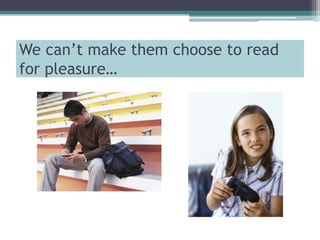
We can’t make them choose to read for pleasure…
So how can educators encourage students  to read more?
How can we use technology to do this better?
Purpose of the Study	This research study will focus on the social aspect of reading motivation. The purpose of this study is to seek a greater understanding about fostering student social interactions about books through student participation in online book discussion forums and how that relates to student reading motivation.
Research QuestionDoes participation in an online book discussion forum motivate middle school students to read for pleasure?
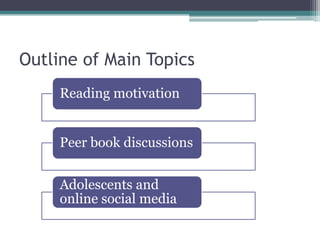
Outline of Main Topics
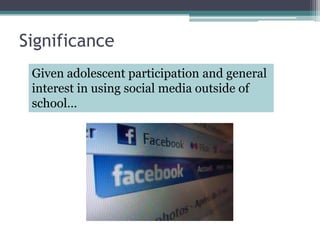
Significance Given adolescent participation and general interest in using social media outside of school…
Educators are becoming more aware of the potential for using social media such as online discussion forums as a motivational power for encouraging reading in an educational context.
Since Web 2.0 and social media are so new, more research is needed to better understand the use of social media  in education, specifically with regard to using these tools to motivate students to read for pleasure.
Literature Review:Reading MotivationCurrent research on reading motivation affirms the general notion that reading motivation plays a large role in learning and achievement (Gutherie et al, 2007).The four main aspects of reading motivation are: “access to books in the classroom, opportunities to self-select books, familiarity with books and social interactions with others about books,”  (Gambrell , 1996).
Educators can engage students by encouraging conversations about reading, either by having students give specific book recommendations, or by providing for informal discussions in which students share their reading experiences.  Both types of interactions are shown to influence reading motivation.  (Pitcher, et al., 2007; Strommen & Fowles Mates, 2004).Literature Review: Peer Sharing
Literature Review:Adolescents and Online Social MediaToday’s adolescents were born into technologyand it is central to many of their social lives.Most adolescents are active users of the Internet and most of those Internet users are creating their own online content.  (Scharber, Melrose, & Wurl 2009, Lenhart, Madden, Rankin Macgill, & Smith 2007).
Students participated in asynchronous online  book discussions “more deeply”  than those who wrote about the books with pen and paper  in a journal (Grisham, 2006).  
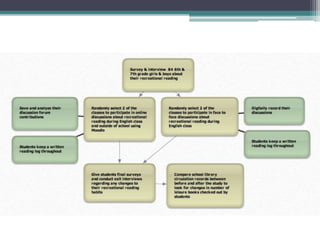
Research DesignQuasi-experimental  methodology Participants:  84 sixth and seventh grade students divided into four homerooms
MethodTwo of the homerooms will participate in the online discussion forums for an 18-week period.  These students will use Moodle forums.  Moodle is a free, open-source online platform used to create interactive classroom experiences.
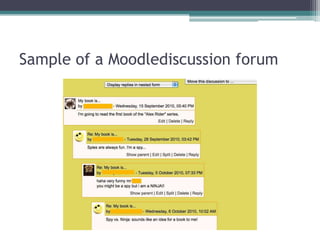
Sample of a Moodlediscussion forum
Method
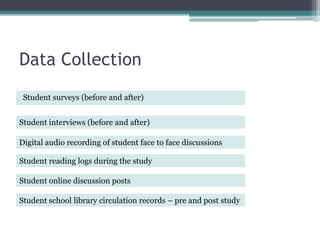
Data CollectionStudent surveys (before and after)Student interviews (before and after)Digital audio recording of student face to face discussionsStudent reading logs during the studyStudent online discussion postsStudent school library circulation records – pre and post study
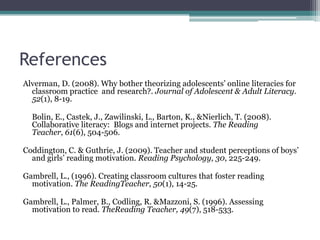
ReferencesAlverman, D. (2008). Why bother theorizing adolescents’ online literacies for classroom practice  and research?. Journal of Adolescent & Adult Literacy. 52(1), 8-19.	Bolin, E., Castek, J., Zawilinski, L., Barton, K., & Nierlich, T. (2008). Collaborative literacy:  Blogs and internet projects. The Reading Teacher, 61(6), 504-506.Coddington, C. & Guthrie, J. (2009). Teacher and student perceptions of boys’ and girls’ reading motivation. Reading Psychology, 30, 225-249.Gambrell, L., (1996). Creating classroom cultures that foster reading motivation. The ReadingTeacher, 50(1), 14-25.Gambrell, L., Palmer, B., Codling, R. & Mazzoni, S. (1996). Assessing motivation to read. TheReading Teacher, 49(7), 518-533.
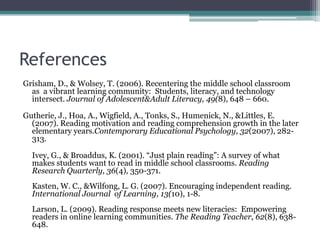
ReferencesGrisham, D., & Wolsey, T. (2006). Recentering the middle school classroom as  a vibrant learning community:  Students, literacy, and technology intersect. Journal of Adolescent & Adult Literacy, 49(8), 648 – 660.Gutherie, J., Hoa, A., Wigfield, A., Tonks, S., Humenick, N., & Littles, E. (2007). Reading motivation and reading comprehension growth in the later elementary years.Contemporary Educational Psychology, 32(2007), 282-313.Ivey, G., & Broaddus, K. (2001). “Just plain reading”: A survey of what makes students want to read in middle school classrooms. Reading Research Quarterly, 36(4), 350-371.Kasten, W. C., & Wilfong, L. G. (2007). Encouraging independent reading. International Journal  of Learning, 13(10), 1-8.Larson, L. (2009). Reading response meets new literacies:  Empowering readers in online learning communities. The Reading Teacher, 62(8), 638-648.
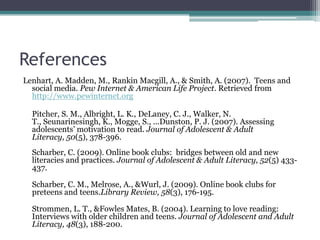
ReferencesLenhart, A. Madden, M., Rankin Macgill, A., & Smith, A. (2007).  Teens and social media. Pew Internet & American Life Project. Retrieved from http://www.pewinternet.org	Pitcher, S. M., Albright, L. K., DeLaney, C. J., Walker, N. T., Seunarinesingh, K., Mogge, S., ...Dunston, P. J. (2007). Assessing adolescents’ motivation to read. Journal of Adolescent & Adult Literacy, 50(5), 378-396.Scharber, C. (2009). Online book clubs:  bridges between old and new literacies and practices. Journal of Adolescent & Adult Literacy, 52(5) 433-437.Scharber, C. M., Melrose, A., & Wurl, J. (2009). Online book clubs for preteens and teens.Library Review, 58(3), 176-195.Strommen, L. T., & Fowles Mates, B. (2004). Learning to love reading: Interviews with older children and teens. Journal of Adolescent and Adult Literacy, 48(3), 188-200.

Bennett platnick research design project ppt

  • 1.
    Using Online DiscussionForums with Adolescents to Promote Recreational Reading Rebecca Bennett and Kim PlatnickEDIT 6900Fall 2010
  • 2.
    Reading MotivationResearch affirmsthat reading motivation plays a large role in learning and achievement. (Gutherie et al, 2007)Motivated readers “want to read and choose to read for a wide range of personal reasons” (Gambrell, Palmer, Codling and Mazzoni (2006).
  • 3.
    We can’t makethem choose to read for pleasure…
  • 4.
    So how caneducators encourage students to read more?
  • 5.
    How can weuse technology to do this better?
  • 6.
    Purpose of theStudy This research study will focus on the social aspect of reading motivation. The purpose of this study is to seek a greater understanding about fostering student social interactions about books through student participation in online book discussion forums and how that relates to student reading motivation.
  • 7.
    Research QuestionDoes participationin an online book discussion forum motivate middle school students to read for pleasure?
  • 8.
  • 9.
    Significance Given adolescentparticipation and general interest in using social media outside of school…
  • 10.
    Educators are becomingmore aware of the potential for using social media such as online discussion forums as a motivational power for encouraging reading in an educational context.
  • 11.
    Since Web 2.0and social media are so new, more research is needed to better understand the use of social media  in education, specifically with regard to using these tools to motivate students to read for pleasure.
  • 12.
    Literature Review:Reading MotivationCurrentresearch on reading motivation affirms the general notion that reading motivation plays a large role in learning and achievement (Gutherie et al, 2007).The four main aspects of reading motivation are: “access to books in the classroom, opportunities to self-select books, familiarity with books and social interactions with others about books,” (Gambrell , 1996).
  • 13.
    Educators can engagestudents by encouraging conversations about reading, either by having students give specific book recommendations, or by providing for informal discussions in which students share their reading experiences.  Both types of interactions are shown to influence reading motivation.  (Pitcher, et al., 2007; Strommen & Fowles Mates, 2004).Literature Review: Peer Sharing
  • 14.
    Literature Review:Adolescents andOnline Social MediaToday’s adolescents were born into technologyand it is central to many of their social lives.Most adolescents are active users of the Internet and most of those Internet users are creating their own online content.  (Scharber, Melrose, & Wurl 2009, Lenhart, Madden, Rankin Macgill, & Smith 2007).
  • 15.
    Students participated inasynchronous online book discussions “more deeply” than those who wrote about the books with pen and paper in a journal (Grisham, 2006).  
  • 16.
    Research DesignQuasi-experimental methodology Participants: 84 sixth and seventh grade students divided into four homerooms
  • 17.
    MethodTwo of thehomerooms will participate in the online discussion forums for an 18-week period.  These students will use Moodle forums.  Moodle is a free, open-source online platform used to create interactive classroom experiences.
  • 18.
    Sample of aMoodlediscussion forum
  • 19.
  • 20.
    Data CollectionStudent surveys(before and after)Student interviews (before and after)Digital audio recording of student face to face discussionsStudent reading logs during the studyStudent online discussion postsStudent school library circulation records – pre and post study
  • 21.
    ReferencesAlverman, D. (2008).Why bother theorizing adolescents’ online literacies for classroom practice and research?. Journal of Adolescent & Adult Literacy. 52(1), 8-19. Bolin, E., Castek, J., Zawilinski, L., Barton, K., & Nierlich, T. (2008). Collaborative literacy:  Blogs and internet projects. The Reading Teacher, 61(6), 504-506.Coddington, C. & Guthrie, J. (2009). Teacher and student perceptions of boys’ and girls’ reading motivation. Reading Psychology, 30, 225-249.Gambrell, L., (1996). Creating classroom cultures that foster reading motivation. The ReadingTeacher, 50(1), 14-25.Gambrell, L., Palmer, B., Codling, R. & Mazzoni, S. (1996). Assessing motivation to read. TheReading Teacher, 49(7), 518-533.
  • 22.
    ReferencesGrisham, D., &Wolsey, T. (2006). Recentering the middle school classroom as  a vibrant learning community:  Students, literacy, and technology intersect. Journal of Adolescent & Adult Literacy, 49(8), 648 – 660.Gutherie, J., Hoa, A., Wigfield, A., Tonks, S., Humenick, N., & Littles, E. (2007). Reading motivation and reading comprehension growth in the later elementary years.Contemporary Educational Psychology, 32(2007), 282-313.Ivey, G., & Broaddus, K. (2001). “Just plain reading”: A survey of what makes students want to read in middle school classrooms. Reading Research Quarterly, 36(4), 350-371.Kasten, W. C., & Wilfong, L. G. (2007). Encouraging independent reading. International Journal of Learning, 13(10), 1-8.Larson, L. (2009). Reading response meets new literacies:  Empowering readers in online learning communities. The Reading Teacher, 62(8), 638-648.
  • 23.
    ReferencesLenhart, A. Madden,M., Rankin Macgill, A., & Smith, A. (2007).  Teens and social media. Pew Internet & American Life Project. Retrieved from http://www.pewinternet.org Pitcher, S. M., Albright, L. K., DeLaney, C. J., Walker, N. T., Seunarinesingh, K., Mogge, S., ...Dunston, P. J. (2007). Assessing adolescents’ motivation to read. Journal of Adolescent & Adult Literacy, 50(5), 378-396.Scharber, C. (2009). Online book clubs:  bridges between old and new literacies and practices. Journal of Adolescent & Adult Literacy, 52(5) 433-437.Scharber, C. M., Melrose, A., & Wurl, J. (2009). Online book clubs for preteens and teens.Library Review, 58(3), 176-195.Strommen, L. T., & Fowles Mates, B. (2004). Learning to love reading: Interviews with older children and teens. Journal of Adolescent and Adult Literacy, 48(3), 188-200.