DEFINITION
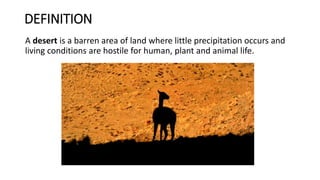
A desert is a barren area of land where little precipitation occurs and
living conditions are hostile for human, plant and animal life.
DENUDATION
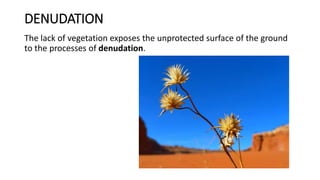
The lack of vegetation exposes the unprotected surface of the ground
to the processes of denudation.
ARID AND SEMI-ARID REGIONS
About one third of the land surface of the world is arid or semi-arid.
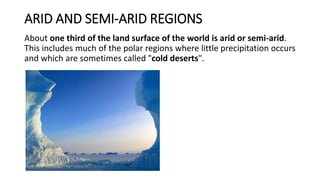
This includes much of the polar regions where little precipitation occurs
and which are sometimes called "cold deserts".
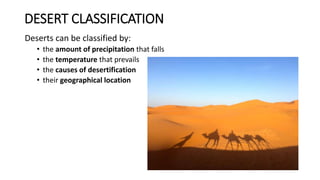
DESERT CLASSIFICATION
Deserts can be classified by:
• the amount of precipitation that falls
• the temperature that prevails
• the causes of desertification
• their geographical location
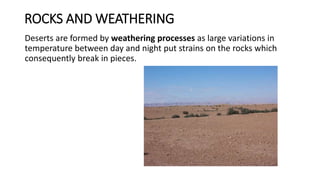
ROCKS AND WEATHERING
Deserts are formed by weathering processes as large variations in
temperature between day and night put strains on the rocks which
consequently break in pieces.
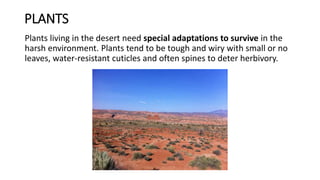
PLANTS
Plants living in the desert need special adaptations to survive in the
harsh environment. Plants tend to be tough and wiry with small or no
leaves, water-resistant cuticles and often spines to deter herbivory.
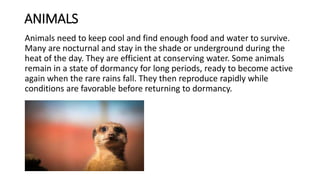
ANIMALS
Animals need to keep cool and find enough food and water to survive.
Many are nocturnal and stay in the shade or underground during the
heat of the day. They are efficient at conserving water. Some animals
remain in a state of dormancy for long periods, ready to become active
again when the rare rains fall. They then reproduce rapidly while
conditions are favorable before returning to dormancy.
HUMAN IMPACT
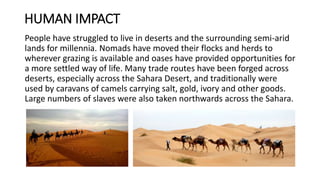
People have struggled to live in deserts and the surrounding semi-arid
lands for millennia. Nomads have moved their flocks and herds to
wherever grazing is available and oases have provided opportunities for
a more settled way of life. Many trade routes have been forged across
deserts, especially across the Sahara Desert, and traditionally were
used by caravans of camels carrying salt, gold, ivory and other goods.
Large numbers of slaves were also taken northwards across the Sahara.
ETYMOLOGY (NAME ORIGIN)
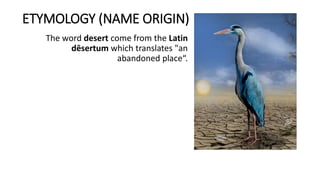
The word desert come from the Latin
dēsertum which translates "an
abandoned place“.
10 LARGEST DESERTS IN THE WORLD
1. Antarctic Desert (Antarctica) 14,200,000 km²
2. Arctic Desert (Arctic) 13,900,000 km²
3. Sahara Desert (Africa) 9,100,000 km²
4. Arabian Desert (Middle East) 2,600,000 km²
5. Gobi Desert (Asia) 1,300,000 km²
6. Patagonian Desert (South America) 670,000 km²
7. Great Victoria Desert (Australia) 647,000 km²
8. Kalahari Desert (Africa) 570,000 km²
9. Great Basin Desert (North America) 490,000 km²
10. Syrian Desert (Middle East) 490,000 km²
ATACAMA DESERT
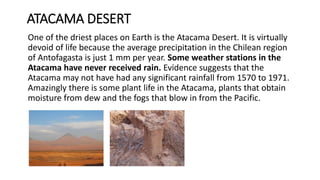
One of the driest places on Earth is the Atacama Desert. It is virtually
devoid of life because the average precipitation in the Chilean region
of Antofagasta is just 1 mm per year. Some weather stations in the
Atacama have never received rain. Evidence suggests that the
Atacama may not have had any significant rainfall from 1570 to 1971.
Amazingly there is some plant life in the Atacama, plants that obtain
moisture from dew and the fogs that blow in from the Pacific.

GEOGRAPHY YEAR 9 - DESERTS

  • 2.
    DEFINITION A desert isa barren area of land where little precipitation occurs and living conditions are hostile for human, plant and animal life.
  • 3.
    DENUDATION The lack ofvegetation exposes the unprotected surface of the ground to the processes of denudation.
  • 4.
    ARID AND SEMI-ARIDREGIONS About one third of the land surface of the world is arid or semi-arid. This includes much of the polar regions where little precipitation occurs and which are sometimes called "cold deserts".
  • 5.
    DESERT CLASSIFICATION Deserts canbe classified by: • the amount of precipitation that falls • the temperature that prevails • the causes of desertification • their geographical location
  • 6.
    ROCKS AND WEATHERING Desertsare formed by weathering processes as large variations in temperature between day and night put strains on the rocks which consequently break in pieces.
  • 7.
    PLANTS Plants living inthe desert need special adaptations to survive in the harsh environment. Plants tend to be tough and wiry with small or no leaves, water-resistant cuticles and often spines to deter herbivory.
  • 8.
    ANIMALS Animals need tokeep cool and find enough food and water to survive. Many are nocturnal and stay in the shade or underground during the heat of the day. They are efficient at conserving water. Some animals remain in a state of dormancy for long periods, ready to become active again when the rare rains fall. They then reproduce rapidly while conditions are favorable before returning to dormancy.
  • 9.
    HUMAN IMPACT People havestruggled to live in deserts and the surrounding semi-arid lands for millennia. Nomads have moved their flocks and herds to wherever grazing is available and oases have provided opportunities for a more settled way of life. Many trade routes have been forged across deserts, especially across the Sahara Desert, and traditionally were used by caravans of camels carrying salt, gold, ivory and other goods. Large numbers of slaves were also taken northwards across the Sahara.
  • 10.
    ETYMOLOGY (NAME ORIGIN) Theword desert come from the Latin dēsertum which translates "an abandoned place“.
  • 11.
    10 LARGEST DESERTSIN THE WORLD 1. Antarctic Desert (Antarctica) 14,200,000 km² 2. Arctic Desert (Arctic) 13,900,000 km² 3. Sahara Desert (Africa) 9,100,000 km² 4. Arabian Desert (Middle East) 2,600,000 km² 5. Gobi Desert (Asia) 1,300,000 km² 6. Patagonian Desert (South America) 670,000 km² 7. Great Victoria Desert (Australia) 647,000 km² 8. Kalahari Desert (Africa) 570,000 km² 9. Great Basin Desert (North America) 490,000 km² 10. Syrian Desert (Middle East) 490,000 km²
  • 12.
    ATACAMA DESERT One ofthe driest places on Earth is the Atacama Desert. It is virtually devoid of life because the average precipitation in the Chilean region of Antofagasta is just 1 mm per year. Some weather stations in the Atacama have never received rain. Evidence suggests that the Atacama may not have had any significant rainfall from 1570 to 1971. Amazingly there is some plant life in the Atacama, plants that obtain moisture from dew and the fogs that blow in from the Pacific.