Critical Chain Project Management  - Introduction
Agenda Refresher Project Network  Critical Path  Earned Value Traditional Project Estimation Critical Chain Project Mgmt. Differences from Critical Path CCPM Principles Task & Project Buffers EVM and Buffer Management CCPM Behaviors CCPM Focus
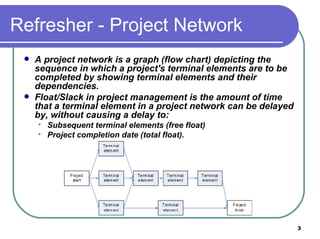
Refresher - Project Network  A project network is a graph (flow chart) depicting the sequence in which a project's terminal elements are to be completed by showing terminal elements and their dependencies.  Float/Slack in project management is the amount of time that a terminal element in a project network can be delayed by, without causing a delay to: Subsequent terminal elements (free float)  Project completion date (total float).
Refresher - Critical Path  A Critical path is the  sequence  of project network terminal elements  with the longest overall duration , determining the shortest time to complete the project. The duration of the critical path determines the duration of the entire project. Any delay of a terminal element on the critical path directly impacts the planned project completion date (i.e.  there is no slack on the critical path ). A project can have several, parallel critical paths. An additional parallel path through the network with the total durations just shorter than the critical path is called a sub-critical path. The critical path method was invented by the DuPont corporation and originally considered only logical dependencies among terminal elements
Refresher - Earned Value Earned value (EV) compares the work finished so far with the estimates made in the beginning of the project.  Gives a measure of how far the project is from completion.  Allows PM to extrapolate to arrive at Estimate at Completion Earned Value is measured in terms of  budgeted cost of work scheduled (BCWS) or planned value: for every period the budgets of the tasks that were planned to be finished in this time unit  budgeted cost of work produced (BCWP) or earned value: for every period the budgets of the tasks that actually finished in this time unit  actual cost of work produced (ACWP) or effort spent: for every period the actual costs of the work  budget at completion (BAC): sum(BCWS), the total budget estimated to be spent to complete the project
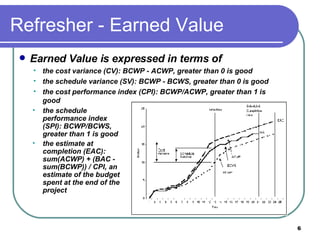
Refresher - Earned Value Earned Value is expressed in terms of  the cost variance (CV): BCWP - ACWP, greater than 0 is good  the schedule variance (SV): BCWP - BCWS, greater than 0 is good  the cost performance index (CPI): BCWP/ACWP, greater than 1 is good  the schedule performance index (SPI): BCWP/BCWS, greater than 1 is good the estimate at completion (EAC): sum(ACWP) + (BAC - sum(BCWP)) / CPI, an estimate of the budget spent at the end of the project
Traditional Project Estimation Assume Infinite Resources Protect the whole by protecting the completion date of each step Pad each step with a lot of safety time Create a Lifecycle network using these estimates to identify the critical path Most of the safety time is taken away by: Student Syndrome Multi-tasking Delays accumulate, advances do not Critical Path  is the constraint on the project
The Limitations “ Work expands to fill (and often exceed) the time allowed.” — Parkinson’s Law “ Whatever can go wrong, will.” — Murphy’s Law “ Many people will start to fully apply themselves to a task just in the wake of a deadline” No matter how long you give students to work on something, they will start the night before. End Result – When problems are encountered deep into the project, there is no buffer to dig into.
Critical Chain Project Mgmt. CCPM was developed by Dr. Eliyahu Goldratt Application of Theory of Constraints (TOC) to Project Management TOC Presented in his Business Novel The Goal CCPM Presented in his Business Novel Critical Chain TOC suggests that all real-world systems have at least one constraint; otherwise they would be capable of infinite throughput, which is clearly impossible.  TOC claims that a real-world system with more than three constraints is extremely unlikely.  Managing a complex system can be made simpler & effective, by providing managers with a few specific focus areas on which to focus -- maximizing performance in the areas of key constraints, or "elevating" the constraint
Critical Chain Project Mgmt. Systems are Analogous to Chains Weakest Link is the System’s Constraint A System’s Optimum Performance IS NOT the Sum of Local Optima A System Has Only One Constraint at a Time Constraints Can Never Really be Eliminated Can Move From One Part of the System to Another In project management, the critical chain is the sequence of both precedence- and resource-dependent terminal elements that prevents a project from being completed in a shorter time, given finite resources.  If resource availability is not a constraint, then a project's critical chain is identical to its critical path.
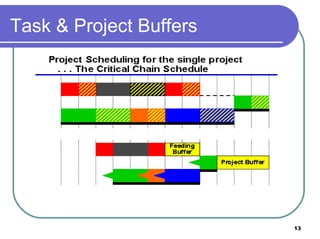
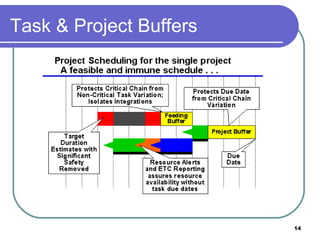
Differences from Critical Path The use of (often implicit) resource dependencies. Implicit means that they are not included in the project network but have to be identified by looking at the resource requirements.  Lack of search for an optimum solution. This means that a "good enough" solution is enough because:  As far as is known, there is no analytical method of finding an absolute optimum  The inherent uncertainty in estimates is much greater than the difference between the optimum and near-optimum ("good enough" solutions).  The identification and insertion of buffers:  project buffer  feeding buffers  resource buffers.
CCPM Principles Single Integrated Schedule Eliminate   Safeties  from Each Task Management Must Not Insist on Each Task Starting & Finishing “On Time” Start  Right Jobs at Right Time  Using Prioritized Task List Focus on  Meeting Milestone Dates , Not Task Dates  Counter Parkinson’s Law Conserve Available Float/Slack on Each Task, Reduce Time Available Counter Student Syndrome.  Claim Early Finishes Immediately Start Each Task As Early As Possible Predict Milestones Based on Buffer Penetration Focus on  Task Throughput , NOT on Task Costs
Task & Project Buffers
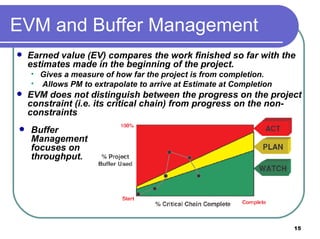
EVM and Buffer Management Earned value (EV) compares the work finished so far with the estimates made in the beginning of the project.  Gives a measure of how far the project is from completion.  Allows PM to extrapolate to arrive at Estimate at Completion EVM does not distinguish between the progress on the project constraint (i.e. its critical chain) from progress on the non-constraints   Buffer Management focuses on throughput.
CCPM Behaviors Base Duration & Cost Estimates on  Average/Bare Bones  Performance When Problems Occur,  Solve the Problem vice Starting New Task   Decrease  Frequency & Duration of Meetings Resolve Conflicts Immediately at the Jobsite Eliminate  Bad Multi-tasking Resources Focus on One Job at a Time, Work to Completion Request  Only  Resources Necessary to Accommodate  Priority Work Request  Only  Overtime Necessary to  Recover Buffer on Priority Work  Move Resources When Work is Done  to Next Priority Work  Quickly  Work  Right  Jobs instead of  Easy  Jobs Plan for  New Work & Scope Changes vice  Complaining About it
Project Focus Identify the System Constraint Exploit the Constraint Subordinate Everything Else Elevate the Constraint Go back to Step 1 Senior Management Buy in Promote early finishes Focus on usage of Project Buffer Avoid evaluating of team w.r.t. task deadlines CCPM Focus
Summary and Conclusion Critical Chain Project Management can dramatically... Improve project delivery date reliability Shorten overall project duration Provide “early warning” of threats to project delivery Enable earlier, less drastic responses Reduce Costs Reduce Overtime Reduce Rework
Bibliography / Reference Wikipedia http://www.wikipedia.org   Critical Chain  Dr. Eliyahu Goldratt  Buffering Against Risk -- Risk Management and Critical Chain.  http://www.focusedperformance.com/articles/ccrisk.html   Getting Out From Between Parkinson's Rock and Murphy's Hard Place – Francis S. Patrick http://www.focusedperformance.com/articles/ccpm.html Managing an ERP project using critical chain M van Loggerenberg. EDS Enterprise Solutions
Thank You

Critical Chain Project Management

  • 1.
    Critical Chain ProjectManagement - Introduction
  • 2.
    Agenda Refresher ProjectNetwork Critical Path Earned Value Traditional Project Estimation Critical Chain Project Mgmt. Differences from Critical Path CCPM Principles Task & Project Buffers EVM and Buffer Management CCPM Behaviors CCPM Focus
  • 3.
    Refresher - ProjectNetwork A project network is a graph (flow chart) depicting the sequence in which a project's terminal elements are to be completed by showing terminal elements and their dependencies. Float/Slack in project management is the amount of time that a terminal element in a project network can be delayed by, without causing a delay to: Subsequent terminal elements (free float) Project completion date (total float).
  • 4.
    Refresher - CriticalPath A Critical path is the sequence of project network terminal elements with the longest overall duration , determining the shortest time to complete the project. The duration of the critical path determines the duration of the entire project. Any delay of a terminal element on the critical path directly impacts the planned project completion date (i.e. there is no slack on the critical path ). A project can have several, parallel critical paths. An additional parallel path through the network with the total durations just shorter than the critical path is called a sub-critical path. The critical path method was invented by the DuPont corporation and originally considered only logical dependencies among terminal elements
  • 5.
    Refresher - EarnedValue Earned value (EV) compares the work finished so far with the estimates made in the beginning of the project. Gives a measure of how far the project is from completion. Allows PM to extrapolate to arrive at Estimate at Completion Earned Value is measured in terms of budgeted cost of work scheduled (BCWS) or planned value: for every period the budgets of the tasks that were planned to be finished in this time unit budgeted cost of work produced (BCWP) or earned value: for every period the budgets of the tasks that actually finished in this time unit actual cost of work produced (ACWP) or effort spent: for every period the actual costs of the work budget at completion (BAC): sum(BCWS), the total budget estimated to be spent to complete the project
  • 6.
    Refresher - EarnedValue Earned Value is expressed in terms of the cost variance (CV): BCWP - ACWP, greater than 0 is good the schedule variance (SV): BCWP - BCWS, greater than 0 is good the cost performance index (CPI): BCWP/ACWP, greater than 1 is good the schedule performance index (SPI): BCWP/BCWS, greater than 1 is good the estimate at completion (EAC): sum(ACWP) + (BAC - sum(BCWP)) / CPI, an estimate of the budget spent at the end of the project
  • 7.
    Traditional Project EstimationAssume Infinite Resources Protect the whole by protecting the completion date of each step Pad each step with a lot of safety time Create a Lifecycle network using these estimates to identify the critical path Most of the safety time is taken away by: Student Syndrome Multi-tasking Delays accumulate, advances do not Critical Path is the constraint on the project
  • 8.
    The Limitations “Work expands to fill (and often exceed) the time allowed.” — Parkinson’s Law “ Whatever can go wrong, will.” — Murphy’s Law “ Many people will start to fully apply themselves to a task just in the wake of a deadline” No matter how long you give students to work on something, they will start the night before. End Result – When problems are encountered deep into the project, there is no buffer to dig into.
  • 9.
    Critical Chain ProjectMgmt. CCPM was developed by Dr. Eliyahu Goldratt Application of Theory of Constraints (TOC) to Project Management TOC Presented in his Business Novel The Goal CCPM Presented in his Business Novel Critical Chain TOC suggests that all real-world systems have at least one constraint; otherwise they would be capable of infinite throughput, which is clearly impossible. TOC claims that a real-world system with more than three constraints is extremely unlikely. Managing a complex system can be made simpler & effective, by providing managers with a few specific focus areas on which to focus -- maximizing performance in the areas of key constraints, or "elevating" the constraint
  • 10.
    Critical Chain ProjectMgmt. Systems are Analogous to Chains Weakest Link is the System’s Constraint A System’s Optimum Performance IS NOT the Sum of Local Optima A System Has Only One Constraint at a Time Constraints Can Never Really be Eliminated Can Move From One Part of the System to Another In project management, the critical chain is the sequence of both precedence- and resource-dependent terminal elements that prevents a project from being completed in a shorter time, given finite resources. If resource availability is not a constraint, then a project's critical chain is identical to its critical path.
  • 11.
    Differences from CriticalPath The use of (often implicit) resource dependencies. Implicit means that they are not included in the project network but have to be identified by looking at the resource requirements. Lack of search for an optimum solution. This means that a "good enough" solution is enough because: As far as is known, there is no analytical method of finding an absolute optimum The inherent uncertainty in estimates is much greater than the difference between the optimum and near-optimum ("good enough" solutions). The identification and insertion of buffers: project buffer feeding buffers resource buffers.
  • 12.
    CCPM Principles SingleIntegrated Schedule Eliminate Safeties from Each Task Management Must Not Insist on Each Task Starting & Finishing “On Time” Start Right Jobs at Right Time Using Prioritized Task List Focus on Meeting Milestone Dates , Not Task Dates Counter Parkinson’s Law Conserve Available Float/Slack on Each Task, Reduce Time Available Counter Student Syndrome. Claim Early Finishes Immediately Start Each Task As Early As Possible Predict Milestones Based on Buffer Penetration Focus on Task Throughput , NOT on Task Costs
  • 13.
  • 14.
  • 15.
    EVM and BufferManagement Earned value (EV) compares the work finished so far with the estimates made in the beginning of the project. Gives a measure of how far the project is from completion. Allows PM to extrapolate to arrive at Estimate at Completion EVM does not distinguish between the progress on the project constraint (i.e. its critical chain) from progress on the non-constraints Buffer Management focuses on throughput.
  • 16.
    CCPM Behaviors BaseDuration & Cost Estimates on Average/Bare Bones Performance When Problems Occur, Solve the Problem vice Starting New Task Decrease Frequency & Duration of Meetings Resolve Conflicts Immediately at the Jobsite Eliminate Bad Multi-tasking Resources Focus on One Job at a Time, Work to Completion Request Only Resources Necessary to Accommodate Priority Work Request Only Overtime Necessary to Recover Buffer on Priority Work Move Resources When Work is Done to Next Priority Work Quickly Work Right Jobs instead of Easy Jobs Plan for New Work & Scope Changes vice Complaining About it
  • 17.
    Project Focus Identifythe System Constraint Exploit the Constraint Subordinate Everything Else Elevate the Constraint Go back to Step 1 Senior Management Buy in Promote early finishes Focus on usage of Project Buffer Avoid evaluating of team w.r.t. task deadlines CCPM Focus
  • 18.
    Summary and ConclusionCritical Chain Project Management can dramatically... Improve project delivery date reliability Shorten overall project duration Provide “early warning” of threats to project delivery Enable earlier, less drastic responses Reduce Costs Reduce Overtime Reduce Rework
  • 19.
    Bibliography / ReferenceWikipedia http://www.wikipedia.org Critical Chain Dr. Eliyahu Goldratt Buffering Against Risk -- Risk Management and Critical Chain. http://www.focusedperformance.com/articles/ccrisk.html Getting Out From Between Parkinson's Rock and Murphy's Hard Place – Francis S. Patrick http://www.focusedperformance.com/articles/ccpm.html Managing an ERP project using critical chain M van Loggerenberg. EDS Enterprise Solutions
  • 20.