PROJECT MANAGEMENT
BEST PRACTICES
Brock Boddie
GET THE FULL EXPERIENCE:
LEARN WHAT YOU WANT,
WHEN YOU WANT
Unlimited access to all upcoming live streams
On-demand streaming classes taught by top
practitioners
A growing video library, updated weekly
Get access for only $25 USD/month.
No risk—you can cancel at any time!

START 14-DAY FREE TRIAL
AGENDA

‣ Who I am
‣ Basic project management
‣ Tactics
‣ Project strategies
‣ Personal strategies

2
PROJECT MANAGEMENT BEST PRACTICES

Who I am.

3
INTRODUCTION

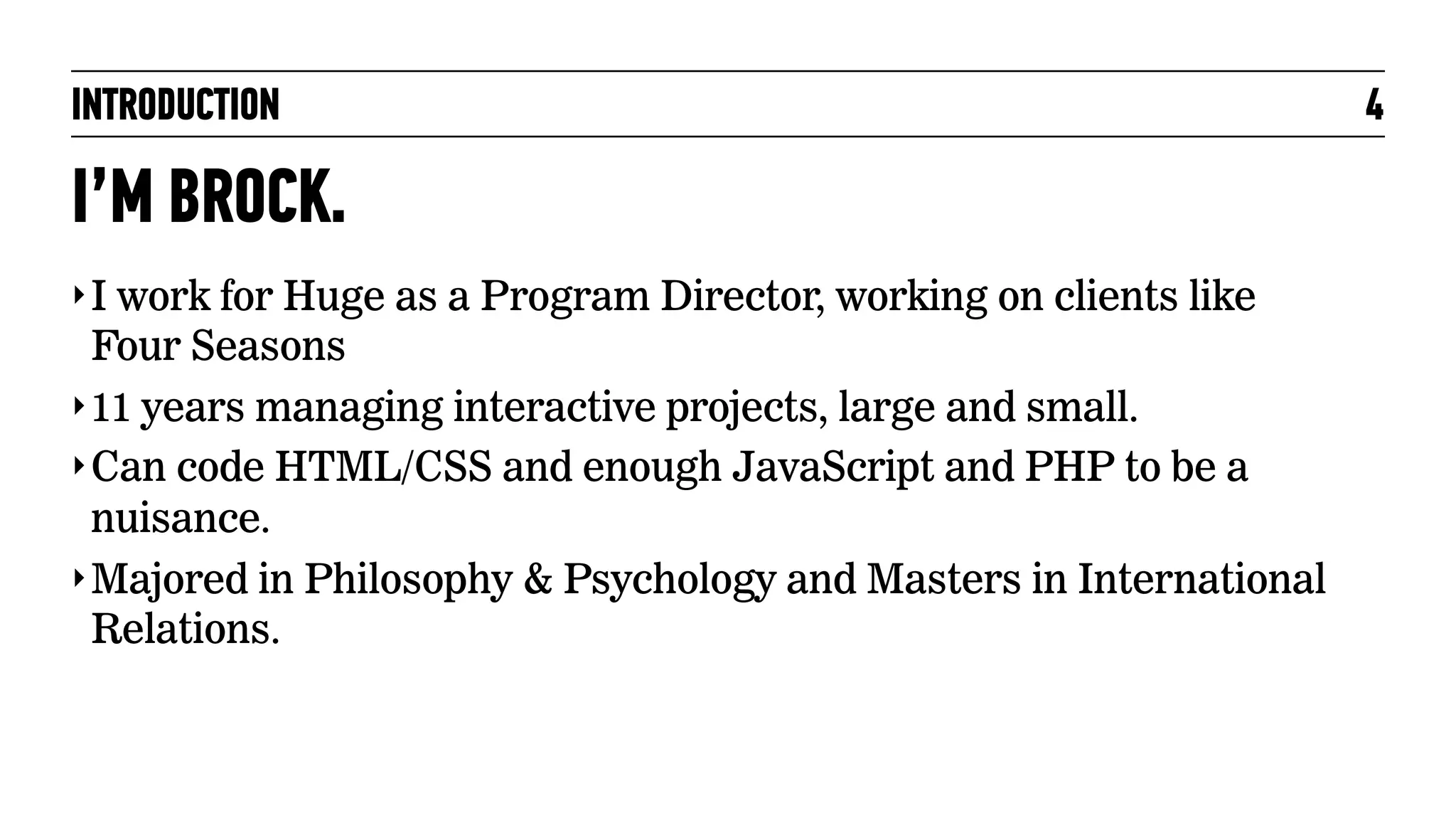
I’M BROCK.
‣ I work for Huge as a Program Director, working on clients like

Four Seasons
‣ 11 years managing interactive projects, large and small.
‣ Can code HTML/CSS and enough JavaScript and PHP to be a
nuisance.
‣ Majored in Philosophy & Psychology and Masters in International
Relations.

4
PROJECT MANAGEMENT BEST PRACTICES

Basic PM stuff.

5
PROJECT MANAGEMENT BEST PRACTICES

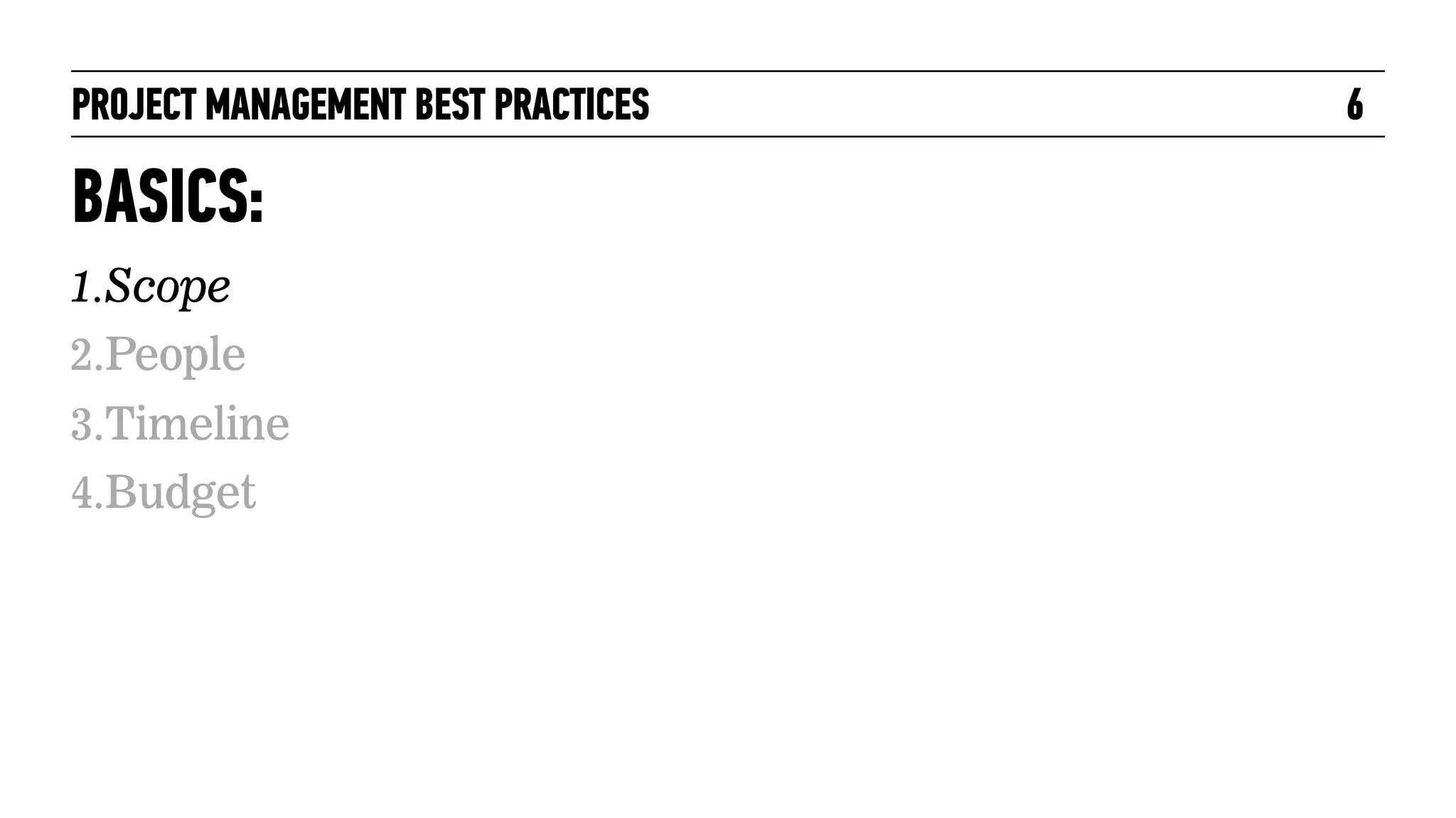
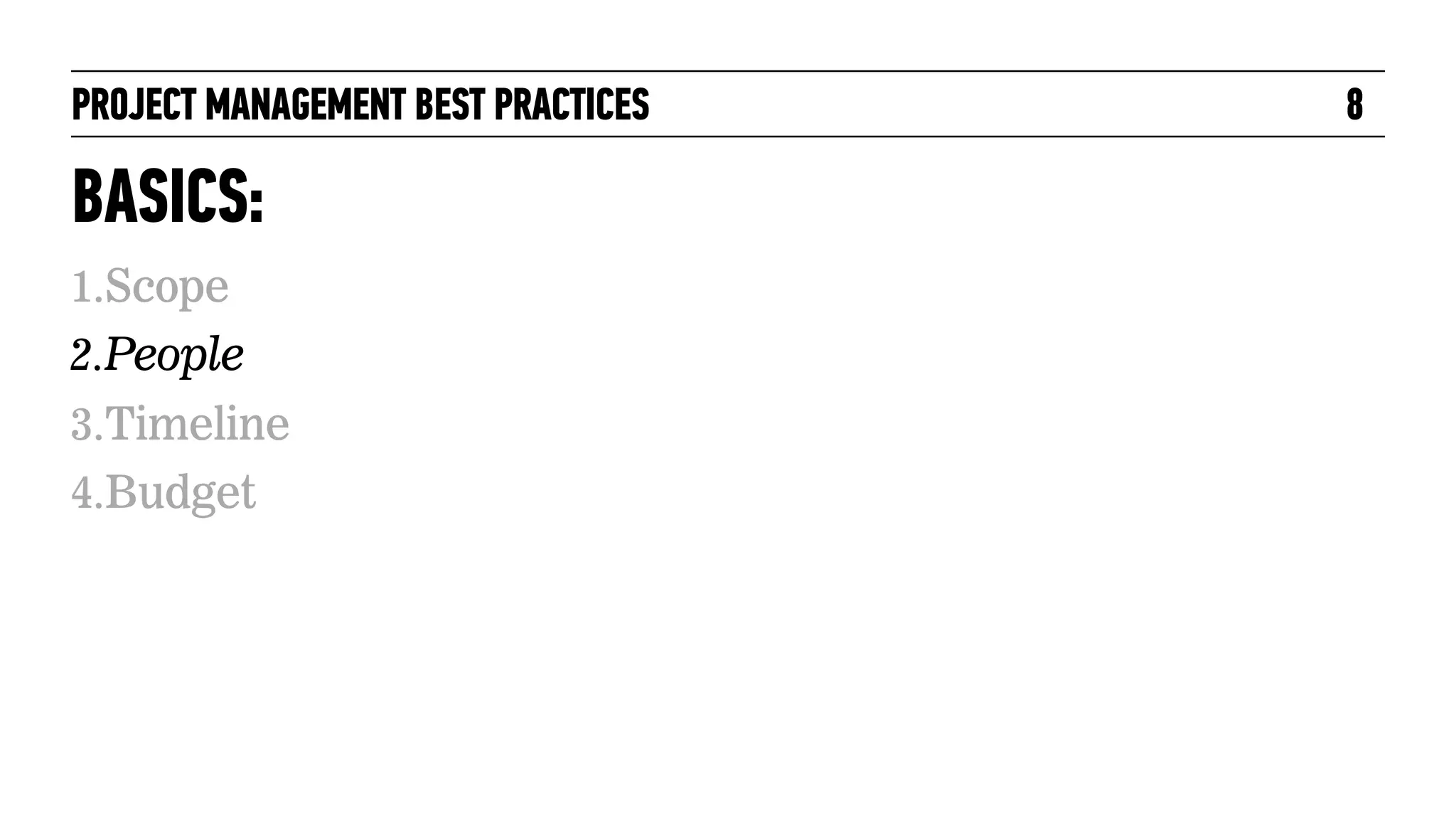
BASICS:
1.Scope
2.People
3.Timeline
4.Budget

6
PROJECT MANAGEMENT BEST PRACTICES

7

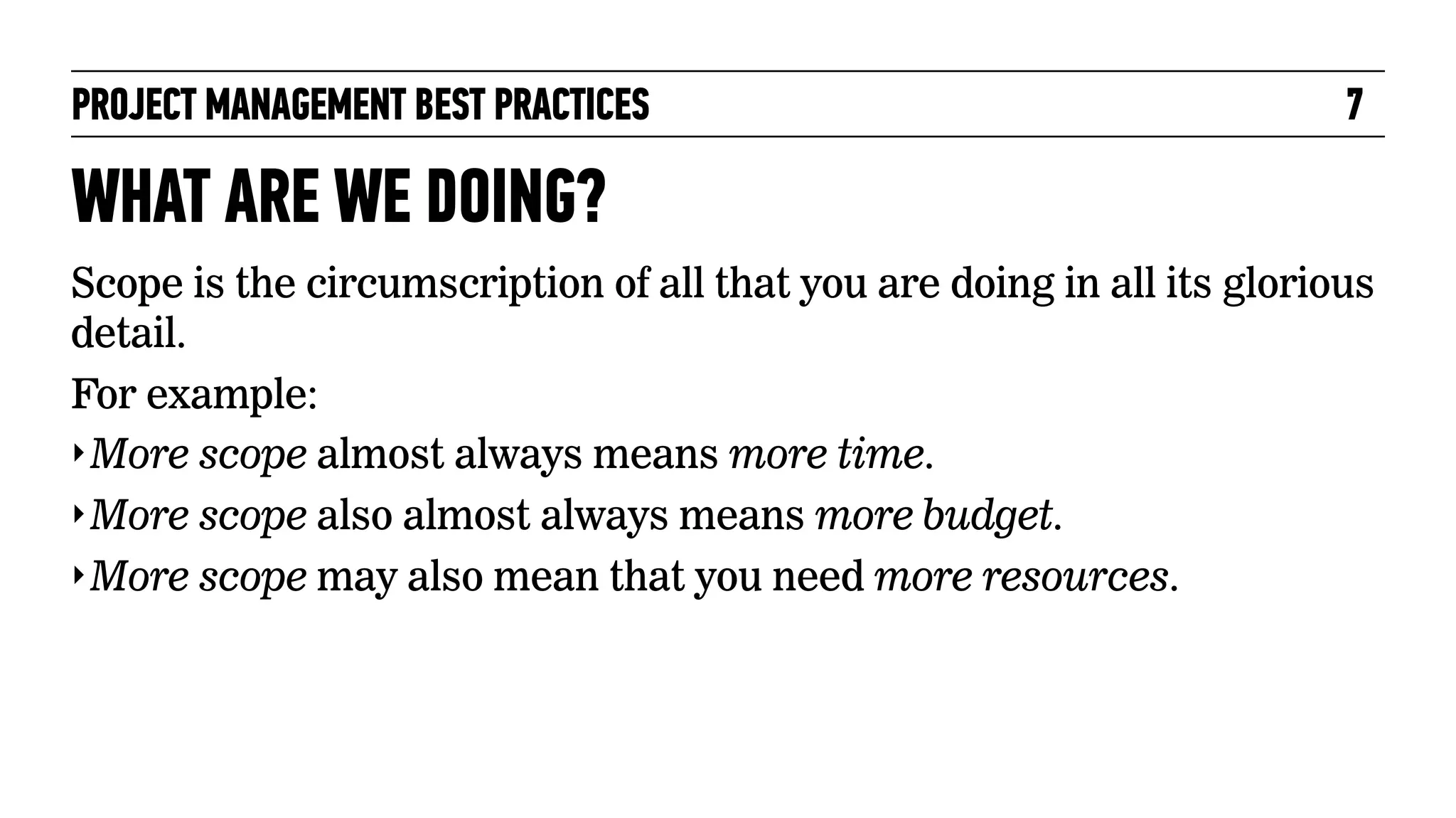
WHAT ARE WE DOING?
Scope is the circumscription of all that you are doing in all its glorious
detail.
For example:
‣ More scope almost always means more time.
‣ More scope also almost always means more budget.
‣ More scope may also mean that you need more resources.
PROJECT MANAGEMENT BEST PRACTICES

BASICS:
1.Scope
2.People
3.Timeline
4.Budget

8
PROJECT MANAGEMENT BEST PRACTICES

IF ONLY THIS PERSON WERE ON MY TEAM…
You’ve got to have the right people in place to get the job done.
Forcing someone to do something they don’t do isn’t a recipe for
success and can impact your project negatively.
For example:
‣ More people almost always means more budget.
‣ More people can mean that you can handle more scope.
‣ More people can mean less time – but…

9
PROJECT MANAGEMENT BEST PRACTICES

One woman can have a baby in
nine months, but nine women
cannot have a baby in one month.

10
PROJECT MANAGEMENT BEST PRACTICES

Some things just take time.

11
PROJECT MANAGEMENT BEST PRACTICES

BASICS:
1.Scope
2.People
3.Timeline
4.Budget

12
PROJECT MANAGEMENT BEST PRACTICES

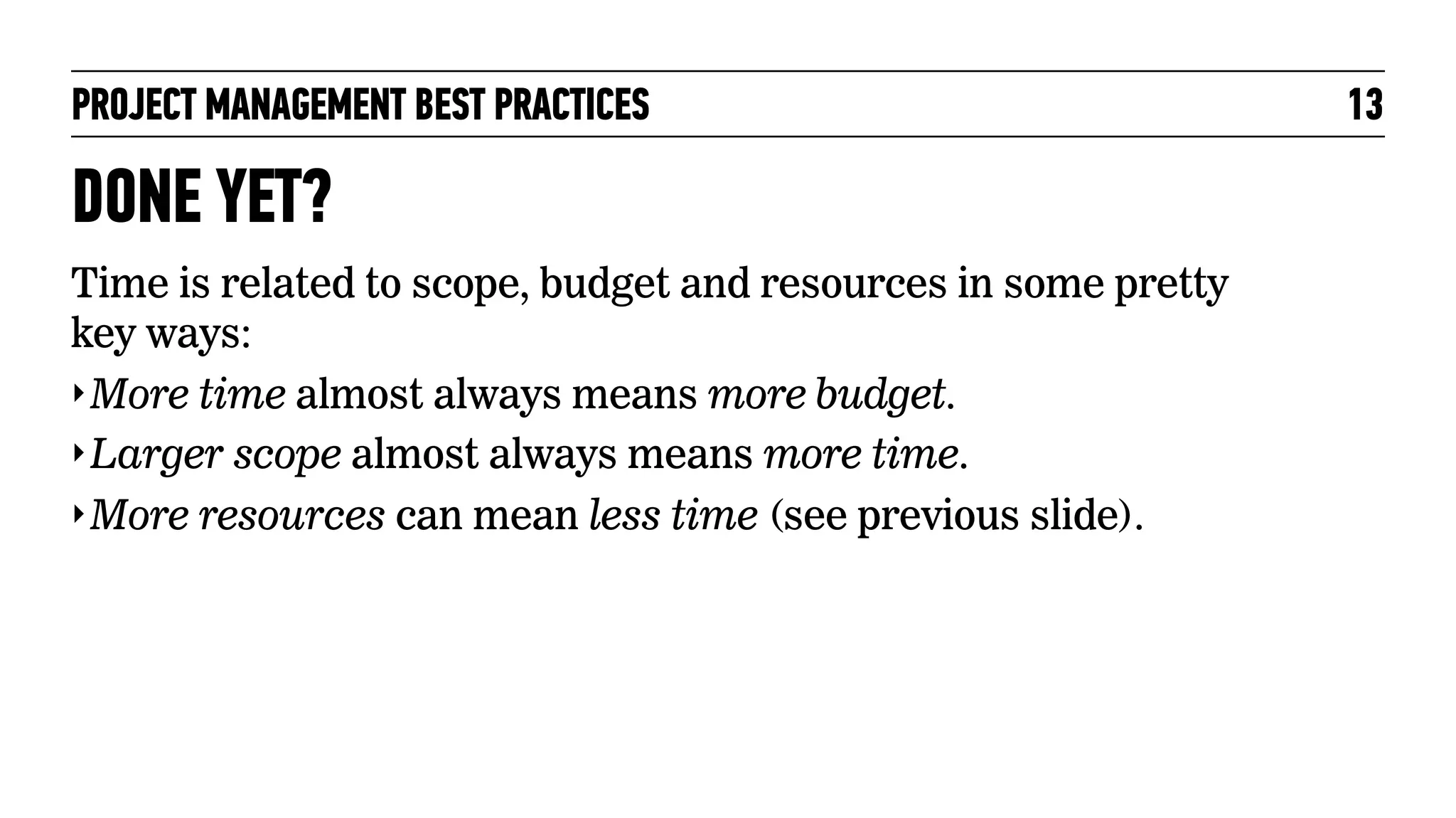
DONE YET?
Time is related to scope, budget and resources in some pretty
key ways:
‣ More time almost always means more budget.
‣ Larger scope almost always means more time.
‣ More resources can mean less time (see previous slide).

13
PROJECT MANAGEMENT BEST PRACTICES

BASICS:
1.Scope
2.People
3.Timeline
4.Budget

14
PROJECT MANAGEMENT BEST PRACTICES

15

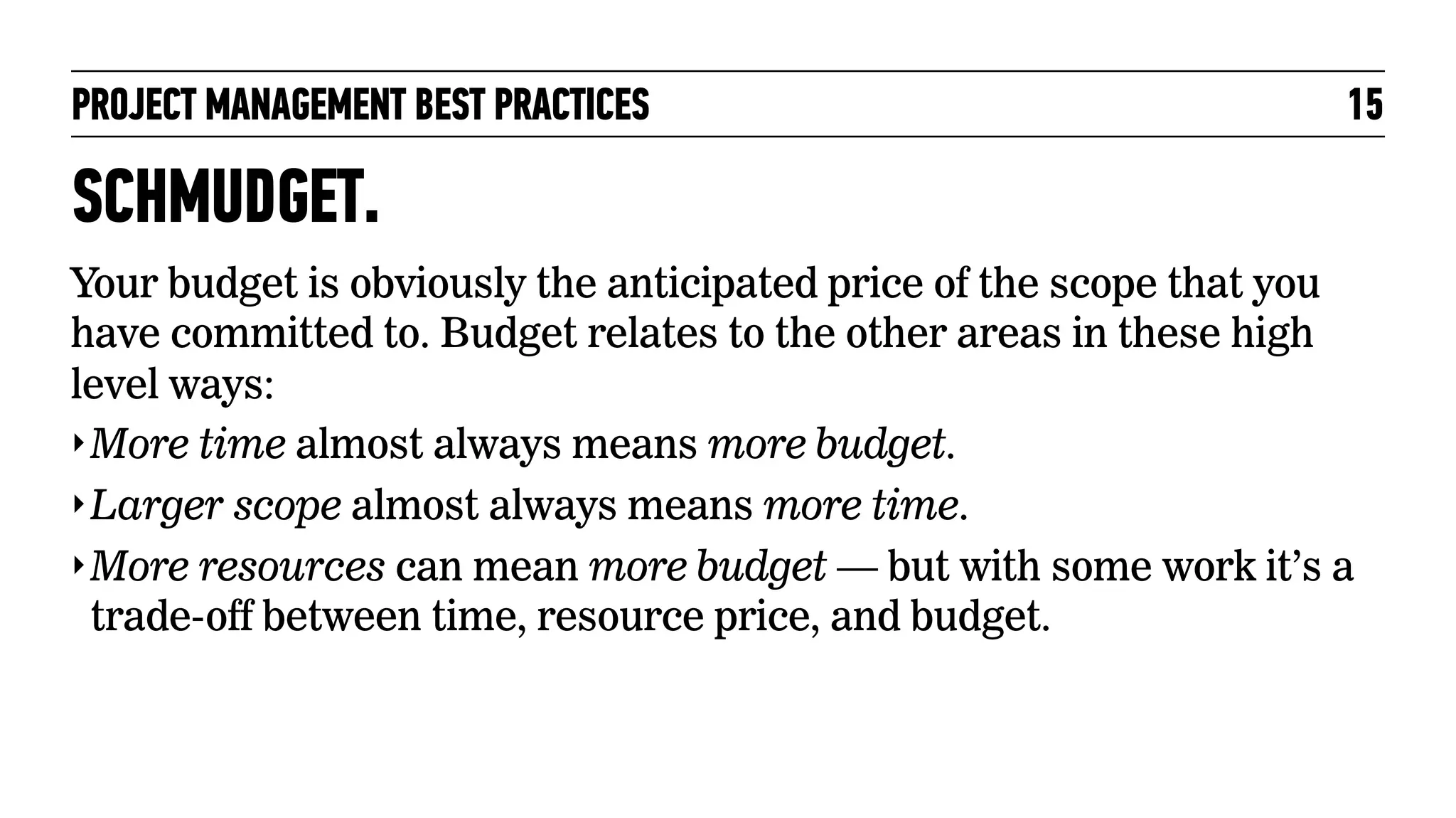
SCHMUDGET.
Your budget is obviously the anticipated price of the scope that you
have committed to. Budget relates to the other areas in these high
level ways:
‣ More time almost always means more budget.
‣ Larger scope almost always means more time.
‣ More resources can mean more budget — but with some work it’s a
trade-off between time, resource price, and budget.
PROJECT MANAGEMENT BEST PRACTICES

Tactics.

16
PROJECT MANAGEMENT BEST PRACTICES

Starting a project.

17
PROJECT MANAGEMENT BEST PRACTICES

18

KNOW YOUR BUSINESS’ STRATEGY.
If they’ll tell you, that is. How does your business view this SOW/account:
‣ Are we trying to develop a long term relationship?
‣ How much margin are we willing to give up to make the client
happy?
‣ Do we just want to finish out this project?
PROJECT MANAGEMENT BEST PRACTICES

KNOW YOUR SCOPE.
Know what you’re on the hook for and what you’re not:
‣ What you said you’d do.
‣ What they agreed they’d do.
‣ Your documented assumptions.
‣ What its weaknesses are that work for you.
‣ What its weaknesses are that work against you.

19
PROJECT MANAGEMENT BEST PRACTICES

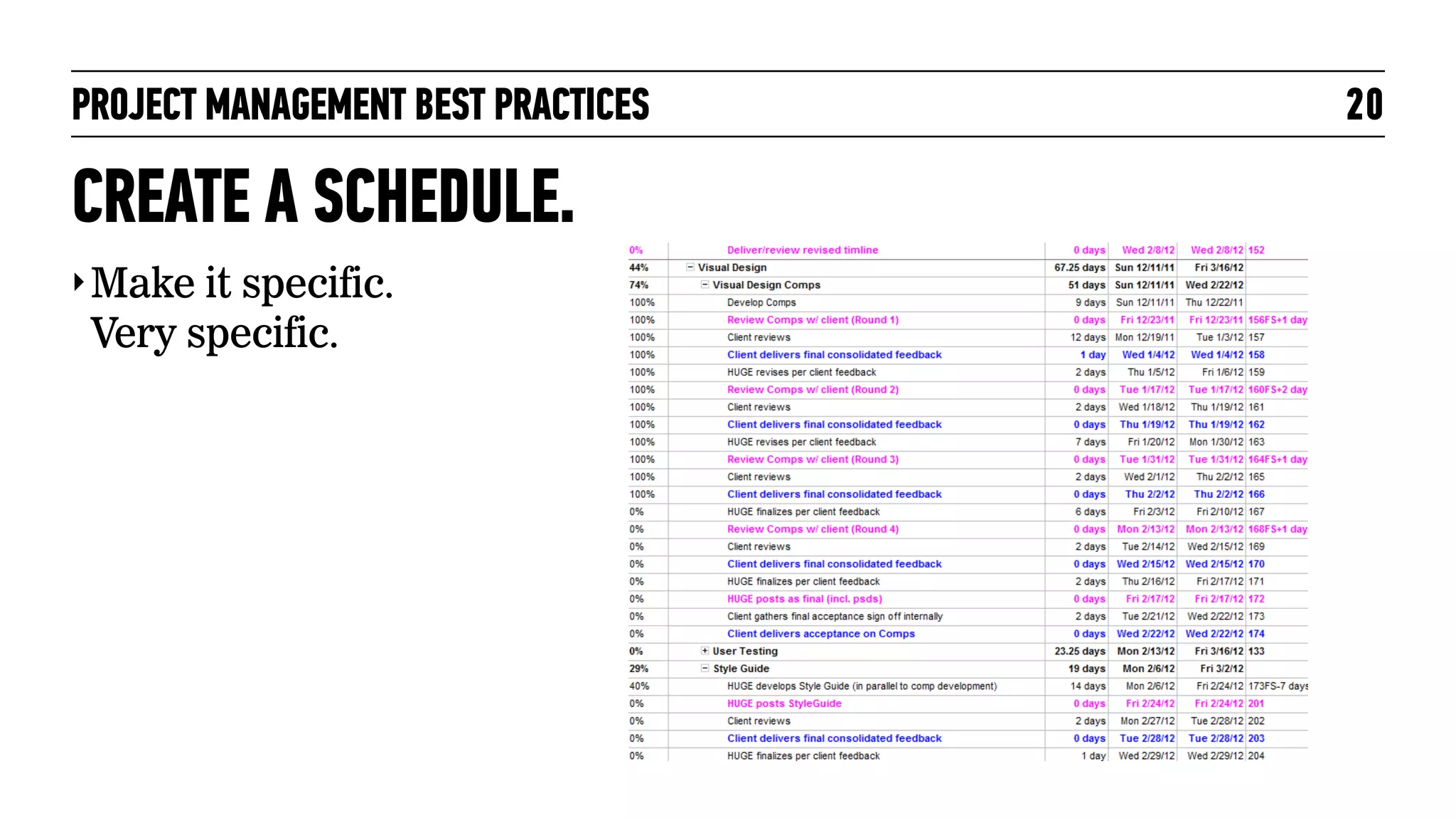
CREATE A SCHEDULE.
‣ Make it specific.

Very specific.

20
PROJECT MANAGEMENT BEST PRACTICES

21

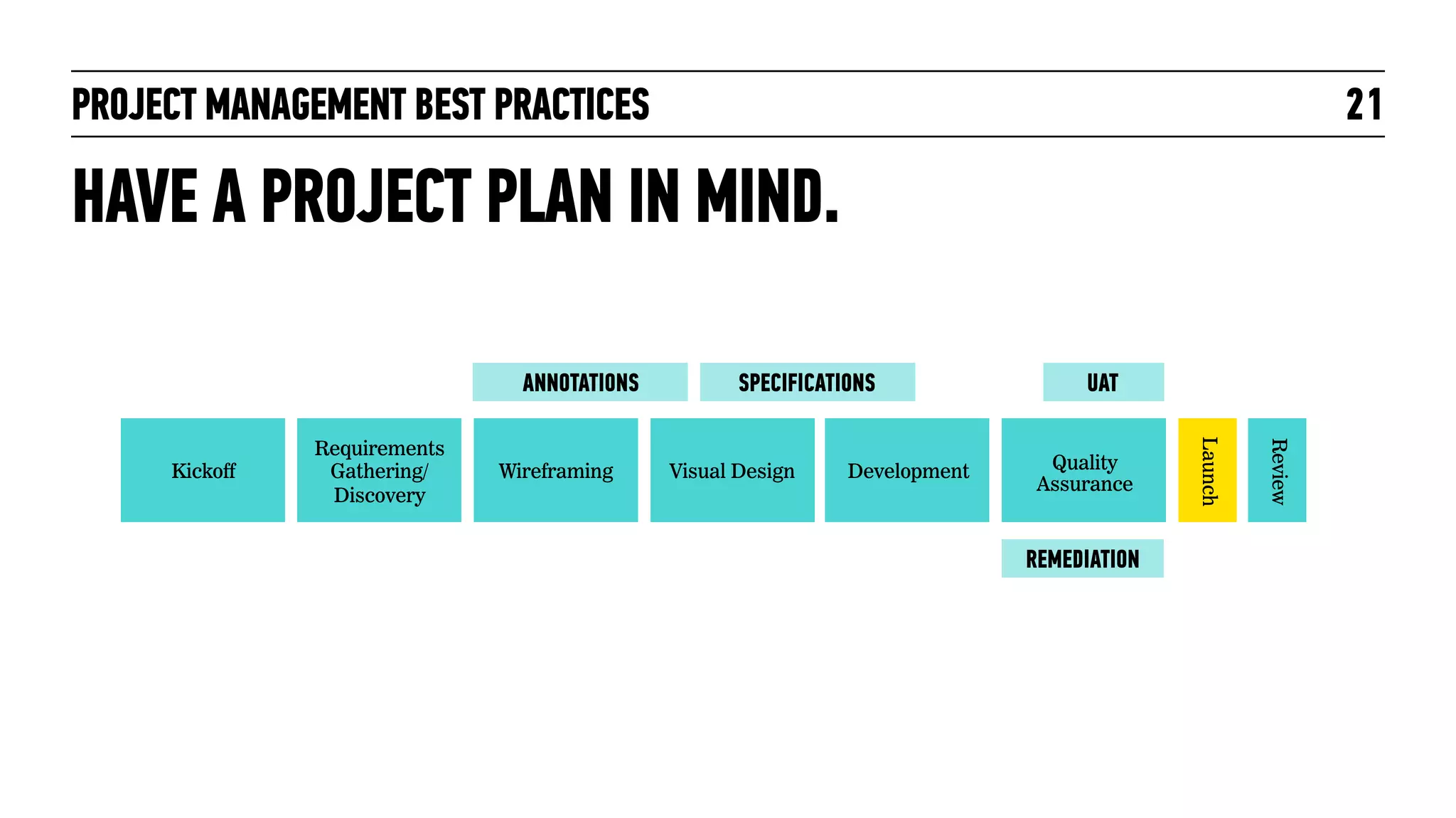
HAVE A PROJECT PLAN IN MIND.
ANNOTATIONS

Visual Design

Development

Quality
Assurance

REMEDIATION

Review

Wireframing

UAT
Launch

Kickoff

Requirements
Gathering/
Discovery

SPECIFICATIONS
PROJECT MANAGEMENT BEST PRACTICES

Operating a project.

22
PROJECT MANAGEMENT BEST PRACTICES

23

ADAPT TO YOUR CLIENT’S PROCESS.
They probably have a way of doing things and they’re not looking for
you to change it — yet.
‣ Research: Figure out what they do and why they do it.
‣ Reduce friction: Adapt your process to accommodate if you can.
‣ Evolve: Keep them aware of inefficiencies that you believe they could
change easily.
‣ Don’t tell them about everything they do wrong. It burns good will
you’ll need when something is really messed up.
PROJECT MANAGEMENT BEST PRACTICES

MAINTAIN YOUR SCHEDULE.
You’re not organized enough to keep track of everything. Use your
schedule to:
‣ Track expected resource utilization.
‣ Measure deviations from the original scope.
‣ Focus on tasks that are relevant today, this week, or this month.
‣ Illustrating the down-stream impacts of deviations from the plan.

24
PROJECT MANAGEMENT BEST PRACTICES

25

COUNT THE HOURS.
An essential task for projects with development; you’ve only budgeted
so many hours or days to complete the scope. Keep track of how
they’ll be consumed.
‣ How many hours of development and QA resources do you have?
‣ How many hours will each of your features take to build and test?
‣ How accurate are your estimates?
PROJECT MANAGEMENT BEST PRACTICES

TRACK YOUR BUDGET.
Calculate the following at least once a week:
‣ Actual hours, cost and billed hours to-date.
‣ Forecasted hours, cost and billed to complete.
‣ Actual+Forecasted hours, cost and billed.

26
PROJECT MANAGEMENT BEST PRACTICES

SEND WEEKLY STATUS REPORTS.
It holds everyone accountable. Include:
‣ What you accomplished this week.
‣ What you expect to accomplish next week.
‣ What you missed this week.
‣ What’s at risk.
‣ How you intend to mitigate the risk.
If you’re doing things correctly, your client and team will never see
anything surprising in this report.

27
PROJECT MANAGEMENT BEST PRACTICES

28

KEEP THE PROJECT ORGANIZED.
Imagine a year from now, someone wanted you to find that file that
you sent them on that day that was about that thing — how would you
find it?
‣ File naming a key. Example:
DDMMYY_Deliverable_FileName_Version
‣ Folder Organization. Design it for someone who doesn’t know your
project.
‣ Insist that team members abide the conventions.
PROJECT MANAGEMENT BEST PRACTICES

Managing your team.

29
PROJECT MANAGEMENT BEST PRACTICES

30

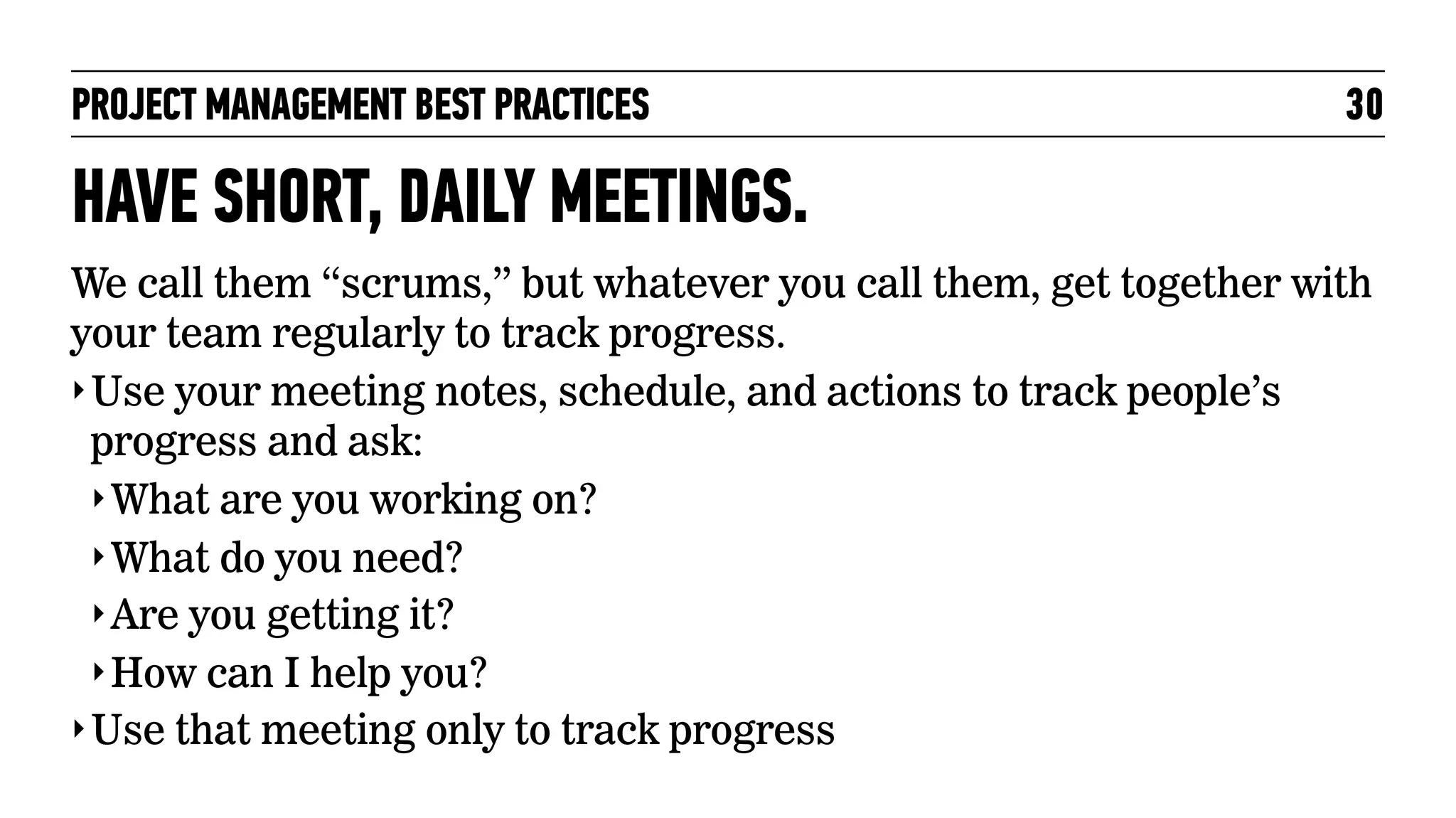
HAVE SHORT, DAILY MEETINGS.
We call them “scrums,” but whatever you call them, get together with
your team regularly to track progress.
‣ Use your meeting notes, schedule, and actions to track people’s
progress and ask:
‣ What are you working on?
‣ What do you need?
‣ Are you getting it?
‣ How can I help you?
‣ Use that meeting only to track progress
PROJECT MANAGEMENT BEST PRACTICES

31

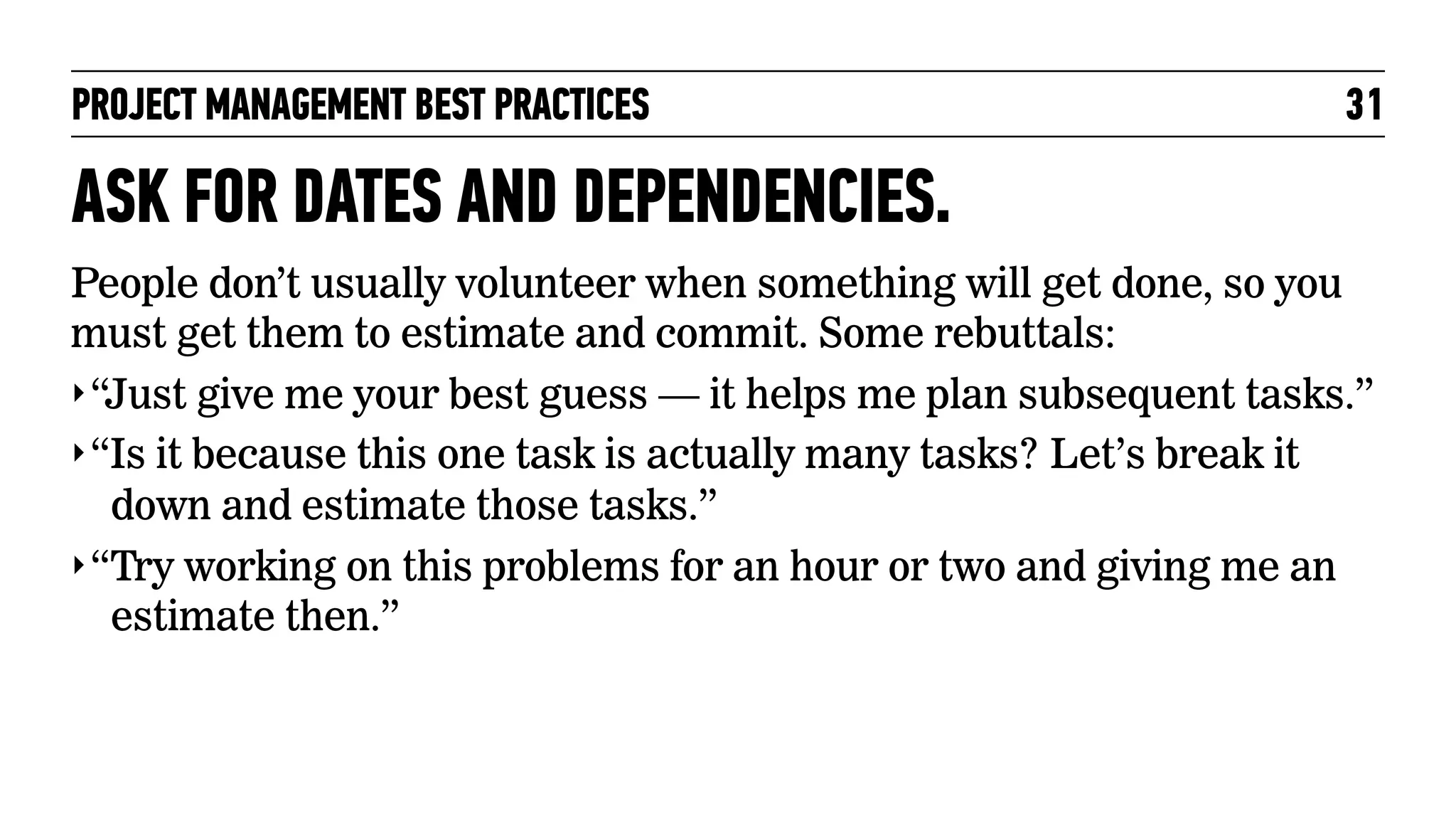
ASK FOR DATES AND DEPENDENCIES.
People don’t usually volunteer when something will get done, so you
must get them to estimate and commit. Some rebuttals:
‣ “Just give me your best guess — it helps me plan subsequent tasks.”
‣ “Is it because this one task is actually many tasks? Let’s break it
down and estimate those tasks.”
‣ “Try working on this problems for an hour or two and giving me an
estimate then.”
PROJECT MANAGEMENT BEST PRACTICES

32

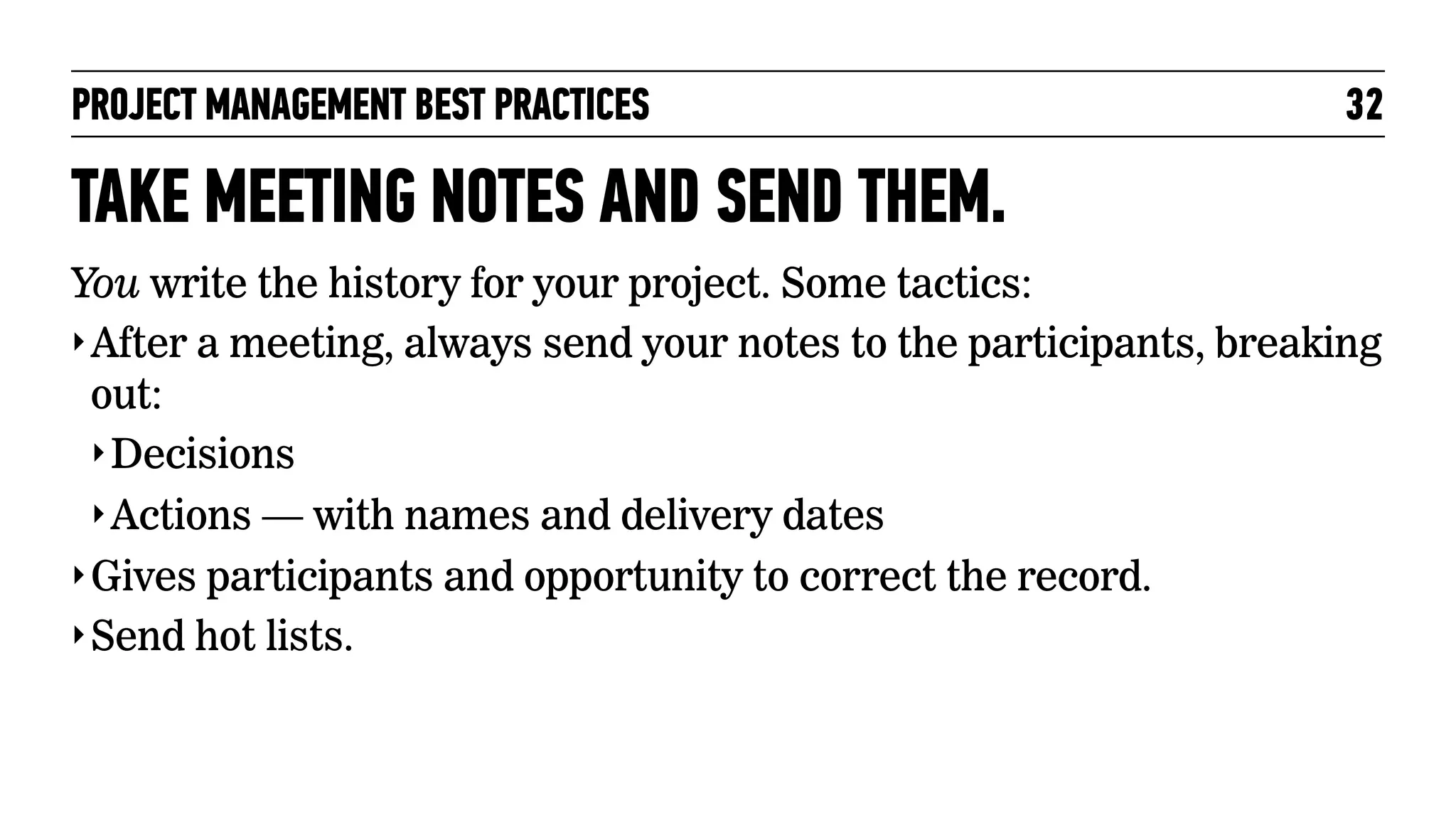
TAKE MEETING NOTES AND SEND THEM.
You write the history for your project. Some tactics:
‣ After a meeting, always send your notes to the participants, breaking
out:
‣ Decisions
‣ Actions — with names and delivery dates
‣ Gives participants and opportunity to correct the record.
‣ Send hot lists.
PROJECT MANAGEMENT BEST PRACTICES

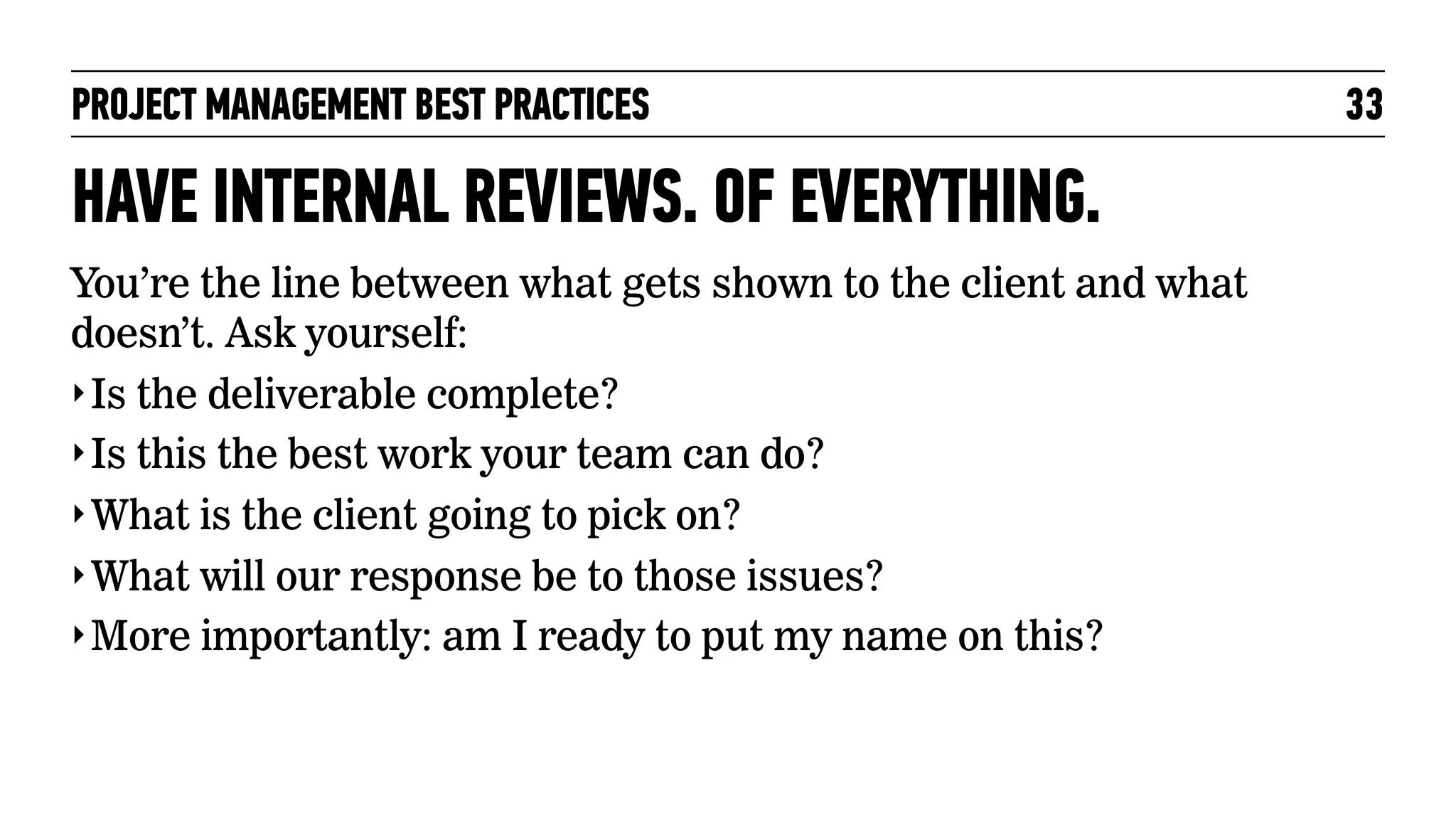
HAVE INTERNAL REVIEWS. OF EVERYTHING.
You’re the line between what gets shown to the client and what
doesn’t. Ask yourself:
‣ Is the deliverable complete?
‣ Is this the best work your team can do?
‣ What is the client going to pick on?
‣ What will our response be to those issues?
‣ More importantly: am I ready to put my name on this?

33
PROJECT MANAGEMENT BEST PRACTICES

EVALUATE STAFFING.
Especially on small projects, every team member is key to your
success. you must have the right team members to get the job done.

34
PROJECT MANAGEMENT BEST PRACTICES

Managing your client.

35
PROJECT MANAGEMENT BEST PRACTICES

36

REVIEW YOUR PROJECT PLAN.
With the client. Sounds crazy. I know. It helps:
‣ Show the client what you’re doing.
‣ Show the client what you need them to do.
‣ Make the schedule be the bad guy instead of you (particularly when
they miss dates).
‣ Keep your head up and focus on something other than the
immediate term.
PROJECT MANAGEMENT BEST PRACTICES

TALK TO THE CLIENT FREQUENTLY.
Maybe or maybe not daily, but at least weekly outside of scheduled
reviews. Use the call to:
‣ Talk about your risks and how you hope to mitigate them (perhaps
with their help).
‣ As what risks they see.
‣ Manage expectations.
‣ Ask what they need you to do that you’re not.
‣ Build trust.

37
PROJECT MANAGEMENT BEST PRACTICES

COMMUNICATE APPROPRIATELY.
Know how your roll affects how your communication will affect the
project. This encompasses several things:
‣ Messages that best come from a day-to-day PM: risks, delays,
mistakes, status, changes in scope.
‣ Messages that come from someone not day-to-day: changes in
scope, resolving contract disputes.

38
PROJECT MANAGEMENT BEST PRACTICES

When it’s bad, talk more often, not less.

39
PROJECT MANAGEMENT BEST PRACTICES

Project strategies.

40
PROJECT MANAGEMENT BEST PRACTICES

Long term goal.

41
PROJECT MANAGEMENT BEST PRACTICES

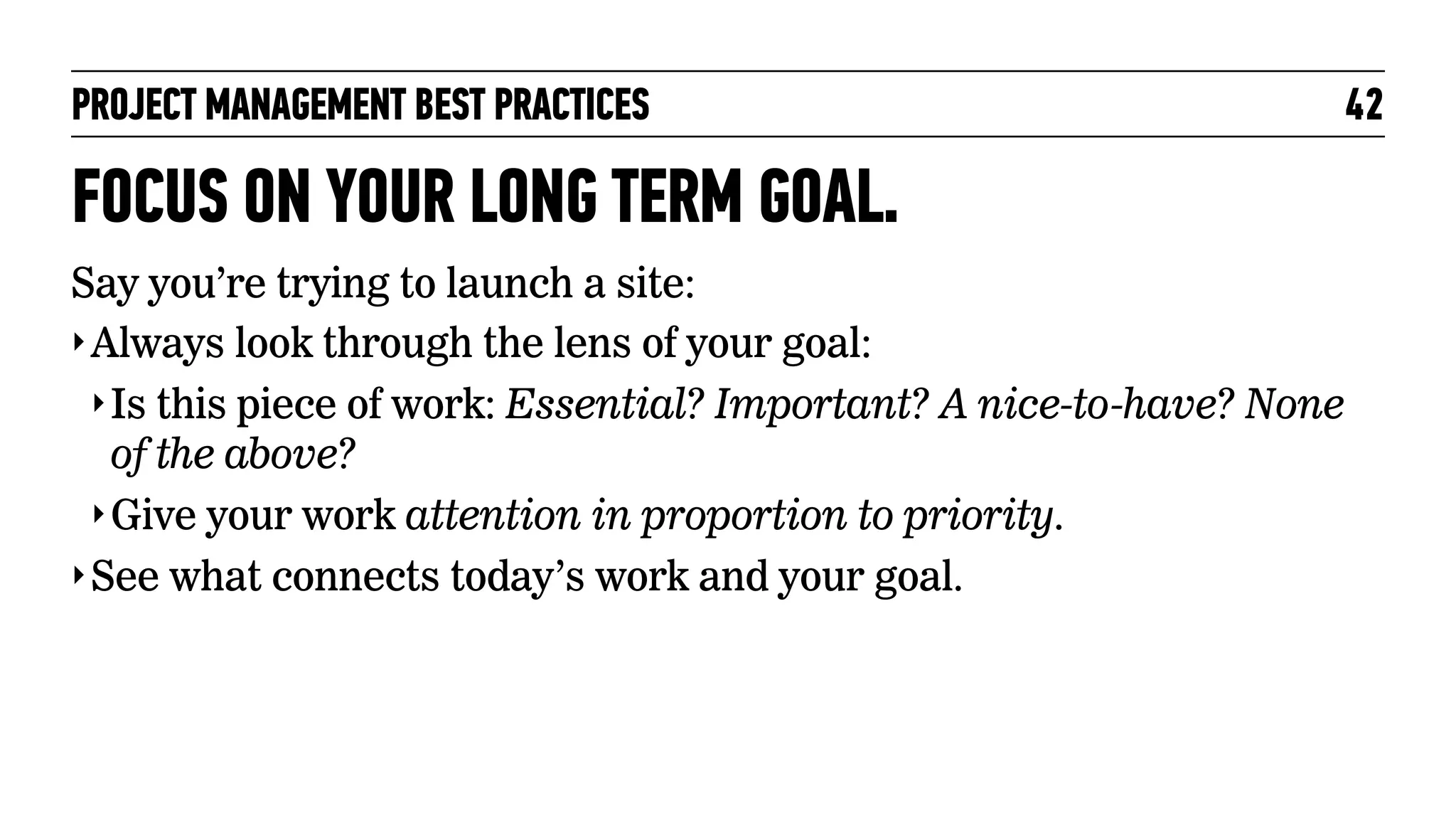
FOCUS ON YOUR LONG TERM GOAL.
Say you’re trying to launch a site:
‣ Always look through the lens of your goal:
‣ Is this piece of work: Essential? Important? A nice-to-have? None
of the above?
‣ Give your work attention in proportion to priority.
‣ See what connects today’s work and your goal.

42
PROJECT MANAGEMENT BEST PRACTICES

Remember:
If it doesn’t connect to your goal,
it gets no attention.

43
PROJECT MANAGEMENT BEST PRACTICES

Opportunity cost.

44
PROJECT MANAGEMENT BEST PRACTICES

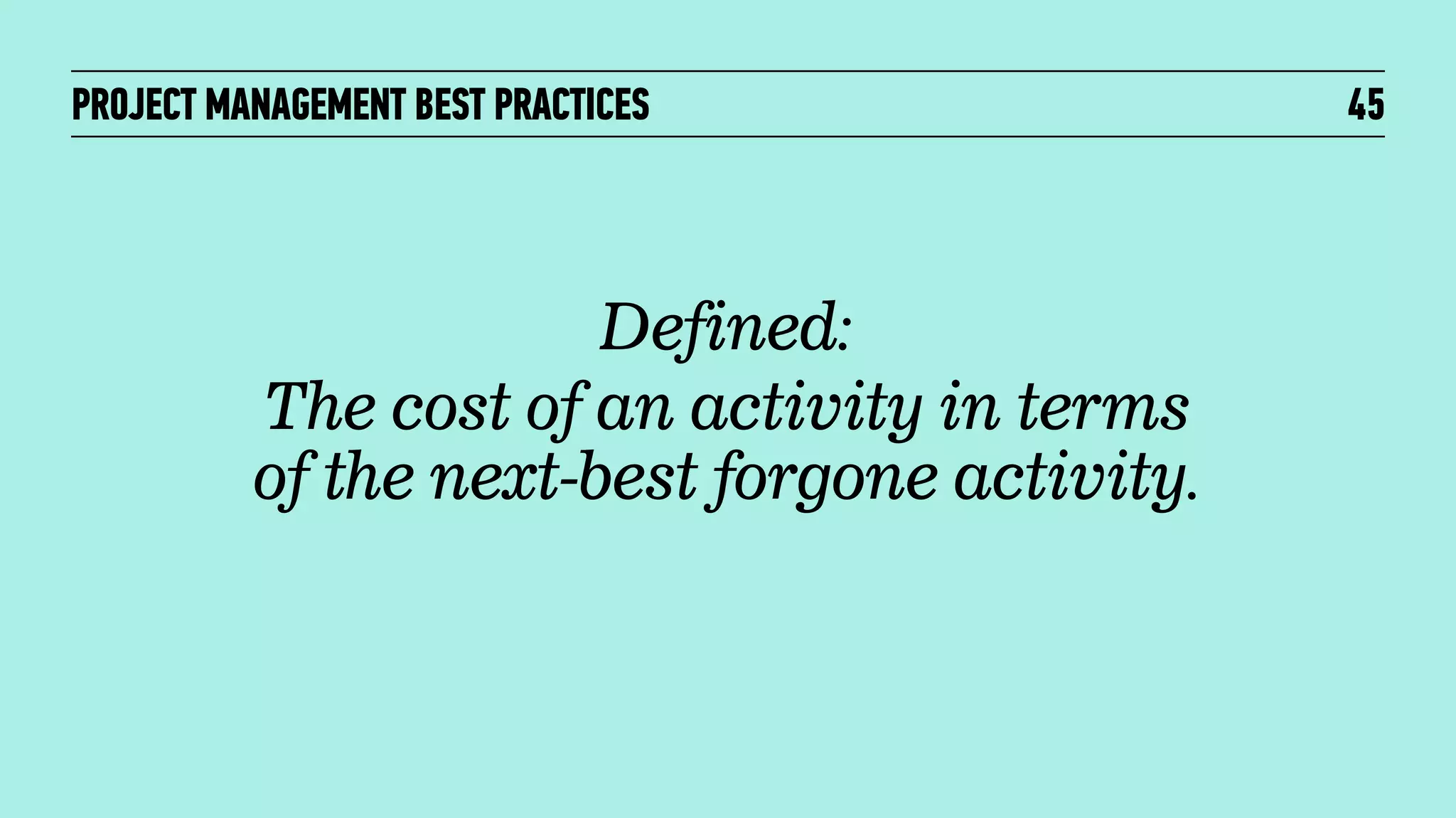
Defined:
The cost of an activity in terms
of the next-best forgone activity.

45
PROJECT MANAGEMENT BEST PRACTICES

46

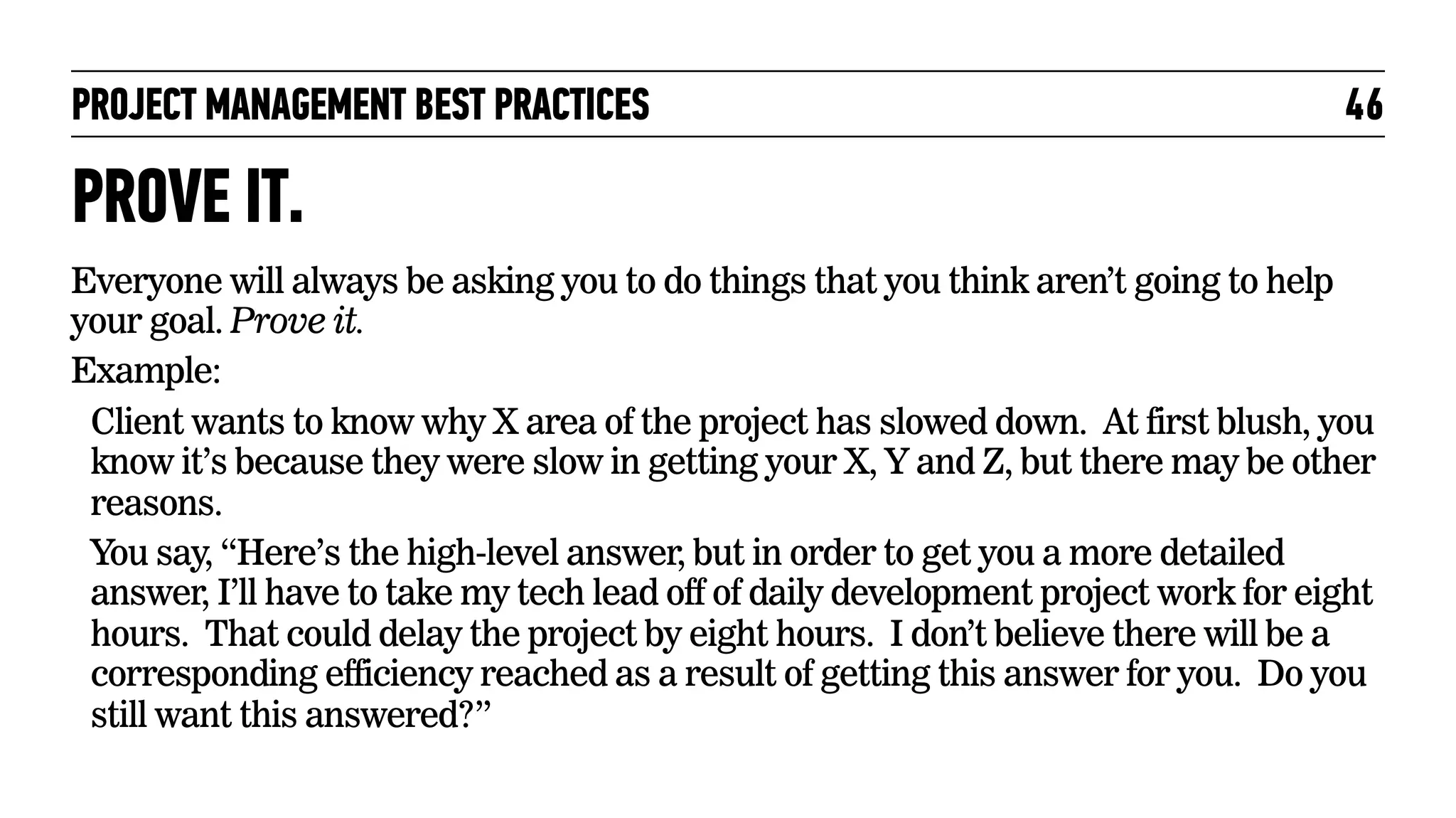
PROVE IT.
Everyone will always be asking you to do things that you think aren’t going to help
your goal. Prove it.
Example:
Client wants to know why X area of the project has slowed down. At first blush, you
know it’s because they were slow in getting your X, Y and Z, but there may be other
reasons.
You say, “Here’s the high-level answer, but in order to get you a more detailed
answer, I’ll have to take my tech lead off of daily development project work for eight
hours. That could delay the project by eight hours. I don’t believe there will be a
corresponding efficiency reached as a result of getting this answer for you. Do you
still want this answered?”
PROJECT MANAGEMENT BEST PRACTICES

Process as protection.

47
PROJECT MANAGEMENT BEST PRACTICES

48

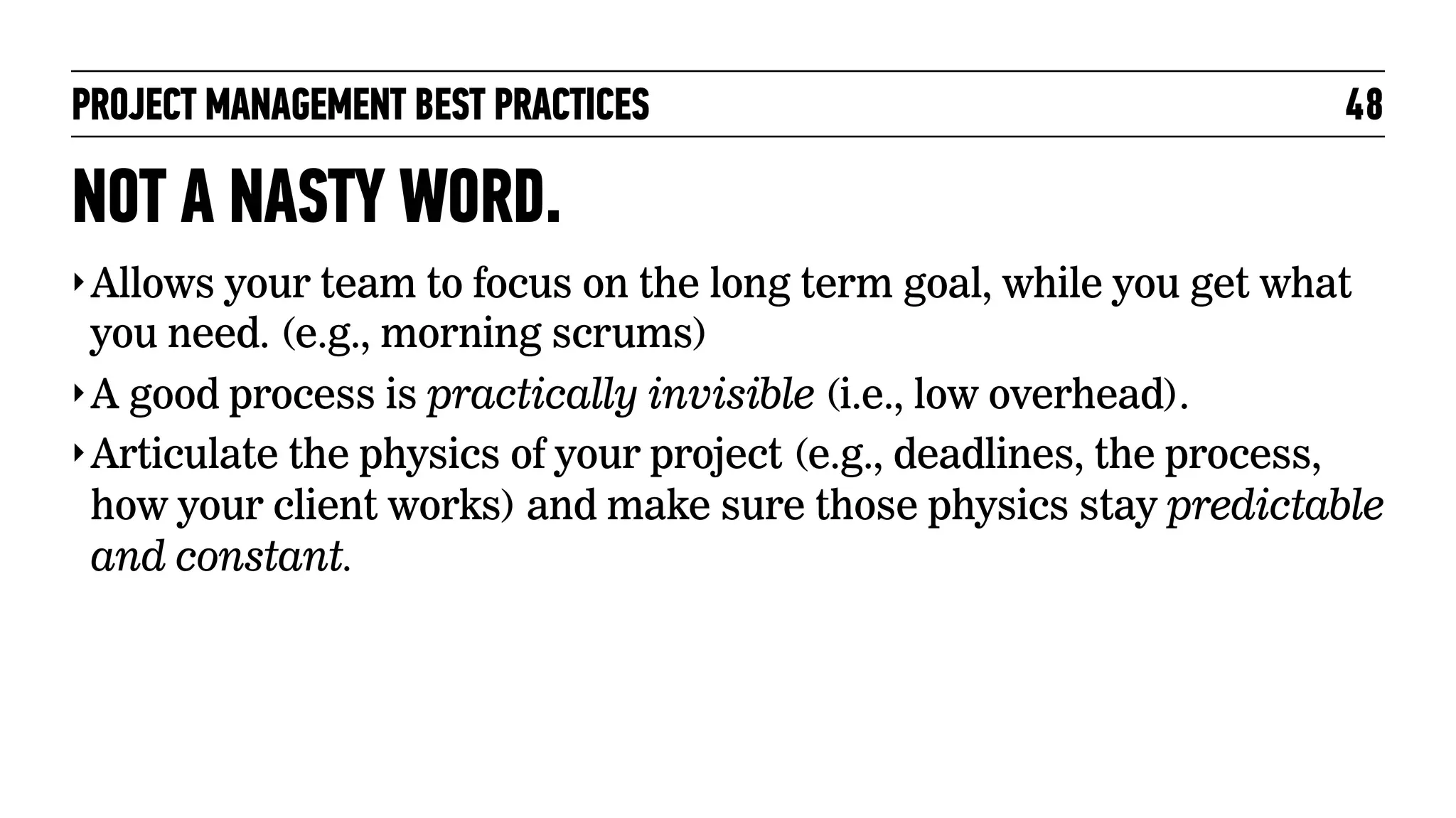
NOT A NASTY WORD.
‣ Allows your team to focus on the long term goal, while you get what

you need. (e.g., morning scrums)
‣ A good process is practically invisible (i.e., low overhead).
‣ Articulate the physics of your project (e.g., deadlines, the process,
how your client works) and make sure those physics stay predictable
and constant.
PROJECT MANAGEMENT BEST PRACTICES

49

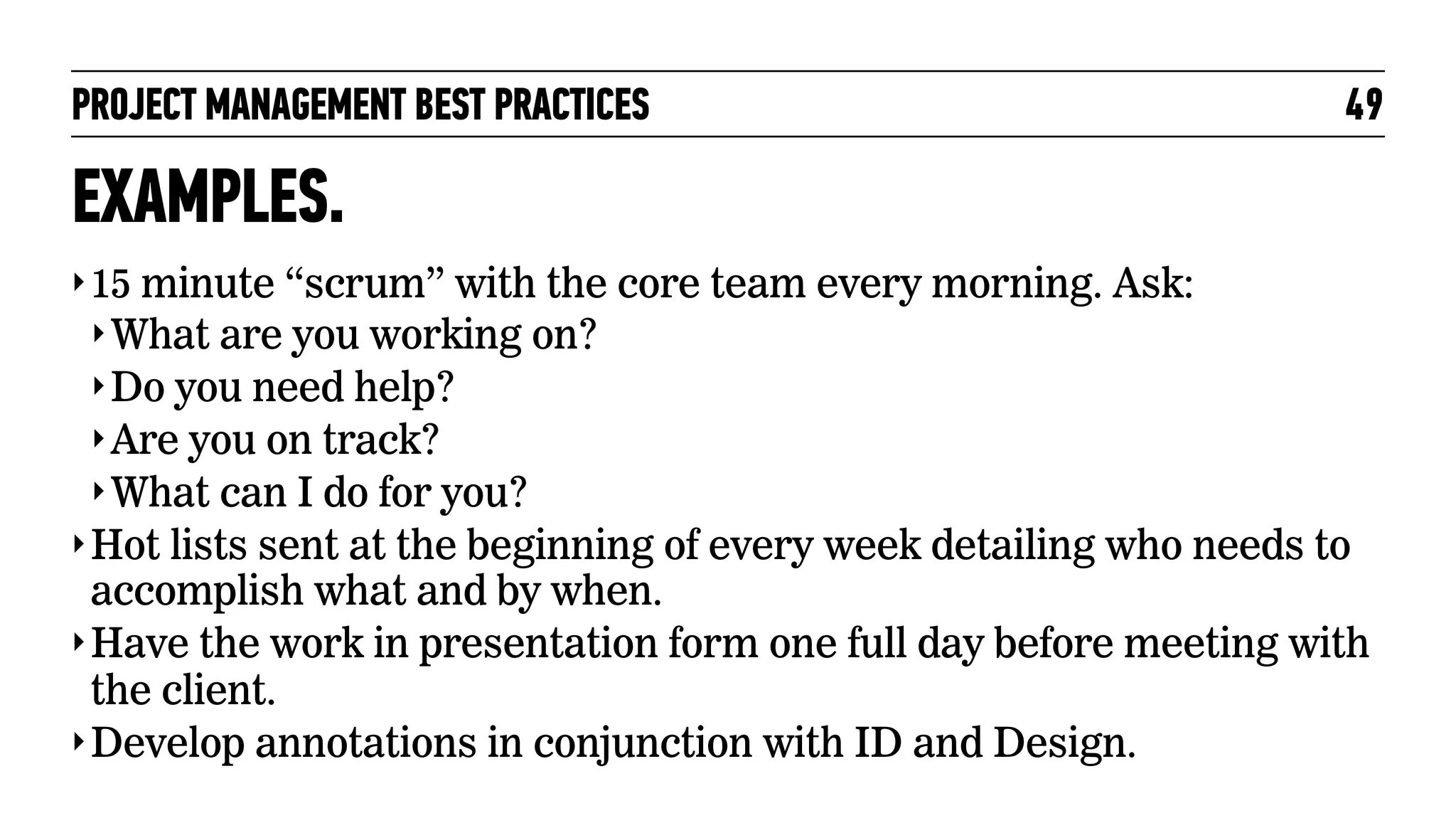
EXAMPLES.
‣ 15 minute “scrum” with the core team every morning. Ask:
‣ What are you working on?
‣ Do you need help?
‣ Are you on track?
‣ What can I do for you?
‣ Hot lists sent at the beginning of every week detailing who needs to

accomplish what and by when.
‣ Have the work in presentation form one full day before meeting with
the client.
‣ Develop annotations in conjunction with ID and Design.
PROJECT MANAGEMENT BEST PRACTICES

Shelter your team.

50
PROJECT MANAGEMENT BEST PRACTICES

51

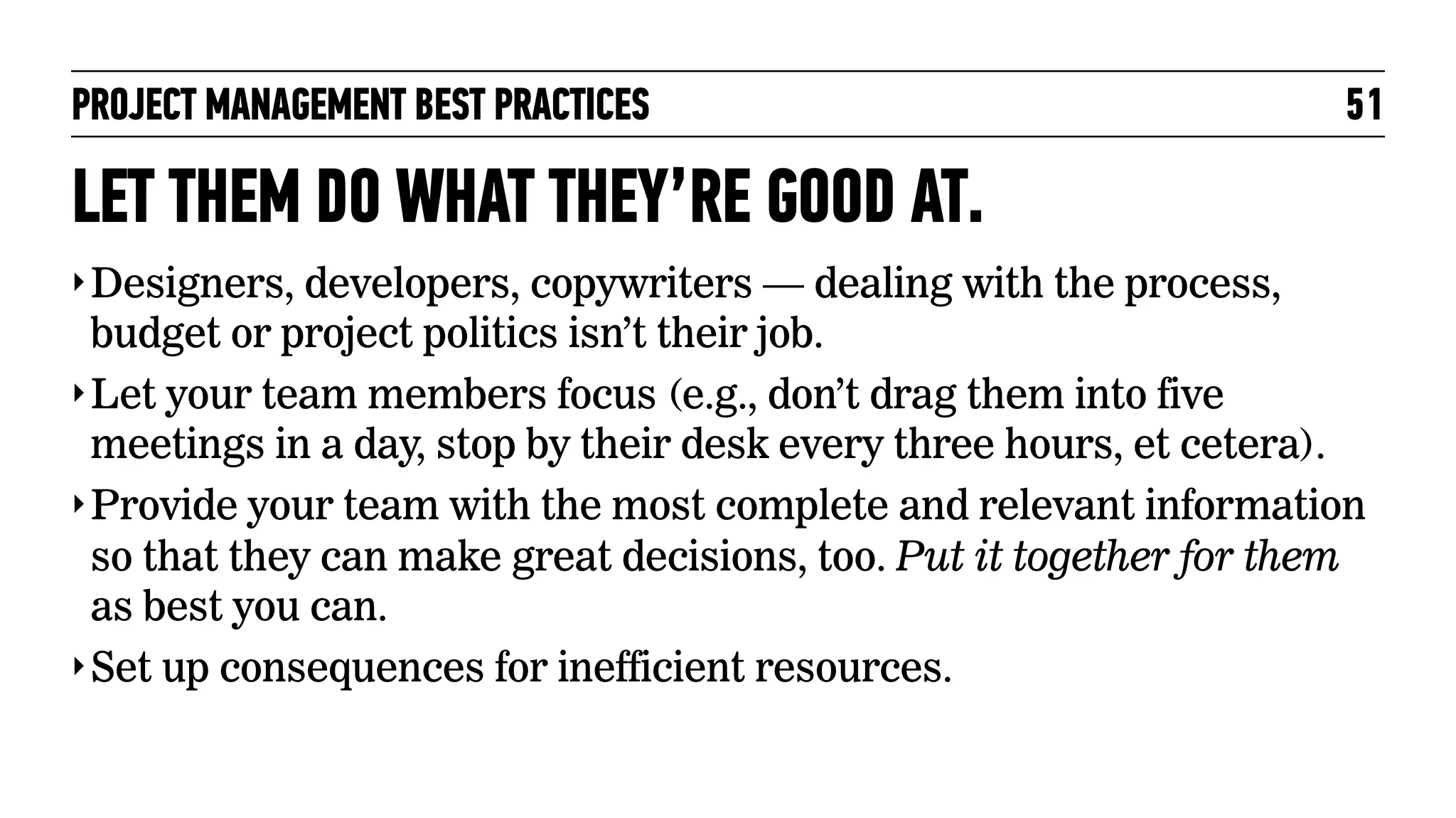
LET THEM DO WHAT THEY’RE GOOD AT.
‣ Designers, developers, copywriters — dealing with the process,

budget or project politics isn’t their job.
‣ Let your team members focus (e.g., don’t drag them into five
meetings in a day, stop by their desk every three hours, et cetera).
‣ Provide your team with the most complete and relevant information
so that they can make great decisions, too. Put it together for them
as best you can.
‣ Set up consequences for inefficient resources.
PROJECT MANAGEMENT BEST PRACTICES

Relationships.

52
PROJECT MANAGEMENT BEST PRACTICES

53

Graham Arader:
Strangers don’t give you money, friends do.
PROJECT MANAGEMENT BEST PRACTICES

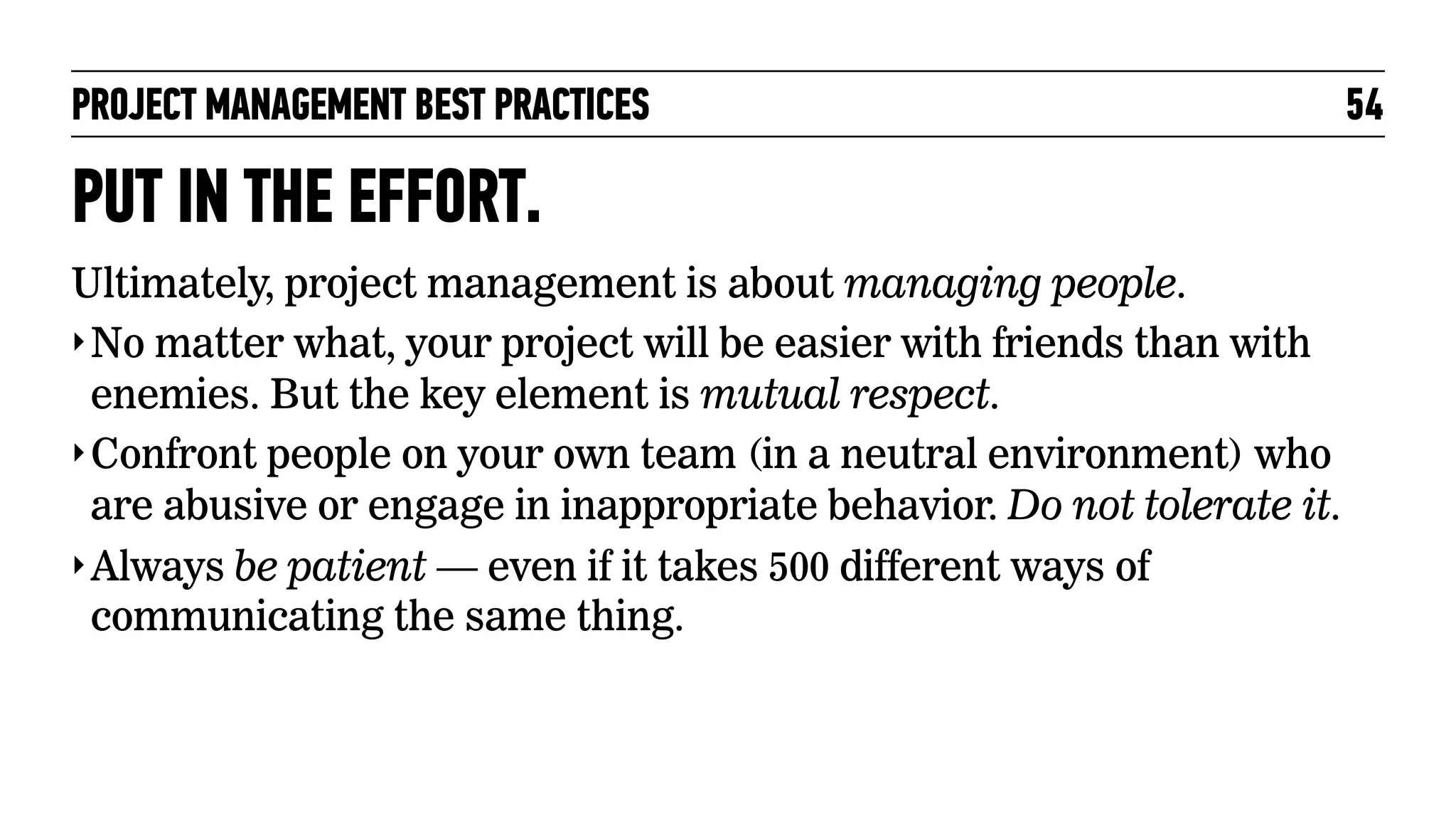
PUT IN THE EFFORT.
Ultimately, project management is about managing people.
‣ No matter what, your project will be easier with friends than with
enemies. But the key element is mutual respect.
‣ Confront people on your own team (in a neutral environment) who
are abusive or engage in inappropriate behavior. Do not tolerate it.
‣ Always be patient — even if it takes 500 different ways of
communicating the same thing.

54
PROJECT MANAGEMENT BEST PRACTICES

Personal strategies.

55
PROJECT MANAGEMENT BEST PRACTICES

Own it.

56
PROJECT MANAGEMENT BEST PRACTICES

Ownership:
If it’s bad, it’s your fault.
If it’s amazing, it’s your fault.

57
PROJECT MANAGEMENT BEST PRACTICES

SMALL TIME CEO.
‣ Think of yourself as an actual business owner.
‣ What do you do if this is your money, your time, your scope.
‣ No matter what, the buck has to stop with you.

58
PROJECT MANAGEMENT BEST PRACTICES

Demand transparency.

59
PROJECT MANAGEMENT BEST PRACTICES

“If you tell the truth, you
don’t have to remember anything.”
– Mark Twain

60
PROJECT MANAGEMENT BEST PRACTICES

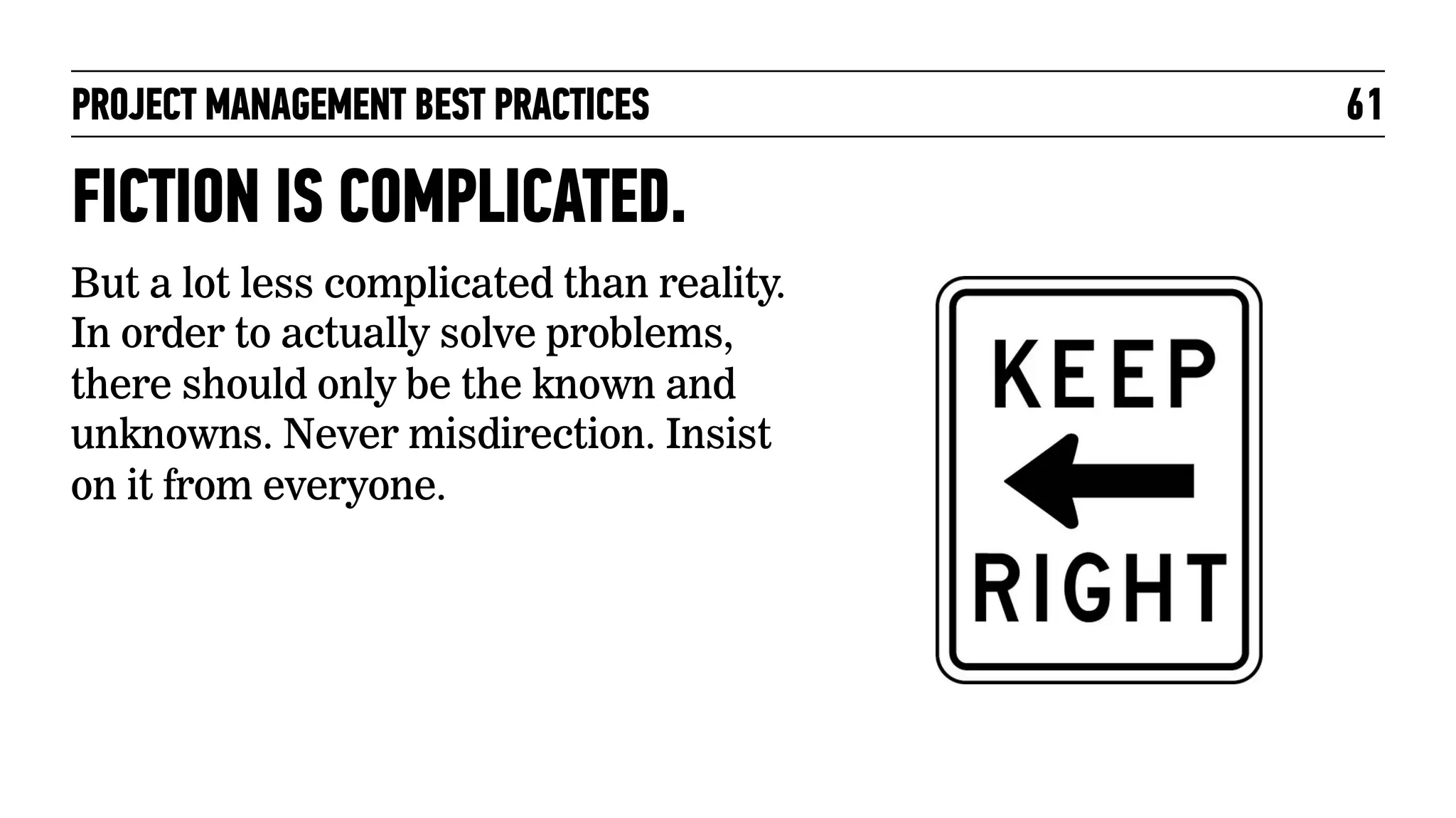
FICTION IS COMPLICATED.
But a lot less complicated than reality.
In order to actually solve problems,
there should only be the known and
unknowns. Never misdirection. Insist
on it from everyone.

61
PROJECT MANAGEMENT BEST PRACTICES

Be curious.

62
your performance, your team members, how does
AfterEffects work? how do you put together CSS and
HTML to build a page? Does it make sense to build this
feature in JavaScript? why does my developer think
that this thing that looks like one feature to me is
actually three features to her? why does it matter that
it’s three features? what does my developer need to
develop this feature? what process do my team
members find most efficient? why is our development
process this way? what does the business need? how
does my client’s business actually work? what is the
project history? in what ways could my last project
could have been more successful? what can I do to make
PROJECT MANAGEMENT BEST PRACTICES

Think quickly.

64
PROJECT MANAGEMENT BEST PRACTICES

65

MAKE PROJECT DECISIONS.
Not arbitrary ones, of course — as quickly as possible.
‣ Collect relevant information, organize it, and make a decision — and
be able to justify that decision in facts or grounded suppositions.
‣ Approach decisions from the perspective of whether or not the
decisions will have made sense a month from now based on what you
knew at the time you made the decision.
‣ Document your big decisions and the process that went into it.
PROJECT MANAGEMENT BEST PRACTICES

Remember:
Indecision is a decision.

66
PROJECT MANAGEMENT BEST PRACTICES

Think solutions.

67
PROJECT MANAGEMENT BEST PRACTICES

When you give someone a problem
without a proposed set of solutions,
you’re making it their problem.

68
PROJECT MANAGEMENT BEST PRACTICES

69

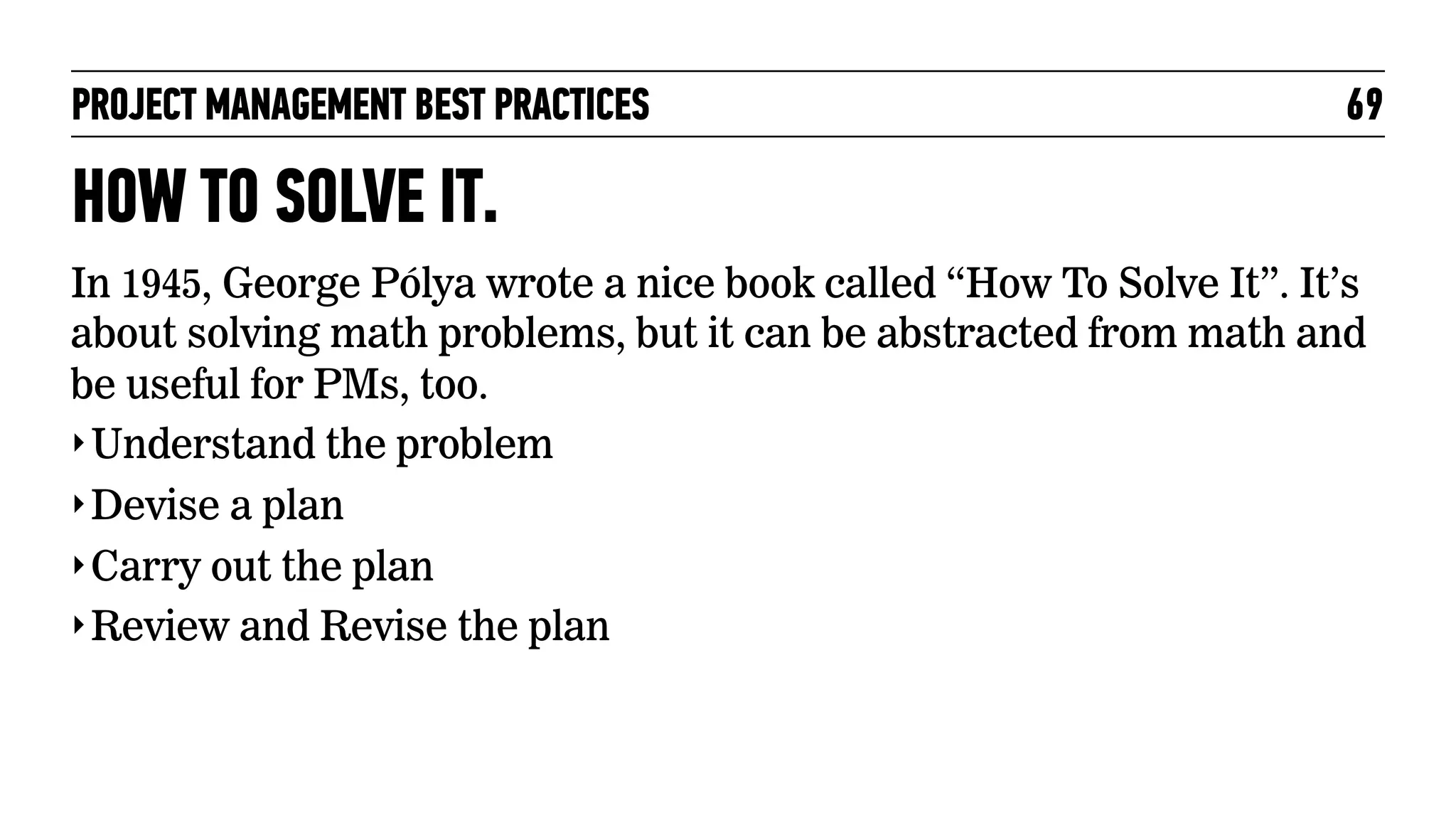
HOW TO SOLVE IT.
In 1945, George Pólya wrote a nice book called “How To Solve It”. It’s
about solving math problems, but it can be abstracted from math and
be useful for PMs, too.
‣ Understand the problem
‣ Devise a plan
‣ Carry out the plan
‣ Review and Revise the plan
PROJECT MANAGEMENT BEST PRACTICES

Carry water for your team
and be the catalyst.

70
PROJECT MANAGEMENT BEST PRACTICES

Communicate.

71
PROJECT MANAGEMENT BEST PRACTICES

72

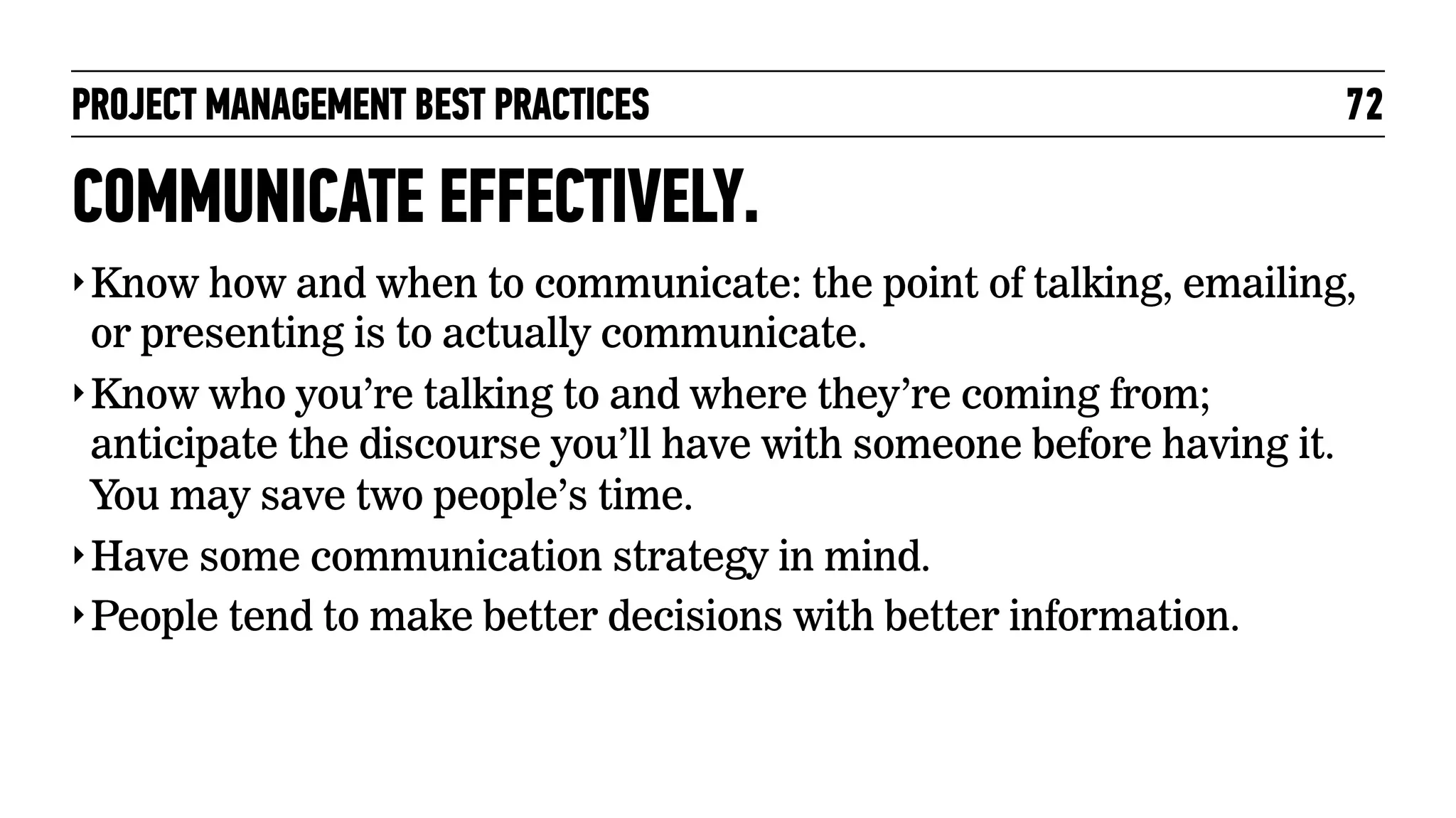
COMMUNICATE EFFECTIVELY.
‣ Know how and when to communicate: the point of talking, emailing,

or presenting is to actually communicate.
‣ Know who you’re talking to and where they’re coming from;
anticipate the discourse you’ll have with someone before having it.
You may save two people’s time.
‣ Have some communication strategy in mind.
‣ People tend to make better decisions with better information.
PROJECT MANAGEMENT BEST PRACTICES

73

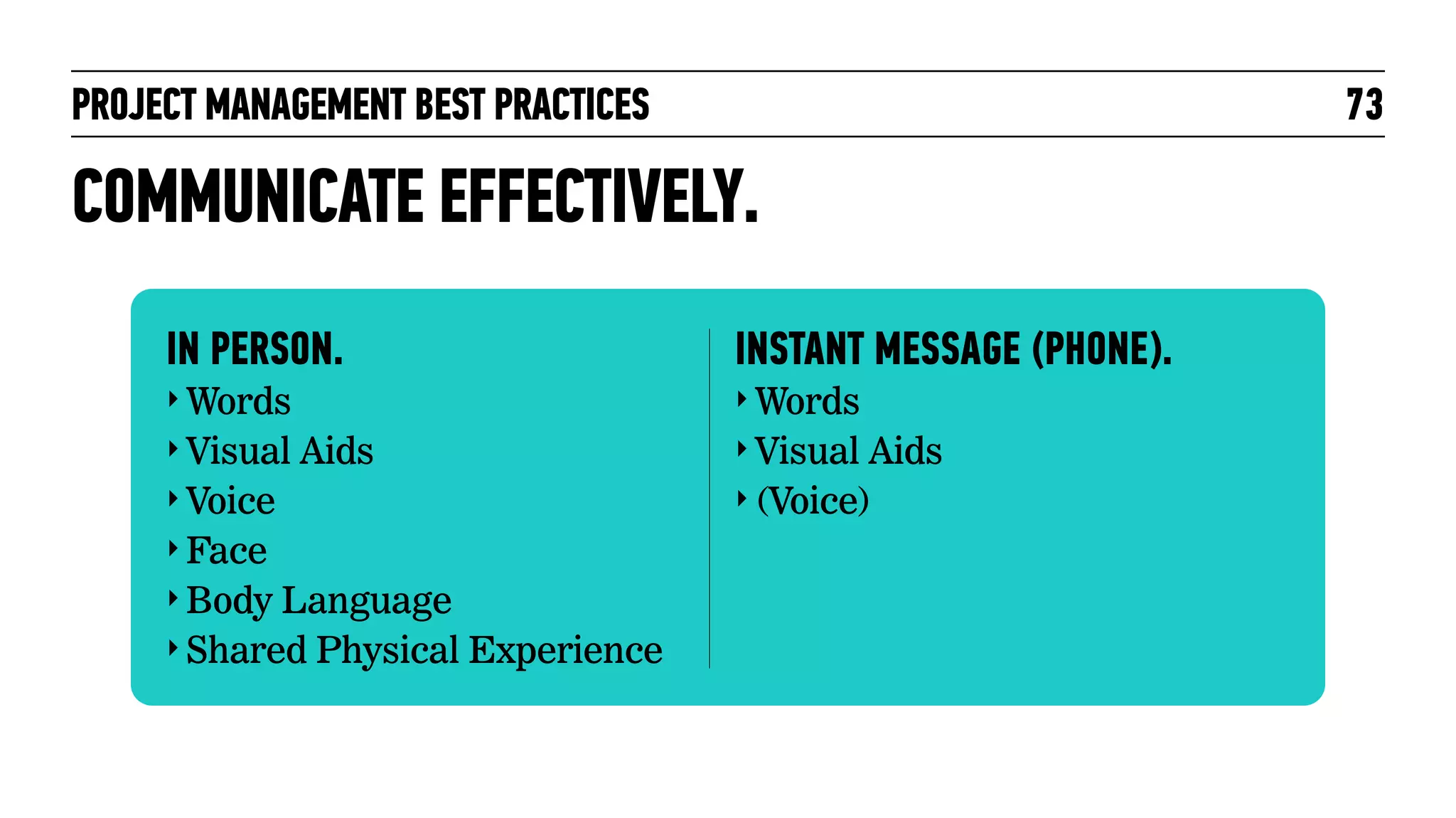
COMMUNICATE EFFECTIVELY.
IN PERSON.

INSTANT MESSAGE (PHONE).

‣ Words

‣ Words

‣ Visual Aids

‣ Visual Aids

‣ Voice

‣ (Voice)

‣ Face
‣ Body Language
‣ Shared Physical Experience
PROJECT MANAGEMENT BEST PRACTICES

Attitude.

74
PROJECT MANAGEMENT BEST PRACTICES

76

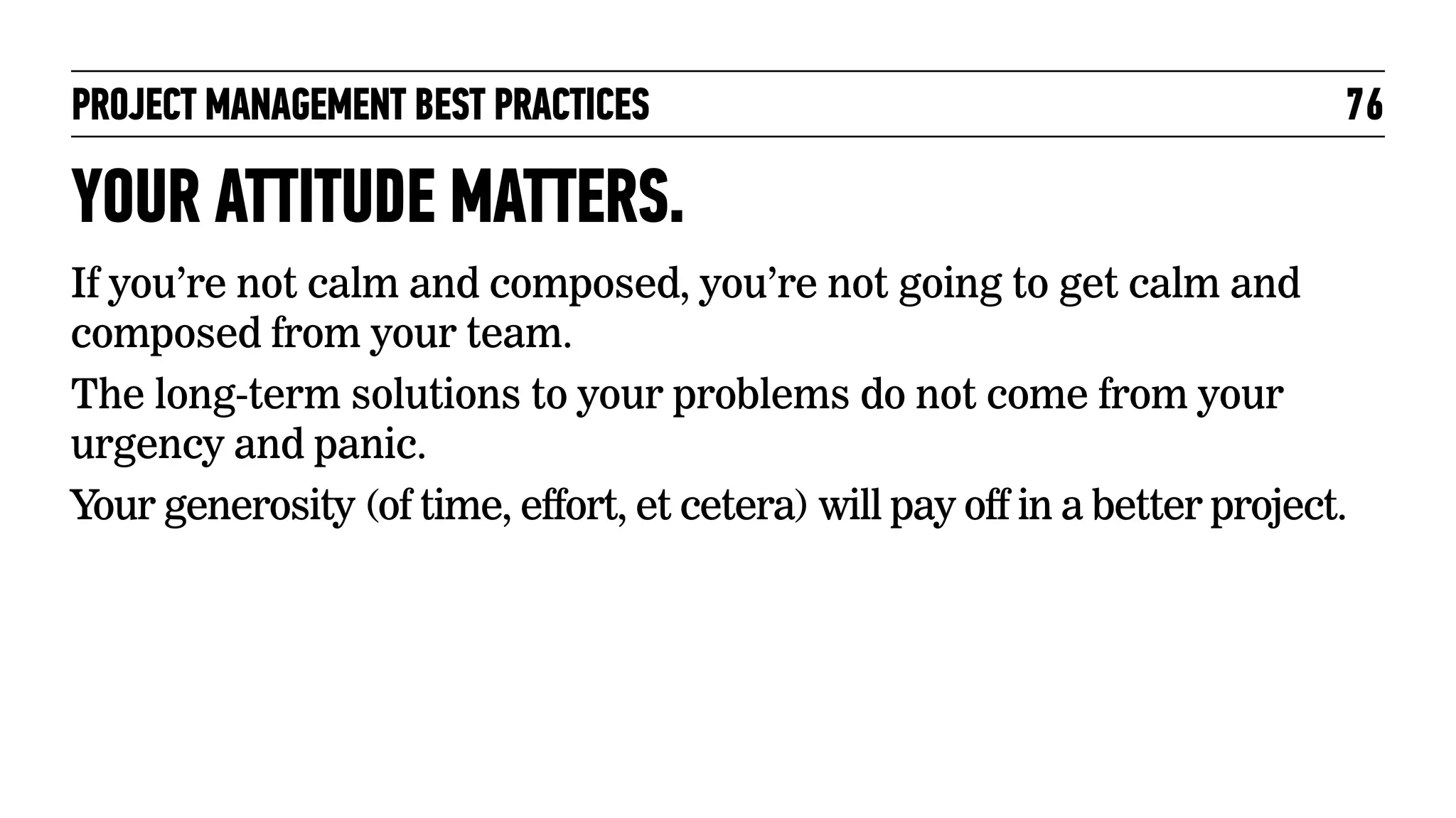
YOUR ATTITUDE MATTERS.
If you’re not calm and composed, you’re not going to get calm and
composed from your team.
The long-term solutions to your problems do not come from your
urgency and panic.
Your generosity (of time, effort, et cetera) will pay off in a better project.
PROJECT MANAGEMENT BEST PRACTICES

Thanks.

78

Project Management Best Practices: Brock Boddie/General Assembly

  • 1.
  • 2.
    GET THE FULLEXPERIENCE: LEARN WHAT YOU WANT, WHEN YOU WANT Unlimited access to all upcoming live streams On-demand streaming classes taught by top practitioners A growing video library, updated weekly Get access for only $25 USD/month. No risk—you can cancel at any time! START 14-DAY FREE TRIAL
  • 3.
    AGENDA ‣ Who Iam ‣ Basic project management ‣ Tactics ‣ Project strategies ‣ Personal strategies 2
  • 4.
    PROJECT MANAGEMENT BESTPRACTICES Who I am. 3
  • 5.
    INTRODUCTION I’M BROCK. ‣ Iwork for Huge as a Program Director, working on clients like Four Seasons ‣ 11 years managing interactive projects, large and small. ‣ Can code HTML/CSS and enough JavaScript and PHP to be a nuisance. ‣ Majored in Philosophy & Psychology and Masters in International Relations. 4
  • 6.
    PROJECT MANAGEMENT BESTPRACTICES Basic PM stuff. 5
  • 7.
    PROJECT MANAGEMENT BESTPRACTICES BASICS: 1.Scope 2.People 3.Timeline 4.Budget 6
  • 8.
    PROJECT MANAGEMENT BESTPRACTICES 7 WHAT ARE WE DOING? Scope is the circumscription of all that you are doing in all its glorious detail. For example: ‣ More scope almost always means more time. ‣ More scope also almost always means more budget. ‣ More scope may also mean that you need more resources.
  • 9.
    PROJECT MANAGEMENT BESTPRACTICES BASICS: 1.Scope 2.People 3.Timeline 4.Budget 8
  • 10.
    PROJECT MANAGEMENT BESTPRACTICES IF ONLY THIS PERSON WERE ON MY TEAM… You’ve got to have the right people in place to get the job done. Forcing someone to do something they don’t do isn’t a recipe for success and can impact your project negatively. For example: ‣ More people almost always means more budget. ‣ More people can mean that you can handle more scope. ‣ More people can mean less time – but… 9
  • 11.
    PROJECT MANAGEMENT BESTPRACTICES One woman can have a baby in nine months, but nine women cannot have a baby in one month. 10
  • 12.
    PROJECT MANAGEMENT BESTPRACTICES Some things just take time. 11
  • 13.
    PROJECT MANAGEMENT BESTPRACTICES BASICS: 1.Scope 2.People 3.Timeline 4.Budget 12
  • 14.
    PROJECT MANAGEMENT BESTPRACTICES DONE YET? Time is related to scope, budget and resources in some pretty key ways: ‣ More time almost always means more budget. ‣ Larger scope almost always means more time. ‣ More resources can mean less time (see previous slide). 13
  • 15.
    PROJECT MANAGEMENT BESTPRACTICES BASICS: 1.Scope 2.People 3.Timeline 4.Budget 14
  • 16.
    PROJECT MANAGEMENT BESTPRACTICES 15 SCHMUDGET. Your budget is obviously the anticipated price of the scope that you have committed to. Budget relates to the other areas in these high level ways: ‣ More time almost always means more budget. ‣ Larger scope almost always means more time. ‣ More resources can mean more budget — but with some work it’s a trade-off between time, resource price, and budget.
  • 17.
    PROJECT MANAGEMENT BESTPRACTICES Tactics. 16
  • 18.
    PROJECT MANAGEMENT BESTPRACTICES Starting a project. 17
  • 19.
    PROJECT MANAGEMENT BESTPRACTICES 18 KNOW YOUR BUSINESS’ STRATEGY. If they’ll tell you, that is. How does your business view this SOW/account: ‣ Are we trying to develop a long term relationship? ‣ How much margin are we willing to give up to make the client happy? ‣ Do we just want to finish out this project?
  • 20.
    PROJECT MANAGEMENT BESTPRACTICES KNOW YOUR SCOPE. Know what you’re on the hook for and what you’re not: ‣ What you said you’d do. ‣ What they agreed they’d do. ‣ Your documented assumptions. ‣ What its weaknesses are that work for you. ‣ What its weaknesses are that work against you. 19
  • 21.
    PROJECT MANAGEMENT BESTPRACTICES CREATE A SCHEDULE. ‣ Make it specific. Very specific. 20
  • 22.
    PROJECT MANAGEMENT BESTPRACTICES 21 HAVE A PROJECT PLAN IN MIND. ANNOTATIONS Visual Design Development Quality Assurance REMEDIATION Review Wireframing UAT Launch Kickoff Requirements Gathering/ Discovery SPECIFICATIONS
  • 23.
    PROJECT MANAGEMENT BESTPRACTICES Operating a project. 22
  • 24.
    PROJECT MANAGEMENT BESTPRACTICES 23 ADAPT TO YOUR CLIENT’S PROCESS. They probably have a way of doing things and they’re not looking for you to change it — yet. ‣ Research: Figure out what they do and why they do it. ‣ Reduce friction: Adapt your process to accommodate if you can. ‣ Evolve: Keep them aware of inefficiencies that you believe they could change easily. ‣ Don’t tell them about everything they do wrong. It burns good will you’ll need when something is really messed up.
  • 25.
    PROJECT MANAGEMENT BESTPRACTICES MAINTAIN YOUR SCHEDULE. You’re not organized enough to keep track of everything. Use your schedule to: ‣ Track expected resource utilization. ‣ Measure deviations from the original scope. ‣ Focus on tasks that are relevant today, this week, or this month. ‣ Illustrating the down-stream impacts of deviations from the plan. 24
  • 26.
    PROJECT MANAGEMENT BESTPRACTICES 25 COUNT THE HOURS. An essential task for projects with development; you’ve only budgeted so many hours or days to complete the scope. Keep track of how they’ll be consumed. ‣ How many hours of development and QA resources do you have? ‣ How many hours will each of your features take to build and test? ‣ How accurate are your estimates?
  • 27.
    PROJECT MANAGEMENT BESTPRACTICES TRACK YOUR BUDGET. Calculate the following at least once a week: ‣ Actual hours, cost and billed hours to-date. ‣ Forecasted hours, cost and billed to complete. ‣ Actual+Forecasted hours, cost and billed. 26
  • 28.
    PROJECT MANAGEMENT BESTPRACTICES SEND WEEKLY STATUS REPORTS. It holds everyone accountable. Include: ‣ What you accomplished this week. ‣ What you expect to accomplish next week. ‣ What you missed this week. ‣ What’s at risk. ‣ How you intend to mitigate the risk. If you’re doing things correctly, your client and team will never see anything surprising in this report. 27
  • 29.
    PROJECT MANAGEMENT BESTPRACTICES 28 KEEP THE PROJECT ORGANIZED. Imagine a year from now, someone wanted you to find that file that you sent them on that day that was about that thing — how would you find it? ‣ File naming a key. Example: DDMMYY_Deliverable_FileName_Version ‣ Folder Organization. Design it for someone who doesn’t know your project. ‣ Insist that team members abide the conventions.
  • 30.
    PROJECT MANAGEMENT BESTPRACTICES Managing your team. 29
  • 31.
    PROJECT MANAGEMENT BESTPRACTICES 30 HAVE SHORT, DAILY MEETINGS. We call them “scrums,” but whatever you call them, get together with your team regularly to track progress. ‣ Use your meeting notes, schedule, and actions to track people’s progress and ask: ‣ What are you working on? ‣ What do you need? ‣ Are you getting it? ‣ How can I help you? ‣ Use that meeting only to track progress
  • 32.
    PROJECT MANAGEMENT BESTPRACTICES 31 ASK FOR DATES AND DEPENDENCIES. People don’t usually volunteer when something will get done, so you must get them to estimate and commit. Some rebuttals: ‣ “Just give me your best guess — it helps me plan subsequent tasks.” ‣ “Is it because this one task is actually many tasks? Let’s break it down and estimate those tasks.” ‣ “Try working on this problems for an hour or two and giving me an estimate then.”
  • 33.
    PROJECT MANAGEMENT BESTPRACTICES 32 TAKE MEETING NOTES AND SEND THEM. You write the history for your project. Some tactics: ‣ After a meeting, always send your notes to the participants, breaking out: ‣ Decisions ‣ Actions — with names and delivery dates ‣ Gives participants and opportunity to correct the record. ‣ Send hot lists.
  • 34.
    PROJECT MANAGEMENT BESTPRACTICES HAVE INTERNAL REVIEWS. OF EVERYTHING. You’re the line between what gets shown to the client and what doesn’t. Ask yourself: ‣ Is the deliverable complete? ‣ Is this the best work your team can do? ‣ What is the client going to pick on? ‣ What will our response be to those issues? ‣ More importantly: am I ready to put my name on this? 33
  • 35.
    PROJECT MANAGEMENT BESTPRACTICES EVALUATE STAFFING. Especially on small projects, every team member is key to your success. you must have the right team members to get the job done. 34
  • 36.
    PROJECT MANAGEMENT BESTPRACTICES Managing your client. 35
  • 37.
    PROJECT MANAGEMENT BESTPRACTICES 36 REVIEW YOUR PROJECT PLAN. With the client. Sounds crazy. I know. It helps: ‣ Show the client what you’re doing. ‣ Show the client what you need them to do. ‣ Make the schedule be the bad guy instead of you (particularly when they miss dates). ‣ Keep your head up and focus on something other than the immediate term.
  • 38.
    PROJECT MANAGEMENT BESTPRACTICES TALK TO THE CLIENT FREQUENTLY. Maybe or maybe not daily, but at least weekly outside of scheduled reviews. Use the call to: ‣ Talk about your risks and how you hope to mitigate them (perhaps with their help). ‣ As what risks they see. ‣ Manage expectations. ‣ Ask what they need you to do that you’re not. ‣ Build trust. 37
  • 39.
    PROJECT MANAGEMENT BESTPRACTICES COMMUNICATE APPROPRIATELY. Know how your roll affects how your communication will affect the project. This encompasses several things: ‣ Messages that best come from a day-to-day PM: risks, delays, mistakes, status, changes in scope. ‣ Messages that come from someone not day-to-day: changes in scope, resolving contract disputes. 38
  • 40.
    PROJECT MANAGEMENT BESTPRACTICES When it’s bad, talk more often, not less. 39
  • 41.
    PROJECT MANAGEMENT BESTPRACTICES Project strategies. 40
  • 42.
    PROJECT MANAGEMENT BESTPRACTICES Long term goal. 41
  • 43.
    PROJECT MANAGEMENT BESTPRACTICES FOCUS ON YOUR LONG TERM GOAL. Say you’re trying to launch a site: ‣ Always look through the lens of your goal: ‣ Is this piece of work: Essential? Important? A nice-to-have? None of the above? ‣ Give your work attention in proportion to priority. ‣ See what connects today’s work and your goal. 42
  • 44.
    PROJECT MANAGEMENT BESTPRACTICES Remember: If it doesn’t connect to your goal, it gets no attention. 43
  • 45.
    PROJECT MANAGEMENT BESTPRACTICES Opportunity cost. 44
  • 46.
    PROJECT MANAGEMENT BESTPRACTICES Defined: The cost of an activity in terms of the next-best forgone activity. 45
  • 47.
    PROJECT MANAGEMENT BESTPRACTICES 46 PROVE IT. Everyone will always be asking you to do things that you think aren’t going to help your goal. Prove it. Example: Client wants to know why X area of the project has slowed down. At first blush, you know it’s because they were slow in getting your X, Y and Z, but there may be other reasons. You say, “Here’s the high-level answer, but in order to get you a more detailed answer, I’ll have to take my tech lead off of daily development project work for eight hours. That could delay the project by eight hours. I don’t believe there will be a corresponding efficiency reached as a result of getting this answer for you. Do you still want this answered?”
  • 48.
    PROJECT MANAGEMENT BESTPRACTICES Process as protection. 47
  • 49.
    PROJECT MANAGEMENT BESTPRACTICES 48 NOT A NASTY WORD. ‣ Allows your team to focus on the long term goal, while you get what you need. (e.g., morning scrums) ‣ A good process is practically invisible (i.e., low overhead). ‣ Articulate the physics of your project (e.g., deadlines, the process, how your client works) and make sure those physics stay predictable and constant.
  • 50.
    PROJECT MANAGEMENT BESTPRACTICES 49 EXAMPLES. ‣ 15 minute “scrum” with the core team every morning. Ask: ‣ What are you working on? ‣ Do you need help? ‣ Are you on track? ‣ What can I do for you? ‣ Hot lists sent at the beginning of every week detailing who needs to accomplish what and by when. ‣ Have the work in presentation form one full day before meeting with the client. ‣ Develop annotations in conjunction with ID and Design.
  • 51.
    PROJECT MANAGEMENT BESTPRACTICES Shelter your team. 50
  • 52.
    PROJECT MANAGEMENT BESTPRACTICES 51 LET THEM DO WHAT THEY’RE GOOD AT. ‣ Designers, developers, copywriters — dealing with the process, budget or project politics isn’t their job. ‣ Let your team members focus (e.g., don’t drag them into five meetings in a day, stop by their desk every three hours, et cetera). ‣ Provide your team with the most complete and relevant information so that they can make great decisions, too. Put it together for them as best you can. ‣ Set up consequences for inefficient resources.
  • 53.
    PROJECT MANAGEMENT BESTPRACTICES Relationships. 52
  • 54.
    PROJECT MANAGEMENT BESTPRACTICES 53 Graham Arader: Strangers don’t give you money, friends do.
  • 55.
    PROJECT MANAGEMENT BESTPRACTICES PUT IN THE EFFORT. Ultimately, project management is about managing people. ‣ No matter what, your project will be easier with friends than with enemies. But the key element is mutual respect. ‣ Confront people on your own team (in a neutral environment) who are abusive or engage in inappropriate behavior. Do not tolerate it. ‣ Always be patient — even if it takes 500 different ways of communicating the same thing. 54
  • 56.
    PROJECT MANAGEMENT BESTPRACTICES Personal strategies. 55
  • 57.
    PROJECT MANAGEMENT BESTPRACTICES Own it. 56
  • 58.
    PROJECT MANAGEMENT BESTPRACTICES Ownership: If it’s bad, it’s your fault. If it’s amazing, it’s your fault. 57
  • 59.
    PROJECT MANAGEMENT BESTPRACTICES SMALL TIME CEO. ‣ Think of yourself as an actual business owner. ‣ What do you do if this is your money, your time, your scope. ‣ No matter what, the buck has to stop with you. 58
  • 60.
    PROJECT MANAGEMENT BESTPRACTICES Demand transparency. 59
  • 61.
    PROJECT MANAGEMENT BESTPRACTICES “If you tell the truth, you don’t have to remember anything.” – Mark Twain 60
  • 62.
    PROJECT MANAGEMENT BESTPRACTICES FICTION IS COMPLICATED. But a lot less complicated than reality. In order to actually solve problems, there should only be the known and unknowns. Never misdirection. Insist on it from everyone. 61
  • 63.
    PROJECT MANAGEMENT BESTPRACTICES Be curious. 62
  • 64.
    your performance, yourteam members, how does AfterEffects work? how do you put together CSS and HTML to build a page? Does it make sense to build this feature in JavaScript? why does my developer think that this thing that looks like one feature to me is actually three features to her? why does it matter that it’s three features? what does my developer need to develop this feature? what process do my team members find most efficient? why is our development process this way? what does the business need? how does my client’s business actually work? what is the project history? in what ways could my last project could have been more successful? what can I do to make
  • 65.
    PROJECT MANAGEMENT BESTPRACTICES Think quickly. 64
  • 66.
    PROJECT MANAGEMENT BESTPRACTICES 65 MAKE PROJECT DECISIONS. Not arbitrary ones, of course — as quickly as possible. ‣ Collect relevant information, organize it, and make a decision — and be able to justify that decision in facts or grounded suppositions. ‣ Approach decisions from the perspective of whether or not the decisions will have made sense a month from now based on what you knew at the time you made the decision. ‣ Document your big decisions and the process that went into it.
  • 67.
    PROJECT MANAGEMENT BESTPRACTICES Remember: Indecision is a decision. 66
  • 68.
    PROJECT MANAGEMENT BESTPRACTICES Think solutions. 67
  • 69.
    PROJECT MANAGEMENT BESTPRACTICES When you give someone a problem without a proposed set of solutions, you’re making it their problem. 68
  • 70.
    PROJECT MANAGEMENT BESTPRACTICES 69 HOW TO SOLVE IT. In 1945, George Pólya wrote a nice book called “How To Solve It”. It’s about solving math problems, but it can be abstracted from math and be useful for PMs, too. ‣ Understand the problem ‣ Devise a plan ‣ Carry out the plan ‣ Review and Revise the plan
  • 71.
    PROJECT MANAGEMENT BESTPRACTICES Carry water for your team and be the catalyst. 70
  • 72.
    PROJECT MANAGEMENT BESTPRACTICES Communicate. 71
  • 73.
    PROJECT MANAGEMENT BESTPRACTICES 72 COMMUNICATE EFFECTIVELY. ‣ Know how and when to communicate: the point of talking, emailing, or presenting is to actually communicate. ‣ Know who you’re talking to and where they’re coming from; anticipate the discourse you’ll have with someone before having it. You may save two people’s time. ‣ Have some communication strategy in mind. ‣ People tend to make better decisions with better information.
  • 74.
    PROJECT MANAGEMENT BESTPRACTICES 73 COMMUNICATE EFFECTIVELY. IN PERSON. INSTANT MESSAGE (PHONE). ‣ Words ‣ Words ‣ Visual Aids ‣ Visual Aids ‣ Voice ‣ (Voice) ‣ Face ‣ Body Language ‣ Shared Physical Experience
  • 75.
    PROJECT MANAGEMENT BESTPRACTICES Attitude. 74
  • 77.
    PROJECT MANAGEMENT BESTPRACTICES 76 YOUR ATTITUDE MATTERS. If you’re not calm and composed, you’re not going to get calm and composed from your team. The long-term solutions to your problems do not come from your urgency and panic. Your generosity (of time, effort, et cetera) will pay off in a better project.
  • 78.
    PROJECT MANAGEMENT BESTPRACTICES Thanks. 78