Course Title 
Project Management 
Assignment #:3 
Assignment Topic: “Lessons for Accidental 
Professions” 
Group Name: Bravo 
Name: Saddam Rafay Waqas Khalid, Misbah 
Jamil, Bilal Naseer, Khurram waheed, 
Junaid Ali 
Enrollment #:01-120121-068, 01-220121-018 
01-120121-039, 01-120121-018, 01-120121-055 
01-220121-022 
Submitted To: Sir Zahid Majeed 
Date: 9-22-2014
Lesson for an Accidental Profession 
Summary: 
The use of projects and project management continues to grow in our society and its 
organizations. Businesses regularly use project management to accomplish unique outcomes 
with limited resources under critical time constraints. Project management is the powerful tool 
for the organization to achieve its goals. Project manager acquires the sills but are not capable of 
providing a future leader with skills and abilities to carry on the project. This article is about to 
enhance the sills of the project manager since the improvement of project management has been 
discussed so many times but not the skills or project manager. The qualities in a leader we see is 
the problem solving, visional, motivational, ethical and etc. project manager is the one who 
manages the project and it can be done by providing full means, support and confidence for their 
team. The project managers have a little authority and have the ability to operate the hierarchy 
different from of traditional one. 
They might be a boss but not in a complete way, they can give the directions but cannot provide 
incentives or rewards instead of that they can only influence the teams. Because of such 
limitations the project management is termed as accidental profession. The two reasons for it are: 
project managers are selected and trained by formal and systematic programs. Secondly, many of 
the individuals grow up with a dream to be a project manager without defining this path. Novice 
managers are given the projects to provide complete data about completion work, budget, and the 
set of performances and those who done it on time are successful and those who don’t are failing. 
This creates among project manager the fear of losing the job and that’s why with pressure they 
aren’t able to perform their task successfully. Many companies do the same mistake again and 
again, instead of providing training and motivating the managers skills. The problems faced by 
the novice managers are mostly behavioral and managerial since the interaction within the 
organization is very much essential. 
This unplanned approach to project management is often coupled with the concept of on the job 
training. Ideally project managers are called upon to lead, coordinate, plan, and control a diverse 
and complex set of processes and people in the pursuit of achieving project objectives. They are 
hindered with inadequate training and unrealistic expectations are to unnecessarily penalize them 
before they can begin to operate with any degree of confidence or effectiveness. A successful 
project is defined as one that has come in on time, has remained under budget, and performs as 
expected (that is, it conforms to specifications). Recently fourth dimension is added that is: client 
satisfaction which determines project success .This means that a project is only successful if it 
satisfies the needs of its intended user. Following 12 rules can tell what problems project 
managers face and how they can be faced.
 Most of project managers are facing the problems of understanding the environment and 
context of the project. Project management is inherently problematic for a normal corporate 
structure, as it forces people to work outside the boundaries of traditional hierarchical 
structures in environments that rely on alternate methods of authority. A project is a 
temporary endeavor companies undertake to create a unique result. Projects tend to threaten 
the status quo, as they intrinsically mean change. Because of this, it is imperative to 
understand stakeholder expectations, how to get and maintain management support and 
resources, how to develop a project scope statement that will hold the test of time and how to 
define, plan, measure and control the project. 
 Most of the project managers get into panic and anxiety state as soon as any conflict occurs. 
However these conflicts occur naturally when such diverse workforce is operating together. 
He should rather take up it as a healthy and positive gesture towards group development. 
Another common mistake is that manager tries to push the conflict below the surface without 
even analyzing its nature. He should first analyze it and then use the best possible conflict 
management strategy. 
 Project manager should identify at an early stage the important stakeholders and their 
expectations from the project. It will help him in reducing conflicts and meeting up their 
expectations. It is almost impossible to please all the groups but he should at least build 
satisfactory relationships with everyone so that they can let him perform all the work without 
any interference. 
 Project managers should be using the political nature of their organizations in a positive way. 
He should neither become over political nor under political in nature but should be 
implementing a midway political sensibility. It includes using politics only when necessary, 
expanding his networking and using negotiation and bargaining strategies. 
 One of the important attribute of these managers is to be a flexible leader. He needs to create 
a balance in his leadership styles and have a great knowledge of using a particular leadership 
style at particular situation and time which can act most effectively. Flexible leadership is an 
important requirement in this regard. It is to be assumed that no individual has all the 
knowledge with him, and it is natural that help is to be seeked at various points of work. A 
good manager is the one who knows the right questions to be asked from the subordinates. It 
is also important that managers must have a strategy to ask questions in a constructive way. 
The questioning should be such that it leads to clarification of the problem at hand not the 
other way round. 
 The traditional practice of assessing a project’s success on the basis of budget, performance 
and time has now evolved with an important fourth element that is client use and satisfaction. 
Modern evaluations lay importance on satisfaction of the clients primarily. Rewards hold a 
significant importance in this regard. Many companies reward the project managers halfway 
through the project completion to increase motivation and dedication levels. The final
assessment rests with client’s satisfaction although the importance of budget, time and 
performance cannot be denied in terms of operational efficiency. 
 Teamwork lays the foundation for success in complex and multi-dimensional projects. It is 
the project manager’s job to create the right combination of functional teams and lay round 
rules for ensuring cohesiveness. This is a time consuming effort but it pays off in terms of 
increased efficiency and productivity. Unconventionally speaking, it is often considered 
workable to allow the teams with refreshment opportunities to keep them working with zest. 
Project manager, here by plays the role of motivator, mediator and someone who resolves 
conflicts creatively. 
 Project leaders need to maintain a balanced flow of information regarding the current 
performance status of the project at hand. The project members should have an idea of what 
is happening in the broader picture so that they integrate themselves with the whole scenario 
more accurately. The information must be true and must be available to the subordinates 
when they require it. 
 The project manager should keep an approach of continuous improvement while assisting the 
project through its different phases. Contending oneself with current performance levels 
leads to monotony and a disability to locate errors. The example of Project Chunnel, which 
was a way to link Britain and France, has been given that because of lack of backup plans, 
the project isn’t completed yet and they missed the boat on major revenue opportunities in 
summers. 
 It is indeed very important to stay focused on the end goal that the project is supposed to 
achieve. It is very easy to get lost in the daily chaos of deadlines, tasks and allocations and 
loose the track of purpose. A project manager and the whole team need to stay focused on the 
purposes idealized in planning phases. Each member of the project should know how their 
individual contribution fits into the bigger picture and what is the big goal that they all are 
trying to achieve? 
 Time management is a very difficult task which needs to be conducted efficiently to ensure that time 
is productively utilized. Time management helps in identifying those common actions and 
proceedings that led to wastage of time and non-productivity. Apart from that, time management 
provides solution to overcome the time killing activities. According to one author time management 
should be based on realistic time estimates, clear requirements, contingencies availability, revise the 
estimates, identification of fixed factors, and flexibility for negotiations. 
 Last is all about the appropriate planning. The crux of the project management is that take 
time to get the things done right at first time. Planning stage should be managed very 
effectively by the project managers as the success of other stages depend on the planning 
stage. But too much time on this stage can lead to point where the existing opportunity can be 
missed.
Question no.1: What are the reasons the author advances for project management to be 
considered an “accidental profession”? The twelve guidelines are presented in no 
particular order. Order them by level of importance and explain your reasoning? 
Answer: 
Accidental Project Team Management: 
Project manager are the little CEO. They have the authority but not in a complete way, they are 
the bosses of the team but cannot reward them or give them appraisals. They have to work 
outside the traditional hierarchy. They are not the kings but kingpin. Because of such limitations 
many writer named the project management as accidental project management. The two reasons 
for naming it are: 
1. The firms which are specialized for project management are having the formal and 
organized programs for selecting and training the Project manager which end in results 
for providing the manager but not his/her skills which need to succeed. 
2. Many individuals dream of becoming a project manager, which is neither a well defined 
nor a well understood career path within the most organizations. 
Twelve Guidelines: 
The order I have given to it is: 
1. Above all, plan, plan and plan: 
The reason for putting it at first is because planning is the efficient project management 
to do it timely. It includes the budget, team’s efficiency, and project specifications. 
Without a proper plan many projects can be left incomplete after wasting money and 
many resources on them. 
2. Build and maintain a cohesive team: 
According to the plan, the project manager has to build the efficient team as when a team 
is selected for project development and its implementation; the healthier the 
relationship/atmosphere of the team, the greater is the chance the team will work 
effectively. 
3. Understand the context of project management: 
It’s very much important to understand the projects challenges by the project manager 
and team. It’s the unique form of organizational work. 
4. Lead from the front:
Project manager is the one with abilities to be a future leader. He should give the 
directions with strong and effective way to succeed in a project even by facing and 
solving the problems or conflicts. 
5. Recognize project team conflicts: 
The best project manager is the one who can recognize the conflict among teams at the 
early stage to resolve it on time so that to maintain the healthy environment within the 
team. 
6. Accept the political nature of the organization: 
For every novice manager to understand the nature of the organization must be difficult. 
So it should be understood early to maintain the project manager’s positions within the 
firm. Many important decisions related to resources are made on bargaining power and 
deal making so it would only be successful if the project manager understands the nature 
of the firm for the future advantage. 
7. Understand who the stakeholders are and what they want: 
Many conflicts arise by the stakeholders in understanding them and their agendas so the 
project manager in the beginning should assess their agendas and try to solve them. 
8. Understand what success means: 
This means we will be successful after having an effective plan but with that the most 
important criteria includes client use and customer satisfactions. So the project should be 
managed in order to provide satisfaction which is directly proportional to the 
organizations success. 
9. One look forward is worth two looks back. 
10. It is important to keep planning on step by step basis. The question ‘what if’ should be 
gets answered by the project manager. That what if it couldn’t be completed on time, 
what if increase in high cost at the execution level would decrease the influence of the 
stakeholders. 
11. Use time carefully or it will use you: 
The time of completion of the project is very much important. The project manager 
should have the ability to utilize resources on time as rest many of the projects are 
pending in line. 
12. Enthusiasm and despair are both infectious: 
The project leader should be enthusiastic for his work and his attitude will show the 
success of the project. The team would take a cue from the manger’s attitude of making 
the project successful.
13. Remember what are you trying to do: 
The project manager has to keep in mind the purpose of the project and also the end 
result. 
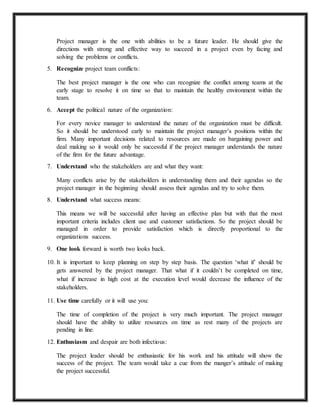
Question no 2: Where would you place yourself in figure 2? 
Answer: 
We would place our self in sensible political actors because we understand the fact that politics is 
necessary for achieving goals through negotiation and bargaining. Another thing is that staying 
out of politics is not the same as standing the middle ground and being mature, but rather being 
naive. And the alternative to being “naive” is not necessarily becoming a “shark”. Hence the real 
middle ground is becoming sensible is to accept , the fact that politics is inseparable from any 
organization, and is therefore a necessary means for achieving goals through bargaining and 
negotiations. This is true for any member of organization, but to Project Managers in particular 
because they are commonly known to have high level of responsibility without appropriate 
level of authority and they are the people of influence so they need to not only the situation at 
hand, but also the people that are involved in order to determine what buttons to push to 
successfully be able to influence the situation in a favorable direction to themselves and the 
project. Sensible political actor’s makes alliances with power members of other stake holder 
departments, networking, negotiating mutually acceptable solutions to seemingly insoluble 
problems and recognizing the importance of the act of give and take in organizational context.
Question no.3: A few of guidelines are related to the need to understand the reason for the 
project at the first place. Which guidelines would you place in this category? Why is this so 
crucial? 
Answer: 
Remember what you are trying to do 
The manager should always give first priority to the mission of the project; he needs to keep it 
forefront to himself as well as he team. It is so important to him because throughout the project 
right from the start to the termination point it will help him focusing on the purpose of the 
project. It will also give him and the team a motivation towards the success of project. Losing the 
mission from mind will detract the entire project which can result into direct failures hence it is 
very crucial to project manager. 
Plan, Plan and Plan 
The saying that those who fail to plan are planning to fail hold true in this case. Planning is the 
core component of every project success. It is the initial planning phase in which project 
manager sets the reason, objective or the purpose of the project. It is very important in deciding 
the success or failure rate of project. Only detailed, specific and realistic planning can leads to 
clear implementation and termination of project otherwise vague planning will leads to vague 
specifications and thus implementation. 
Understand the context of project management 
To understand the reason behind the project it is first important to understand the context of 
project management which is operating in a particular organization. Each project is unique to 
giving new product or services in a temporary different environment outside the routine 
organization environment. The project manager needs to align the project strategy with the 
overall organizational strategy and goal in order to meet success of the project.
Question no.4: Why in lesson 9, is always thinking about “what if” so important? 
Answer: 
The approach “what if” can be considered same as an approach for continuous improvement. It is 
important to have a “what if” approach because being satisfied with the current levels of 
performance may lead to overoptimistic estimates. If the project team maintains the continuous 
improvement approach this allows them to critically analyze the system, and unearth problems 
that aren’t apparent. This approach also enables the team to devise contingency plans and save 
themselves from costs of over budgeting, time wastage and performance loss. Critical thinking 
usually also leads to more cost effective and creative solutions. This approach also means that 
the project team has the opportunity to check and balance the real estimates versus the planned 
ones at the time they occur, otherwise corrections after the loss has been incurred commence. 
The constant drill of critically analyzing all parts of the decisions and actions sound hectic but it 
gives the whole project stability and support. If the project has been continuously analyzed for 
improvements, this gives the members enough room to be creative and take risks, since they 
already have back up plans at their disposal. Some projects are subject to dynamic environment, 
and the future trends cannot be precisely predicted. 
Question no.5: Lesson 12 warns about not planning enough, but also spending too much 
time planning, how do u draw line? 
Answer: 
Planning is an important stage as the success of the other stages totally depends on it. If the 
planning is done efficiently and proper work plans are made out of it then the project manager 
can achieve required results. But it the planning is not done properly then issues will be faced by 
the project manager and things will have to be redone that will incur a lot of cost and there is also 
a chance that project will be a failure. On the other hand if too much time is spend on this stage 
then there is a chance that the existing opportunity may not remain when the project manager is 
done with the planning. So what project managers should do is that they should keep a balance 
that is time they should not spend too much time on this stage and not too less time. They should 
be smart enough like the entrepreneurs who can recognize the mistake and change their strategies 
accordingly.

Project Management case analysis

  • 1.
    Course Title ProjectManagement Assignment #:3 Assignment Topic: “Lessons for Accidental Professions” Group Name: Bravo Name: Saddam Rafay Waqas Khalid, Misbah Jamil, Bilal Naseer, Khurram waheed, Junaid Ali Enrollment #:01-120121-068, 01-220121-018 01-120121-039, 01-120121-018, 01-120121-055 01-220121-022 Submitted To: Sir Zahid Majeed Date: 9-22-2014
  • 2.
    Lesson for anAccidental Profession Summary: The use of projects and project management continues to grow in our society and its organizations. Businesses regularly use project management to accomplish unique outcomes with limited resources under critical time constraints. Project management is the powerful tool for the organization to achieve its goals. Project manager acquires the sills but are not capable of providing a future leader with skills and abilities to carry on the project. This article is about to enhance the sills of the project manager since the improvement of project management has been discussed so many times but not the skills or project manager. The qualities in a leader we see is the problem solving, visional, motivational, ethical and etc. project manager is the one who manages the project and it can be done by providing full means, support and confidence for their team. The project managers have a little authority and have the ability to operate the hierarchy different from of traditional one. They might be a boss but not in a complete way, they can give the directions but cannot provide incentives or rewards instead of that they can only influence the teams. Because of such limitations the project management is termed as accidental profession. The two reasons for it are: project managers are selected and trained by formal and systematic programs. Secondly, many of the individuals grow up with a dream to be a project manager without defining this path. Novice managers are given the projects to provide complete data about completion work, budget, and the set of performances and those who done it on time are successful and those who don’t are failing. This creates among project manager the fear of losing the job and that’s why with pressure they aren’t able to perform their task successfully. Many companies do the same mistake again and again, instead of providing training and motivating the managers skills. The problems faced by the novice managers are mostly behavioral and managerial since the interaction within the organization is very much essential. This unplanned approach to project management is often coupled with the concept of on the job training. Ideally project managers are called upon to lead, coordinate, plan, and control a diverse and complex set of processes and people in the pursuit of achieving project objectives. They are hindered with inadequate training and unrealistic expectations are to unnecessarily penalize them before they can begin to operate with any degree of confidence or effectiveness. A successful project is defined as one that has come in on time, has remained under budget, and performs as expected (that is, it conforms to specifications). Recently fourth dimension is added that is: client satisfaction which determines project success .This means that a project is only successful if it satisfies the needs of its intended user. Following 12 rules can tell what problems project managers face and how they can be faced.
  • 3.
     Most ofproject managers are facing the problems of understanding the environment and context of the project. Project management is inherently problematic for a normal corporate structure, as it forces people to work outside the boundaries of traditional hierarchical structures in environments that rely on alternate methods of authority. A project is a temporary endeavor companies undertake to create a unique result. Projects tend to threaten the status quo, as they intrinsically mean change. Because of this, it is imperative to understand stakeholder expectations, how to get and maintain management support and resources, how to develop a project scope statement that will hold the test of time and how to define, plan, measure and control the project.  Most of the project managers get into panic and anxiety state as soon as any conflict occurs. However these conflicts occur naturally when such diverse workforce is operating together. He should rather take up it as a healthy and positive gesture towards group development. Another common mistake is that manager tries to push the conflict below the surface without even analyzing its nature. He should first analyze it and then use the best possible conflict management strategy.  Project manager should identify at an early stage the important stakeholders and their expectations from the project. It will help him in reducing conflicts and meeting up their expectations. It is almost impossible to please all the groups but he should at least build satisfactory relationships with everyone so that they can let him perform all the work without any interference.  Project managers should be using the political nature of their organizations in a positive way. He should neither become over political nor under political in nature but should be implementing a midway political sensibility. It includes using politics only when necessary, expanding his networking and using negotiation and bargaining strategies.  One of the important attribute of these managers is to be a flexible leader. He needs to create a balance in his leadership styles and have a great knowledge of using a particular leadership style at particular situation and time which can act most effectively. Flexible leadership is an important requirement in this regard. It is to be assumed that no individual has all the knowledge with him, and it is natural that help is to be seeked at various points of work. A good manager is the one who knows the right questions to be asked from the subordinates. It is also important that managers must have a strategy to ask questions in a constructive way. The questioning should be such that it leads to clarification of the problem at hand not the other way round.  The traditional practice of assessing a project’s success on the basis of budget, performance and time has now evolved with an important fourth element that is client use and satisfaction. Modern evaluations lay importance on satisfaction of the clients primarily. Rewards hold a significant importance in this regard. Many companies reward the project managers halfway through the project completion to increase motivation and dedication levels. The final
  • 4.
    assessment rests withclient’s satisfaction although the importance of budget, time and performance cannot be denied in terms of operational efficiency.  Teamwork lays the foundation for success in complex and multi-dimensional projects. It is the project manager’s job to create the right combination of functional teams and lay round rules for ensuring cohesiveness. This is a time consuming effort but it pays off in terms of increased efficiency and productivity. Unconventionally speaking, it is often considered workable to allow the teams with refreshment opportunities to keep them working with zest. Project manager, here by plays the role of motivator, mediator and someone who resolves conflicts creatively.  Project leaders need to maintain a balanced flow of information regarding the current performance status of the project at hand. The project members should have an idea of what is happening in the broader picture so that they integrate themselves with the whole scenario more accurately. The information must be true and must be available to the subordinates when they require it.  The project manager should keep an approach of continuous improvement while assisting the project through its different phases. Contending oneself with current performance levels leads to monotony and a disability to locate errors. The example of Project Chunnel, which was a way to link Britain and France, has been given that because of lack of backup plans, the project isn’t completed yet and they missed the boat on major revenue opportunities in summers.  It is indeed very important to stay focused on the end goal that the project is supposed to achieve. It is very easy to get lost in the daily chaos of deadlines, tasks and allocations and loose the track of purpose. A project manager and the whole team need to stay focused on the purposes idealized in planning phases. Each member of the project should know how their individual contribution fits into the bigger picture and what is the big goal that they all are trying to achieve?  Time management is a very difficult task which needs to be conducted efficiently to ensure that time is productively utilized. Time management helps in identifying those common actions and proceedings that led to wastage of time and non-productivity. Apart from that, time management provides solution to overcome the time killing activities. According to one author time management should be based on realistic time estimates, clear requirements, contingencies availability, revise the estimates, identification of fixed factors, and flexibility for negotiations.  Last is all about the appropriate planning. The crux of the project management is that take time to get the things done right at first time. Planning stage should be managed very effectively by the project managers as the success of other stages depend on the planning stage. But too much time on this stage can lead to point where the existing opportunity can be missed.
  • 5.
    Question no.1: Whatare the reasons the author advances for project management to be considered an “accidental profession”? The twelve guidelines are presented in no particular order. Order them by level of importance and explain your reasoning? Answer: Accidental Project Team Management: Project manager are the little CEO. They have the authority but not in a complete way, they are the bosses of the team but cannot reward them or give them appraisals. They have to work outside the traditional hierarchy. They are not the kings but kingpin. Because of such limitations many writer named the project management as accidental project management. The two reasons for naming it are: 1. The firms which are specialized for project management are having the formal and organized programs for selecting and training the Project manager which end in results for providing the manager but not his/her skills which need to succeed. 2. Many individuals dream of becoming a project manager, which is neither a well defined nor a well understood career path within the most organizations. Twelve Guidelines: The order I have given to it is: 1. Above all, plan, plan and plan: The reason for putting it at first is because planning is the efficient project management to do it timely. It includes the budget, team’s efficiency, and project specifications. Without a proper plan many projects can be left incomplete after wasting money and many resources on them. 2. Build and maintain a cohesive team: According to the plan, the project manager has to build the efficient team as when a team is selected for project development and its implementation; the healthier the relationship/atmosphere of the team, the greater is the chance the team will work effectively. 3. Understand the context of project management: It’s very much important to understand the projects challenges by the project manager and team. It’s the unique form of organizational work. 4. Lead from the front:
  • 6.
    Project manager isthe one with abilities to be a future leader. He should give the directions with strong and effective way to succeed in a project even by facing and solving the problems or conflicts. 5. Recognize project team conflicts: The best project manager is the one who can recognize the conflict among teams at the early stage to resolve it on time so that to maintain the healthy environment within the team. 6. Accept the political nature of the organization: For every novice manager to understand the nature of the organization must be difficult. So it should be understood early to maintain the project manager’s positions within the firm. Many important decisions related to resources are made on bargaining power and deal making so it would only be successful if the project manager understands the nature of the firm for the future advantage. 7. Understand who the stakeholders are and what they want: Many conflicts arise by the stakeholders in understanding them and their agendas so the project manager in the beginning should assess their agendas and try to solve them. 8. Understand what success means: This means we will be successful after having an effective plan but with that the most important criteria includes client use and customer satisfactions. So the project should be managed in order to provide satisfaction which is directly proportional to the organizations success. 9. One look forward is worth two looks back. 10. It is important to keep planning on step by step basis. The question ‘what if’ should be gets answered by the project manager. That what if it couldn’t be completed on time, what if increase in high cost at the execution level would decrease the influence of the stakeholders. 11. Use time carefully or it will use you: The time of completion of the project is very much important. The project manager should have the ability to utilize resources on time as rest many of the projects are pending in line. 12. Enthusiasm and despair are both infectious: The project leader should be enthusiastic for his work and his attitude will show the success of the project. The team would take a cue from the manger’s attitude of making the project successful.
  • 7.
    13. Remember whatare you trying to do: The project manager has to keep in mind the purpose of the project and also the end result. Question no 2: Where would you place yourself in figure 2? Answer: We would place our self in sensible political actors because we understand the fact that politics is necessary for achieving goals through negotiation and bargaining. Another thing is that staying out of politics is not the same as standing the middle ground and being mature, but rather being naive. And the alternative to being “naive” is not necessarily becoming a “shark”. Hence the real middle ground is becoming sensible is to accept , the fact that politics is inseparable from any organization, and is therefore a necessary means for achieving goals through bargaining and negotiations. This is true for any member of organization, but to Project Managers in particular because they are commonly known to have high level of responsibility without appropriate level of authority and they are the people of influence so they need to not only the situation at hand, but also the people that are involved in order to determine what buttons to push to successfully be able to influence the situation in a favorable direction to themselves and the project. Sensible political actor’s makes alliances with power members of other stake holder departments, networking, negotiating mutually acceptable solutions to seemingly insoluble problems and recognizing the importance of the act of give and take in organizational context.
  • 8.
    Question no.3: Afew of guidelines are related to the need to understand the reason for the project at the first place. Which guidelines would you place in this category? Why is this so crucial? Answer: Remember what you are trying to do The manager should always give first priority to the mission of the project; he needs to keep it forefront to himself as well as he team. It is so important to him because throughout the project right from the start to the termination point it will help him focusing on the purpose of the project. It will also give him and the team a motivation towards the success of project. Losing the mission from mind will detract the entire project which can result into direct failures hence it is very crucial to project manager. Plan, Plan and Plan The saying that those who fail to plan are planning to fail hold true in this case. Planning is the core component of every project success. It is the initial planning phase in which project manager sets the reason, objective or the purpose of the project. It is very important in deciding the success or failure rate of project. Only detailed, specific and realistic planning can leads to clear implementation and termination of project otherwise vague planning will leads to vague specifications and thus implementation. Understand the context of project management To understand the reason behind the project it is first important to understand the context of project management which is operating in a particular organization. Each project is unique to giving new product or services in a temporary different environment outside the routine organization environment. The project manager needs to align the project strategy with the overall organizational strategy and goal in order to meet success of the project.
  • 9.
    Question no.4: Whyin lesson 9, is always thinking about “what if” so important? Answer: The approach “what if” can be considered same as an approach for continuous improvement. It is important to have a “what if” approach because being satisfied with the current levels of performance may lead to overoptimistic estimates. If the project team maintains the continuous improvement approach this allows them to critically analyze the system, and unearth problems that aren’t apparent. This approach also enables the team to devise contingency plans and save themselves from costs of over budgeting, time wastage and performance loss. Critical thinking usually also leads to more cost effective and creative solutions. This approach also means that the project team has the opportunity to check and balance the real estimates versus the planned ones at the time they occur, otherwise corrections after the loss has been incurred commence. The constant drill of critically analyzing all parts of the decisions and actions sound hectic but it gives the whole project stability and support. If the project has been continuously analyzed for improvements, this gives the members enough room to be creative and take risks, since they already have back up plans at their disposal. Some projects are subject to dynamic environment, and the future trends cannot be precisely predicted. Question no.5: Lesson 12 warns about not planning enough, but also spending too much time planning, how do u draw line? Answer: Planning is an important stage as the success of the other stages totally depends on it. If the planning is done efficiently and proper work plans are made out of it then the project manager can achieve required results. But it the planning is not done properly then issues will be faced by the project manager and things will have to be redone that will incur a lot of cost and there is also a chance that project will be a failure. On the other hand if too much time is spend on this stage then there is a chance that the existing opportunity may not remain when the project manager is done with the planning. So what project managers should do is that they should keep a balance that is time they should not spend too much time on this stage and not too less time. They should be smart enough like the entrepreneurs who can recognize the mistake and change their strategies accordingly.