CAR ENGINE MANUFACTURE PROCESS
Project Management Assignment: Evaluating the
Process in Car Manufacturing
Table of Contents
1. Scope of the Manufacturing Processes ..................................................................................3
1.1. Identify, and document, the parameters and context ......................................................3
1.2 Identify features and functions of plant, facilities, services, labour and skill distribution
used for manufacturing processes..........................................................................................4
1.3 Identify stakeholders to be consulted as part of the evaluation .......................................5
1.4 Confirm work health and safety (WHS) and regulatory requirements, codes of practice,
standards, risk assessment and registration requirements for manufacturing plant...............6
1.5 Investigate sustainability implications of manufacturing processes................................6
1.6 Identify sources of professional and technical assistance................................................7
2 Evaluate manufacturing processes..........................................................................................8
2.1 Identify manufacturing principles and techniques required to evaluate and optimise the
processes ................................................................................................................................8
2.2 Identify appropriate analysis techniques, software and software validation techniques .8
2.3 Evaluate and assess facilities, services, plant and tooling in relation to product
manufacturability and maintainability...................................................................................9
2.4 Evaluate and assess process layout, use of automation and process control using lean
systems and techniques........................................................................................................10
2.5 Evaluate and assess materials, product flow and transfer operations, buffer and
emergency stocks, warehousing, stores and logistics using lean systems and techniques ..12
CAR ENGINE MANUFACTURE PROCESS
2
2.6 Evaluate WHS and regulatory compliance and risk management practices of
manufacturing processes and maintenance procedures .......................................................12
2.7 Evaluate processes for sustainability .............................................................................13
2.8 Evaluate process compatibility with maintenance management system .......................14
References................................................................................................................................18
CAR ENGINE MANUFACTURE PROCESS
3
1. Scope of the Manufacturing Processes
1.1. Identify, and document, the parameters and context
The engine block is essential part of a car manufacturing and assemble process. The
advancement of technology has increase the demand for lightweight, durable, wear resistance
and increase in power and efficiency of the engine (Jadhav, Mantha, & Rane, 2015). The car
manufacturing industry operates closely with the all the organisational and technical
environment required for developing the accurate structure of the manufactured item. The
environment in the manufacturing process is dependent on the interplay between
organisational, psychological and physical ergonomics of both human and technical resource
associated.
The manufacturing procedure and criteria used in the processes associated with chemical,
hazardous substance, safety of the workers, competency development, vibrations and sound.
Further, the engine manufacturing industry follows specific legislative and regulation
compliance for maintaining the safety to the workers as well as to the environment. The
technical design and efficiency of the engine should be specifically made with the aim of
reducing carbon emission from the car.
In this Project Management Assignment it is identified that Lean manufacturing process is
utilised in the engine design and manufacturing in car industry for increasing the work
efficiency and reducing the negative impact on the environment. The manufacturing of the
car engine requires various number of raw materials including aluminium, steel for base and
chassis, rubber for moulded parts used in the engine. Further, technical assessment software
and analysis tools are required to evaluate and manage the yield stress, normal stress, fatigue,
creep and notch toughness on the engine with regular usage.
CAR ENGINE MANUFACTURE PROCESS
4
1.2 Identify features and functions of plant, facilities, services, labour and skill
distribution used for manufacturing processes
In the car engine manufacturing process, the sand casting process is employed in spite of the
cost effective process obtained with die-casting. The casting process used in the
manufacturing includes high temperature of the molten aluminium for obtaining the coolant
passages and surface finis of the car engine (Prasad, Kumar, & Jeeva, 2016). Further, a
combination of water and silica are used with the sand compacting the high pressure and
vibration of the molten metal during the casting. Therefore, the car manufacturing plant has
specialised element and physical component for handing the high temperature of the molten
metal. In addition to that, physical components like woods are used for compacting and
maintaining the shape of the engine.
Further a worker friendly production line has been utilised in the manufacturing process, for
ensuing the aesthetic design and quality of the engine frame. Press die method is utilised for
analysing the design accuracy of the engine, and welding and assembly jibs robots are used
for precise evaluation of the design constraints (Rafique et al., 2016). The results of the
evaluation process helps in creating technical and physical audits.
The design of the engine is generated with the application of advanced designing and
simulation tools. The technical experts and human resources are allocated based on their
expertise for examining the moulding die components and quality of the finishing. Similarly,
simulated jigs are installed to evaluate the design precision with the help of 3D data of the
engine.
CAR ENGINE MANUFACTURE PROCESS
5
1.3 Identify stakeholders to be consulted as part of the evaluation
The manufacturing of the car engine process, are associated with both direct and indirect
influence of various stakeholders. The external stakeholder involved in manufacturing
includes:
• Customers: Customers are one of the most essential stakeholders associated with the
engine manufacture process. The requirements, demands, satisfaction of the
customers have vital impact on the engine design and quality;
• Suppliers: The raw materials essential of the manufacturing are outsources from
various countries. Therefore, the availability of the suppliers are essential for the
manufacturing process;
• Policy Maker: the local and international government bodies including Keidanren and
the Japan Automobile Manufacturers Association, often produce various policies and
regulations that needs to be followed during the design and manufacturing. The
environmental laws includes the reduction of the CO2 emission from the car engines
and reduction of the waste chemicals from the manufacturing process (Samant, Mittal,
& Prakash, 2018);
The internal stakeholders involved with the manufacturing process as inferred in this Project
Management Assignment includes:
• Investors: The investors providing financial resource to the manufacturing process are
essential for verifying, reviewing and launching of any new products or process used
in the engine manufacturing.
• Technical Experts: The technical expert associated in the manufacturing process
develops the schematic diagram and engine design for the car. The developed design
are used in the moulding process for manufacturing.
CAR ENGINE MANUFACTURE PROCESS
6
• Labours: The labours are used during the casting, core design, and assembling of the
main engine mould process;
• Consultant: The consultant are the decision making authorities associated in the
engine manufacturing. The addition, modification or exclusion of any critical design
in the engine are evaluated and reviewed by consultant before including it in
manufacturing.
1.4 Confirm work health and safety (WHS) and regulatory requirements, codes of
practice, standards, risk assessment and registration requirements for manufacturing
plant
The work environment for engine manufacturing is associated with various risks and safety
concern for the workers. The car engine manufacturing process includes various guidance
and regulations that needs to be maintained in the manufacturing environment for ensuring
the safety of the workers. The WHS (Work Health and Safety) ensures the process of safe
and secure equipment used by the labours. The chemical hazards produced as the by-products
of the manufacturing process are treated properly before disposing.
Further, the manufacturing environment as mentioned in this Project Management
Assignment includes and complies with the Work Health and Safety Act 2011 (Qld), along
with regulations mentioned in Workplace Health and Safety Queensland. The utilisation of
the safety acts and regulation in the manufacturing process helps in enabling following of the
safety and best practices used and maintaining save environment to work for the employees.
1.5 Investigate sustainability implications of manufacturing processes
The motor industry has created significant environmental issues and concern in the recent
days. The introduction of the various environmental legislation by Australian government
including “Environmental Resource Efficiency Plans” have affected the process the vehicles
CAR ENGINE MANUFACTURE PROCESS
7
and its parts are manufactured. Invocative gearbox and enhanced design of the car engine are
developed for reducing the transmission of the CO2 from tailpipe (Ghobakhloo & Azar,
2018). Further, the inclusion of the Auto Oil program in the car design has provided inclusion
of more stringent performance standard for the engine. The manufacturing process is in
continuous monitoring and evaluation for ensuing the effective impact on the environmental
sustainability and compliance with the environmental laws and legislation.
1.6 Identify sources of professional and technical assistance
Source of professional assistance: The manufacturing process requires the development of
the appropriate design for the engine while maintaining the accurate weight, resistance,
durability and power (Karthe et al., 2017). In addition to that, various legislative rules and
regulations are needs to be incorporated in engine design for maintaining the safety of both
environment and the car. Therefore, professional assistance of the laws and policy makers
along with the expertise of the human resource management, process control and industry
specialists are included for smooth operational efficiency.
Source of technical assistance: In terms of technical assistance, the mathematical and
physics experts specialised in drafting. Kinetics, mechanics and mechatronics to be included
in the design. Further, the engineering and technical professionals are utilised for analysing
and incorporating the corrosion resistance, vibration withstanding and elasticity factor of the
engine.
CAR ENGINE MANUFACTURE PROCESS
8
2 Evaluate manufacturing processes
2.1 Identify manufacturing principles and techniques required to evaluate and optimise
the processes
The manufacturing of the car engine are developed based on the casting process for
developing the main block. The manufacturing process requires controlled environment for
the safety of the workers and ensuring the quality of the engine compliance with design.
Further the reliability and quality of the engine design is developed based in the application
of various principles that are followed throughout the manufacturing process. For the
optimisation of the manufacturing process, various principles are utilised including optimised
production, zero defects, zero wastage for scaling up the performance metric (Dandin, &
Mench, 2015). Further, for ensuing the required quality and decreasing defects in the engine,
the permeability of the sand grains are monitored and maintained for reducing the porosity
and providing a good surface finish. Further it is identified in this Project Management
Assignment that the evaluation and testing process are optimised by the inclusion of
automated system for precise size and design of the engine. In addition to that, during the
entire manufacturing cycle and process, proper monitoring and control of the equipment are
done for ensuring the effectives and reducing the possibility of flaws.
2.2 Identify appropriate analysis techniques, software and software validation
techniques
The casting process used during the engine manufacturing often creates small indentation and
glitches in the finishing surface of the aluminium body. The lack of proper evaluation and
verification of the engine before assembling in the car would result in poor performance.
Therefore, in order to ensure the required quality and design of the engine, various simulation
and advanced quality assurance tools are utilised. Jigs are installed for installation of 3D data
creation in the manufacturing process. The 3D simulation process helps in determining the
CAR ENGINE MANUFACTURE PROCESS
9
quality and productivity of the engine with heat simulation. In addition to that, for analysing
the reliability and design optimisation of the produced engine, CAE (Computer Aided
Software), CFD (Computational Fluid Dynamics) tools are used for time efficient and
accurate design analysis (Alhuraish, Robledo & Kobi, 2016). This ensures that the
manufactured engine have met the requirements and specification of ISO 13485 and ISO
9000 (Murugesan, Rajenthirakumar & Chandrasekar 2016).
2.3 Evaluate and assess facilities, services, plant and tooling in relation to product
manufacturability and maintainability
Product manufacturability: Product manufacturability of the car engine is identified based in
the impact of various factors that influence the manufacturing process as illustrated in the
below section:
Cost: The manufacturing proves for the engine are planned to be cost effective with the use
of light weight and durable materials. In addition to that, reusability of the sand and wood for
inserting pressure reduced the overall cost.
Quality Control: Various advanced technical software application are utilised including
failure effects analysis (FEA) for ensuing the best quality provided to the market (Rafique et
al., 2016).
Efficiency: The efficiency of the manufactured engine are ensured with the advanced design
and simulation process for gaining enhanced resistance, durability, strength, wear resistance
and low carbon emission.
Resource Requirement: The engine manufacturing process requires lightweight materials
including aluminium, sand and wood for casting process. Other raw materials includes
vinyl’s, silicon and plastics (Schnellbach, & Reinhart 2015). Other resources includes
specialised equipment for controlling high temperature and pressure required for
CAR ENGINE MANUFACTURE PROCESS
10
manufacturing. In addition to that, specialised technical personnel and software application
are essential for ensuing the quality and efficiency of the developed engine.
Price: The required cost for manufactured engine ranges between AUD $5000 to AUD
$3000 (Kumar, Sharma & Agarwal, 2015).
Product maintainability: The maintainability of the car engine is developed based on the
remedial maintenance and preventive maintenance. Based on the historical data obtained,
preventive maintenance requires the replacement of spark plugs after every 30 thousand km
of usage for reducing the chances of failure (Samant, Mittal, & Prakash, 2018). Further,
changes of the oil filter in regular time interval would help in cleaning the metal sludge inside
the engine and ensure optimised performance of the engine. The remedial maintenance
requires the replacement of the engine in case of any failure or issues identified.
2.4 Evaluate and assess process layout, use of automation and process control using lean
systems and techniques
Process layout: Reducing waste in the manufacturing process are implemented with the
development of effective plan while eliminating or reducing the possibilities of errors.
Waiting, overproductions, over processing defects are reduced with implementation of
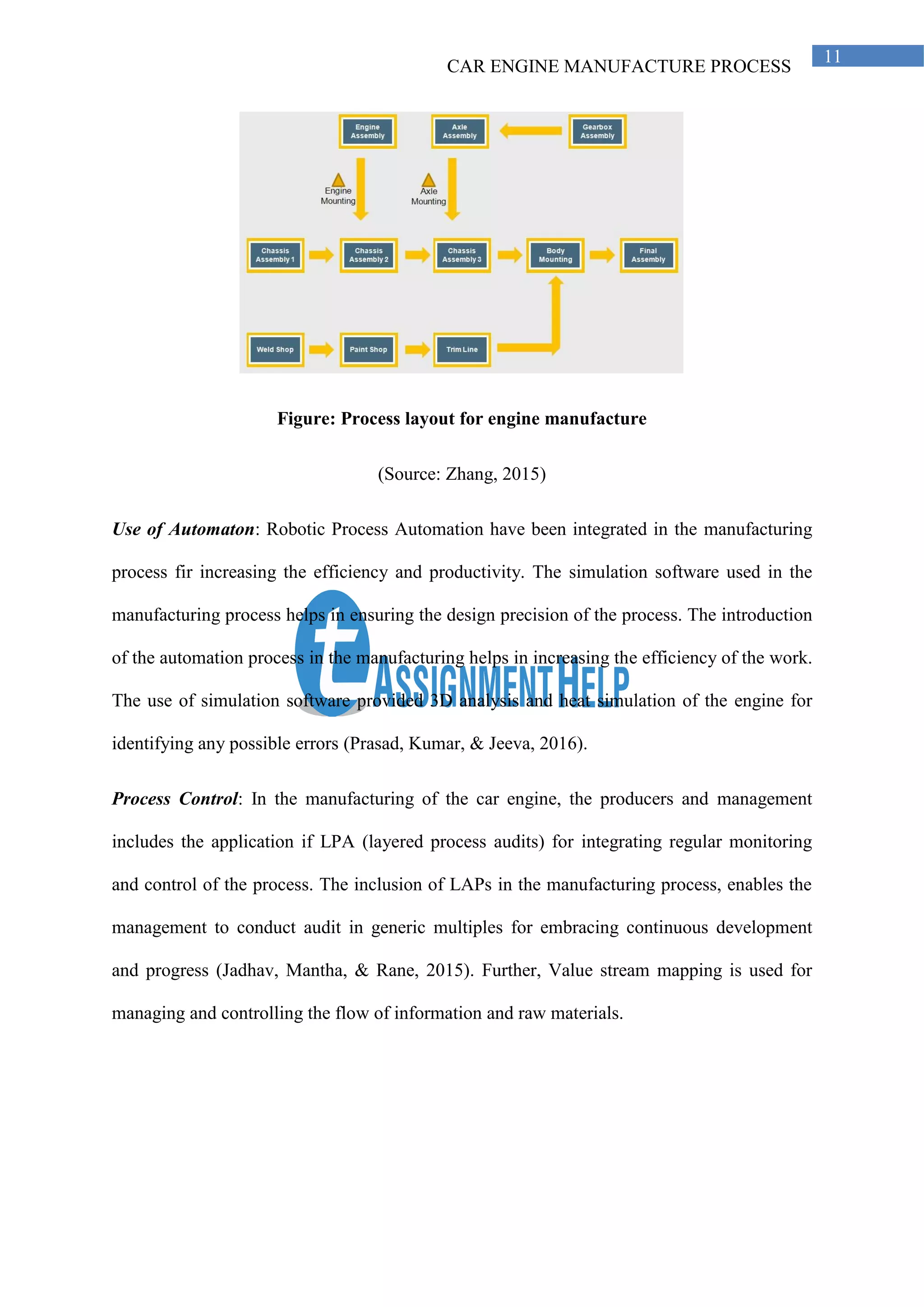
transparent layout of operations (Nallusamy, & Saravanan, 2016). The below process layout
have been provided for the engine management used in the industry. The transparency in the
process layout has assisted the workers in the manufacturing industry to reduce the waiting time
for raw materials to reach the production area while ensuing the verification of each engine
before distribution in the market.
CAR ENGINE MANUFACTURE PROCESS
11
Figure: Process layout for engine manufacture
(Source: Zhang, 2015)
Use of Automaton: Robotic Process Automation have been integrated in the manufacturing
process fir increasing the efficiency and productivity. The simulation software used in the
manufacturing process helps in ensuring the design precision of the process. The introduction
of the automation process in the manufacturing helps in increasing the efficiency of the work.
The use of simulation software provided 3D analysis and heat simulation of the engine for
identifying any possible errors (Prasad, Kumar, & Jeeva, 2016).
Process Control: In the manufacturing of the car engine, the producers and management
includes the application if LPA (layered process audits) for integrating regular monitoring
and control of the process. The inclusion of LAPs in the manufacturing process, enables the
management to conduct audit in generic multiples for embracing continuous development
and progress (Jadhav, Mantha, & Rane, 2015). Further, Value stream mapping is used for
managing and controlling the flow of information and raw materials.
CAR ENGINE MANUFACTURE PROCESS
12
2.5 Evaluate and assess materials, product flow and transfer operations, buffer and
emergency stocks, warehousing, stores and logistics using lean systems and techniques
Materials: The elimination of the waste materials, defect products are the essential needs of
the lean manufacturing process used. (Amrouche, et al., 2016) During the manufacturing of
the engine, the application of the automated software and machineries have eliminated the
possibilities of the defects.
Product flow: The flow of manufacturing for the car engine includes the software design of
the engine, simulation of the schematic work, steel casting process, and quality analysis of
the developed engine structure (Mahendran, Kumar & Jeyapaul, 2016). The prominent
identification of the manufacturing process have reduced unnecessary transfer of the
materials. In addition to that, the visual presentation of each step and information has boosted
the problem solving processes while increasing the work efficiency.
Transfer operations: The transfer of the raw materials along with the engine during the
manufacturing has been limited with the proper identification of the process flow and
defining the manufactuing environment for optimised results.
Warehousing, store, and logistics: The completion of the successful manufacture of the
engine requires the painting and storage job for the engines. Automated simulation process
identified the appropriate condition for paint and automated robots are used for simulated
movement and effective painting (Ellis 2016). Further, proper inspections are carried out with
3D simulation tools for identification of effects or manufactuing errors.
2.6 Evaluate WHS and regulatory compliance and risk management practices of
manufacturing processes and maintenance procedures
With the increase in environmental concern, the Government of Australia have highlighted
and introduced various policies and rules that needs to be integrated within the automobile
CAR ENGINE MANUFACTURE PROCESS
13
manufactuing process for car engine. The increased number of regulations and policies have
created multiple challenges for the manufactured and engineers. The failure in manufacturing
process often results in significant financial loss, injury to the workers and even death.
Application of security standard ISO 26262 have become more essential and unavoidable for
ensuing the product development and safety of the work environment (Alves Filho, Nogueira,
& Bento 2015). Furthermore, various studies have showed that the technical development in
the field of automobile industry have been emerging that improved the product alignment,
verification, quality assurance and integration of various safety regulation in much effective
manner. In addition to that, the regular risks management and assessment in the manufactuing
process assist the manufacturing team to be updated with the possible risks.
2.7 Evaluate processes for sustainability
The right balance between the work efficiency, social responsibility, environmental care and
economic progress recognises the manufacturing process for the automobile engine
production. Therefore, in engine manufacturing process, the sustainability steps have been
included in LCA (life cycle analysis), reducing carbon footprints, and testing of the
automobile volatile organic compounds (Ferguson & Kirkpatrick, 2015). Through the
application of the LCA the management gets detailed information regarding the distribution,
production, outsourcing raw materials, proper disposal of the waste materials. Further, this
includes the alignment of various governmental policies and environmental laws for reducing
the carbon footprints and emission from the engine.
CAR ENGINE MANUFACTURE PROCESS
14
2.8 Evaluate process compatibility with maintenance management system
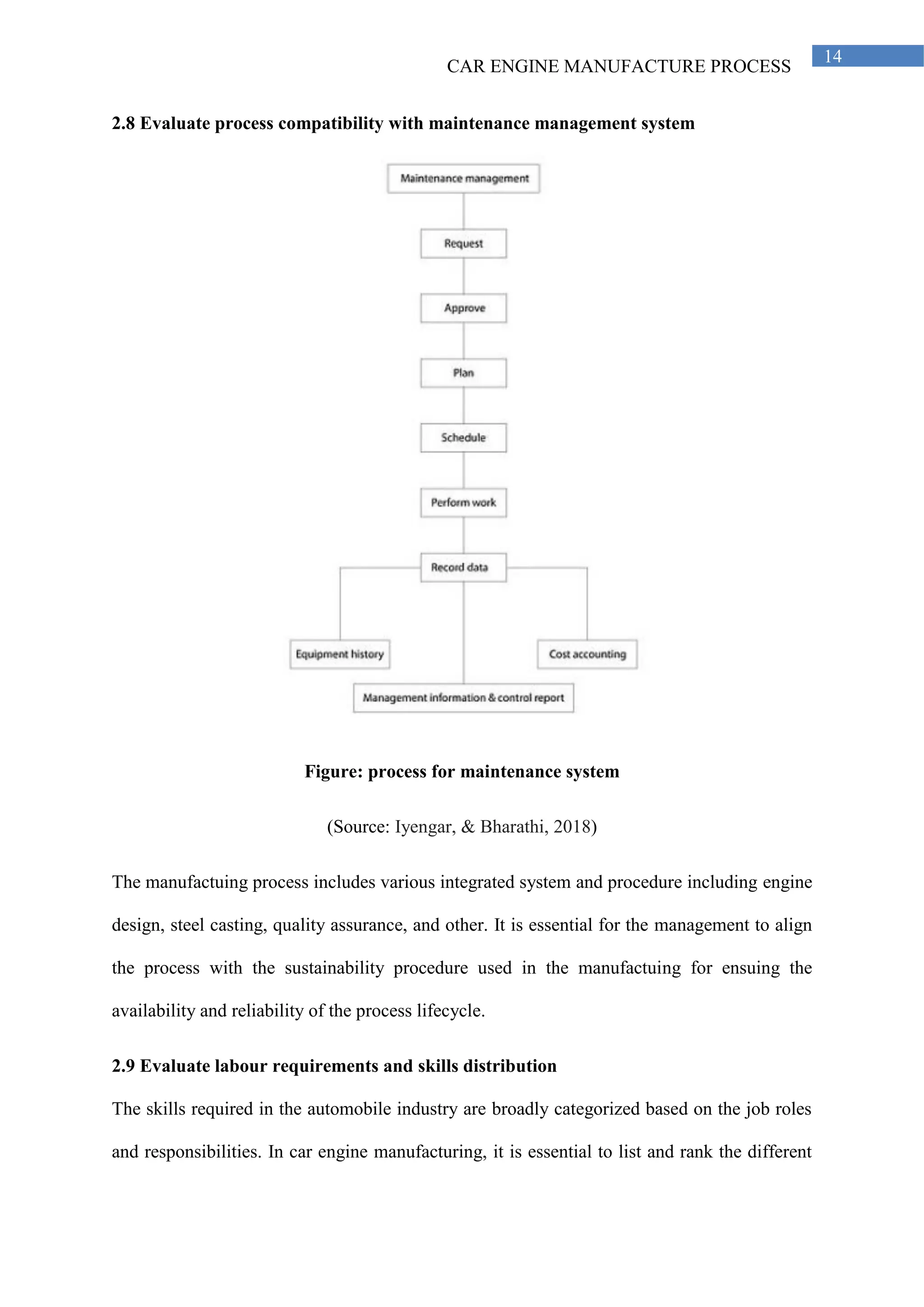
Figure: process for maintenance system
(Source: Iyengar, & Bharathi, 2018)
The manufactuing process includes various integrated system and procedure including engine
design, steel casting, quality assurance, and other. It is essential for the management to align
the process with the sustainability procedure used in the manufactuing for ensuing the
availability and reliability of the process lifecycle.
2.9 Evaluate labour requirements and skills distribution
The skills required in the automobile industry are broadly categorized based on the job roles
and responsibilities. In car engine manufacturing, it is essential to list and rank the different
CAR ENGINE MANUFACTURE PROCESS
15
level or degree of skills pertaining to each personnel. Engine manufacturing is a vast process
encompassing a huge part of mechanical engineering integrated with automobile engineering.
Therefore, it requires certain IT and mathematical skills, technical skills as well as cognitive
and communicate skills. Now, it is important to identify which skill is useful in what context.
Therefore, these different types of skills are required to successfully perform and execute the
complete process of car engine manufacturing (Singh, Rastogi & Sharma, 2013). Apart from
that, the time and timing requirements are to be assessed in order to identify the necessary
project requirements related to material block casting, tooling and finally manufacturing the
engine block. Another factor to decide when categorizing the labour skills is the component
considerations. It is closely associated with maintenance skills and therefore, it is important
that the project manager of the particular car engine-manufacturing project clearly define the
roles and responsibilities depending on the degree of skills expertise and availability of
labour resources.
2.10 Evaluate process information flows for control and process improvement
The overall process of manufacturing the engine block involves information flow across the
different activity or process segments. The schedule planning, resource allocation and skills
distribution information are shared with the concerned entities involved with the project in
order to execute the individual process segments and activities / tasks in a successful manner.
Protection upkeep requires the substitution of parts that are yet working however are relied
upon to bomb soon. It is additionally attempted where corruption of a segment jeopardizes
parts somewhere else in the item (Koren, 2010). The primary apparatus required for sand
throwing is the shape; the form is created by a blend of sand, earth, and water. The example
is the primary instrument required to shape the form, it is typically machined by wood or
aluminium, which can be effectively machined (Jiang, Zhang & Sutherland, 2012). With the
end goal to meet the above utilitarian necessities the material utilized for assembling the item
CAR ENGINE MANUFACTURE PROCESS
16
ought to contain numerous properties (Kalpakjian, Vijai Sekar & Schmid, 2014). The
material ought to contain high quality, modulus of flexibility, wear opposition, capacity to
withstand vibrations, and erosion obstruction. High quality is for the most part worried in
diesel motors due to their high pressure proportions contrasted and petroleum motors.
3 Report results
3.1 Review results of evaluation and assessment with stakeholders
The engine manufacturer company needs to establish proper stakeholder engagement plan in
order to review the results of evaluation and assessment in a successful manner so that the
product meets the requirements. For this purpose, surveys and networking events are carried
out in order to get feedbacks from all the stakeholders directly or indirectly associated with
the project. Information of all the issues is shared across the concerned authoritative
department for reviewing. Outside evaluation results, partner corporations and opinions from
the participants are thoroughly reviewed within a specific span of time. It also closely relates
to the corporate social responsibility of the organization. The communities, investors,
shareholders and customer feedbacks need to be reviewed in order to reach to a meaningful
conclusion and achievement.
3.2 Provide recommendations for improvements, where appropriate
It is important to establish a supportive and stable regulatory environment to be able to drive
productivity and growth simultaneously. New labour laws should be thoroughly monitored
and suitable laws are required to be incorporated in the regulatory structure of the automobile
manufacturing companies. In addition to that, it is recommended to make efforts for
simplification of the existing regulations and laws in order to ensure ease of compliance.
Another important aspect for process improvement in the automobile manufacturing industry
is to have a strong and efficient resource management program (Callister & Rethwisch,
CAR ENGINE MANUFACTURE PROCESS
17
2011). The organization needs to ensure that the manufacturing process has adequate
transparency. In will in turn reduce the resource management costs as well as logistics costs
in an indirect manner. Moreover, it is recommended to concentrate more on developing a
skilled and talented labour pool, which will essentially drive growth and productivity.
3.3 Provide reports and documentation, such as layouts, programs and flow charts
Throughout the process, the engineers need to document all the steps involved in each
process so that the issues and problems can be effectively identified and appropriate measures
can be undertaken. It is essential to develop an initial high-level flow chart to understand the
nature of the process and dependencies between the interrelated tasks or activities.
Furthermore, it helps in performing performance analysis and maintenance and monitoring in
the post-production phases (Unger & Eppinger, 2011). It also sets the pre-requisites or
requirements related to the different aspects of industrial practices in the organizational
culture as well as in the automobile manufacturing sector. Moreover, the overall
manufacturing process will follow a predefined sequential phases, which in turn involves
particular layouts of the individual processes in each stage. It is inferred in this Project
Management Assignment that the responsibility of the project manager to design a clear
activity flow chart and diagram as a guideline or framework for executing the overall
manufacturing project.
CAR ENGINE MANUFACTURE PROCESS
18
References
Alhuraish, I., Robledo, C., & Kobi, A. (2016). Assessment of lean manufacturing and six
sigma operation with decision making based on the analytic hierarchy process. IFAC-
PapersOnLine, 49(12), 59-64.
Alves Filho, A. G., Nogueira, E., & Bento, P. E. G. (2015). Operations strategies of engine
assembly plants in the Brazilian automotive industry. International Journal of
Operations & Production Management, 35(5), 817-838.
Amrouche, F., Erickson, P. A., Varnhagen, S., & Park, J. W. (2016). An experimental study
of a hydrogen-enriched ethanol fueled Wankel rotary engine at ultra lean and full load
conditions. Energy Conversion and management, 123, 174-184.
Callister, W. D., & Rethwisch, D. G. (2011). Materials science and engineering (Vol. 5, pp.
344-348). NY: John Wiley & Sons.
Dandin, S. V., & Mench, R. G. (2015). Development and implementation of Kaizen activities
in an Automobile manufacturing firm. Development, 2(6).
Ellis, S. F. (2016). The Application Of Lean Six Sigma To Improve A Business Process: A
Study Of The Order Processing Process At An Automobile Manufacturing Facility.
Ferguson, C. R., & Kirkpatrick, A. T. (2015). Internal combustion engines: applied
thermosciences. John Wiley & Sons.
Ghobakhloo, M., & Azar, A. (2018). Business excellence via advanced manufacturing
technology and lean-agile manufacturing. Journal of Manufacturing Technology
Management, 29(1), 2-24.
CAR ENGINE MANUFACTURE PROCESS
19
Iyengar, V., & Bharathi, S. V. (2018). Bibliometric Analysis of Lean, Agile, and Leagile
Supply Chains in Automobile Industry (1990-2017). International Journal of
Information Systems and Supply Chain Management (IJISSCM), 11(3), 22-45.
Jadhav, J. R., Mantha, S. S., & Rane, S. B. (2015). Roadmap for Lean implementation in
Indian automotive component manufacturing industry: comparative study of UNIDO
Model and ISM Model. Journal of Industrial Engineering International, 11(2), 179-
198.
Jiang, Z., Zhang, H., & Sutherland, J. W. (2012). Development of an environmental
performance assessment method for manufacturing process plans. The International
Journal of Advanced Manufacturing Technology, 58(5-8), 783-790.
Kalpakjian, S., Vijai Sekar, K. S., & Schmid, S. R. (2014). Manufacturing engineering and
technology. Pearson.
Karthe, M., Tamilarasan, M., Prasanna, S. C., & Manikandan, A. (2017). Experimental
Investigation on Reduction of NOx Emission Using Zeolite Coated Converter in CI
Engine. In Applied Mechanics and Materials (Vol. 854, pp. 72-77). Trans Tech
Publications.
Koren, Y. (2010). The global manufacturing revolution: product-process-business
integration and reconfigurable systems (Vol. 80). John Wiley & Sons.
Kumar BR, R., Sharma, M. K., & Agarwal, A. (2015). An experimental investigation of lean
management in aviation: Avoiding unforced errors for better supply chain. Journal of
Manufacturing Technology Management, 26(2), 231-260.
CAR ENGINE MANUFACTURE PROCESS
20
Mahendran, S., Kumar, A. S., & Jeyapaul, R. (2016). Lean manufacturing in a manufacturing
industry through value stream mapping and simulation study. Int J AdvEngg
Tech/Vol. VII/Issue I/Jan.-March, 554, 558.
Murugesan, V. M., Rajenthirakumar, D., & Chandrasekar, M. (2016). Manufacturing process
improvement using lean tools. Annals of the Faculty of Engineering
Hunedoara, 14(2), 151.
Nallusamy, S., & Saravanan, V. (2016). Lean tools execution in a small scale manufacturing
industry for productivity improvement-A case study. Indian Journal of Science and
Technology, 9(35).
Negi, S., Dhiman, S., & Sharma, R. K. (2013). Basics, applications and future of additive
manufacturing technologies: A review. Journal of Manufacturing Technology
Research, 5(1/2), 75.
Prasad, R. D., Kumar, K. V., & Jeeva, P. A. (2016). Systematic Layout Planning and
Balancing of Engine Production Processes for After Test and After Paint Assembly
Lines. International Journal of Vehicle Structures & Systems, 8(1), 41.
Rafique, M. Z., Ab Rahman, M. N., Saibani, N., Arsad, N., & Saadat, W. (2016). RFID
impacts on barriers affecting lean manufacturing. Industrial Management & Data
Systems, 116(8), 1585-1616.
Samant, S., Mittal, V. K., & Prakash, R. (2018). Resource optimisation for an automobile
chassis manufacturer through value stream mapping enhanced with simulation
technique and constraint programming. International Journal of Industrial and
Systems Engineering, 28(3), 379-401.
CAR ENGINE MANUFACTURE PROCESS
21
Schnellbach, P., & Reinhart, G. (2015). Evaluating the effects of energy productivity
measures on lean production key performance indicators. Procedia CIRP, 26, 492-
497.
Singh, J., Rastogi, V., & Sharma, R. (2013). Total productive maintenance review: a case
study in automobile manufacturing industry. International Journal of Current
Engineering and Technology, 3(5), 2010-2016.
Swain, M. N., Jordan, O. P., Mackey, T. J., Seemann, P. S., Samarajeewa, H., & Swain, M.
R. (2016). Modifications to Improve Fuel Consumption in the Remanufacture of
Spark-Ignition Engines for Electric Generators. Journal of Engineering for Gas
Turbines and Power, 138(12), 122803.
Unger, D., & Eppinger, S. (2011). Improving product development process design: a method
for managing information flows, risks, and iterations. Journal of Engineering
Design, 22(10), 689-699.
Zhang, L. (2015). Lean production “with Chinese characteristics”: A case study of China’s
automobile industry. International Journal of Sociology, 45(2), 152-170.

Project management assignment evaluating the process in car manufacturing

  • 1.
    CAR ENGINE MANUFACTUREPROCESS Project Management Assignment: Evaluating the Process in Car Manufacturing Table of Contents 1. Scope of the Manufacturing Processes ..................................................................................3 1.1. Identify, and document, the parameters and context ......................................................3 1.2 Identify features and functions of plant, facilities, services, labour and skill distribution used for manufacturing processes..........................................................................................4 1.3 Identify stakeholders to be consulted as part of the evaluation .......................................5 1.4 Confirm work health and safety (WHS) and regulatory requirements, codes of practice, standards, risk assessment and registration requirements for manufacturing plant...............6 1.5 Investigate sustainability implications of manufacturing processes................................6 1.6 Identify sources of professional and technical assistance................................................7 2 Evaluate manufacturing processes..........................................................................................8 2.1 Identify manufacturing principles and techniques required to evaluate and optimise the processes ................................................................................................................................8 2.2 Identify appropriate analysis techniques, software and software validation techniques .8 2.3 Evaluate and assess facilities, services, plant and tooling in relation to product manufacturability and maintainability...................................................................................9 2.4 Evaluate and assess process layout, use of automation and process control using lean systems and techniques........................................................................................................10 2.5 Evaluate and assess materials, product flow and transfer operations, buffer and emergency stocks, warehousing, stores and logistics using lean systems and techniques ..12
  • 2.
    CAR ENGINE MANUFACTUREPROCESS 2 2.6 Evaluate WHS and regulatory compliance and risk management practices of manufacturing processes and maintenance procedures .......................................................12 2.7 Evaluate processes for sustainability .............................................................................13 2.8 Evaluate process compatibility with maintenance management system .......................14 References................................................................................................................................18
  • 3.
    CAR ENGINE MANUFACTUREPROCESS 3 1. Scope of the Manufacturing Processes 1.1. Identify, and document, the parameters and context The engine block is essential part of a car manufacturing and assemble process. The advancement of technology has increase the demand for lightweight, durable, wear resistance and increase in power and efficiency of the engine (Jadhav, Mantha, & Rane, 2015). The car manufacturing industry operates closely with the all the organisational and technical environment required for developing the accurate structure of the manufactured item. The environment in the manufacturing process is dependent on the interplay between organisational, psychological and physical ergonomics of both human and technical resource associated. The manufacturing procedure and criteria used in the processes associated with chemical, hazardous substance, safety of the workers, competency development, vibrations and sound. Further, the engine manufacturing industry follows specific legislative and regulation compliance for maintaining the safety to the workers as well as to the environment. The technical design and efficiency of the engine should be specifically made with the aim of reducing carbon emission from the car. In this Project Management Assignment it is identified that Lean manufacturing process is utilised in the engine design and manufacturing in car industry for increasing the work efficiency and reducing the negative impact on the environment. The manufacturing of the car engine requires various number of raw materials including aluminium, steel for base and chassis, rubber for moulded parts used in the engine. Further, technical assessment software and analysis tools are required to evaluate and manage the yield stress, normal stress, fatigue, creep and notch toughness on the engine with regular usage.
  • 4.
    CAR ENGINE MANUFACTUREPROCESS 4 1.2 Identify features and functions of plant, facilities, services, labour and skill distribution used for manufacturing processes In the car engine manufacturing process, the sand casting process is employed in spite of the cost effective process obtained with die-casting. The casting process used in the manufacturing includes high temperature of the molten aluminium for obtaining the coolant passages and surface finis of the car engine (Prasad, Kumar, & Jeeva, 2016). Further, a combination of water and silica are used with the sand compacting the high pressure and vibration of the molten metal during the casting. Therefore, the car manufacturing plant has specialised element and physical component for handing the high temperature of the molten metal. In addition to that, physical components like woods are used for compacting and maintaining the shape of the engine. Further a worker friendly production line has been utilised in the manufacturing process, for ensuing the aesthetic design and quality of the engine frame. Press die method is utilised for analysing the design accuracy of the engine, and welding and assembly jibs robots are used for precise evaluation of the design constraints (Rafique et al., 2016). The results of the evaluation process helps in creating technical and physical audits. The design of the engine is generated with the application of advanced designing and simulation tools. The technical experts and human resources are allocated based on their expertise for examining the moulding die components and quality of the finishing. Similarly, simulated jigs are installed to evaluate the design precision with the help of 3D data of the engine.
  • 5.
    CAR ENGINE MANUFACTUREPROCESS 5 1.3 Identify stakeholders to be consulted as part of the evaluation The manufacturing of the car engine process, are associated with both direct and indirect influence of various stakeholders. The external stakeholder involved in manufacturing includes: • Customers: Customers are one of the most essential stakeholders associated with the engine manufacture process. The requirements, demands, satisfaction of the customers have vital impact on the engine design and quality; • Suppliers: The raw materials essential of the manufacturing are outsources from various countries. Therefore, the availability of the suppliers are essential for the manufacturing process; • Policy Maker: the local and international government bodies including Keidanren and the Japan Automobile Manufacturers Association, often produce various policies and regulations that needs to be followed during the design and manufacturing. The environmental laws includes the reduction of the CO2 emission from the car engines and reduction of the waste chemicals from the manufacturing process (Samant, Mittal, & Prakash, 2018); The internal stakeholders involved with the manufacturing process as inferred in this Project Management Assignment includes: • Investors: The investors providing financial resource to the manufacturing process are essential for verifying, reviewing and launching of any new products or process used in the engine manufacturing. • Technical Experts: The technical expert associated in the manufacturing process develops the schematic diagram and engine design for the car. The developed design are used in the moulding process for manufacturing.
  • 6.
    CAR ENGINE MANUFACTUREPROCESS 6 • Labours: The labours are used during the casting, core design, and assembling of the main engine mould process; • Consultant: The consultant are the decision making authorities associated in the engine manufacturing. The addition, modification or exclusion of any critical design in the engine are evaluated and reviewed by consultant before including it in manufacturing. 1.4 Confirm work health and safety (WHS) and regulatory requirements, codes of practice, standards, risk assessment and registration requirements for manufacturing plant The work environment for engine manufacturing is associated with various risks and safety concern for the workers. The car engine manufacturing process includes various guidance and regulations that needs to be maintained in the manufacturing environment for ensuring the safety of the workers. The WHS (Work Health and Safety) ensures the process of safe and secure equipment used by the labours. The chemical hazards produced as the by-products of the manufacturing process are treated properly before disposing. Further, the manufacturing environment as mentioned in this Project Management Assignment includes and complies with the Work Health and Safety Act 2011 (Qld), along with regulations mentioned in Workplace Health and Safety Queensland. The utilisation of the safety acts and regulation in the manufacturing process helps in enabling following of the safety and best practices used and maintaining save environment to work for the employees. 1.5 Investigate sustainability implications of manufacturing processes The motor industry has created significant environmental issues and concern in the recent days. The introduction of the various environmental legislation by Australian government including “Environmental Resource Efficiency Plans” have affected the process the vehicles
  • 7.
    CAR ENGINE MANUFACTUREPROCESS 7 and its parts are manufactured. Invocative gearbox and enhanced design of the car engine are developed for reducing the transmission of the CO2 from tailpipe (Ghobakhloo & Azar, 2018). Further, the inclusion of the Auto Oil program in the car design has provided inclusion of more stringent performance standard for the engine. The manufacturing process is in continuous monitoring and evaluation for ensuing the effective impact on the environmental sustainability and compliance with the environmental laws and legislation. 1.6 Identify sources of professional and technical assistance Source of professional assistance: The manufacturing process requires the development of the appropriate design for the engine while maintaining the accurate weight, resistance, durability and power (Karthe et al., 2017). In addition to that, various legislative rules and regulations are needs to be incorporated in engine design for maintaining the safety of both environment and the car. Therefore, professional assistance of the laws and policy makers along with the expertise of the human resource management, process control and industry specialists are included for smooth operational efficiency. Source of technical assistance: In terms of technical assistance, the mathematical and physics experts specialised in drafting. Kinetics, mechanics and mechatronics to be included in the design. Further, the engineering and technical professionals are utilised for analysing and incorporating the corrosion resistance, vibration withstanding and elasticity factor of the engine.
  • 8.
    CAR ENGINE MANUFACTUREPROCESS 8 2 Evaluate manufacturing processes 2.1 Identify manufacturing principles and techniques required to evaluate and optimise the processes The manufacturing of the car engine are developed based on the casting process for developing the main block. The manufacturing process requires controlled environment for the safety of the workers and ensuring the quality of the engine compliance with design. Further the reliability and quality of the engine design is developed based in the application of various principles that are followed throughout the manufacturing process. For the optimisation of the manufacturing process, various principles are utilised including optimised production, zero defects, zero wastage for scaling up the performance metric (Dandin, & Mench, 2015). Further, for ensuing the required quality and decreasing defects in the engine, the permeability of the sand grains are monitored and maintained for reducing the porosity and providing a good surface finish. Further it is identified in this Project Management Assignment that the evaluation and testing process are optimised by the inclusion of automated system for precise size and design of the engine. In addition to that, during the entire manufacturing cycle and process, proper monitoring and control of the equipment are done for ensuring the effectives and reducing the possibility of flaws. 2.2 Identify appropriate analysis techniques, software and software validation techniques The casting process used during the engine manufacturing often creates small indentation and glitches in the finishing surface of the aluminium body. The lack of proper evaluation and verification of the engine before assembling in the car would result in poor performance. Therefore, in order to ensure the required quality and design of the engine, various simulation and advanced quality assurance tools are utilised. Jigs are installed for installation of 3D data creation in the manufacturing process. The 3D simulation process helps in determining the
  • 9.
    CAR ENGINE MANUFACTUREPROCESS 9 quality and productivity of the engine with heat simulation. In addition to that, for analysing the reliability and design optimisation of the produced engine, CAE (Computer Aided Software), CFD (Computational Fluid Dynamics) tools are used for time efficient and accurate design analysis (Alhuraish, Robledo & Kobi, 2016). This ensures that the manufactured engine have met the requirements and specification of ISO 13485 and ISO 9000 (Murugesan, Rajenthirakumar & Chandrasekar 2016). 2.3 Evaluate and assess facilities, services, plant and tooling in relation to product manufacturability and maintainability Product manufacturability: Product manufacturability of the car engine is identified based in the impact of various factors that influence the manufacturing process as illustrated in the below section: Cost: The manufacturing proves for the engine are planned to be cost effective with the use of light weight and durable materials. In addition to that, reusability of the sand and wood for inserting pressure reduced the overall cost. Quality Control: Various advanced technical software application are utilised including failure effects analysis (FEA) for ensuing the best quality provided to the market (Rafique et al., 2016). Efficiency: The efficiency of the manufactured engine are ensured with the advanced design and simulation process for gaining enhanced resistance, durability, strength, wear resistance and low carbon emission. Resource Requirement: The engine manufacturing process requires lightweight materials including aluminium, sand and wood for casting process. Other raw materials includes vinyl’s, silicon and plastics (Schnellbach, & Reinhart 2015). Other resources includes specialised equipment for controlling high temperature and pressure required for
  • 10.
    CAR ENGINE MANUFACTUREPROCESS 10 manufacturing. In addition to that, specialised technical personnel and software application are essential for ensuing the quality and efficiency of the developed engine. Price: The required cost for manufactured engine ranges between AUD $5000 to AUD $3000 (Kumar, Sharma & Agarwal, 2015). Product maintainability: The maintainability of the car engine is developed based on the remedial maintenance and preventive maintenance. Based on the historical data obtained, preventive maintenance requires the replacement of spark plugs after every 30 thousand km of usage for reducing the chances of failure (Samant, Mittal, & Prakash, 2018). Further, changes of the oil filter in regular time interval would help in cleaning the metal sludge inside the engine and ensure optimised performance of the engine. The remedial maintenance requires the replacement of the engine in case of any failure or issues identified. 2.4 Evaluate and assess process layout, use of automation and process control using lean systems and techniques Process layout: Reducing waste in the manufacturing process are implemented with the development of effective plan while eliminating or reducing the possibilities of errors. Waiting, overproductions, over processing defects are reduced with implementation of transparent layout of operations (Nallusamy, & Saravanan, 2016). The below process layout have been provided for the engine management used in the industry. The transparency in the process layout has assisted the workers in the manufacturing industry to reduce the waiting time for raw materials to reach the production area while ensuing the verification of each engine before distribution in the market.
  • 11.
    CAR ENGINE MANUFACTUREPROCESS 11 Figure: Process layout for engine manufacture (Source: Zhang, 2015) Use of Automaton: Robotic Process Automation have been integrated in the manufacturing process fir increasing the efficiency and productivity. The simulation software used in the manufacturing process helps in ensuring the design precision of the process. The introduction of the automation process in the manufacturing helps in increasing the efficiency of the work. The use of simulation software provided 3D analysis and heat simulation of the engine for identifying any possible errors (Prasad, Kumar, & Jeeva, 2016). Process Control: In the manufacturing of the car engine, the producers and management includes the application if LPA (layered process audits) for integrating regular monitoring and control of the process. The inclusion of LAPs in the manufacturing process, enables the management to conduct audit in generic multiples for embracing continuous development and progress (Jadhav, Mantha, & Rane, 2015). Further, Value stream mapping is used for managing and controlling the flow of information and raw materials.
  • 12.
    CAR ENGINE MANUFACTUREPROCESS 12 2.5 Evaluate and assess materials, product flow and transfer operations, buffer and emergency stocks, warehousing, stores and logistics using lean systems and techniques Materials: The elimination of the waste materials, defect products are the essential needs of the lean manufacturing process used. (Amrouche, et al., 2016) During the manufacturing of the engine, the application of the automated software and machineries have eliminated the possibilities of the defects. Product flow: The flow of manufacturing for the car engine includes the software design of the engine, simulation of the schematic work, steel casting process, and quality analysis of the developed engine structure (Mahendran, Kumar & Jeyapaul, 2016). The prominent identification of the manufacturing process have reduced unnecessary transfer of the materials. In addition to that, the visual presentation of each step and information has boosted the problem solving processes while increasing the work efficiency. Transfer operations: The transfer of the raw materials along with the engine during the manufacturing has been limited with the proper identification of the process flow and defining the manufactuing environment for optimised results. Warehousing, store, and logistics: The completion of the successful manufacture of the engine requires the painting and storage job for the engines. Automated simulation process identified the appropriate condition for paint and automated robots are used for simulated movement and effective painting (Ellis 2016). Further, proper inspections are carried out with 3D simulation tools for identification of effects or manufactuing errors. 2.6 Evaluate WHS and regulatory compliance and risk management practices of manufacturing processes and maintenance procedures With the increase in environmental concern, the Government of Australia have highlighted and introduced various policies and rules that needs to be integrated within the automobile
  • 13.
    CAR ENGINE MANUFACTUREPROCESS 13 manufactuing process for car engine. The increased number of regulations and policies have created multiple challenges for the manufactured and engineers. The failure in manufacturing process often results in significant financial loss, injury to the workers and even death. Application of security standard ISO 26262 have become more essential and unavoidable for ensuing the product development and safety of the work environment (Alves Filho, Nogueira, & Bento 2015). Furthermore, various studies have showed that the technical development in the field of automobile industry have been emerging that improved the product alignment, verification, quality assurance and integration of various safety regulation in much effective manner. In addition to that, the regular risks management and assessment in the manufactuing process assist the manufacturing team to be updated with the possible risks. 2.7 Evaluate processes for sustainability The right balance between the work efficiency, social responsibility, environmental care and economic progress recognises the manufacturing process for the automobile engine production. Therefore, in engine manufacturing process, the sustainability steps have been included in LCA (life cycle analysis), reducing carbon footprints, and testing of the automobile volatile organic compounds (Ferguson & Kirkpatrick, 2015). Through the application of the LCA the management gets detailed information regarding the distribution, production, outsourcing raw materials, proper disposal of the waste materials. Further, this includes the alignment of various governmental policies and environmental laws for reducing the carbon footprints and emission from the engine.
  • 14.
    CAR ENGINE MANUFACTUREPROCESS 14 2.8 Evaluate process compatibility with maintenance management system Figure: process for maintenance system (Source: Iyengar, & Bharathi, 2018) The manufactuing process includes various integrated system and procedure including engine design, steel casting, quality assurance, and other. It is essential for the management to align the process with the sustainability procedure used in the manufactuing for ensuing the availability and reliability of the process lifecycle. 2.9 Evaluate labour requirements and skills distribution The skills required in the automobile industry are broadly categorized based on the job roles and responsibilities. In car engine manufacturing, it is essential to list and rank the different
  • 15.
    CAR ENGINE MANUFACTUREPROCESS 15 level or degree of skills pertaining to each personnel. Engine manufacturing is a vast process encompassing a huge part of mechanical engineering integrated with automobile engineering. Therefore, it requires certain IT and mathematical skills, technical skills as well as cognitive and communicate skills. Now, it is important to identify which skill is useful in what context. Therefore, these different types of skills are required to successfully perform and execute the complete process of car engine manufacturing (Singh, Rastogi & Sharma, 2013). Apart from that, the time and timing requirements are to be assessed in order to identify the necessary project requirements related to material block casting, tooling and finally manufacturing the engine block. Another factor to decide when categorizing the labour skills is the component considerations. It is closely associated with maintenance skills and therefore, it is important that the project manager of the particular car engine-manufacturing project clearly define the roles and responsibilities depending on the degree of skills expertise and availability of labour resources. 2.10 Evaluate process information flows for control and process improvement The overall process of manufacturing the engine block involves information flow across the different activity or process segments. The schedule planning, resource allocation and skills distribution information are shared with the concerned entities involved with the project in order to execute the individual process segments and activities / tasks in a successful manner. Protection upkeep requires the substitution of parts that are yet working however are relied upon to bomb soon. It is additionally attempted where corruption of a segment jeopardizes parts somewhere else in the item (Koren, 2010). The primary apparatus required for sand throwing is the shape; the form is created by a blend of sand, earth, and water. The example is the primary instrument required to shape the form, it is typically machined by wood or aluminium, which can be effectively machined (Jiang, Zhang & Sutherland, 2012). With the end goal to meet the above utilitarian necessities the material utilized for assembling the item
  • 16.
    CAR ENGINE MANUFACTUREPROCESS 16 ought to contain numerous properties (Kalpakjian, Vijai Sekar & Schmid, 2014). The material ought to contain high quality, modulus of flexibility, wear opposition, capacity to withstand vibrations, and erosion obstruction. High quality is for the most part worried in diesel motors due to their high pressure proportions contrasted and petroleum motors. 3 Report results 3.1 Review results of evaluation and assessment with stakeholders The engine manufacturer company needs to establish proper stakeholder engagement plan in order to review the results of evaluation and assessment in a successful manner so that the product meets the requirements. For this purpose, surveys and networking events are carried out in order to get feedbacks from all the stakeholders directly or indirectly associated with the project. Information of all the issues is shared across the concerned authoritative department for reviewing. Outside evaluation results, partner corporations and opinions from the participants are thoroughly reviewed within a specific span of time. It also closely relates to the corporate social responsibility of the organization. The communities, investors, shareholders and customer feedbacks need to be reviewed in order to reach to a meaningful conclusion and achievement. 3.2 Provide recommendations for improvements, where appropriate It is important to establish a supportive and stable regulatory environment to be able to drive productivity and growth simultaneously. New labour laws should be thoroughly monitored and suitable laws are required to be incorporated in the regulatory structure of the automobile manufacturing companies. In addition to that, it is recommended to make efforts for simplification of the existing regulations and laws in order to ensure ease of compliance. Another important aspect for process improvement in the automobile manufacturing industry is to have a strong and efficient resource management program (Callister & Rethwisch,
  • 17.
    CAR ENGINE MANUFACTUREPROCESS 17 2011). The organization needs to ensure that the manufacturing process has adequate transparency. In will in turn reduce the resource management costs as well as logistics costs in an indirect manner. Moreover, it is recommended to concentrate more on developing a skilled and talented labour pool, which will essentially drive growth and productivity. 3.3 Provide reports and documentation, such as layouts, programs and flow charts Throughout the process, the engineers need to document all the steps involved in each process so that the issues and problems can be effectively identified and appropriate measures can be undertaken. It is essential to develop an initial high-level flow chart to understand the nature of the process and dependencies between the interrelated tasks or activities. Furthermore, it helps in performing performance analysis and maintenance and monitoring in the post-production phases (Unger & Eppinger, 2011). It also sets the pre-requisites or requirements related to the different aspects of industrial practices in the organizational culture as well as in the automobile manufacturing sector. Moreover, the overall manufacturing process will follow a predefined sequential phases, which in turn involves particular layouts of the individual processes in each stage. It is inferred in this Project Management Assignment that the responsibility of the project manager to design a clear activity flow chart and diagram as a guideline or framework for executing the overall manufacturing project.
  • 18.
    CAR ENGINE MANUFACTUREPROCESS 18 References Alhuraish, I., Robledo, C., & Kobi, A. (2016). Assessment of lean manufacturing and six sigma operation with decision making based on the analytic hierarchy process. IFAC- PapersOnLine, 49(12), 59-64. Alves Filho, A. G., Nogueira, E., & Bento, P. E. G. (2015). Operations strategies of engine assembly plants in the Brazilian automotive industry. International Journal of Operations & Production Management, 35(5), 817-838. Amrouche, F., Erickson, P. A., Varnhagen, S., & Park, J. W. (2016). An experimental study of a hydrogen-enriched ethanol fueled Wankel rotary engine at ultra lean and full load conditions. Energy Conversion and management, 123, 174-184. Callister, W. D., & Rethwisch, D. G. (2011). Materials science and engineering (Vol. 5, pp. 344-348). NY: John Wiley & Sons. Dandin, S. V., & Mench, R. G. (2015). Development and implementation of Kaizen activities in an Automobile manufacturing firm. Development, 2(6). Ellis, S. F. (2016). The Application Of Lean Six Sigma To Improve A Business Process: A Study Of The Order Processing Process At An Automobile Manufacturing Facility. Ferguson, C. R., & Kirkpatrick, A. T. (2015). Internal combustion engines: applied thermosciences. John Wiley & Sons. Ghobakhloo, M., & Azar, A. (2018). Business excellence via advanced manufacturing technology and lean-agile manufacturing. Journal of Manufacturing Technology Management, 29(1), 2-24.
  • 19.
    CAR ENGINE MANUFACTUREPROCESS 19 Iyengar, V., & Bharathi, S. V. (2018). Bibliometric Analysis of Lean, Agile, and Leagile Supply Chains in Automobile Industry (1990-2017). International Journal of Information Systems and Supply Chain Management (IJISSCM), 11(3), 22-45. Jadhav, J. R., Mantha, S. S., & Rane, S. B. (2015). Roadmap for Lean implementation in Indian automotive component manufacturing industry: comparative study of UNIDO Model and ISM Model. Journal of Industrial Engineering International, 11(2), 179- 198. Jiang, Z., Zhang, H., & Sutherland, J. W. (2012). Development of an environmental performance assessment method for manufacturing process plans. The International Journal of Advanced Manufacturing Technology, 58(5-8), 783-790. Kalpakjian, S., Vijai Sekar, K. S., & Schmid, S. R. (2014). Manufacturing engineering and technology. Pearson. Karthe, M., Tamilarasan, M., Prasanna, S. C., & Manikandan, A. (2017). Experimental Investigation on Reduction of NOx Emission Using Zeolite Coated Converter in CI Engine. In Applied Mechanics and Materials (Vol. 854, pp. 72-77). Trans Tech Publications. Koren, Y. (2010). The global manufacturing revolution: product-process-business integration and reconfigurable systems (Vol. 80). John Wiley & Sons. Kumar BR, R., Sharma, M. K., & Agarwal, A. (2015). An experimental investigation of lean management in aviation: Avoiding unforced errors for better supply chain. Journal of Manufacturing Technology Management, 26(2), 231-260.
  • 20.
    CAR ENGINE MANUFACTUREPROCESS 20 Mahendran, S., Kumar, A. S., & Jeyapaul, R. (2016). Lean manufacturing in a manufacturing industry through value stream mapping and simulation study. Int J AdvEngg Tech/Vol. VII/Issue I/Jan.-March, 554, 558. Murugesan, V. M., Rajenthirakumar, D., & Chandrasekar, M. (2016). Manufacturing process improvement using lean tools. Annals of the Faculty of Engineering Hunedoara, 14(2), 151. Nallusamy, S., & Saravanan, V. (2016). Lean tools execution in a small scale manufacturing industry for productivity improvement-A case study. Indian Journal of Science and Technology, 9(35). Negi, S., Dhiman, S., & Sharma, R. K. (2013). Basics, applications and future of additive manufacturing technologies: A review. Journal of Manufacturing Technology Research, 5(1/2), 75. Prasad, R. D., Kumar, K. V., & Jeeva, P. A. (2016). Systematic Layout Planning and Balancing of Engine Production Processes for After Test and After Paint Assembly Lines. International Journal of Vehicle Structures & Systems, 8(1), 41. Rafique, M. Z., Ab Rahman, M. N., Saibani, N., Arsad, N., & Saadat, W. (2016). RFID impacts on barriers affecting lean manufacturing. Industrial Management & Data Systems, 116(8), 1585-1616. Samant, S., Mittal, V. K., & Prakash, R. (2018). Resource optimisation for an automobile chassis manufacturer through value stream mapping enhanced with simulation technique and constraint programming. International Journal of Industrial and Systems Engineering, 28(3), 379-401.
  • 21.
    CAR ENGINE MANUFACTUREPROCESS 21 Schnellbach, P., & Reinhart, G. (2015). Evaluating the effects of energy productivity measures on lean production key performance indicators. Procedia CIRP, 26, 492- 497. Singh, J., Rastogi, V., & Sharma, R. (2013). Total productive maintenance review: a case study in automobile manufacturing industry. International Journal of Current Engineering and Technology, 3(5), 2010-2016. Swain, M. N., Jordan, O. P., Mackey, T. J., Seemann, P. S., Samarajeewa, H., & Swain, M. R. (2016). Modifications to Improve Fuel Consumption in the Remanufacture of Spark-Ignition Engines for Electric Generators. Journal of Engineering for Gas Turbines and Power, 138(12), 122803. Unger, D., & Eppinger, S. (2011). Improving product development process design: a method for managing information flows, risks, and iterations. Journal of Engineering Design, 22(10), 689-699. Zhang, L. (2015). Lean production “with Chinese characteristics”: A case study of China’s automobile industry. International Journal of Sociology, 45(2), 152-170.