Management,
Bhubaneswar
Sustainability practices across Industries
PRESENTED BY :-
GROUP 7
PANKAJ GANDOTRA UM15094
PIYUSH UM15095
PRATISTHA SENAPATY UM15096
PREETI PATNAIK UM15097
PRITISH PRADHAN UM15098
Overview
 Industry driven by Just-In-Time production.
 Industry requires its suppliers to also provide materials and components
on a just-in-time basis to reduce inventory
 Clients of engines industry are especially original equipment
manufacturers
 Highly Competitive market because greater demand for higher quality
and more environmentally friendly engines
Types of Engines
 Light vehicle diesel engines
 Heavy duty diesel engines
 Hybrid and alternative fuel engines
 Engines are also classified according to:
 stroke
 fuel used
 method of ignition
 number of cylinder
 arrangement of cylinder
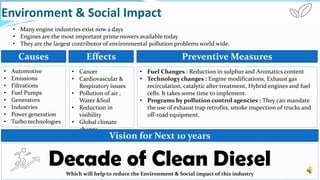
Environment & Social Impact
• Many engine industries exist now a days
• Engines are the most important prime movers available today
• They are the largest contributor of environmental pollution problems world wide.
Causes
• Automotive
• Emissions
• Filtrations
• Fuel Pumps
• Generators
• Industries
• Power generation
• Turbo technologies
Effects
• Cancer
• Cardiovascular &
Respiratory issues
• Pollution of air ,
Water &Soil
• Reduction in
visibility
• Global climate
change
Preventive Measures
• Fuel Changes : Reduction in sulphur and Aromatics content
• Technology changes : Engine modifications, Exhaust gas
recirculation, catalytic after treatment, Hybrid engines and fuel
cells. It takes some time to implement.
• Programs by pollution control agencies : They can mandate
the use of exhaust trap retrofits, smoke inspection of trucks and
off-road equipment.
Vision for Next 10 years
Decade of Clean DieselWhich will help to reduce the Environment & Social impact of this industry
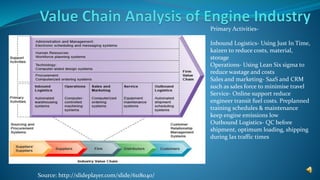
Primary Activities-
Inbound Logistics- Using Just In Time,
kaizen to reduce costs, material,
storage
Operations- Using Lean Six sigma to
reduce wastage and costs
Sales and marketing- SaaS and CRM
such as sales force to minimise travel
Service- Online support reduce
engineer transit fuel costs. Preplanned
training schedules & maintenance
keep engine emissions low
Outbound Logistics- QC before
shipment, optimum loading, shipping
during lax traffic times
Source: http://slideplayer.com/slide/6118040/
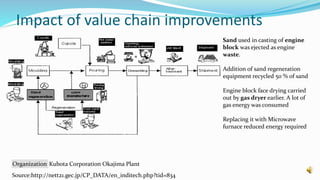
Impact of value chain improvements
Sand used in casting of engine
block was ejected as engine
waste.
Addition of sand regeneration
equipment recycled 50 % of sand
Engine block face drying carried
out by gas dryer earlier. A lot of
gas energy was consumed
Replacing it with Microwave
furnace reduced energy required
Source:http://nett21.gec.jp/CP_DATA/en_inditech.php?tid=834
Organization Kubota Corporation Okajima Plant
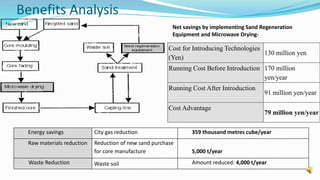
Benefits Analysis
Energy savings City gas reduction 359 thousand metres cube/year
Raw materials reduction Reduction of new sand purchase
for core manufacture 5,000 t/year
Waste Reduction Waste soil Amount reduced: 4,000 t/year
Net savings by implementing Sand Regeneration
Equipment and Microwave Drying-
Cost for Introducing Technologies
(Yen)
130 million yen
Running Cost Before Introduction 170 million
yen/year
Running Cost After Introduction
91 million yen/year
Cost Advantage
79 million yen/year
BEST PRACTICES ADOPTED BY THE
COMPANIES IN
TERMS OF SUSTAINABILITY IN ENGINE
MANUFACTURING SECTOR
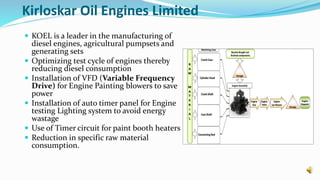
Kirloskar Oil Engines Limited
 KOEL is a leader in the manufacturing of
diesel engines, agricultural pumpsets and
generating sets
 Optimizing test cycle of engines thereby
reducing diesel consumption
 Installation of VFD (Variable Frequency
Drive) for Engine Painting blowers to save
power
 Installation of auto timer panel for Engine
testing Lighting system to avoid energy
wastage
 Use of Timer circuit for paint booth heaters
 Reduction in specific raw material
consumption.
Continued…
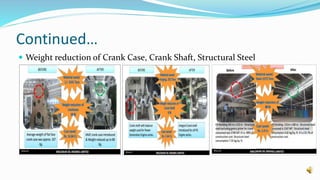
 Weight reduction of Crank Case, Crank Shaft, Structural Steel
Continued…
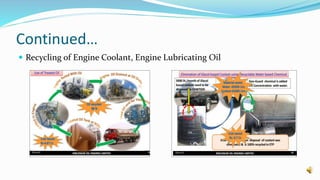
 Recycling of Engine Coolant, Engine Lubricating Oil
Cummins
 Cummins has been a pioneer in clean diesel technology
 Cummins introduced more than seventy new productsupdates all over
the world in 2013, many addressing emissions, fuel efficiency or both.
 Cummins strives to reach new ‘Zero Disposal’ challenge . Company in 2013
recycled about 89 percent of its waste
 A Cummins ReCon engine Or part requires about 85 percent less energy
than manufacturing a new engine or part
 Cummins has reduced company-wide water usage intensity by more than
30 percent, adjusted to total work hours
Ford’s Dagenham Diesel Center , UK
 The new Ford EcoBlue diesel engine production line at Dagenham Engine
Plant (Dagenham, United Kingdom ) will use less water and energy by
more than 50%.
 The reduction in the volume of coolant pumped reduce energy usage. 3
smaller coolant systems require 70% less energy
 Minimum quantity lubrication (MQL) machining tools—these replace
high coolant volumes with fine mists of oil to cool, lubricate and clean
during the metal working process—use 99.8% less water
 Cold testing technology that allows completed engines to be tested
without being started—saving 50,000 liters of diesel per year.
 Zero waste sent to landfill
Continental’s engine mounts with rubber
made from dandelion roots
 Continental has developed and tested engine mounts with rubber made
from dandelion roots
 The plant is potentially an alternative, environmentally friendly resource
and could further reduce dependency on traditionally produced natural
rubber
 It can also generate savings in CO2 emissions and transport costs.
Toyota to pioneer use of biosynthetic rubber
in engine
 Toyota is the first automaker to use biohydrin, a newly-developed
biosynthetic rubber product, in engine
 Biohydrin rubber is manufactured using plant-derived bio-materials
instead of epichlorohydrin
 These bio-materials achieve an estimated 20% reduction in material
lifecycle carbon emissions in comparison to conventional petroleum-
based hydrin rubber
Facts Say….
 In India, the policies and regulatory laws have not been very successful in
bringing down the pollution level of these companies
 R&D is lesser in compared to Global Players
 More of a Profit Oriented Market
 However, in US, since engines started being regulated by the U.S.
Environmental Protection Agency in the 1970s, there have been a drastic
reduction in emissions
 For example, on-highway diesel engines, emit 90 % less particulate matter
(PM) and oxides of nitrogen (NOx) today compared to just a little over a
decade ago, reaching near-zero levels
(XIMB) Sustainability engines

(XIMB) Sustainability engines

  • 1.
  • 2.
    PRESENTED BY :- GROUP7 PANKAJ GANDOTRA UM15094 PIYUSH UM15095 PRATISTHA SENAPATY UM15096 PREETI PATNAIK UM15097 PRITISH PRADHAN UM15098
  • 3.
    Overview  Industry drivenby Just-In-Time production.  Industry requires its suppliers to also provide materials and components on a just-in-time basis to reduce inventory  Clients of engines industry are especially original equipment manufacturers  Highly Competitive market because greater demand for higher quality and more environmentally friendly engines
  • 4.
    Types of Engines Light vehicle diesel engines  Heavy duty diesel engines  Hybrid and alternative fuel engines  Engines are also classified according to:  stroke  fuel used  method of ignition  number of cylinder  arrangement of cylinder
  • 5.
    Environment & SocialImpact • Many engine industries exist now a days • Engines are the most important prime movers available today • They are the largest contributor of environmental pollution problems world wide. Causes • Automotive • Emissions • Filtrations • Fuel Pumps • Generators • Industries • Power generation • Turbo technologies Effects • Cancer • Cardiovascular & Respiratory issues • Pollution of air , Water &Soil • Reduction in visibility • Global climate change Preventive Measures • Fuel Changes : Reduction in sulphur and Aromatics content • Technology changes : Engine modifications, Exhaust gas recirculation, catalytic after treatment, Hybrid engines and fuel cells. It takes some time to implement. • Programs by pollution control agencies : They can mandate the use of exhaust trap retrofits, smoke inspection of trucks and off-road equipment. Vision for Next 10 years Decade of Clean DieselWhich will help to reduce the Environment & Social impact of this industry
  • 6.
    Primary Activities- Inbound Logistics-Using Just In Time, kaizen to reduce costs, material, storage Operations- Using Lean Six sigma to reduce wastage and costs Sales and marketing- SaaS and CRM such as sales force to minimise travel Service- Online support reduce engineer transit fuel costs. Preplanned training schedules & maintenance keep engine emissions low Outbound Logistics- QC before shipment, optimum loading, shipping during lax traffic times Source: http://slideplayer.com/slide/6118040/
  • 7.
    Impact of valuechain improvements Sand used in casting of engine block was ejected as engine waste. Addition of sand regeneration equipment recycled 50 % of sand Engine block face drying carried out by gas dryer earlier. A lot of gas energy was consumed Replacing it with Microwave furnace reduced energy required Source:http://nett21.gec.jp/CP_DATA/en_inditech.php?tid=834 Organization Kubota Corporation Okajima Plant
  • 8.
    Benefits Analysis Energy savingsCity gas reduction 359 thousand metres cube/year Raw materials reduction Reduction of new sand purchase for core manufacture 5,000 t/year Waste Reduction Waste soil Amount reduced: 4,000 t/year Net savings by implementing Sand Regeneration Equipment and Microwave Drying- Cost for Introducing Technologies (Yen) 130 million yen Running Cost Before Introduction 170 million yen/year Running Cost After Introduction 91 million yen/year Cost Advantage 79 million yen/year
  • 9.
    BEST PRACTICES ADOPTEDBY THE COMPANIES IN TERMS OF SUSTAINABILITY IN ENGINE MANUFACTURING SECTOR
  • 10.
    Kirloskar Oil EnginesLimited  KOEL is a leader in the manufacturing of diesel engines, agricultural pumpsets and generating sets  Optimizing test cycle of engines thereby reducing diesel consumption  Installation of VFD (Variable Frequency Drive) for Engine Painting blowers to save power  Installation of auto timer panel for Engine testing Lighting system to avoid energy wastage  Use of Timer circuit for paint booth heaters  Reduction in specific raw material consumption.
  • 11.
    Continued…  Weight reductionof Crank Case, Crank Shaft, Structural Steel
  • 12.
    Continued…  Recycling ofEngine Coolant, Engine Lubricating Oil
  • 13.
    Cummins  Cummins hasbeen a pioneer in clean diesel technology  Cummins introduced more than seventy new productsupdates all over the world in 2013, many addressing emissions, fuel efficiency or both.  Cummins strives to reach new ‘Zero Disposal’ challenge . Company in 2013 recycled about 89 percent of its waste  A Cummins ReCon engine Or part requires about 85 percent less energy than manufacturing a new engine or part  Cummins has reduced company-wide water usage intensity by more than 30 percent, adjusted to total work hours
  • 14.
    Ford’s Dagenham DieselCenter , UK  The new Ford EcoBlue diesel engine production line at Dagenham Engine Plant (Dagenham, United Kingdom ) will use less water and energy by more than 50%.  The reduction in the volume of coolant pumped reduce energy usage. 3 smaller coolant systems require 70% less energy  Minimum quantity lubrication (MQL) machining tools—these replace high coolant volumes with fine mists of oil to cool, lubricate and clean during the metal working process—use 99.8% less water  Cold testing technology that allows completed engines to be tested without being started—saving 50,000 liters of diesel per year.  Zero waste sent to landfill
  • 15.
    Continental’s engine mountswith rubber made from dandelion roots  Continental has developed and tested engine mounts with rubber made from dandelion roots  The plant is potentially an alternative, environmentally friendly resource and could further reduce dependency on traditionally produced natural rubber  It can also generate savings in CO2 emissions and transport costs.
  • 16.
    Toyota to pioneeruse of biosynthetic rubber in engine  Toyota is the first automaker to use biohydrin, a newly-developed biosynthetic rubber product, in engine  Biohydrin rubber is manufactured using plant-derived bio-materials instead of epichlorohydrin  These bio-materials achieve an estimated 20% reduction in material lifecycle carbon emissions in comparison to conventional petroleum- based hydrin rubber
  • 17.
    Facts Say….  InIndia, the policies and regulatory laws have not been very successful in bringing down the pollution level of these companies  R&D is lesser in compared to Global Players  More of a Profit Oriented Market  However, in US, since engines started being regulated by the U.S. Environmental Protection Agency in the 1970s, there have been a drastic reduction in emissions  For example, on-highway diesel engines, emit 90 % less particulate matter (PM) and oxides of nitrogen (NOx) today compared to just a little over a decade ago, reaching near-zero levels