Financing Large Projects
Prof N.R.Bhusnurmath
Scope of the Course
• Financing Large Projects
• Appraisal of Projects – Feasibility & Viability
• Determination of the planned Capex
• Assumptions
• Projected Revenues, expenses, Interest to be paid, Loan Amortization,
Tax, Dividend
Conventional Project Appraisal
•To decide whether the project should be taken up
•We can use XL Sheet modelling
•NPV / IRR from the company point of view
•difficulties in deciding the "cost of capital" ...especially when the
companies shares are not traded publicly
•so generally IRR is used
•Challenge
•can we structure the financing so that the wacc < IRR
•constraints - cost of debt goes up with increasing leverage and
beyond certain point, banks may not be willing to lend
3
IRR of Promoters’ Cash Flows
• Can we not calculate the IRR of Promoters’ Cash Flows?
• Two sets of sources of capital funds
• Equity
• Debt
• Since debt providers look for “debt servicing”
• Once debt servicing is taken care of
• If the promoters are satisfied, get adequate return (IRR)
• The project can take off and would be successful
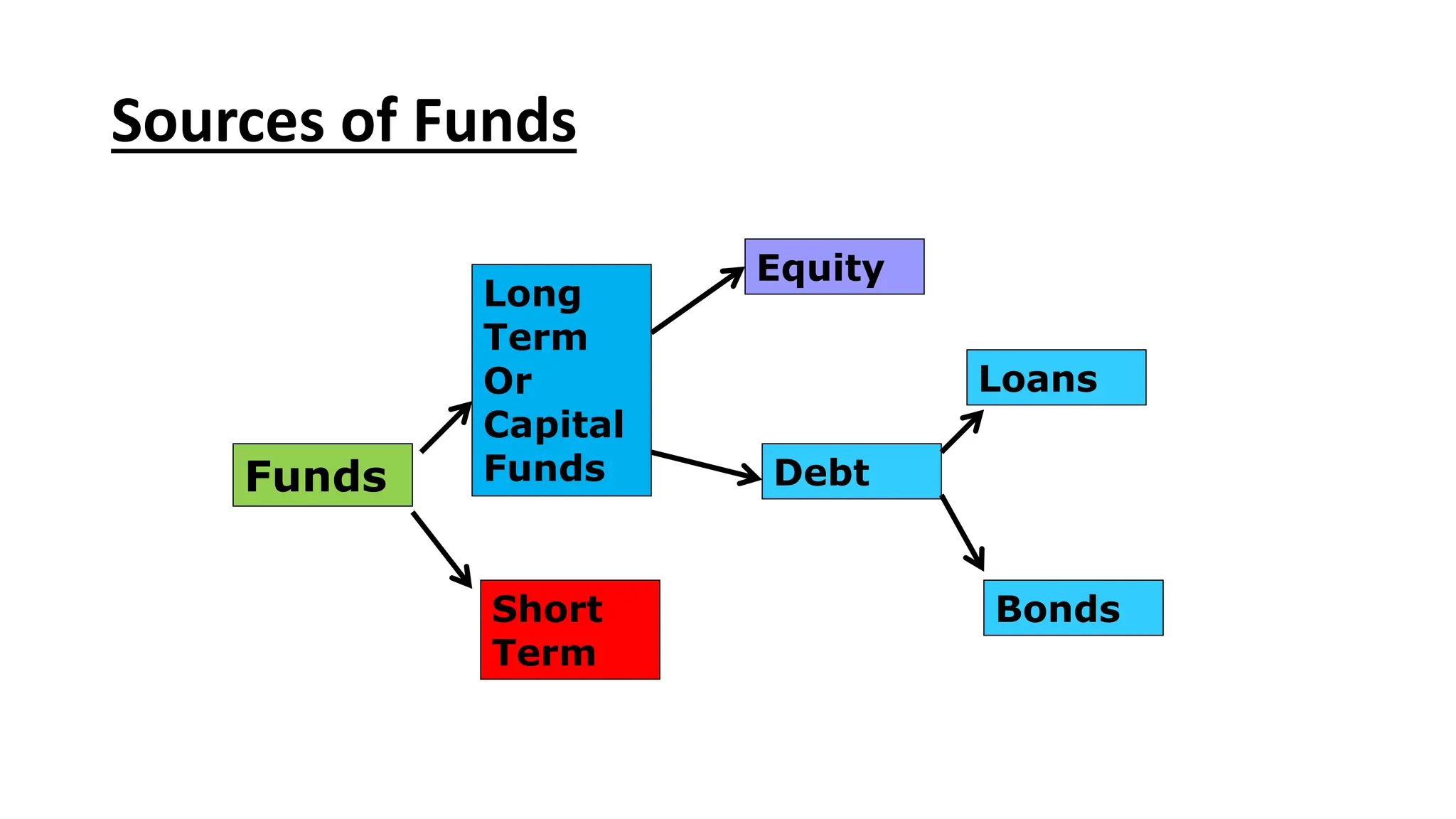
Sources of Funds
Funds
Short
Term
Equity
Long
Term
Or
Capital
Funds Debt
Loans
Bonds
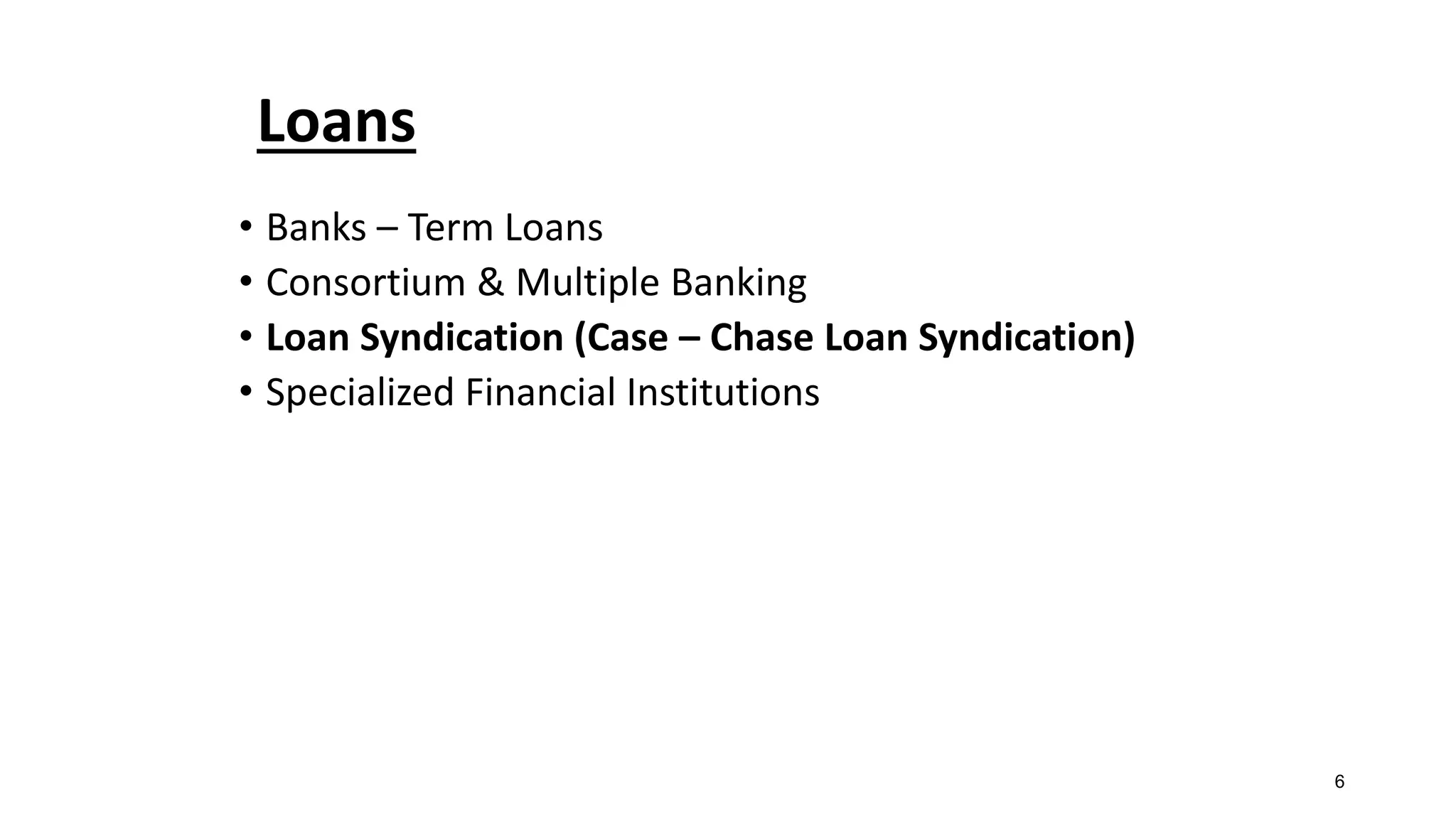
• Banks – Term Loans
• Consortium & Multiple Banking
• Loan Syndication (Case – Chase Loan Syndication)
• Specialized Financial Institutions
Loans
6
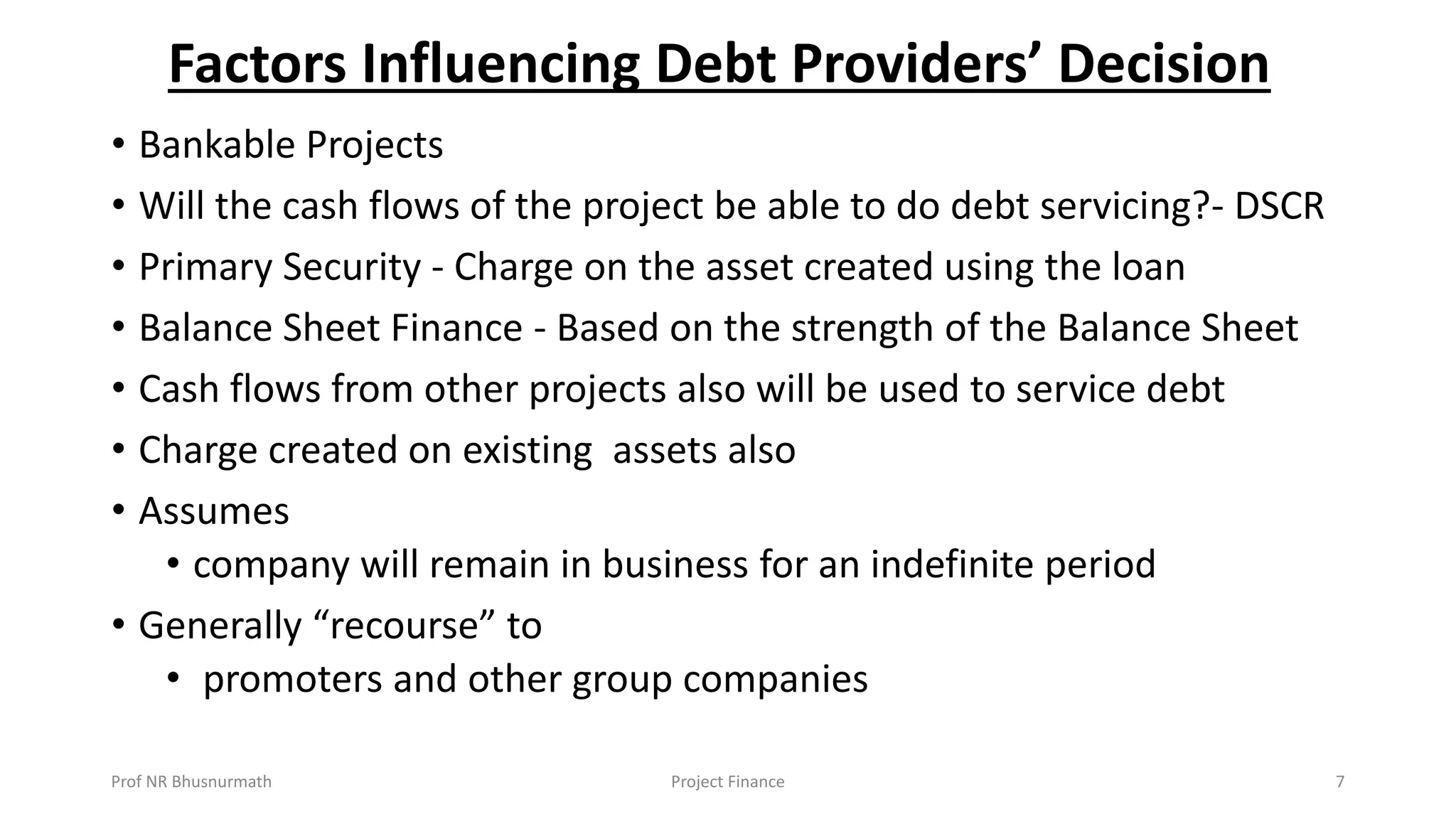
Factors Influencing Debt Providers’ Decision
• Bankable Projects
• Will the cash flows of the project be able to do debt servicing?- DSCR
• Primary Security - Charge on the asset created using the loan
• Balance Sheet Finance - Based on the strength of the Balance Sheet
• Cash flows from other projects also will be used to service debt
• Charge created on existing assets also
• Assumes
• company will remain in business for an indefinite period
• Generally “recourse” to
• promoters and other group companies
Prof NR Bhusnurmath Project Finance 7
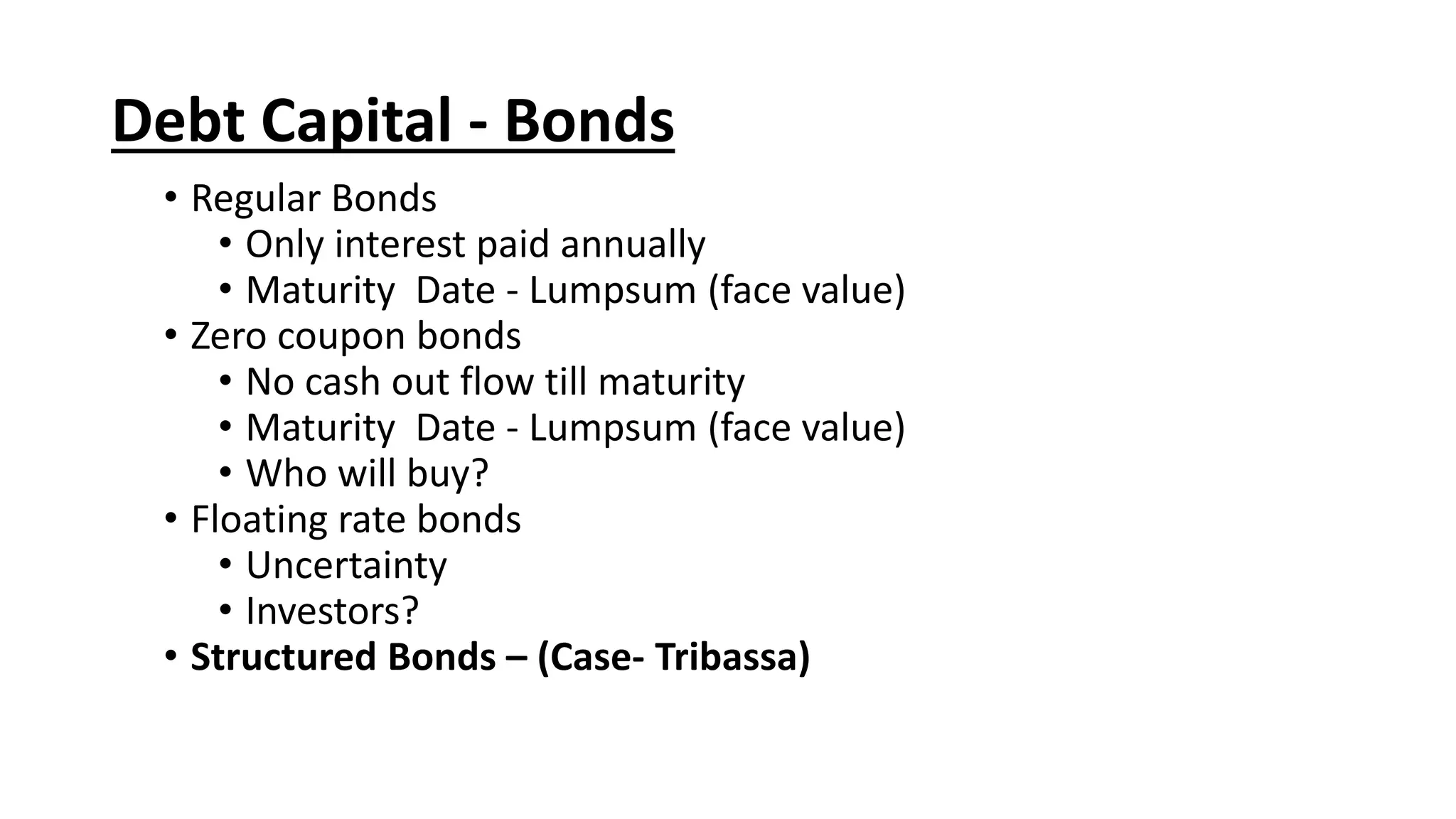
• Regular Bonds
• Only interest paid annually
• Maturity Date - Lumpsum (face value)
• Zero coupon bonds
• No cash out flow till maturity
• Maturity Date - Lumpsum (face value)
• Who will buy?
• Floating rate bonds
• Uncertainty
• Investors?
• Structured Bonds – (Case- Tribassa)
Debt Capital - Bonds
• Debt – fixed financial cost
• Unpaid creditor has the right to demand liquidation of
the company
• If no profits – no dividend
& so, no outflow of funds
the show can go on
firm can make up in the next cycle
• Equity more expensive
Is equity better?
Financing Alternatives
Cases
• Cox Communications –
• Equity – Control issues, market sentiment
• Sale of non-strategic assets
• Prada
• Accessing international financial markets
• Issues with issuing equity overseas – ADRs & GDRs
• Strategic Partnerships – win-win? Or loss of control?
• Petrobras – accessing international financial markets because of lack
of depth in local financial markets
Raising capital funds in Overseas Markets
• Equity
• Issue overseas
• ADR & GDR route
• Bonds Issue Overseas
• Euro Bonds
• FCCBs
• External Commercial Borrowings
• In the context of financing projects –
• replacing existing debt by fresh debt
• Or equity
• Or a combination of debt & equity
• Take-Out financing
• Financed by banks initially
• “taken – out” by other financial institutions
Refinancing
Peculiarities of Infrastructure Projects
• Huge funds requirement
• Long gestation periods
• Asset created generally does not have any market value
• Public goods
• Public property – ownership issues ..(A J Cable Case - landing stations)
• Revenues?
• Additional Risks
• Regulatory Risk
• Political Risk
• To be acceptable to “public” … it has to be a BOT arrangement
Problems with Infrastructure Projects
• ‘Public Utilities
• Highly Risky – not “bank-able” projects
• Assets created may not have market value (bridges)
• No assets for collateral security
• Balance Sheet Financing and With Recourse Financing
not possible
Equity from Promoters/ Sponsors
• Contamination of existing B/S
• Off-Balance Sheet / Non-Recourse
• Future :
• BOT Projects…..no “future”
• Uncertainty about Dividend’s cash flows
• Can we find equity investors who have limited
expectations?
• Return = IRR cash flows of equity providers
Concerns of Equity Sponsors
• High Risk….therefore
• Contamination of existing B/S - Off-Balance Sheet / Non-Recourse
• Future :
• BOT Projects…..no “future”
• Return = IRR cash flows of equity providers
• Equity providers would require higher than normal returns (higher EPS)
• Given the project cash-flows…
• Higher EPS can be achieved with high Leverage
• But high leverage increases the risk perception of debt providers –
lenders and bond holders
Attracting Equity “Sponsors”/ Promoters
• Can we find equity investors who have limited expectations?
• Challenge : how to make the project attractive to promoters ?
• How to maximize IRR of sponsors’ cash-flows - Base Case
• And, other benefits with the project coming up (externalities)
(Poland A2 Motorways Case)
• Selection of Equity Sponsors critical (A_J Cable Case)
• Equity from interested and capable firms
• The project should be important to potential promoters
Debt Providers - High Leverage & Stand-alone!
• Effect of high leverage=> Risk perception by banks / debt
providers
=> Non-Availability of Debt Funds
=> High Rate of Interest
• Stand alone – Non Recourse
• Why will debt providers (banks) agree to lend to projects with
very high leverage?
• It is necessary to structure the project so that banks feel
comfortable !
Concerns of Debt Providers
• Basic concern – the debt should be serviced as per agreed
terms
• DSCR (Debt Service Coverage Ratio)
• In case of non-recourse/ off balance sheet financing….
• Lenders have to depend solely on the project cash flows
• Uncertainty of Revenues
• Uncertainty of Expenses
• Uncertainty of Managerial decisions
• Operating decisions
• Dividend Decisions
Comfort for debt providers
• Base Financial Plan (Financial Model) is drawn up in which all the parties
are involved and approved by the debt providers
• To ensure no change from the Base Case, no role for management to
play….everything is decided before financial closure…
• All work related to project out sourced
• Project Company …. SPV (Poland A2 Motorways)
• Ring fenced project cash flows (Tribasa)
• First charge to lenders on project revenues
• Pre-determined cash utilization
• Cash Waterfall – (Poland A2 Mtorways, Tribasa)
• Contracts for Capex and Opex
• Remove uncertainties of Revenues
• Credit Enhancement
• Government underwriting Revenues
• Annuity payments from Government (Annuity & HAM Models)
Risks in a Project
• The greatest concern while deciding whether to
take up a project or not, apart from its feasibility &
viability, is whether things would work out as
planned
• The uncertainty !
• Risk
• To increase the probability of success – of things
working out as planned can be increased by
removing the uncertainty
• Risk Management
21
Managing Risks during construction period
• LSTK (Lump Sum Turn Key) contracts
• Liquidated damages
• Positive reinforcement – extra payments
• Hiring the best companies
• Expensive
• But they have a reputation to protect
• Infra – make the EPC companies as one of the sponsors
• Government help- access, land acquisitions
22
Cost of Operations
• Long Term contracts
• Supply contracts
• Fuel linkages
• O & M Contract
23
Sales Revenue
• Off – Take contract
• PPA – Power purchase agreement
• Pre-Sales (A J Case)
• Negative covenants – Government assurances
• Underwriting of revenues by Government
• “Annuity” by Government
24
Role of the Government
• Regulatory Risk
• Political Risk
• Governments short of capital funds but can raise
taxes and cess
• Guarantee bonds issued (Poland A2 Motorways)
• Tax free bonds’ issue
• Tax holidays / concessions
• VGF – Viability Gap Funding
Prof NR Bhusnurmath Project Finance-Risk Management 25
Features of Project Finance
• Project financing :
• A separate new “ring-fenced” company –SPV or
Project Company
• Off-balance sheet or non-recourse financing
• Very high leverage
• Usually for a new project
• Stand-alone Projects
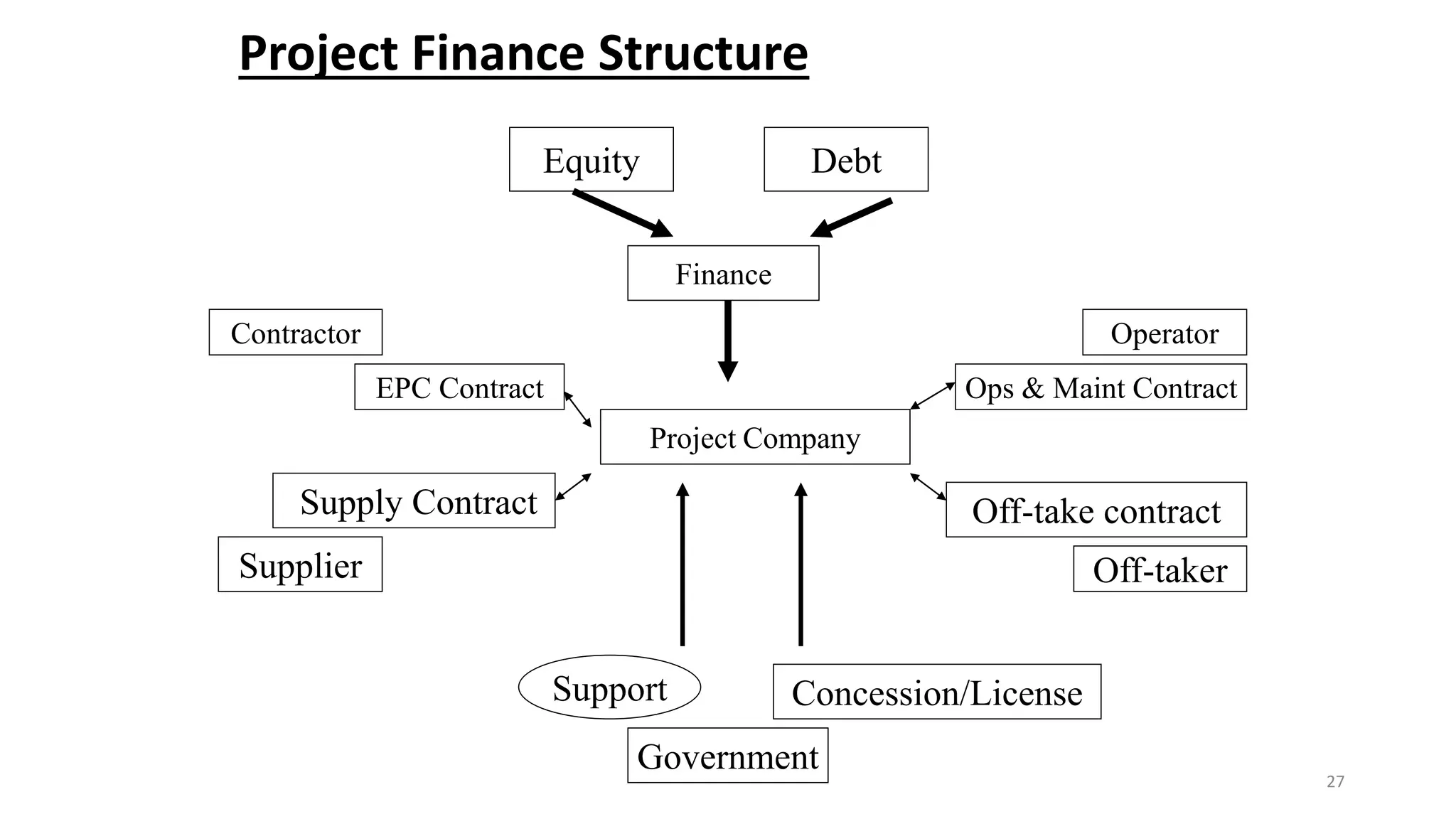
Project Finance Structure
27
Project Company
Equity Debt
Finance
EPC Contract
Contractor
Supply Contract
Supplier
Off-take contract
Off-taker
Government
Concession/License
Ops & Maint Contract
Operator
Support
When can Project Finance be used?
• Project can be set up as an independent economic unit
• Cash flows from the project are large enough to support high
leverage
• When public goods, public land, rivers air-space etc are involved
• When “public” is one the important stake-holders
• Licenses, Permits and Concessions, Ownership rights to natural
resources, Assurance that competitors will be limited (telecom)
Financing - Need for Structuring
• Conventional financing and instruments may indicate that the project is not viable
• Attracting capital funds - management of risks through contract and structure
(Poland A2 Motorways)
• Making it attractive to international capital markets (Euro Tunnel)
• Subordinated debt / mezzanine debt (Poland A2 Motorways)
• Taking a portion of sponsors’ funds in the form of ‘debt’
• “Shareholders’ Loan” A & B in Poland A2 Motorways
• Managing the cash flows
• Increasing IRR of equity sponsors / promoters
• Use of zero coupon bonds to shift cash outflows to times when their repayment
can me made (Poland A2 Motorways)
• Structured or innovative instruments
• Non uniform amortization of debt (Tribasa)
• Revenue “claw-back” to increase comfort to debt providers (Tribasa)
Structured Financing
• Structuring the financing
• Innovative instruments may have to be designed
• Step up / irregular amortization (Tribaasa Case)
• Comfort to the debt providers (Tribaasa Case)
• Subordinated debt – Promoters’ funds in the form of debt
• “Shareholders’ Loan” (Poland A2 Motorways)
• Subordinated Zero Coupon Bonds (Poland A2 Motorways)

Financing Large Projects 13 - Sum Up.pptx

  • 1.
  • 2.
    Scope of theCourse • Financing Large Projects • Appraisal of Projects – Feasibility & Viability • Determination of the planned Capex • Assumptions • Projected Revenues, expenses, Interest to be paid, Loan Amortization, Tax, Dividend
  • 3.
    Conventional Project Appraisal •Todecide whether the project should be taken up •We can use XL Sheet modelling •NPV / IRR from the company point of view •difficulties in deciding the "cost of capital" ...especially when the companies shares are not traded publicly •so generally IRR is used •Challenge •can we structure the financing so that the wacc < IRR •constraints - cost of debt goes up with increasing leverage and beyond certain point, banks may not be willing to lend 3
  • 4.
    IRR of Promoters’Cash Flows • Can we not calculate the IRR of Promoters’ Cash Flows? • Two sets of sources of capital funds • Equity • Debt • Since debt providers look for “debt servicing” • Once debt servicing is taken care of • If the promoters are satisfied, get adequate return (IRR) • The project can take off and would be successful
  • 5.
  • 6.
    • Banks –Term Loans • Consortium & Multiple Banking • Loan Syndication (Case – Chase Loan Syndication) • Specialized Financial Institutions Loans 6
  • 7.
    Factors Influencing DebtProviders’ Decision • Bankable Projects • Will the cash flows of the project be able to do debt servicing?- DSCR • Primary Security - Charge on the asset created using the loan • Balance Sheet Finance - Based on the strength of the Balance Sheet • Cash flows from other projects also will be used to service debt • Charge created on existing assets also • Assumes • company will remain in business for an indefinite period • Generally “recourse” to • promoters and other group companies Prof NR Bhusnurmath Project Finance 7
  • 8.
    • Regular Bonds •Only interest paid annually • Maturity Date - Lumpsum (face value) • Zero coupon bonds • No cash out flow till maturity • Maturity Date - Lumpsum (face value) • Who will buy? • Floating rate bonds • Uncertainty • Investors? • Structured Bonds – (Case- Tribassa) Debt Capital - Bonds
  • 9.
    • Debt –fixed financial cost • Unpaid creditor has the right to demand liquidation of the company • If no profits – no dividend & so, no outflow of funds the show can go on firm can make up in the next cycle • Equity more expensive Is equity better?
  • 10.
    Financing Alternatives Cases • CoxCommunications – • Equity – Control issues, market sentiment • Sale of non-strategic assets • Prada • Accessing international financial markets • Issues with issuing equity overseas – ADRs & GDRs • Strategic Partnerships – win-win? Or loss of control? • Petrobras – accessing international financial markets because of lack of depth in local financial markets
  • 11.
    Raising capital fundsin Overseas Markets • Equity • Issue overseas • ADR & GDR route • Bonds Issue Overseas • Euro Bonds • FCCBs • External Commercial Borrowings
  • 12.
    • In thecontext of financing projects – • replacing existing debt by fresh debt • Or equity • Or a combination of debt & equity • Take-Out financing • Financed by banks initially • “taken – out” by other financial institutions Refinancing
  • 13.
    Peculiarities of InfrastructureProjects • Huge funds requirement • Long gestation periods • Asset created generally does not have any market value • Public goods • Public property – ownership issues ..(A J Cable Case - landing stations) • Revenues? • Additional Risks • Regulatory Risk • Political Risk • To be acceptable to “public” … it has to be a BOT arrangement
  • 14.
    Problems with InfrastructureProjects • ‘Public Utilities • Highly Risky – not “bank-able” projects • Assets created may not have market value (bridges) • No assets for collateral security • Balance Sheet Financing and With Recourse Financing not possible
  • 15.
    Equity from Promoters/Sponsors • Contamination of existing B/S • Off-Balance Sheet / Non-Recourse • Future : • BOT Projects…..no “future” • Uncertainty about Dividend’s cash flows • Can we find equity investors who have limited expectations? • Return = IRR cash flows of equity providers
  • 16.
    Concerns of EquitySponsors • High Risk….therefore • Contamination of existing B/S - Off-Balance Sheet / Non-Recourse • Future : • BOT Projects…..no “future” • Return = IRR cash flows of equity providers • Equity providers would require higher than normal returns (higher EPS) • Given the project cash-flows… • Higher EPS can be achieved with high Leverage • But high leverage increases the risk perception of debt providers – lenders and bond holders
  • 17.
    Attracting Equity “Sponsors”/Promoters • Can we find equity investors who have limited expectations? • Challenge : how to make the project attractive to promoters ? • How to maximize IRR of sponsors’ cash-flows - Base Case • And, other benefits with the project coming up (externalities) (Poland A2 Motorways Case) • Selection of Equity Sponsors critical (A_J Cable Case) • Equity from interested and capable firms • The project should be important to potential promoters
  • 18.
    Debt Providers -High Leverage & Stand-alone! • Effect of high leverage=> Risk perception by banks / debt providers => Non-Availability of Debt Funds => High Rate of Interest • Stand alone – Non Recourse • Why will debt providers (banks) agree to lend to projects with very high leverage? • It is necessary to structure the project so that banks feel comfortable !
  • 19.
    Concerns of DebtProviders • Basic concern – the debt should be serviced as per agreed terms • DSCR (Debt Service Coverage Ratio) • In case of non-recourse/ off balance sheet financing…. • Lenders have to depend solely on the project cash flows • Uncertainty of Revenues • Uncertainty of Expenses • Uncertainty of Managerial decisions • Operating decisions • Dividend Decisions
  • 20.
    Comfort for debtproviders • Base Financial Plan (Financial Model) is drawn up in which all the parties are involved and approved by the debt providers • To ensure no change from the Base Case, no role for management to play….everything is decided before financial closure… • All work related to project out sourced • Project Company …. SPV (Poland A2 Motorways) • Ring fenced project cash flows (Tribasa) • First charge to lenders on project revenues • Pre-determined cash utilization • Cash Waterfall – (Poland A2 Mtorways, Tribasa) • Contracts for Capex and Opex • Remove uncertainties of Revenues • Credit Enhancement • Government underwriting Revenues • Annuity payments from Government (Annuity & HAM Models)
  • 21.
    Risks in aProject • The greatest concern while deciding whether to take up a project or not, apart from its feasibility & viability, is whether things would work out as planned • The uncertainty ! • Risk • To increase the probability of success – of things working out as planned can be increased by removing the uncertainty • Risk Management 21
  • 22.
    Managing Risks duringconstruction period • LSTK (Lump Sum Turn Key) contracts • Liquidated damages • Positive reinforcement – extra payments • Hiring the best companies • Expensive • But they have a reputation to protect • Infra – make the EPC companies as one of the sponsors • Government help- access, land acquisitions 22
  • 23.
    Cost of Operations •Long Term contracts • Supply contracts • Fuel linkages • O & M Contract 23
  • 24.
    Sales Revenue • Off– Take contract • PPA – Power purchase agreement • Pre-Sales (A J Case) • Negative covenants – Government assurances • Underwriting of revenues by Government • “Annuity” by Government 24
  • 25.
    Role of theGovernment • Regulatory Risk • Political Risk • Governments short of capital funds but can raise taxes and cess • Guarantee bonds issued (Poland A2 Motorways) • Tax free bonds’ issue • Tax holidays / concessions • VGF – Viability Gap Funding Prof NR Bhusnurmath Project Finance-Risk Management 25
  • 26.
    Features of ProjectFinance • Project financing : • A separate new “ring-fenced” company –SPV or Project Company • Off-balance sheet or non-recourse financing • Very high leverage • Usually for a new project • Stand-alone Projects
  • 27.
    Project Finance Structure 27 ProjectCompany Equity Debt Finance EPC Contract Contractor Supply Contract Supplier Off-take contract Off-taker Government Concession/License Ops & Maint Contract Operator Support
  • 28.
    When can ProjectFinance be used? • Project can be set up as an independent economic unit • Cash flows from the project are large enough to support high leverage • When public goods, public land, rivers air-space etc are involved • When “public” is one the important stake-holders • Licenses, Permits and Concessions, Ownership rights to natural resources, Assurance that competitors will be limited (telecom)
  • 29.
    Financing - Needfor Structuring • Conventional financing and instruments may indicate that the project is not viable • Attracting capital funds - management of risks through contract and structure (Poland A2 Motorways) • Making it attractive to international capital markets (Euro Tunnel) • Subordinated debt / mezzanine debt (Poland A2 Motorways) • Taking a portion of sponsors’ funds in the form of ‘debt’ • “Shareholders’ Loan” A & B in Poland A2 Motorways • Managing the cash flows • Increasing IRR of equity sponsors / promoters • Use of zero coupon bonds to shift cash outflows to times when their repayment can me made (Poland A2 Motorways) • Structured or innovative instruments • Non uniform amortization of debt (Tribasa) • Revenue “claw-back” to increase comfort to debt providers (Tribasa)
  • 30.
    Structured Financing • Structuringthe financing • Innovative instruments may have to be designed • Step up / irregular amortization (Tribaasa Case) • Comfort to the debt providers (Tribaasa Case) • Subordinated debt – Promoters’ funds in the form of debt • “Shareholders’ Loan” (Poland A2 Motorways) • Subordinated Zero Coupon Bonds (Poland A2 Motorways)