4
Introduction
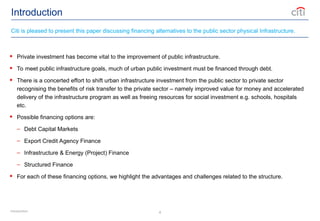
Private investmenthas become vital to the improvement of public infrastructure.
To meet public infrastructure goals, much of urban public investment must be financed through debt.
There is a concerted effort to shift urban infrastructure investment from the public sector to private sector
recognising the benefits of risk transfer to the private sector – namely improved value for money and accelerated
delivery of the infrastructure program as well as freeing resources for social investment e.g. schools, hospitals
etc.
Possible financing options are:
– Debt Capital Markets
– Export Credit Agency Finance
– Infrastructure & Energy (Project) Finance
– Structured Finance
For each of these financing options, we highlight the advantages and challenges related to the structure.
Citi is pleased to present this paper discussing financing alternatives to the public sector physical Infrastructure.
Introduction
5.
5
Overview of PublicSector Infrastructure Financing
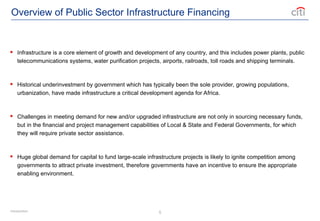
Infrastructure is a core element of growth and development of any country, and this includes power plants, public
telecommunications systems, water purification projects, airports, railroads, toll roads and shipping terminals.
Historical underinvestment by government which has typically been the sole provider, growing populations,
urbanization, have made infrastructure a critical development agenda for Africa.
Challenges in meeting demand for new and/or upgraded infrastructure are not only in sourcing necessary funds,
but in the financial and project management capabilities of Local & State and Federal Governments, for which
they will require private sector assistance.
Huge global demand for capital to fund large-scale infrastructure projects is likely to ignite competition among
governments to attract private investment, therefore governments have an incentive to ensure the appropriate
enabling environment.
Introduction
6.
6
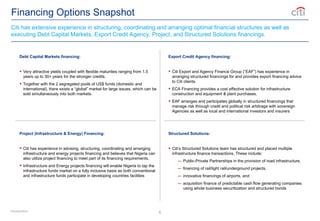
Financing Options Snapshot
Citihas extensive experience in structuring, coordinating and arranging optimal financial structures as well as
executing Debt Capital Markets, Export Credit Agency, Project, and Structured Solutions financings.
Debt Capital Markets financing:
• Very attractive yields coupled with flexible maturities ranging from 1.5
years up to 30+ years for the stronger credits.
• Together with the 2 segregated pools of US$ funds (domestic and
international), there exists a “global” market for large issues, which can be
sold simultaneously into both markets.
Export Credit Agency financing:
• Citi Export and Agency Finance Group (“EAF”) has experience in
arranging structured financings for and provides export financing advice
to Citi clients.
• ECA Financing provides a cost effective solution for infrastructure
construction and equipment & plant purchases.
• EAF arranges and participates globally in structured financings that
manage risk through credit and political risk arbitrage with sovereign
Agencies as well as local and international investors and insurers
Project (Infrastructure & Energy) Financing:
Citi has experience in advising, structuring, coordinating and arranging
infrastructure and energy projects financing and believes that Nigeria can
also utilize project financing to meet part of its financing requirements.
Infrastructure and Energy projects financing will enable Nigeria to tap the
infrastructure funds market on a fully inclusive basis as both conventional
and infrastructure funds participate in developing countries facilities
Structured Solutions:
• Citi’s Structured Solutions team has structured and placed multiple
infrastructure finance transactions. These include:
– Public-Private Partnerships in the provision of road infrastructure,
– financing of rail/light rail/underground projects,
– innovative financings of airports, and
– acquisition finance of predictable cash flow generating companies
using whole business securitization and structured bonds
Introduction
9
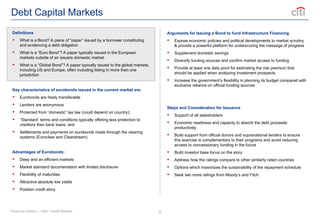
Debt Capital Markets
Definitions
What is a Bond? A piece of “paper” issued by a borrower constituting
and evidencing a debt obligation
What is a “Euro Bond”? A paper typically issued in the European
markets outside of an issuers domestic market
What is a “Global Bond”? A paper typically issued to the global markets,
including US and Europe, often including listing in more than one
jurisdiction
Key characteristics of eurobonds issued in the current market are:
Eurobonds are freely transferable
Lenders are anonymous
Protected from “domestic” tax law (could depend on country);
“Standard” terms and conditions typically offering less protection to
creditors than bank loans; and
Settlements and payments on eurobonds made through the clearing
systems (Euroclear and Clearstream)
Advantages of Eurobonds:
Deep and an efficient markets
Market standard documentation with limited disclosure
Flexibility of maturities
Attractive absolute low yields
Position credit story
Arguments for Issuing a Bond to fund Infrastructure Financing
Expose economic policies and political developments to market scrutiny
& provide a powerful platform for underscoring the message of progress
Supplement domestic savings
Diversify funding sources and confirm market access to funding
Provide at least one data point for estimating the risk premium that
should be applied when analyzing investment prospects
Increase the government’s flexibility in planning its budget compared with
exclusive reliance on official funding sources
Steps and Consideration for Issuance
Support of all stakeholders
Economic readiness and capacity to absorb the debt proceeds
productively
Build support from official donors and supranational lenders to ensure
this exercise is complementary to their programs and avoid reducing
access to concessionary funding in the future
Build investor base focus on the story
Address how the ratings compare to other similarly rated countries
Options which maximizes the sustainability of the repayment schedule
Seek two more ratings from Moody’s and Fitch
Financing Options – Debt Capital Markets
11
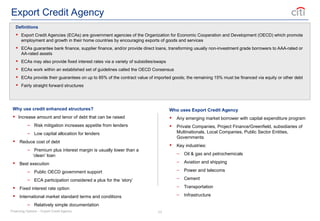
Export Credit Agency
Definitions
Export Credit Agencies (ECAs) are government agencies of the Organization for Economic Cooperation and Development (OECD) which promote
employment and growth in their home countries by encouraging exports of goods and services
ECAs guarantee bank finance, supplier finance, and/or provide direct loans, transforming usually non-investment grade borrowers to AAA-rated or
AA-rated assets
ECAs may also provide fixed interest rates via a variety of subsidies/swaps
ECAs work within an established set of guidelines called the OECD Consensus
ECAs provide their guarantees on up to 85% of the contract value of imported goods; the remaining 15% must be financed via equity or other debt
Fairly straight forward structures
Who uses Export Credit Agency
Any emerging market borrower with capital expenditure program
Private Companies, Project Finance/Greenfield, subsidiaries of
Multinationals, Local Companies, Public Sector Entities,
Governments
Key industries:
– Oil & gas and petrochemicals
– Aviation and shipping
– Power and telecoms
– Cement
– Transportation
– Infrastructure
Why use credit enhanced structures?
Increase amount and tenor of debt that can be raised
– Risk mitigation increases appetite from lenders
– Low capital allocation for lenders
Reduce cost of debt
– Premium plus interest margin is usually lower than a
‘clean’ loan
Best execution
– Public OECD government support
– ECA participation considered a plus for the ‘story’
Fixed interest rate option
International market standard terms and conditions
– Relatively simple documentation
Financing Options – Export Credit Agency
12.
12
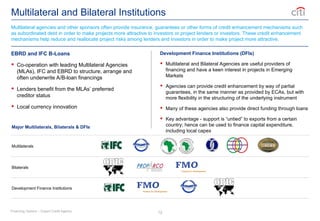
Multilateral and BilateralInstitutions
EBRD and IFC B-Loans
Co-operation with leading Multilateral Agencies
(MLAs), IFC and EBRD to structure, arrange and
often underwrite A/B-loan financings
Lenders benefit from the MLAs’ preferred
creditor status
Local currency innovation
Multilateral agencies and other sponsors often provide insurance, guarantees or other forms of credit enhancement mechanisms such
as subordinated debt in order to make projects more attractive to investors or project lenders or investors. These credit enhancement
mechanisms help reduce and reallocate project risks among lenders and investors in order to make project more attractive.
Development Finance Institutions (DFIs)
Multilateral and Bilateral Agencies are useful providers of
financing and have a keen interest in projects in Emerging
Markets
Agencies can provide credit enhancement by way of partial
guarantees, in the same manner as provided by ECAs, but with
more flexibility in the structuring of the underlying instrument
Many of these agencies also provide direct funding through loans
Key advantage - support is “untied” to exports from a certain
country; hence can be used to finance capital expenditure,
including local capex
Major Multilaterals, Bilaterals & DFIs
Multilaterals
Bilaterals
Development Finance Institutions
Financing Options – Export Credit Agency
14
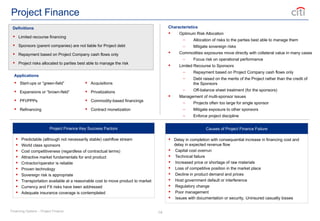
Project Finance
Definitions
Limitedrecourse financing
Sponsors (parent companies) are not liable for Project debt
Repayment based on Project Company cash flows only
Project risks allocated to parties best able to manage the risk
Characteristics
Optimum Risk Allocation
– Allocation of risks to the parties best able to manage them
– Mitigate sovereign risks
Commodities exposures move directly with collateral value in many cases
– Focus risk on operational performance
Limited Recourse to Sponsors
– Repayment based on Project Company cash flows only
– Debt raised on the merits of the Project rather than the credit of
the Sponsors
– Off-balance sheet treatment (for the sponsors)
Management of multi-sponsor issues
– Projects often too large for single sponsor
– Mitigate exposure to other sponsors
– Enforce project discipline
Applications
Start-ups or “green-field”
Expansions or “brown-field”
PFI/PPPs
Refinancing
Acquisitions
Privatizations
Commodity-based financings
Contract monetization
Project Finance Key Success Factors
Predictable (although not necessarily stable) cashflow stream
World class sponsors
Cost competitiveness (regardless of contractual terms)
Attractive market fundamentals for end product
Cntractor/operator is reliable
Proven technology
Sovereign risk is appropriate
Transportation available at a reasonable cost to move product to market
Currency and FX risks have been addressed
Adequate insurance coverage is contemplated
Causes of Project Finance Failure
Delay in completion with consequential increase in financing cost and
delay in expected revenue flow
Capital cost overrun
Technical failure
Increased price or shortage of raw materials
Loss of competitive position in the market place
Decline in product demand and prices
Host government default or interference
Regulatory change
Poor management
Issues with documentation or security, Uninsured casualty losses
Financing Options – Project Finance
15.
15
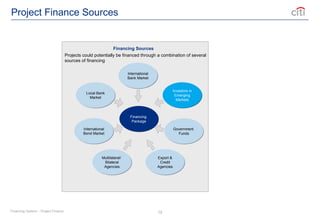
Project Finance Sources
FinancingSources
Local Bank
Market
Financing
Package
Export &
Credit
Agencies
International
Bond Market
International
Bank Market
Government
Funds
Multilateral/
Bilateral
Agencies
Investors in
Emerging
Markets
Projects could potentially be financed through a combination of several
sources of financing
Financing Options – Project Finance
17
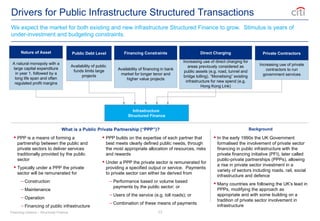
Drivers for PublicInfrastructure Structured Transactions
We expect the market for both existing and new infrastructure Structured Finance to grow. Stimulus is years of
under-investment and budgeting constraints.
A natural monopoly with a
large capital expenditure
in year 1, followed by a
long life span and often
regulated profit margins
Nature of Asset
Increasing use of direct charging for
areas previously considered as
public assets (e.g. road, tunnel and
bridge tolling). “Monetising” existing
infrastructure for new spend (e.g.
Hong Kong Link)
Direct Charging
Availability of public
funds limits large
projects
Public Debt Level
Increasing use of private
contractors to run
government services
Private Contractors
Availability of financing in bank
market for longer tenor and
higher value projects
Financing Constraints
Infrastructure
Structured Finance
What is a Public Private Partnership (“PPP”)? Background
PPP is a means of forming a
partnership between the public and
private sectors to deliver services
traditionally provided by the public
sector
Typically under a PPP the private
sector will be remunerated for
– Construction
– Maintenance
– Operation
– Financing of public infrastructure
PPP builds on the expertise of each partner that
best meets clearly defined public needs, through
the most appropriate allocation of resources, risks
and rewards
Under a PPP the private sector is remunerated for
providing a specified output or service. Payments
to private sector can either be derived from
– Performance based or volume based
payments by the public sector; or
– Users of the service (e.g. toll roads); or
– Combination of these means of payments
In the early 1990s the UK Government
formalised the involvement of private sector
financing in public infrastructure with the
private financing initiative (PFI), later called
public-private partnerships (PPPs), allowing
a rise in private sector investment in a
variety of sectors including roads, rail, social
infrastructure and defence
Many countries are following the UK’s lead in
PPPs, modifying the approach as
appropriate and with some building on a
tradition of private sector involvement in
infrastructure
Financing Options – Structured Finance
19
Conclusion
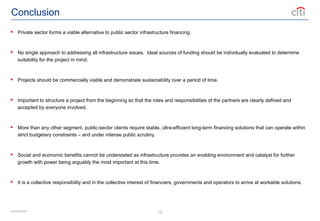
Private sectorforms a viable alternative to public sector infrastructure financing.
No single approach to addressing all infrastructure issues. Ideal sources of funding should be individually evaluated to determine
suitability for the project in mind.
Projects should be commercially viable and demonstrate sustainability over a period of time.
Important to structure a project from the beginning so that the roles and responsibilities of the partners are clearly defined and
accepted by everyone involved.
More than any other segment, public-sector clients require stable, ultra-efficient long-term financing solutions that can operate within
strict budgetary constraints – and under intense public scrutiny.
Social and economic benefits cannot be understated as infrastructure provides an enabling environment and catalyst for further
growth with power being arguably the most important at this time.
It is a collective responsibility and in the collective interest of financiers, governments and operators to arrive at workable solutions.
Conclusion
#1 Myself and role
Reason for giving presentation – inform about commodities and the group.
Reluctant speaker at best. Trader DNA – not slick sales
New presentation – tried to make more interesting. Test case. Will need polish and may be a bit patchy in places – you’ve been warned….