© 2018 HDR, Inc., all rights reserved.
Tomouh Internship Program
Hatem Hegazi
Project Controls Manager
Project Controls
Function
KAEC- Saudi Arabia
October 2018
Contents
▪ About HDR Inc.
▪ Construction Industry Organizations
▪ Project Controls - The cost dimension
▪ Project Controls Vs. Project Management
▪ Project Controls Vs. Project Accounting
▪ Organization for Project Control
▪ Project Controls Deliverables
▪ Planning Vs. Scheduling
▪ Planning Cycle
▪ Earned Value Management EVM
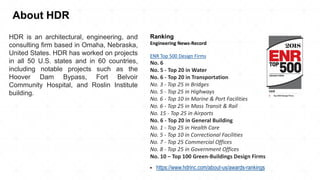
Ranking
Engineering News-Record
ENR Top 500 Design Firms
No. 6
No. 5 - Top 20 in Water
No. 6 - Top 20 in Transportation
No. 3 - Top 25 in Bridges
No. 5 - Top 25 in Highways
No. 6 - Top 10 in Marine & Port Facilities
No. 6 - Top 25 in Mass Transit & Rail
No. 15 - Top 25 in Airports
No. 6 - Top 20 in General Building
No. 1 - Top 25 in Health Care
No. 5 - Top 10 in Correctional Facilities
No. 7 - Top 25 Commercial Offices
No. 8 - Top 25 in Government Offices
No. 10 – Top 100 Green-Buildings Design Firms
▪ https://www.hdrinc.com/about-us/awards-rankings
About HDR
HDR is an architectural, engineering, and
consulting firm based in Omaha, Nebraska,
United States. HDR has worked on projects
in all 50 U.S. states and in 60 countries,
including notable projects such as the
Hoover Dam Bypass, Fort Belvoir
Community Hospital, and Roslin Institute
building.
© 2014 HDR Architecture, Inc., all rights reserved.© 2014 HDR Architecture, Inc., all rights reserved.© 2014 HDR Architecture, Inc., all rights reserved.© 2014 HDR, Inc., all rights reserved.© 2014 HDR, Inc., all rights reserved.© 2014 HDR, Inc., all rights reserved.
Construction Industry Organizations
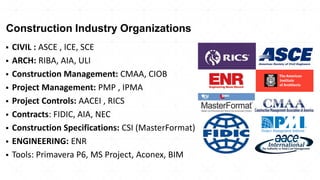
▪ CIVIL : ASCE , ICE, SCE
▪ ARCH: RIBA, AIA, ULI
▪ Construction Management: CMAA, CIOB
▪ Project Management: PMP , IPMA
▪ Project Controls: AACEI , RICS
▪ Contracts: FIDIC, AIA, NEC
▪ Construction Specifications: CSI (MasterFormat)
▪ ENGINEERING: ENR
▪ Tools: Primavera P6, MS Project, Aconex, BIM
Project Controls - The cost dimension
Most look at engineering and see the element of physical “design” and the calculation and analysis tasks that are done
to support that physical design (e.g., design a bridge). However, many people don’t see that beyond the physical
dimension of the design (e.g., the bridge structure), there are less tangible dimensions of money, time, and other
resources that are invested in the creation of the asset. We refer to these investments collectively as “costs”.
Someone needs to estimate what the bridge might cost, determine the activities needed to design and build it, estimate
how long these activities will take, and so on. Furthermore, someone needs to continually monitor and assess the
progress of the bridge design and construction (in relation to the expenditure of money and time) to ensure that the
completed bridge meets the owner’s objectives.
The cost dimension requires calculation, analysis, planning, and control. No bridge has ever been built without dealing
with both the physical and cost dimensions. However, the engineering skills and knowledge required to deal with
“costs” are quite different from those required to deal with the physical design dimension. From that difference, the field
of Project Controls was born.
Project Controls engineers often specialize in one function with a focus on one side of the asset and project business.
They may have titles such as cost estimator, strategic planner, scheduler, cost/schedule engineer, or project control
lead. They may work for the business that owns and operates the asset (emphasis on economics and analysis), or they
may work for the contractor that executes the projects emphasis on planning and control. But, no matter what their job
title or business environment, a general knowledge of, and skills in, all areas of cost engineering are required to
perform their job effectively.
Project Controls Vs. Project Management
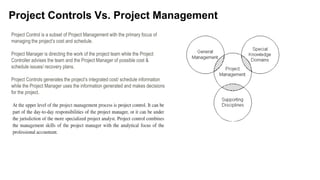
Project Control is a subset of Project Management with the primary focus of
managing the project’s cost and schedule.
Project Manager is directing the work of the project team while the Project
Controller advises the team and the Project Manager of possible cost &
schedule issues/ recovery plans.
Project Controls generates the project’s integrated cost/ schedule information
while the Project Manager uses the information generated and makes decisions
for the project.
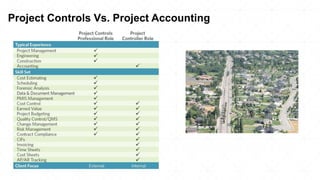
Project Controls Vs. Project Accounting
Organization for Project Control
▪ On smaller projects or those with limited types and quantity of resources, the project control
process may be managed by the project leader, a project manager, engineer, architect, systems
analyst, cost engineer, or whoever. On larger projects, with many resources to deal with (such as
major construction projects), there may be planners, schedulers, estimators, cost/schedule
controllers, value specialists, cost accountants, and other specialists involved. Project control on
large teams may be coordinated by a lead cost/schedule or resource manager, quantity surveyor,
project controls manager, or project manager. For certain techniques, the individual performing the
project tasks (i.e., turning the wrench) may be responsible for control tasks such as progress
measurement.
▪ A central project management organization may be responsible for development of project
personnel, processes, and procedures for all projects in an enterprise (i.e., a project system). That
organization may also manage relationships with project resource providers. All of the project
control steps require experience and skills in which an enterprise should develop organizational
excellence.
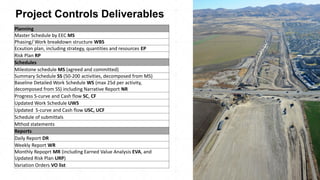
Project Controls Deliverables
Planning
Master Schedule by EEC MS
Phasing/ Work breakdown structure WBS
Ecxution plan, including strategy, quantities and resources EP
Risk Plan RP
Schedules
Milestone schedule MS (agreed and committed)
Summary Schedule SS (50-200 activities, decomposed from MS)
Baseline Detailed Work Schedule WS (max 25d per activity,
decomposed from SS) including Narrative Report NR
Progress S-curve and Cash flow SC, CF
Updated Work Schedule UWS
Updated S-curve and Cash flow USC, UCF
Schedule of submittals
Mthod statements
Reports
Daily Report DR
Weekly Report WR
Monthly Repoprt MR (including Earned Value Analysis EVA, and
Updated Risk Plan URP)
Variation Orders VO list
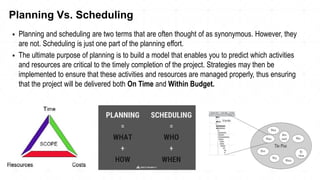
▪ Planning and scheduling are two terms that are often thought of as synonymous. However, they
are not. Scheduling is just one part of the planning effort.
▪ The ultimate purpose of planning is to build a model that enables you to predict which activities
and resources are critical to the timely completion of the project. Strategies may then be
implemented to ensure that these activities and resources are managed properly, thus ensuring
that the project will be delivered both On Time and Within Budget.
Planning Vs. Scheduling
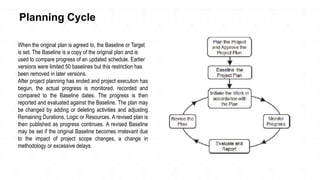
Planning Cycle
When the original plan is agreed to, the Baseline or Target
is set. The Baseline is a copy of the original plan and is
used to compare progress of an updated schedule. Earlier
versions were limited 50 baselines but this restriction has
been removed in later versions.
After project planning has ended and project execution has
begun, the actual progress is monitored, recorded and
compared to the Baseline dates. The progress is then
reported and evaluated against the Baseline. The plan may
be changed by adding or deleting activities and adjusting
Remaining Durations, Logic or Resources. A revised plan is
then published as progress continues. A revised Baseline
may be set if the original Baseline becomes irrelevant due
to the impact of project scope changes, a change in
methodology or excessive delays.
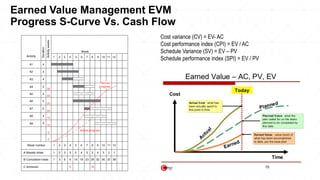
Earned Value Management EVM
Progress S-Curve Vs. Cash Flow
Cost variance (CV) = EV- AC
Cost performance index (CPI) = EV / AC
Schedule Variance (SV) = EV – PV
Schedule performance index (SPI) = EV / PV
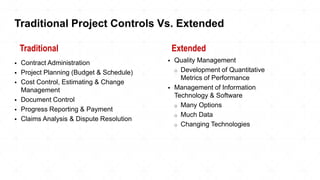
Traditional Project Controls Vs. Extended
▪ Contract Administration
▪ Project Planning (Budget & Schedule)
▪ Cost Control, Estimating & Change
Management
▪ Document Control
▪ Progress Reporting & Payment
▪ Claims Analysis & Dispute Resolution
▪ Quality Management
o Development of Quantitative
Metrics of Performance
▪ Management of Information
Technology & Software
o Many Options
o Much Data
o Changing Technologies
Traditional Extended
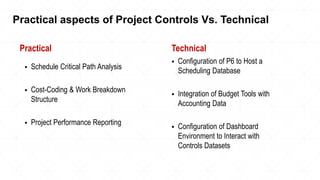
Practical aspects of Project Controls Vs. Technical
Practical Technical
▪ Schedule Critical Path Analysis
▪ Cost-Coding & Work Breakdown
Structure
▪ Project Performance Reporting
▪ Configuration of P6 to Host a
Scheduling Database
▪ Integration of Budget Tools with
Accounting Data
▪ Configuration of Dashboard
Environment to Interact with
Controls Datasets
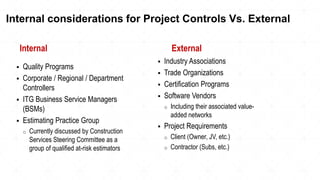
Internal considerations for Project Controls Vs. External
Internal External
▪ Quality Programs
▪ Corporate / Regional / Department
Controllers
▪ ITG Business Service Managers
(BSMs)
▪ Estimating Practice Group
o Currently discussed by Construction
Services Steering Committee as a
group of qualified at-risk estimators
▪ Industry Associations
▪ Trade Organizations
▪ Certification Programs
▪ Software Vendors
o Including their associated value-
added networks
▪ Project Requirements
o Client (Owner, JV, etc.)
o Contractor (Subs, etc.)
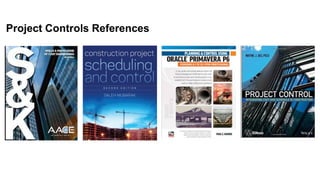
Project Controls References
LinkedIn
▪ https://www.cmu.edu/cee/projects/PMbook/index.html
▪ http://library.aacei.org/terminology/
▪ https://plannerstips.blogspot.com/2016/08/5-things-you-might-not-have-been-told.html?spref=fb
▪ https://www.slideshare.net/ChrisWCarson
▪ https://www.planacademy.com/blog/topics/
Check it By Yourself
Thank you
Hatem.Hegazi@hdrinc.com (enghtm@gmail.com)
https://www.linkedin.com/in/enghtm/

Project controls function

  • 1.
    © 2018 HDR,Inc., all rights reserved. Tomouh Internship Program Hatem Hegazi Project Controls Manager Project Controls Function KAEC- Saudi Arabia October 2018
  • 2.
    Contents ▪ About HDRInc. ▪ Construction Industry Organizations ▪ Project Controls - The cost dimension ▪ Project Controls Vs. Project Management ▪ Project Controls Vs. Project Accounting ▪ Organization for Project Control ▪ Project Controls Deliverables ▪ Planning Vs. Scheduling ▪ Planning Cycle ▪ Earned Value Management EVM
  • 3.
    Ranking Engineering News-Record ENR Top500 Design Firms No. 6 No. 5 - Top 20 in Water No. 6 - Top 20 in Transportation No. 3 - Top 25 in Bridges No. 5 - Top 25 in Highways No. 6 - Top 10 in Marine & Port Facilities No. 6 - Top 25 in Mass Transit & Rail No. 15 - Top 25 in Airports No. 6 - Top 20 in General Building No. 1 - Top 25 in Health Care No. 5 - Top 10 in Correctional Facilities No. 7 - Top 25 Commercial Offices No. 8 - Top 25 in Government Offices No. 10 – Top 100 Green-Buildings Design Firms ▪ https://www.hdrinc.com/about-us/awards-rankings About HDR HDR is an architectural, engineering, and consulting firm based in Omaha, Nebraska, United States. HDR has worked on projects in all 50 U.S. states and in 60 countries, including notable projects such as the Hoover Dam Bypass, Fort Belvoir Community Hospital, and Roslin Institute building.
  • 4.
    © 2014 HDRArchitecture, Inc., all rights reserved.© 2014 HDR Architecture, Inc., all rights reserved.© 2014 HDR Architecture, Inc., all rights reserved.© 2014 HDR, Inc., all rights reserved.© 2014 HDR, Inc., all rights reserved.© 2014 HDR, Inc., all rights reserved.
  • 5.
    Construction Industry Organizations ▪CIVIL : ASCE , ICE, SCE ▪ ARCH: RIBA, AIA, ULI ▪ Construction Management: CMAA, CIOB ▪ Project Management: PMP , IPMA ▪ Project Controls: AACEI , RICS ▪ Contracts: FIDIC, AIA, NEC ▪ Construction Specifications: CSI (MasterFormat) ▪ ENGINEERING: ENR ▪ Tools: Primavera P6, MS Project, Aconex, BIM
  • 6.
    Project Controls -The cost dimension Most look at engineering and see the element of physical “design” and the calculation and analysis tasks that are done to support that physical design (e.g., design a bridge). However, many people don’t see that beyond the physical dimension of the design (e.g., the bridge structure), there are less tangible dimensions of money, time, and other resources that are invested in the creation of the asset. We refer to these investments collectively as “costs”. Someone needs to estimate what the bridge might cost, determine the activities needed to design and build it, estimate how long these activities will take, and so on. Furthermore, someone needs to continually monitor and assess the progress of the bridge design and construction (in relation to the expenditure of money and time) to ensure that the completed bridge meets the owner’s objectives. The cost dimension requires calculation, analysis, planning, and control. No bridge has ever been built without dealing with both the physical and cost dimensions. However, the engineering skills and knowledge required to deal with “costs” are quite different from those required to deal with the physical design dimension. From that difference, the field of Project Controls was born. Project Controls engineers often specialize in one function with a focus on one side of the asset and project business. They may have titles such as cost estimator, strategic planner, scheduler, cost/schedule engineer, or project control lead. They may work for the business that owns and operates the asset (emphasis on economics and analysis), or they may work for the contractor that executes the projects emphasis on planning and control. But, no matter what their job title or business environment, a general knowledge of, and skills in, all areas of cost engineering are required to perform their job effectively.
  • 7.
    Project Controls Vs.Project Management Project Control is a subset of Project Management with the primary focus of managing the project’s cost and schedule. Project Manager is directing the work of the project team while the Project Controller advises the team and the Project Manager of possible cost & schedule issues/ recovery plans. Project Controls generates the project’s integrated cost/ schedule information while the Project Manager uses the information generated and makes decisions for the project.
  • 8.
    Project Controls Vs.Project Accounting
  • 9.
    Organization for ProjectControl ▪ On smaller projects or those with limited types and quantity of resources, the project control process may be managed by the project leader, a project manager, engineer, architect, systems analyst, cost engineer, or whoever. On larger projects, with many resources to deal with (such as major construction projects), there may be planners, schedulers, estimators, cost/schedule controllers, value specialists, cost accountants, and other specialists involved. Project control on large teams may be coordinated by a lead cost/schedule or resource manager, quantity surveyor, project controls manager, or project manager. For certain techniques, the individual performing the project tasks (i.e., turning the wrench) may be responsible for control tasks such as progress measurement. ▪ A central project management organization may be responsible for development of project personnel, processes, and procedures for all projects in an enterprise (i.e., a project system). That organization may also manage relationships with project resource providers. All of the project control steps require experience and skills in which an enterprise should develop organizational excellence.
  • 10.
    Project Controls Deliverables Planning MasterSchedule by EEC MS Phasing/ Work breakdown structure WBS Ecxution plan, including strategy, quantities and resources EP Risk Plan RP Schedules Milestone schedule MS (agreed and committed) Summary Schedule SS (50-200 activities, decomposed from MS) Baseline Detailed Work Schedule WS (max 25d per activity, decomposed from SS) including Narrative Report NR Progress S-curve and Cash flow SC, CF Updated Work Schedule UWS Updated S-curve and Cash flow USC, UCF Schedule of submittals Mthod statements Reports Daily Report DR Weekly Report WR Monthly Repoprt MR (including Earned Value Analysis EVA, and Updated Risk Plan URP) Variation Orders VO list
  • 11.
    ▪ Planning andscheduling are two terms that are often thought of as synonymous. However, they are not. Scheduling is just one part of the planning effort. ▪ The ultimate purpose of planning is to build a model that enables you to predict which activities and resources are critical to the timely completion of the project. Strategies may then be implemented to ensure that these activities and resources are managed properly, thus ensuring that the project will be delivered both On Time and Within Budget. Planning Vs. Scheduling
  • 12.
    Planning Cycle When theoriginal plan is agreed to, the Baseline or Target is set. The Baseline is a copy of the original plan and is used to compare progress of an updated schedule. Earlier versions were limited 50 baselines but this restriction has been removed in later versions. After project planning has ended and project execution has begun, the actual progress is monitored, recorded and compared to the Baseline dates. The progress is then reported and evaluated against the Baseline. The plan may be changed by adding or deleting activities and adjusting Remaining Durations, Logic or Resources. A revised plan is then published as progress continues. A revised Baseline may be set if the original Baseline becomes irrelevant due to the impact of project scope changes, a change in methodology or excessive delays.
  • 13.
    Earned Value ManagementEVM Progress S-Curve Vs. Cash Flow Cost variance (CV) = EV- AC Cost performance index (CPI) = EV / AC Schedule Variance (SV) = EV – PV Schedule performance index (SPI) = EV / PV
  • 14.
    Traditional Project ControlsVs. Extended ▪ Contract Administration ▪ Project Planning (Budget & Schedule) ▪ Cost Control, Estimating & Change Management ▪ Document Control ▪ Progress Reporting & Payment ▪ Claims Analysis & Dispute Resolution ▪ Quality Management o Development of Quantitative Metrics of Performance ▪ Management of Information Technology & Software o Many Options o Much Data o Changing Technologies Traditional Extended
  • 15.
    Practical aspects ofProject Controls Vs. Technical Practical Technical ▪ Schedule Critical Path Analysis ▪ Cost-Coding & Work Breakdown Structure ▪ Project Performance Reporting ▪ Configuration of P6 to Host a Scheduling Database ▪ Integration of Budget Tools with Accounting Data ▪ Configuration of Dashboard Environment to Interact with Controls Datasets
  • 16.
    Internal considerations forProject Controls Vs. External Internal External ▪ Quality Programs ▪ Corporate / Regional / Department Controllers ▪ ITG Business Service Managers (BSMs) ▪ Estimating Practice Group o Currently discussed by Construction Services Steering Committee as a group of qualified at-risk estimators ▪ Industry Associations ▪ Trade Organizations ▪ Certification Programs ▪ Software Vendors o Including their associated value- added networks ▪ Project Requirements o Client (Owner, JV, etc.) o Contractor (Subs, etc.)
  • 17.
  • 18.
  • 19.
    ▪ https://www.cmu.edu/cee/projects/PMbook/index.html ▪ http://library.aacei.org/terminology/ ▪https://plannerstips.blogspot.com/2016/08/5-things-you-might-not-have-been-told.html?spref=fb ▪ https://www.slideshare.net/ChrisWCarson ▪ https://www.planacademy.com/blog/topics/ Check it By Yourself
  • 20.