Under the Guidance of
Er. Sonu Kumar
Submitted by
Bhoop Narain Pathak (1273720008)
Rajesh Kumar(1273720036)
Jay Hind(1273720019)
Branch-Electrical Engineering, Final Year
REC AMBEDKAR NAGAR (U.P.)
Power Grid Synchronization Failure Detection
 Synchronization means the minimization of difference in
voltage, frequency and phase angle between the corresponding
phases of the generator output and grid supply. An alternating
current generator must be synchronized with the grid prior to
connection. It can’t deliver the power unless it is running at
same frequency as the network.
 Synchronization must occur before connecting the generator to
a grid. Synchronization can be achieved manually or
automatically. The purpose of synchronization is to monitor,
access, enable, and automatically take the control action to
prevent the abnormalities of voltage and frequency.
Voltage fluctuation :
 When a generator is synchronized with a power grid.
 There is a voltage fluctuation on the distribution line.
 During synchronization the voltage fluctuation should not
exceed 7% at the at the point of common coupling.
Limits allowing for synchronization are :
 Phase angle- +/-20 degrees
 Maximum voltage difference – 7%
 Maximum slip frequency – 0.44%
 Lighting is one of the main causes for power system faults.
 The major advantage is detecting the synchronization failure
between generators and power grid.
 When there is an Under/over voltage or under/over frequency.
 The comparator will detect the difference the actual power and
reactive power.
 If there is no failure of power grid synchronization then the
detectors will give the zero values.
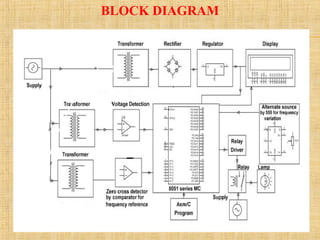
BLOCK DIAGRAM
HARDWARE REQUIREMENTS
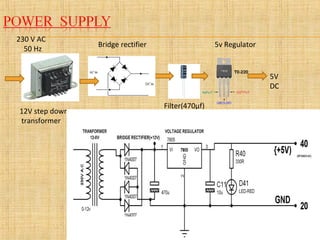
 POWER SUPPLY
 MICROCONTROLLER
 555 TIMER
 LM358
 LM339
 RELAYS
 BC547
 LIQUID CRYSTAL DISPLAY
 LED
 IN4007
 RESISTORS
 CAPACITORS
230 V AC
50 Hz
5V
DC
12V step down
transformer
Filter(470µf)
5v RegulatorBridge rectifier
 It is a smaller computer
 Has on-chip RAM, ROM, I/O ports...
RAM ROM
I/O Port
Timer
Serial
COM
Port
Microcontroller
CPU
A single chip
CPU
On-chip
RAM
On-chip
ROM for
program
code
4 I/O Ports
Timer 0
Serial
Port
OSC
Interrup
t
Control
External interrupts
Timer 1
Timer/Counter
Bus
Control
TxD RxDP0 P1 P2 P3
Address/Data
Counter
Inputs
 8K Bytes of In-System Programmable (ISP) Flash Memory
 Endurance: 10,000 Write/Erase Cycles
 4.0V to 5.5V Operating Range
 Fully Static Operation: 0 Hz to 33 MHz
 256 x 8-bit Internal RAM
 32 Programmable I/O Lines
 Three 16-bit Timer/Counters
 Eight Interrupt Sources
 Full Duplex UART Serial Channel
 Interrupt Recovery from Power-down
Mode
 Dual Data Pointer
555 TIMER
The 555 Timer IC is an integrated circuit (chip) implementing a variety of timer
and multivibrator applications
The 555 has three operating modes:
•Monostable mode: in this mode, the 555 functions as a "one-
shot". Applications include timers, missing pulse detection,
switches, touch switches, frequency divider, capacitance
measurement, pulse-width modulation (PWM) etc.
•Astable - free running mode: the 555 can operate as an
oscillator. Uses include LED and lamp flashers, pulse
generation, logic clocks, tone generation, security alarms,
pulse position modulation, etc.
•Bistable mode or Schmitt trigger: the 555 can operate as a
flip-flop, if the DIS pin is not connected and no capacitor is
used. Uses include bounce free latched switches, etc.
Pin Name Purpose
1 GND Ground, low level (0 V)
2 TRIG OUT rises, and interval starts, when this input falls below 1/3 VCC.
3 OUT This output is driven to +VCC or GND.
4 RESET A timing interval may be interrupted by driving this input to GND.
5 CTRL "Control" access to the internal voltage divider (by default, 2/3 VCC).
6 THR The interval ends when the voltage at THR is greater than at CTRL.
7 DIS Open collector output; may discharge a capacitor between intervals.
8 V+, VCC Positive supply voltage is usually between 3 and 15 V.
Internal architecture of 555 timer
LM339( COMPARATOR)
The LM339 consists of four independent precision voltage comparators
The LM339 series was designed to directly interface with TTL and CMOS.
When operated from both plus and minus power supplies, the LM339
series will directly interface with MOS logic where their low power drain is a
distinct advantage over standard comparators.
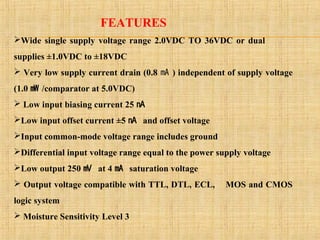
FEATURES
Wide single supply voltage range 2.0VDC TO 36VDC or dual
supplies ±1.0VDC to ±18VDC
 Very low supply current drain (0.8 ㎃ ) independent of supply voltage
(1.0 ㎽ /comparator at 5.0VDC)
 Low input biasing current 25 ㎁
Low input offset current ±5 ㎁ and offset voltage
Input common-mode voltage range includes ground
Differential input voltage range equal to the power supply voltage
Low output 250 ㎷ at 4 ㎃ saturation voltage
 Output voltage compatible with TTL, DTL, ECL, MOS and CMOS
logic system
 Moisture Sensitivity Level 3
IT IS A ELECTRO MAGNETIC SWITCH
USED TO CONTROL THE ELECTRICAL DEVICES
COPPER CORE MAGNETIC FLUX PLAYS MAIN ROLE HERE
The relay's switch connections are usually labeled COM, NC and
NO:
COM = Common, always connect to this; it is the moving part of
the itch.
NC = Normally Closed, COM is connected to this when the relay
coil is off.
NO = Normally Open, COM is connected to this when the relay
coil is on
BC547 (NPN –Transistor)
The BC547 transistor is an NPN Epitaxial
Silicon Transistor.
It is used in general-purpose switching and
amplification BC847/BC547 series 45 V, 100
mA NPN general-purpose transistors.
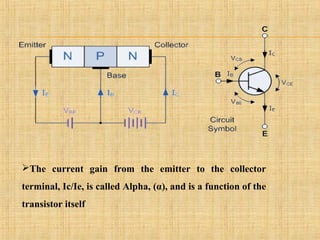
The ratio of two currents (Ic/Ib) is called the DC Current Gain of
the device and is given the symbol of hfe or nowadays Beta, (β).
The current gain from the emitter to the collector
terminal, Ic/Ie, is called Alpha, (α), and is a function of the
transistor itself
LIQUID CRYSTAL DISPLAY (LCD)
Most common LCDs connected to the microcontrollers are
16x2 and 20x2 displays.
This means 16 characters per line by 2 lines and 20
characters per line by 2 lines, respectively.
The standard is referred to as HD44780U, which refers to
the controller chip which receives data from an external
source (and communicates directly with the LCD.
LCD BACKGROUND
If an 8-bit data bus is used the LCD will require 11 data lines
(3 control lines plus the 8 lines for the data bus)
The three control lines are referred to as EN, RS, and RW
EN=Enable (used to tell the LCD that you are sending it data)
RS=Register Select (When RS is low (0), data is treated as a command)
(When RS is High(1), data being sent is text data )
R/W=Read/Write (When RW is low (0), the data written to the LCD)
(When RW is low (0), the data reading to the LCD)
 Keil an ARM Company makes C compilers, macro assemblers, real-
time kernels, debuggers, simulators, integrated environments,
evaluation boards, and emulators for ARM7/ARM9/Cortex-M3,
XC16x/C16x/ST10, 251, and 8051 MCU families.
 Compilers are programs used to convert a High Level Language to
object code. Desktop compilers produce an output object code for the
underlying microprocessor, but not for other microprocessors.
This project is applicable for Solar Power Plant where
frequency varies; frequency and voltage parameters should
match with the Power grid.
This system will help us to get uninterrupted power supply.
This system will be helpful for industrial areas where
continuous electricity is needed.
This system can also be apply on small power house to provide
uninterrupted power supply in homes.
The advantage of this project is, it’s secured the
Power of the Grid i.e., Power Plants should supply
power to the grid rather than drawing the power from
the grid.
The disadvantage of this project is, it’s available in
single phase supply where power Grid is of Three
Phase supply.
THANKYOU

power grid synchronization failure detection

  • 1.
    Under the Guidanceof Er. Sonu Kumar Submitted by Bhoop Narain Pathak (1273720008) Rajesh Kumar(1273720036) Jay Hind(1273720019) Branch-Electrical Engineering, Final Year REC AMBEDKAR NAGAR (U.P.) Power Grid Synchronization Failure Detection
  • 2.
     Synchronization meansthe minimization of difference in voltage, frequency and phase angle between the corresponding phases of the generator output and grid supply. An alternating current generator must be synchronized with the grid prior to connection. It can’t deliver the power unless it is running at same frequency as the network.  Synchronization must occur before connecting the generator to a grid. Synchronization can be achieved manually or automatically. The purpose of synchronization is to monitor, access, enable, and automatically take the control action to prevent the abnormalities of voltage and frequency.
  • 3.
    Voltage fluctuation : When a generator is synchronized with a power grid.  There is a voltage fluctuation on the distribution line.  During synchronization the voltage fluctuation should not exceed 7% at the at the point of common coupling. Limits allowing for synchronization are :  Phase angle- +/-20 degrees  Maximum voltage difference – 7%  Maximum slip frequency – 0.44%
  • 4.
     Lighting isone of the main causes for power system faults.  The major advantage is detecting the synchronization failure between generators and power grid.  When there is an Under/over voltage or under/over frequency.  The comparator will detect the difference the actual power and reactive power.  If there is no failure of power grid synchronization then the detectors will give the zero values.
  • 5.
  • 6.
    HARDWARE REQUIREMENTS  POWERSUPPLY  MICROCONTROLLER  555 TIMER  LM358  LM339  RELAYS  BC547  LIQUID CRYSTAL DISPLAY  LED  IN4007  RESISTORS  CAPACITORS
  • 7.
    230 V AC 50Hz 5V DC 12V step down transformer Filter(470µf) 5v RegulatorBridge rectifier
  • 8.
     It isa smaller computer  Has on-chip RAM, ROM, I/O ports... RAM ROM I/O Port Timer Serial COM Port Microcontroller CPU A single chip
  • 9.
    CPU On-chip RAM On-chip ROM for program code 4 I/OPorts Timer 0 Serial Port OSC Interrup t Control External interrupts Timer 1 Timer/Counter Bus Control TxD RxDP0 P1 P2 P3 Address/Data Counter Inputs
  • 10.
     8K Bytesof In-System Programmable (ISP) Flash Memory  Endurance: 10,000 Write/Erase Cycles  4.0V to 5.5V Operating Range  Fully Static Operation: 0 Hz to 33 MHz  256 x 8-bit Internal RAM  32 Programmable I/O Lines  Three 16-bit Timer/Counters  Eight Interrupt Sources  Full Duplex UART Serial Channel  Interrupt Recovery from Power-down Mode  Dual Data Pointer
  • 11.
    555 TIMER The 555Timer IC is an integrated circuit (chip) implementing a variety of timer and multivibrator applications The 555 has three operating modes: •Monostable mode: in this mode, the 555 functions as a "one- shot". Applications include timers, missing pulse detection, switches, touch switches, frequency divider, capacitance measurement, pulse-width modulation (PWM) etc. •Astable - free running mode: the 555 can operate as an oscillator. Uses include LED and lamp flashers, pulse generation, logic clocks, tone generation, security alarms, pulse position modulation, etc. •Bistable mode or Schmitt trigger: the 555 can operate as a flip-flop, if the DIS pin is not connected and no capacitor is used. Uses include bounce free latched switches, etc.
  • 12.
    Pin Name Purpose 1GND Ground, low level (0 V) 2 TRIG OUT rises, and interval starts, when this input falls below 1/3 VCC. 3 OUT This output is driven to +VCC or GND. 4 RESET A timing interval may be interrupted by driving this input to GND. 5 CTRL "Control" access to the internal voltage divider (by default, 2/3 VCC). 6 THR The interval ends when the voltage at THR is greater than at CTRL. 7 DIS Open collector output; may discharge a capacitor between intervals. 8 V+, VCC Positive supply voltage is usually between 3 and 15 V. Internal architecture of 555 timer
  • 13.
    LM339( COMPARATOR) The LM339consists of four independent precision voltage comparators The LM339 series was designed to directly interface with TTL and CMOS. When operated from both plus and minus power supplies, the LM339 series will directly interface with MOS logic where their low power drain is a distinct advantage over standard comparators.
  • 14.
    FEATURES Wide single supplyvoltage range 2.0VDC TO 36VDC or dual supplies ±1.0VDC to ±18VDC  Very low supply current drain (0.8 ㎃ ) independent of supply voltage (1.0 ㎽ /comparator at 5.0VDC)  Low input biasing current 25 ㎁ Low input offset current ±5 ㎁ and offset voltage Input common-mode voltage range includes ground Differential input voltage range equal to the power supply voltage Low output 250 ㎷ at 4 ㎃ saturation voltage  Output voltage compatible with TTL, DTL, ECL, MOS and CMOS logic system  Moisture Sensitivity Level 3
  • 16.
    IT IS AELECTRO MAGNETIC SWITCH USED TO CONTROL THE ELECTRICAL DEVICES COPPER CORE MAGNETIC FLUX PLAYS MAIN ROLE HERE
  • 17.
    The relay's switchconnections are usually labeled COM, NC and NO: COM = Common, always connect to this; it is the moving part of the itch. NC = Normally Closed, COM is connected to this when the relay coil is off. NO = Normally Open, COM is connected to this when the relay coil is on
  • 18.
    BC547 (NPN –Transistor) TheBC547 transistor is an NPN Epitaxial Silicon Transistor. It is used in general-purpose switching and amplification BC847/BC547 series 45 V, 100 mA NPN general-purpose transistors. The ratio of two currents (Ic/Ib) is called the DC Current Gain of the device and is given the symbol of hfe or nowadays Beta, (β).
  • 19.
    The current gainfrom the emitter to the collector terminal, Ic/Ie, is called Alpha, (α), and is a function of the transistor itself
  • 20.
    LIQUID CRYSTAL DISPLAY(LCD) Most common LCDs connected to the microcontrollers are 16x2 and 20x2 displays. This means 16 characters per line by 2 lines and 20 characters per line by 2 lines, respectively. The standard is referred to as HD44780U, which refers to the controller chip which receives data from an external source (and communicates directly with the LCD.
  • 21.
    LCD BACKGROUND If an8-bit data bus is used the LCD will require 11 data lines (3 control lines plus the 8 lines for the data bus) The three control lines are referred to as EN, RS, and RW EN=Enable (used to tell the LCD that you are sending it data) RS=Register Select (When RS is low (0), data is treated as a command) (When RS is High(1), data being sent is text data ) R/W=Read/Write (When RW is low (0), the data written to the LCD) (When RW is low (0), the data reading to the LCD)
  • 22.
     Keil anARM Company makes C compilers, macro assemblers, real- time kernels, debuggers, simulators, integrated environments, evaluation boards, and emulators for ARM7/ARM9/Cortex-M3, XC16x/C16x/ST10, 251, and 8051 MCU families.  Compilers are programs used to convert a High Level Language to object code. Desktop compilers produce an output object code for the underlying microprocessor, but not for other microprocessors.
  • 23.
    This project isapplicable for Solar Power Plant where frequency varies; frequency and voltage parameters should match with the Power grid. This system will help us to get uninterrupted power supply. This system will be helpful for industrial areas where continuous electricity is needed. This system can also be apply on small power house to provide uninterrupted power supply in homes.
  • 24.
    The advantage ofthis project is, it’s secured the Power of the Grid i.e., Power Plants should supply power to the grid rather than drawing the power from the grid.
  • 25.
    The disadvantage ofthis project is, it’s available in single phase supply where power Grid is of Three Phase supply.
  • 26.