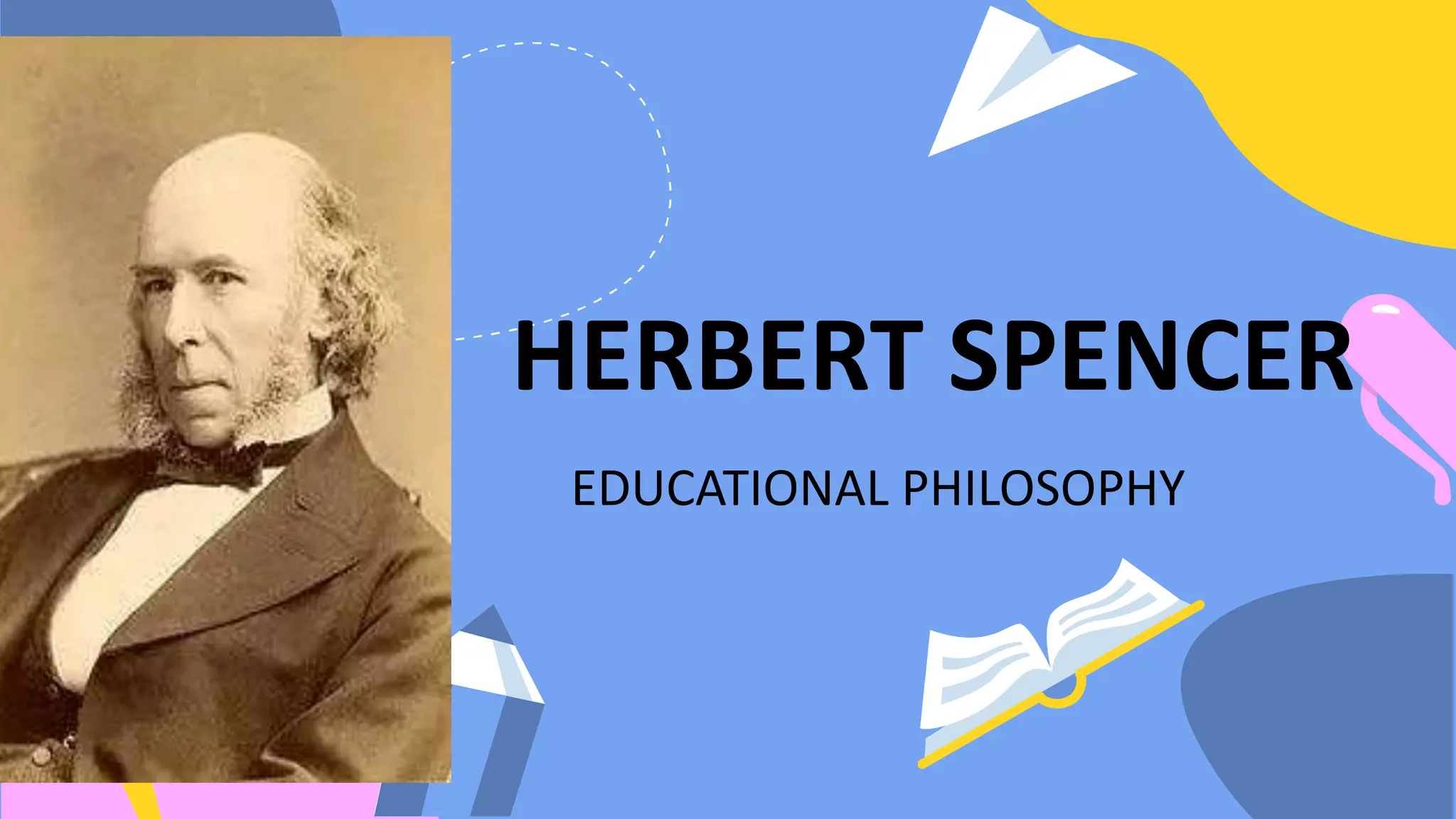
HERBERT SPENCER
EDUCATIONAL PHILOSOPHY
OBJECTIVES
At the end of this lesson, the student will be able to:
a. Know a brief background of Herbert Spencer;
b. Identify his Philosophy in Education; and
c. Learn what are the Influence of his Philosophy on
Education Practices today.
HERBERT SPENCER
 (1820-1903) was a British National. An English philosopher,
biologist, sociologist, anthropologist, and a prolific writer.
 Was known as one of the leading Social Darwinists of the
19th century.
 He was the first person to coin the phrase "survival of the
fittest".
HERBERT SPENCER
Spencer was an agnostic who believed
that the only way to gain knowledge
was through a scientific approach.
Synthetic Philosophy.
Herbert Spencer --Social Darwinist
 "Survival of the Fittest".
 Spencer believes that competition is a natural ethical
force that motivates the best equipped humans to climb
to the top of socioeconomic ladder.
 The fittest population will increase, and the unfit (weaker
individual) will slowly disappear.
Herbert Spencer --Social Darwinism Education
Opposition to Public Schools
 He did not believed in the public school system. His major
criticism of the school system was that it did not prepare
children to live in the society.
 Instead, he believed in the private school system which
competed for the brightest students. Spencer felt that the
most exemplary schools would eventually acquire the best
teachers and students.
UTILITARIANISM
 Is a moral theory that holds that the best action is the one
that maximizes overall pain or suffering.
 a doctrine that the useful is the good and that the
determining consideration of right conduct should be the
usefulness of its consequences
 a theory that the aim of action should be the largest possible
balance of pleasure over pain or the greatest happiness of
the greatest number
UTILITARIAN EDUCATION
 The teaching of skills and subjects applicable to daily life, work, and
society.
 Focused on practical skills and knowledge that will be useful in daily
life and that it should be geared towards producing individuals who
were self-sufficient, self-reliant, and capable of contributing to society
in a meaningful way.
 This kind of education is characterized by its focus on
learning/teaching applied science and recognition of the futility of
Sciences fundamental and philosophical.
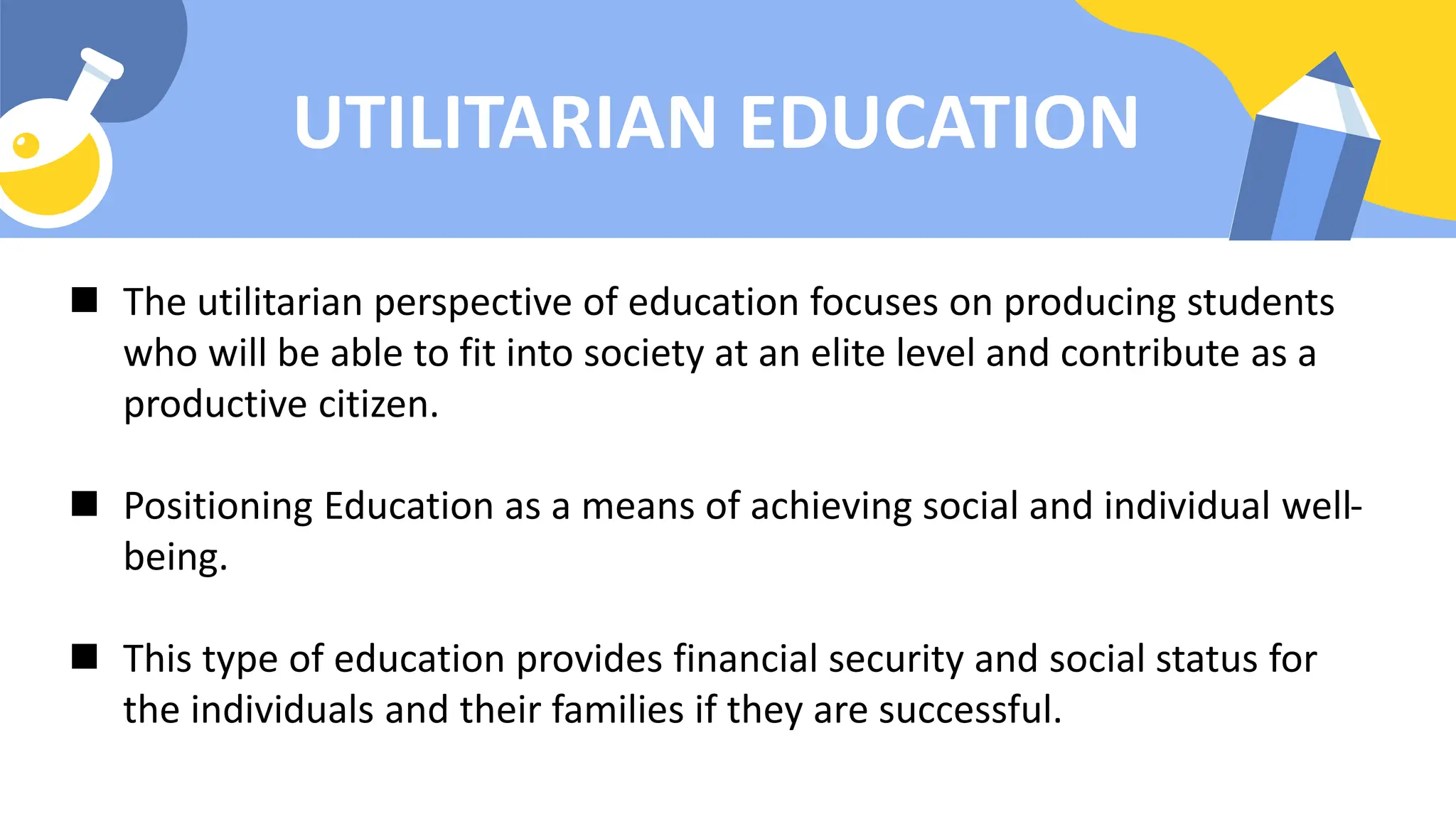
UTILITARIAN EDUCATION
 The utilitarian perspective of education focuses on producing students
who will be able to fit into society at an elite level and contribute as a
productive citizen.
 Positioning Education as a means of achieving social and individual well-
being.
 This type of education provides financial security and social status for
the individuals and their families if they are successful.
Activities in Utilitarian Education
Activities in the classroom that will
improve interpersonal
communication skills
 Speeches
 Essays
 Teaching demonstration
 Sample job interview
 Basic Microsoft
 Utilization of LMS
 Math models
 Word problems
 Researches
Computer Skills
Critical thinking and problem
solving skills
INFLUENCE ON EDUCATIONAL PRACTICES TODAY
 He wanted private schools to compete against each other
in trying to attract the brightest students and most capable
teachers.
 The standardized testing used in the No Child Left Behind
Act is a way of introducing competition in to schools, as it
identifies achieving and non- achieving schools and
teachers
INFLUENCE ON EDUCATIONAL PRACTICES TODAY
 The raise of entry standards for students of pre-service
education teachers to make them more competitive.
 His influences are still felt as education continues to discuss
voucher system to private schools and in the stressing of
teaching skills that will assist students in becoming
individuals who contribute to the good of society.
"THE GREAT AIM OF
EDUCATION IS NOT
KNOWLEDGE BUT
ACTION"
---- HERBERT SPENCER---
Mary Anne Reyta
Prepared by:
Thank you for
listening!

THE EDUCATIONAL PHILOSOPHY OF HERBERT SPENCER.pptx

  • 1.
  • 2.
    OBJECTIVES At the endof this lesson, the student will be able to: a. Know a brief background of Herbert Spencer; b. Identify his Philosophy in Education; and c. Learn what are the Influence of his Philosophy on Education Practices today.
  • 3.
    HERBERT SPENCER  (1820-1903)was a British National. An English philosopher, biologist, sociologist, anthropologist, and a prolific writer.  Was known as one of the leading Social Darwinists of the 19th century.  He was the first person to coin the phrase "survival of the fittest".
  • 4.
    HERBERT SPENCER Spencer wasan agnostic who believed that the only way to gain knowledge was through a scientific approach. Synthetic Philosophy.
  • 5.
    Herbert Spencer --SocialDarwinist  "Survival of the Fittest".  Spencer believes that competition is a natural ethical force that motivates the best equipped humans to climb to the top of socioeconomic ladder.  The fittest population will increase, and the unfit (weaker individual) will slowly disappear.
  • 6.
    Herbert Spencer --SocialDarwinism Education Opposition to Public Schools  He did not believed in the public school system. His major criticism of the school system was that it did not prepare children to live in the society.  Instead, he believed in the private school system which competed for the brightest students. Spencer felt that the most exemplary schools would eventually acquire the best teachers and students.
  • 7.
    UTILITARIANISM  Is amoral theory that holds that the best action is the one that maximizes overall pain or suffering.  a doctrine that the useful is the good and that the determining consideration of right conduct should be the usefulness of its consequences  a theory that the aim of action should be the largest possible balance of pleasure over pain or the greatest happiness of the greatest number
  • 8.
    UTILITARIAN EDUCATION  Theteaching of skills and subjects applicable to daily life, work, and society.  Focused on practical skills and knowledge that will be useful in daily life and that it should be geared towards producing individuals who were self-sufficient, self-reliant, and capable of contributing to society in a meaningful way.  This kind of education is characterized by its focus on learning/teaching applied science and recognition of the futility of Sciences fundamental and philosophical.
  • 9.
    UTILITARIAN EDUCATION  Theutilitarian perspective of education focuses on producing students who will be able to fit into society at an elite level and contribute as a productive citizen.  Positioning Education as a means of achieving social and individual well- being.  This type of education provides financial security and social status for the individuals and their families if they are successful.
  • 10.
    Activities in UtilitarianEducation Activities in the classroom that will improve interpersonal communication skills  Speeches  Essays  Teaching demonstration  Sample job interview  Basic Microsoft  Utilization of LMS  Math models  Word problems  Researches Computer Skills Critical thinking and problem solving skills
  • 11.
    INFLUENCE ON EDUCATIONALPRACTICES TODAY  He wanted private schools to compete against each other in trying to attract the brightest students and most capable teachers.  The standardized testing used in the No Child Left Behind Act is a way of introducing competition in to schools, as it identifies achieving and non- achieving schools and teachers
  • 12.
    INFLUENCE ON EDUCATIONALPRACTICES TODAY  The raise of entry standards for students of pre-service education teachers to make them more competitive.  His influences are still felt as education continues to discuss voucher system to private schools and in the stressing of teaching skills that will assist students in becoming individuals who contribute to the good of society.
  • 13.
    "THE GREAT AIMOF EDUCATION IS NOT KNOWLEDGE BUT ACTION" ---- HERBERT SPENCER---
  • 14.
    Mary Anne Reyta Preparedby: Thank you for listening!