ETHICS IN
PHYSIOTHERAPY
PRACTICE
PRESENTED BY
APARNA GOSWAMI
MPT (NEUROLOGY)
INTRODUCTION
Ethics derives from, the Greek word “ethicos” which
means arising from custom or from the French word
“ethos” meaning custom.
DEFINITION OF ETHICS:
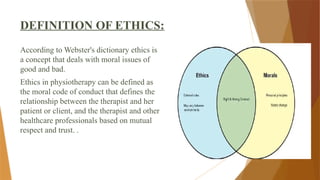
According to Webster's dictionary ethics is
a concept that deals with moral issues of
good and bad.
Ethics in physiotherapy can be defined as
the moral code of conduct that defines the
relationship between the therapist and her
patient or client, and the therapist and other
healthcare professionals based on mutual
respect and trust. .
PHYSIOTHERAPY IN INDIA:
According to THE NATIONAL COMMISSION FOR ALLIED AND
HEALTHCARE PROFESSIONS ACT, 2021,
"Physiotherapy Professional is a person who practices physiotherapy by
undertaking comprehensive examination and appropriate investigation, provides
treatment and advice to any persons preparatory to or for the purpose of or in
connection with movement or functional dysfunction, malfunction, disorder,
disability, healing and pain from trauma and disease, using physical modalities
including exercise, mobilization, manipulations, electrical and thermal agents and
other electro therapeutics for prevention, screening, diagnosis, treatment, health
promotion and fitness.
The physiotherapist can practice independently or as a part of a multi-disciplinary
team and has a minimum qualification of a baccalaureate degree".
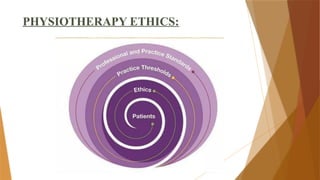
PHYSIOTHERAPY ETHICS:
PURPOSE OF THE CODE OF ETHICS:
 1.Define the ethical principles that form the foundation of physical therapist
practice in patient management, consultation, education, research and
administration
 2. Provide standards of behavior and performance that form the basis of
professional accountability to the public.
 3. Provide guidance for physical therapists facing ethical challenges, regardless
of their professional roles and responsibilities.
 4. Educate physical therapist, students, other health care professionals,
regulators and the public regarding the core values, ethical principles, and
standards that guide the professional conduct of the physical therapist.
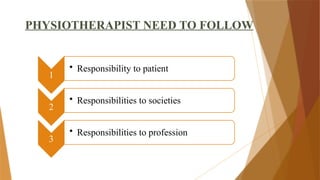
1
• Responsibility to patient
2
• Responsibilities to societies
3
• Responsibilities to profession
PHYSIOTHERAPIST NEED TO FOLLOW
Behave ethically
UNDER PINNING
ETHICS, VALUES
AND CONCEPTS
Deliver an effective
service
Take responsibility for
your action
Strive to achieve
excellence
THE FOUR PRINCIPLES:
PRINCIPLES:
Principle 1: Physical therapists shall respect the inherent
dignity and rights of all individuals:
Physical therapists shall act in a respectful manner toward each
person regardless of age, gender, race, nationality, religion.
Principle 2: Physical therapists shall be trustworthy and
compassionate in addressing the rights and needs of patients/clients:
Physical therapists shall provide physical therapy services with
compassionate and caring behaviors
Physical therapists shall protect confidential patient/ client information and
may disclose confidential information to appropriate authorities only when
allowed or as required by law
Principle 3: Physical therapists shall be accountable for
making sound professional judgments:
Physical therapists shall make judgments within their scope of
practice and level of expertise
Principle 4: Physical therapists shall demonstrate integrity in their
relationships with patients/clients, families, colleagues, students,
research participants, other health care providers, employers,
payers, and the public:
Physical therapists shall provide truthful, accurate, and relevant information
and shall not make misleading representations.
Principle 5: Physical therapists shall fulfill their legal and
professional obligations:
Physical therapists shall comply with applicable local, state, and
federal laws and regulations.
Physical therapists shall have primary responsibility for supervision
of physical therapist assistants and support personnel.
Physical therapists who have knowledge that a colleague is unable
to perform their professional responsibilities with reasonable skill
and safety shall report this information to the appropriate authority
Principle 6: Physical therapists shall enhance their expertise
through the lifelong acquisition and refinement of
knowledge, skills, abilities, and professional behaviors:
Physical therapists shall take responsibility for their professional
development.
Principle 7: Physical therapists shall promote
organizational behaviors and business practices that
benefit patients and society:
Physical therapists shall seek remuneration as is deserved and
reasonable for physical therapist services.
Physical therapists shall not accept gifts or other considerations that
influence or give an appearance of influencing their professional
judgment.
Principle 8: Physical therapists shall participate in efforts to
meet the health needs of people locally, nationally, or
globally:
Physical therapist shall meet the health needs of people who are
economically disadvantaged, uninsured, and underinsured.
Physical therapists shall educate members of the public about the
benefits of physical therapy.
Physiotherapists engaged in research shall
ensure that they:
 Abide by all current rules and policies applying to the conduct of
research on human subjects
 Have obtained subjects’ informed consent
 Have obtained approval from relevant ethical and administrative
bodies
 Protect subjects’ confidentialityy
 Protect subjects’ safety and well-being
 Do not engage in fraud or plagiarism
 Freely share the results of their research
Physiotherapists in the role of employer shall:
 Ensure all employees are properly and duly qualified
 Apply current management principles and practices to the conduct
of the service
 Ensure policies and procedures are properly developed,
implemented and monitored
 Ensure that clinical practice is appropriately evaluated and audited
 Provide adequate opportunities for staff education and personal
development based on effective performance appraise
ETHICS IN RESEARCH:
 Essentially
 Non- exploitation
 Social responsibility
 Ensuring confidentiality
 Risk minimization
 Maximization of benefit
 Totality of responsibility
 Environmental protection
ETHICAL VALUES:
Respect
Physiotherapists are respectful of the differing needs of each
individual and honor the patient’s right to privacy, confidentiality,
dignity and treatment without discrimination.
Excellence
Physiotherapists are committed to excellence in professional practice
through continued development of knowledge, skills, judgment and
attitudes.
Autonomy and Well Being
Patients have the right to self-determination and are empowered to
participate in decisions about their health-related quality of life and
physical functioning.
Communication, Collaboration
Physiotherapists value the contribution of all individuals involved in
the care of a patient. Communication, collaboration are essential to
achieve the best possible outcomes.
Honesty and Integrity
Each physiotherapist’s commitment to act with honesty and integrity
is fundamental to the delivery of high quality, safe and professional
services.
ETHICAL ISSUES IN PHYSIOTHERAPY:
CONFIDENTIALITY
INFORMED CONCENT
INTER PROFESSIONAL ISSUES
ETHICAL ISSUES IN PHYSIOTHERAPY:
Praestegaard J et al conducted study entitled “Ethical issues in physiotherapy –
Reflected from the perspective of physiotherapists in private practice ” which
was a semi-structured interviews with 21 physiotherapists were carried out
twice and analyzed.
The study shows that Physiotherapists in private practice have many reflections
on ethics and these reflections are primarily based on individual common sense
arguments.
As physiotherapy by condition is characterized by asymmetrical power
encounters where the parties are in close physical and emotional contact,
practiced physiotherapy has many ethical issues embedded.
Some physiotherapists meet these issues in a professional manner, but others
meet them in unconscious or unprofessional ways.
REFFERENCE
1. Prestegard J, Gard G. Ethical issues in physiotherapy–Reflected
from the perspective of physiotherapists in private practice.
Physiotherapy theory and practice. 2013 Feb 1;29(2):96-112.
2. APTA guideline for physiotherapy practice.
UPLOAD ETHICS IN PHYSIOTHERAPY PRACTICE NEW.pptx

UPLOAD ETHICS IN PHYSIOTHERAPY PRACTICE NEW.pptx

  • 1.
  • 2.
    INTRODUCTION Ethics derives from,the Greek word “ethicos” which means arising from custom or from the French word “ethos” meaning custom.
  • 3.
    DEFINITION OF ETHICS: Accordingto Webster's dictionary ethics is a concept that deals with moral issues of good and bad. Ethics in physiotherapy can be defined as the moral code of conduct that defines the relationship between the therapist and her patient or client, and the therapist and other healthcare professionals based on mutual respect and trust. .
  • 4.
    PHYSIOTHERAPY IN INDIA: Accordingto THE NATIONAL COMMISSION FOR ALLIED AND HEALTHCARE PROFESSIONS ACT, 2021, "Physiotherapy Professional is a person who practices physiotherapy by undertaking comprehensive examination and appropriate investigation, provides treatment and advice to any persons preparatory to or for the purpose of or in connection with movement or functional dysfunction, malfunction, disorder, disability, healing and pain from trauma and disease, using physical modalities including exercise, mobilization, manipulations, electrical and thermal agents and other electro therapeutics for prevention, screening, diagnosis, treatment, health promotion and fitness. The physiotherapist can practice independently or as a part of a multi-disciplinary team and has a minimum qualification of a baccalaureate degree".
  • 5.
  • 6.
    PURPOSE OF THECODE OF ETHICS:  1.Define the ethical principles that form the foundation of physical therapist practice in patient management, consultation, education, research and administration  2. Provide standards of behavior and performance that form the basis of professional accountability to the public.  3. Provide guidance for physical therapists facing ethical challenges, regardless of their professional roles and responsibilities.  4. Educate physical therapist, students, other health care professionals, regulators and the public regarding the core values, ethical principles, and standards that guide the professional conduct of the physical therapist.
  • 7.
    1 • Responsibility topatient 2 • Responsibilities to societies 3 • Responsibilities to profession PHYSIOTHERAPIST NEED TO FOLLOW
  • 8.
    Behave ethically UNDER PINNING ETHICS,VALUES AND CONCEPTS Deliver an effective service Take responsibility for your action Strive to achieve excellence THE FOUR PRINCIPLES:
  • 9.
    PRINCIPLES: Principle 1: Physicaltherapists shall respect the inherent dignity and rights of all individuals: Physical therapists shall act in a respectful manner toward each person regardless of age, gender, race, nationality, religion.
  • 10.
    Principle 2: Physicaltherapists shall be trustworthy and compassionate in addressing the rights and needs of patients/clients: Physical therapists shall provide physical therapy services with compassionate and caring behaviors Physical therapists shall protect confidential patient/ client information and may disclose confidential information to appropriate authorities only when allowed or as required by law
  • 11.
    Principle 3: Physicaltherapists shall be accountable for making sound professional judgments: Physical therapists shall make judgments within their scope of practice and level of expertise
  • 12.
    Principle 4: Physicaltherapists shall demonstrate integrity in their relationships with patients/clients, families, colleagues, students, research participants, other health care providers, employers, payers, and the public: Physical therapists shall provide truthful, accurate, and relevant information and shall not make misleading representations.
  • 13.
    Principle 5: Physicaltherapists shall fulfill their legal and professional obligations: Physical therapists shall comply with applicable local, state, and federal laws and regulations. Physical therapists shall have primary responsibility for supervision of physical therapist assistants and support personnel. Physical therapists who have knowledge that a colleague is unable to perform their professional responsibilities with reasonable skill and safety shall report this information to the appropriate authority
  • 14.
    Principle 6: Physicaltherapists shall enhance their expertise through the lifelong acquisition and refinement of knowledge, skills, abilities, and professional behaviors: Physical therapists shall take responsibility for their professional development.
  • 15.
    Principle 7: Physicaltherapists shall promote organizational behaviors and business practices that benefit patients and society: Physical therapists shall seek remuneration as is deserved and reasonable for physical therapist services. Physical therapists shall not accept gifts or other considerations that influence or give an appearance of influencing their professional judgment.
  • 16.
    Principle 8: Physicaltherapists shall participate in efforts to meet the health needs of people locally, nationally, or globally: Physical therapist shall meet the health needs of people who are economically disadvantaged, uninsured, and underinsured. Physical therapists shall educate members of the public about the benefits of physical therapy.
  • 17.
    Physiotherapists engaged inresearch shall ensure that they:  Abide by all current rules and policies applying to the conduct of research on human subjects  Have obtained subjects’ informed consent  Have obtained approval from relevant ethical and administrative bodies  Protect subjects’ confidentialityy  Protect subjects’ safety and well-being  Do not engage in fraud or plagiarism  Freely share the results of their research
  • 18.
    Physiotherapists in therole of employer shall:  Ensure all employees are properly and duly qualified  Apply current management principles and practices to the conduct of the service  Ensure policies and procedures are properly developed, implemented and monitored  Ensure that clinical practice is appropriately evaluated and audited  Provide adequate opportunities for staff education and personal development based on effective performance appraise
  • 19.
    ETHICS IN RESEARCH: Essentially  Non- exploitation  Social responsibility  Ensuring confidentiality  Risk minimization  Maximization of benefit  Totality of responsibility  Environmental protection
  • 20.
    ETHICAL VALUES: Respect Physiotherapists arerespectful of the differing needs of each individual and honor the patient’s right to privacy, confidentiality, dignity and treatment without discrimination. Excellence Physiotherapists are committed to excellence in professional practice through continued development of knowledge, skills, judgment and attitudes.
  • 21.
    Autonomy and WellBeing Patients have the right to self-determination and are empowered to participate in decisions about their health-related quality of life and physical functioning. Communication, Collaboration Physiotherapists value the contribution of all individuals involved in the care of a patient. Communication, collaboration are essential to achieve the best possible outcomes. Honesty and Integrity Each physiotherapist’s commitment to act with honesty and integrity is fundamental to the delivery of high quality, safe and professional services.
  • 22.
    ETHICAL ISSUES INPHYSIOTHERAPY: CONFIDENTIALITY INFORMED CONCENT INTER PROFESSIONAL ISSUES
  • 23.
    ETHICAL ISSUES INPHYSIOTHERAPY: Praestegaard J et al conducted study entitled “Ethical issues in physiotherapy – Reflected from the perspective of physiotherapists in private practice ” which was a semi-structured interviews with 21 physiotherapists were carried out twice and analyzed. The study shows that Physiotherapists in private practice have many reflections on ethics and these reflections are primarily based on individual common sense arguments. As physiotherapy by condition is characterized by asymmetrical power encounters where the parties are in close physical and emotional contact, practiced physiotherapy has many ethical issues embedded. Some physiotherapists meet these issues in a professional manner, but others meet them in unconscious or unprofessional ways.
  • 25.
    REFFERENCE 1. Prestegard J,Gard G. Ethical issues in physiotherapy–Reflected from the perspective of physiotherapists in private practice. Physiotherapy theory and practice. 2013 Feb 1;29(2):96-112. 2. APTA guideline for physiotherapy practice.