PROFESSIONAL GROWTH
Presented by Surekha v s
Assistant professor in commerce education
SVTEC Akkikkavu
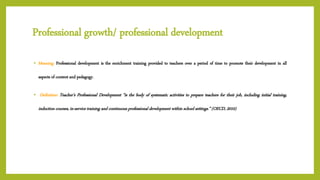
Professional growth/ professional development
• Meaning: Professional development is the enrichment training provided to teachers over a period of time to promote their development in all
aspects of content and pedagogy.
• Definition: Teacher’s Professional Development “is the body of systematic activities to prepare teachers for their job, including initial training,
induction courses, in-service training and continuous professional development within school settings.” (OECD, 2010)
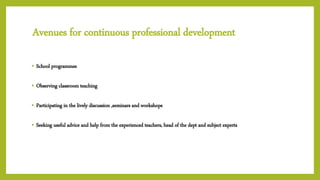
Avenues for continuous professional development
• School programmes
• Observing classroom teaching
• Participating in the lively discussion ,seminars and workshops
• Seeking useful advice and help from the experienced teachers, head of the dept and subject experts
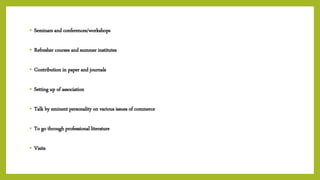
• Seminars and conferences/workshops
• Refresher courses and summer institutes
• Contribution in paper and journals
• Setting up of association
• Talk by eminent personality on various issues of commerce
• To go through professional literature
• Visits
ROLE OF SCERT, NCERT &
COMMERCE TEACHERS’
ASSOCIATION
SCERT
• REFRESHER COURSE
• CONFERENCES
• STUDY GROUPS
• SCHOOL PROGRAMMES
• MISCELLANEOUS PROGRAMMES
NCERT
• Organizes pre-service and in-service training of teachers, teacher educators
• To undertake aid, promote and co-ordinate research in all branches of education
• Conducts and promotes educational research
• Disseminates improved educational techniques and practices
Commerce Teachers’ Associations
• To safeguard their professional interests & to secure satisfactory condition of work and service.
• To secure the professional growth of teachers through refresher courses, seminars, publications etc.
• To improve the teaching of subjects through the establishment of subject teachers’ association
• It has provided a platform where teachers can exchange their ideas, suggestions, views, problems, innovative methods and observations
Thank you…….

Professional growth

  • 1.
    PROFESSIONAL GROWTH Presented bySurekha v s Assistant professor in commerce education SVTEC Akkikkavu
  • 2.
    Professional growth/ professionaldevelopment • Meaning: Professional development is the enrichment training provided to teachers over a period of time to promote their development in all aspects of content and pedagogy. • Definition: Teacher’s Professional Development “is the body of systematic activities to prepare teachers for their job, including initial training, induction courses, in-service training and continuous professional development within school settings.” (OECD, 2010)
  • 3.
    Avenues for continuousprofessional development • School programmes • Observing classroom teaching • Participating in the lively discussion ,seminars and workshops • Seeking useful advice and help from the experienced teachers, head of the dept and subject experts
  • 4.
    • Seminars andconferences/workshops • Refresher courses and summer institutes • Contribution in paper and journals • Setting up of association • Talk by eminent personality on various issues of commerce • To go through professional literature • Visits
  • 5.
    ROLE OF SCERT,NCERT & COMMERCE TEACHERS’ ASSOCIATION
  • 6.
    SCERT • REFRESHER COURSE •CONFERENCES • STUDY GROUPS • SCHOOL PROGRAMMES • MISCELLANEOUS PROGRAMMES
  • 7.
    NCERT • Organizes pre-serviceand in-service training of teachers, teacher educators • To undertake aid, promote and co-ordinate research in all branches of education • Conducts and promotes educational research • Disseminates improved educational techniques and practices
  • 8.
    Commerce Teachers’ Associations •To safeguard their professional interests & to secure satisfactory condition of work and service. • To secure the professional growth of teachers through refresher courses, seminars, publications etc. • To improve the teaching of subjects through the establishment of subject teachers’ association • It has provided a platform where teachers can exchange their ideas, suggestions, views, problems, innovative methods and observations
  • 9.