
By
Dr APPALA RAJU DIDDI
Assistant Professor of Management
UCE, Adikavi Nannaya University
Rajamundry
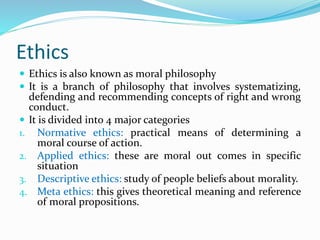
Ethics
 Ethics is also known as moral philosophy
 It is a branch of philosophy that involves systematizing,
defending and recommending concepts of right and wrong
conduct.
 It is divided into 4 major categories
1. Normative ethics: practical means of determining a
moral course of action.
2. Applied ethics: these are moral out comes in specific
situation
3. Descriptive ethics: study of people beliefs about morality.
4. Meta ethics: this gives theoretical meaning and reference
of moral propositions.
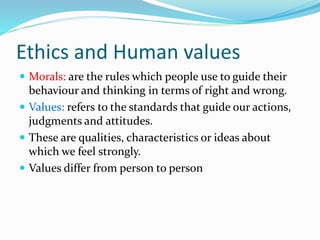
Ethics and Human values
 Morals: are the rules which people use to guide their
behaviour and thinking in terms of right and wrong.
 Values: refers to the standards that guide our actions,
judgments and attitudes.
 These are qualities, characteristics or ideas about
which we feel strongly.
 Values differ from person to person
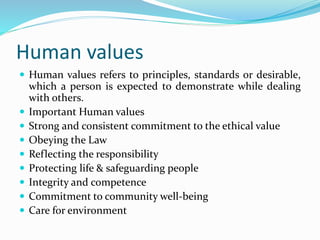
Human values
 Human values refers to principles, standards or desirable,
which a person is expected to demonstrate while dealing
with others.
 Important Human values
 Strong and consistent commitment to the ethical value
 Obeying the Law
 Reflecting the responsibility
 Protecting life & safeguarding people
 Integrity and competence
 Commitment to community well-being
 Care for environment
Core Human Values
 Love: Acceptance, affection, care, compassion, consideration, dedication,
devotion, empathy, forbearance, forgiveness, friendship, generosity, gentleness,
humanness, interdependence, kindness, patience, patriotism, reverence,
sacrifice, selflessness, service, sharing, sympathy, thoughtfulness, tolerance
and trust
 Peace: Attention, calmness, concentration, contentment, dignity, discipline,
equality, equanimity, faithfulness, focus, gratitude, happiness, harmony,
humility, inner silence, optimism, patience, reflection, satisfaction, self-
acceptance, self-confidence, self-control, self-discipline, self-esteem, self-
respect, sense control, tolerance, and understanding
 Truth: Accuracy, curiosity, discernment, fairness, fearlessness, honesty,
 integrity (unity of thought, word, and deed), intuition, justice, optimism,
purity, quest for knowledge, reason, self-analysis, sincerity, sprit of enquiry,
synthesis, trust, truthfulness, and determination.
 Right conduct:
 Non-violence
Understanding Value Education
 Value education refers to planned educational actions
aimed at the development of proper attitudes, values
emotions and behaviour pattern of the individuals.
 It is concerned with the transformation of an
individual personality
Need for value Education
 Value Erosion: we are going through a crisis of values
in our social and political life
 It degraded the basic values like honesty and integrity
 Speared of degraded culture: ‘might is right’ ‘Bose is
boss’ “my word is Law”
 No social concern:
 Indifference to national welfare:
Contd…
 Value Education equated with transmission of
knowledge
 It is process of initiating the learns to good life.
 But today the prime importance is given to
transmission of knowledge and cultivation of
occupational skills.
Types of Values
 1. Social Values:
 Human conditions: Reflected in life, Compassion, Joy &
love and truth
2. Cultural values: a. Variables with time and place, b.
Right or wrong, true or false, behaviour of humans
beings.
3. Individual values: Individual personality- Help
parents, family & others, Individual goals and
relationships
Contd…
 4. Global values: part of planet and similarity nature
are inter linked with harmony
 5. Spiritual values:
-Promote conservationism (in particular) and
transform our consumeristic approach.
- Reduction of wants and self discipline
- Reflected in self restraint (Self control)
Content of Value Education
 To understand myself, my aspiration, my happiness: it has
4 dimensions
 Thought, Behaviour, Work and understanding
 To understand goal of human life
 To understand the other entities in nature, their inter
connectedness and co-existence and role of human being
in nature.
 To understand harmony at the four levels of human living:
individual, family, society &natural existance.
Components of value education
 Moral education
 Environmental education
 Population education
 Human rights education
 Health education
 Physical education
 Yoga education
 Indian culture
 History of Indian freedom movement
Self exploration
 self-exploration involves “taking a look at your own
thoughts, feelings, behaviors and motivations and asking
why. It's looking for the roots of who we are — answers to
all the questions we have about [ourselves]
 It is process to find out what is valuable to me by investigating
with in myself. Since it is me who feel happy, successful,
unhappy or unsuccessful. Therefore what is right for me is to
be judged by myself only. This whole process is called self
exploration.
 The examination and analysis of one's own unrealized
spiritual or intellectual capacities.’’
Self exploration is just finding answers to the following
fundamental questions of all human beings:
1. What is my Desire/ Goal?
2.What do I really want in life, or what is the goal of human
life?
3.What is my program for fulfilling the desire? How to fulfill it?
4.What is the program to actualize the above?
 START WHERE YOU ARE ?
 WE BECOME WHAT WE THINK ABOUT
PURPOSE OF SELF EXPLORATION
1. It is a process of dialogue between “what you are”
and “what you really want to be”
2. It is a process of self evolution through self
investigation.
3. Process of knowing oneself and through that
understanding entire existence.
4. Process of recognizing relationship with every unit in
existence.
Cont..
CONT
..
5. Process of knowing human conduct, human character
& living accordingly.
6. Process of being in harmony with oneself and with
entire existence.
7. Process of knowing innateness, & moving towards self
organization & self expression.
Introspection
 Introspection is the Latin word ‘introspicere’ means to look inside, and
that’s what an introspective person does, metaphorically speaking.
Therefore it is the process of thinking deeply and carefully to examine
your own ideas, feelings, etc.
 Introspection is the examination of one's own conscious thoughts and
feelings. In psychology, the process of introspection relies on the
observation of one's mental state, while in a spiritual context it may
refer to the examination of one's soul.
 It is self examination, analysing yourself, looking at your own
personality and actions and considering your own motivations.
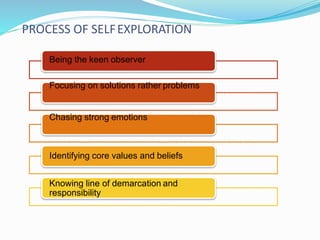
PROCESS OF SELFEXPLORATION
Being the keen observer
Focusing on solutions rather problems
Chasing strong emotions
Identifying core values and beliefs
Knowing line of demarcation and
responsibility
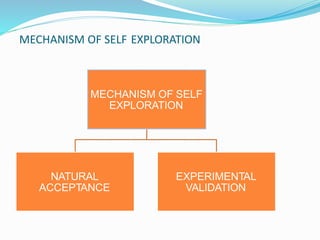
MECHANISM OF SELF EXPLORATION
MECHANISM OF SELF
EXPLORATION
NATURAL
ACCEPTANCE
EXPERIMENTAL
VALIDATION
1. NATURAL ACCEPTANCE
 Natural acceptance implies unconditional and total
acceptance of the self, people and environment.
 It also refers to the absence of any exception from
others.
 Once we fully and truly commit ourselves on the basis of
natural acceptance, we feel a holistic sense of inner
harmony, tranquility and fulfillment.
2. EXPERIMENTAL VALIDATION:
 Experimental validation is a process that infuses direct
experience with the learning environment and content.
 It may be regarded as a philosophy and methodology in
which the direct experience and focused reflection of the
individual helps to increase knowledge, develop skill and
clarify values.
 Self exploration takes place in the self and not the body.
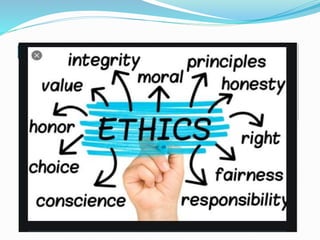
ETHICS
Definition of Ethics
 The way people behave based on how their beliefs about
what is right and wrong influence behaviour
 ‘Ethics’ comes from the Greek word ‘Ethos’ means
character, or what a good person is or does to have a good
character.
 The discipline of dealing with what is good and bad, with
moral duty and obligation
 A set of moral principles or values
 The principle of conduct governing an individual or group
Ethical Vision
 Vision is one type of long range plan
 This commitment to ethics is about how we, as members of the
unified profession of engineering strive towards balancing what is
good for us with what is good for our primary
stakeholders, which includes our friends, our colleagues as
well as society.
 It is important that we value and respect their diversity and
engage with them in both a professional and accountable
manner with their best interests at heart.
 As professionals, we are committed to continuously developing our
skills as well as ourselves.
Ethics Vision &Our ethical
values
• Respect: We uphold the dignity of our stakeholders and treat
them with respect and empathy.
• Integrity: We do the right thing fairly and consistently. We
also stand up for what is wrong and do something about it.
• Accountability: We take responsibility for our decisions and
ownership for our conduct.
• Diversity: We value and respect individual differences and
encourage diversity within our profession.
• Trust: We strive to instill a sense of confidence in our
stakeholders by being honest and by providing truthful
information and feedback.
• Objectivity: We make decisions based on valid, reliable,
unbiased information. Practice is evidence-based and we aim to
avoid bias. All information is evaluated with a critical eye.
Ethical Decision
 Choosing one of the best option among all evaluable
alternatives is called decision making.
 Institutions that examine power and responsibility and
audit their ethical decisions regulating, develop employees
that function with honesty, integrity, serve their institution
and community.
 Therefore the ethical decision means a best option chosen
with a ethical support.
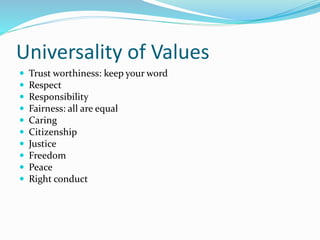
Universality of Values
 Trust worthiness: keep your word
 Respect
 Responsibility
 Fairness: all are equal
 Caring
 Citizenship
 Justice
 Freedom
 Peace
 Right conduct

Professional ethics and human values init 1

  • 1.
    By Dr APPALA RAJUDIDDI Assistant Professor of Management UCE, Adikavi Nannaya University Rajamundry
  • 2.
    Ethics  Ethics isalso known as moral philosophy  It is a branch of philosophy that involves systematizing, defending and recommending concepts of right and wrong conduct.  It is divided into 4 major categories 1. Normative ethics: practical means of determining a moral course of action. 2. Applied ethics: these are moral out comes in specific situation 3. Descriptive ethics: study of people beliefs about morality. 4. Meta ethics: this gives theoretical meaning and reference of moral propositions.
  • 3.
    Ethics and Humanvalues  Morals: are the rules which people use to guide their behaviour and thinking in terms of right and wrong.  Values: refers to the standards that guide our actions, judgments and attitudes.  These are qualities, characteristics or ideas about which we feel strongly.  Values differ from person to person
  • 4.
    Human values  Humanvalues refers to principles, standards or desirable, which a person is expected to demonstrate while dealing with others.  Important Human values  Strong and consistent commitment to the ethical value  Obeying the Law  Reflecting the responsibility  Protecting life & safeguarding people  Integrity and competence  Commitment to community well-being  Care for environment
  • 5.
    Core Human Values Love: Acceptance, affection, care, compassion, consideration, dedication, devotion, empathy, forbearance, forgiveness, friendship, generosity, gentleness, humanness, interdependence, kindness, patience, patriotism, reverence, sacrifice, selflessness, service, sharing, sympathy, thoughtfulness, tolerance and trust  Peace: Attention, calmness, concentration, contentment, dignity, discipline, equality, equanimity, faithfulness, focus, gratitude, happiness, harmony, humility, inner silence, optimism, patience, reflection, satisfaction, self- acceptance, self-confidence, self-control, self-discipline, self-esteem, self- respect, sense control, tolerance, and understanding  Truth: Accuracy, curiosity, discernment, fairness, fearlessness, honesty,  integrity (unity of thought, word, and deed), intuition, justice, optimism, purity, quest for knowledge, reason, self-analysis, sincerity, sprit of enquiry, synthesis, trust, truthfulness, and determination.  Right conduct:  Non-violence
  • 6.
    Understanding Value Education Value education refers to planned educational actions aimed at the development of proper attitudes, values emotions and behaviour pattern of the individuals.  It is concerned with the transformation of an individual personality
  • 7.
    Need for valueEducation  Value Erosion: we are going through a crisis of values in our social and political life  It degraded the basic values like honesty and integrity  Speared of degraded culture: ‘might is right’ ‘Bose is boss’ “my word is Law”  No social concern:  Indifference to national welfare:
  • 8.
    Contd…  Value Educationequated with transmission of knowledge  It is process of initiating the learns to good life.  But today the prime importance is given to transmission of knowledge and cultivation of occupational skills.
  • 9.
    Types of Values 1. Social Values:  Human conditions: Reflected in life, Compassion, Joy & love and truth 2. Cultural values: a. Variables with time and place, b. Right or wrong, true or false, behaviour of humans beings. 3. Individual values: Individual personality- Help parents, family & others, Individual goals and relationships
  • 10.
    Contd…  4. Globalvalues: part of planet and similarity nature are inter linked with harmony  5. Spiritual values: -Promote conservationism (in particular) and transform our consumeristic approach. - Reduction of wants and self discipline - Reflected in self restraint (Self control)
  • 11.
    Content of ValueEducation  To understand myself, my aspiration, my happiness: it has 4 dimensions  Thought, Behaviour, Work and understanding  To understand goal of human life  To understand the other entities in nature, their inter connectedness and co-existence and role of human being in nature.  To understand harmony at the four levels of human living: individual, family, society &natural existance.
  • 12.
    Components of valueeducation  Moral education  Environmental education  Population education  Human rights education  Health education  Physical education  Yoga education  Indian culture  History of Indian freedom movement
  • 13.
    Self exploration  self-explorationinvolves “taking a look at your own thoughts, feelings, behaviors and motivations and asking why. It's looking for the roots of who we are — answers to all the questions we have about [ourselves]  It is process to find out what is valuable to me by investigating with in myself. Since it is me who feel happy, successful, unhappy or unsuccessful. Therefore what is right for me is to be judged by myself only. This whole process is called self exploration.
  • 14.
     The examinationand analysis of one's own unrealized spiritual or intellectual capacities.’’ Self exploration is just finding answers to the following fundamental questions of all human beings: 1. What is my Desire/ Goal? 2.What do I really want in life, or what is the goal of human life? 3.What is my program for fulfilling the desire? How to fulfill it? 4.What is the program to actualize the above?
  • 15.
     START WHEREYOU ARE ?  WE BECOME WHAT WE THINK ABOUT
  • 16.
    PURPOSE OF SELFEXPLORATION 1. It is a process of dialogue between “what you are” and “what you really want to be” 2. It is a process of self evolution through self investigation. 3. Process of knowing oneself and through that understanding entire existence. 4. Process of recognizing relationship with every unit in existence. Cont..
  • 17.
    CONT .. 5. Process ofknowing human conduct, human character & living accordingly. 6. Process of being in harmony with oneself and with entire existence. 7. Process of knowing innateness, & moving towards self organization & self expression.
  • 18.
    Introspection  Introspection isthe Latin word ‘introspicere’ means to look inside, and that’s what an introspective person does, metaphorically speaking. Therefore it is the process of thinking deeply and carefully to examine your own ideas, feelings, etc.  Introspection is the examination of one's own conscious thoughts and feelings. In psychology, the process of introspection relies on the observation of one's mental state, while in a spiritual context it may refer to the examination of one's soul.  It is self examination, analysing yourself, looking at your own personality and actions and considering your own motivations.
  • 19.
    PROCESS OF SELFEXPLORATION Beingthe keen observer Focusing on solutions rather problems Chasing strong emotions Identifying core values and beliefs Knowing line of demarcation and responsibility
  • 20.
    MECHANISM OF SELFEXPLORATION MECHANISM OF SELF EXPLORATION NATURAL ACCEPTANCE EXPERIMENTAL VALIDATION
  • 21.
    1. NATURAL ACCEPTANCE Natural acceptance implies unconditional and total acceptance of the self, people and environment.  It also refers to the absence of any exception from others.  Once we fully and truly commit ourselves on the basis of natural acceptance, we feel a holistic sense of inner harmony, tranquility and fulfillment.
  • 22.
    2. EXPERIMENTAL VALIDATION: Experimental validation is a process that infuses direct experience with the learning environment and content.  It may be regarded as a philosophy and methodology in which the direct experience and focused reflection of the individual helps to increase knowledge, develop skill and clarify values.  Self exploration takes place in the self and not the body.
  • 23.
  • 24.
    Definition of Ethics The way people behave based on how their beliefs about what is right and wrong influence behaviour  ‘Ethics’ comes from the Greek word ‘Ethos’ means character, or what a good person is or does to have a good character.  The discipline of dealing with what is good and bad, with moral duty and obligation  A set of moral principles or values  The principle of conduct governing an individual or group
  • 25.
    Ethical Vision  Visionis one type of long range plan  This commitment to ethics is about how we, as members of the unified profession of engineering strive towards balancing what is good for us with what is good for our primary stakeholders, which includes our friends, our colleagues as well as society.  It is important that we value and respect their diversity and engage with them in both a professional and accountable manner with their best interests at heart.  As professionals, we are committed to continuously developing our skills as well as ourselves.
  • 26.
    Ethics Vision &Ourethical values • Respect: We uphold the dignity of our stakeholders and treat them with respect and empathy. • Integrity: We do the right thing fairly and consistently. We also stand up for what is wrong and do something about it. • Accountability: We take responsibility for our decisions and ownership for our conduct. • Diversity: We value and respect individual differences and encourage diversity within our profession. • Trust: We strive to instill a sense of confidence in our stakeholders by being honest and by providing truthful information and feedback. • Objectivity: We make decisions based on valid, reliable, unbiased information. Practice is evidence-based and we aim to avoid bias. All information is evaluated with a critical eye.
  • 27.
    Ethical Decision  Choosingone of the best option among all evaluable alternatives is called decision making.  Institutions that examine power and responsibility and audit their ethical decisions regulating, develop employees that function with honesty, integrity, serve their institution and community.  Therefore the ethical decision means a best option chosen with a ethical support.
  • 28.
    Universality of Values Trust worthiness: keep your word  Respect  Responsibility  Fairness: all are equal  Caring  Citizenship  Justice  Freedom  Peace  Right conduct