Universal Human Values and Professional Ethics
BVE301 / BVE401/ L T P C
BVE301H / BVE401H 2 1 0 3
Objectives:
1. To help students distinguish between values and skills, and understand the need, basic
guidelines, content, and process of value education.
2. To help students initiate a process of dialog within themselves to know what they really
want to be in their life and profession
3. To help students understand the meaning of happiness and prosperity for a human being.
4. To facilitate the students to understand harmony at all the levels of human living, and live
accordingly.
5. To facilitate the students in applying the understanding of harmony in existence in their
profession and lead an ethical life
Course Outcome:
On completion of this course, the students will be able to
1. Understand the significance of value inputs in a classroom, distinguish between values
and skills, understand the need, basic guidelines, content, and process of value education,
explore the meaning of happiness and prosperity, and do a correct appraisal of the current
scenario in the society
2. Distinguish between the Self and the Body, and understand the meaning of Harmony in
the Self and the Co-existence of Self and Body.
3. Understand the value of harmonious relationships based on trust, respect, and other
naturally acceptable feelings in human-human relationships and explore their role in
ensuring a harmonious society
4. Understand the harmony in nature and existence, and workout their mutually fulfilling
participation in nature.
5. Distinguish between ethical and unethical practices, and start working out the strategy to
actualize a harmonious environment wherever they work.
Catalogue Description
Every human being has two sets of questions to answer for his life: a) what to do? and, b) how to
do? The first set pertains to the value domain, and the other to the skill domain. Both are
complimentary, but the value domain has a higher priority. Today, education has become more
and more skill-biased, and hence, the basic aspiration of a human being, that is to live with
happiness and prosperity, gets defeated, inspite of abundant technological progress. This course
is aimed at giving inputs that will help to ensure the right understanding and right feelings in the
students in their lives and professions, enabling them to lead an ethical life. In this course, the
students learn the process of self-exploration, the difference between the Self and the Body, the
naturally acceptable feelings in relationships in a family, the comprehensive human goal in
society, the mutual fulfillment in nature, and the co-existence in existence. As a natural outcome
of such inputs, they are able to evaluate an ethical life and profession ahead.
UNIT-1 Introduction to Value Education
Understanding the need, basic guidelines, content, and process for Value Education, Self-
Exploration–what is it? - its content and process; ‘Natural Acceptance’ and Experiential
Validation –as the mechanism for self-exploration, Continuous Happiness, and Prosperity-A look
at basic Human Aspirations, Right understanding, Relationship, and Physical Facilities-the basic
requirements for fulfillment of aspirations of every human being with their correct priority,
Understanding Happiness and Prosperity correctly – A critical appraisal of the current scenario,
Method to fulfill the above human aspirations: understanding and living in harmony at various
levels.
UNIT-2 Understanding Harmony in the Human Being
Understanding human being as a co-existence of the sentient ‘I’ and the material ‘Body’,
Understanding the needs of Self (‘I’) and ‘Body’ - Sukh and Suvidha, Understanding the Body as
an instrument of ‘I’ (I being the doer, seer, and enjoyer), Understanding the characteristics and
activities of ‘I’ and harmony in ‘I’, Understanding the harmony of I with the Body: Sanyam and
Swasthya; correct appraisal of Physical needs, the meaning of Prosperity in detail, Programs
to ensure Sanyam and Swasthya.
UNIT-3 Understanding Harmony in the Family and Society
Harmony in Human-Human Relationship Understanding harmony in the Family-the basic unit of
human interaction, Understanding values in the human-human relationship; meaning of Nyaya
and program for its fulfillment to ensure Ubhay-tripti; Trust (Vishwas) and Respect(Samman) as
the foundational values of relationship, Understanding the meaning of Vishwas; Difference
between intention and competence, Understanding the meaning of Samman, Difference between
respect and differentiation; the other salient values in a relationship, Understanding the harmony
in the society (society being an extension of the family): Samadhan, Samridhi, Abhay, Sah-
astitva as comprehensive Human Goals, Visualizing a universal harmonious order in society-
Undivided Society (Akhand Samaj), Universal Order (Sarvabhaum Vyawastha) – from family to
world family!.
UNIT-4 Understanding Harmony in Nature and Existence
Whole existence as Co-existence Understanding the harmony in Nature, Inter connectedness, and
mutual fulfillment among the four orders of nature- recyclability and self-regulation in nature,
Understanding Existence as Co-existence (Sah-astitva) of mutually interacting units in all-
pervasive space, Holistic perception of harmony at all levels of existence.
UNIT-5 Implications of the above Holistic Understanding of Harmony on
Professional Ethics
Natural acceptance of human values, Definitiveness of Ethical Human Conduct, Basis for
Humanistic Education, Humanistic Constitution and Humanistic Universal Order, Competence
in Professional Ethics: a) Ability to utilize the professional competence for augmenting universal
human order, b) Ability to identify the scope and characteristics of people-friendly and eco-
friendly production systems, technologies, and management models, Case studies of typical
holistic technologies, management models and production systems, Strategy for the transition
from the present state to Universal Human Order: a) At the level of individual: as socially and
ecologically responsible engineers, technologists and managers, b)At the level of society: as
mutually enriching institutions and organizations.
Text Book
1. R R Gaur, R Asthana, G P Bagaria, 2019 (2nd Revised Edition), A Foundation Course in
Human Values and Professional Ethics. ISBN 978-93-87034-47-1, Excel Books, New
Delhi.
References
1. Ivan Illich, 1974, Energy & Equity, The Trinity Press, Worcester, and Harper Collins,
USA
2. E.F. Schumacher, 1973, Small is Beautiful: a study of economics as if people mattered,
Blond & Briggs, Britain.
3. Sussan George, 1976, How the Other Half Dies, Penguin Press. Reprinted 1986, 1991
4. Donella H. Meadows, Dennis L. Meadows, Jorgen Randers, William W. Behrens III,
1972, Limits to Growth – Club of Rome’s report, Universe Books.
5. A Nagraj, 1998, Jeevan Vidya EkParichay, Divya Path Sansthan, Amarkantak.
6. P L Dhar, RR Gaur, 1990, Science and Humanism, Commonwealth Publishers.
7. A N Tripathy, 2003, Human Values, New Age International Publishers.
8. Subhas Palekar, 2000, How to practice Natural Farming, Pracheen (Vaidik) Krishi Tantra
Shodh, Amravati.
9. E G Seebauer& Robert L. Berry, 2000, Fundamentals of Ethics for Scientists
&Engineers, Oxford University Press
10. M Govindrajran, S Natrajan& V.S. Senthil Kumar, Engineering Ethics (including Human
Values), Eastern Economy Edition, Prentice Hall of India Ltd.
11. B P Banerjee, 2005, Foundations of Ethics and Management, Excel Books.
12. B L Bajpai, 2004, Indian Ethos and Modern Management, New Royal Book Co.,
Lucknow. Reprinted 2008.
Mode of Evaluation:
Based on participation of student in classroom discussions/Self-assessment/Peer
assessment/Assignments/ Seminar/Continuous Assessment Test/Semester End Exam Socially
relevant project/Group Activities/Assignments may be given importance in this course
Guidelines and Content for Practice Sessions
After every two lectures, there will be a one/two-hour practice session. This is meant to provide
an opportunity to the students for carrying out self-exploration on the salient propositions made
during the lectures. It is to clarify the concepts being introduced and connect them to their
everyday life. Further it will also be utilized to make them evaluate their propensities and pre-
conditionings vis-à-vis their ‘natural acceptance’ using examples and issues relevant to them in
their day-to-day life situations. Keeping this objective in mind, the following exercises are being
proposed for the practice sessions. These are sequentially arranged according to the lecture
material. With each of these exercises, the expected outcome is also indicated to facilitate the
teacher.
In the text-book, a larger set of practice exercises for self-exploration are given after each
chapter, particularly in part 2, of test your understanding. A list of such exercises and the
experiences of some of the students and teachers who have done these exercises is also available
on the web-site. The teacher may select exercises from this set as well as develop appropriate
exercises on their own. Ultimately, it is the teacher who has to use his/ her own creativity to
make the best use of these sessions to guide the students towards the expected outcome.
Practice Sessions for Module 1 – Introduction to Value Education
PS 1
Introduce yourself in detail:
• Share about yourself, your family and your friends.
• Share salient achievements and failures in your life.
• Share how do you presently differentiate between right and wrong.
• Share your aspirations from life. Share what a fulfilling life means for you. For this, you
may list out the top five points that occur to you when you think of a fulfilling life. While
making the list, please consider your entire life, not just the present stage of your life (youth,
middle age, old age, etc.). How do you expect to fulfil these aspirations and live a life of
fulfillment?
What are your observations and conclusions from your life experiences so far?
Expected Outcome: The students start exploring themselves; get comfortable with each other
and with the teacher and start appreciating the need and relevance of the course.
PS 2
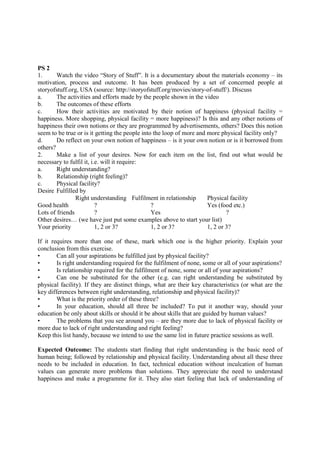
1. Watch the video “Story of Stuff”. It is a documentary about the materials economy – its
motivation, process and outcome. It has been produced by a set of concerned people at
storyofstuff.org, USA (source: http://storyofstuff.org/movies/story-of-stuff/). Discuss
a. The activities and efforts made by the people shown in the video
b. The outcomes of these efforts
c. How their activities are motivated by their notion of happiness (physical facility =
happiness. More shopping, physical facility = more happiness)? Is this and any other notions of
happiness their own notions or they are programmed by advertisements, others? Does this notion
seem to be true or is it getting the people into the loop of more and more physical facility only?
d. Do reflect on your own notion of happiness – is it your own notion or is it borrowed from
others?
2. Make a list of your desires. Now for each item on the list, find out what would be
necessary to fulfil it, i.e. will it require:
a. Right understanding?
b. Relationship (right feeling)?
c. Physical facility?
Desire Fulfilled by
Right understanding Fulfilment in relationship Physical facility
Good health ? ? Yes (food etc.)
Lots of friends ? Yes ?
Other desires… (we have just put some examples above to start your list)
Your priority 1, 2 or 3? 1, 2 or 3? 1, 2 or 3?
If it requires more than one of these, mark which one is the higher priority. Explain your
conclusion from this exercise.
• Can all your aspirations be fulfilled just by physical facility?
• Is right understanding required for the fulfilment of none, some or all of your aspirations?
• Is relationship required for the fulfilment of none, some or all of your aspirations?
• Can one be substituted for the other (e.g. can right understanding be substituted by
physical facility). If they are distinct things, what are their key characteristics (or what are the
key differences between right understanding, relationship and physical facility)?
• What is the priority order of these three?
• In your education, should all three be included? To put it another way, should your
education be only about skills or should it be about skills that are guided by human values?
• The problems that you see around you – are they more due to lack of physical facility or
more due to lack of right understanding and right feeling?
Keep this list handy, because we intend to use the same list in future practice sessions as well.
Expected Outcome: The students start finding that right understanding is the basic need of
human being; followed by relationship and physical facility. Understanding about all these three
needs to be included in education. In fact, technical education without inculcation of human
values can generate more problems than solutions. They appreciate the need to understand
happiness and make a programme for it. They also start feeling that lack of understanding of
human values is the root cause of all problems and the sustained solution could emerge only
through understanding of human values and value-based living.
PS3
1. Observe that you have the faculty of ‘Natural Acceptance’, based on which you can
verify what is right or what is not right for you. Of course, you may or may not be generally
referring to your natural acceptance for making decisions. So, find out if you get a spontaneous
answer when you ask yourself basic questions, like the ones mentioned below:
a. You want to live in relationship (harmony) with others or You want to live in opposition
with others?
b. In relationship, you want to live with the feeling of respect or disrespect (for yourself and
for others)?
c. You want to nurture others or to exploit others?
Is your living in accordance with your natural acceptance or different from it? How do you feel
when your living is in accordance with your natural acceptance; and when it is in contradiction to
your natural acceptance?
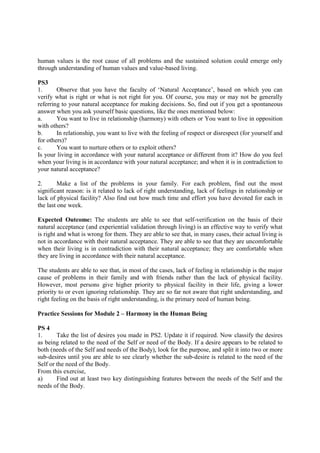
2. Make a list of the problems in your family. For each problem, find out the most
significant reason: is it related to lack of right understanding, lack of feelings in relationship or
lack of physical facility? Also find out how much time and effort you have devoted for each in
the last one week.
Expected Outcome: The students are able to see that self-verification on the basis of their
natural acceptance (and experiential validation through living) is an effective way to verify what
is right and what is wrong for them. They are able to see that, in many cases, their actual living is
not in accordance with their natural acceptance. They are able to see that they are uncomfortable
when their living is in contradiction with their natural acceptance; they are comfortable when
they are living in accordance with their natural acceptance.
The students are able to see that, in most of the cases, lack of feeling in relationship is the major
cause of problems in their family and with friends rather than the lack of physical facility.
However, most persons give higher priority to physical facility in their life, giving a lower
priority to or even ignoring relationship. They are so far not aware that right understanding, and
right feeling on the basis of right understanding, is the primary need of human being.
Practice Sessions for Module 2 – Harmony in the Human Being
PS 4
1. Take the list of desires you made in PS2. Update it if required. Now classify the desires
as being related to the need of the Self or need of the Body. If a desire appears to be related to
both (needs of the Self and needs of the Body), look for the purpose, and split it into two or more
sub-desires until you are able to see clearly whether the sub-desire is related to the need of the
Self or the need of the Body.
From this exercise,
a) Find out at least two key distinguishing features between the needs of the Self and the
needs of the Body.
b) Roughly what percentage of your desires is related to the needs of the Self and what
percentage is related to the needs of the Body?
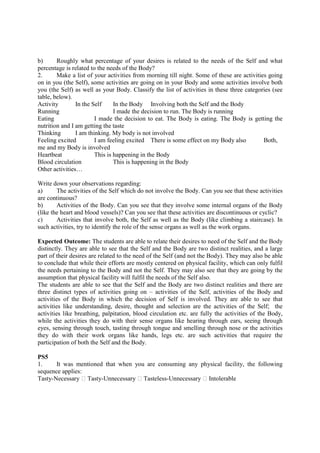
2. Make a list of your activities from morning till night. Some of these are activities going
on in you (the Self), some activities are going on in your Body and some activities involve both
you (the Self) as well as your Body. Classify the list of activities in these three categories (see
table, below).
Activity In the Self In the Body Involving both the Self and the Body
Running I made the decision to run. The Body is running
Eating I made the decision to eat. The Body is eating. The Body is getting the
nutrition and I am getting the taste
Thinking I am thinking. My body is not involved
Feeling excited I am feeling excited There is some effect on my Body also Both,
me and my Body is involved
Heartbeat This is happening in the Body
Blood circulation This is happening in the Body
Other activities…
Write down your observations regarding:
a) The activities of the Self which do not involve the Body. Can you see that these activities
are continuous?
b) Activities of the Body. Can you see that they involve some internal organs of the Body
(like the heart and blood vessels)? Can you see that these activities are discontinuous or cyclic?
c) Activities that involve both, the Self as well as the Body (like climbing a staircase). In
such activities, try to identify the role of the sense organs as well as the work organs.
Expected Outcome: The students are able to relate their desires to need of the Self and the Body
distinctly. They are able to see that the Self and the Body are two distinct realities, and a large
part of their desires are related to the need of the Self (and not the Body). They may also be able
to conclude that while their efforts are mostly centered on physical facility, which can only fulfil
the needs pertaining to the Body and not the Self. They may also see that they are going by the
assumption that physical facility will fulfil the needs of the Self also.
The students are able to see that the Self and the Body are two distinct realities and there are
three distinct types of activities going on – activities of the Self, activities of the Body and
activities of the Body in which the decision of Self is involved. They are able to see that
activities like understanding, desire, thought and selection are the activities of the Self; the
activities like breathing, palpitation, blood circulation etc. are fully the activities of the Body,
while the activities they do with their sense organs like hearing through ears, seeing through
eyes, sensing through touch, tasting through tongue and smelling through nose or the activities
they do with their work organs like hands, legs etc. are such activities that require the
participation of both the Self and the Body.
PS5
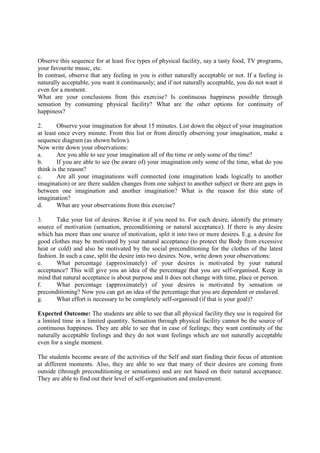
1. It was mentioned that when you are consuming any physical facility, the following
sequence applies:
Tasty-Necessary  Tasty-Unnecessary  Tasteless-Unnecessary  Intolerable
Observe this sequence for at least five types of physical facility, say a tasty food, TV programs,
your favourite music, etc.
In contrast, observe that any feeling in you is either naturally acceptable or not. If a feeling is
naturally acceptable, you want it continuously; and if not naturally acceptable, you do not want it
even for a moment.
What are your conclusions from this exercise? Is continuous happiness possible through
sensation by consuming physical facility? What are the other options for continuity of
happiness?
2. Observe your imagination for about 15 minutes. List down the object of your imagination
at least once every minute. From this list or from directly observing your imagination, make a
sequence diagram (as shown below).
Now write down your observations:
a. Are you able to see your imagination all of the time or only some of the time?
b. If you are able to see (be aware of) your imagination only some of the time, what do you
think is the reason?
c. Are all your imaginations well connected (one imagination leads logically to another
imagination) or are there sudden changes from one subject to another subject or there are gaps in
between one imagination and another imagination? What is the reason for this state of
imagination?
d. What are your observations from this exercise?
3. Take your list of desires. Revise it if you need to. For each desire, identify the primary
source of motivation (sensation, preconditioning or natural acceptance). If there is any desire
which has more than one source of motivation, split it into two or more desires. E.g. a desire for
good clothes may be motivated by your natural acceptance (to protect the Body from excessive
heat or cold) and also be motivated by the social preconditioning for the clothes of the latest
fashion. In such a case, split the desire into two desires. Now, write down your observations:
e. What percentage (approximately) of your desires is motivated by your natural
acceptance? This will give you an idea of the percentage that you are self-organised. Keep in
mind that natural acceptance is about purpose and it does not change with time, place or person.
f. What percentage (approximately) of your desires is motivated by sensation or
preconditioning? Now you can get an idea of the percentage that you are dependent or enslaved.
g. What effort is necessary to be completely self-organised (if that is your goal)?
Expected Outcome: The students are able to see that all physical facility they use is required for
a limited time in a limited quantity. Sensation through physical facility cannot be the source of
continuous happiness. They are able to see that in case of feelings; they want continuity of the
naturally acceptable feelings and they do not want feelings which are not naturally acceptable
even for a single moment.
The students become aware of the activities of the Self and start finding their focus of attention
at different moments. Also, they are able to see that many of their desires are coming from
outside (through preconditioning or sensations) and are not based on their natural acceptance.
They are able to find out their level of self-organisation and enslavement.
PS6
1. In the last 3 years, recall the times that your body has been ill (in disharmony). What steps
were taken to restore the harmony of the Body?
Date(s)Illness or disharmony Type (Accident, viral infection, bacterial infection, lifestyle related
disorder, any other) Steps taken Root Cause
If you were to take full responsibility for your body (i.e. you had the feeling of self-regulation),
what kind of daily schedule would you have? Approximately how much time would you allocate
for keeping your body in good health through:
• Healthy intake (food, air, water, sunlight, etc.)
• Timings for upkeep of the Body (sleeping and waking up time, excretion, bathing, etc.)
• Labour (production of physical facility)
• Exercise
• Balancing internal and external organs of body
• Regulating breathing of body
• Medicine
• Treatment
(Of course, you need to keep adequate time for studying, understanding, learning, behaviour,
work etc.)
Do you think this schedule will make you more productive or less productive? What conclusions
do you draw from this exercise?
2. Calculate the quantity required for a specific physical facility, say clothes, in your family.
Now find out the quantity available. Is the quantity available less, equal or more than the
quantity required? In that sense, do you feel prosperous or deprived (at least regarding that
particular physical facility)? Do the same for other needs. For that you can make an inventory of
everything in your home (or at least your room). How much of the physical facility is being
rightly utilised? Discuss this with your family and work out your conclusions regarding:
a. Meaning of prosperity
b. The role of understanding (human being, the role of physical facility and the feeling of
self-regulation)
c. Ability of your family to identify its needs, with the required quantity
Expected Outcome: The students are able to list down activities related to proper upkeep of the
Body and practice them in their daily routine. They are also able to appreciate the plants growing
in and around the campus which can be beneficial in maintaining their health and even curing
common ailments.
The students begin to recognise that the need for physical facility for nurturing, protection and
right utilization of their body is limited in quantity. In cases where they are able to see that they
have more than enough physical facility, they develop a feeling of prosperity. In cases of lack in
physical facility, they start thinking about how to produce more than required physical facility by
way of a mutually-enriching cyclic process (rather than through exploitation).
Practice Sessions for Module 3 – Harmony in the Family and Society
PS 7
1. Make a list of your family members and friends. Take the eight questions regarding
evaluation of trust and reflect on the answers for each person in your list, one person at a time.
First reflect on the four questions about natural acceptance (intention):
1a. I want to make myself happy.
2a. I want to make the other happy.
3a. The other wants to make herself/himself happy.
4a. The other wants to make me happy.
Next, reflect on the four questions about competence – your competence and their competence:
1b. I am always able to make myself happy
2b. I am always able to make the other happy
3b. The other is always able to make herself/himself happy
4b. The other is always able to make me happy
From this reflection, how many people are there with whom you have a feeling of trust on
intention? Is the feeling unconditional and continuous? The indicators of unconditional,
continuous trust on intention are:
• You never get irritated or angry with them
• You never have a feeling of opposition for them
• You are always thinking and making effort for their development
Now in your class group, share your findings and discuss:
• What you have understood about intention and competence – do you evaluate them
separately?
• How you evaluate yourself and how you evaluate others – do you evaluate yourself on
the basis of your intention and evaluate others on the basis of their competence?
• What is the result of such evaluation?
• What would be the result if you evaluated the intention and competence separately? Will
it lead to a feeling of trust for each other?
• Reflect on some instances where you got irritated or angry with someone. What was the
result of it? Can you recollect that you had a doubt on their intention? Try to call them and share
your reflections with one or more of them.
Write down your conclusions from this exercise.
2. Show the video “Right Here Right Now”. It is a short film directed by Anand Gandhi
about human behaviour and its propagation.
(Source: Part 1: https://www.youtube.com/watch?v=OVAokeqQuFM
Part 2: https://www.youtube.com/watch?v=gIYJePEnvUY).
Discuss:
a. Specific interactions shown in the video – are these interactions showing reaction or
response?
b. Reflect on your own interactions – what percentage of your interactions are reactions and
what percentage are response?
c. Is it desirable to have 100% response (and no reaction)? What effort is required for it?
Expected Outcome: The students are able to see that the natural acceptance (intention) of
everyone is to be happy and make others happy! It is the competence that is lacking – it is
lacking in themselves and it is lacking in others also.
Whenever they evaluate themselves on the basis of their intention and others on the basis of their
competence, whenever they doubt the intention of the other, there is a feeling of opposition,
irritation or anger. They conclude that I am a good person and other is a bad person! This is a
major problem in their relationship with their family and friends.
As soon as they are able to see their own natural acceptance (intention), they are able to see that
the other also has the same natural acceptance (intention), they have a feeling of being related
and they start thinking in terms of mutual development. This is relieving for them and also
relieving for the other.
They are able to distinguish between reaction and response; appreciate the need for 100%
response in human-human interaction and make effort towards it.
PS 8
1. List out ten or more of your interactions with other people in your family and friends in
the last one week. Now analyse these interactions:
a. From your side, was it over-evaluation, under/ otherwise evaluation or right evaluation of
the other? In each interaction, were you comfortable within, uncomfortable within or unaware of
your state?
b. Did they evaluate you rightly or they over evaluated or under/ otherwise evaluated you?
In each interaction, were you comfortable within, uncomfortable within or unaware of your
state?
2. Study the chart regarding differentiation (discrimination) and regarding respect (on the
basis of the Self). Where has most of your effort been? Where would you like to put in your
effort now? What effort, if any, is required from your side now?
Expected Outcome: The students are able to see that respect is the right evaluation (of intention
and competence). Only right evaluation leads to fulfillment in relationship. Over evaluation leads
to ego and under/ otherwise evaluation leads to depression.
They are able to see that many present-day problems in the family and society are side-effects of
the lack of correct understanding of respect. This results into differentiation (discrimination)
such as gender bias, generation gap, caste conflicts, class struggle, domination through power,
communal violence, clash of interests, and so on.
Once they can see beyond the superficial differences at the level of body, physical facility,
beliefs etc., they are able to see that the other is like me (at the level of the Self):
• The other has the same natural acceptance as me.
• The other has the same potential as me.
• The other has the same programme for happiness as me.
PS 9
1. What are your personal goals or values that you would like to make effort for? Discuss
with your family and find out the goals of other members. Is there a common family goal? What
are the goals being pursued by your workplace or educational institution? How much of these
three sets of goals are aligned to each other? What is your role in the fulfilment of these three
sets of goals?
2. Assuming that you would like to see your hostel/ educational institution/ workplace/
neighborhood as a model of human society, write down:
a. Its goal(s) – relate it to the four human goals and elaborate on what each goal
means. Also develop some key indicators or measures which will show that the
goals are realised
b. The system to achieve these goals – Make a comprehensive plan for the fulfilment
of each goal. Relate it to the dimensions of human order.
3. Working on the dimension of Education-Sanskar and Sanyam-Health, suggest what
programs can be taken up to ensure right nutrition of the child along with the right sanskar.
Expected Outcome: The students are able to see that as a family, a society, the comprehensive
human goal is naturally acceptable:
• Right understanding and right feeling in every human being
• Prosperity in every family
• Fearlessness (trust) in society
• Co-existence (mutual fulfilment) in nature/existence
They are able to see that the systems required for their fulfilment include:
Education-Sanskar, Health-Self regulation, Production-Work, Justice-Preservation and
Exchange-Storage.
Meaningful participation by every individual, every family, every family cluster… every village,
town, city… country and the whole world is required in these systems for the human goals to be
fulfilled.
They are also able to see that presently they do not have definite goals and their family goals are
unknown or not clearly defined. The goals of their educational institution or workplace are
articulated as vision-mission-goals-objectives-values etc. These various goals need to be aligned
for them to appreciate, commit and fully participate in their fulfilment. Presently there is neither
clarity nor alignment, so there is limited focused effort. They start to refine their goals and think
about how to discuss them in their family, in their hostel, institution etc. and make more focused
effort.
Practice Sessions for Module 4 – Harmony in the Nature (Existence)
PS 10
1. Watch the video “An Inconvenient Truth”. It is a 2006 documentary about global climate
change presented by Former US Vice President Al Gore. He raises the question “What were you
doing when you had the time to do something?” (Source: http://an-inconvenient-truth.com/).
Discuss:
a. State of the planet
b. Root cause of the problems
c. Comprehensive solution for the problems and your specific part in it
Take any one environmental issue in your neighbourhood/ village/ country and try to find out the
root cause of it. [for instance, water scarcity, air pollution, food adulteration, etc.]. What exactly
can you contribute as an individual, class or institution to the solution?
2. Observe the activity, innateness, natural characteristic and inheritance of at least two
units in each of the four orders. Are you able to see that these orders are in a relationship of
mutual fulfilment?
Expected Outcome: The students are able to appreciate the interconnectedness, interdependence
and the relationship of mutual fulfilment existing in nature. They are able to see that they have a
natural acceptance to participate in a mutually fulfilling manner in nature. By understanding the
activity, innateness, natural characteristic and inheritance of the four orders in nature, they are
able to identify the role of human being in the entire nature.
They are able to see that the present-day environmental issues are related to lack of
understanding; and these issues can be resolved only with the development of right
understanding on the part of human being.
PS 11
1. Observe your Self.
Are you in space?
Are you getting energy from the body? Is your energy dependent on the body? When your body
is sick, does your energy to think diminish? Are you energised in space?
Are you being dictated by the body? Are you self-organised in space?
Innately, you have a natural acceptance for co-existence, harmony and relationship. To
understand and live in co-existence, harmony and relationship is the scope of your full potential,
your full possibility as a human being. Find out if that is the case for you.
2. Make a chart for the whole existence. List down different courses of studies and relate them to
different realities in the existence (such as plants, human mind, animals etc.).
Expected Outcome: The students are able to obtain a holistic vision about the existence. It is in
the form of co-existence, rather than a chaos. Every unit is energized, self-organised and is
participating with other units in an orderly manner for mutual-fulfilment. It is only the human
being without right understanding that is violating this underlying co-existence. They are able to
appreciate the need to understand the co-existence in existence.
In the light of this understanding, they are able to place various educational inputs appropriately
and see that education is, after all, to understand the underlying harmony and live in harmony at
every level – at the level of individual human being, at the level of family, at the level of society
and at the level of nature/existence.
Practice Sessions for Module 5 – Implications of the Holistic Understanding – a Look at
Professional Ethics
PS 12
1. Watch the video "Hiware Bazaar". It is a documentary about a progressive village in
Maharashtra, India about how good governance, along with the people of the village have made
significant change in their society (Source: https://www.youtube.com/watch?v=cb0Qvh9BJ0s).
Discuss:
a. The goal of this village and the systems that they have to fulfil these goals
b. The outcomes – achievements and areas of improvement
You can additionally pick current social problems in the campus or neighboring community and
discuss how they can be solved with the involvement of the students and teachers.
2. Recollect any situation in your life when you had to face a strong ethical dilemma.
Explain how, with the help of proper self-exploration and understanding, the dilemma could be
resolved.
Expected Outcome: The students are able to clearly visualise the co-relation between lack of
Human Values and the prevailing problems. They are also able to visualise tangible steps and a
roadmap for moving in the cherished direction – for a humane society.
PS 13
1. By careful analysis, identify some important features which, when incorporated, will
make our education more humanistic. What are the right expectations in terms of the outcome
from humanistic education?
2. Some people feel that talking about holistic development is like trying to turn the wheel
of time backwards. It will greatly hamper our progress. What is your view in this regard? Explain
with justification.
Expected Outcome: The students are able to detail out various social systems essential for their
own fulfilment, as well as the fulfilment of future generations. In particular, they are able to
visualize the education system required for individual, and then societal transformation.
They are also able to appreciate those many efforts made in the tradition that were in line with
desirable human goals. Thus, they are able to learn from tradition and develop a deep sense of
gratitude for the effort, for the people, for the tradition, culture etc.
PS 14
1. Suggest ways in which you can use your knowledge of Technology/Engineering/
Management/Medicine etc. for universal human order, from your family order to the world
family order.
2. The course is going to be over now. Evaluate your state before and after the course in
terms of
a. Thought b. Behaviour c. Work d. Realization
3. Do you have any plan to participate in the transition for the humane society after
graduating from the institute? Write a brief note on it.
Expected Outcome: The students are able to visualise an appropriate utilization of the
knowledge in their respective streams to ensure mutually enriching and sustainable systems.
They are able to sincerely evaluate the course and the transformation achieved in this process.
They are also able to make use of this understanding for moving towards a happy and prosperous
life, including an ethical conduct of their profession.
Socially Relevant Projects
Projects may be chosen to develop all the three aspects, in order of priority:
• Right understanding
• Relationship (right feeling and right thought)
• Skills for living in harmony
For illustration, let us take a project of tree plantation. It should help the teacher and students to:
1. Experience and understand mutual fulfillment in nature.
2. Understand human participation in enrichment, protection and right utilization of rest of
the nature as well as to get a feel for prosperity within. i.e. get an idea of
a. Right utilization of the products from the tree (like fruit, vegetables, wood etc.)
b. Protection and nurturing of the trees planted; at least to be aware not to damage existing
trees while planting the new ones.
3. Planning and Physical plantation of the tree.
The tree plantation project can be helpful in developing the three aspects mentioned. Of course,
if they are doing tree plantation primarily as a task to be done or a means to get attention and
some press coverage, then the project with the same physical tasks will not be as productive for
this course.
Projects should take into consideration local requirements – it should be socially relevant. For
instance, a gasifier power generation project in a city can use the waste wood, leaves, cardboard
and paper etc. and contribute the clean power in the neighborhood power grid using a net-meter.
Projects can be of three types:
1. Study – Observing/Recognizing/Survey/Proposing a solution. e.g. finding out the change
in water table in the local area and potential sustainable solutions
2. Modelling / Prototyping – Analysing, doing on a small scale and for a short term. e.g.
developing a prototype of a pedal driven generator
3. Implementation – on some scale and for the long term. e.g. establishing an evening
school in the local community, solar based lighting and pumping in the village community
Some topics:
1. Find out the quantity of food-grain (rice, wheat, corn, jowar etc.) that your family
consumes annually. Taking this as the base, find out the total requirement of food-grain for your
country. Find out the total production of food-grain in your country. Is the production sufficient?
Articulate your conclusions
2. What do we consider important as a family -understanding, relationship and/ or physical
facility? Is our time and effort applied for what we consider important? What do we evaluate at
the end of every month? Discuss this at home and articulate your conclusions
3. Does my family have sufficient physical facility for my physical needs? Is my family
prosperous? What do we need for feeling prosperous? Discuss this at home and articulate your
conclusions
4. For the proper development of a child, there is a need to ensure a proper system in the
society and make an appraisal of the current state. As a project work, find out the following in
the society regarding the nutrition of children:
a. The demographic divide
b. Present social determinant of Health
c. Current child Health Policies
d. Involvement of Society and steps to be taken in this direction
Suggest policies which would ensure a better state of the society in terms of the above.
5. Find out how much water is available (rain, rivers, canals), how much water is needed
6. Find out how much water is available annually, and how much is used to generate
electricity
7. Find out about power generation from low-head flowing-water, i.e. without making any
dams. Can this system be cyclic and mutually-enriching?
8. Find out the change in water table in the local area and suggest possible sustainable
solutions
9. List Socially Relevant Work in your state, nearby states, whole country, nearby countries,
whole world
10. What is one valuable lesson from your tradition? Study its impact on Trust in your family
11. Document your understanding of the meaning of Health of your Body and the
Programme for Health
12. Study the needs of families around your campus that are selling liquor. Suggest ways that
they can meet their needs in a mutually fulfilling manner, rather than taking to means that are
harmful for the society
13. Study the ‘Sulabh-Shauchalaya’ organisation and systems. Write a case study report on it
with sections on its eco-friendly sustainable technology and human-friendly entrepreneurial
system

Universal Human Values Syllabus for AKTU

  • 1.
    Universal Human Valuesand Professional Ethics BVE301 / BVE401/ L T P C BVE301H / BVE401H 2 1 0 3 Objectives: 1. To help students distinguish between values and skills, and understand the need, basic guidelines, content, and process of value education. 2. To help students initiate a process of dialog within themselves to know what they really want to be in their life and profession 3. To help students understand the meaning of happiness and prosperity for a human being. 4. To facilitate the students to understand harmony at all the levels of human living, and live accordingly. 5. To facilitate the students in applying the understanding of harmony in existence in their profession and lead an ethical life Course Outcome: On completion of this course, the students will be able to 1. Understand the significance of value inputs in a classroom, distinguish between values and skills, understand the need, basic guidelines, content, and process of value education, explore the meaning of happiness and prosperity, and do a correct appraisal of the current scenario in the society 2. Distinguish between the Self and the Body, and understand the meaning of Harmony in the Self and the Co-existence of Self and Body. 3. Understand the value of harmonious relationships based on trust, respect, and other naturally acceptable feelings in human-human relationships and explore their role in ensuring a harmonious society 4. Understand the harmony in nature and existence, and workout their mutually fulfilling participation in nature. 5. Distinguish between ethical and unethical practices, and start working out the strategy to actualize a harmonious environment wherever they work. Catalogue Description Every human being has two sets of questions to answer for his life: a) what to do? and, b) how to do? The first set pertains to the value domain, and the other to the skill domain. Both are complimentary, but the value domain has a higher priority. Today, education has become more and more skill-biased, and hence, the basic aspiration of a human being, that is to live with
  • 2.
    happiness and prosperity,gets defeated, inspite of abundant technological progress. This course is aimed at giving inputs that will help to ensure the right understanding and right feelings in the students in their lives and professions, enabling them to lead an ethical life. In this course, the students learn the process of self-exploration, the difference between the Self and the Body, the naturally acceptable feelings in relationships in a family, the comprehensive human goal in society, the mutual fulfillment in nature, and the co-existence in existence. As a natural outcome of such inputs, they are able to evaluate an ethical life and profession ahead. UNIT-1 Introduction to Value Education Understanding the need, basic guidelines, content, and process for Value Education, Self- Exploration–what is it? - its content and process; ‘Natural Acceptance’ and Experiential Validation –as the mechanism for self-exploration, Continuous Happiness, and Prosperity-A look at basic Human Aspirations, Right understanding, Relationship, and Physical Facilities-the basic requirements for fulfillment of aspirations of every human being with their correct priority, Understanding Happiness and Prosperity correctly – A critical appraisal of the current scenario, Method to fulfill the above human aspirations: understanding and living in harmony at various levels. UNIT-2 Understanding Harmony in the Human Being Understanding human being as a co-existence of the sentient ‘I’ and the material ‘Body’, Understanding the needs of Self (‘I’) and ‘Body’ - Sukh and Suvidha, Understanding the Body as an instrument of ‘I’ (I being the doer, seer, and enjoyer), Understanding the characteristics and activities of ‘I’ and harmony in ‘I’, Understanding the harmony of I with the Body: Sanyam and Swasthya; correct appraisal of Physical needs, the meaning of Prosperity in detail, Programs to ensure Sanyam and Swasthya. UNIT-3 Understanding Harmony in the Family and Society Harmony in Human-Human Relationship Understanding harmony in the Family-the basic unit of human interaction, Understanding values in the human-human relationship; meaning of Nyaya and program for its fulfillment to ensure Ubhay-tripti; Trust (Vishwas) and Respect(Samman) as the foundational values of relationship, Understanding the meaning of Vishwas; Difference between intention and competence, Understanding the meaning of Samman, Difference between respect and differentiation; the other salient values in a relationship, Understanding the harmony in the society (society being an extension of the family): Samadhan, Samridhi, Abhay, Sah- astitva as comprehensive Human Goals, Visualizing a universal harmonious order in society- Undivided Society (Akhand Samaj), Universal Order (Sarvabhaum Vyawastha) – from family to world family!. UNIT-4 Understanding Harmony in Nature and Existence
  • 3.
    Whole existence asCo-existence Understanding the harmony in Nature, Inter connectedness, and mutual fulfillment among the four orders of nature- recyclability and self-regulation in nature, Understanding Existence as Co-existence (Sah-astitva) of mutually interacting units in all- pervasive space, Holistic perception of harmony at all levels of existence. UNIT-5 Implications of the above Holistic Understanding of Harmony on Professional Ethics Natural acceptance of human values, Definitiveness of Ethical Human Conduct, Basis for Humanistic Education, Humanistic Constitution and Humanistic Universal Order, Competence in Professional Ethics: a) Ability to utilize the professional competence for augmenting universal human order, b) Ability to identify the scope and characteristics of people-friendly and eco- friendly production systems, technologies, and management models, Case studies of typical holistic technologies, management models and production systems, Strategy for the transition from the present state to Universal Human Order: a) At the level of individual: as socially and ecologically responsible engineers, technologists and managers, b)At the level of society: as mutually enriching institutions and organizations. Text Book 1. R R Gaur, R Asthana, G P Bagaria, 2019 (2nd Revised Edition), A Foundation Course in Human Values and Professional Ethics. ISBN 978-93-87034-47-1, Excel Books, New Delhi. References 1. Ivan Illich, 1974, Energy & Equity, The Trinity Press, Worcester, and Harper Collins, USA 2. E.F. Schumacher, 1973, Small is Beautiful: a study of economics as if people mattered, Blond & Briggs, Britain. 3. Sussan George, 1976, How the Other Half Dies, Penguin Press. Reprinted 1986, 1991 4. Donella H. Meadows, Dennis L. Meadows, Jorgen Randers, William W. Behrens III, 1972, Limits to Growth – Club of Rome’s report, Universe Books. 5. A Nagraj, 1998, Jeevan Vidya EkParichay, Divya Path Sansthan, Amarkantak. 6. P L Dhar, RR Gaur, 1990, Science and Humanism, Commonwealth Publishers. 7. A N Tripathy, 2003, Human Values, New Age International Publishers. 8. Subhas Palekar, 2000, How to practice Natural Farming, Pracheen (Vaidik) Krishi Tantra Shodh, Amravati. 9. E G Seebauer& Robert L. Berry, 2000, Fundamentals of Ethics for Scientists &Engineers, Oxford University Press 10. M Govindrajran, S Natrajan& V.S. Senthil Kumar, Engineering Ethics (including Human Values), Eastern Economy Edition, Prentice Hall of India Ltd.
  • 4.
    11. B PBanerjee, 2005, Foundations of Ethics and Management, Excel Books. 12. B L Bajpai, 2004, Indian Ethos and Modern Management, New Royal Book Co., Lucknow. Reprinted 2008. Mode of Evaluation: Based on participation of student in classroom discussions/Self-assessment/Peer assessment/Assignments/ Seminar/Continuous Assessment Test/Semester End Exam Socially relevant project/Group Activities/Assignments may be given importance in this course Guidelines and Content for Practice Sessions After every two lectures, there will be a one/two-hour practice session. This is meant to provide an opportunity to the students for carrying out self-exploration on the salient propositions made during the lectures. It is to clarify the concepts being introduced and connect them to their everyday life. Further it will also be utilized to make them evaluate their propensities and pre- conditionings vis-à-vis their ‘natural acceptance’ using examples and issues relevant to them in their day-to-day life situations. Keeping this objective in mind, the following exercises are being proposed for the practice sessions. These are sequentially arranged according to the lecture material. With each of these exercises, the expected outcome is also indicated to facilitate the teacher. In the text-book, a larger set of practice exercises for self-exploration are given after each chapter, particularly in part 2, of test your understanding. A list of such exercises and the experiences of some of the students and teachers who have done these exercises is also available on the web-site. The teacher may select exercises from this set as well as develop appropriate exercises on their own. Ultimately, it is the teacher who has to use his/ her own creativity to make the best use of these sessions to guide the students towards the expected outcome. Practice Sessions for Module 1 – Introduction to Value Education PS 1 Introduce yourself in detail: • Share about yourself, your family and your friends. • Share salient achievements and failures in your life. • Share how do you presently differentiate between right and wrong. • Share your aspirations from life. Share what a fulfilling life means for you. For this, you may list out the top five points that occur to you when you think of a fulfilling life. While making the list, please consider your entire life, not just the present stage of your life (youth, middle age, old age, etc.). How do you expect to fulfil these aspirations and live a life of fulfillment? What are your observations and conclusions from your life experiences so far? Expected Outcome: The students start exploring themselves; get comfortable with each other and with the teacher and start appreciating the need and relevance of the course.
  • 5.
    PS 2 1. Watchthe video “Story of Stuff”. It is a documentary about the materials economy – its motivation, process and outcome. It has been produced by a set of concerned people at storyofstuff.org, USA (source: http://storyofstuff.org/movies/story-of-stuff/). Discuss a. The activities and efforts made by the people shown in the video b. The outcomes of these efforts c. How their activities are motivated by their notion of happiness (physical facility = happiness. More shopping, physical facility = more happiness)? Is this and any other notions of happiness their own notions or they are programmed by advertisements, others? Does this notion seem to be true or is it getting the people into the loop of more and more physical facility only? d. Do reflect on your own notion of happiness – is it your own notion or is it borrowed from others? 2. Make a list of your desires. Now for each item on the list, find out what would be necessary to fulfil it, i.e. will it require: a. Right understanding? b. Relationship (right feeling)? c. Physical facility? Desire Fulfilled by Right understanding Fulfilment in relationship Physical facility Good health ? ? Yes (food etc.) Lots of friends ? Yes ? Other desires… (we have just put some examples above to start your list) Your priority 1, 2 or 3? 1, 2 or 3? 1, 2 or 3? If it requires more than one of these, mark which one is the higher priority. Explain your conclusion from this exercise. • Can all your aspirations be fulfilled just by physical facility? • Is right understanding required for the fulfilment of none, some or all of your aspirations? • Is relationship required for the fulfilment of none, some or all of your aspirations? • Can one be substituted for the other (e.g. can right understanding be substituted by physical facility). If they are distinct things, what are their key characteristics (or what are the key differences between right understanding, relationship and physical facility)? • What is the priority order of these three? • In your education, should all three be included? To put it another way, should your education be only about skills or should it be about skills that are guided by human values? • The problems that you see around you – are they more due to lack of physical facility or more due to lack of right understanding and right feeling? Keep this list handy, because we intend to use the same list in future practice sessions as well. Expected Outcome: The students start finding that right understanding is the basic need of human being; followed by relationship and physical facility. Understanding about all these three needs to be included in education. In fact, technical education without inculcation of human values can generate more problems than solutions. They appreciate the need to understand happiness and make a programme for it. They also start feeling that lack of understanding of
  • 6.
    human values isthe root cause of all problems and the sustained solution could emerge only through understanding of human values and value-based living. PS3 1. Observe that you have the faculty of ‘Natural Acceptance’, based on which you can verify what is right or what is not right for you. Of course, you may or may not be generally referring to your natural acceptance for making decisions. So, find out if you get a spontaneous answer when you ask yourself basic questions, like the ones mentioned below: a. You want to live in relationship (harmony) with others or You want to live in opposition with others? b. In relationship, you want to live with the feeling of respect or disrespect (for yourself and for others)? c. You want to nurture others or to exploit others? Is your living in accordance with your natural acceptance or different from it? How do you feel when your living is in accordance with your natural acceptance; and when it is in contradiction to your natural acceptance? 2. Make a list of the problems in your family. For each problem, find out the most significant reason: is it related to lack of right understanding, lack of feelings in relationship or lack of physical facility? Also find out how much time and effort you have devoted for each in the last one week. Expected Outcome: The students are able to see that self-verification on the basis of their natural acceptance (and experiential validation through living) is an effective way to verify what is right and what is wrong for them. They are able to see that, in many cases, their actual living is not in accordance with their natural acceptance. They are able to see that they are uncomfortable when their living is in contradiction with their natural acceptance; they are comfortable when they are living in accordance with their natural acceptance. The students are able to see that, in most of the cases, lack of feeling in relationship is the major cause of problems in their family and with friends rather than the lack of physical facility. However, most persons give higher priority to physical facility in their life, giving a lower priority to or even ignoring relationship. They are so far not aware that right understanding, and right feeling on the basis of right understanding, is the primary need of human being. Practice Sessions for Module 2 – Harmony in the Human Being PS 4 1. Take the list of desires you made in PS2. Update it if required. Now classify the desires as being related to the need of the Self or need of the Body. If a desire appears to be related to both (needs of the Self and needs of the Body), look for the purpose, and split it into two or more sub-desires until you are able to see clearly whether the sub-desire is related to the need of the Self or the need of the Body. From this exercise, a) Find out at least two key distinguishing features between the needs of the Self and the needs of the Body.
  • 7.
    b) Roughly whatpercentage of your desires is related to the needs of the Self and what percentage is related to the needs of the Body? 2. Make a list of your activities from morning till night. Some of these are activities going on in you (the Self), some activities are going on in your Body and some activities involve both you (the Self) as well as your Body. Classify the list of activities in these three categories (see table, below). Activity In the Self In the Body Involving both the Self and the Body Running I made the decision to run. The Body is running Eating I made the decision to eat. The Body is eating. The Body is getting the nutrition and I am getting the taste Thinking I am thinking. My body is not involved Feeling excited I am feeling excited There is some effect on my Body also Both, me and my Body is involved Heartbeat This is happening in the Body Blood circulation This is happening in the Body Other activities… Write down your observations regarding: a) The activities of the Self which do not involve the Body. Can you see that these activities are continuous? b) Activities of the Body. Can you see that they involve some internal organs of the Body (like the heart and blood vessels)? Can you see that these activities are discontinuous or cyclic? c) Activities that involve both, the Self as well as the Body (like climbing a staircase). In such activities, try to identify the role of the sense organs as well as the work organs. Expected Outcome: The students are able to relate their desires to need of the Self and the Body distinctly. They are able to see that the Self and the Body are two distinct realities, and a large part of their desires are related to the need of the Self (and not the Body). They may also be able to conclude that while their efforts are mostly centered on physical facility, which can only fulfil the needs pertaining to the Body and not the Self. They may also see that they are going by the assumption that physical facility will fulfil the needs of the Self also. The students are able to see that the Self and the Body are two distinct realities and there are three distinct types of activities going on – activities of the Self, activities of the Body and activities of the Body in which the decision of Self is involved. They are able to see that activities like understanding, desire, thought and selection are the activities of the Self; the activities like breathing, palpitation, blood circulation etc. are fully the activities of the Body, while the activities they do with their sense organs like hearing through ears, seeing through eyes, sensing through touch, tasting through tongue and smelling through nose or the activities they do with their work organs like hands, legs etc. are such activities that require the participation of both the Self and the Body. PS5 1. It was mentioned that when you are consuming any physical facility, the following sequence applies: Tasty-Necessary  Tasty-Unnecessary  Tasteless-Unnecessary  Intolerable
  • 8.
    Observe this sequencefor at least five types of physical facility, say a tasty food, TV programs, your favourite music, etc. In contrast, observe that any feeling in you is either naturally acceptable or not. If a feeling is naturally acceptable, you want it continuously; and if not naturally acceptable, you do not want it even for a moment. What are your conclusions from this exercise? Is continuous happiness possible through sensation by consuming physical facility? What are the other options for continuity of happiness? 2. Observe your imagination for about 15 minutes. List down the object of your imagination at least once every minute. From this list or from directly observing your imagination, make a sequence diagram (as shown below). Now write down your observations: a. Are you able to see your imagination all of the time or only some of the time? b. If you are able to see (be aware of) your imagination only some of the time, what do you think is the reason? c. Are all your imaginations well connected (one imagination leads logically to another imagination) or are there sudden changes from one subject to another subject or there are gaps in between one imagination and another imagination? What is the reason for this state of imagination? d. What are your observations from this exercise? 3. Take your list of desires. Revise it if you need to. For each desire, identify the primary source of motivation (sensation, preconditioning or natural acceptance). If there is any desire which has more than one source of motivation, split it into two or more desires. E.g. a desire for good clothes may be motivated by your natural acceptance (to protect the Body from excessive heat or cold) and also be motivated by the social preconditioning for the clothes of the latest fashion. In such a case, split the desire into two desires. Now, write down your observations: e. What percentage (approximately) of your desires is motivated by your natural acceptance? This will give you an idea of the percentage that you are self-organised. Keep in mind that natural acceptance is about purpose and it does not change with time, place or person. f. What percentage (approximately) of your desires is motivated by sensation or preconditioning? Now you can get an idea of the percentage that you are dependent or enslaved. g. What effort is necessary to be completely self-organised (if that is your goal)? Expected Outcome: The students are able to see that all physical facility they use is required for a limited time in a limited quantity. Sensation through physical facility cannot be the source of continuous happiness. They are able to see that in case of feelings; they want continuity of the naturally acceptable feelings and they do not want feelings which are not naturally acceptable even for a single moment. The students become aware of the activities of the Self and start finding their focus of attention at different moments. Also, they are able to see that many of their desires are coming from outside (through preconditioning or sensations) and are not based on their natural acceptance. They are able to find out their level of self-organisation and enslavement.
  • 9.
    PS6 1. In thelast 3 years, recall the times that your body has been ill (in disharmony). What steps were taken to restore the harmony of the Body? Date(s)Illness or disharmony Type (Accident, viral infection, bacterial infection, lifestyle related disorder, any other) Steps taken Root Cause If you were to take full responsibility for your body (i.e. you had the feeling of self-regulation), what kind of daily schedule would you have? Approximately how much time would you allocate for keeping your body in good health through: • Healthy intake (food, air, water, sunlight, etc.) • Timings for upkeep of the Body (sleeping and waking up time, excretion, bathing, etc.) • Labour (production of physical facility) • Exercise • Balancing internal and external organs of body • Regulating breathing of body • Medicine • Treatment (Of course, you need to keep adequate time for studying, understanding, learning, behaviour, work etc.) Do you think this schedule will make you more productive or less productive? What conclusions do you draw from this exercise? 2. Calculate the quantity required for a specific physical facility, say clothes, in your family. Now find out the quantity available. Is the quantity available less, equal or more than the quantity required? In that sense, do you feel prosperous or deprived (at least regarding that particular physical facility)? Do the same for other needs. For that you can make an inventory of everything in your home (or at least your room). How much of the physical facility is being rightly utilised? Discuss this with your family and work out your conclusions regarding: a. Meaning of prosperity b. The role of understanding (human being, the role of physical facility and the feeling of self-regulation) c. Ability of your family to identify its needs, with the required quantity Expected Outcome: The students are able to list down activities related to proper upkeep of the Body and practice them in their daily routine. They are also able to appreciate the plants growing in and around the campus which can be beneficial in maintaining their health and even curing common ailments. The students begin to recognise that the need for physical facility for nurturing, protection and right utilization of their body is limited in quantity. In cases where they are able to see that they have more than enough physical facility, they develop a feeling of prosperity. In cases of lack in physical facility, they start thinking about how to produce more than required physical facility by way of a mutually-enriching cyclic process (rather than through exploitation). Practice Sessions for Module 3 – Harmony in the Family and Society
  • 10.
    PS 7 1. Makea list of your family members and friends. Take the eight questions regarding evaluation of trust and reflect on the answers for each person in your list, one person at a time. First reflect on the four questions about natural acceptance (intention): 1a. I want to make myself happy. 2a. I want to make the other happy. 3a. The other wants to make herself/himself happy. 4a. The other wants to make me happy. Next, reflect on the four questions about competence – your competence and their competence: 1b. I am always able to make myself happy 2b. I am always able to make the other happy 3b. The other is always able to make herself/himself happy 4b. The other is always able to make me happy From this reflection, how many people are there with whom you have a feeling of trust on intention? Is the feeling unconditional and continuous? The indicators of unconditional, continuous trust on intention are: • You never get irritated or angry with them • You never have a feeling of opposition for them • You are always thinking and making effort for their development Now in your class group, share your findings and discuss: • What you have understood about intention and competence – do you evaluate them separately? • How you evaluate yourself and how you evaluate others – do you evaluate yourself on the basis of your intention and evaluate others on the basis of their competence? • What is the result of such evaluation? • What would be the result if you evaluated the intention and competence separately? Will it lead to a feeling of trust for each other? • Reflect on some instances where you got irritated or angry with someone. What was the result of it? Can you recollect that you had a doubt on their intention? Try to call them and share your reflections with one or more of them. Write down your conclusions from this exercise. 2. Show the video “Right Here Right Now”. It is a short film directed by Anand Gandhi about human behaviour and its propagation. (Source: Part 1: https://www.youtube.com/watch?v=OVAokeqQuFM Part 2: https://www.youtube.com/watch?v=gIYJePEnvUY). Discuss: a. Specific interactions shown in the video – are these interactions showing reaction or response? b. Reflect on your own interactions – what percentage of your interactions are reactions and what percentage are response? c. Is it desirable to have 100% response (and no reaction)? What effort is required for it?
  • 11.
    Expected Outcome: Thestudents are able to see that the natural acceptance (intention) of everyone is to be happy and make others happy! It is the competence that is lacking – it is lacking in themselves and it is lacking in others also. Whenever they evaluate themselves on the basis of their intention and others on the basis of their competence, whenever they doubt the intention of the other, there is a feeling of opposition, irritation or anger. They conclude that I am a good person and other is a bad person! This is a major problem in their relationship with their family and friends. As soon as they are able to see their own natural acceptance (intention), they are able to see that the other also has the same natural acceptance (intention), they have a feeling of being related and they start thinking in terms of mutual development. This is relieving for them and also relieving for the other. They are able to distinguish between reaction and response; appreciate the need for 100% response in human-human interaction and make effort towards it. PS 8 1. List out ten or more of your interactions with other people in your family and friends in the last one week. Now analyse these interactions: a. From your side, was it over-evaluation, under/ otherwise evaluation or right evaluation of the other? In each interaction, were you comfortable within, uncomfortable within or unaware of your state? b. Did they evaluate you rightly or they over evaluated or under/ otherwise evaluated you? In each interaction, were you comfortable within, uncomfortable within or unaware of your state? 2. Study the chart regarding differentiation (discrimination) and regarding respect (on the basis of the Self). Where has most of your effort been? Where would you like to put in your effort now? What effort, if any, is required from your side now? Expected Outcome: The students are able to see that respect is the right evaluation (of intention and competence). Only right evaluation leads to fulfillment in relationship. Over evaluation leads to ego and under/ otherwise evaluation leads to depression. They are able to see that many present-day problems in the family and society are side-effects of the lack of correct understanding of respect. This results into differentiation (discrimination) such as gender bias, generation gap, caste conflicts, class struggle, domination through power, communal violence, clash of interests, and so on. Once they can see beyond the superficial differences at the level of body, physical facility, beliefs etc., they are able to see that the other is like me (at the level of the Self): • The other has the same natural acceptance as me. • The other has the same potential as me. • The other has the same programme for happiness as me. PS 9
  • 12.
    1. What areyour personal goals or values that you would like to make effort for? Discuss with your family and find out the goals of other members. Is there a common family goal? What are the goals being pursued by your workplace or educational institution? How much of these three sets of goals are aligned to each other? What is your role in the fulfilment of these three sets of goals? 2. Assuming that you would like to see your hostel/ educational institution/ workplace/ neighborhood as a model of human society, write down: a. Its goal(s) – relate it to the four human goals and elaborate on what each goal means. Also develop some key indicators or measures which will show that the goals are realised b. The system to achieve these goals – Make a comprehensive plan for the fulfilment of each goal. Relate it to the dimensions of human order. 3. Working on the dimension of Education-Sanskar and Sanyam-Health, suggest what programs can be taken up to ensure right nutrition of the child along with the right sanskar. Expected Outcome: The students are able to see that as a family, a society, the comprehensive human goal is naturally acceptable: • Right understanding and right feeling in every human being • Prosperity in every family • Fearlessness (trust) in society • Co-existence (mutual fulfilment) in nature/existence They are able to see that the systems required for their fulfilment include: Education-Sanskar, Health-Self regulation, Production-Work, Justice-Preservation and Exchange-Storage. Meaningful participation by every individual, every family, every family cluster… every village, town, city… country and the whole world is required in these systems for the human goals to be fulfilled. They are also able to see that presently they do not have definite goals and their family goals are unknown or not clearly defined. The goals of their educational institution or workplace are articulated as vision-mission-goals-objectives-values etc. These various goals need to be aligned for them to appreciate, commit and fully participate in their fulfilment. Presently there is neither clarity nor alignment, so there is limited focused effort. They start to refine their goals and think about how to discuss them in their family, in their hostel, institution etc. and make more focused effort. Practice Sessions for Module 4 – Harmony in the Nature (Existence) PS 10 1. Watch the video “An Inconvenient Truth”. It is a 2006 documentary about global climate change presented by Former US Vice President Al Gore. He raises the question “What were you doing when you had the time to do something?” (Source: http://an-inconvenient-truth.com/). Discuss: a. State of the planet b. Root cause of the problems c. Comprehensive solution for the problems and your specific part in it
  • 13.
    Take any oneenvironmental issue in your neighbourhood/ village/ country and try to find out the root cause of it. [for instance, water scarcity, air pollution, food adulteration, etc.]. What exactly can you contribute as an individual, class or institution to the solution? 2. Observe the activity, innateness, natural characteristic and inheritance of at least two units in each of the four orders. Are you able to see that these orders are in a relationship of mutual fulfilment? Expected Outcome: The students are able to appreciate the interconnectedness, interdependence and the relationship of mutual fulfilment existing in nature. They are able to see that they have a natural acceptance to participate in a mutually fulfilling manner in nature. By understanding the activity, innateness, natural characteristic and inheritance of the four orders in nature, they are able to identify the role of human being in the entire nature. They are able to see that the present-day environmental issues are related to lack of understanding; and these issues can be resolved only with the development of right understanding on the part of human being. PS 11 1. Observe your Self. Are you in space? Are you getting energy from the body? Is your energy dependent on the body? When your body is sick, does your energy to think diminish? Are you energised in space? Are you being dictated by the body? Are you self-organised in space? Innately, you have a natural acceptance for co-existence, harmony and relationship. To understand and live in co-existence, harmony and relationship is the scope of your full potential, your full possibility as a human being. Find out if that is the case for you. 2. Make a chart for the whole existence. List down different courses of studies and relate them to different realities in the existence (such as plants, human mind, animals etc.). Expected Outcome: The students are able to obtain a holistic vision about the existence. It is in the form of co-existence, rather than a chaos. Every unit is energized, self-organised and is participating with other units in an orderly manner for mutual-fulfilment. It is only the human being without right understanding that is violating this underlying co-existence. They are able to appreciate the need to understand the co-existence in existence. In the light of this understanding, they are able to place various educational inputs appropriately and see that education is, after all, to understand the underlying harmony and live in harmony at every level – at the level of individual human being, at the level of family, at the level of society and at the level of nature/existence. Practice Sessions for Module 5 – Implications of the Holistic Understanding – a Look at Professional Ethics PS 12 1. Watch the video "Hiware Bazaar". It is a documentary about a progressive village in Maharashtra, India about how good governance, along with the people of the village have made
  • 14.
    significant change intheir society (Source: https://www.youtube.com/watch?v=cb0Qvh9BJ0s). Discuss: a. The goal of this village and the systems that they have to fulfil these goals b. The outcomes – achievements and areas of improvement You can additionally pick current social problems in the campus or neighboring community and discuss how they can be solved with the involvement of the students and teachers. 2. Recollect any situation in your life when you had to face a strong ethical dilemma. Explain how, with the help of proper self-exploration and understanding, the dilemma could be resolved. Expected Outcome: The students are able to clearly visualise the co-relation between lack of Human Values and the prevailing problems. They are also able to visualise tangible steps and a roadmap for moving in the cherished direction – for a humane society. PS 13 1. By careful analysis, identify some important features which, when incorporated, will make our education more humanistic. What are the right expectations in terms of the outcome from humanistic education? 2. Some people feel that talking about holistic development is like trying to turn the wheel of time backwards. It will greatly hamper our progress. What is your view in this regard? Explain with justification. Expected Outcome: The students are able to detail out various social systems essential for their own fulfilment, as well as the fulfilment of future generations. In particular, they are able to visualize the education system required for individual, and then societal transformation. They are also able to appreciate those many efforts made in the tradition that were in line with desirable human goals. Thus, they are able to learn from tradition and develop a deep sense of gratitude for the effort, for the people, for the tradition, culture etc. PS 14 1. Suggest ways in which you can use your knowledge of Technology/Engineering/ Management/Medicine etc. for universal human order, from your family order to the world family order. 2. The course is going to be over now. Evaluate your state before and after the course in terms of a. Thought b. Behaviour c. Work d. Realization 3. Do you have any plan to participate in the transition for the humane society after graduating from the institute? Write a brief note on it. Expected Outcome: The students are able to visualise an appropriate utilization of the knowledge in their respective streams to ensure mutually enriching and sustainable systems. They are able to sincerely evaluate the course and the transformation achieved in this process. They are also able to make use of this understanding for moving towards a happy and prosperous life, including an ethical conduct of their profession.
  • 15.
    Socially Relevant Projects Projectsmay be chosen to develop all the three aspects, in order of priority: • Right understanding • Relationship (right feeling and right thought) • Skills for living in harmony For illustration, let us take a project of tree plantation. It should help the teacher and students to: 1. Experience and understand mutual fulfillment in nature. 2. Understand human participation in enrichment, protection and right utilization of rest of the nature as well as to get a feel for prosperity within. i.e. get an idea of a. Right utilization of the products from the tree (like fruit, vegetables, wood etc.) b. Protection and nurturing of the trees planted; at least to be aware not to damage existing trees while planting the new ones. 3. Planning and Physical plantation of the tree. The tree plantation project can be helpful in developing the three aspects mentioned. Of course, if they are doing tree plantation primarily as a task to be done or a means to get attention and some press coverage, then the project with the same physical tasks will not be as productive for this course. Projects should take into consideration local requirements – it should be socially relevant. For instance, a gasifier power generation project in a city can use the waste wood, leaves, cardboard and paper etc. and contribute the clean power in the neighborhood power grid using a net-meter. Projects can be of three types: 1. Study – Observing/Recognizing/Survey/Proposing a solution. e.g. finding out the change in water table in the local area and potential sustainable solutions 2. Modelling / Prototyping – Analysing, doing on a small scale and for a short term. e.g. developing a prototype of a pedal driven generator 3. Implementation – on some scale and for the long term. e.g. establishing an evening school in the local community, solar based lighting and pumping in the village community Some topics: 1. Find out the quantity of food-grain (rice, wheat, corn, jowar etc.) that your family consumes annually. Taking this as the base, find out the total requirement of food-grain for your country. Find out the total production of food-grain in your country. Is the production sufficient? Articulate your conclusions 2. What do we consider important as a family -understanding, relationship and/ or physical facility? Is our time and effort applied for what we consider important? What do we evaluate at the end of every month? Discuss this at home and articulate your conclusions 3. Does my family have sufficient physical facility for my physical needs? Is my family prosperous? What do we need for feeling prosperous? Discuss this at home and articulate your conclusions 4. For the proper development of a child, there is a need to ensure a proper system in the society and make an appraisal of the current state. As a project work, find out the following in the society regarding the nutrition of children: a. The demographic divide b. Present social determinant of Health
  • 16.
    c. Current childHealth Policies d. Involvement of Society and steps to be taken in this direction Suggest policies which would ensure a better state of the society in terms of the above. 5. Find out how much water is available (rain, rivers, canals), how much water is needed 6. Find out how much water is available annually, and how much is used to generate electricity 7. Find out about power generation from low-head flowing-water, i.e. without making any dams. Can this system be cyclic and mutually-enriching? 8. Find out the change in water table in the local area and suggest possible sustainable solutions 9. List Socially Relevant Work in your state, nearby states, whole country, nearby countries, whole world 10. What is one valuable lesson from your tradition? Study its impact on Trust in your family 11. Document your understanding of the meaning of Health of your Body and the Programme for Health 12. Study the needs of families around your campus that are selling liquor. Suggest ways that they can meet their needs in a mutually fulfilling manner, rather than taking to means that are harmful for the society 13. Study the ‘Sulabh-Shauchalaya’ organisation and systems. Write a case study report on it with sections on its eco-friendly sustainable technology and human-friendly entrepreneurial system