



Professional Ethics
Kuldeep Sharma
B.Tech Biotechnology, IV Sem
Amity Institute of Biotechnology
Amity University Rajasthan
Contents
Introduction
Human values
Harmony
Co-existence in human being
 Orders in Nature
Universal Human Order
Professional Competence
Competence in professional ethics
Strategy for the transition to Universal Human Order
Introduction
•Professional ethics refer to the ethical obligations that
people follow because of their professional status by
encompassing how to behave in their professional work
and how they conduct themselves.
•Components :
oHonesty
oIntegrity
oTransparency
oAccountability
oConfidentiality
oObjectivity
oRespectfulness
oObedience to law
oLoyalty
Human Values
Morals
Morals are the pre-defined welfare principles that people
believe what is right and what is wrong.
Eg., Corruption, Crime.
Values
Values are the set of rules that are internal to a person,
unconsciously acquires through his personal experiences
promoting well-being or prevents harm
Ethics
Study and philosophy of moral values of right conduct.
Eg. , Customs, laws
Harmony
The term ‘harmony’ means compatibility in our
opinion and action.
•Harmony in Myself
•Harmony in Family
•Harmony in Society
•Harmony in Nature
Human being is a composition of two basic
constituents:
•Material Body (SUVIDHA)
It is a physio-chemical composition helping Self ‘I’ to
achieve its non-materialistic desires.
•Self ‘I’ (SUKH)
It is the soul which is a part of human being which is
marked by the consciousness
Co-Existence In Human Being
Orders in Nature
In order to create an environment for mutual prosperity and
fulfillment, it is necessary to understand the different orders of
nature.
There are four orders in nature;
1. Material Order (PADARTHAWASTHA):
2. Pranic Order (PRANAWASTHA):
3. Animal Order (JEEVAWASTHA):
4. Human Order (GYANAWSTHA):
1. Material Order (PADARTHAWASTHA):
soil, water, minerals, air, man made materials etc.
2. Pranic Order (PRANAWASTHA):
Plants
3. Animal Order (JEEVAWASTHA):
Animals and birds
4. Human Order (GYANAWSTHA):
It includes the human beings and, physical body and the
self or ‘I’.
Orders in Nature
Universal Human Order
Universal- Encompassing All Order- A Systematic Arrangement
•Universal human order refers to the efforts of an individual to
have a systematic arrangement of entire universe which
initiates with the individual itself.
The vision for human order has three elements:
•Humanistic Education:
Education which transforms the animal
consciousness of human to human consciousness
putting a check on our actions.
•Humanistic Constitution:
It is the framework of human, living in harmony
with himself and with the other orders.
•Humanistic Order:
It includes the right understanding in the society
living continuously with harmony and happiness.
Visions for human order:
Professional Competence
1. Ability to augment the universal human order
oEducation-Sanskar
oHealth-Sanyam:
oProduction-Work
oExchange-Storage
oJustice-Preservation
Competence in Professional Ethics
2. Ability to identify and develop appropriate
technologies and management patterns
•Holistic Technologies:
oSatisfy real human needs
oCompatible with nature
oPromote use of renewable resources
oLow cost and energy efficient
oNot harmful to health
Competence in Professional Ethics
Some of the holistic technologies and
production systems include ;
•Solar Energy Devices·
•Green Building Materials and Techniques·
•Water Shed Management·
•Biomass based Energy Technologies·
•Eco-Friendly Agriculture·
•Eco-Sanitation Technologies
Competence in Professional Ethics
•Management Models or Patterns
To develop a humanistic management model,
the following points must be adopted:
oCo-ordination in working unit
oCo-operative and motivation management
oHealthy Employer-Employee relationship
oNo Exploitation of labour
oEffective integrity of individual competencies
Competence in Professional Ethics
Source
Case Study (Management Model)
Lijjat-Cooperative
Source: www.lijjat.com
•Started in the year 1959 with a
seed capital of Rs. 80
•Founded by 7 lady entrepreneur in
Gujrat
• Runs as Shri Mahila Griha Udyog
Lijjat Papad.
•It provides employment to around
42,000 people
•Annual turnover of more than Rs.
650 crore.
•Factors contributing to its phenomenal success:
1. Members believed in principle of co-operation.
2. Collective ownership helped them to attain steady
income.
3. Adopted the practice of sharing equal profit among
the group.
4. Main focus was the maintenance of quality.
5. Tremendous practice of ethical code of conduct.
6. Reasonable pricing, regularity and reliability
7. Collective decision.
Thus, we see that values and ethical conduct pave
the path for success.
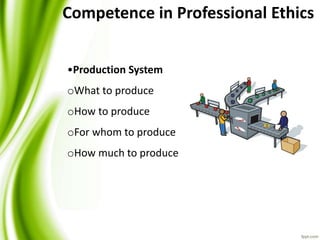
•Production System
oWhat to produce
oHow to produce
oFor whom to produce
oHow much to produce
Competence in Professional Ethics
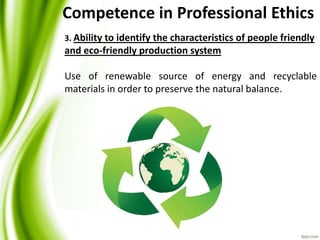
3. Ability to identify the characteristics of people friendly
and eco-friendly production system
Use of renewable source of energy and recyclable
materials in order to preserve the natural balance.
Competence in Professional Ethics
Case Study
“Nike Reuse-A-Shoe Program”
•Established in the early 1990s
•Collects old, worn-out athletic shoes
•Recycling transforms them into Nike
Grind, a material used to create
athletic and playground surfaces and
more.
•1.5 million pairs of worn-out shoes
are collected for recycling each year
Strategy for transition to universal
human order:
Transition is the gradual change for betterment which
take place at two levels;
1. At the individual level
2. At the Society level
•Perform services only in the areas of competence
•Uphold and enhance the honor, integrity, and dignity of
their respective profession
•Provide opportunities for the profession development of
the employee under their supervision
•Promote safety, health and welfare of the public in their
respective area of services.
•Strive to the principles of sustainable development
•To be accountable for their action
•Morally responsible for their respective organization
At the Individual level
At the Society Level
•Collective measures for prevention and removal of
threats to the peace.
•Promote the value based education for the ultimate
betterment of society.
•Framing positive agenda, mission statement, objectives,
values and behaviors of the business and service etc.
•Sustainable development
•Assigning the possible social role to its respective
members
• Promoting self awareness and enhancing healthy
employer-employee relationship and ultimately the
human inter-relationship.
References Cited
1. A Foundation Course in Human Values and Professionals
Ethics By RR Gaur, R Sangal, G P Bagaria
2. Human Values And Professional Ethics By Vaishali R Khosla,
Kavita Bhagat
Competence in Professional Ethics

Competence in Professional Ethics

  • 1.
    Professional Ethics Kuldeep Sharma B.TechBiotechnology, IV Sem Amity Institute of Biotechnology Amity University Rajasthan
  • 2.
    Contents Introduction Human values Harmony Co-existence inhuman being  Orders in Nature Universal Human Order Professional Competence Competence in professional ethics Strategy for the transition to Universal Human Order
  • 3.
    Introduction •Professional ethics referto the ethical obligations that people follow because of their professional status by encompassing how to behave in their professional work and how they conduct themselves. •Components : oHonesty oIntegrity oTransparency oAccountability oConfidentiality oObjectivity oRespectfulness oObedience to law oLoyalty
  • 4.
    Human Values Morals Morals arethe pre-defined welfare principles that people believe what is right and what is wrong. Eg., Corruption, Crime. Values Values are the set of rules that are internal to a person, unconsciously acquires through his personal experiences promoting well-being or prevents harm Ethics Study and philosophy of moral values of right conduct. Eg. , Customs, laws
  • 5.
    Harmony The term ‘harmony’means compatibility in our opinion and action. •Harmony in Myself •Harmony in Family •Harmony in Society •Harmony in Nature
  • 6.
    Human being isa composition of two basic constituents: •Material Body (SUVIDHA) It is a physio-chemical composition helping Self ‘I’ to achieve its non-materialistic desires. •Self ‘I’ (SUKH) It is the soul which is a part of human being which is marked by the consciousness Co-Existence In Human Being
  • 7.
    Orders in Nature Inorder to create an environment for mutual prosperity and fulfillment, it is necessary to understand the different orders of nature. There are four orders in nature; 1. Material Order (PADARTHAWASTHA): 2. Pranic Order (PRANAWASTHA): 3. Animal Order (JEEVAWASTHA): 4. Human Order (GYANAWSTHA):
  • 8.
    1. Material Order(PADARTHAWASTHA): soil, water, minerals, air, man made materials etc. 2. Pranic Order (PRANAWASTHA): Plants 3. Animal Order (JEEVAWASTHA): Animals and birds 4. Human Order (GYANAWSTHA): It includes the human beings and, physical body and the self or ‘I’. Orders in Nature
  • 9.
    Universal Human Order Universal-Encompassing All Order- A Systematic Arrangement •Universal human order refers to the efforts of an individual to have a systematic arrangement of entire universe which initiates with the individual itself.
  • 10.
    The vision forhuman order has three elements: •Humanistic Education: Education which transforms the animal consciousness of human to human consciousness putting a check on our actions. •Humanistic Constitution: It is the framework of human, living in harmony with himself and with the other orders. •Humanistic Order: It includes the right understanding in the society living continuously with harmony and happiness. Visions for human order:
  • 11.
  • 12.
    1. Ability toaugment the universal human order oEducation-Sanskar oHealth-Sanyam: oProduction-Work oExchange-Storage oJustice-Preservation Competence in Professional Ethics
  • 13.
    2. Ability toidentify and develop appropriate technologies and management patterns •Holistic Technologies: oSatisfy real human needs oCompatible with nature oPromote use of renewable resources oLow cost and energy efficient oNot harmful to health Competence in Professional Ethics
  • 14.
    Some of theholistic technologies and production systems include ; •Solar Energy Devices· •Green Building Materials and Techniques· •Water Shed Management· •Biomass based Energy Technologies· •Eco-Friendly Agriculture· •Eco-Sanitation Technologies Competence in Professional Ethics
  • 15.
    •Management Models orPatterns To develop a humanistic management model, the following points must be adopted: oCo-ordination in working unit oCo-operative and motivation management oHealthy Employer-Employee relationship oNo Exploitation of labour oEffective integrity of individual competencies Competence in Professional Ethics
  • 16.
    Source Case Study (ManagementModel) Lijjat-Cooperative Source: www.lijjat.com •Started in the year 1959 with a seed capital of Rs. 80 •Founded by 7 lady entrepreneur in Gujrat • Runs as Shri Mahila Griha Udyog Lijjat Papad. •It provides employment to around 42,000 people •Annual turnover of more than Rs. 650 crore.
  • 17.
    •Factors contributing toits phenomenal success: 1. Members believed in principle of co-operation. 2. Collective ownership helped them to attain steady income. 3. Adopted the practice of sharing equal profit among the group. 4. Main focus was the maintenance of quality. 5. Tremendous practice of ethical code of conduct. 6. Reasonable pricing, regularity and reliability 7. Collective decision. Thus, we see that values and ethical conduct pave the path for success.
  • 18.
    •Production System oWhat toproduce oHow to produce oFor whom to produce oHow much to produce Competence in Professional Ethics
  • 19.
    3. Ability toidentify the characteristics of people friendly and eco-friendly production system Use of renewable source of energy and recyclable materials in order to preserve the natural balance. Competence in Professional Ethics
  • 20.
    Case Study “Nike Reuse-A-ShoeProgram” •Established in the early 1990s •Collects old, worn-out athletic shoes •Recycling transforms them into Nike Grind, a material used to create athletic and playground surfaces and more. •1.5 million pairs of worn-out shoes are collected for recycling each year
  • 21.
    Strategy for transitionto universal human order: Transition is the gradual change for betterment which take place at two levels; 1. At the individual level 2. At the Society level
  • 22.
    •Perform services onlyin the areas of competence •Uphold and enhance the honor, integrity, and dignity of their respective profession •Provide opportunities for the profession development of the employee under their supervision •Promote safety, health and welfare of the public in their respective area of services. •Strive to the principles of sustainable development •To be accountable for their action •Morally responsible for their respective organization At the Individual level
  • 23.
    At the SocietyLevel •Collective measures for prevention and removal of threats to the peace. •Promote the value based education for the ultimate betterment of society. •Framing positive agenda, mission statement, objectives, values and behaviors of the business and service etc. •Sustainable development •Assigning the possible social role to its respective members • Promoting self awareness and enhancing healthy employer-employee relationship and ultimately the human inter-relationship.
  • 24.
    References Cited 1. AFoundation Course in Human Values and Professionals Ethics By RR Gaur, R Sangal, G P Bagaria 2. Human Values And Professional Ethics By Vaishali R Khosla, Kavita Bhagat