ETHICS IN
PROFESSION
WHAT ARE ETHICS?
• Ethics: The principles that guide our decisions and
actions, shaping how we behave towards others
and our responsibilities.
• Moral compass: Guiding us towards right and
wrong.
• Professional ethics: Specific principles and
standards applied within a particular profession.
WHY ARE ETHICS IMPORTANT?
• Creates trust and credibility: Ethical behavior builds trust
within teams, with clients, and with the public.
• Supports positive workplace culture: Promotes fairness,
respect, and accountability, fostering a positive work
environment.
• Minimizes risk and legal issues: Ethical conduct helps
avoid legal and financial repercussions associated with
unethical practices.
• Upholds social responsibility: Contributes to a more just
and responsible society, considering the broader impact
of our actions.
KEY ETHICAL PRINCIPLES
• Honesty & Integrity: Truthfulness and genuineness
in our words and actions, aligning our beliefs with
our conduct.
• Fairness & Respect: Treating others with
impartiality and consideration, valuing their rights
and perspectives.
• Responsibility & Accountability: Taking ownership of
our actions and decisions, fulfilling our
commitments and being answerable for the
consequences.
ETHICAL DILEMMAS IN THE
WORKPLACE
• Ethical dilemmas: Situations where competing
values or options make it difficult to determine the
right course of action.
• Analyzing situations: Consider all relevant
information, including potential consequences for all
parties involved.
• Seeking guidance: Consult with colleagues,
superiors, or ethics officers when facing complex
situations.
ETHICS AND EXCELLENCE:
MORAL VALUES
Moral values are embedded in even the simplest
projects including:
• The basic standards of safety and efficiency
• The structure of technological corporations as
communities of people engaged in shared activities.
WHAT ARE MORAL VALUES?
• Moral values are deeply held beliefs about what is
right and wrong, good and bad.
• They influence our choices and behaviors in
various situations.
• Moral values can be shaped by various factors,
including:
• Family upbringing
• Cultural background
• Religious beliefs
• Personal experiences
• Morality is concerned with principles and practices
of morals such as: (a) What ought or ought
not to be done in a given situation? (b) What is right
or wrong about the handling of a situation? and
(c) What is good or bad about the people, policies,
and ideals involved?
WHY ARE MORAL VALUES
IMPORTANT?
• Moral values provide a sense of direction and
purpose in life.
• They guide us in making decisions that align with
our beliefs and principles.
• They foster positive relationships and interactions
with others.
• They contribute to a just and ethical society.
• Direction and Purpose: Our values provide a
sense of direction and purpose in life, guiding us
towards what we deem important and worthwhile.
• Ethical Decision-Making: They act as a moral
compass, helping us navigate complex situations
and make choices aligned with our beliefs and
principles.
• Positive Relationships: Strong moral values can
foster positive relationships with others as they
promote trust, respect, and empathy.
• Just and Ethical Society: By upholding ethical
values, we contribute to building a just and
equitable society, where everyone thrives under
COMMON MORAL VALUES
• Honesty: Truthfulness and authenticity in our words and
actions.
• Respect: Treating others with dignity and consideration,
valuing their rights and perspectives.
• Compassion: Understanding and caring for the suffering
of others.
• Fairness: Acting justly and treating everyone with
impartiality.
• Responsibility: Taking ownership of our actions and
decisions, fulfilling commitments and being accountable
for the consequences.
WHILE INDIVIDUAL MORAL VALUES MAY VARY,
CERTAIN CORE VALUES ARE WIDELY RECOGNIZED
AS ESSENTIAL FOR CREATING A POSITIVE AND
HARMONIOUS SOCIETY. THESE COMMONLY SHARED
VALUES INCLUDE:
• Honesty: It is the foundation of trust and integrity,
ensuring our words and actions align with our
beliefs.
• Respect: Treating others with dignity and
consideration, valuing their rights and perspectives,
is crucial for building positive relationships.
• Compassion: Understanding and caring for the
suffering of others fosters empathy and promotes a
sense of shared humanity.
• Fairness: Acting with impartiality and treating
everyone justly ensures equality and fosters a
sense of trust and respect within society.
• Responsibility: Taking ownership of our actions
and decisions, fulfilling commitments and being
accountable for the consequences strengthens
integrity and individual growth.
DEVELOPING AND REFINING
YOUR MORAL VALUES
• Self-reflection: Reflect upon your experiences,
beliefs, and motivations to understand your existing
values.
• Open-mindedness: Be willing to consider different
perspectives and learn from diverse viewpoints.
• Critical thinking: Analyze situations and decisions
with a thoughtful approach, considering the
potential consequences of various actions.
• Engaging in ethical discussions: Engage in honest
and respectful discussions about values with
22160059
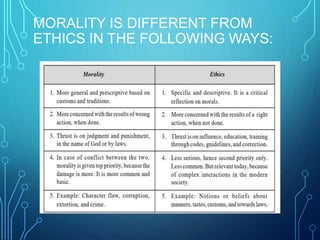
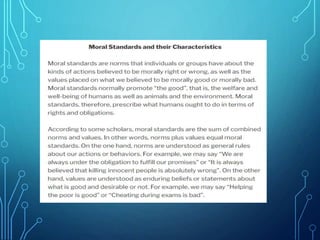
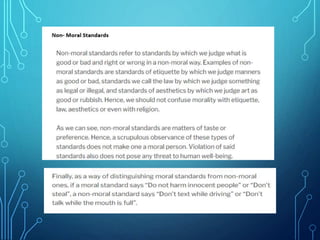
MORALITY IS DIFFERENT FROM
ETHICS IN THE FOLLOWING WAYS:
ETHICS AND EXCELLENCE:
MORAL VALUES
• In engineering, as in other professions, excellence
and ethics go together
• In general, ethics involves much more than
problems and punishment, duties and dilemmas.
• Ethics involves the full range of moral values to
which we aspire in guiding our endeavors and in
structuring our relationships and communities.
VALUES
• Humans have the unique ability to define their
identity, choose their values and establish their
beliefs.
• All three of these directly influence a person’s
behavior.
• People have gone to great lengths to demonstrate
the validity of their beliefs, including war and
sacrificing their own life!
• Conversely, people are not motivated to support or
validate the beliefs of another, when those beliefs
• People will act congruent with their personal values
or what they deem to be important.
• A value is defined as a principle that promotes well-
being or prevents harm.”
• Another definition is: Values are our guidelines for
our success—our paradigm about what is
acceptable.”
• Personal valuesare defined as: “Emotional beliefs
in principles regarded as particularly favorable or
important for the individual.”
• Our values associate emotions to our experiences
and guide our choices, decisions and actions.
TYPES OF VALUES
1. Values related to RIGHT CONDUCT are:
(a) SELF-HELP SKILLS: Care of possessions,
diet, hygiene, modesty, posture, self-reliance, and
tidy appearance
(b) SOCIAL SKILLS: Good behavior, good
manners, good relationships, helpfulness, No
wastage, and good environment, and
(c) ETHICAL SKILLS: Code of conduct,
courage, dependability, duty, efficiency, ingenuity,
initiative, perseverance, punctuality, resourcefulness,
respect for all, and responsibility
• 2. Values related to PEACE are: Attention,
calmness, concentration, contentment, dignity,
discipline, equality, equanimity, faithfulness, focus,
gratitude, happiness, harmony, humility,
inner silence, optimism, patience, reflection,
satisfaction, self-acceptance, self-confidence,
self-control, self-discipline, self-esteem, self-
respect, sense control, tolerance, and
understanding
• 3. Values related to TRUTH are: Accuracy, curiosity,
discernment, fairness, fearlessness, honesty,
integrity (unity of thought, word, and deed), intuition,
justice, optimism, purity, quest for
knowledge, reason, self-analysis, sincerity, sprit of
enquiry, synthesis, trust, truthfulness,
and determination
• 4. Values related to LOVE are: Acceptance,
affection, care, compassion, consideration,
dedication, devotion, empathy, forbearance,
forgiveness, friendship, generosity, gentleness,
humanness, interdependence, kindness, patience,
patriotism, reverence, sacrifice, selflessness,
service, sharing, sympathy, thoughtfulness,
tolerance and trust
• 5. Values related to NON-VIOLENCE are:
(a) PSYCHOLOGICAL: Benevolence, compassion,
concern for others, consideration,
forbearance, forgiveness, manners, happiness,
loyalty, morality, and universal love
(b) SOCIAL: Appreciation of other cultures and
religions, brotherhood, care of environment,
citizenship, equality, harmlessness, national
awareness, perseverance, respect for property, and
social justice.
EVOLUTION OF HUMAN VALUES
• The human values evolve because of the following
factors:
1. The impact of norms of the society on the
fulfillment of the individual’s needs or desires.
2. Developed or modified by one’s own awareness,
choice, and judgment in fulfilling the
needs.
3. By the teachings and practice of Preceptors
(Gurus) or Saviors or religious leaders.
4. Fostered or modified by social leaders, rulers of
kingdom, and by law (government)
MYRIAD MORAL REASONS
GENERATE ETHICAL DILEMMAS
• Ethical dilemmas or moral dilemmas, are situations
in which moral reasons come into conflict, or in
which the applications of moral values are
problematic, and it is not immediately obvious what
should be done.
• The moral reasons might be obligations, rights,
goods, ideals, or other moral considerations.
MICRO AND MACRO ISSUES
• Micro issues concern the decisions made by
individual and companies
• Macro issues concern more global issues, such as
the directions in technological development, the
laws that should or should not be passed, and the
collective responsibilities of groups such as
engineering professioanal societies and consumer
groups.
CAUTIOUS OPTIMISM ABOUT
TECHNOLOGY
• Pessimists view advanced technology as ominous
and often out of our control. They point to pollution,
depletion of natural resources, mass death on
highways and in high-tech wars, fears of biological
and chemical weapons and threat of nuclear war.
• Optimists highlight how technology profoundly
improves all our lives.
CAUTIOUS OPTIMISM ABOUT
TECHNOLOGY
Top 20 engineering achievements of the 20th century
as identified by the National Academy of Engineering:
 Electrification
Automobiles
Airplanes
Water supply and distribution
CAUTIOUS OPTIMISM ABOUT
TECHNOLOGY
Electronics
Radio and television
Computers, telephones
Air conditioning and refrigeration
Highways, spacecrafts
İnternet, imaging technologies, laser and fiber optics
High performance materials
ACCEPTING AND SHARING
RESPONSIBILITY
• Wrongdoing takes two primary forms: voluntary
wrongdoing and negligence. Voluntary actions
occur when we knew what we were doing was
wrong and we were not coerced.
• Neglience occurs when we unintentionally fail to
excercise due care in meeting responsibilities.
ACCEPTING AND SHARING
RESPONSIBILITY
• Moral responsibility overlaps with, but is
distinguishable from, causal, job, and legal
responsibility. Causal responsibilıty consists
simply in being a cause of some event. (A young
child playing with matches causes a house to burn
down, but the adult who left the child with the
matches is morally responsible.) Job
responsibility consists of one’s assigned tasks at
the place of employement.
ACCEPTING AND SHARING
RESPONSIBILITY
• Legal responsibility is whateever the law requires
including legal obligations and accountability for
meeting them.
• Responsibilities are obligations, types of actions
that are morally mandatory. Other obligations are
role responsibilities, acquired when we take on
special roles such as parents, employees, or
professionals.
RESPONSIBLE PROFESSIONALS
AND ETHICAL CORPORATIONS
What are professions?
 A profession is any occupation that provides a
means by which to earn a living. Professions are
those forms of work involving advanced expertise,
self-regulation, and concerted service to the public
good.
RESPONSIBLE PROFESSIONALS
AND ETHICAL CORPORATIONS
• Advanced expertise: professions require
sophisticated skills and theoretical knowledge in
exercising judgment that is not entirely routine or
susceptible to mechanization.
RESPONSIBLE PROFESSIONALS
AND ETHICAL CORPORATIONS
• Self-regulation: Well-established societies of
professionals are allowed by the public to play a
major role in setting standards for admission to the
profession, drafting codes of ethics enforcing
standards of conduct, and representing the
profession before the public and the government.
RESPONSIBLE PROFESSIONALS
AND ETHICAL CORPORATIONS
• Public good: The occupation serves some important
public good, or aspect of the public good, and it
does so by making a concerted effort to maintain
high ethical standards throughout the profession.
SENSES OF CORPORATE
RESPONSIBILITY
• Just as individuals have reponsibilities (obligations)
so do corporations. Corporations are communities
of individuals, structured within legal frameworks.
Yet corporations have internal structures consisting
of policy manuals and flowcharts assigning
responsibilities to individuals. When those individual
act in accordance with their assigned
responsibilities, the corporation as a unity can be
said to act.
MORAL REASONING AND
CODES OF ETHICS
• Ethical(or moral) dilemmas are situations in which
moral reasons come into conflict, or in which the
applications of moral values are uncleari and it is
not immediately obvious what should be done.
RESOLVING ETHICAL DILEMMAS
Steps in Resolving Ethical Dilemmas
1- Moral clarity: Identify the relevant moral values:
Identifying the moral values and reasons applicable
in the situation, and bearing them in mind as further
investigations are made.
These values and reasons might be obligations,
duties, rights, goods, ideals or other moral
considerations.
RESOLVING ETHICAL DILEMMAS
• Like most codes of ethics, the code of ethics of the
American Institute of Chemical Engineers indicates
the engineer has at least three responsibilities in
the situation.
• a) to be honest: “Issue statements or present
information only in an objective and truthful
manner”.
RESOLVING ETHICAL DILEMMAS
• b) responsibility the employer: “act in professional
matters for each employer or client as faithful
agents or trustees, avoiding conflicts of interest and
never breaching confidentiality”
RESOLVING ETHICAL DILEMMAS
• c) Responsibility to the public and also to protect
the environment: “Hold paramount the safety,
health and welfare of the public and protect the
environment in performance of their professional
duties.
RESOLVING ETHICAL DILEMMAS
• 2- Conceptual clarity: clarify key concepts:
Professionalism requires being a faithful agent of
one’s employer, but does that mean doing what
one’s supervisor directs or doing what is good for
the corporation in the long run?
RESOLVING ETHICAL DILEMMAS
• 3-Informed about the facts: obtain relevant
information
• This means gathering information that is relevant in
light of the applicable moral values.
• 4- Informed about the options: consider all
options
• Initially, ethical dilemmas seem to force us into a
two-way choice: do this or do that.
RESOLVING ETHICAL DILEMMAS
• 5-Well-reasoned: make a reasonable decision
• Arrive at a carefully reasoned judgement by
weighing all the relevant moral reasons and facts.
• Often a code of ethics provides a straightforward
solution to dilemmas, but not always. The code
does assert one very important hierarchy: Hold
paramount the public safety, health, and welfare.
RESOLVING ETHICAL DILEMMAS
Right-Wrong or Better-Worse?
• We might divide ethical dilemmas into two broad
categories. On the one hand, many, perhaps, most,
dilemmas have solutions that are either right or
wrong. “
RESOLVING ETHICAL DILEMMAS
• Right” means that one course of action is obligatory,
and failing to do that action is unethical (immoral).
In most instances a code of ethics specifies what is
clearly required: obey the law and heed engineering
standards, do not offer or accept bribes, speak and
write truthfully, maintain confidentiality.
RESOLVING ETHICAL DILEMMAS
• On the other hand, some dilemmas have two or
more solutions, no one of which is mandatory but
one of which should be chosen. These solutions
might be better or worse than others in some
respects, but not necessarily in all respects.
MAKING MORAL CHOICES
• Moral dilemmas comprise the most difficult
occasions for moral reasoning. Most moral choices
are routine and straightforward.
• Moral values entered implicitly into the decision-
making process of engineers adn their managers-
decisions that probably appeared to be purely
technical or purely economic.
MAKING MORAL CHOICES
• This appearance is misleading, for the technical and
economic decisions: safety, environmental protection,
consumer usefulness, and economic benefits.
• First, human safety is obviosly a moral value, rooted
directly in the moral worth of human beings. Some
aspects of safety seem minor-slight cuts to lips and
noses from poorly designed openers and minor injuries
to feet inrecreation areas like beaches.
MAKING MORAL CHOICES
• But minor injures might cause infections, and even
by themselves they have some moral significance.
• Again, various kinds of poisoning might occur
unless all materials were tested under a range of
conditions, and there are potential industrial
accidents during the manufacturing process.
MAKING MORAL CHOICES
• A second set of moral values concern the
environment. Many of them overlap with the first
set, safety.
• Third, some moral values are masked under terms
like ‘useful’ and ‘convenient’ products.
• Finally, the economic benefits to stakeholders in the
corporation have moral implications. Money
matters, and it matters morally.
MAKING MORAL CHOICES
• Jobs provide the livelihood for workers and their
families that make possible the material goods that
contribute happiness-and survival.
CODES OF ETHICS
Importance of Codes
Codes of ethics state the moral responsibilities of
engineers as seen by the profession, and as
represented by a professional society. Codes are
enormously important, not only in stressing
engineers’ responsibilities but also the freedom to
exercise them.
CODES OF ETHICS
• Codes of ethics play at least eight essential roles:
serving and protecting the public, providing
guidance, offering inspiration, establishing shared
standards, supporting responsible professionals,
contributing to education, deterring wrong-doing,
and strengthening a profession’s image.
CODES OF ETHICS
1- Serving and protecting the public:
Engineers involves both advanced expertise that
professionals, but not the general public, have, and
considerable dangers to a vulnerable public. A
code of ethics functions as a commitment by
profession as a whole that engineers will serve the
public health, safety, and welfare.
CODES OF ETHICS
2- Guidance
Codes provide helpful guidance concerning the
main obligations of engineers. Since codes should
be brief to be effective, they offer mostly general
guidance. They identify primary responsibilities.
CODES OF ETHICS
3-Inspiration:
Because codes express a profession’s collective
commitment to ethics, they provide a positive
motivation for ethical conduct.
They voice what it means to be a member of a
profession committed to responsible conduct in
promoting the safety, health, and welfare of the
public.
CODES OF ETHICS
4-Shared Standards:
 The diversity of moral viewpoints among individual
engineers makes it essential that professions establish
explicit standards, in particular minimum (often high)
standards. In this way, the public is assured of a
minimum standard of excellence on which it can
depend, and professionals are provided a fair playing
field in competing for clients.
CODES OF ETHICS
5- Support for responsible professionals:
Codes give positive support to professionals
seeking to act ethically.
Codes can potentially serve as legal support for
engineers criticized for living up to work-related
professional obligations.
CODES OF ETHICS
6- Education and mutual understanding
Codes can be used by professional societies and
in the classroom to prompt discussion and
reflection on moral issues.
Codes encourage a shared understanding among
professionals, the public and government
organizations about the moral responsibilities of
engineers.
CODES OF ETHICS
7- Deterrence and discipline
Codes can also serve as the formal basis for
investigating unethical conduct. Where such
investigation is possible, a deterrent for immoral
behavior is thereby provided.
CODES OF ETHICS
• Some professional societies do suspend or expel
members whose professional conduct has been
proven unethical, and this alone can be a powerful
sanction when combined with the loss of respect
from colleagues and the local community that such
action is bound to produce.
CODES OF ETHICS
8- Contributing to the professional image:
Codes can present a positive image to the public of
an ethically committed profession. Where the image
şs warranted, it can help engineers more effectively
serve the public. It can also win greater powers of
self-regulation for the profession itself, while
lessening the demand for more government
regulation.

ethics of profession spring semsester 1.ppt

  • 1.
  • 2.
    WHAT ARE ETHICS? •Ethics: The principles that guide our decisions and actions, shaping how we behave towards others and our responsibilities. • Moral compass: Guiding us towards right and wrong. • Professional ethics: Specific principles and standards applied within a particular profession.
  • 3.
    WHY ARE ETHICSIMPORTANT? • Creates trust and credibility: Ethical behavior builds trust within teams, with clients, and with the public. • Supports positive workplace culture: Promotes fairness, respect, and accountability, fostering a positive work environment. • Minimizes risk and legal issues: Ethical conduct helps avoid legal and financial repercussions associated with unethical practices. • Upholds social responsibility: Contributes to a more just and responsible society, considering the broader impact of our actions.
  • 4.
    KEY ETHICAL PRINCIPLES •Honesty & Integrity: Truthfulness and genuineness in our words and actions, aligning our beliefs with our conduct. • Fairness & Respect: Treating others with impartiality and consideration, valuing their rights and perspectives. • Responsibility & Accountability: Taking ownership of our actions and decisions, fulfilling our commitments and being answerable for the consequences.
  • 5.
    ETHICAL DILEMMAS INTHE WORKPLACE • Ethical dilemmas: Situations where competing values or options make it difficult to determine the right course of action. • Analyzing situations: Consider all relevant information, including potential consequences for all parties involved. • Seeking guidance: Consult with colleagues, superiors, or ethics officers when facing complex situations.
  • 6.
    ETHICS AND EXCELLENCE: MORALVALUES Moral values are embedded in even the simplest projects including: • The basic standards of safety and efficiency • The structure of technological corporations as communities of people engaged in shared activities.
  • 7.
    WHAT ARE MORALVALUES? • Moral values are deeply held beliefs about what is right and wrong, good and bad. • They influence our choices and behaviors in various situations. • Moral values can be shaped by various factors, including: • Family upbringing • Cultural background • Religious beliefs • Personal experiences
  • 8.
    • Morality isconcerned with principles and practices of morals such as: (a) What ought or ought not to be done in a given situation? (b) What is right or wrong about the handling of a situation? and (c) What is good or bad about the people, policies, and ideals involved?
  • 9.
    WHY ARE MORALVALUES IMPORTANT? • Moral values provide a sense of direction and purpose in life. • They guide us in making decisions that align with our beliefs and principles. • They foster positive relationships and interactions with others. • They contribute to a just and ethical society.
  • 10.
    • Direction andPurpose: Our values provide a sense of direction and purpose in life, guiding us towards what we deem important and worthwhile. • Ethical Decision-Making: They act as a moral compass, helping us navigate complex situations and make choices aligned with our beliefs and principles. • Positive Relationships: Strong moral values can foster positive relationships with others as they promote trust, respect, and empathy. • Just and Ethical Society: By upholding ethical values, we contribute to building a just and equitable society, where everyone thrives under
  • 11.
    COMMON MORAL VALUES •Honesty: Truthfulness and authenticity in our words and actions. • Respect: Treating others with dignity and consideration, valuing their rights and perspectives. • Compassion: Understanding and caring for the suffering of others. • Fairness: Acting justly and treating everyone with impartiality. • Responsibility: Taking ownership of our actions and decisions, fulfilling commitments and being accountable for the consequences.
  • 12.
    WHILE INDIVIDUAL MORALVALUES MAY VARY, CERTAIN CORE VALUES ARE WIDELY RECOGNIZED AS ESSENTIAL FOR CREATING A POSITIVE AND HARMONIOUS SOCIETY. THESE COMMONLY SHARED VALUES INCLUDE: • Honesty: It is the foundation of trust and integrity, ensuring our words and actions align with our beliefs. • Respect: Treating others with dignity and consideration, valuing their rights and perspectives, is crucial for building positive relationships.
  • 13.
    • Compassion: Understandingand caring for the suffering of others fosters empathy and promotes a sense of shared humanity. • Fairness: Acting with impartiality and treating everyone justly ensures equality and fosters a sense of trust and respect within society. • Responsibility: Taking ownership of our actions and decisions, fulfilling commitments and being accountable for the consequences strengthens integrity and individual growth.

  • 14.
    DEVELOPING AND REFINING YOURMORAL VALUES • Self-reflection: Reflect upon your experiences, beliefs, and motivations to understand your existing values. • Open-mindedness: Be willing to consider different perspectives and learn from diverse viewpoints. • Critical thinking: Analyze situations and decisions with a thoughtful approach, considering the potential consequences of various actions. • Engaging in ethical discussions: Engage in honest and respectful discussions about values with 22160059
  • 15.
    MORALITY IS DIFFERENTFROM ETHICS IN THE FOLLOWING WAYS:
  • 16.
    ETHICS AND EXCELLENCE: MORALVALUES • In engineering, as in other professions, excellence and ethics go together • In general, ethics involves much more than problems and punishment, duties and dilemmas. • Ethics involves the full range of moral values to which we aspire in guiding our endeavors and in structuring our relationships and communities.
  • 22.
    VALUES • Humans havethe unique ability to define their identity, choose their values and establish their beliefs. • All three of these directly influence a person’s behavior. • People have gone to great lengths to demonstrate the validity of their beliefs, including war and sacrificing their own life! • Conversely, people are not motivated to support or validate the beliefs of another, when those beliefs
  • 23.
    • People willact congruent with their personal values or what they deem to be important. • A value is defined as a principle that promotes well- being or prevents harm.” • Another definition is: Values are our guidelines for our success—our paradigm about what is acceptable.” • Personal valuesare defined as: “Emotional beliefs in principles regarded as particularly favorable or important for the individual.” • Our values associate emotions to our experiences and guide our choices, decisions and actions.
  • 24.
    TYPES OF VALUES 1.Values related to RIGHT CONDUCT are: (a) SELF-HELP SKILLS: Care of possessions, diet, hygiene, modesty, posture, self-reliance, and tidy appearance (b) SOCIAL SKILLS: Good behavior, good manners, good relationships, helpfulness, No wastage, and good environment, and (c) ETHICAL SKILLS: Code of conduct, courage, dependability, duty, efficiency, ingenuity, initiative, perseverance, punctuality, resourcefulness, respect for all, and responsibility
  • 25.
    • 2. Valuesrelated to PEACE are: Attention, calmness, concentration, contentment, dignity, discipline, equality, equanimity, faithfulness, focus, gratitude, happiness, harmony, humility, inner silence, optimism, patience, reflection, satisfaction, self-acceptance, self-confidence, self-control, self-discipline, self-esteem, self- respect, sense control, tolerance, and understanding
  • 26.
    • 3. Valuesrelated to TRUTH are: Accuracy, curiosity, discernment, fairness, fearlessness, honesty, integrity (unity of thought, word, and deed), intuition, justice, optimism, purity, quest for knowledge, reason, self-analysis, sincerity, sprit of enquiry, synthesis, trust, truthfulness, and determination
  • 27.
    • 4. Valuesrelated to LOVE are: Acceptance, affection, care, compassion, consideration, dedication, devotion, empathy, forbearance, forgiveness, friendship, generosity, gentleness, humanness, interdependence, kindness, patience, patriotism, reverence, sacrifice, selflessness, service, sharing, sympathy, thoughtfulness, tolerance and trust
  • 28.
    • 5. Valuesrelated to NON-VIOLENCE are: (a) PSYCHOLOGICAL: Benevolence, compassion, concern for others, consideration, forbearance, forgiveness, manners, happiness, loyalty, morality, and universal love (b) SOCIAL: Appreciation of other cultures and religions, brotherhood, care of environment, citizenship, equality, harmlessness, national awareness, perseverance, respect for property, and social justice.
  • 29.
    EVOLUTION OF HUMANVALUES • The human values evolve because of the following factors: 1. The impact of norms of the society on the fulfillment of the individual’s needs or desires. 2. Developed or modified by one’s own awareness, choice, and judgment in fulfilling the needs. 3. By the teachings and practice of Preceptors (Gurus) or Saviors or religious leaders. 4. Fostered or modified by social leaders, rulers of kingdom, and by law (government)
  • 30.
    MYRIAD MORAL REASONS GENERATEETHICAL DILEMMAS • Ethical dilemmas or moral dilemmas, are situations in which moral reasons come into conflict, or in which the applications of moral values are problematic, and it is not immediately obvious what should be done. • The moral reasons might be obligations, rights, goods, ideals, or other moral considerations.
  • 31.
    MICRO AND MACROISSUES • Micro issues concern the decisions made by individual and companies • Macro issues concern more global issues, such as the directions in technological development, the laws that should or should not be passed, and the collective responsibilities of groups such as engineering professioanal societies and consumer groups.
  • 32.
    CAUTIOUS OPTIMISM ABOUT TECHNOLOGY •Pessimists view advanced technology as ominous and often out of our control. They point to pollution, depletion of natural resources, mass death on highways and in high-tech wars, fears of biological and chemical weapons and threat of nuclear war. • Optimists highlight how technology profoundly improves all our lives.
  • 33.
    CAUTIOUS OPTIMISM ABOUT TECHNOLOGY Top20 engineering achievements of the 20th century as identified by the National Academy of Engineering:  Electrification Automobiles Airplanes Water supply and distribution
  • 34.
    CAUTIOUS OPTIMISM ABOUT TECHNOLOGY Electronics Radioand television Computers, telephones Air conditioning and refrigeration Highways, spacecrafts İnternet, imaging technologies, laser and fiber optics High performance materials
  • 35.
    ACCEPTING AND SHARING RESPONSIBILITY •Wrongdoing takes two primary forms: voluntary wrongdoing and negligence. Voluntary actions occur when we knew what we were doing was wrong and we were not coerced. • Neglience occurs when we unintentionally fail to excercise due care in meeting responsibilities.
  • 36.
    ACCEPTING AND SHARING RESPONSIBILITY •Moral responsibility overlaps with, but is distinguishable from, causal, job, and legal responsibility. Causal responsibilıty consists simply in being a cause of some event. (A young child playing with matches causes a house to burn down, but the adult who left the child with the matches is morally responsible.) Job responsibility consists of one’s assigned tasks at the place of employement.
  • 37.
    ACCEPTING AND SHARING RESPONSIBILITY •Legal responsibility is whateever the law requires including legal obligations and accountability for meeting them. • Responsibilities are obligations, types of actions that are morally mandatory. Other obligations are role responsibilities, acquired when we take on special roles such as parents, employees, or professionals.
  • 38.
    RESPONSIBLE PROFESSIONALS AND ETHICALCORPORATIONS What are professions?  A profession is any occupation that provides a means by which to earn a living. Professions are those forms of work involving advanced expertise, self-regulation, and concerted service to the public good.
  • 39.
    RESPONSIBLE PROFESSIONALS AND ETHICALCORPORATIONS • Advanced expertise: professions require sophisticated skills and theoretical knowledge in exercising judgment that is not entirely routine or susceptible to mechanization.
  • 40.
    RESPONSIBLE PROFESSIONALS AND ETHICALCORPORATIONS • Self-regulation: Well-established societies of professionals are allowed by the public to play a major role in setting standards for admission to the profession, drafting codes of ethics enforcing standards of conduct, and representing the profession before the public and the government.
  • 41.
    RESPONSIBLE PROFESSIONALS AND ETHICALCORPORATIONS • Public good: The occupation serves some important public good, or aspect of the public good, and it does so by making a concerted effort to maintain high ethical standards throughout the profession.
  • 42.
    SENSES OF CORPORATE RESPONSIBILITY •Just as individuals have reponsibilities (obligations) so do corporations. Corporations are communities of individuals, structured within legal frameworks. Yet corporations have internal structures consisting of policy manuals and flowcharts assigning responsibilities to individuals. When those individual act in accordance with their assigned responsibilities, the corporation as a unity can be said to act.
  • 43.
    MORAL REASONING AND CODESOF ETHICS • Ethical(or moral) dilemmas are situations in which moral reasons come into conflict, or in which the applications of moral values are uncleari and it is not immediately obvious what should be done.
  • 44.
    RESOLVING ETHICAL DILEMMAS Stepsin Resolving Ethical Dilemmas 1- Moral clarity: Identify the relevant moral values: Identifying the moral values and reasons applicable in the situation, and bearing them in mind as further investigations are made. These values and reasons might be obligations, duties, rights, goods, ideals or other moral considerations.
  • 45.
    RESOLVING ETHICAL DILEMMAS •Like most codes of ethics, the code of ethics of the American Institute of Chemical Engineers indicates the engineer has at least three responsibilities in the situation. • a) to be honest: “Issue statements or present information only in an objective and truthful manner”.
  • 46.
    RESOLVING ETHICAL DILEMMAS •b) responsibility the employer: “act in professional matters for each employer or client as faithful agents or trustees, avoiding conflicts of interest and never breaching confidentiality”
  • 47.
    RESOLVING ETHICAL DILEMMAS •c) Responsibility to the public and also to protect the environment: “Hold paramount the safety, health and welfare of the public and protect the environment in performance of their professional duties.
  • 48.
    RESOLVING ETHICAL DILEMMAS •2- Conceptual clarity: clarify key concepts: Professionalism requires being a faithful agent of one’s employer, but does that mean doing what one’s supervisor directs or doing what is good for the corporation in the long run?
  • 49.
    RESOLVING ETHICAL DILEMMAS •3-Informed about the facts: obtain relevant information • This means gathering information that is relevant in light of the applicable moral values. • 4- Informed about the options: consider all options • Initially, ethical dilemmas seem to force us into a two-way choice: do this or do that.
  • 50.
    RESOLVING ETHICAL DILEMMAS •5-Well-reasoned: make a reasonable decision • Arrive at a carefully reasoned judgement by weighing all the relevant moral reasons and facts. • Often a code of ethics provides a straightforward solution to dilemmas, but not always. The code does assert one very important hierarchy: Hold paramount the public safety, health, and welfare.
  • 51.
    RESOLVING ETHICAL DILEMMAS Right-Wrongor Better-Worse? • We might divide ethical dilemmas into two broad categories. On the one hand, many, perhaps, most, dilemmas have solutions that are either right or wrong. “
  • 52.
    RESOLVING ETHICAL DILEMMAS •Right” means that one course of action is obligatory, and failing to do that action is unethical (immoral). In most instances a code of ethics specifies what is clearly required: obey the law and heed engineering standards, do not offer or accept bribes, speak and write truthfully, maintain confidentiality.
  • 53.
    RESOLVING ETHICAL DILEMMAS •On the other hand, some dilemmas have two or more solutions, no one of which is mandatory but one of which should be chosen. These solutions might be better or worse than others in some respects, but not necessarily in all respects.
  • 54.
    MAKING MORAL CHOICES •Moral dilemmas comprise the most difficult occasions for moral reasoning. Most moral choices are routine and straightforward. • Moral values entered implicitly into the decision- making process of engineers adn their managers- decisions that probably appeared to be purely technical or purely economic.
  • 55.
    MAKING MORAL CHOICES •This appearance is misleading, for the technical and economic decisions: safety, environmental protection, consumer usefulness, and economic benefits. • First, human safety is obviosly a moral value, rooted directly in the moral worth of human beings. Some aspects of safety seem minor-slight cuts to lips and noses from poorly designed openers and minor injuries to feet inrecreation areas like beaches.
  • 56.
    MAKING MORAL CHOICES •But minor injures might cause infections, and even by themselves they have some moral significance. • Again, various kinds of poisoning might occur unless all materials were tested under a range of conditions, and there are potential industrial accidents during the manufacturing process.
  • 57.
    MAKING MORAL CHOICES •A second set of moral values concern the environment. Many of them overlap with the first set, safety. • Third, some moral values are masked under terms like ‘useful’ and ‘convenient’ products. • Finally, the economic benefits to stakeholders in the corporation have moral implications. Money matters, and it matters morally.
  • 58.
    MAKING MORAL CHOICES •Jobs provide the livelihood for workers and their families that make possible the material goods that contribute happiness-and survival.
  • 59.
    CODES OF ETHICS Importanceof Codes Codes of ethics state the moral responsibilities of engineers as seen by the profession, and as represented by a professional society. Codes are enormously important, not only in stressing engineers’ responsibilities but also the freedom to exercise them.

  • 60.
    CODES OF ETHICS •Codes of ethics play at least eight essential roles: serving and protecting the public, providing guidance, offering inspiration, establishing shared standards, supporting responsible professionals, contributing to education, deterring wrong-doing, and strengthening a profession’s image.
  • 61.
    CODES OF ETHICS 1-Serving and protecting the public: Engineers involves both advanced expertise that professionals, but not the general public, have, and considerable dangers to a vulnerable public. A code of ethics functions as a commitment by profession as a whole that engineers will serve the public health, safety, and welfare.
  • 62.
    CODES OF ETHICS 2-Guidance Codes provide helpful guidance concerning the main obligations of engineers. Since codes should be brief to be effective, they offer mostly general guidance. They identify primary responsibilities.
  • 63.
    CODES OF ETHICS 3-Inspiration: Becausecodes express a profession’s collective commitment to ethics, they provide a positive motivation for ethical conduct. They voice what it means to be a member of a profession committed to responsible conduct in promoting the safety, health, and welfare of the public.
  • 64.
    CODES OF ETHICS 4-SharedStandards:  The diversity of moral viewpoints among individual engineers makes it essential that professions establish explicit standards, in particular minimum (often high) standards. In this way, the public is assured of a minimum standard of excellence on which it can depend, and professionals are provided a fair playing field in competing for clients.
  • 65.
    CODES OF ETHICS 5-Support for responsible professionals: Codes give positive support to professionals seeking to act ethically. Codes can potentially serve as legal support for engineers criticized for living up to work-related professional obligations.
  • 66.
    CODES OF ETHICS 6-Education and mutual understanding Codes can be used by professional societies and in the classroom to prompt discussion and reflection on moral issues. Codes encourage a shared understanding among professionals, the public and government organizations about the moral responsibilities of engineers.
  • 67.
    CODES OF ETHICS 7-Deterrence and discipline Codes can also serve as the formal basis for investigating unethical conduct. Where such investigation is possible, a deterrent for immoral behavior is thereby provided.
  • 68.
    CODES OF ETHICS •Some professional societies do suspend or expel members whose professional conduct has been proven unethical, and this alone can be a powerful sanction when combined with the loss of respect from colleagues and the local community that such action is bound to produce.
  • 69.
    CODES OF ETHICS 8-Contributing to the professional image: Codes can present a positive image to the public of an ethically committed profession. Where the image şs warranted, it can help engineers more effectively serve the public. It can also win greater powers of self-regulation for the profession itself, while lessening the demand for more government regulation.