O Preamble: Toenable students to create
awareness on ethics and human values
3.
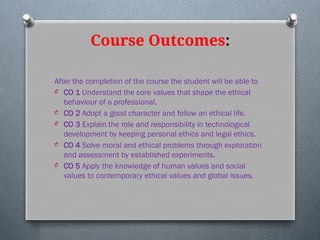
Course Outcomes:
After thecompletion of the course the student will be able to
O CO 1 Understand the core values that shape the ethical
behaviour of a professional.
O CO 2 Adopt a good character and follow an ethical life.
O CO 3 Explain the role and responsibility in technological
development by keeping personal ethics and legal ethics.
O CO 4 Solve moral and ethical problems through exploration
and assessment by established experiments.
O CO 5 Apply the knowledge of human values and social
values to contemporary ethical values and global issues.
8.
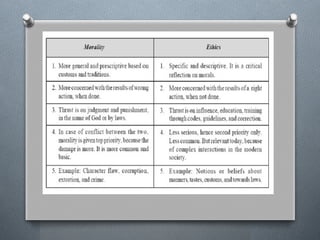
Morals
• Morals arethe welfare principles enunciated
by the wise people, based on their experience
and wisdom.
• They were edited, changed or modified or
evolved to suit the geography of the region,
rulers (dynasty), and in accordance with
development of knowledge in science and
technology and with time
9.
Morality and Ethics
Moralityis concerned with principles and
practices of morals such as:
(a) What ought or ought not to be done in
a given situation?
(b) What is right or wrong about the
handling of a situation? and
(c) What is good or bad about the people,
policies, and ideals involved?
11.
Laws
O As againstmorals and ethics, laws are
norms, formally approved by state, power or
national or international political bodies.
• Breaking the norms is called crime, and
invite specific punishment.
12.
Values
O Humans havethe unique ability to define
their identity, choose their values and
establish their beliefs.
• Conversely, people are not motivated to
support or validate the beliefs of another,
when those beliefs are contrary to their own.
• People will act congruent with their personal
values or what they deem to be important.
13.
Values - Definition
OA value is defined as a principle that promotes wellbeing
or prevents harm.
• Values are our guidelines for our success—our paradigm
about what is acceptable.
• Emotional beliefs in principles regarded as particularly
favorable or important for the individual.
• Our values associate emotions to our experiences and
guide our choices, decisions and actions.
• Values are the scales we use to weigh our choices for
our actions, whether to move towards or away from
something
14.
Values
• A person’sbeliefs, values and identity are
usually acquired unconsciously based on his
personal experience or observations of others’
experiences as to what produces desirable or
undesirable results in the environment
• By positive affirmations, one can modify or
create new beliefs about a person’s identity
and/or what is important to him (values)
15.
Types of Values
•The five core human
values
– Right conduct
– Peace
– Truth
– Love
– Nonviolence.
16.
Values related toRIGHT CONDUCT
• SELF-HELP SKILLS: Care of possessions, diet,
hygiene, modesty, posture, self reliance, and tidy
appearance
• SOCIAL SKILLS: Good behavior, good manners,
good relationships, helpfulness, No wastage, and
good environment,
• ETHICAL SKILLS: Code of conduct, courage,
dependability, duty, efficiency, ingenuity,
Initiative, perseverance, punctuality,
resourcefulness, respect for all, and responsibility
Values related toTRUTH
O Accuracy, curiosity, discernment, fairness,
fearlessness, honesty, integrity (unity of
thought, word, and deed), intuition, justice,
optimism, purity, quest for knowledge,
reason, self-analysis, sincerity, sprit of
enquiry,synthesis, trust, truthfulness, and
determination.
19.
Values related toLOVE
O Acceptance, affection, care, compassion,
consideration, dedication, devotion, empathy,
forbearance, forgiveness, friendship,
generosity, gentleness, humanness,
interdependence, kindness, patience,
patriotism, reverence, sacrifice, selflessness,
service, sharing, sympathy, thoughtfulness,
tolerance and trust
20.
Values related toNON-
VIOLENCE
• PSYCHOLOGICAL: Benevolence, compassion,
concern for others, consideration,
forbearance, forgiveness, manners, happiness,
loyalty, morality, and universal love
• SOCIAL: Appreciation of other cultures and
religions, brotherhood, care of environment,
citizenship, equality, harmlessness, national
awareness, perseverance, respect for property,
and social justice.
21.
Reasons for Evolutionof
Human Values
O The impact of norms of the society on the
fulfillment of the individual’s needs or desires.
• Developed or modified by one’s own
awareness, choice, and judgment in fulfilling the
needs.
• By the teachings and practice of Preceptors
(Gurus) or Saviors or religious leaders.
• Fostered or modified by social leaders, rulers
of kingdom, and by law (government).
22.
Ethics
O Ethics isthe word that refers to morals,
values, and beliefs of the individuals, family
or the society
• In addition, ethics tells us how to live, to
respond to issues, through the duties, rights,
responsibilities, and obligations
23.
INTEGRITY
• Integrity isdefined as the unity of thought,
word and deed (honesty) and open
mindedness. It includes the capacity to
communicate the factual information so that
others can make well-informed decisions.
• Moral integrity is defined as a virtue, which
reflects a consistency of one’s attitudes,
emotions, and conduct in relation to justified
moral values.
24.
WORK ETHICS
O Workethics is defined as a set of attitudes concerned
with the value of work, which forms the motivational
orientation.
• To work (job), is not for monetary considerations only.
• Human beings believe that it is good to work.
• Work is good for the body and mind.
• It promotes self-respect, self-esteem, good for the
family, and obligation to the society and allow the world
to prosper.
25.
Aim of WorkEthics
O ensuring the economy (get job, create wealth, earn salary)
• productivity (wealth, profit)
• safety (in workplace)
• health and hygiene (working conditions)
• privacy (raise family)
• security (permanence against contractual, pension, and retirement
benefits)
• cultural and social development (leisure, hobby, and happiness)
• welfare (social work)
• Environment (anti-pollution activities)
• offer opportunities for all, according to their abilities, but without
discrimination.
26.
Complex social problemsexist in the
industrial/business scenario
O The people desire to be recognized as individuals and treated with
dignity, as living human beings
• Economic independence
• Pay as well as the pace of work should be in commensurate with the
expertise required
• Privacy (personal freedom) of the employee, including women, is to be
protected
• Security during job and upon retirement
• Recognition to non-work activities, such as leisure, paid holiday on the
day of visit of a
• dignitary, social service, and other developmental activities
• Hard work and productivity are very essential for the success of an
industry
• Employee alienation
27.
SERVICE LEARNING
O Theservice learning may be defined as the
non-paid activity, in which service is provided
on voluntary basis to the public (have-nots in
the community), non-profitable institutions,
and charitable organizations.
• It is the service during learning
• The engineering student analyzing and
executing a socially-relevant project is
O example of service learning.
28.
Service learning is
Experientialeducation
Connection to curriculum: Integrating the learning into
a service project is a key to successful service learning.
• Learner’s voice: Beyond being actively engaged in the
project, trainees have the opportunity to select, design,
implement, and evaluate their service activity.
• Reflection: Structured opportunities are created to
think, talk, and write about the service experience.
• Partners in the community: Partnership with
community agencies are used to identify genuine
needs, provide mentorship, and contribute input such
as labor and expertise towards completing the project
29.
Virtues
• Virtues arepositive and preferred values.
• Virtues are desirable attitudes or character traits,
motives and emotions that enable us to be
successful and to act in ways that develop our
highest potential.
• They energize and enable us to pursue the ideals
that we have adopted.
• Honesty, courage, compassion, generosity,
fidelity, integrity, fairness, transparency, selfcontrol,
and prudence are all examples of virtues.
30.
Civic Virtues
Civic Knowledge: Responsibilities of Citizens
• Self Restraint : citizen must be able to control
or restrain himself
• Self-Assertion : citizens must be proud of their
rights, and have the courage to stand up in
public and defend their rights
• Self-Reliance : Self-reliant citizens are free
citizens in the sense that they are not
dependent on others for their basic needs
31.
LIVING PEACEFULLY
To livepeacefully, one should start install
peace within (self). Charity begins at home.
• Then one can spread peace to family,
organization where one works, and then to
the world, including the environment.
• Only who are at peace can spread peace.
• You can not gift an article which you do not
possess
32.
RESPECT FOR OTHERS
Thisis a basic requirement for nurturing friendship,
team work, and for the synergy it promotes and
sustains. The four principles enunciated in this regard
are
– Recognize and accept the existence of other persons as
human beings
– Respect others’ ideas (decisions), words, and labor
(actions).
– Appreciate colleagues and subordinates on their positive
actions. Criticize constructively and encourage them.
– Show ‘goodwill’ on others. Love others. Allow others to
grow.
33.
LIVING PEACEFULLY
One shouldadopt the following means to live
peacefully, in the
world:
Nurture order in one’s life (self-regulation, discipline, and duty).
• Nurture pure thoughts in one’s soul (loving others, blessing others,
friendly, and not criticizing or hurting others by thought, word or
deed).
• Nurture creativity in one’s head (useful and constructive).
• Nurture beauty in one’s heart (love, service, happiness, and
peace).
• Get good health/body (physical strength for service).
• Help the needy with head, heart, and hands (charity). Service to
the poor is considered holier than the service to God.
• Not hurting and torturing others either physically, verbally, or
mentally.
34.
O Caring isfeeling for others.
O It is a process which exhibits the interest in,
and support for, the welfare of others with
fairness, impartiality and justice in all
activities, among the employees, in the
context of professional ethics.
O In the present day context, caring for the
environment (including the fauna and flora)
has become a necessity for our very survival
CARING
35.
O Primarily, caringinfluences ‘sharing’. Sharing is
a process that describes the transfer of
knowledge (teaching, learning, and information),
experience (training), commodities (material
possession) and facilities with others.
O The transfer should be genuine, legal, positive,
voluntary, and without any expectation in return.
O Sharing is voluntary and it can not be driven by
force, but motivated successfully through ethical
principles. In short, sharing is ‘charity’
SHARING
36.
HONESTY
Honesty is avirtue, and it is exhibited in two aspects
O Truthfulness : Truthfulness is to face the
responsibilities upon telling truth. One
should keep one’s word or promise.
O Trustworthiness : Maintaining integrity and
taking responsibility for personal
performance. People abide by law and live
by mutual trust.
37.
Reflections of honesty
OBeliefs (intellectual honesty).
O Communication (writing and speech).
O Decisions (ideas, discretion).
O Actions (means, timing, place, and the
goals).
O Intended and unintended results achieved.
38.
Dishonesty
O Lying
O Deliberatedeception
O Withholding the information
O Not seeking the truth
O Not maintaining confidentiality
O Giving professional judgment under the
influence of extraneous factors .
39.
COURAGE
O Courage isthe tendency to accept and face risks
and difficult tasks in rational ways.
O Self-confidence is the basic requirement to
nurture courage.
O Courage is classified into three types, based on
the types of risks:
O Physical courage -adequacy of the physical strength
O Social courage-change the order, based on
conviction
O Intellectual courage - through acquired knowledge
40.
COURAGE
O Facing thecriticism, owning responsibility, and
accepting the mistakes or errors when committed
and exposed are the expressions of courage
O Characteristics of courageous people
O Perseverance (sustained hard work),
O Experimentation (preparedness to face the
challenges)
O Involvement (attitude, clear and firm resolve to
act)
O Commitment (willing to get into action)
41.
VALUING TIME
O Timeis the most perishable and most
valuable resource too.
O This resource is continuously spent, whether
any decision or action is taken or not.
42.
Value of Time
OTo realize the value of one year, ask the student who has failed in the
examinations;.
O To realize the value of one month, ask the mother who has delivered a
premature baby;
O To realize the value of one week, ask the editor of weekly;
O To realize the value of one day, ask the daily-wage laborer
O To realize now the value of one hour, ask the lovers longing to meet;
O To realize the value of one minute, ask a person who has missed the train
O To realize the value of one second, ask the person who has survived an
accident;
O To realize the value one milli second, ask the person who has won the
bronze medal in Olympics;
O To realize the value of one micro second, ask the NASA team of scientists;
O To realize the value of one nano-second, ask a Hardware engineer!;
43.
Cooperation
O Co-operation isactivity between two persons or sectors that
aims at integration of operations (synergy), while not
sacrificing the autonomy of either party.
O Further, working together ensures, coherence, i.e., blending
of different skills required, towards common goals
O According to professional ethics, cooperation should exist or
be developed, and maintained, at several levels; between
the employers and employees, between the superiors and
subordinates, among the colleagues, between the
producers and the suppliers (spare parts), and between the
organisation and its customers.
44.
The impediments tosuccessful
cooperation
O Clash of ego of individuals.
O Lack of leadership and motivation.
O Conflicts of interests, based on region,
religion, language, and caste.
O Ignorance and lack of interest
45.
Required characteristics for
empathy
OUnderstanding others
O Service orientation
O Developing
O Leveraging diversity (opportunities through
diverse people)
O Political awareness
46.
Characteristics of self
confidence
OA self-assured standing,
O Willing to listen to learn from others and
adopt (flexibility),
O Frank to speak the truth,
O Respect others’ efforts and give due credit.
47.
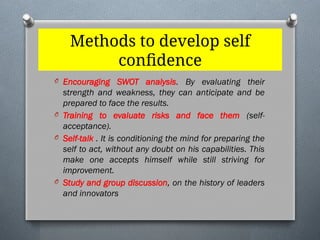
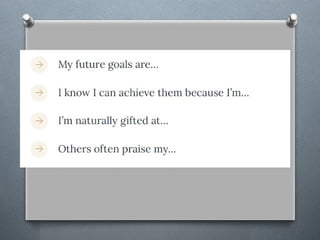
Methods to developself
confidence
O Encouraging SWOT analysis. By evaluating their
strength and weakness, they can anticipate and be
prepared to face the results.
O Training to evaluate risks and face them (self-
acceptance).
O Self-talk . It is conditioning the mind for preparing the
self to act, without any doubt on his capabilities. This
make one accepts himself while still striving for
improvement.
O Study and group discussion, on the history of leaders
and innovators
50.
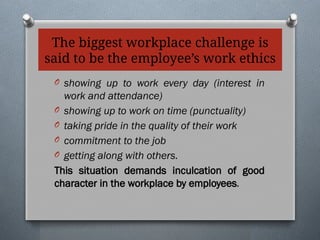
The biggest workplacechallenge is
said to be the employee’s work ethics
O showing up to work every day (interest in
work and attendance)
O showing up to work on time (punctuality)
O taking pride in the quality of their work
O commitment to the job
O getting along with others.
This situation demands inculcation of good
character in the workplace by employees.
51.
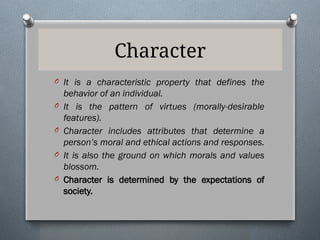
Character
O It isa characteristic property that defines the
behavior of an individual.
O It is the pattern of virtues (morally-desirable
features).
O Character includes attributes that determine a
person’s moral and ethical actions and responses.
O It is also the ground on which morals and values
blossom.
O Character is determined by the expectations of
society.
52.
Types of Character
OThe sensitive (humble, contemplative and
emotional,
O The active (great and the mediocre)
O The apathetic (purely apathetic or dull)
O The intelligent.
53.
Building Character inthe
Workplace
O Employee Hiring, Training, and Promotion
Activities
O Internal Communication
O External Communication
O Financial and Human Resources
O Community Outreach