The Economic Problem
CHAPTER
3
When you have completed your study of this
chapter, you will be able to
C H A P T E R C H E C K L I S T
Use the production possibilities frontier to illustrate the economic problem
and calculate opportunity cost.
1
Define efficiency and describe an efficient use of
resources.
Explain how technological change and increases in capital and human capital expand
production possibilities.
2
3
Explain how people gain from specialization and
trade.
4
PRODUCTION POSSIBILITIES
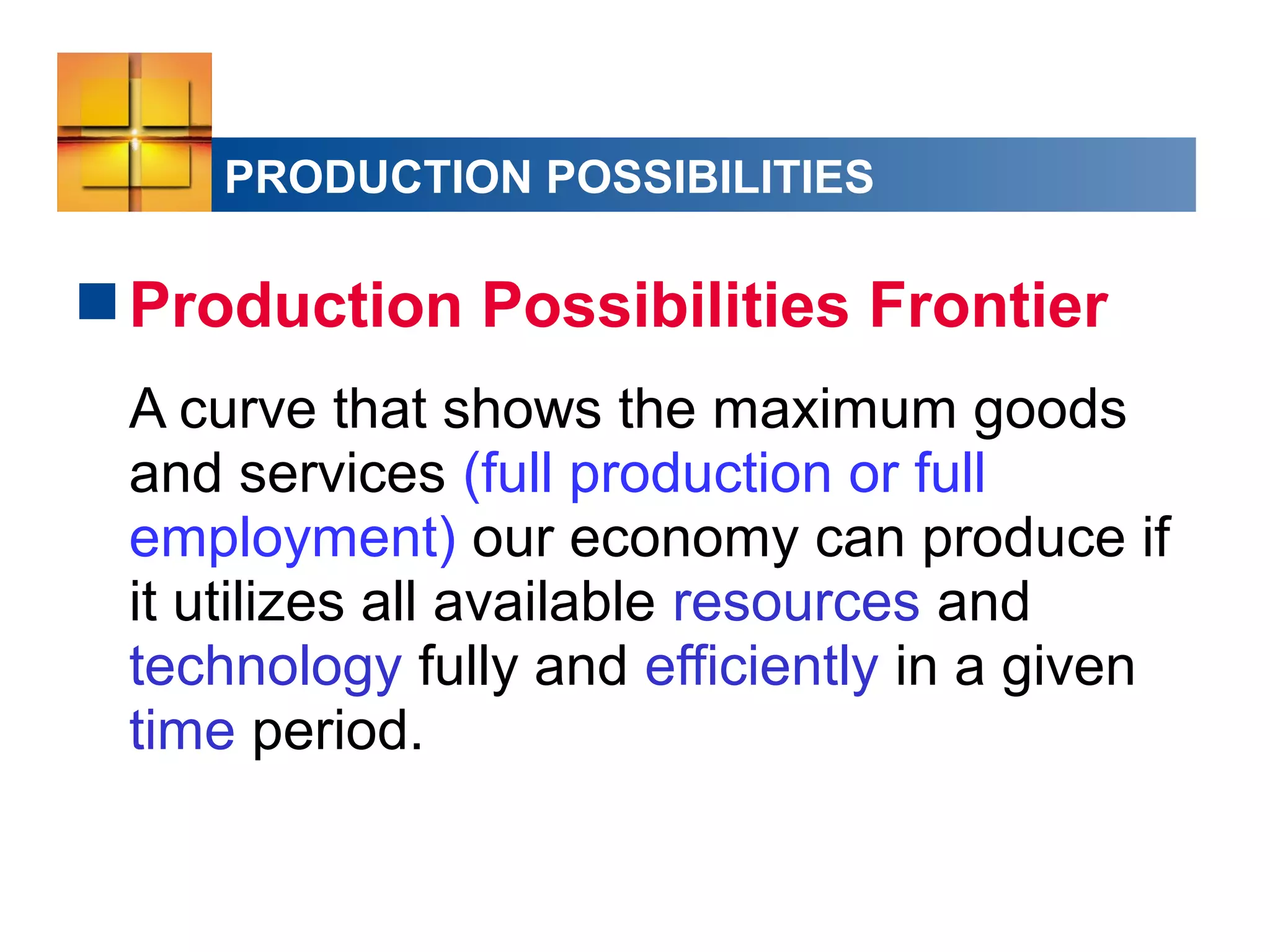
Production Possibilities Frontier
A curve that shows the maximum goods
and services (full production or full
employment) our economy can produce if
it utilizes all available resources and
technology fully and efficiently in a given
time period.
What are some of the assumptions
used to explain production PPC?
 Why make assumptions?
 Simplify complex situation
 Easy to understand by focusing on key
variables of interest while keeping all other
background variables constant. (Ceteris
Paribus)
1. Maximum goods and services that can be
produced
2. Two goods world.
3. Available resources are fixed and fully
employed.
 land, labor, capital, management
Technology, education, and training is fixed.
4. One time period model.
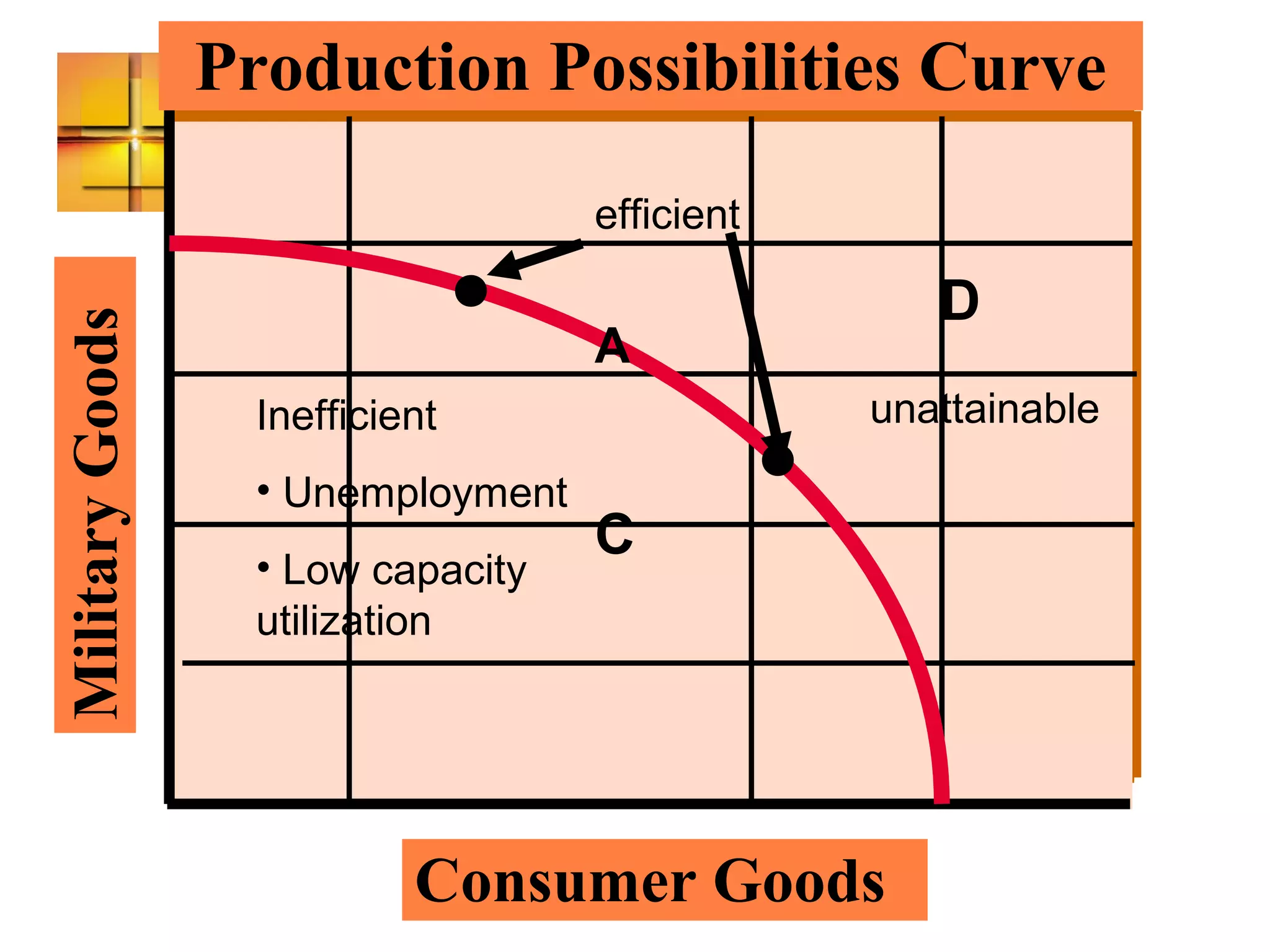
MilitaryGoods
Consumer Goods
Production Possibilities CurveMilitaryGoods
A
efficient
C
Inefficient
• Unemployment
• Low capacity
utilization
D
unattainable
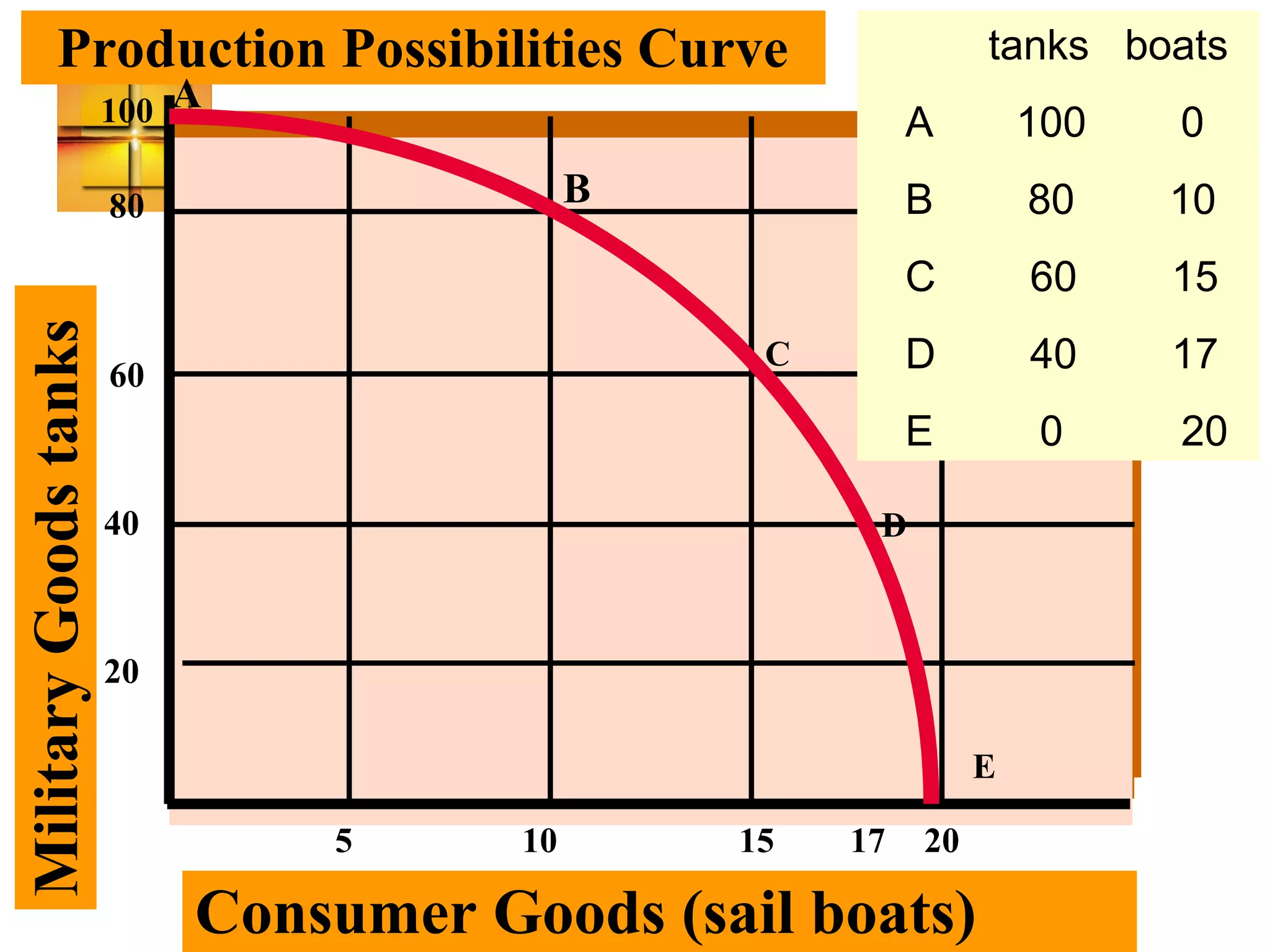
MilitaryGoodstanks
Consumer Goods (sail boats)
Production Possibilities Curve
20
40
60
80
100
5 10 15 20
A
B
C
E
D
17
tanks boats
A 100 0
B 80 10
C 60 15
D 40 17
E 0 20
MilitaryGoodstanks
Consumer Goods (sail boats)
Production Possibilities Curve
20
40
60
80
100
5 10 15 20
A
B
C
E
D
17
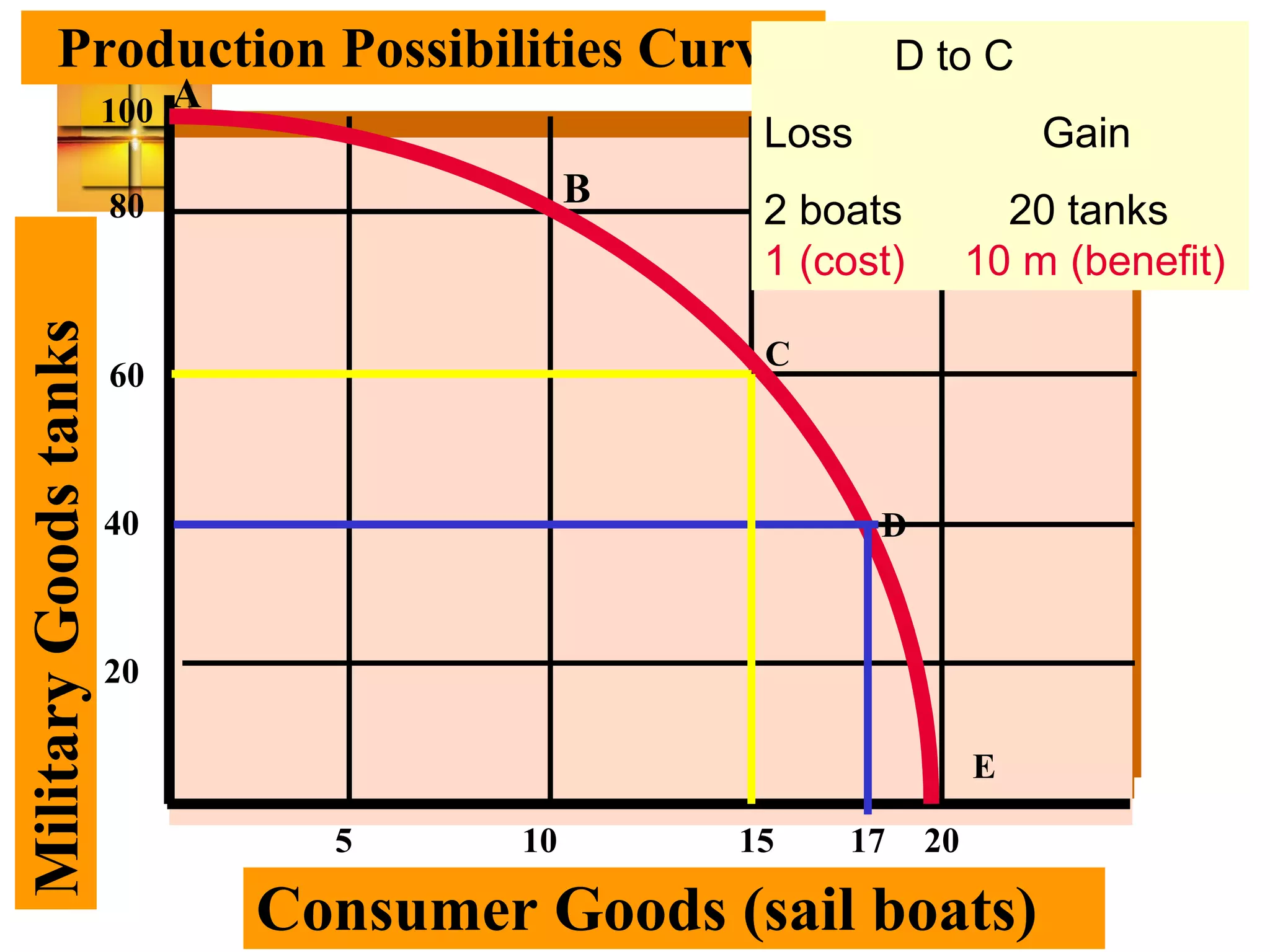
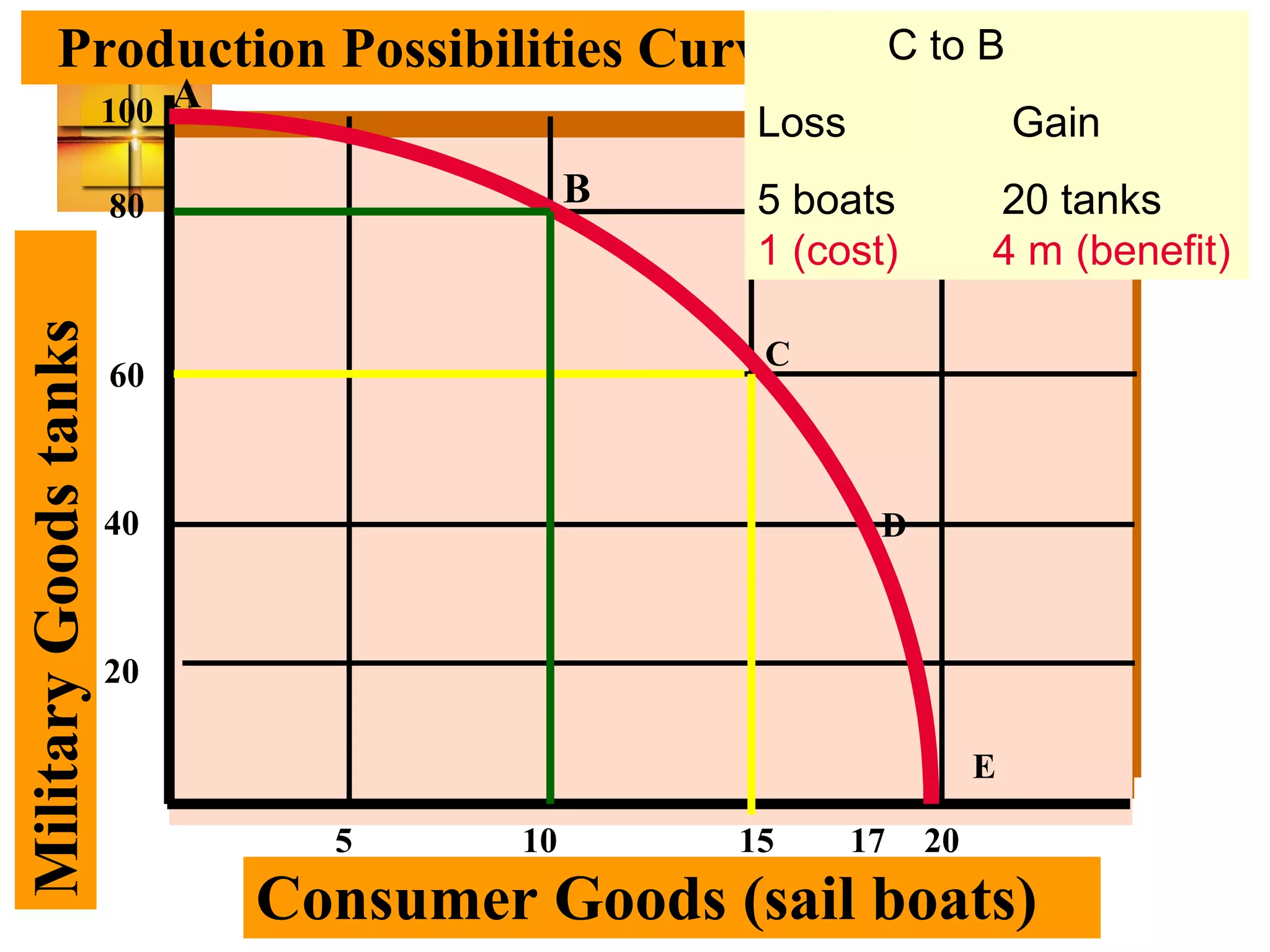
D to C
Loss Gain
2 boats 20 tanks
1 (cost) 10 m (benefit)
MilitaryGoodstanks
Consumer Goods (sail boats)
Production Possibilities Curve
20
40
60
80
100
5 10 15 20
A
B
C
E
D
17
C to B
Loss Gain
5 boats 20 tanks
1 (cost) 4 m (benefit)
MilitaryGoodstanks
Consumer Goods (sail boats)
Production Possibilities Curve
20
40
60
80
100
5 10 15 20
A
B
C
E
D
17
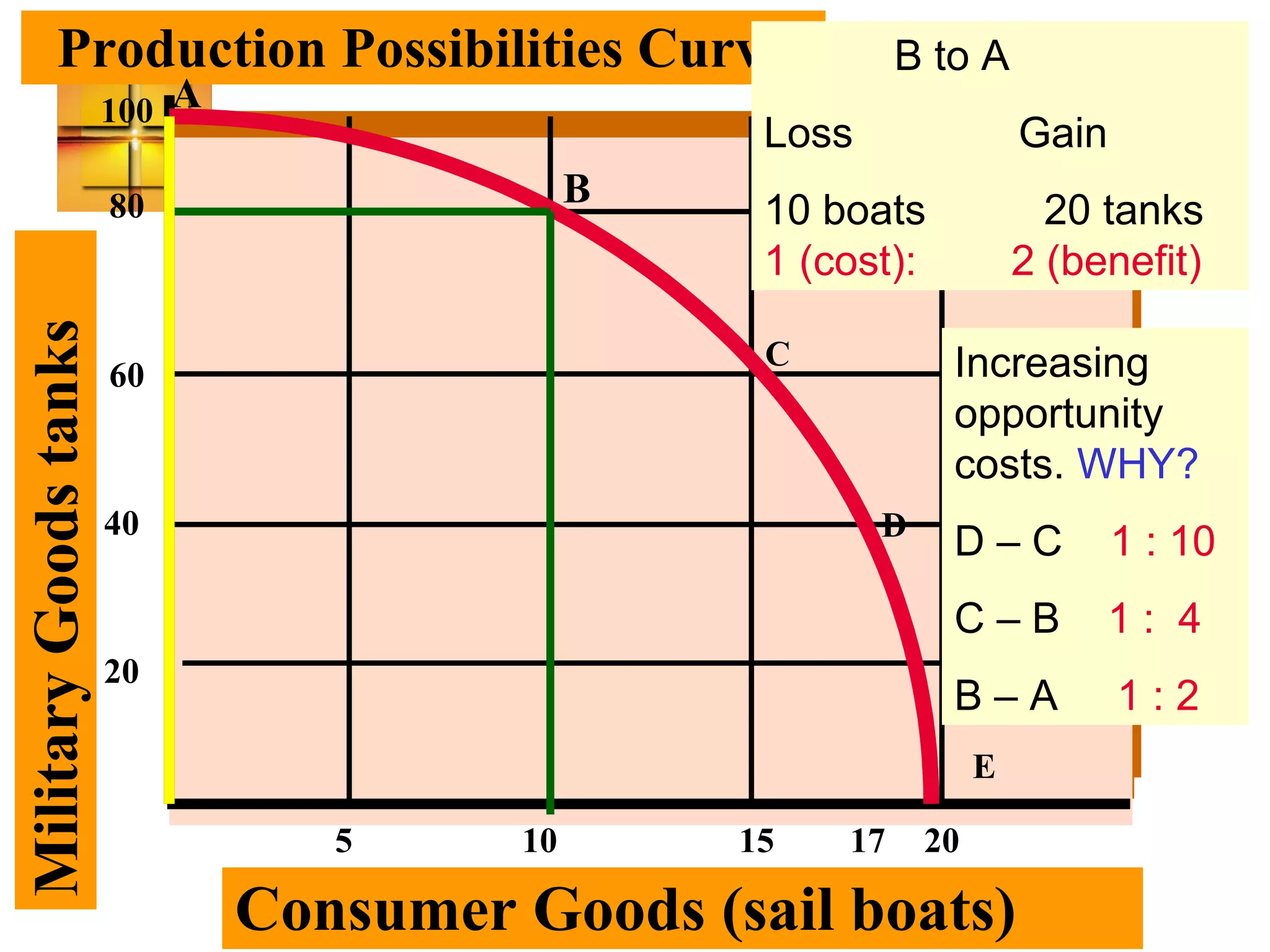
B to A
Loss Gain
10 boats 20 tanks
1 (cost): 2 (benefit)
Increasing
opportunity
costs. WHY?
D – C 1 : 10
C – B 1 : 4
B – A 1 : 2
INCREASING OPPORTUNITY COSTS
 As seen in the sail boats and tanks
example, as we attempted to produce
more tanks the opportunity costs
increased. Why?
 For every 1 additional tank we
produced we had to give up more and
more sail boats.
 Why is the Production Possibilities
Curve Bowed Outwards?
Why is the Production Possibilities
Curve Bowed Outwards?
Opportunity cost
you cannot produce more of both, if you try to produce more
of one you have to give up production of one.
Shows increasing opportunity cost
If you try to produce more of one good (Tanks) the opportunity
cost increases by you having to give up more of another
good (Sail boats)
Diminishing returns
Decreasing benefits
Factor Unsuitability
Resources are not equally efficient in producing both goods.
If the production possibility is in fact a straight line, then it
means that resources would be equally productive in both
gods.
USING RESOURCES EFFICIENTLY
Production efficiency
A situation in which we cannot produce
more of one good or service without
producing less of something else.
(Producing on the PPC).
Allocative efficiency
A situation in which the quantities of goods
and services produced are those that
people value most highly.
Two Conditions for Allocative Efficiency
• Production efficiency—producing on
PPF
• Producing at the highest-valued point
OPPORTUNITY COST
Marginal Benefit
The benefit that a person receives from consuming
one more unit of a good or service.
Marginal benefit decreases as more bottled water is
available.
Marginal Cost
The opportunity cost of producing one more unit of
a good or service.
The marginal cost of producing a good increases as
more of the good is produced.
Discussion questions
• Efficiency in the U.S. Economy
• Does our economy achieve an efficient use of
resources? If yes, why? If not, how could we improve
resource utilization?
• Do we have an efficient energy policy, or would a
policy that favors clean-energy technologies be more
efficient?
• Do we have an efficient method of urban
transportation, or would more mass transit systems
be more efficient?
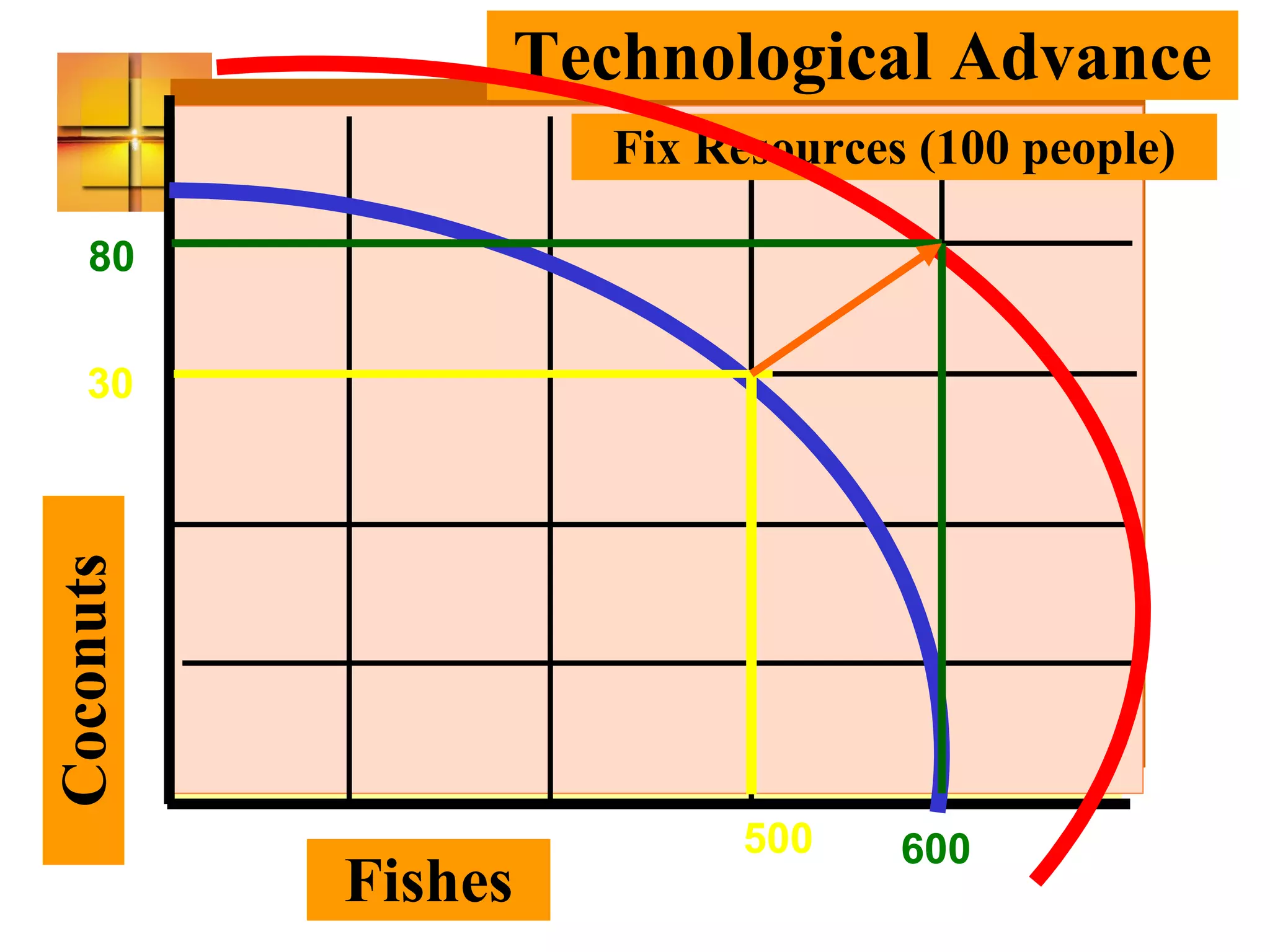
What is Economic Growth?
The ability of an economy to
produce greater levels of
output, represented by an
outward shift of its
production possibilities
curve
Coconuts
Fishes
Technological Advance
80
500 600
30
Fix Resources (100 people)
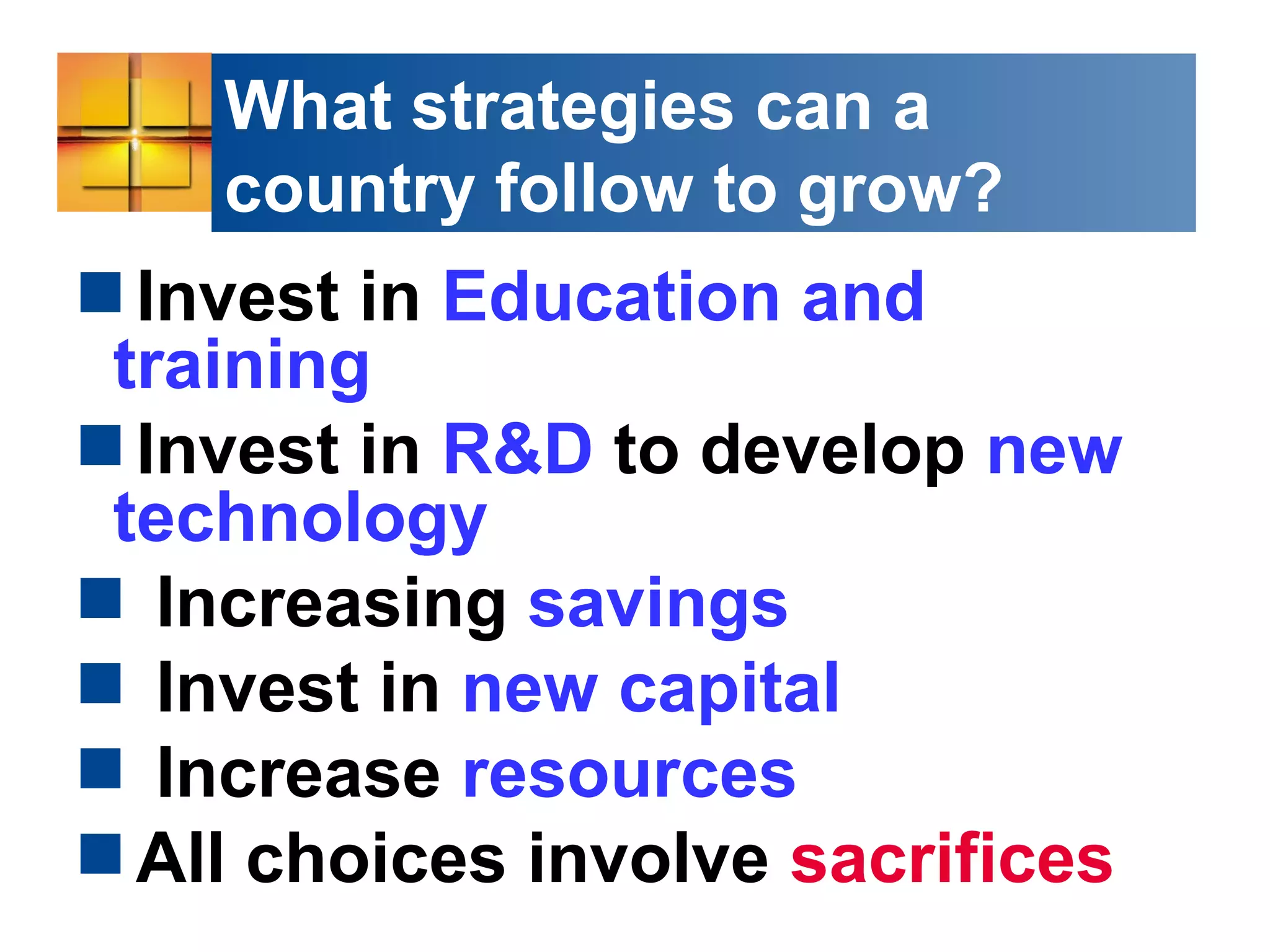
What strategies can a
country follow to grow?
Invest in Education and
training
Invest in R&D to develop new
technology
 Increasing savings
 Invest in new capital
 Increase resources
All choices involve sacrifices
GAINS FROM SPECIALIZATION AND
EXCHANGE
Comparative Advantage
The ability of a person to
perform an activity or produce
a good or service at a lower
opportunity cost than someone
else.
SPECIALIZATION AND TRADE
Absolute Advantage
Absolute advantage
When one person is more productive
than another person in several or
even all activities.
GAINS FROM SPECIALIZATION AND
TRADE
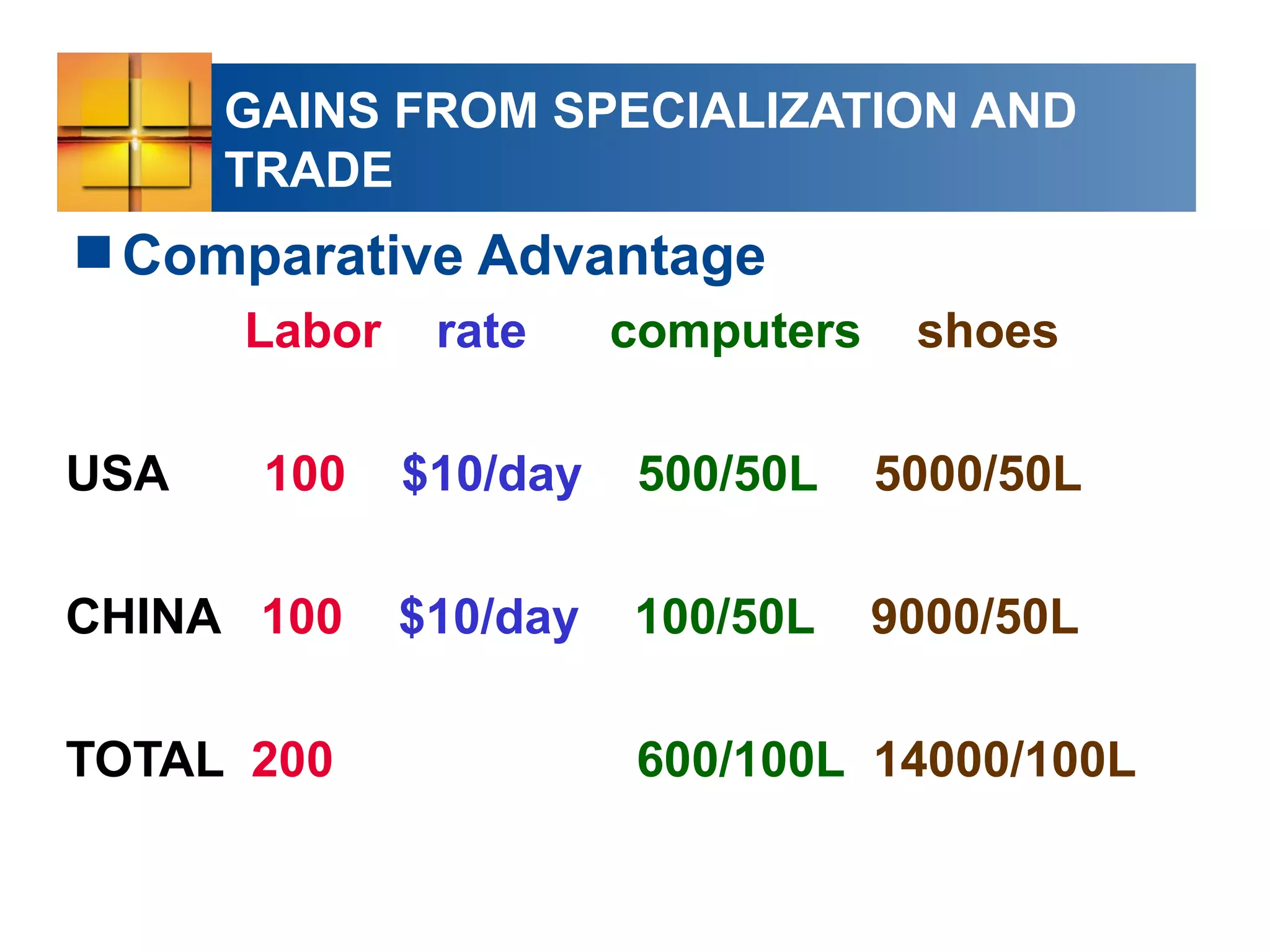
Comparative Advantage
Labor rate computers shoes
USA 100 $10/day 500/50L 5000/50L
CHINA 100 $10/day 100/50L 9000/50L
TOTAL 200 600/100L 14000/100L
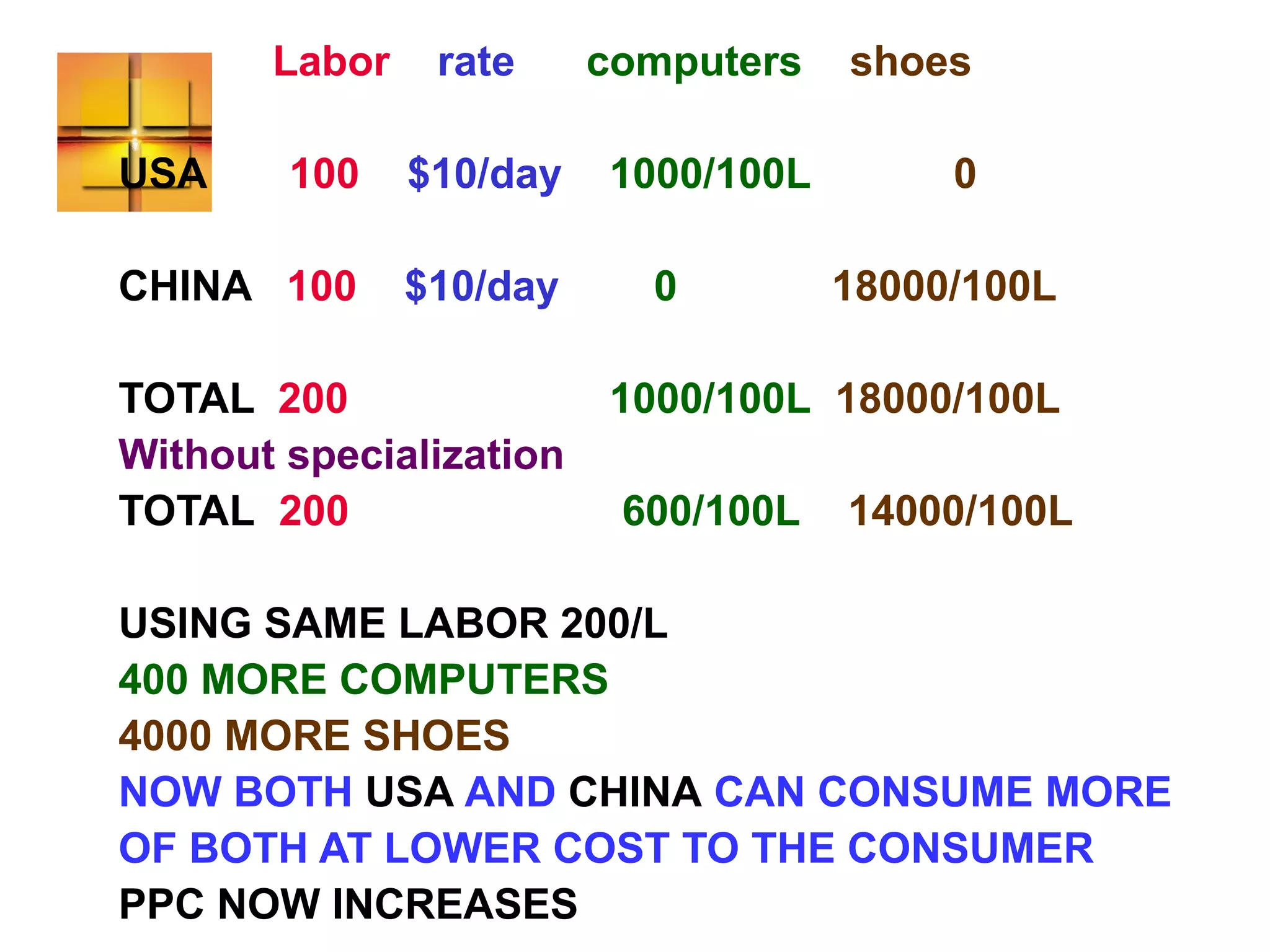
Labor rate computers shoes
USA 100 $10/day 1000/100L 0
CHINA 100 $10/day 0 18000/100L
TOTAL 200 1000/100L 18000/100L
Without specialization
TOTAL 200 600/100L 14000/100L
USING SAME LABOR 200/L
400 MORE COMPUTERS
4000 MORE SHOES
NOW BOTH USA AND CHINA CAN CONSUME MORE
OF BOTH AT LOWER COST TO THE CONSUMER
PPC NOW INCREASES
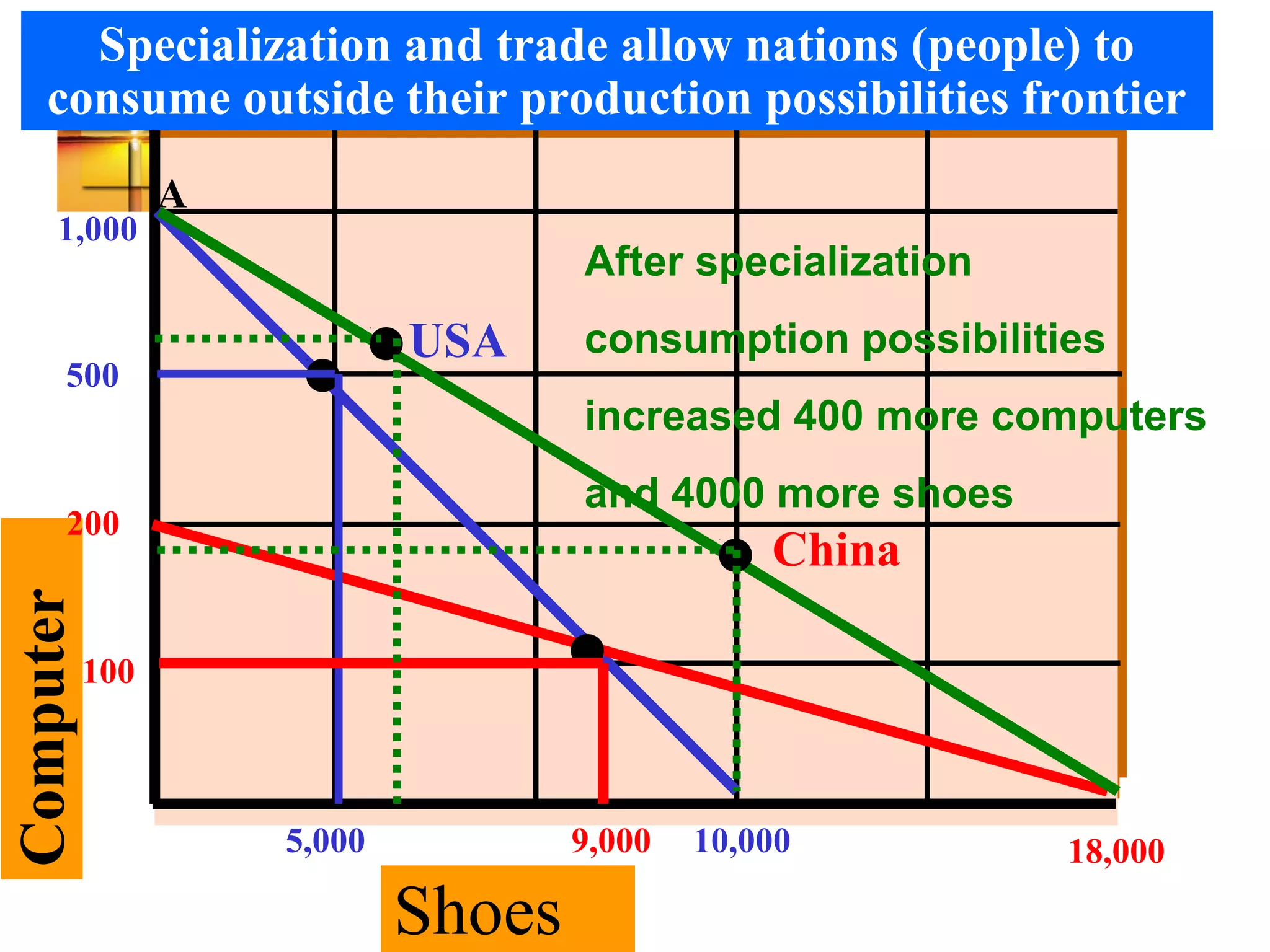
Computer
Shoes
Specialization and trade allow nations (people) to
consume outside their production possibilities frontier
200
10,000
A
After specialization
consumption possibilities
increased 400 more computers
and 4000 more shoes
18,0005,000 9,000
100
USA
China
1,000
500
Video questions for Chapter 3: The Economic Problem
Video: "Resources and Scarcity"
You can view this video online on your computer and/or
view it in the library. (No 1 online)
Q1: Explain the principle of opportunity costs using the
example of Alaska mineral development. Which one
would you choose mineral development or wilderness,
and Why? (10 points/YES, you need a graph and two
detailed paragraphs for this question)
Q2: In the class we discussed in detail how limits exists
in economics, using the example from the video
presentation, explain how were we able to produce more
of both, guns and butter during the Second World War.
(10 points/YES, you need a graph and two detailed
paragraphs for this question)
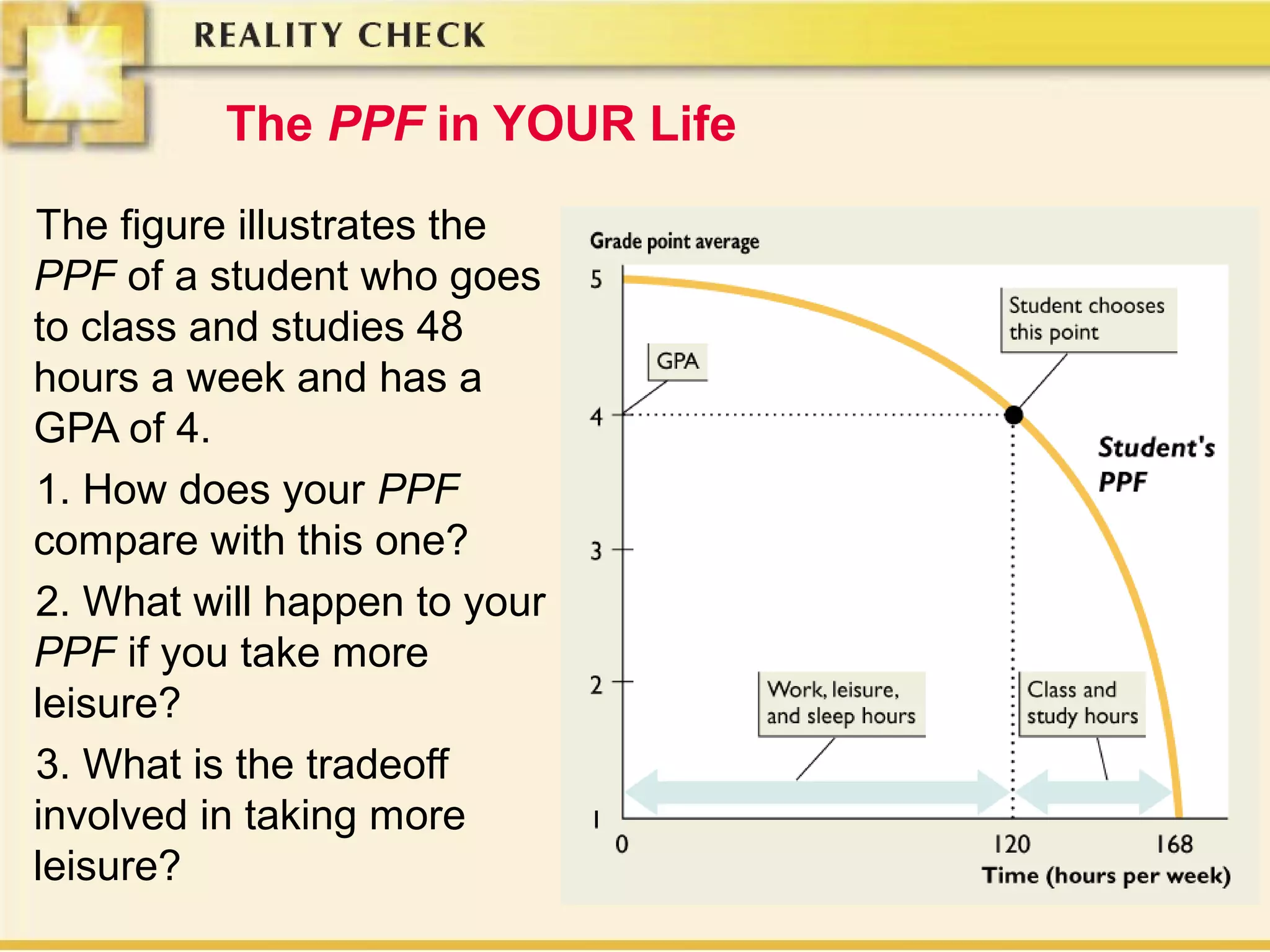
The PPF in YOUR Life
The figure illustrates the
PPF of a student who goes
to class and studies 48
hours a week and has a
GPA of 4.
1. How does your PPF
compare with this one?
2. What will happen to your
PPF if you take more
leisure?
3. What is the tradeoff
involved in taking more
leisure?
Discussion questions
What you have learned in this chapter has huge
implications for the way you organize your life and for the
position you take on the political hot potato of outsourcing.
1.By accumulating human capital, your production
possibilities will expand.
2.By discovering your comparative advantage and
focusing on producing the items that you are relatively
better at, you will make yourself as well off as possible.
3.Regardless of whether outsourcing is across the United
States or around the globe, all parties that produce more
of the good in which they have a comparative advantage
and trade gain.
Revisiting SCARCITY
Do we always face scarcity?
Unlimited wants and desires and limited
resources
It forces us to make choices (Rational
choices)
All choices involves making sacrifices.
We have to give up the next best alternative
when we make a choice
There are no free lunches in economics.
What is Opportunity cost?
The next best
alternative sacrificed
when a decision is
made
What is the opportunity Cost of
attending this class?
Ask yourself, if you did not attend this
class, what is the next best activity you
would have done?
 It is the individual who decides what he or
she is giving (the next best alternative) up
to attend this class.
Spending time with your family and friends
Earning $/hour
Watching TV
 Can Opportunity Cost be something other
than money?
Revisiting rational choice and inventives
Rational Choice and Incentives
A rational choice is one that uses the
available resources to most effectively
satisfy the wants of the person making
the choice.
You make a decision that does not make
you worse off
Cost: What You Must Give Up
Opportunity cost
The highest-valued alternative forgone.

production_possibility_curve

  • 2.
  • 3.
    When you havecompleted your study of this chapter, you will be able to C H A P T E R C H E C K L I S T Use the production possibilities frontier to illustrate the economic problem and calculate opportunity cost. 1 Define efficiency and describe an efficient use of resources. Explain how technological change and increases in capital and human capital expand production possibilities. 2 3 Explain how people gain from specialization and trade. 4
  • 4.
    PRODUCTION POSSIBILITIES Production PossibilitiesFrontier A curve that shows the maximum goods and services (full production or full employment) our economy can produce if it utilizes all available resources and technology fully and efficiently in a given time period.
  • 5.
    What are someof the assumptions used to explain production PPC?  Why make assumptions?  Simplify complex situation  Easy to understand by focusing on key variables of interest while keeping all other background variables constant. (Ceteris Paribus) 1. Maximum goods and services that can be produced 2. Two goods world. 3. Available resources are fixed and fully employed.  land, labor, capital, management Technology, education, and training is fixed. 4. One time period model.
  • 6.
    MilitaryGoods Consumer Goods Production PossibilitiesCurveMilitaryGoods A efficient C Inefficient • Unemployment • Low capacity utilization D unattainable
  • 7.
    MilitaryGoodstanks Consumer Goods (sailboats) Production Possibilities Curve 20 40 60 80 100 5 10 15 20 A B C E D 17 tanks boats A 100 0 B 80 10 C 60 15 D 40 17 E 0 20
  • 8.
    MilitaryGoodstanks Consumer Goods (sailboats) Production Possibilities Curve 20 40 60 80 100 5 10 15 20 A B C E D 17 D to C Loss Gain 2 boats 20 tanks 1 (cost) 10 m (benefit)
  • 9.
    MilitaryGoodstanks Consumer Goods (sailboats) Production Possibilities Curve 20 40 60 80 100 5 10 15 20 A B C E D 17 C to B Loss Gain 5 boats 20 tanks 1 (cost) 4 m (benefit)
  • 10.
    MilitaryGoodstanks Consumer Goods (sailboats) Production Possibilities Curve 20 40 60 80 100 5 10 15 20 A B C E D 17 B to A Loss Gain 10 boats 20 tanks 1 (cost): 2 (benefit) Increasing opportunity costs. WHY? D – C 1 : 10 C – B 1 : 4 B – A 1 : 2
  • 11.
    INCREASING OPPORTUNITY COSTS As seen in the sail boats and tanks example, as we attempted to produce more tanks the opportunity costs increased. Why?  For every 1 additional tank we produced we had to give up more and more sail boats.  Why is the Production Possibilities Curve Bowed Outwards?
  • 12.
    Why is theProduction Possibilities Curve Bowed Outwards? Opportunity cost you cannot produce more of both, if you try to produce more of one you have to give up production of one. Shows increasing opportunity cost If you try to produce more of one good (Tanks) the opportunity cost increases by you having to give up more of another good (Sail boats) Diminishing returns Decreasing benefits Factor Unsuitability Resources are not equally efficient in producing both goods. If the production possibility is in fact a straight line, then it means that resources would be equally productive in both gods.
  • 13.
    USING RESOURCES EFFICIENTLY Productionefficiency A situation in which we cannot produce more of one good or service without producing less of something else. (Producing on the PPC). Allocative efficiency A situation in which the quantities of goods and services produced are those that people value most highly. Two Conditions for Allocative Efficiency • Production efficiency—producing on PPF • Producing at the highest-valued point
  • 14.
    OPPORTUNITY COST Marginal Benefit Thebenefit that a person receives from consuming one more unit of a good or service. Marginal benefit decreases as more bottled water is available. Marginal Cost The opportunity cost of producing one more unit of a good or service. The marginal cost of producing a good increases as more of the good is produced.
  • 15.
    Discussion questions • Efficiencyin the U.S. Economy • Does our economy achieve an efficient use of resources? If yes, why? If not, how could we improve resource utilization? • Do we have an efficient energy policy, or would a policy that favors clean-energy technologies be more efficient? • Do we have an efficient method of urban transportation, or would more mass transit systems be more efficient?
  • 16.
    What is EconomicGrowth? The ability of an economy to produce greater levels of output, represented by an outward shift of its production possibilities curve
  • 17.
  • 18.
    What strategies cana country follow to grow? Invest in Education and training Invest in R&D to develop new technology  Increasing savings  Invest in new capital  Increase resources All choices involve sacrifices
  • 19.
    GAINS FROM SPECIALIZATIONAND EXCHANGE Comparative Advantage The ability of a person to perform an activity or produce a good or service at a lower opportunity cost than someone else.
  • 20.
    SPECIALIZATION AND TRADE AbsoluteAdvantage Absolute advantage When one person is more productive than another person in several or even all activities.
  • 21.
    GAINS FROM SPECIALIZATIONAND TRADE Comparative Advantage Labor rate computers shoes USA 100 $10/day 500/50L 5000/50L CHINA 100 $10/day 100/50L 9000/50L TOTAL 200 600/100L 14000/100L
  • 22.
    Labor rate computersshoes USA 100 $10/day 1000/100L 0 CHINA 100 $10/day 0 18000/100L TOTAL 200 1000/100L 18000/100L Without specialization TOTAL 200 600/100L 14000/100L USING SAME LABOR 200/L 400 MORE COMPUTERS 4000 MORE SHOES NOW BOTH USA AND CHINA CAN CONSUME MORE OF BOTH AT LOWER COST TO THE CONSUMER PPC NOW INCREASES
  • 23.
    Computer Shoes Specialization and tradeallow nations (people) to consume outside their production possibilities frontier 200 10,000 A After specialization consumption possibilities increased 400 more computers and 4000 more shoes 18,0005,000 9,000 100 USA China 1,000 500
  • 24.
    Video questions forChapter 3: The Economic Problem Video: "Resources and Scarcity" You can view this video online on your computer and/or view it in the library. (No 1 online) Q1: Explain the principle of opportunity costs using the example of Alaska mineral development. Which one would you choose mineral development or wilderness, and Why? (10 points/YES, you need a graph and two detailed paragraphs for this question) Q2: In the class we discussed in detail how limits exists in economics, using the example from the video presentation, explain how were we able to produce more of both, guns and butter during the Second World War. (10 points/YES, you need a graph and two detailed paragraphs for this question)
  • 25.
    The PPF inYOUR Life The figure illustrates the PPF of a student who goes to class and studies 48 hours a week and has a GPA of 4. 1. How does your PPF compare with this one? 2. What will happen to your PPF if you take more leisure? 3. What is the tradeoff involved in taking more leisure?
  • 26.
    Discussion questions What youhave learned in this chapter has huge implications for the way you organize your life and for the position you take on the political hot potato of outsourcing. 1.By accumulating human capital, your production possibilities will expand. 2.By discovering your comparative advantage and focusing on producing the items that you are relatively better at, you will make yourself as well off as possible. 3.Regardless of whether outsourcing is across the United States or around the globe, all parties that produce more of the good in which they have a comparative advantage and trade gain.
  • 27.
    Revisiting SCARCITY Do wealways face scarcity? Unlimited wants and desires and limited resources It forces us to make choices (Rational choices) All choices involves making sacrifices. We have to give up the next best alternative when we make a choice There are no free lunches in economics.
  • 28.
    What is Opportunitycost? The next best alternative sacrificed when a decision is made
  • 29.
    What is theopportunity Cost of attending this class? Ask yourself, if you did not attend this class, what is the next best activity you would have done?  It is the individual who decides what he or she is giving (the next best alternative) up to attend this class. Spending time with your family and friends Earning $/hour Watching TV  Can Opportunity Cost be something other than money?
  • 30.
    Revisiting rational choiceand inventives Rational Choice and Incentives A rational choice is one that uses the available resources to most effectively satisfy the wants of the person making the choice. You make a decision that does not make you worse off Cost: What You Must Give Up Opportunity cost The highest-valued alternative forgone.

Editor's Notes

  • #2 Notes appear on slides 5, 6, 17, and 59