Chapter 1
Section 1
How would you define the study Economics?
What factors influence the choices you make?
What does it mean when something is scarce?
How does scarcity force people to make
economic choices?
Scarcity forces all of us to make choices by making
us decide which options are most important to us.
The principle of scarcity states that there are limited
goods and services for unlimited wants. Thus,
people need to make choices in order to satisfy the
wants that are most important to them.
People satisfy their needs and wants with goods
and services.
People’s needs and wants are unlimited, yet goods
and services are limited.
Economics begins with the idea that people cannot
have everything they need and want.
The fact that limited amounts of goods and services
are available to meet unlimited wants is called
scarcity.
Scarcity forces people to make choices but it is not
the same as a shortage.
Shortages are temporary while scarcity always exists.
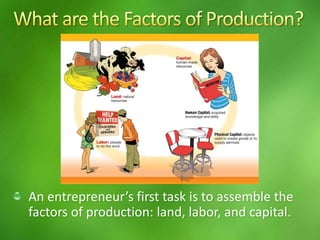
An entrepreneur’s first task is to assemble the
factors of production: land, labor, and capital.
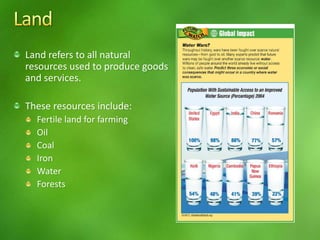
Land refers to all natural
resources used to produce goods
and services.
These resources include:
Fertile land for farming
Oil
Coal
Iron
Water
Forests
Labor is the effort people devote to tasks for
which they are paid.
Labor includes:
The medical care provided by a doctor
The classroom instruction provided by a teacher
The tightening of a bolt by an assembly-line worker
The creation of a painting by an artist
The repair of a television by a technician
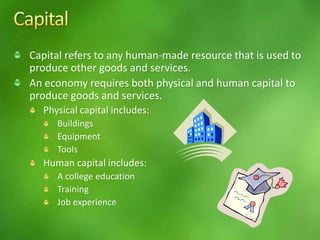
Capital refers to any human-made resource that is used to
produce other goods and services.
An economy requires both physical and human capital to
produce goods and services.
Physical capital includes:
Buildings
Equipment
Tools
Human capital includes:
A college education
Training
Job experience
Section 2
How does opportunity cost affect decision
making?
Every time we choose to do something, like sleep in
late, we are given up the opportunity to do
something less, like study an extra hour for a big
test.
When we make decisions about how to spend our
scarce resources, like money or time, we are giving
up the chance to spend that money or time on
something else.
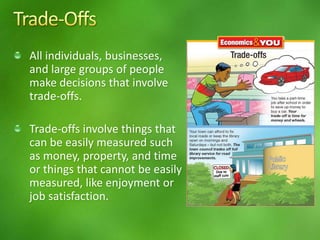
All individuals, businesses,
and large groups of people
make decisions that involve
trade-offs.
Trade-offs involve things that
can be easily measured such
as money, property, and time
or things that cannot be easily
measured, like enjoyment or
job satisfaction.
In most trade-offs, one of the rejected
alternatives is more desirable than the rest.
The most desirable alternative somebody gives
up as a result of a decision is the opportunity
cost.
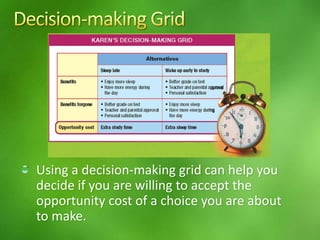
Using a decision-making grid can help you
decide if you are willing to accept the
opportunity cost of a choice you are about
to make.
When you decide how much more or less to do,
you are thinking on the margin.
Deciding by thinking on the margin involves
comparing the opportunity costs and benefits.
This decision-making process is called a cost/benefit
analysis.
To make good decisions on the margin, you
must weigh marginal costs against marginal
benefits.
The marginal cost is the extra cost of adding one
unit such as sleeping an extra hour or building one
extra house.
The marginal benefit is the extra benefit of adding
the same unit.
Once the marginal costs outweigh the marginal
benefit, no more units can be added.
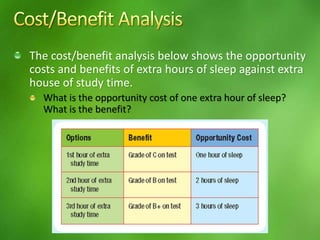
The cost/benefit analysis below shows the opportunity
costs and benefits of extra hours of sleep against extra
house of study time.
What is the opportunity cost of one extra hour of sleep?
What is the benefit?
Like opportunity cost, thinking at the margin
applies not just to individuals, but to businesses
and governments as well.
Employers think at the margin when they decide
how many workers to hire.
Legislators think at the margin when they decide
how much to increase government spending on a
particular project.
Section 3
How does a nation decide what and how
to produce?
To decide what and how to produce, economists
use a tool known as a production possibilities curve.
This curve helps a nation’s economists determine the
alternative ways of using that nation’s resources.
Economists often use graphs to analyze the
choices and trade-offs that people make.
A production possibilities curve is a graph that
shows alternative ways to use an economy’s
productive resources.
To draw a production possibilities curve, an
economist begins by deciding which goods or
services to examine.
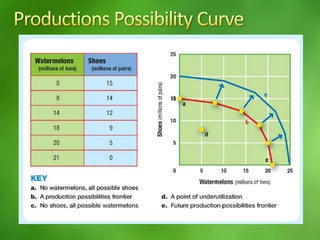
The line on a production possibilities curve that
shows the maximum possible output an
economy can produce is called the production
possibilities frontier.
Each point on the production possibilities frontier
reflects a trade-off. These trade-offs are necessary
because factors of production are scarce.
Using land, labor, and capital to make one product
means that fewer resources are left to make
something else.
A production possibilities frontier
represents an economy working at its
most efficient level.
Sometimes an economy works inefficiently
and it uses fewer resources than it is
capable of using. This is known as
underutilization.
A production possibilities curve can also
show growth.
When an economy grows, the curve shifts to
the right.
However, when an economy’s production
capacity decreases, the economy slows and
the curve shifts to the left.
Production possibilities curves can be
used to determine the opportunity costs
involved in make an economic decision.
Cost increases as production shifts from
making one item to another.
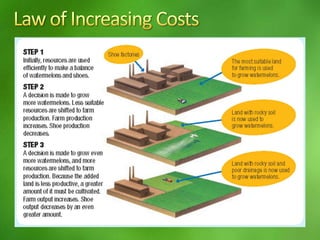
The law of increasing costs helps explain the
production possibilities curve.
As we move along the curve, we trade off more
and more for less and less output.
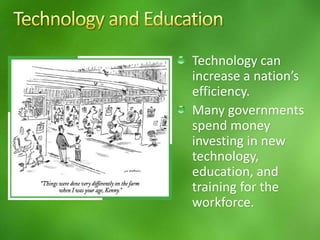
Technology can
increase a nation’s
efficiency.
Many governments
spend money
investing in new
technology,
education, and
training for the
workforce.

Economics: Chapter 1

  • 1.
  • 2.
  • 3.
    How would youdefine the study Economics? What factors influence the choices you make? What does it mean when something is scarce?
  • 4.
    How does scarcityforce people to make economic choices? Scarcity forces all of us to make choices by making us decide which options are most important to us. The principle of scarcity states that there are limited goods and services for unlimited wants. Thus, people need to make choices in order to satisfy the wants that are most important to them.
  • 5.
    People satisfy theirneeds and wants with goods and services. People’s needs and wants are unlimited, yet goods and services are limited. Economics begins with the idea that people cannot have everything they need and want. The fact that limited amounts of goods and services are available to meet unlimited wants is called scarcity. Scarcity forces people to make choices but it is not the same as a shortage. Shortages are temporary while scarcity always exists.
  • 6.
    An entrepreneur’s firsttask is to assemble the factors of production: land, labor, and capital.
  • 7.
    Land refers toall natural resources used to produce goods and services. These resources include: Fertile land for farming Oil Coal Iron Water Forests
  • 8.
    Labor is theeffort people devote to tasks for which they are paid. Labor includes: The medical care provided by a doctor The classroom instruction provided by a teacher The tightening of a bolt by an assembly-line worker The creation of a painting by an artist The repair of a television by a technician
  • 9.
    Capital refers toany human-made resource that is used to produce other goods and services. An economy requires both physical and human capital to produce goods and services. Physical capital includes: Buildings Equipment Tools Human capital includes: A college education Training Job experience
  • 10.
  • 11.
    How does opportunitycost affect decision making? Every time we choose to do something, like sleep in late, we are given up the opportunity to do something less, like study an extra hour for a big test. When we make decisions about how to spend our scarce resources, like money or time, we are giving up the chance to spend that money or time on something else.
  • 12.
    All individuals, businesses, andlarge groups of people make decisions that involve trade-offs. Trade-offs involve things that can be easily measured such as money, property, and time or things that cannot be easily measured, like enjoyment or job satisfaction.
  • 13.
    In most trade-offs,one of the rejected alternatives is more desirable than the rest. The most desirable alternative somebody gives up as a result of a decision is the opportunity cost.
  • 14.
    Using a decision-makinggrid can help you decide if you are willing to accept the opportunity cost of a choice you are about to make.
  • 15.
    When you decidehow much more or less to do, you are thinking on the margin. Deciding by thinking on the margin involves comparing the opportunity costs and benefits. This decision-making process is called a cost/benefit analysis.
  • 16.
    To make gooddecisions on the margin, you must weigh marginal costs against marginal benefits. The marginal cost is the extra cost of adding one unit such as sleeping an extra hour or building one extra house. The marginal benefit is the extra benefit of adding the same unit. Once the marginal costs outweigh the marginal benefit, no more units can be added.
  • 17.
    The cost/benefit analysisbelow shows the opportunity costs and benefits of extra hours of sleep against extra house of study time. What is the opportunity cost of one extra hour of sleep? What is the benefit?
  • 18.
    Like opportunity cost,thinking at the margin applies not just to individuals, but to businesses and governments as well. Employers think at the margin when they decide how many workers to hire. Legislators think at the margin when they decide how much to increase government spending on a particular project.
  • 19.
  • 20.
    How does anation decide what and how to produce? To decide what and how to produce, economists use a tool known as a production possibilities curve. This curve helps a nation’s economists determine the alternative ways of using that nation’s resources.
  • 21.
    Economists often usegraphs to analyze the choices and trade-offs that people make. A production possibilities curve is a graph that shows alternative ways to use an economy’s productive resources. To draw a production possibilities curve, an economist begins by deciding which goods or services to examine.
  • 23.
    The line ona production possibilities curve that shows the maximum possible output an economy can produce is called the production possibilities frontier. Each point on the production possibilities frontier reflects a trade-off. These trade-offs are necessary because factors of production are scarce. Using land, labor, and capital to make one product means that fewer resources are left to make something else.
  • 24.
    A production possibilitiesfrontier represents an economy working at its most efficient level. Sometimes an economy works inefficiently and it uses fewer resources than it is capable of using. This is known as underutilization.
  • 25.
    A production possibilitiescurve can also show growth. When an economy grows, the curve shifts to the right. However, when an economy’s production capacity decreases, the economy slows and the curve shifts to the left.
  • 26.
    Production possibilities curvescan be used to determine the opportunity costs involved in make an economic decision. Cost increases as production shifts from making one item to another. The law of increasing costs helps explain the production possibilities curve. As we move along the curve, we trade off more and more for less and less output.
  • 28.
    Technology can increase anation’s efficiency. Many governments spend money investing in new technology, education, and training for the workforce.