A Preliminary Introduction
 Economics is the science that deals with production,
exchange and consumption of various commodities in
economic systems.
 Two major factors are responsible for the emergence of
economic problems. They are:
1. The existence of unlimited human wants and
2. The scarcity of available resources
Economics
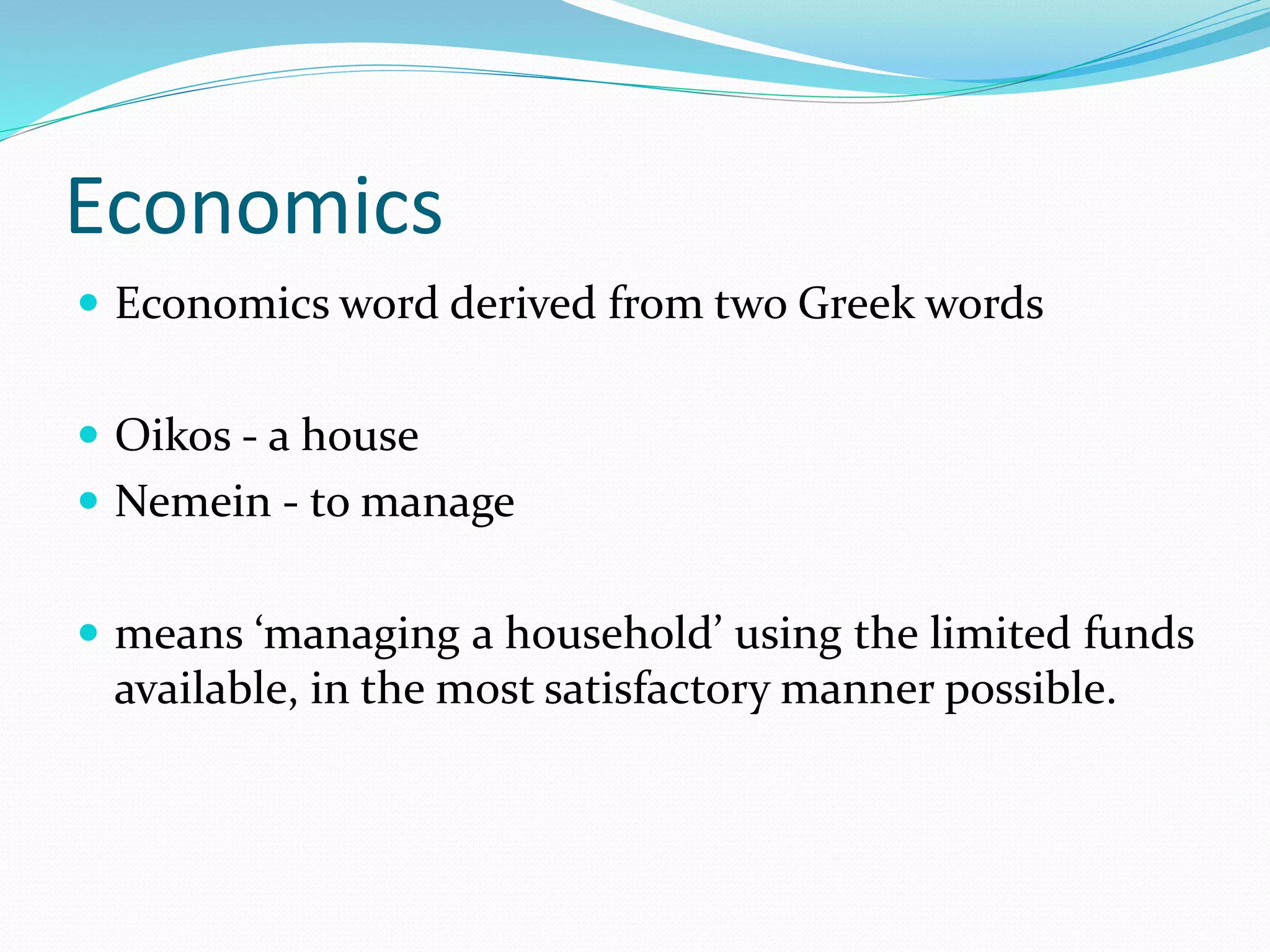
 Economics word derived from two Greek words
 Oikos - a house
 Nemein - to manage
 means ‘managing a household’ using the limited funds
available, in the most satisfactory manner possible.
Economics Definitions
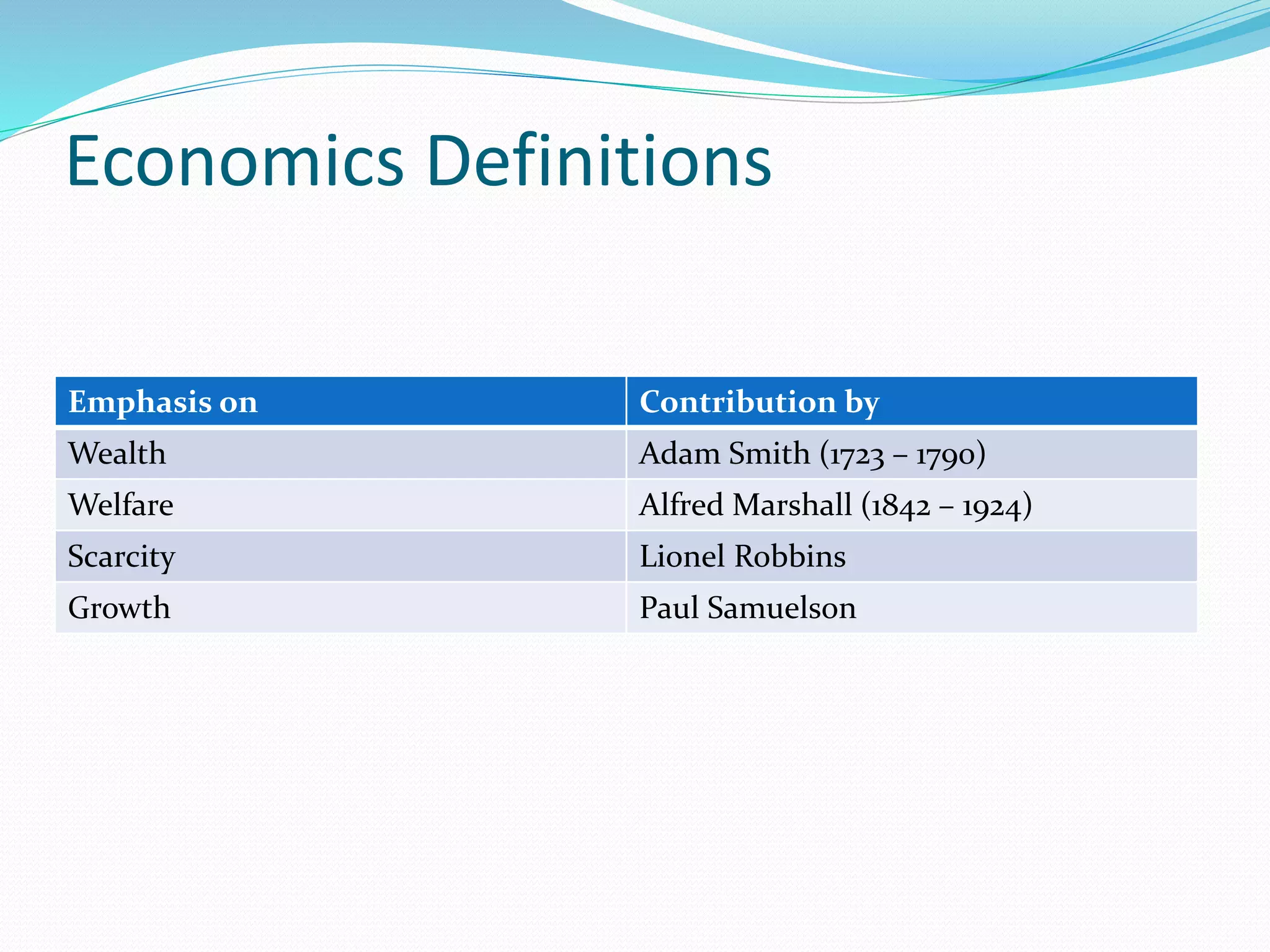
Emphasis on Contribution by
Wealth Adam Smith (1723 – 1790)
Welfare Alfred Marshall (1842 – 1924)
Scarcity Lionel Robbins
Growth Paul Samuelson
Wealth Definition
 Adam smith (1723 – 1790)
 His book “An Inquiry into Nature and Causes of
Wealth of Nations” (1776) defined economics as the
science of wealth.
 He explained how a nation’s wealth is created. He
considered that the individual in the society wants to
promote only his own gain and in this, he is led by an
“invisible hand” to promote the interests of the society
though he has no real intention to promote the
society’s interests.
Wealth Definition – Criticism
 Smith defined economics only in terms of wealth and not
in terms of human welfare.
 Ruskin and Carlyle condemned economics as a ‘dismal
science’, as it taught selfishness which was against ethics.
 However, now, wealth is considered only to be a mean to
end, the end being the human welfare.
 Hence, wealth definition was rejected and the emphasis
was shifted from ‘wealth’ to ‘welfare’.
Welfare Definition…
 Alfred Marshall (1842 - 1924) wrote a book “Principles
of Economics” (1890) in which he defined “Political
Economy” or Economics is a study of mankind in the
ordinary business of life.
 It examines that part of individual and social action
which is most closely connected with the attainment
and with the use of the material requisites of well
being.
Welfare Definition
 The important features of Marshall’s definition are as follows:
a) Economics is a study of mankind in the ordinary business of
life, i.e., economic aspect of human life.
b) Economics studies both individual and social actions aimed at
promoting economic welfare of people.
c) Marshall makes a distinction between two types of things, viz.
material things and immaterial things. Material things are those
that can be seen, felt and touched, (E.g.) book, rice etc.
Immaterial things are those that cannot be seen, felt and
touched.
 In his definition, Marshall considered only the material things
that are capable of promoting welfare of people.
Welfare Definition – Criticism
a) Considered only material things. But immaterial
things, such as the services of a doctor, a teacher and
so on, also promote welfare of the people.
b) Marshall makes a distinction between (i) those things
that are capable of promoting welfare of people and
(ii) those things that are not capable of promoting
welfare of people. But anything, (E.g.) liquor, that is
not capable of promoting welfare but commands a
price, comes under the purview of economics.
c) Marshall’s definition is based on the concept of
welfare. But there is no clear-cut definition of welfare.
Welfare Definition….
 Lionel Robbins published a book “An Essay on the
Nature and Significance of Economic Science” in 1932.
 According to him, “economics is a science which
studies human behaviour as a relationship between
ends and scarce means which have alternative uses”.
…Welfare Definition
 The major features of Robbins’ definition are as follows:
a) Ends refer to human wants. Human beings have unlimited
number of wants.
b) Resources or means, on the other hand, are limited or scarce in
supply. There is scarcity of a commodity, if its demand is greater
than its supply.
c) The scarce means are capable of having alternative uses. Hence,
anyone will choose the resource that will satisfy his particular
want.
 Thus, economics, according to Robbins, is a science of choice.
Welfare Definition – Criticism
a) Robbins does not make any distinction between goods
conducive to human welfare and goods that are not
conducive to human welfare.
b) In economics, we not only study the micro economic
aspects like how resources are allocated and how price is
determined, but we also study the macroeconomic aspect
like how national income is generated. But, Robbins has
reduced economics merely to theory of resource allocation.
c) Robbins definition does not cover the theory of economic
growth and development.
Growth Definition…
 Prof. Paul Samuelson defined economics as “the study
of how men and society choose, with or without the
use of money, to employ scarce productive resources
which could have alternative uses, to produce various
commodities over time, and distribute them for
consumption, now and in the future among various
people and groups of society”.
…Growth Definition
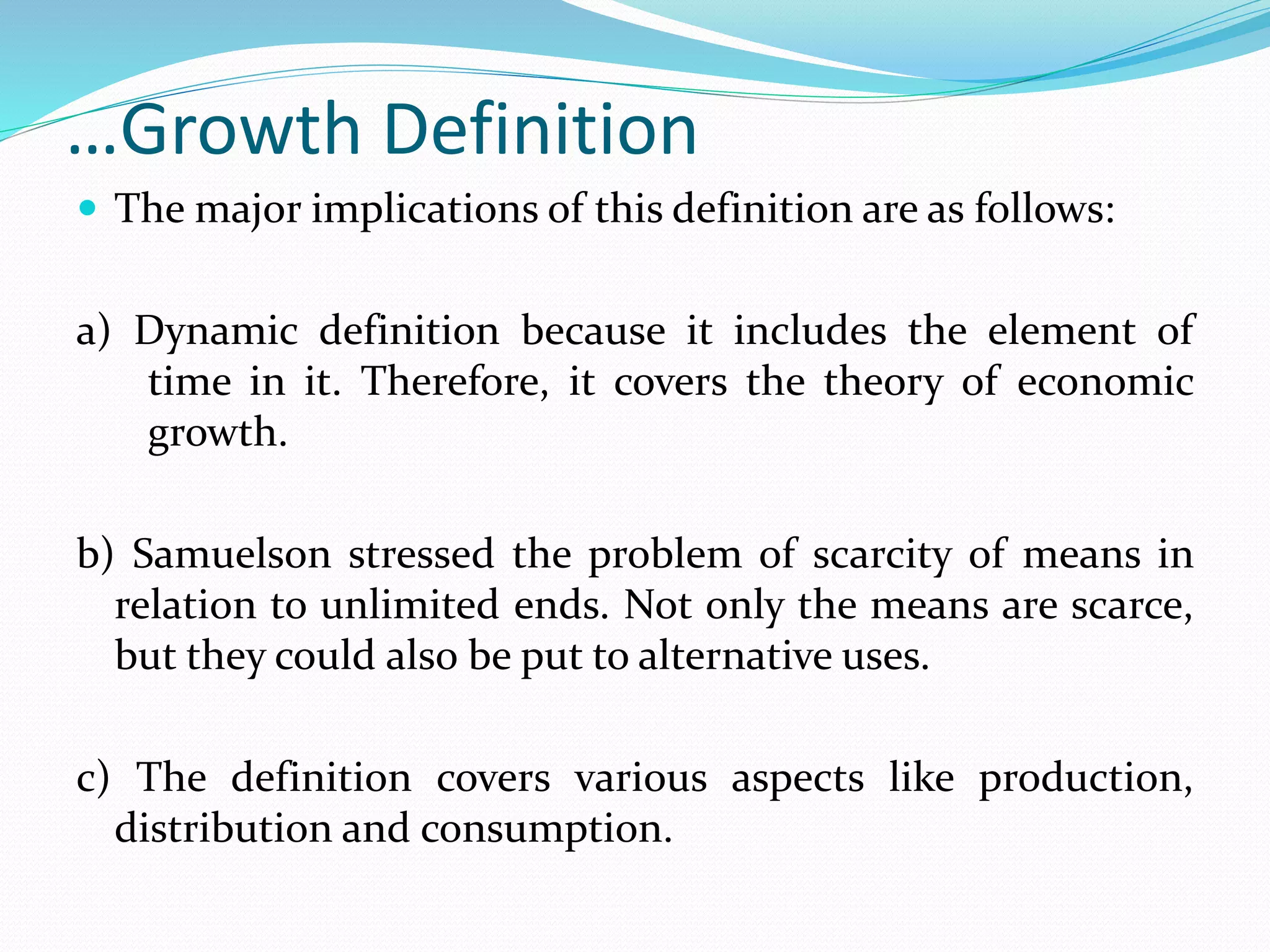
 The major implications of this definition are as follows:
a) Dynamic definition because it includes the element of
time in it. Therefore, it covers the theory of economic
growth.
b) Samuelson stressed the problem of scarcity of means in
relation to unlimited ends. Not only the means are scarce,
but they could also be put to alternative uses.
c) The definition covers various aspects like production,
distribution and consumption.
Economics Definitions
 Of all the definitions discussed above, the ‘growth’
definition stated by Samuelson appears to be the most
satisfactory. However, in modern economics, the
subject matter of economics is divided into main parts,
viz., i) Micro Economics and ii) Macro Economics.
 Economics is, therefore, rightly considered as the
study of allocation of scarce resources (in relation to
unlimited ends) and of determinants of income,
output, employment and economic growth.
Scope of Economics
 Economics is a science.
 Economics is a social science.
 Economics is also an art.
 Positive science.
 Normative science.
Nature of Economics…
 Economics has to deal with the limited resources to
satisfy the wants of the society.
 Even wealthy nations do not have enough resources to
satisfy the needs of all persons.
 It is necessary to reduce the gap between more wants
and limited resources.
 Economist does not prefer to reduce the wants but
they believe to increase the availability of resources.
…Nature of Economics…
 Economics limits its field up to exchangeable goods
and these goods are called economic goods. All other
goods are called non-economic goods.
 Further, these resources are of two classes, human and
natural.
 If resources were so ample or wants so few that we
could not have economics, but this happy situation
can never happen.
…Nature of Economics
 In every society, critical decisions have to be made
such as what to produce, how much to produce, how
to produce, when to produce and who gets it, how
much producer gets from production.
 The arrangements used to enforce these decisions in
any society constitute the economic organization, or
economic system, or that society having nature of
providing scare resources to satisfy maximum needs of
the society.
Micro Economics
 The prefix “micro” means “small,” so it shouldn’t be
surprising that microeconomics is the study of small
economic units. The field of microeconomics is
concerned with things like:
o Consumer decision making and utility maximization
o Firm production and profit maximization
o Individual market equilibrium
o Effects of government regulation on individual
markets
o Externalities and other market side effects
Macro Economics
 Macroeconomics can be thought of as the “big picture”
version of economics. Rather than analyzing individual
markets, macroeconomics focuses on aggregate production
and consumption in an economy. Some topics that
macroeconomists study are:
o The effects of general taxes such as income and sales taxes
on output and prices
o The causes of economic upswings and downturns
o The effects of monetary and fiscal policy on economic
health
o How interest rates are determined
o Why some economies grow faster than others
Difference between Micro and Macro
Economics
Micro Economics Macro Economics
Microeconomics is the study of particular
firm, particular household, individual prices,
wages, incomes, individual industries, and
individual commodities.
Macroeconomics deals not with individual
quantities as such but with aggregates of
these quantities not with individual income
but with national income, not with
individual prices but with the price level not
with individual output but with national
output.
Micro means very small or millionth part. Macro means large or whole.
The subject or example of microeconomics is
about person, an investor, a producer.
The subject of macro economics is about
national production, national income,
income level.
As it analyzes individually it provides a
partial concept or partial figure of a country.
As it analyzes overall it provides full figure or
complete reflection of a country.
Micro economics is concerned with the
individual entities.
Macroeconomics is concerned with the
overall performance of the economy.
Theory of Demand and
Supply
Theory of Demand
 The most powerful tools of economics for analyzing
the way market forces determine price and production
in a competitive market are—Demand and Supply
analysis. In an open economy it is demand for a good
and its supply that jointly determine its prices.
 The term demand reflects consumer behaviour. It
shows how much a consumer is willing to buy at a
given income, price and time. A mere want is not
demand in economics.
Definition of Demand
 “It is the amount of goods and services consumers are
willing and able to buy at a given period of time”.
 Thus desire for a good accompanied by enough
purchasing power and willingness to pay determine
the demand for that particular commodity.
The Law of Demand…
 The law of demand presents the functional
relationship between price and quantity demanded.
 The statement of the law is as follows:
 “Other things remaining constant, the quantity
demanded increases when price falls and quantity
demanded decreases when price rises”.
 Thus price and quantity demanded are inversely
related keeping other affecting variables constant.
…The Law of Demand
 The inverse relation between price and quantity demanded
can be explained by two effects.
 Substitution Effect: suppose when prices of a particular
good rises, the consumer find its’ substitutes comparatively
cheaper and so they shift their demand to the substitute
good which leads to the decrease it the demand of the
original good.
 Income Effect: With the rise in price of goods or services,
keeping the money income constant ,the consumer’s real
income decreases i.e. their purchasing power decreases.
Thus this leads to the decrease in the quantity demanded.
Demand Analysis
Demand Curve
Theory of Supply
 The two main pillars of a market are consumers and suppliers.
Their existence depends on each other. The terms supply
determines the quantity of goods and services that a supplier is
ready to supply at a given price.
 Before understanding the meaning of supply one should know a
clear distinction between production, stock and supply.
 Production: It is a systematic process whereby inputs are
converted into output.
 Stocks: A part or whole of the production produced during the
production process, that is kept in the warehouse and not
offered for sale is termed as stock.
Definition of Supply
 “Supply refers to the that quantity of goods that are
bought into the market and offered for sale at a price at
a given time”.
 Thus it should not be mistaken with stock lying in the
godown or quantity produced.
The Law of Supply
 “Other factors remaining constant, at higher prices the
quantity supplied is high and at low price the quantity
supplied is less.”
 The law of supply states a direct relation between price and
quantity supplied keeping other affecting factors constant.
 Price is the prime factor that affects supply just as it affects
demand. With the cost of production remaining constant
as price increases, the profit margin increases due to which
the supplier is motivated to supply more.
 Similarly with decrease in price the supply reduces as the
suppliers are demotivated by reduced profits. Thus price
directly affects the quantity supplied by a supplier.
Supply Analysis
Supply Curve
Equilibrium between Demand and
Supply
 When supply and demand are equal (i.e. when the supply
function and demand function intersect) the economy is said to
be at equilibrium
 At this point, the allocation of goods is at its most efficient
because the amount of goods being supplied is exactly the same
as the amount of goods being demanded.
 Thus, everyone (individuals, firms, or countries) is satisfied with
the current economic condition.
 At the given price, suppliers are selling all the goods that they
have produced and consumers are getting all the goods that they
are demanding.
Equilibrium
Equilibrium
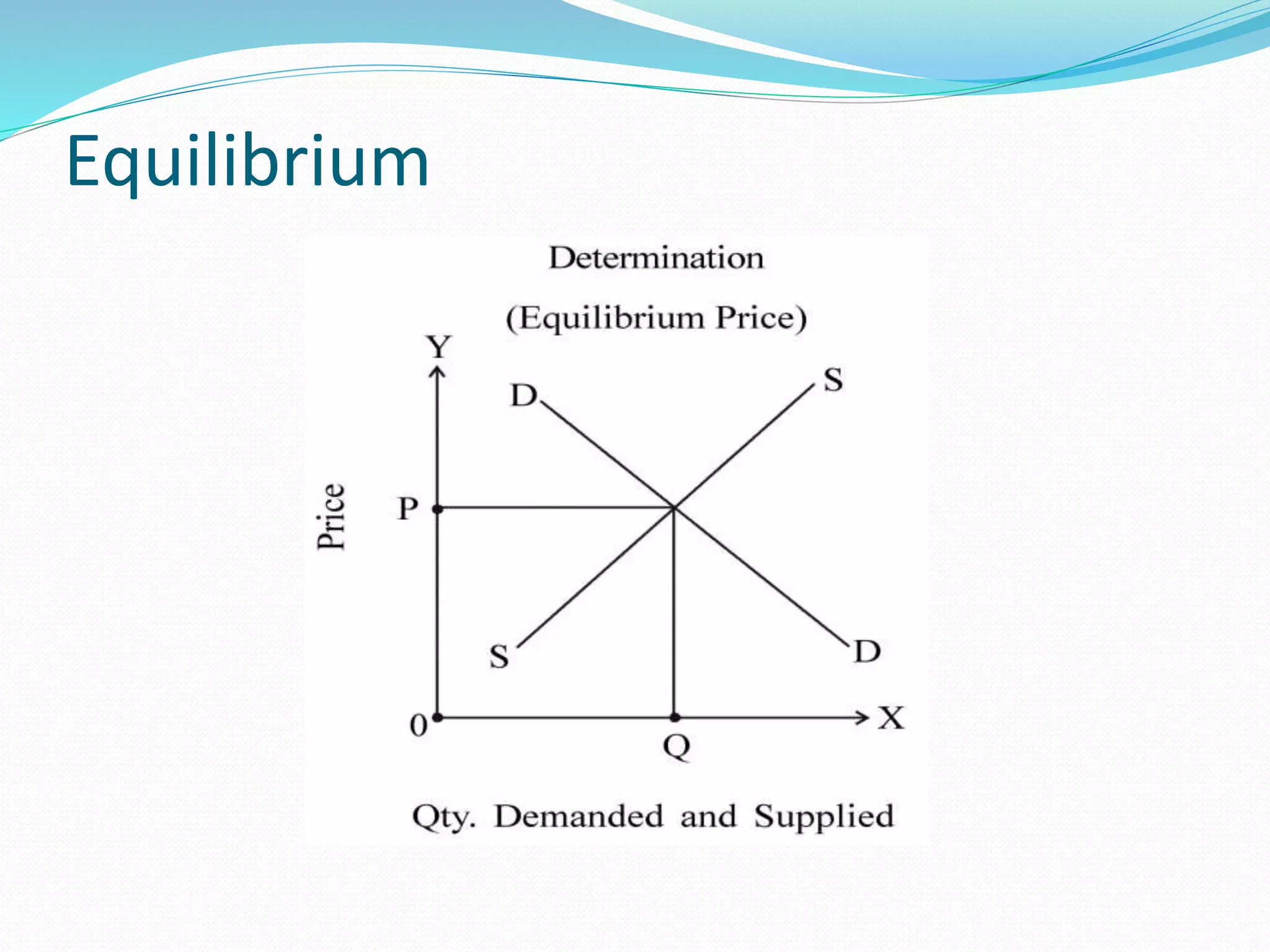
 Equilibrium occurs at the intersection of the demand and
supply curve, which indicates no allocative inefficiency.
 At this point, the price of the goods will be P* and the
quantity will be Q*. These figures are referred to as
equilibrium price and quantity.
 In the real market place equilibrium can only ever be
reached in theory, so the prices of goods and services are
constantly changing in relation to fluctuations in demand
and supply.
Disequilibrium
 Disequilibrium occurs whenever the price or quantity
is not equal to P* or Q*.
 Excess Supply
 If the price is set too high, excess supply will be created
within the economy and there will be allocative
inefficiency.
Excess Supply…
…Excess Supply
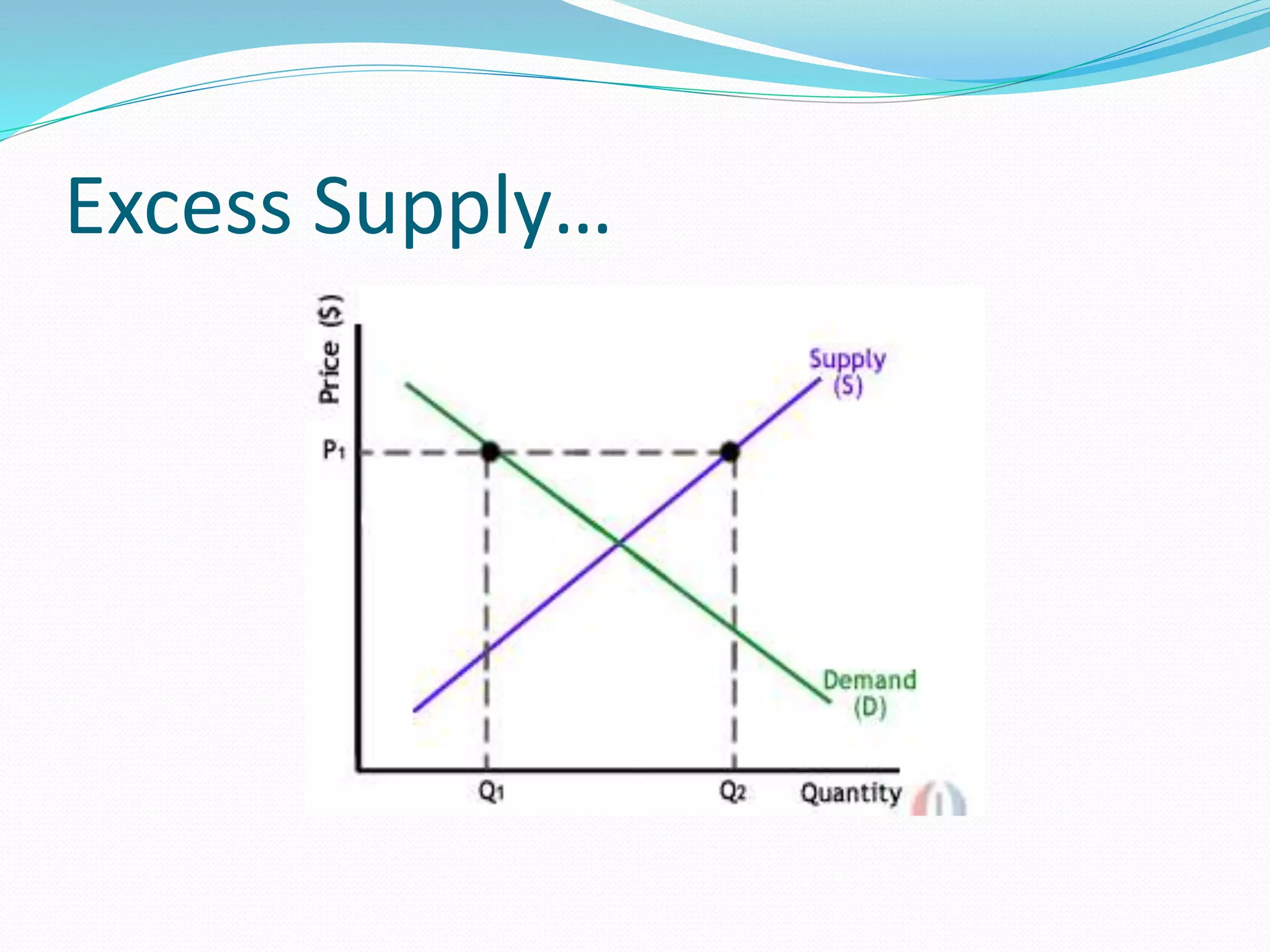
 At price P1 the quantity of goods that the producers wish to
supply is indicated by Q2. At P1, however, the quantity that
the consumers want to consume is at Q1, a quantity much
less than Q2.
 Because Q2 is greater than Q1, too much is being produced
and too little is being consumed.
 The suppliers are trying to produce more goods, which they
hope to sell to increase profits, but those consuming the
goods will find the product less attractive and purchase less
because the price is too high.
Excess Demand…
 Excess demand is created when price is set below the
equilibrium price. Because the price is so low, too
many consumers want the good while producers are
not making enough of it.
…Excess Demand
 In this situation, at price P1, the quantity of goods
demanded by consumers at this price is Q2.
Conversely, the quantity of goods that producers are
willing to produce at this price is Q1.
 Thus, there are too few goods being produced to
satisfy the wants (demand) of the consumers.
 However, as consumers have to compete with one
other to buy the good at this price, the demand will
push the price up, making suppliers want to supply
more and bringing the price closer to its equilibrium.
Determinants of Demand
 The following determinants cause shifts in the entire
demand curve:
1. Change in consumer tastes
2. Change in the number of buyers
3. Change in consumer incomes
4. Change in the prices of complementary and
substitute goods
5. Change in consumer expectations
Determinants of Supply
 The following determinants cause shifts in the entire
supply curve:
1. Change in input prices
2. Change in technology
3. Change in taxes and subsidies
4. Change in the prices of other goods
5. Change in producer expectations
6. Change in the number of suppliers
 Any factor that increases/decreases the cost of
production decreases/increases supply.
Changes in Demand
 Demand of commodity may change. It may increase or
decrease due to changes in certain factors.
 These factors are:
1. Price of a commodity
2. Nature of commodity
3. Income and wealth of consumer
4. Taste and preferences of consumer
5. Price of related goods
6. Consumer expectations
7. Advertisements etc…
Demand Function
 There is a functional relationship between demand and its
various determinants.
 When this relationship expressed mathematically, it is called
Demand function.
D = f (P, Y, T, Ps, U)
 Where,
 D = quantity demanded
 P = price of the commodity
 Y = income of the consumer
 T = taste and preferences of consumers
 Ps = price of substitutes
 U = consumers expectations and others
 F = function of (indicates how variables are related)
Extension and Contraction of
Demand…
 The change in demand due to change in price only,
where other factors remaining constant, it is called
extension and contraction of demand.
 When the quantity demanded of a commodity rises
due to a fall in price, it is called extension of demand.
 When the quantity of demanded falls due to rise in
price, it is called contraction of demand.
…Extension and Contraction of
Demand
Shift in Demand…
 When the demand changes due to changes in other
factors, like taste and preferences, income, price of
related goods etc., it is called shift in demand.
 Due to changes in other factors, if the consumer buy
more goods, it is called increase in demand or upward
shift.
 If the consumer buy fewer goods due to change in
other factors, it is called downward shift or decrease in
demand.
…Shift in Demand
Comparison between extension/contraction
and shift in demand
Extension/Contraction of Demand Shift in Demand
Demand is varying due to changes in
price.
Demand is varying due to changes in
other factors.
Other factors like tastes, preferences,
income etc… remaining the same.
Price of commodity remain the same.
Consumer moves along with the same
demand curve.
Consumer may moves to higher or
lower demand curve.
Elasticity Of
Demand
Elasticity of Demand…
 In market place for making real price decision, the business
person needs to know the quantitative impact of price change on
quantity demanded.
 Thus in the most real world situations economist and business
analysts cannot just get away by saying “if we raise our prices our
sales will fall OR if income rises this quarter then our demand
will increase”.
 The question that needs to be answered is “By how much”. To
measure this we use the concept “ELASTICITY”.
 ‘Elasticity’ is the measure of responsiveness of one variable to the
change in another.
…Elasticity of Demand
 The degree of responsiveness in quantity demanded to
a change in price.
 It represents the rate of change in quantity demanded
due to change in price.
 Thus it measures the effect of a change in any factor
affecting demand on the total consumption
expenditure on a product.
Types of Demand Elasticity
 There are mainly three types of elasticity of demand.
1. Price Elasticity of Demand
2. Income Elasticity of Demand
3. Cross Elasticity of Demand
Price Elasticity of Demand…
 ‘Price’ is one of the important determinants of demand
that affects the quantity demanded. Price elasticity of
demand measures the relationship between price and
quantity demanded for a particular commodity.
 Price elasticity of demand is defined as “a measure of
the responsiveness of demand to the change in price”.
 Thus price elasticity of demand shows the relative
amount by which the quantity demanded will change
in response to the change in price of a particular
commodity.
…Price Elasticity of Demand
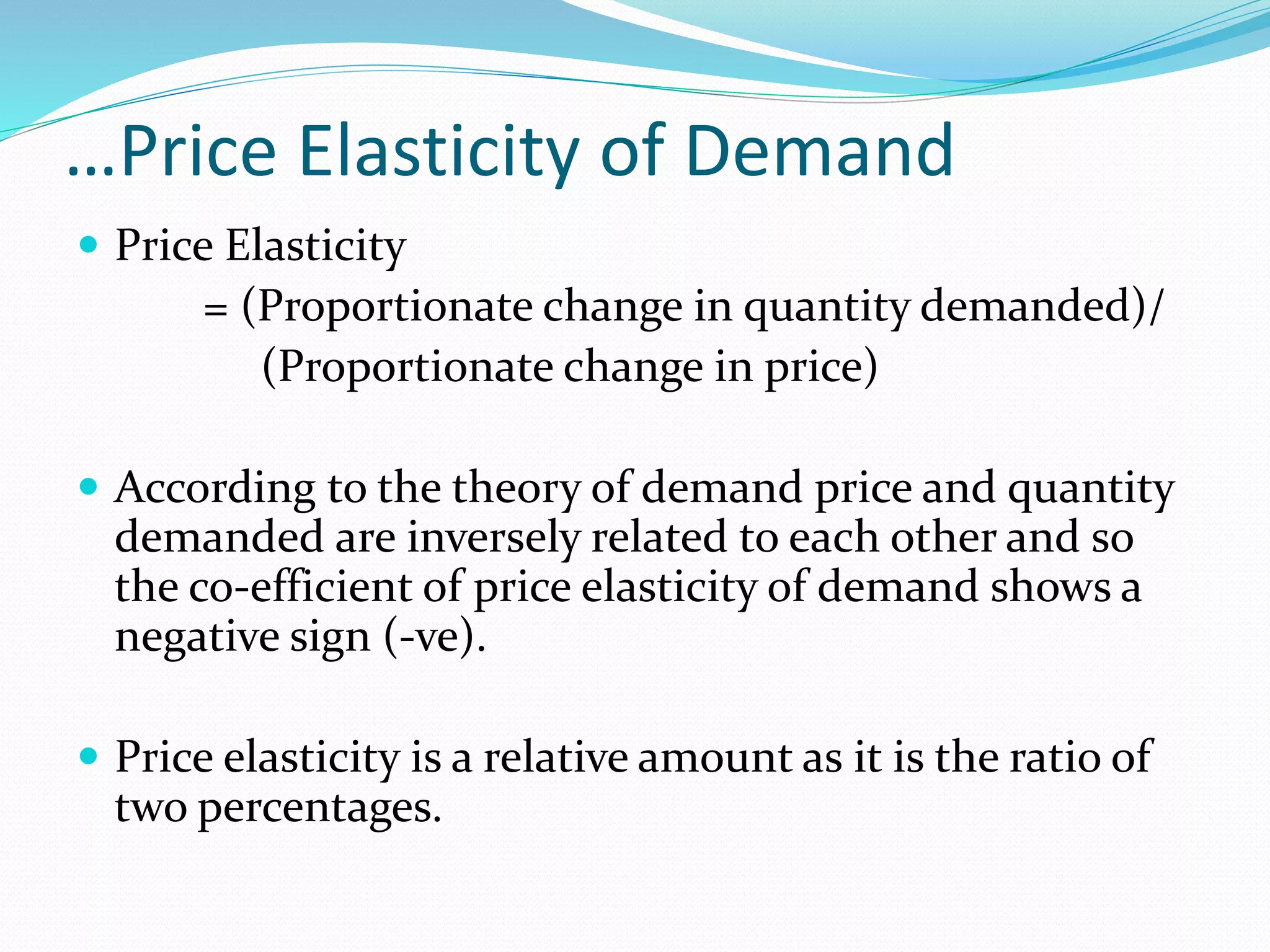
 Price Elasticity
= (Proportionate change in quantity demanded)/
(Proportionate change in price)
 According to the theory of demand price and quantity
demanded are inversely related to each other and so
the co-efficient of price elasticity of demand shows a
negative sign (-ve).
 Price elasticity is a relative amount as it is the ratio of
two percentages.
Types of Price Elasticity
 There are five types of price elasticity of demand.
1. Perfectly elastic demand (e = ∞)
2. Perfectly inelastic demand (e = 0)
3. Relatively elastic demand (e > 1)
4. Relatively inelastic demand (e < 1)
5. Unitary elastic demand (e = 1)
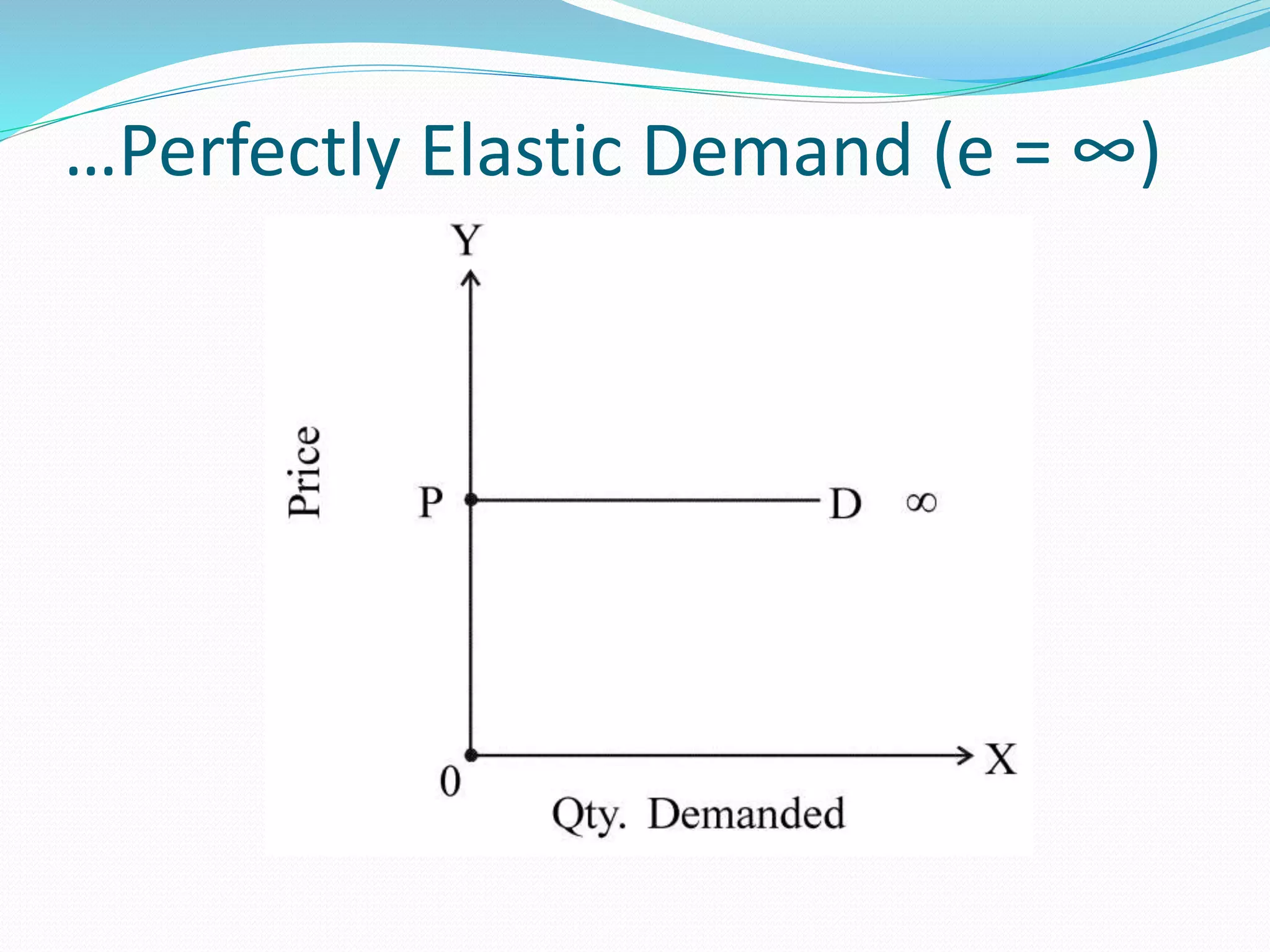
Perfectly Elastic Demand (e = ∞)…
 When an insignificant or extremely small change in
price causes an extraordinary larger change in the
demand then it is termed as perfectly elastic demand.
 Here a slight rise in price renders the demand zero and
a slight fall in price raises the demand to infinity.
 It is a case of complete responsiveness.
…Perfectly Elastic Demand (e = ∞)
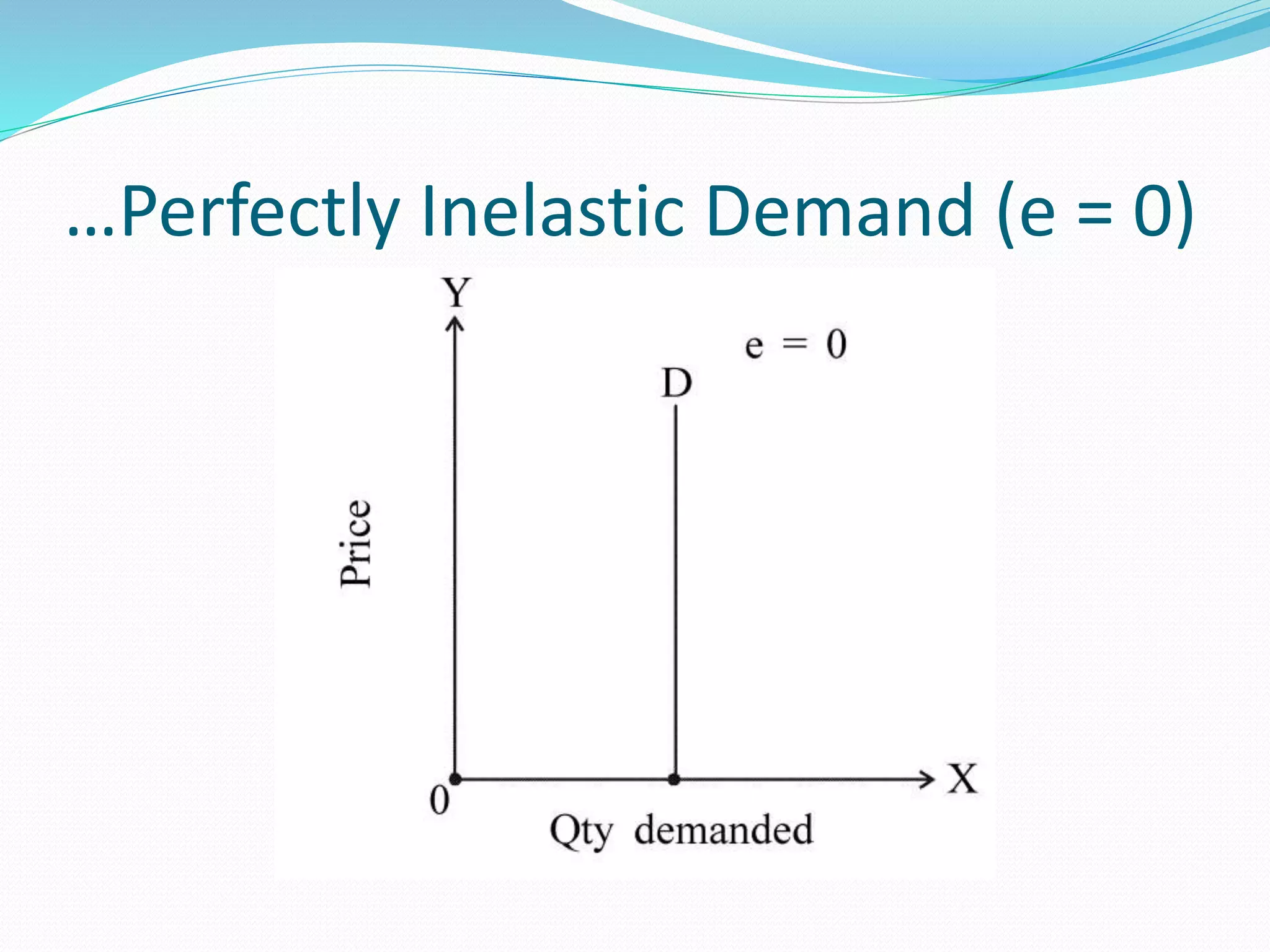
Perfectly Inelastic Demand (e = 0)…
 Irrespective of any change in price, if the quantity
demanded remains constant then such a demand is
termed as perfectly inelastic demand.
 Thus in this type of elasticity change in price fails to
bring about any change in the quantity demanded.
 It is also termed as zero elasticity and is a case of total
unresponsiveness
…Perfectly Inelastic Demand (e = 0)
Relatively Elastic Demand (e > 1)…
 When percentage change in quantity demanded is
more than percentage change in its price then such a
demand is termed as elastic.
 Elastic demand is also termed as ‘more elastic’ demand
or ‘relatively elastic’ demand.
…Relatively Elastic Demand (e > 1)
Relatively Inelastic Demand (e < 1)…
 When percentage change in quantity demanded is less
than percentage change in price then such a demand is
termed as inelastic demand.
 Inelastic demand is also termed as ‘less elastic’
demand or ‘relatively inelastic’ demand.
…Relatively Inelastic Demand (e < 1)
Unitary Elastic Demand (e = 1)…
 When the percentage change in quantity demanded is
proportionate or equal to the percentage change in
price then such a demand is termed as unitary elastic
demand.
…Unitary Elastic Demand (e = 1)
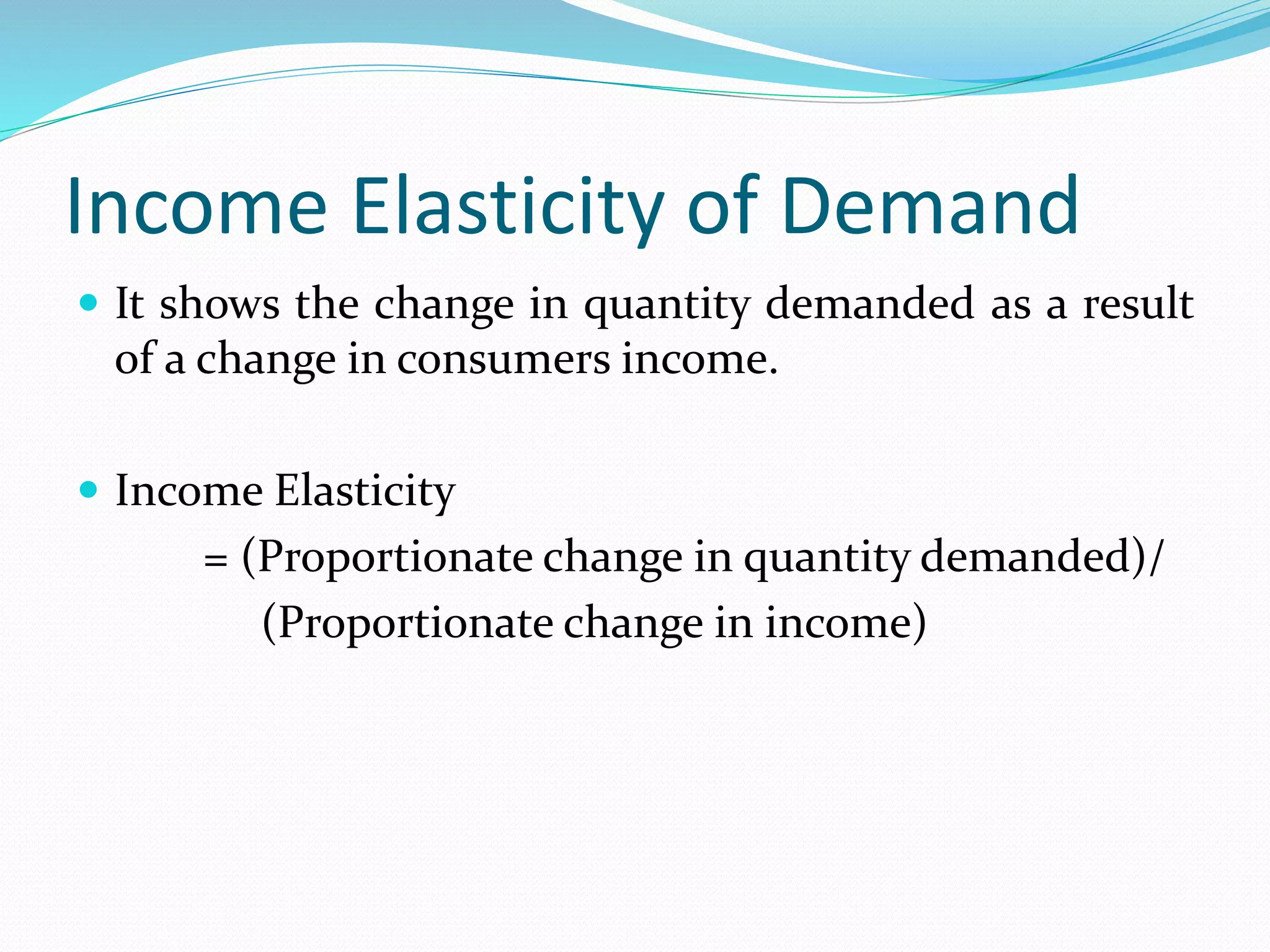
Income Elasticity of Demand
 It shows the change in quantity demanded as a result
of a change in consumers income.
 Income Elasticity
= (Proportionate change in quantity demanded)/
(Proportionate change in income)
Types of Income Elasticity
1. Unitary income elasticity (℮y = 1)
2. Income elasticity greater than 1 (℮y > 1)
3. Income elasticity less than 1 (℮y < 1)
4. Zero income elasticity (℮y = 0)
5. Negative income elasticity (℮y < 0)
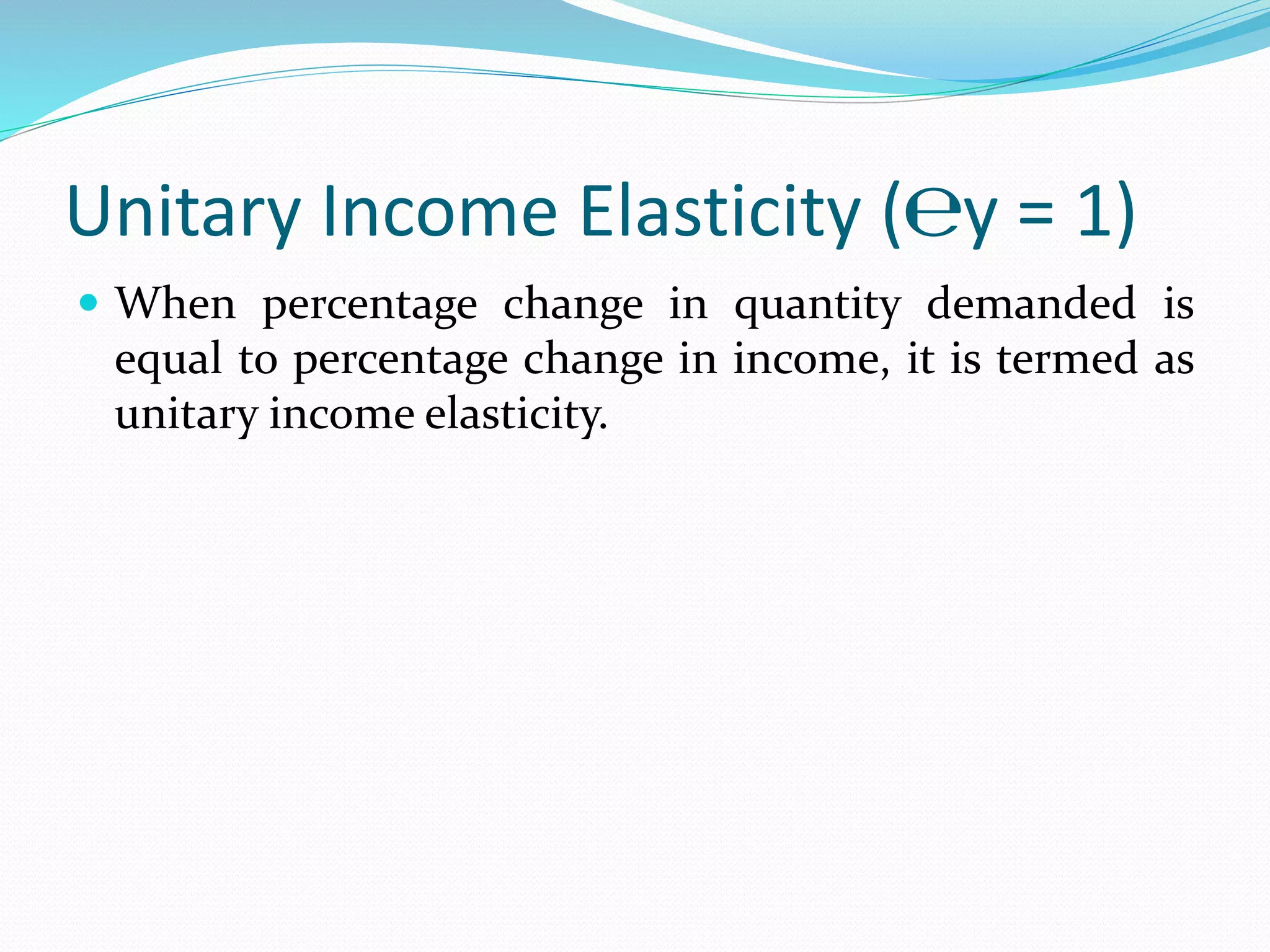
Unitary Income Elasticity (℮y = 1)
 When percentage change in quantity demanded is
equal to percentage change in income, it is termed as
unitary income elasticity.
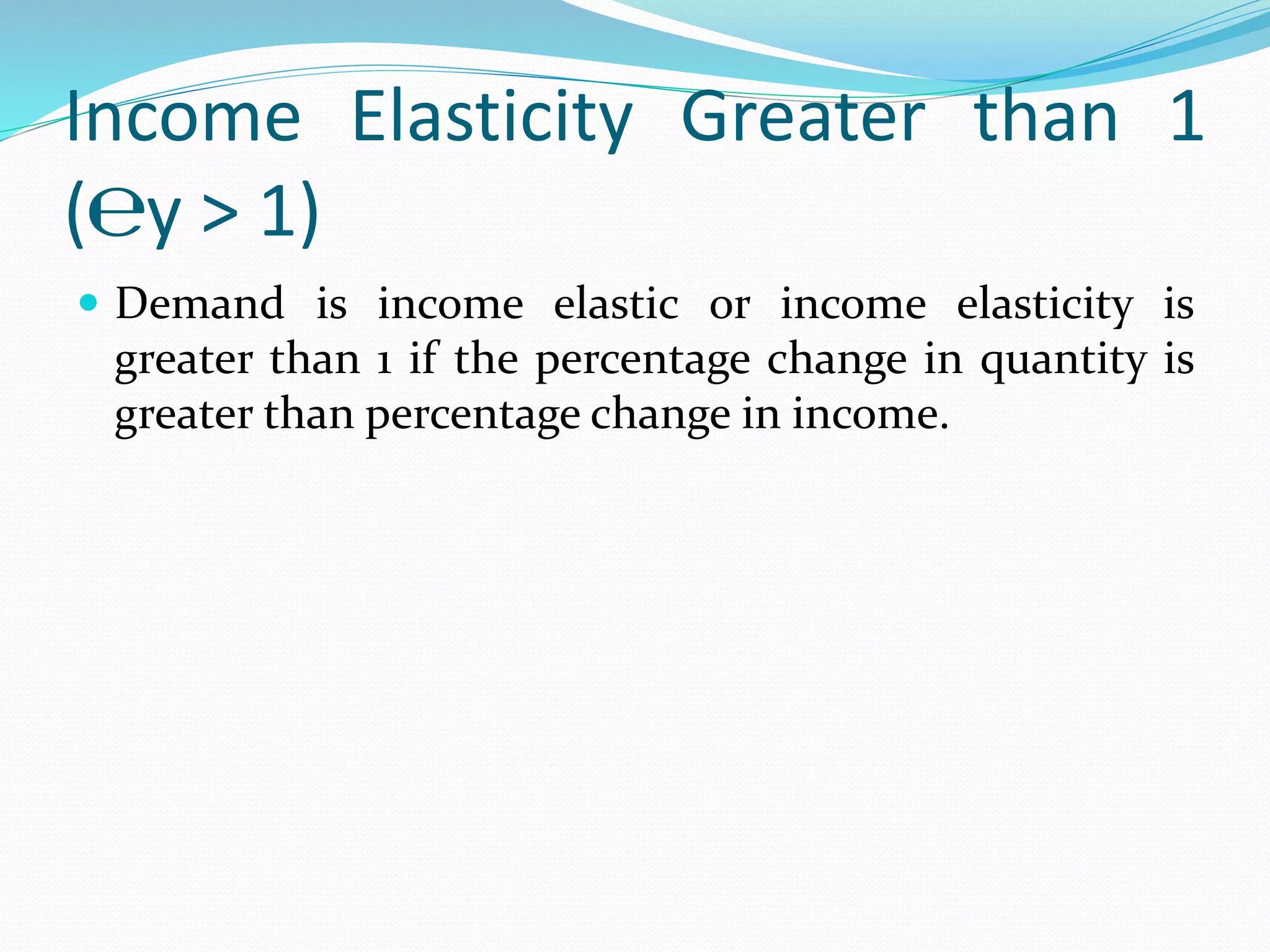
Income Elasticity Greater than 1
(℮y > 1)
 Demand is income elastic or income elasticity is
greater than 1 if the percentage change in quantity is
greater than percentage change in income.
Income Elasticity Less than 1 (℮y <
1)
 Demand is termed as income inelastic or less than 1 if
the percentage change in quantity demanded is less
than percentage change in income of the consumer.
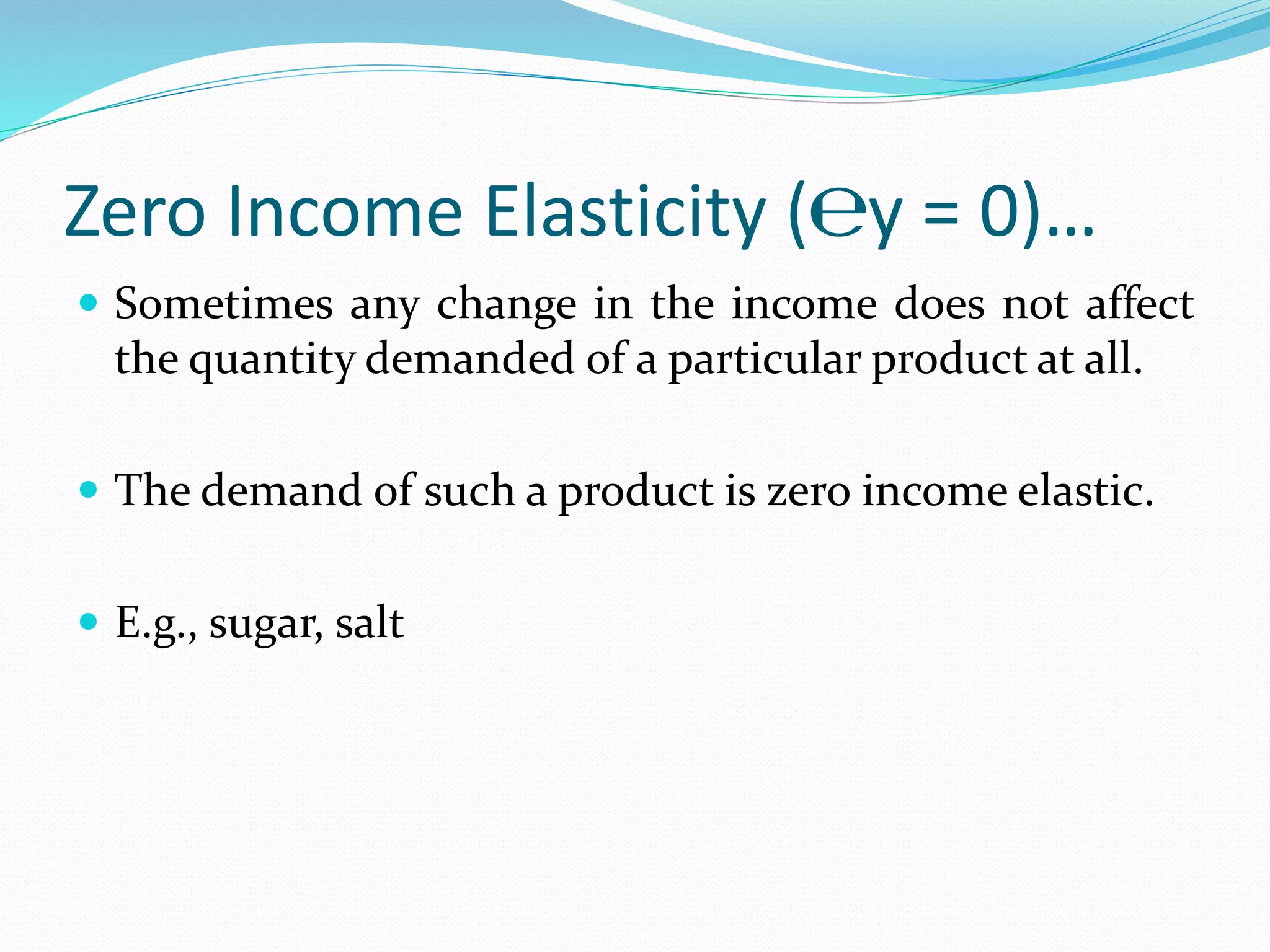
Zero Income Elasticity (℮y = 0)…
 Sometimes any change in the income does not affect
the quantity demanded of a particular product at all.
 The demand of such a product is zero income elastic.
 E.g., sugar, salt
Negative Income Elasticity (℮y <
0)…
 When rise in income of a consumer actually reduces
the demand of a particular product, then such a
product it said to have a negative income elastic
demand.
 Usually inferior goods are negatively income elastic.
 When consumers of such product have a rise in their
income, they tend to purchase lesser and lesser of
inferior goods and move towards superior goods.
Cross Elasticity of Demand
 Cross elasticity of demand measures the degree of
responsiveness of demand of a commodity to the
change in price of another related commodity
(whether a substitute or complementary good).
 Thus cross elasticity measures the extent to which the
price of a substitute or complementary good affects the
demand of a particular good.
 Cross Elasticity = (Proportionate change in quantity
demanded of a commodity / Proportionate change in
the price of related commodity)
Types of Cross Elasticity
 From business people to planners the concept of cross
elasticity of demand is equally important as that of
price and income elasticity.
 Following are the three types of cross elasticity:
1. Positive Cross Elasticity of Demand
2. Negative Cross Elasticity of Demand
3. Zero Cross Elasticity of Demand
Positive Cross Elasticity of Demand
(Substitute)…
 Substitute goods reflect positive cross elasticity of demand.
 Positive cross elasticity of demand is the ratio of percentage
increase(decrease)in the demand of A to the percentage
increase(decrease) in the price of B.
 Example: With the rise in price of coffee ,the consumers of
coffee find tea relatively cheaper and so shift to tea. Thus
with the rise in price of coffee the demand of tea rise.
Another example is coke and Pepsi.
…Positive Cross Elasticity of
Demand (Substitute)
Negative Cross Elasticity of
Demand (Complementary)…
 Complementary goods reflect negative cross elasticity
between them.
 Negative cross elasticity of demand is the ratio of
percentage increase(decrease) in demand of A to the
percentage decrease(increase) in price of B.
 Example: Petrol and petrol car as complementary
goods. With rise in price of petrol, there is a fall in
demand for petrol cars.
…Negative Cross Elasticity of
Demand (Complementary)
Zero Cross Elasticity of Demand
 If two products are not at all related or zero relation
exists between them then these goods are said to have
zero cross elasticity.
 Thus when price of one product have no effect on the
demand of another, then it is termed as zero cross
elasticity.
 Example: price of cars and demand for books have no
relation between them and so have zero cross elasticity
of demand.
Importance of Elasticity
 Production
 Price fixation
 Distribution
 International trade
 Public finance
 Nationalization
 Price discrimination
 Others
Determinants of Elasticity
 Nature of commodity
 Availability/range of substitutes
 Extent/variety of uses
 Postponement/urgency of demand
 Income level
 Amount of money spend on the commodity
 Durability of commodity
 Purchase frequency of a product/time
 Range of prices
 Others
Thank You

economics

  • 2.
    A Preliminary Introduction Economics is the science that deals with production, exchange and consumption of various commodities in economic systems.  Two major factors are responsible for the emergence of economic problems. They are: 1. The existence of unlimited human wants and 2. The scarcity of available resources
  • 3.
    Economics  Economics wordderived from two Greek words  Oikos - a house  Nemein - to manage  means ‘managing a household’ using the limited funds available, in the most satisfactory manner possible.
  • 4.
    Economics Definitions Emphasis onContribution by Wealth Adam Smith (1723 – 1790) Welfare Alfred Marshall (1842 – 1924) Scarcity Lionel Robbins Growth Paul Samuelson
  • 5.
    Wealth Definition  Adamsmith (1723 – 1790)  His book “An Inquiry into Nature and Causes of Wealth of Nations” (1776) defined economics as the science of wealth.  He explained how a nation’s wealth is created. He considered that the individual in the society wants to promote only his own gain and in this, he is led by an “invisible hand” to promote the interests of the society though he has no real intention to promote the society’s interests.
  • 6.
    Wealth Definition –Criticism  Smith defined economics only in terms of wealth and not in terms of human welfare.  Ruskin and Carlyle condemned economics as a ‘dismal science’, as it taught selfishness which was against ethics.  However, now, wealth is considered only to be a mean to end, the end being the human welfare.  Hence, wealth definition was rejected and the emphasis was shifted from ‘wealth’ to ‘welfare’.
  • 7.
    Welfare Definition…  AlfredMarshall (1842 - 1924) wrote a book “Principles of Economics” (1890) in which he defined “Political Economy” or Economics is a study of mankind in the ordinary business of life.  It examines that part of individual and social action which is most closely connected with the attainment and with the use of the material requisites of well being.
  • 8.
    Welfare Definition  Theimportant features of Marshall’s definition are as follows: a) Economics is a study of mankind in the ordinary business of life, i.e., economic aspect of human life. b) Economics studies both individual and social actions aimed at promoting economic welfare of people. c) Marshall makes a distinction between two types of things, viz. material things and immaterial things. Material things are those that can be seen, felt and touched, (E.g.) book, rice etc. Immaterial things are those that cannot be seen, felt and touched.  In his definition, Marshall considered only the material things that are capable of promoting welfare of people.
  • 9.
    Welfare Definition –Criticism a) Considered only material things. But immaterial things, such as the services of a doctor, a teacher and so on, also promote welfare of the people. b) Marshall makes a distinction between (i) those things that are capable of promoting welfare of people and (ii) those things that are not capable of promoting welfare of people. But anything, (E.g.) liquor, that is not capable of promoting welfare but commands a price, comes under the purview of economics. c) Marshall’s definition is based on the concept of welfare. But there is no clear-cut definition of welfare.
  • 10.
    Welfare Definition….  LionelRobbins published a book “An Essay on the Nature and Significance of Economic Science” in 1932.  According to him, “economics is a science which studies human behaviour as a relationship between ends and scarce means which have alternative uses”.
  • 11.
    …Welfare Definition  Themajor features of Robbins’ definition are as follows: a) Ends refer to human wants. Human beings have unlimited number of wants. b) Resources or means, on the other hand, are limited or scarce in supply. There is scarcity of a commodity, if its demand is greater than its supply. c) The scarce means are capable of having alternative uses. Hence, anyone will choose the resource that will satisfy his particular want.  Thus, economics, according to Robbins, is a science of choice.
  • 12.
    Welfare Definition –Criticism a) Robbins does not make any distinction between goods conducive to human welfare and goods that are not conducive to human welfare. b) In economics, we not only study the micro economic aspects like how resources are allocated and how price is determined, but we also study the macroeconomic aspect like how national income is generated. But, Robbins has reduced economics merely to theory of resource allocation. c) Robbins definition does not cover the theory of economic growth and development.
  • 13.
    Growth Definition…  Prof.Paul Samuelson defined economics as “the study of how men and society choose, with or without the use of money, to employ scarce productive resources which could have alternative uses, to produce various commodities over time, and distribute them for consumption, now and in the future among various people and groups of society”.
  • 14.
    …Growth Definition  Themajor implications of this definition are as follows: a) Dynamic definition because it includes the element of time in it. Therefore, it covers the theory of economic growth. b) Samuelson stressed the problem of scarcity of means in relation to unlimited ends. Not only the means are scarce, but they could also be put to alternative uses. c) The definition covers various aspects like production, distribution and consumption.
  • 15.
    Economics Definitions  Ofall the definitions discussed above, the ‘growth’ definition stated by Samuelson appears to be the most satisfactory. However, in modern economics, the subject matter of economics is divided into main parts, viz., i) Micro Economics and ii) Macro Economics.  Economics is, therefore, rightly considered as the study of allocation of scarce resources (in relation to unlimited ends) and of determinants of income, output, employment and economic growth.
  • 16.
    Scope of Economics Economics is a science.  Economics is a social science.  Economics is also an art.  Positive science.  Normative science.
  • 17.
    Nature of Economics… Economics has to deal with the limited resources to satisfy the wants of the society.  Even wealthy nations do not have enough resources to satisfy the needs of all persons.  It is necessary to reduce the gap between more wants and limited resources.  Economist does not prefer to reduce the wants but they believe to increase the availability of resources.
  • 18.
    …Nature of Economics… Economics limits its field up to exchangeable goods and these goods are called economic goods. All other goods are called non-economic goods.  Further, these resources are of two classes, human and natural.  If resources were so ample or wants so few that we could not have economics, but this happy situation can never happen.
  • 19.
    …Nature of Economics In every society, critical decisions have to be made such as what to produce, how much to produce, how to produce, when to produce and who gets it, how much producer gets from production.  The arrangements used to enforce these decisions in any society constitute the economic organization, or economic system, or that society having nature of providing scare resources to satisfy maximum needs of the society.
  • 20.
    Micro Economics  Theprefix “micro” means “small,” so it shouldn’t be surprising that microeconomics is the study of small economic units. The field of microeconomics is concerned with things like: o Consumer decision making and utility maximization o Firm production and profit maximization o Individual market equilibrium o Effects of government regulation on individual markets o Externalities and other market side effects
  • 21.
    Macro Economics  Macroeconomicscan be thought of as the “big picture” version of economics. Rather than analyzing individual markets, macroeconomics focuses on aggregate production and consumption in an economy. Some topics that macroeconomists study are: o The effects of general taxes such as income and sales taxes on output and prices o The causes of economic upswings and downturns o The effects of monetary and fiscal policy on economic health o How interest rates are determined o Why some economies grow faster than others
  • 22.
    Difference between Microand Macro Economics Micro Economics Macro Economics Microeconomics is the study of particular firm, particular household, individual prices, wages, incomes, individual industries, and individual commodities. Macroeconomics deals not with individual quantities as such but with aggregates of these quantities not with individual income but with national income, not with individual prices but with the price level not with individual output but with national output. Micro means very small or millionth part. Macro means large or whole. The subject or example of microeconomics is about person, an investor, a producer. The subject of macro economics is about national production, national income, income level. As it analyzes individually it provides a partial concept or partial figure of a country. As it analyzes overall it provides full figure or complete reflection of a country. Micro economics is concerned with the individual entities. Macroeconomics is concerned with the overall performance of the economy.
  • 23.
    Theory of Demandand Supply
  • 24.
    Theory of Demand The most powerful tools of economics for analyzing the way market forces determine price and production in a competitive market are—Demand and Supply analysis. In an open economy it is demand for a good and its supply that jointly determine its prices.  The term demand reflects consumer behaviour. It shows how much a consumer is willing to buy at a given income, price and time. A mere want is not demand in economics.
  • 25.
    Definition of Demand “It is the amount of goods and services consumers are willing and able to buy at a given period of time”.  Thus desire for a good accompanied by enough purchasing power and willingness to pay determine the demand for that particular commodity.
  • 26.
    The Law ofDemand…  The law of demand presents the functional relationship between price and quantity demanded.  The statement of the law is as follows:  “Other things remaining constant, the quantity demanded increases when price falls and quantity demanded decreases when price rises”.  Thus price and quantity demanded are inversely related keeping other affecting variables constant.
  • 27.
    …The Law ofDemand  The inverse relation between price and quantity demanded can be explained by two effects.  Substitution Effect: suppose when prices of a particular good rises, the consumer find its’ substitutes comparatively cheaper and so they shift their demand to the substitute good which leads to the decrease it the demand of the original good.  Income Effect: With the rise in price of goods or services, keeping the money income constant ,the consumer’s real income decreases i.e. their purchasing power decreases. Thus this leads to the decrease in the quantity demanded.
  • 28.
  • 29.
  • 30.
    Theory of Supply The two main pillars of a market are consumers and suppliers. Their existence depends on each other. The terms supply determines the quantity of goods and services that a supplier is ready to supply at a given price.  Before understanding the meaning of supply one should know a clear distinction between production, stock and supply.  Production: It is a systematic process whereby inputs are converted into output.  Stocks: A part or whole of the production produced during the production process, that is kept in the warehouse and not offered for sale is termed as stock.
  • 31.
    Definition of Supply “Supply refers to the that quantity of goods that are bought into the market and offered for sale at a price at a given time”.  Thus it should not be mistaken with stock lying in the godown or quantity produced.
  • 32.
    The Law ofSupply  “Other factors remaining constant, at higher prices the quantity supplied is high and at low price the quantity supplied is less.”  The law of supply states a direct relation between price and quantity supplied keeping other affecting factors constant.  Price is the prime factor that affects supply just as it affects demand. With the cost of production remaining constant as price increases, the profit margin increases due to which the supplier is motivated to supply more.  Similarly with decrease in price the supply reduces as the suppliers are demotivated by reduced profits. Thus price directly affects the quantity supplied by a supplier.
  • 33.
  • 34.
  • 35.
    Equilibrium between Demandand Supply  When supply and demand are equal (i.e. when the supply function and demand function intersect) the economy is said to be at equilibrium  At this point, the allocation of goods is at its most efficient because the amount of goods being supplied is exactly the same as the amount of goods being demanded.  Thus, everyone (individuals, firms, or countries) is satisfied with the current economic condition.  At the given price, suppliers are selling all the goods that they have produced and consumers are getting all the goods that they are demanding.
  • 36.
  • 37.
    Equilibrium  Equilibrium occursat the intersection of the demand and supply curve, which indicates no allocative inefficiency.  At this point, the price of the goods will be P* and the quantity will be Q*. These figures are referred to as equilibrium price and quantity.  In the real market place equilibrium can only ever be reached in theory, so the prices of goods and services are constantly changing in relation to fluctuations in demand and supply.
  • 38.
    Disequilibrium  Disequilibrium occurswhenever the price or quantity is not equal to P* or Q*.  Excess Supply  If the price is set too high, excess supply will be created within the economy and there will be allocative inefficiency.
  • 39.
  • 40.
    …Excess Supply  Atprice P1 the quantity of goods that the producers wish to supply is indicated by Q2. At P1, however, the quantity that the consumers want to consume is at Q1, a quantity much less than Q2.  Because Q2 is greater than Q1, too much is being produced and too little is being consumed.  The suppliers are trying to produce more goods, which they hope to sell to increase profits, but those consuming the goods will find the product less attractive and purchase less because the price is too high.
  • 41.
    Excess Demand…  Excessdemand is created when price is set below the equilibrium price. Because the price is so low, too many consumers want the good while producers are not making enough of it.
  • 42.
    …Excess Demand  Inthis situation, at price P1, the quantity of goods demanded by consumers at this price is Q2. Conversely, the quantity of goods that producers are willing to produce at this price is Q1.  Thus, there are too few goods being produced to satisfy the wants (demand) of the consumers.  However, as consumers have to compete with one other to buy the good at this price, the demand will push the price up, making suppliers want to supply more and bringing the price closer to its equilibrium.
  • 43.
    Determinants of Demand The following determinants cause shifts in the entire demand curve: 1. Change in consumer tastes 2. Change in the number of buyers 3. Change in consumer incomes 4. Change in the prices of complementary and substitute goods 5. Change in consumer expectations
  • 44.
    Determinants of Supply The following determinants cause shifts in the entire supply curve: 1. Change in input prices 2. Change in technology 3. Change in taxes and subsidies 4. Change in the prices of other goods 5. Change in producer expectations 6. Change in the number of suppliers  Any factor that increases/decreases the cost of production decreases/increases supply.
  • 45.
    Changes in Demand Demand of commodity may change. It may increase or decrease due to changes in certain factors.  These factors are: 1. Price of a commodity 2. Nature of commodity 3. Income and wealth of consumer 4. Taste and preferences of consumer 5. Price of related goods 6. Consumer expectations 7. Advertisements etc…
  • 46.
    Demand Function  Thereis a functional relationship between demand and its various determinants.  When this relationship expressed mathematically, it is called Demand function. D = f (P, Y, T, Ps, U)  Where,  D = quantity demanded  P = price of the commodity  Y = income of the consumer  T = taste and preferences of consumers  Ps = price of substitutes  U = consumers expectations and others  F = function of (indicates how variables are related)
  • 47.
    Extension and Contractionof Demand…  The change in demand due to change in price only, where other factors remaining constant, it is called extension and contraction of demand.  When the quantity demanded of a commodity rises due to a fall in price, it is called extension of demand.  When the quantity of demanded falls due to rise in price, it is called contraction of demand.
  • 48.
  • 49.
    Shift in Demand… When the demand changes due to changes in other factors, like taste and preferences, income, price of related goods etc., it is called shift in demand.  Due to changes in other factors, if the consumer buy more goods, it is called increase in demand or upward shift.  If the consumer buy fewer goods due to change in other factors, it is called downward shift or decrease in demand.
  • 50.
  • 51.
    Comparison between extension/contraction andshift in demand Extension/Contraction of Demand Shift in Demand Demand is varying due to changes in price. Demand is varying due to changes in other factors. Other factors like tastes, preferences, income etc… remaining the same. Price of commodity remain the same. Consumer moves along with the same demand curve. Consumer may moves to higher or lower demand curve.
  • 52.
  • 53.
    Elasticity of Demand… In market place for making real price decision, the business person needs to know the quantitative impact of price change on quantity demanded.  Thus in the most real world situations economist and business analysts cannot just get away by saying “if we raise our prices our sales will fall OR if income rises this quarter then our demand will increase”.  The question that needs to be answered is “By how much”. To measure this we use the concept “ELASTICITY”.  ‘Elasticity’ is the measure of responsiveness of one variable to the change in another.
  • 54.
    …Elasticity of Demand The degree of responsiveness in quantity demanded to a change in price.  It represents the rate of change in quantity demanded due to change in price.  Thus it measures the effect of a change in any factor affecting demand on the total consumption expenditure on a product.
  • 55.
    Types of DemandElasticity  There are mainly three types of elasticity of demand. 1. Price Elasticity of Demand 2. Income Elasticity of Demand 3. Cross Elasticity of Demand
  • 56.
    Price Elasticity ofDemand…  ‘Price’ is one of the important determinants of demand that affects the quantity demanded. Price elasticity of demand measures the relationship between price and quantity demanded for a particular commodity.  Price elasticity of demand is defined as “a measure of the responsiveness of demand to the change in price”.  Thus price elasticity of demand shows the relative amount by which the quantity demanded will change in response to the change in price of a particular commodity.
  • 57.
    …Price Elasticity ofDemand  Price Elasticity = (Proportionate change in quantity demanded)/ (Proportionate change in price)  According to the theory of demand price and quantity demanded are inversely related to each other and so the co-efficient of price elasticity of demand shows a negative sign (-ve).  Price elasticity is a relative amount as it is the ratio of two percentages.
  • 58.
    Types of PriceElasticity  There are five types of price elasticity of demand. 1. Perfectly elastic demand (e = ∞) 2. Perfectly inelastic demand (e = 0) 3. Relatively elastic demand (e > 1) 4. Relatively inelastic demand (e < 1) 5. Unitary elastic demand (e = 1)
  • 59.
    Perfectly Elastic Demand(e = ∞)…  When an insignificant or extremely small change in price causes an extraordinary larger change in the demand then it is termed as perfectly elastic demand.  Here a slight rise in price renders the demand zero and a slight fall in price raises the demand to infinity.  It is a case of complete responsiveness.
  • 60.
  • 61.
    Perfectly Inelastic Demand(e = 0)…  Irrespective of any change in price, if the quantity demanded remains constant then such a demand is termed as perfectly inelastic demand.  Thus in this type of elasticity change in price fails to bring about any change in the quantity demanded.  It is also termed as zero elasticity and is a case of total unresponsiveness
  • 62.
  • 63.
    Relatively Elastic Demand(e > 1)…  When percentage change in quantity demanded is more than percentage change in its price then such a demand is termed as elastic.  Elastic demand is also termed as ‘more elastic’ demand or ‘relatively elastic’ demand.
  • 64.
  • 65.
    Relatively Inelastic Demand(e < 1)…  When percentage change in quantity demanded is less than percentage change in price then such a demand is termed as inelastic demand.  Inelastic demand is also termed as ‘less elastic’ demand or ‘relatively inelastic’ demand.
  • 66.
  • 67.
    Unitary Elastic Demand(e = 1)…  When the percentage change in quantity demanded is proportionate or equal to the percentage change in price then such a demand is termed as unitary elastic demand.
  • 68.
  • 69.
    Income Elasticity ofDemand  It shows the change in quantity demanded as a result of a change in consumers income.  Income Elasticity = (Proportionate change in quantity demanded)/ (Proportionate change in income)
  • 70.
    Types of IncomeElasticity 1. Unitary income elasticity (℮y = 1) 2. Income elasticity greater than 1 (℮y > 1) 3. Income elasticity less than 1 (℮y < 1) 4. Zero income elasticity (℮y = 0) 5. Negative income elasticity (℮y < 0)
  • 71.
    Unitary Income Elasticity(℮y = 1)  When percentage change in quantity demanded is equal to percentage change in income, it is termed as unitary income elasticity.
  • 72.
    Income Elasticity Greaterthan 1 (℮y > 1)  Demand is income elastic or income elasticity is greater than 1 if the percentage change in quantity is greater than percentage change in income.
  • 73.
    Income Elasticity Lessthan 1 (℮y < 1)  Demand is termed as income inelastic or less than 1 if the percentage change in quantity demanded is less than percentage change in income of the consumer.
  • 74.
    Zero Income Elasticity(℮y = 0)…  Sometimes any change in the income does not affect the quantity demanded of a particular product at all.  The demand of such a product is zero income elastic.  E.g., sugar, salt
  • 75.
    Negative Income Elasticity(℮y < 0)…  When rise in income of a consumer actually reduces the demand of a particular product, then such a product it said to have a negative income elastic demand.  Usually inferior goods are negatively income elastic.  When consumers of such product have a rise in their income, they tend to purchase lesser and lesser of inferior goods and move towards superior goods.
  • 76.
    Cross Elasticity ofDemand  Cross elasticity of demand measures the degree of responsiveness of demand of a commodity to the change in price of another related commodity (whether a substitute or complementary good).  Thus cross elasticity measures the extent to which the price of a substitute or complementary good affects the demand of a particular good.  Cross Elasticity = (Proportionate change in quantity demanded of a commodity / Proportionate change in the price of related commodity)
  • 77.
    Types of CrossElasticity  From business people to planners the concept of cross elasticity of demand is equally important as that of price and income elasticity.  Following are the three types of cross elasticity: 1. Positive Cross Elasticity of Demand 2. Negative Cross Elasticity of Demand 3. Zero Cross Elasticity of Demand
  • 78.
    Positive Cross Elasticityof Demand (Substitute)…  Substitute goods reflect positive cross elasticity of demand.  Positive cross elasticity of demand is the ratio of percentage increase(decrease)in the demand of A to the percentage increase(decrease) in the price of B.  Example: With the rise in price of coffee ,the consumers of coffee find tea relatively cheaper and so shift to tea. Thus with the rise in price of coffee the demand of tea rise. Another example is coke and Pepsi.
  • 79.
    …Positive Cross Elasticityof Demand (Substitute)
  • 80.
    Negative Cross Elasticityof Demand (Complementary)…  Complementary goods reflect negative cross elasticity between them.  Negative cross elasticity of demand is the ratio of percentage increase(decrease) in demand of A to the percentage decrease(increase) in price of B.  Example: Petrol and petrol car as complementary goods. With rise in price of petrol, there is a fall in demand for petrol cars.
  • 81.
    …Negative Cross Elasticityof Demand (Complementary)
  • 82.
    Zero Cross Elasticityof Demand  If two products are not at all related or zero relation exists between them then these goods are said to have zero cross elasticity.  Thus when price of one product have no effect on the demand of another, then it is termed as zero cross elasticity.  Example: price of cars and demand for books have no relation between them and so have zero cross elasticity of demand.
  • 83.
    Importance of Elasticity Production  Price fixation  Distribution  International trade  Public finance  Nationalization  Price discrimination  Others
  • 84.
    Determinants of Elasticity Nature of commodity  Availability/range of substitutes  Extent/variety of uses  Postponement/urgency of demand  Income level  Amount of money spend on the commodity  Durability of commodity  Purchase frequency of a product/time  Range of prices  Others
  • 85.