SCHEMES AND PROGRAMMES RELATED TO HORTICULTURE Presentation by Aditya K.S
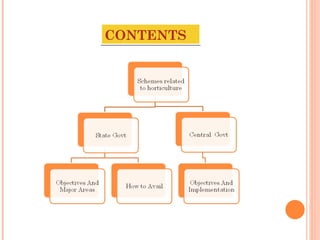
CONTENTS
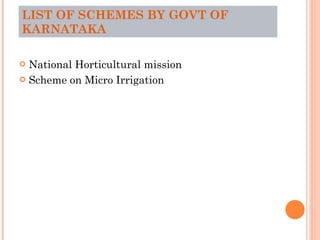
LIST OF SCHEMES BY GOVT OF KARNATAKA National Horticultural mission Scheme on Micro Irrigation
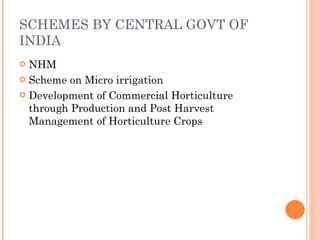
SCHEMES BY CENTRAL GOVT OF INDIA NHM Scheme on Micro irrigation Development of Commercial Horticulture through Production and Post Harvest Management of Horticulture Crops
Capital Investment Subsidy Scheme for construction/ expansion/ modernization of Cold Storages/Storages of Horticulture Produce Technology Development and Transfer for promotion of Horticulture Market Information Service for Horticulture Crops National Medicinal Plants Board and schemes
The Government of India provide assistance  85%  with  15%  contribution by the State Governments. AIM- Promote  holistic growth  of the horticulture sector covering fruits, vegetables, root & tuber crops, mushroom, spices, flowers, aromatic plants, cashew and cocoa NATIONAL HORTICULTURAL MISSION
OBJECTIVES Holistic growth  of the horticulture sector To enhance horticulture  production To establish  convergence and synergy  among multiple on-going and planned programmes for horticulture development; To create opportunities for  employment generation  for skilled and unskilled persons.
Promote  R&D technologies  for production, post-harvest management and processing. Enhance acreage, coverage, and productivity Diversification , from traditional crops to plantations, orchards, vineyards, flower and vegetable gardens  Extension of appropriate technology to the farmers for  high-tech horticulture cultivation and precision farming.
Assist setting up  post harvest facilities  such as pack house, ripening chamber, cold storages, Controlled Atmosphere (CA) 
Nurseries The nurseries which would be established under the Public sector will be eligible for 100% assistance for the nurseries in the Private sector, the  assistance will be 50% of the cost , as Credit linked subsidy MAJOR  AREAS
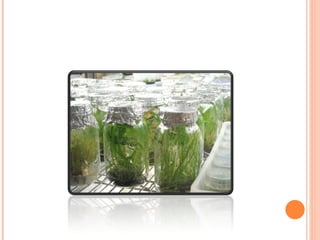
TISSUE CULTURE UNITS Rehabilitation/ strengthening  of existing TC Units subject to a maximum ceiling of Rs.15.00 lakh 50% of the cost   as Credit linked subsidy, with a  ceiling of Rs.7.50 lakh  for the TC units in the Private sector.
 
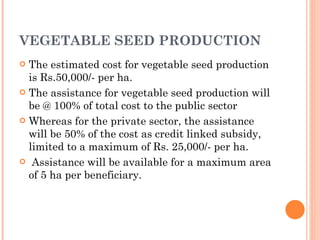
VEGETABLE SEED PRODUCTION The estimated cost for vegetable seed production is Rs.50,000/- per ha.   The assistance for vegetable seed production will be @ 100% of total cost to the public sector Whereas for the private sector, the assistance will be 50% of the cost as credit linked subsidy, limited to a maximum of Rs. 25,000/- per ha.   Assistance will be available for a maximum area of 5 ha per beneficiary.
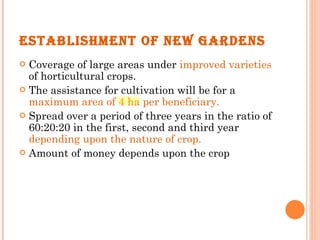
ESTABLISHMENT OF NEW GARDENS Coverage of large areas under  improved varieties  of horticultural crops. The assistance for cultivation will be for a  maximum area of 4 ha per beneficiary. Spread over a period of three years in the ratio of 60:20:20 in the first, second and third year  depending upon the nature of crop. Amount of money depends upon the crop
 
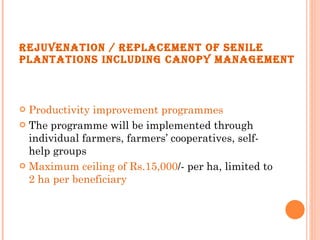
REJUVENATION / REPLACEMENT OF SENILE PLANTATIONS INCLUDING CANOPY MANAGEMENT Productivity improvement programmes The programme will be implemented through individual farmers, farmers’ cooperatives, self-help groups Maximum ceiling of Rs.15,000 /- per ha, limited to  2 ha per beneficiary
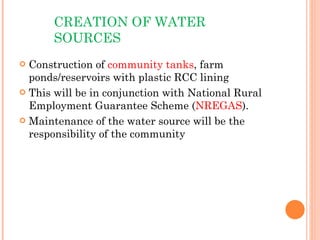
CREATION OF WATER SOURCES Construction of  community tanks , farm ponds/reservoirs with plastic RCC lining This will be in conjunction with National Rural Employment Guarantee Scheme ( NREGAS ). Maintenance of the water source will be the responsibility of the community
Activities like construction of shade net house, green houses, mulching, and plastic tunnels, anti bird/ hail nets would be promoted PROTECTED CULTIVATION
 
 
PROMOTION OF INTEGRATED NUTRIENT MANAGEMENT (INM) AND INTEGRATED PEST MANAGEMENT (IPM) Assistance for INM and IPM will be @ 50% of cost subject to a maximum ceiling of  Rs.1000/- per ha limited to 4 ha per beneficiary
HUMAN RESOURCE DEVELOPMENT (HRD) IN HORTICULTURE Human resource development through trainings and demonstrations is an integral part of the Mission It is proposed to provide assistance to the agencies involved in training programme @ of Rs.1500/- per farmer trained
Mechanization of horticulture related activities to improve farm efficiency and reduce drudgery of farm work force HORTICULTURE MECHANIZATION “ Indian Agriculture cannot develop un till and unless every farmer  has a Tractor in his field and eyes on market”
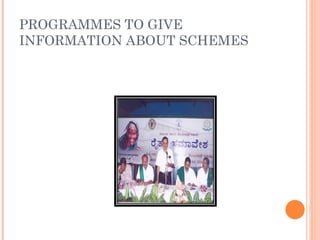
PROGRAMMES TO GIVE INFORMATION ABOUT SCHEMES
PRESENT STATUS As Bacterial blight is the major problem for the cultivation of Pomegranate Govt has sanctioned 50 lakhs for research on it to UAS Dharwad. Germplasm conservation of 51 rare medicinal plants found only in Western Ghats. Total amounts of funds used under NHM in Karnataka is 9900.98 lakhs. Assistance to around 19985.39 ha area for establishing gardens. Assistance to adopt organic farming in 2703 ha.
Under IPM sub scheme of NHM, Grants have been given to farmers for the control of Bacterial blight of pomegranate and Kole roga of Arecanut
WHOM TO CONTACT ????? Implemented by the State Horticulture Mission At the district level, the  District level Committee  is responsible for implementing the programme. The  District Horticulture officer  is the Member Secretary of the DLC, who may be contacted for availing the assistance. At Taluk level  Assistant Director of Horticulture  can be contacted to avail the scheme
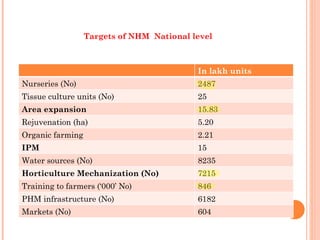
Targets of NHM  National level In lakh units Nurseries (No) 2487 Tissue culture units (No) 25 Area expansion 15.83 Rejuvenation (ha) 5.20 Organic farming  2.21 IPM 15 Water sources (No) 8235 Horticulture Mechanization (No) 7215 Training to farmers (‘000’ No) 846 PHM infrastructure (No) 6182 Markets (No) 604
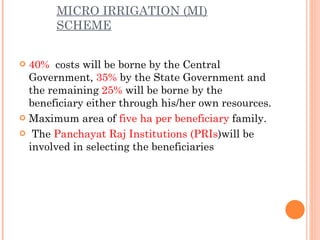
MICRO IRRIGATION (MI) SCHEME 40%   costs will be borne by the Central Government,  35%  by the State Government and the remaining  25%  will be borne by the beneficiary either through his/her own resources. Maximum area of  five ha per beneficiary  family.   The  Panchayat Raj Institutions (PRIs )will be involved in selecting the beneficiaries
 
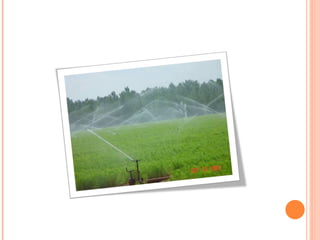
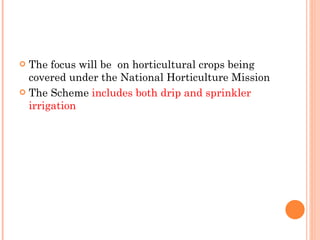
The focus will be  on horticultural crops being covered under the National Horticulture Mission The Scheme  includes both drip and sprinkler irrigation
PRESENT STATUS Total of 5595.88 lakhs assistance given. 24,766 ha area brought under micro irrigation.
District Rural Development Agencies (DRDA ) or any identified Agency, to whom funds will be released directly on the basis of approved district plans for each year IMPLEMENTATION
District Deputy Director of Horticulture (ZP )/ Taluk Senior Assistant Director of Horticulture/ Assistant Director of Horticulture WHOM TO CONTACT
Schemes Implemented By Central Government And its agencies
DEVELOPMENT OF COMMERCIAL HORTICULTURE THROUGH PRODUCTION AND POST HARVEST MANAGEMENT OF HORTICULTURE CROPS- NHB Credit linked projects relating to establishment of  hi-tech commercial production units . Credit linked subsidy @  20% of the total project cost limited to Rs 25 lakh  per project in general area. The above assistance shall be available for projects covering area  above four hectares  (above 10 acre in case of open cultivation,) More than 1000 sq. meter in case of protected cultivation.
Credit linked projects relating to Cold Storages including Controlled Atmosphere (CA) and Modified Atmosphere (MA) Stores, pre-cooling units, other Storages for onion, etc The assistance will be as credit linked back-ended subsidy  @ 40% of the capital cost of project . CAPITAL INVESTMENT SUBSIDY SCHEME FOR CONSTRUCTION/ EXPANSION/ MODERNIZATION OF COLD STORAGES/STORAGES OF HORTICULTURE PRODUCE
National Horticulture Board No. 14/43, 2nd Floor, 1 & 2 Stage Industrial Suburb, Tumkur Road, Yeshwantpur BANGALORE 560022 Tele/Fax : 08023371935, 23374149 [email_address]   and  nhbblr@yahoo.com
TECHNOLOGY DEVELOPMENT AND TRANSFER FOR PROMOTION OF HORTICULTURE i)  Introduction of New Technology ii)  Visit of progressive farmers iii)  Promotional and Extension Activities iv)  Technical knowhow from India/Abroad v)  Technology Awareness vi)  Organising/participation in  seminars/symposia/exhibitions
viii) Publicity and Films ix) Awareness for technology up gradation and markets x) Honorarium to scientists for effective transfer of technology. xi) Accreditation and Rating of Horticulture Nurseries xii) Mother Plant Nurseries for pedigreed planting material for fruit crops xiii) Assistance for Common Facilities in Horticulture Parks/ Agri Export Zones etc.
IMPLEMENTATION AND FALLOW UP Concentrated efforts by Coordinating all Line departments, NHB, State NHM division, ICAR institutes, SAU’s, KVK etc.
MARKET INFORMATION SERVICE FOR HORTICULTURE CROPS Objectives To generate information on wholesale prices, arrivals and trends To analyze the trends of arrivals, prices and other related factors and generate Market Intelligence Reports
To establish a nation-wide communication network for speedy collection and dissemination of market information data for its efficient and timely utilization. To collect and disseminate information on international prices prevailing in potential foreign markets To collect and compile  horticulture database  and strengthen existing system of ‘Crop Estimation Survey-Fruits & Vegetables’ (CES-F&V) as far as possible
Coverage of markets by NHB shall be increased from 36 fruits and vegetables markets to 100 markets.  This will be done by outsourcing existing marketing/professional agencies/ unemployed Agriculture graduates or recognized/ established brokers in Mandi etc.
NATIONAL MEDICINAL PLANTS BOARD 24th November 2000 under the Chairpersonship of Union Health & Family Welfare Minister. Promotional scheme  mainly includes survey, conservation, herbal gardens, extension activities, demand-supply studies, R&D, value addition etc. and Commercial scheme  mainly includes production of quality planting material, large scale cultivation, post harvest technology studies, innovative marketing mechanism etc.
Sponsored by Central Government -100%.  Implemented by the Division of Horticulture THE NATIONAL BAMBOO MISSION-2006
MISSION OBJECTIVES  To promote the growth of the bamboo sector. To increase the coverage of area under bamboo in potential areas, with improved varieties to enhance yields. To promote  marketing  of bamboo and bamboo based handicrafts. To generate  employment opportunities  for skilled and unskilled persons, especially unemployed youths.
MISSION STRATEGY  Adopt a coordinated approach Promote Research and Development (R&D) of varieties and technologies for enhanced production. To generate employment opportunities for skilled and unskilled persons, especially unemployed youths .
 

Horticulture related Developmental programmes

  • 1.
  • 2.
    SCHEMES AND PROGRAMMESRELATED TO HORTICULTURE Presentation by Aditya K.S
  • 3.
  • 4.
    LIST OF SCHEMESBY GOVT OF KARNATAKA National Horticultural mission Scheme on Micro Irrigation
  • 5.
    SCHEMES BY CENTRALGOVT OF INDIA NHM Scheme on Micro irrigation Development of Commercial Horticulture through Production and Post Harvest Management of Horticulture Crops
  • 6.
    Capital Investment SubsidyScheme for construction/ expansion/ modernization of Cold Storages/Storages of Horticulture Produce Technology Development and Transfer for promotion of Horticulture Market Information Service for Horticulture Crops National Medicinal Plants Board and schemes
  • 7.
    The Government ofIndia provide assistance 85% with 15% contribution by the State Governments. AIM- Promote holistic growth of the horticulture sector covering fruits, vegetables, root & tuber crops, mushroom, spices, flowers, aromatic plants, cashew and cocoa NATIONAL HORTICULTURAL MISSION
  • 8.
    OBJECTIVES Holistic growth of the horticulture sector To enhance horticulture production To establish convergence and synergy among multiple on-going and planned programmes for horticulture development; To create opportunities for employment generation for skilled and unskilled persons.
  • 9.
    Promote R&Dtechnologies for production, post-harvest management and processing. Enhance acreage, coverage, and productivity Diversification , from traditional crops to plantations, orchards, vineyards, flower and vegetable gardens  Extension of appropriate technology to the farmers for high-tech horticulture cultivation and precision farming.
  • 10.
    Assist setting up post harvest facilities such as pack house, ripening chamber, cold storages, Controlled Atmosphere (CA) 
  • 11.
    Nurseries The nurserieswhich would be established under the Public sector will be eligible for 100% assistance for the nurseries in the Private sector, the assistance will be 50% of the cost , as Credit linked subsidy MAJOR AREAS
  • 12.
    TISSUE CULTURE UNITSRehabilitation/ strengthening of existing TC Units subject to a maximum ceiling of Rs.15.00 lakh 50% of the cost   as Credit linked subsidy, with a ceiling of Rs.7.50 lakh for the TC units in the Private sector.
  • 13.
  • 14.
    VEGETABLE SEED PRODUCTIONThe estimated cost for vegetable seed production is Rs.50,000/- per ha.  The assistance for vegetable seed production will be @ 100% of total cost to the public sector Whereas for the private sector, the assistance will be 50% of the cost as credit linked subsidy, limited to a maximum of Rs. 25,000/- per ha.   Assistance will be available for a maximum area of 5 ha per beneficiary.
  • 15.
    ESTABLISHMENT OF NEWGARDENS Coverage of large areas under improved varieties of horticultural crops. The assistance for cultivation will be for a maximum area of 4 ha per beneficiary. Spread over a period of three years in the ratio of 60:20:20 in the first, second and third year depending upon the nature of crop. Amount of money depends upon the crop
  • 16.
  • 17.
    REJUVENATION / REPLACEMENTOF SENILE PLANTATIONS INCLUDING CANOPY MANAGEMENT Productivity improvement programmes The programme will be implemented through individual farmers, farmers’ cooperatives, self-help groups Maximum ceiling of Rs.15,000 /- per ha, limited to 2 ha per beneficiary
  • 18.
    CREATION OF WATERSOURCES Construction of community tanks , farm ponds/reservoirs with plastic RCC lining This will be in conjunction with National Rural Employment Guarantee Scheme ( NREGAS ). Maintenance of the water source will be the responsibility of the community
  • 19.
    Activities like constructionof shade net house, green houses, mulching, and plastic tunnels, anti bird/ hail nets would be promoted PROTECTED CULTIVATION
  • 20.
  • 21.
  • 22.
    PROMOTION OF INTEGRATEDNUTRIENT MANAGEMENT (INM) AND INTEGRATED PEST MANAGEMENT (IPM) Assistance for INM and IPM will be @ 50% of cost subject to a maximum ceiling of Rs.1000/- per ha limited to 4 ha per beneficiary
  • 23.
    HUMAN RESOURCE DEVELOPMENT(HRD) IN HORTICULTURE Human resource development through trainings and demonstrations is an integral part of the Mission It is proposed to provide assistance to the agencies involved in training programme @ of Rs.1500/- per farmer trained
  • 24.
    Mechanization of horticulturerelated activities to improve farm efficiency and reduce drudgery of farm work force HORTICULTURE MECHANIZATION “ Indian Agriculture cannot develop un till and unless every farmer has a Tractor in his field and eyes on market”
  • 25.
    PROGRAMMES TO GIVEINFORMATION ABOUT SCHEMES
  • 26.
    PRESENT STATUS AsBacterial blight is the major problem for the cultivation of Pomegranate Govt has sanctioned 50 lakhs for research on it to UAS Dharwad. Germplasm conservation of 51 rare medicinal plants found only in Western Ghats. Total amounts of funds used under NHM in Karnataka is 9900.98 lakhs. Assistance to around 19985.39 ha area for establishing gardens. Assistance to adopt organic farming in 2703 ha.
  • 27.
    Under IPM subscheme of NHM, Grants have been given to farmers for the control of Bacterial blight of pomegranate and Kole roga of Arecanut
  • 28.
    WHOM TO CONTACT????? Implemented by the State Horticulture Mission At the district level, the District level Committee is responsible for implementing the programme. The District Horticulture officer is the Member Secretary of the DLC, who may be contacted for availing the assistance. At Taluk level Assistant Director of Horticulture can be contacted to avail the scheme
  • 29.
    Targets of NHM National level In lakh units Nurseries (No) 2487 Tissue culture units (No) 25 Area expansion 15.83 Rejuvenation (ha) 5.20 Organic farming 2.21 IPM 15 Water sources (No) 8235 Horticulture Mechanization (No) 7215 Training to farmers (‘000’ No) 846 PHM infrastructure (No) 6182 Markets (No) 604
  • 30.
    MICRO IRRIGATION (MI)SCHEME 40% costs will be borne by the Central Government, 35% by the State Government and the remaining 25% will be borne by the beneficiary either through his/her own resources. Maximum area of five ha per beneficiary family.   The Panchayat Raj Institutions (PRIs )will be involved in selecting the beneficiaries
  • 31.
  • 32.
    The focus willbe  on horticultural crops being covered under the National Horticulture Mission The Scheme includes both drip and sprinkler irrigation
  • 33.
    PRESENT STATUS Totalof 5595.88 lakhs assistance given. 24,766 ha area brought under micro irrigation.
  • 34.
    District Rural DevelopmentAgencies (DRDA ) or any identified Agency, to whom funds will be released directly on the basis of approved district plans for each year IMPLEMENTATION
  • 35.
    District Deputy Directorof Horticulture (ZP )/ Taluk Senior Assistant Director of Horticulture/ Assistant Director of Horticulture WHOM TO CONTACT
  • 36.
    Schemes Implemented ByCentral Government And its agencies
  • 37.
    DEVELOPMENT OF COMMERCIALHORTICULTURE THROUGH PRODUCTION AND POST HARVEST MANAGEMENT OF HORTICULTURE CROPS- NHB Credit linked projects relating to establishment of hi-tech commercial production units . Credit linked subsidy @ 20% of the total project cost limited to Rs 25 lakh per project in general area. The above assistance shall be available for projects covering area above four hectares (above 10 acre in case of open cultivation,) More than 1000 sq. meter in case of protected cultivation.
  • 38.
    Credit linked projectsrelating to Cold Storages including Controlled Atmosphere (CA) and Modified Atmosphere (MA) Stores, pre-cooling units, other Storages for onion, etc The assistance will be as credit linked back-ended subsidy @ 40% of the capital cost of project . CAPITAL INVESTMENT SUBSIDY SCHEME FOR CONSTRUCTION/ EXPANSION/ MODERNIZATION OF COLD STORAGES/STORAGES OF HORTICULTURE PRODUCE
  • 39.
    National Horticulture BoardNo. 14/43, 2nd Floor, 1 & 2 Stage Industrial Suburb, Tumkur Road, Yeshwantpur BANGALORE 560022 Tele/Fax : 08023371935, 23374149 [email_address] and nhbblr@yahoo.com
  • 40.
    TECHNOLOGY DEVELOPMENT ANDTRANSFER FOR PROMOTION OF HORTICULTURE i) Introduction of New Technology ii) Visit of progressive farmers iii) Promotional and Extension Activities iv) Technical knowhow from India/Abroad v) Technology Awareness vi) Organising/participation in seminars/symposia/exhibitions
  • 41.
    viii) Publicity andFilms ix) Awareness for technology up gradation and markets x) Honorarium to scientists for effective transfer of technology. xi) Accreditation and Rating of Horticulture Nurseries xii) Mother Plant Nurseries for pedigreed planting material for fruit crops xiii) Assistance for Common Facilities in Horticulture Parks/ Agri Export Zones etc.
  • 42.
    IMPLEMENTATION AND FALLOWUP Concentrated efforts by Coordinating all Line departments, NHB, State NHM division, ICAR institutes, SAU’s, KVK etc.
  • 43.
    MARKET INFORMATION SERVICEFOR HORTICULTURE CROPS Objectives To generate information on wholesale prices, arrivals and trends To analyze the trends of arrivals, prices and other related factors and generate Market Intelligence Reports
  • 44.
    To establish anation-wide communication network for speedy collection and dissemination of market information data for its efficient and timely utilization. To collect and disseminate information on international prices prevailing in potential foreign markets To collect and compile horticulture database and strengthen existing system of ‘Crop Estimation Survey-Fruits & Vegetables’ (CES-F&V) as far as possible
  • 45.
    Coverage of marketsby NHB shall be increased from 36 fruits and vegetables markets to 100 markets. This will be done by outsourcing existing marketing/professional agencies/ unemployed Agriculture graduates or recognized/ established brokers in Mandi etc.
  • 46.
    NATIONAL MEDICINAL PLANTSBOARD 24th November 2000 under the Chairpersonship of Union Health & Family Welfare Minister. Promotional scheme  mainly includes survey, conservation, herbal gardens, extension activities, demand-supply studies, R&D, value addition etc. and Commercial scheme  mainly includes production of quality planting material, large scale cultivation, post harvest technology studies, innovative marketing mechanism etc.
  • 47.
    Sponsored by CentralGovernment -100%. Implemented by the Division of Horticulture THE NATIONAL BAMBOO MISSION-2006
  • 48.
    MISSION OBJECTIVES  Topromote the growth of the bamboo sector. To increase the coverage of area under bamboo in potential areas, with improved varieties to enhance yields. To promote marketing of bamboo and bamboo based handicrafts. To generate employment opportunities for skilled and unskilled persons, especially unemployed youths.
  • 49.
    MISSION STRATEGY Adopt a coordinated approach Promote Research and Development (R&D) of varieties and technologies for enhanced production. To generate employment opportunities for skilled and unskilled persons, especially unemployed youths .
  • 50.