
Cara Mullen
• Starch and Enzyme Stuff
Indiana University alumni
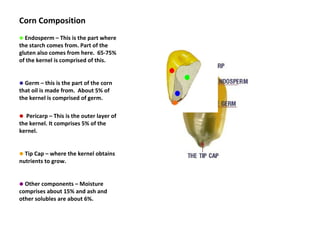
Corn Composition
•Endosperm – This is the part where
the starch comes from. Part of the
gluten also comes from here. 65-75%
of the kernel is comprised of this.
•Germ – this is the part of the corn
that oil is made from. About 5% of
the kernel is comprised of germ.
• Pericarp – This is the outer layer of
the kernel. It comprises 5% of the
kernel.
•Tip Cap – where the kernel obtains
nutrients to grow.
•Other components – Moisture
comprises about 15% and ash and
other solubles are about 6%.
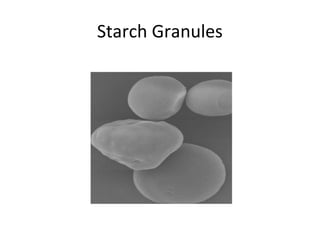
Starch Granules
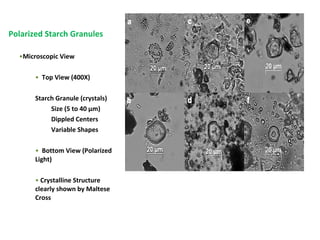
Polarized Starch Granules
•Microscopic View
• Top View (400X)
Starch Granule (crystals)
Size (5 to 40 µm)
Dippled Centers
Variable Shapes
• Bottom View (Polarized
Light)
• Crystalline Structure
clearly shown by Maltese
Cross
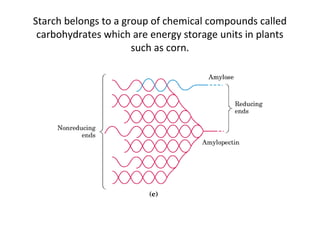
Starch belongs to a group of chemical compounds called
carbohydrates which are energy storage units in plants
such as corn.
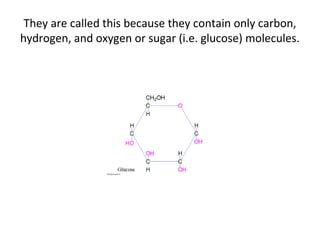
They are called this because they contain only carbon,
hydrogen, and oxygen or sugar (i.e. glucose) molecules.
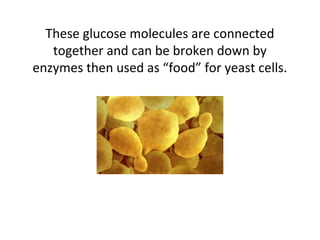
These glucose molecules are connected
together and can be broken down by
enzymes then used as “food” for yeast cells.
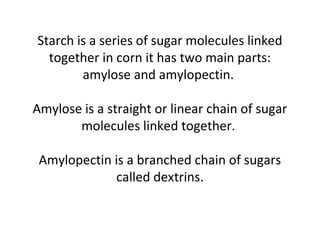
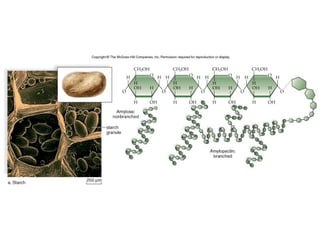
Starch is a series of sugar molecules linked
together in corn it has two main parts:
amylose and amylopectin.
Amylose is a straight or linear chain of sugar
molecules linked together.
Amylopectin is a branched chain of sugars
called dextrins.
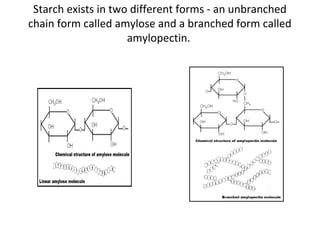
Starch exists in two different forms - an unbranched
chain form called amylose and a branched form called
amylopectin.
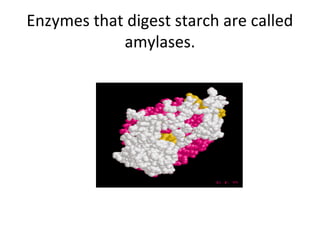
Enzymes that digest starch are called
amylases.
Tradename: SPEZYME®
XTRA
Alpha amylase
Liquefying enzyme
Slurry enzyme
Enzyme randomly hydrolyzes α-1,4-
glucosidic bonds to reduce the
viscosity of gelatinized starch
producing soluble dextrins and
oligosaccharides.
Alpha Amylase
is a catalytic protein (enzyme) which is
harvested from genetically modified bacteria.
Most alpha amylases are “thermostable”
meaning tolerating higher heat which increases
enzyme half-life and reaction rate.
Optimum pH ~ 5.8
Temperature ~ 175-185º
Genencor industrial enzymes
• Controlled fermentation of non-pathogenic
microorganisms.
• Most industrial enzymes are made from
bacteria, yeast and fungi.
• Usually sold as concentrated, partially purified.
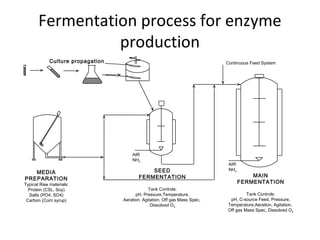
Fermentation process for enzyme
production
MEDIA
PREPARATION
Typical Raw materials:
Protein (CSL, Soy)
Salts (PO4, SO4)
Carbon (Corn syrup)
AIR
NH3
Culture propagation
SEED
FERMENTATION
Tank Controls:
pH, Pressure,Temperature,
Aeration, Agitation, Off gas Mass Spec,
Dissolved O2
MAIN
FERMENTATION
Tank Controls:
pH, C-source Feed, Pressure,
Temperature,Aeration, Agitation,
Off gas Mass Spec, Dissolved O2
AIR
NH3
Continuous Feed System
General Enzyme (Catalytic Proteins) Properties
In general, enzymes share the properties of globular proteins:
• Soluble in water.
• Insoluble in organic solvents.
• Denature and lose their catalytic properties due to heat, pH,
some chemicals, and heavy metals.
• Stabilized by ions such as sodium, potassium and calcium.
• One distinctive property of enzymes versus chemical
catalysts is their thermal sensitivity to acids and bases.
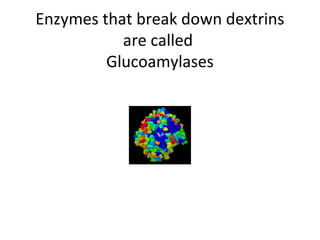
Enzymes that break down dextrins
are called
Glucoamylases
Glucoamylase
is a catalytic protein (enzyme) which is
harvested from fungi.
Best pH 3.5 - 6.5 at
Fermentation temperature 88 - 94ºF
Tighter pH 4.0 – 5.0 at
Saccharification temperature 140 - 150ºF
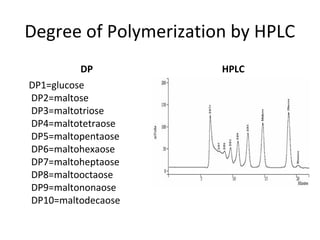
DP = Degree of Polymerization
number of dextrose molecules
linked together examples: DP1,
DP2, DP3, DP4…DP10…
Degree of Polymerization by HPLC
DP
DP1=glucose
DP2=maltose
DP3=maltotriose
DP4=maltotetraose
DP5=maltopentaose
DP6=maltohexaose
DP7=maltoheptaose
DP8=maltooctaose
DP9=maltononaose
DP10=maltodecaose
HPLC
The extent of starch hydrolysis is expressed as Dextrose
Equivalent (DE). DE is the percentage of glucosyl bonds that
have been broken.
Dextrose is another word for D-glucose.
So, DE will be low (4 - 6) at the beginning of the process such
as the Slurry tank outlet.
Meaning: Mostly large molecules exist and not many molecules
of glucose.
DEXTROSE EQUIVALENT (DE)
When the DE is 100, all of the bonds between glucose units in the starch have been
hydrolyzed. About 10% of the starch bonds are broken by the end of Conversion and
up to half of the bonds are broken coming out of Saccharification.
If half of the starch bonds are hydrolyzed the average DP is 2 and the
DE = 50
example: 25% DP1 + 25% DP3 + 50% DP2 = 50 DE
If a fourth of the starch bonds are broken the average DP is 4 and the
DE = 25.
DE determines the average DP length of the liquefied mash.
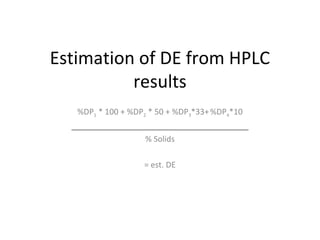
Estimation of DE from HPLC
results
%DP1 * 100 + %DP2 * 50 + %DP3*33+%DP4*10
________________________________________
% Solids
= est. DE
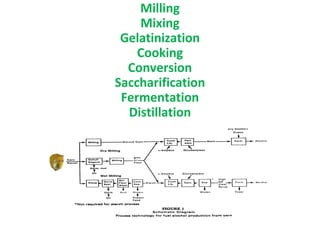
Milling
Mixing
Gelatinization
Cooking
Conversion
Saccharification
Fermentation
Distillation
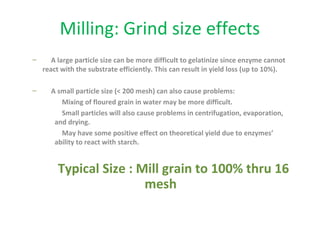
Milling: Grind size effects
– A large particle size can be more difficult to gelatinize since enzyme cannot
react with the substrate efficiently. This can result in yield loss (up to 10%).
– A small particle size (< 200 mesh) can also cause problems:
Mixing of floured grain in water may be more difficult.
Small particles will also cause problems in centrifugation, evaporation,
and drying.
May have some positive effect on theoretical yield due to enzymes’
ability to react with starch.
Typical Size : Mill grain to 100% thru 16
mesh
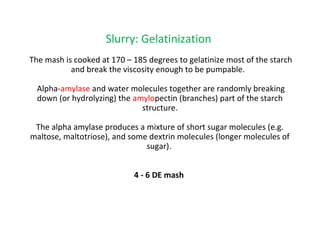
Slurry: Gelatinization
The mash is cooked at 170 – 185 degrees to gelatinize most of the starch
and break the viscosity enough to be pumpable.
Alpha-amylase and water molecules together are randomly breaking
down (or hydrolyzing) the amylopectin (branches) part of the starch
structure.
The alpha amylase produces a mixture of short sugar molecules (e.g.
maltose, maltotriose), and some dextrin molecules (longer molecules of
sugar).
4 - 6 DE mash
Liquefaction
Alpha amylase is denatured in Liquefaction
primarily because of heat.
The heat further breaks down starch
molecules for the second addition of alpha
amylase.
DE of 12 – 14
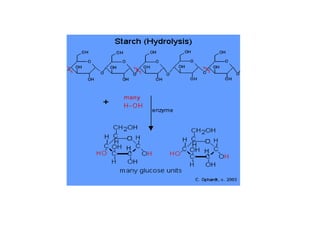
Purpose of Saccharification:
• To break down dextrin chains to maltose or
glucose molecules, using Glucoamylase which
specifically attacks 1-4 linkages, one glucose unit
at a time off non-reducing end. Also hydrolyzes
1-6 bonds using Pullulanase.
Purpose of Fermentation:
To produce ethanol through the
anaerobic conversion of glucose by
yeast.
51% of the glucose is converted to
ethanol and 49% is converted to
carbon dioxide
Ethanol Level at end of Fermentation is
typically 12 - 15% v/v.
This is what is happening through Fermentation?
Glucoamylase and water molecules together are randomly
breaking down (or hydrolyzing) the mixture of short sugar
molecules (e.g. maltose, maltotriose), and dextrin molecules
(longer molecules of sugar are also called oligosaccharides).
This produces individual molecules of glucose. Yeast
metabolize (or ferment) the glucose. The theoretical byproducts
are CO2 and Ethanol. In reality the yeast also produces some
glycerol, succinic acid, and new yeast.
Any Questions??

How Cara's presentation ethanol process

  • 1.
    Cara Mullen • Starchand Enzyme Stuff Indiana University alumni
  • 2.
    Corn Composition •Endosperm –This is the part where the starch comes from. Part of the gluten also comes from here. 65-75% of the kernel is comprised of this. •Germ – this is the part of the corn that oil is made from. About 5% of the kernel is comprised of germ. • Pericarp – This is the outer layer of the kernel. It comprises 5% of the kernel. •Tip Cap – where the kernel obtains nutrients to grow. •Other components – Moisture comprises about 15% and ash and other solubles are about 6%.
  • 3.
  • 4.
    Polarized Starch Granules •MicroscopicView • Top View (400X) Starch Granule (crystals) Size (5 to 40 µm) Dippled Centers Variable Shapes • Bottom View (Polarized Light) • Crystalline Structure clearly shown by Maltese Cross
  • 5.
    Starch belongs toa group of chemical compounds called carbohydrates which are energy storage units in plants such as corn.
  • 6.
    They are calledthis because they contain only carbon, hydrogen, and oxygen or sugar (i.e. glucose) molecules.
  • 7.
    These glucose moleculesare connected together and can be broken down by enzymes then used as “food” for yeast cells.
  • 8.
    Starch is aseries of sugar molecules linked together in corn it has two main parts: amylose and amylopectin. Amylose is a straight or linear chain of sugar molecules linked together. Amylopectin is a branched chain of sugars called dextrins.
  • 10.
    Starch exists intwo different forms - an unbranched chain form called amylose and a branched form called amylopectin.
  • 11.
    Enzymes that digeststarch are called amylases.
  • 12.
    Tradename: SPEZYME® XTRA Alpha amylase Liquefyingenzyme Slurry enzyme Enzyme randomly hydrolyzes α-1,4- glucosidic bonds to reduce the viscosity of gelatinized starch producing soluble dextrins and oligosaccharides.
  • 13.
    Alpha Amylase is acatalytic protein (enzyme) which is harvested from genetically modified bacteria. Most alpha amylases are “thermostable” meaning tolerating higher heat which increases enzyme half-life and reaction rate. Optimum pH ~ 5.8 Temperature ~ 175-185º
  • 14.
    Genencor industrial enzymes •Controlled fermentation of non-pathogenic microorganisms. • Most industrial enzymes are made from bacteria, yeast and fungi. • Usually sold as concentrated, partially purified.
  • 15.
    Fermentation process forenzyme production MEDIA PREPARATION Typical Raw materials: Protein (CSL, Soy) Salts (PO4, SO4) Carbon (Corn syrup) AIR NH3 Culture propagation SEED FERMENTATION Tank Controls: pH, Pressure,Temperature, Aeration, Agitation, Off gas Mass Spec, Dissolved O2 MAIN FERMENTATION Tank Controls: pH, C-source Feed, Pressure, Temperature,Aeration, Agitation, Off gas Mass Spec, Dissolved O2 AIR NH3 Continuous Feed System
  • 16.
    General Enzyme (CatalyticProteins) Properties In general, enzymes share the properties of globular proteins: • Soluble in water. • Insoluble in organic solvents. • Denature and lose their catalytic properties due to heat, pH, some chemicals, and heavy metals. • Stabilized by ions such as sodium, potassium and calcium. • One distinctive property of enzymes versus chemical catalysts is their thermal sensitivity to acids and bases.
  • 17.
    Enzymes that breakdown dextrins are called Glucoamylases
  • 18.
    Glucoamylase is a catalyticprotein (enzyme) which is harvested from fungi. Best pH 3.5 - 6.5 at Fermentation temperature 88 - 94ºF Tighter pH 4.0 – 5.0 at Saccharification temperature 140 - 150ºF
  • 20.
    DP = Degreeof Polymerization number of dextrose molecules linked together examples: DP1, DP2, DP3, DP4…DP10…
  • 21.
    Degree of Polymerizationby HPLC DP DP1=glucose DP2=maltose DP3=maltotriose DP4=maltotetraose DP5=maltopentaose DP6=maltohexaose DP7=maltoheptaose DP8=maltooctaose DP9=maltononaose DP10=maltodecaose HPLC
  • 22.
    The extent ofstarch hydrolysis is expressed as Dextrose Equivalent (DE). DE is the percentage of glucosyl bonds that have been broken. Dextrose is another word for D-glucose. So, DE will be low (4 - 6) at the beginning of the process such as the Slurry tank outlet. Meaning: Mostly large molecules exist and not many molecules of glucose.
  • 23.
    DEXTROSE EQUIVALENT (DE) Whenthe DE is 100, all of the bonds between glucose units in the starch have been hydrolyzed. About 10% of the starch bonds are broken by the end of Conversion and up to half of the bonds are broken coming out of Saccharification. If half of the starch bonds are hydrolyzed the average DP is 2 and the DE = 50 example: 25% DP1 + 25% DP3 + 50% DP2 = 50 DE If a fourth of the starch bonds are broken the average DP is 4 and the DE = 25. DE determines the average DP length of the liquefied mash.
  • 24.
    Estimation of DEfrom HPLC results %DP1 * 100 + %DP2 * 50 + %DP3*33+%DP4*10 ________________________________________ % Solids = est. DE
  • 25.
  • 26.
    Milling: Grind sizeeffects – A large particle size can be more difficult to gelatinize since enzyme cannot react with the substrate efficiently. This can result in yield loss (up to 10%). – A small particle size (< 200 mesh) can also cause problems: Mixing of floured grain in water may be more difficult. Small particles will also cause problems in centrifugation, evaporation, and drying. May have some positive effect on theoretical yield due to enzymes’ ability to react with starch. Typical Size : Mill grain to 100% thru 16 mesh
  • 27.
    Slurry: Gelatinization The mashis cooked at 170 – 185 degrees to gelatinize most of the starch and break the viscosity enough to be pumpable. Alpha-amylase and water molecules together are randomly breaking down (or hydrolyzing) the amylopectin (branches) part of the starch structure. The alpha amylase produces a mixture of short sugar molecules (e.g. maltose, maltotriose), and some dextrin molecules (longer molecules of sugar). 4 - 6 DE mash
  • 28.
    Liquefaction Alpha amylase isdenatured in Liquefaction primarily because of heat. The heat further breaks down starch molecules for the second addition of alpha amylase. DE of 12 – 14
  • 30.
    Purpose of Saccharification: •To break down dextrin chains to maltose or glucose molecules, using Glucoamylase which specifically attacks 1-4 linkages, one glucose unit at a time off non-reducing end. Also hydrolyzes 1-6 bonds using Pullulanase.
  • 31.
    Purpose of Fermentation: Toproduce ethanol through the anaerobic conversion of glucose by yeast. 51% of the glucose is converted to ethanol and 49% is converted to carbon dioxide Ethanol Level at end of Fermentation is typically 12 - 15% v/v.
  • 32.
    This is whatis happening through Fermentation? Glucoamylase and water molecules together are randomly breaking down (or hydrolyzing) the mixture of short sugar molecules (e.g. maltose, maltotriose), and dextrin molecules (longer molecules of sugar are also called oligosaccharides). This produces individual molecules of glucose. Yeast metabolize (or ferment) the glucose. The theoretical byproducts are CO2 and Ethanol. In reality the yeast also produces some glycerol, succinic acid, and new yeast.
  • 33.