Lecture 01
Introduction to Production Management
 Production is often used as manufacturing as well.
 The word manufacturing is derived from the Latin
words,” Menus” and ,”Factus” means hand and made.
Literally meaning is “Made by hand”.
 Thus “Production Engineering “ or “ Manufacturing
Engineering” may be defined as the art of making
components and machines of already planned quality
and quantity using all resources .
Introduction to Production
Management
 Product: It means some thing that is being to be produced.

 Production does not mean the making of goods ( Tangibly) but
in general it includes services ( Intangibly ) also.

 Productivity: For manufacturing enterprise ,
 The input resources are :
 Men, Money, Materials, machinery , Time , Energy, space etc.”

 The out put is ,” Goods and/or Services”

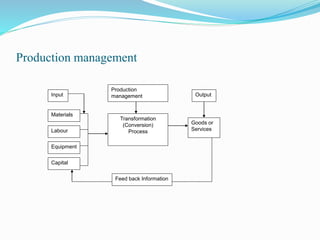
Production management
Input
Production
management Output
Materials
Labour
Equipment
Capital
Transformation
(Conversion)
Process
Goods or
Services
Feed back Information
Prepare by Engr Noshad Ali
Mehran UET Jamshoro
Production system
 The production system mainly uses facilities,
equipment's and operating methods ( called the
production system ) to produce goods .
 The requirements of a production system depend on the
type of product that the company offers and the strategy
that it employs to serve its customers.
Elements of Production system
Elements of production system are as follows ;
1. Product Design engineering
2. Purchasing
3. Sales and marketing
4. Financing and Accounting
5. Inventory control
6. Quality control
7. Research & development ( R & D )
8. Personnel Procurement including recruitment training ,
9. Industrial maintenance and safety
10. PPC (Production planning & Control)
11. Process Engineering
12. Plant Engineering
Production management
Elwood Buffa defines production management as follow:
Production management deals with decision-making related
to the production process so that the resulting goods or
services are produced according to specification, in the
amounts and by the schedule demanded and out minimum
cost
History and Development of
Production Management
 Production systems did not begin until the industrial
revolution in the 1700s.
 Prior to that time, the skilled craftsmen and their
apprentices fashioned goods for the individual customers.
 The typical production facility has a handful of
apprentice's workers under the supervision of master
craftsman cum owner .
 Its technology was embedded in minds and hands rather
than equipment
Continue
 Production design and production process were united in
the person of owner, materials and quality of control,
personnel scheduling were done from experience using
simple rules.
 Markets were small and distribution was uncompleted.
Objectives of Production
Management
 Production is an organized activity, and each organized
activity has its objectives.
 Which helps to evaluate its performance against the set
objectives
 The objective of the production management is stated as:
 To produce goods services of right quality and quantity at
the predetermined time and pre-established cost.
Objectives of Production
Management
 Thus, the objectives of production management are
reflected in
1) Right Quality
2) Right Quantity
3) Predetermined Time
4) Pre established Cost (Manufacturing Cost)
1. Right Quality
 The quality of the product is established based upon the
customer’s needs.
 Customer’s needs are translated into product.
specifications by the design or engineering department.
 The manufacturing department then translates these
specifications into measureable objectives.
Continue
 Thus, the cost quality trade off decides the final quality of
product.
 Thus, a proper balance must be obtained such that the
product quality offered to the customer should be within
the pre-established manufacturing cost.
2.Right Quantity
 The manufacturing organization should produce the
products at the right number.
 If the products are produced, in quantity excess of
demand the capital will block up in the form of inventory
and if it produce in quantity short of demand, these will be
shortages products. Thus, a decision is to be taken
regarding how much to produce.
(Right quantity)
3. Manufacturing costs
 Manufacturing cost are established before the product is
actually manufactured.
 The manufacturing department has to manufacturing the
products at the pre- established cost in any case, any
variation between the actual costs and the standards (pre
established) should be kept at minimum.
4. Manufacturing schedule
 Timeliness of delivery (schedule) is one of the important
parameter to judge the effectiveness of the production
department.
 There are many reasons like non-availability of materials
at right time, absenteeism, machine break down etc. which
effect the timely completion of the products. So the
manufacturing department should organize its activities in
such away that products will be manufactured.
Continue
 To achieve the above objectives, the manufacturing
production department has to make the optimum
utilization of resources of inputs like men, material and
machine.
 So, to have as better utilization of resources, the
production department has to achieve the other objectives,
which are lower in hierarchy.
Intermediate objectives:
 The intermediate objectives can be stated in terms of
1. Machinery and equipments
the objectives concerned to these areas is that the machine
and equipment should be such that they should be able
to produce the products as per the specifications and
accuracy required.
Continue
 The total cost of procurement and running cost should be
minimum.
 Once the machines are produced and put to productive
use, and then the next objectives is to utilize these
resources to the maximum extent.
2. Materials
 The material should be available when required as per the
specifications (shape, size , quality etc.) and at the most
economical price.
 The production department should aim at maximum
utilization of the material with minimum wastage and
scrap.
3.Manpower
 Manpower is an important resources or input to
production and the success of production depends to a
greater degree upon the type of manpower an organization
have.
 Thus these should be perfect matching between the
workers & jobs and the manufacturing department climate
should be such that the potential skills and energies for the
workers should be channelized in to constructive outputs.
 The objectives are set with respect to productivity per
worker . Labor turn rate, safety and industrial relations etc.
4. Supporting Services
 This helps indirectly to achieve the other objectives and
adequate provision of the services help to utilize other
inputs effectively.
 The objectives should be set for each of the services like
water steam power, material handling etc.
 Thus, intermediate objectives are supporting to the
primary objectives. The achievement of these objectives
helps the company to satisfy the customers needs and
increase the market share resulting in increased
profitability.

Production Management Lec-01.pptx

  • 1.
    Lecture 01 Introduction toProduction Management  Production is often used as manufacturing as well.  The word manufacturing is derived from the Latin words,” Menus” and ,”Factus” means hand and made. Literally meaning is “Made by hand”.  Thus “Production Engineering “ or “ Manufacturing Engineering” may be defined as the art of making components and machines of already planned quality and quantity using all resources .
  • 2.
    Introduction to Production Management Product: It means some thing that is being to be produced.   Production does not mean the making of goods ( Tangibly) but in general it includes services ( Intangibly ) also.   Productivity: For manufacturing enterprise ,  The input resources are :  Men, Money, Materials, machinery , Time , Energy, space etc.”   The out put is ,” Goods and/or Services” 
  • 3.
  • 4.
    Prepare by EngrNoshad Ali Mehran UET Jamshoro Production system  The production system mainly uses facilities, equipment's and operating methods ( called the production system ) to produce goods .  The requirements of a production system depend on the type of product that the company offers and the strategy that it employs to serve its customers.
  • 5.
    Elements of Productionsystem Elements of production system are as follows ; 1. Product Design engineering 2. Purchasing 3. Sales and marketing 4. Financing and Accounting 5. Inventory control 6. Quality control 7. Research & development ( R & D ) 8. Personnel Procurement including recruitment training , 9. Industrial maintenance and safety 10. PPC (Production planning & Control) 11. Process Engineering 12. Plant Engineering
  • 6.
    Production management Elwood Buffadefines production management as follow: Production management deals with decision-making related to the production process so that the resulting goods or services are produced according to specification, in the amounts and by the schedule demanded and out minimum cost
  • 7.
    History and Developmentof Production Management  Production systems did not begin until the industrial revolution in the 1700s.  Prior to that time, the skilled craftsmen and their apprentices fashioned goods for the individual customers.  The typical production facility has a handful of apprentice's workers under the supervision of master craftsman cum owner .  Its technology was embedded in minds and hands rather than equipment
  • 8.
    Continue  Production designand production process were united in the person of owner, materials and quality of control, personnel scheduling were done from experience using simple rules.  Markets were small and distribution was uncompleted.
  • 9.
    Objectives of Production Management Production is an organized activity, and each organized activity has its objectives.  Which helps to evaluate its performance against the set objectives  The objective of the production management is stated as:  To produce goods services of right quality and quantity at the predetermined time and pre-established cost.
  • 10.
    Objectives of Production Management Thus, the objectives of production management are reflected in 1) Right Quality 2) Right Quantity 3) Predetermined Time 4) Pre established Cost (Manufacturing Cost)
  • 11.
    1. Right Quality The quality of the product is established based upon the customer’s needs.  Customer’s needs are translated into product. specifications by the design or engineering department.  The manufacturing department then translates these specifications into measureable objectives.
  • 12.
    Continue  Thus, thecost quality trade off decides the final quality of product.  Thus, a proper balance must be obtained such that the product quality offered to the customer should be within the pre-established manufacturing cost.
  • 13.
    2.Right Quantity  Themanufacturing organization should produce the products at the right number.  If the products are produced, in quantity excess of demand the capital will block up in the form of inventory and if it produce in quantity short of demand, these will be shortages products. Thus, a decision is to be taken regarding how much to produce. (Right quantity)
  • 14.
    3. Manufacturing costs Manufacturing cost are established before the product is actually manufactured.  The manufacturing department has to manufacturing the products at the pre- established cost in any case, any variation between the actual costs and the standards (pre established) should be kept at minimum.
  • 15.
    4. Manufacturing schedule Timeliness of delivery (schedule) is one of the important parameter to judge the effectiveness of the production department.  There are many reasons like non-availability of materials at right time, absenteeism, machine break down etc. which effect the timely completion of the products. So the manufacturing department should organize its activities in such away that products will be manufactured.
  • 16.
    Continue  To achievethe above objectives, the manufacturing production department has to make the optimum utilization of resources of inputs like men, material and machine.  So, to have as better utilization of resources, the production department has to achieve the other objectives, which are lower in hierarchy.
  • 17.
    Intermediate objectives:  Theintermediate objectives can be stated in terms of 1. Machinery and equipments the objectives concerned to these areas is that the machine and equipment should be such that they should be able to produce the products as per the specifications and accuracy required.
  • 18.
    Continue  The totalcost of procurement and running cost should be minimum.  Once the machines are produced and put to productive use, and then the next objectives is to utilize these resources to the maximum extent.
  • 19.
    2. Materials  Thematerial should be available when required as per the specifications (shape, size , quality etc.) and at the most economical price.  The production department should aim at maximum utilization of the material with minimum wastage and scrap.
  • 20.
    3.Manpower  Manpower isan important resources or input to production and the success of production depends to a greater degree upon the type of manpower an organization have.  Thus these should be perfect matching between the workers & jobs and the manufacturing department climate should be such that the potential skills and energies for the workers should be channelized in to constructive outputs.  The objectives are set with respect to productivity per worker . Labor turn rate, safety and industrial relations etc.
  • 21.
    4. Supporting Services This helps indirectly to achieve the other objectives and adequate provision of the services help to utilize other inputs effectively.  The objectives should be set for each of the services like water steam power, material handling etc.  Thus, intermediate objectives are supporting to the primary objectives. The achievement of these objectives helps the company to satisfy the customers needs and increase the market share resulting in increased profitability.