Film production techniques
So far….. We have looked at the  structure  of narrative film. This can be summed up as the  story elements  of a film: Plot structure Cause and effect Narrative possibilities point of view Theme Genre Character Time structure  Setting Resolution
But that’s just half of it… The other important aspect of film are the techniques used to make them, or the  Production elements We’ve begun looking at these already, and most are obvious, like the type of shots and camera angles.
Mise en scene Is the umbrella term given to everything we see inside a shot or a scene Think of it as the  visual composition  of a film. How each individual component comes together to make meaning is one of the most analised elements of film studies.
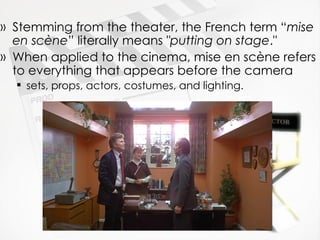
Stemming from the theater, the French term “ mise en scène ” literally means  "putting on stage ."  When applied to the cinema, mise en scène refers to everything that appears before the camera sets, props, actors, costumes, and lighting.
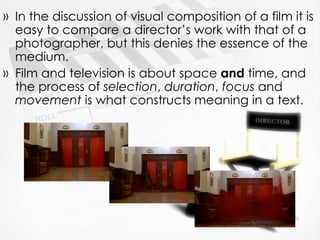
In the discussion of visual composition of a film it is easy to compare a director’s work with that of a photographer, but this denies the essence of the medium. Film and television is about space  and  time, and the process of  selection ,  duration ,  focus  and  movement  is what constructs meaning in a text.
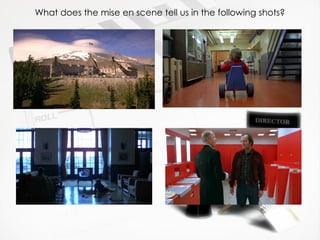
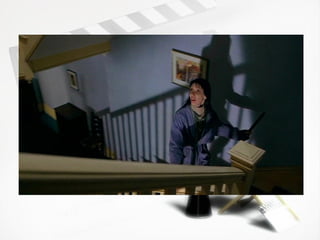
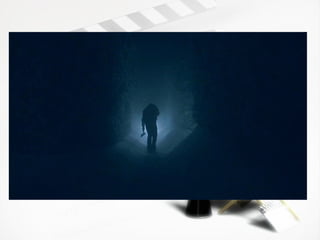
What does the mise en scene tell us in the following shots?
 
 
These single frames or stills from a film are the smallest single part of a film, like a letter is the smallest part of a novel. Taking this analogy further, the next step up from a letter is a word, and we can think of a  shot  the same way. Some principles of the shot: The longer a camera lingers on a subject, the more important that subject has to the narrative
More is more: the size of a character or object in a shot reveals much about the importance and/or dominance within the narrative Close ups are about emotional engagement and revealing secrets Light and shadow reveal goodness and badness in characters, places and objects. Camera angles reveal dominance and submission Smooth camera movements - pan, tilt, track, zoom - indicate control and order. Jerky hand held camera movements indicate disarray Selective focus forces an audience to attend to the subject and may raise questions about what and why they can’t clearly see some part of the action.
Examples.. As you can see I got sick of thinking for an example for each of the previous principles….. That’s your job.   Now.
Sound Diegetic sound Sound that comes from the narrative action Non-diegetic sound Sound that originates fromoutside the narrative
Diegetic You can think of this as every sound a character in a movie would hear;  dialogue ,  sound effects , and  music coming from a radio or band .
Non-diegetic Are all the sounds that a character could not hear inside the world of the narrative;  soundtrack music ,  film score ,  special sound effects  and  voice over . Non-diegetic is sometimes referred to as “ sound-over ”
 

Production Elements

  • 1.
  • 2.
    So far….. Wehave looked at the structure of narrative film. This can be summed up as the story elements of a film: Plot structure Cause and effect Narrative possibilities point of view Theme Genre Character Time structure Setting Resolution
  • 3.
    But that’s justhalf of it… The other important aspect of film are the techniques used to make them, or the Production elements We’ve begun looking at these already, and most are obvious, like the type of shots and camera angles.
  • 4.
    Mise en sceneIs the umbrella term given to everything we see inside a shot or a scene Think of it as the visual composition of a film. How each individual component comes together to make meaning is one of the most analised elements of film studies.
  • 5.
    Stemming from thetheater, the French term “ mise en scène ” literally means "putting on stage ." When applied to the cinema, mise en scène refers to everything that appears before the camera sets, props, actors, costumes, and lighting.
  • 6.
    In the discussionof visual composition of a film it is easy to compare a director’s work with that of a photographer, but this denies the essence of the medium. Film and television is about space and time, and the process of selection , duration , focus and movement is what constructs meaning in a text.
  • 7.
    What does themise en scene tell us in the following shots?
  • 8.
  • 9.
  • 10.
    These single framesor stills from a film are the smallest single part of a film, like a letter is the smallest part of a novel. Taking this analogy further, the next step up from a letter is a word, and we can think of a shot the same way. Some principles of the shot: The longer a camera lingers on a subject, the more important that subject has to the narrative
  • 11.
    More is more:the size of a character or object in a shot reveals much about the importance and/or dominance within the narrative Close ups are about emotional engagement and revealing secrets Light and shadow reveal goodness and badness in characters, places and objects. Camera angles reveal dominance and submission Smooth camera movements - pan, tilt, track, zoom - indicate control and order. Jerky hand held camera movements indicate disarray Selective focus forces an audience to attend to the subject and may raise questions about what and why they can’t clearly see some part of the action.
  • 12.
    Examples.. As youcan see I got sick of thinking for an example for each of the previous principles….. That’s your job. Now.
  • 13.
    Sound Diegetic soundSound that comes from the narrative action Non-diegetic sound Sound that originates fromoutside the narrative
  • 14.
    Diegetic You canthink of this as every sound a character in a movie would hear; dialogue , sound effects , and music coming from a radio or band .
  • 15.
    Non-diegetic Are allthe sounds that a character could not hear inside the world of the narrative; soundtrack music , film score , special sound effects and voice over . Non-diegetic is sometimes referred to as “ sound-over ”
  • 16.