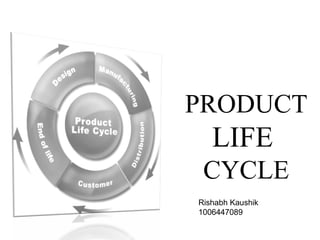
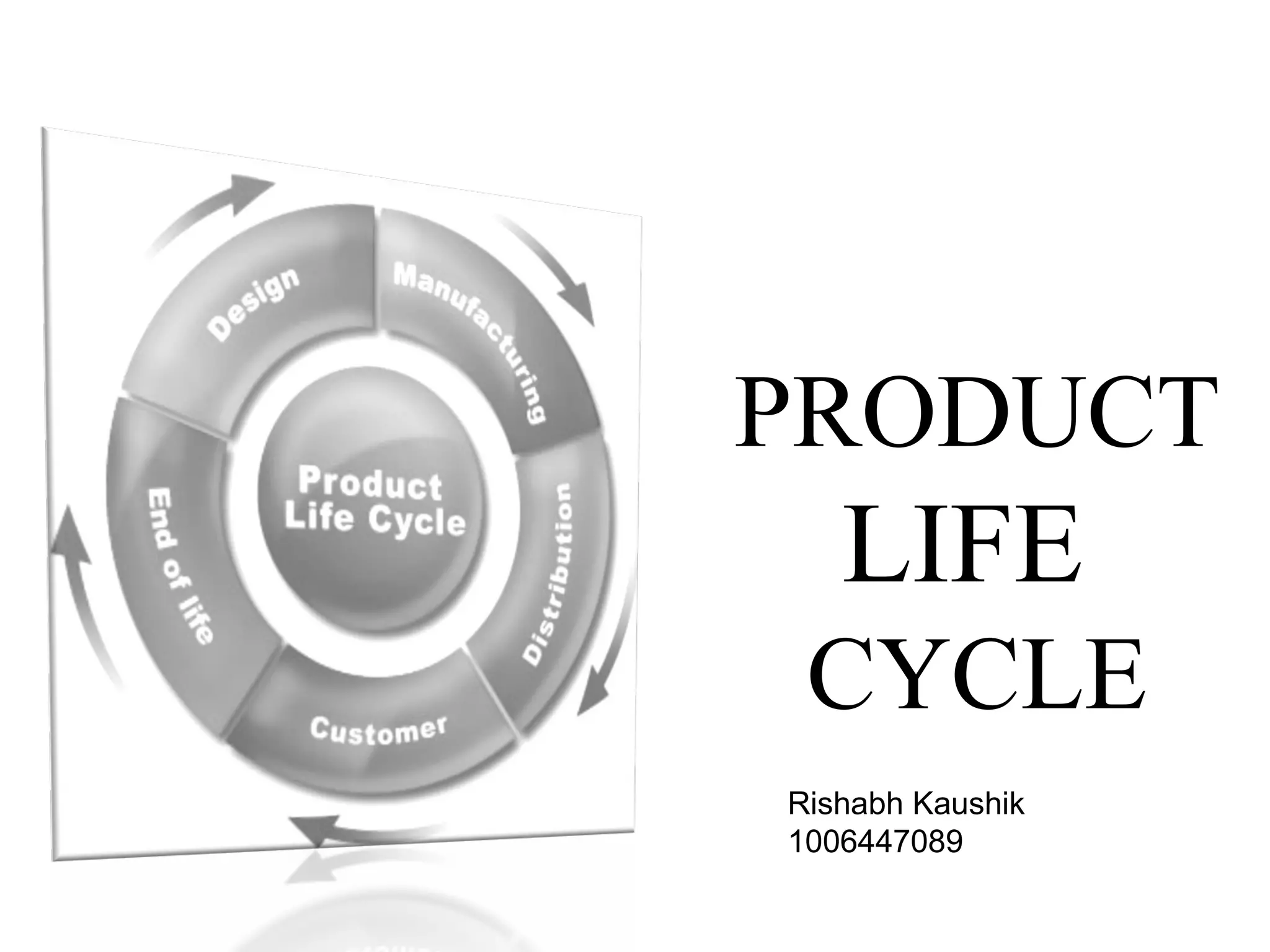
PRODUCT

LIFE
CYCLE
Rishabh Kaushik
1006447089
WHAT IS A PRODUCT?
A PRODUCT is anything that can be offered
to a market usually to satisfy a want or need
CATEGORIES
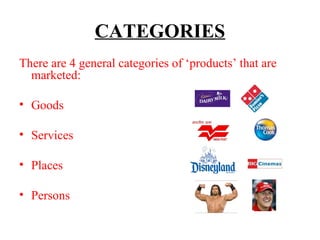
There are 4 general categories of ‘products’ that are
marketed:
• Goods
• Services
• Places
• Persons
PRODUCT LIFE CYCLE
• Every PRODUCT has a life cycle and asserts four
things about a PRODUCT
 PRODUCTS have a limited life
 PRODUCT sales pass through different stages each
posing different challenges, opportunities n problems to
the seller
 Profits rise n fall at different stages
 PRODUCTS require different marketing, financial,
purchasing strategies at each stage
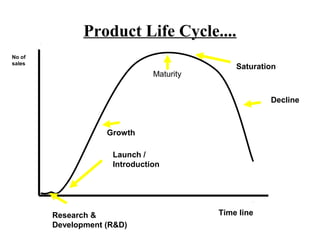
Product Life Cycle....
No of
sales

Maturity

Saturation

Decline

Growth
Launch /
Introduction

Research &
Development (R&D)

Time line
PRODUCT LIFE CYCLE......
RESEARCH AND DEVELOPMENT PHASE
•
•
•
•

Begins when the company develops a new-product idea
Sales are zero
Investment costs are high
Profits are negative
PRODUCT LIFE CYCLE......
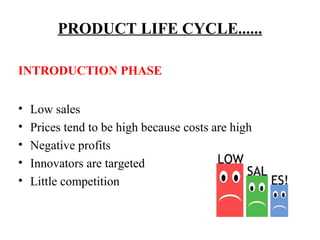
INTRODUCTION PHASE
•
•
•
•
•

Low sales
Prices tend to be high because costs are high
Negative profits
Innovators are targeted
Little competition
PRODUCT LIFE CYCLE......
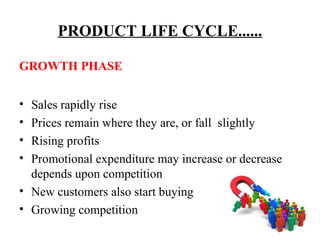
GROWTH PHASE
•
•
•
•

Sales rapidly rise
Prices remain where they are, or fall slightly
Rising profits
Promotional expenditure may increase or decrease
depends upon competition
• New customers also start buying
• Growing competition
PRODUCT LIFE CYCLE......
MATURITY PHASE
• Usually lasts longer than previous stages
• Divided into three phases:
1. Growth-sales growth rate starts to decline
2. Stable-sales flatten because of market saturation
3. Decaying maturity-the absolute level of sales begin to
decline and customers start switching to other products
PRODUCT LIFE CYCLE......
DECLINE PHASE
•Sales and profits decline
•Some companies withdraw their products from market
•Those remaining reduce number of products
•High prices on spare parts
•Focuses on cost reduction
MARKETING STRATEGY
INTRODUCTION PHASE
• Rapid-skimming strategy (high price/high promotion).
• Slow-skimming strategy (high price/low promotion).
• Rapid-penetration strategy (low price/high promotion).
• Slow-penetration strategy (low price/low promotion).
MARKETING STRATEGY
GROWTH PHASE
• Improve service quality and add new service features and
elements
• Enter new market segments
• Use new channels of distribution
• Lower prices to attract more price-sensitive customers
• Shift from product awareness advertising to productpreference advertising
MARKETING STRATEGY
MATURITY PHASE
1.

Market-modification strategy
• Increase frequency use by current consumers
• Look for new target market

1.

Product-modification strategy
• Quality improvement
• Feature improvement
MARKETING STRATEGY
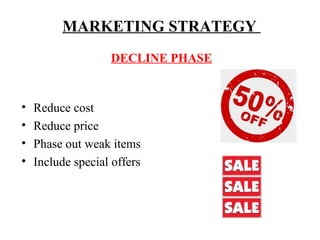
DECLINE PHASE

•
•
•
•

Reduce cost
Reduce price
Phase out weak items
Include special offers

Product life cycle

  • 1.
  • 2.
    WHAT IS APRODUCT? A PRODUCT is anything that can be offered to a market usually to satisfy a want or need
  • 3.
    CATEGORIES There are 4general categories of ‘products’ that are marketed: • Goods • Services • Places • Persons
  • 4.
    PRODUCT LIFE CYCLE •Every PRODUCT has a life cycle and asserts four things about a PRODUCT  PRODUCTS have a limited life  PRODUCT sales pass through different stages each posing different challenges, opportunities n problems to the seller  Profits rise n fall at different stages  PRODUCTS require different marketing, financial, purchasing strategies at each stage
  • 5.
    Product Life Cycle.... Noof sales Maturity Saturation Decline Growth Launch / Introduction Research & Development (R&D) Time line
  • 6.
    PRODUCT LIFE CYCLE...... RESEARCHAND DEVELOPMENT PHASE • • • • Begins when the company develops a new-product idea Sales are zero Investment costs are high Profits are negative
  • 7.
    PRODUCT LIFE CYCLE...... INTRODUCTIONPHASE • • • • • Low sales Prices tend to be high because costs are high Negative profits Innovators are targeted Little competition
  • 8.
    PRODUCT LIFE CYCLE...... GROWTHPHASE • • • • Sales rapidly rise Prices remain where they are, or fall slightly Rising profits Promotional expenditure may increase or decrease depends upon competition • New customers also start buying • Growing competition
  • 9.
    PRODUCT LIFE CYCLE...... MATURITYPHASE • Usually lasts longer than previous stages • Divided into three phases: 1. Growth-sales growth rate starts to decline 2. Stable-sales flatten because of market saturation 3. Decaying maturity-the absolute level of sales begin to decline and customers start switching to other products
  • 10.
    PRODUCT LIFE CYCLE...... DECLINEPHASE •Sales and profits decline •Some companies withdraw their products from market •Those remaining reduce number of products •High prices on spare parts •Focuses on cost reduction
  • 11.
    MARKETING STRATEGY INTRODUCTION PHASE •Rapid-skimming strategy (high price/high promotion). • Slow-skimming strategy (high price/low promotion). • Rapid-penetration strategy (low price/high promotion). • Slow-penetration strategy (low price/low promotion).
  • 12.
    MARKETING STRATEGY GROWTH PHASE •Improve service quality and add new service features and elements • Enter new market segments • Use new channels of distribution • Lower prices to attract more price-sensitive customers • Shift from product awareness advertising to productpreference advertising
  • 13.
    MARKETING STRATEGY MATURITY PHASE 1. Market-modificationstrategy • Increase frequency use by current consumers • Look for new target market 1. Product-modification strategy • Quality improvement • Feature improvement
  • 14.
    MARKETING STRATEGY DECLINE PHASE • • • • Reducecost Reduce price Phase out weak items Include special offers

Editor's Notes

  • #4 Refer to their handout – add some of their own examples