Module 2
Unit 2.4 Extended Product Life
Learning Objectives
The aim of this unit is to introduce participants to the concepts and principles of
product life-cycle, on the factors influencing the life-cycle, and on how the
product life-cycle can be extended.
Once you have completed this unit you will be able to:
Learning
objectives
• Describe the Product Life Cycle
• Identify/recognize the factors influencing the
product life-cycle
• Know the ways to extend the product life-cycle
• Elaborate case studies (based on their own
experience) on the extension of product life-cycle.
EQF Levels: This Content is mainly suitable for EQF level 5
Introduction
In a circular economy, the intention is to produce no waste or
pollution. Instead, products, parts and materials are used, cared
for, repaired, reused and recycled as much as possible.
This requires new and innovative business models.
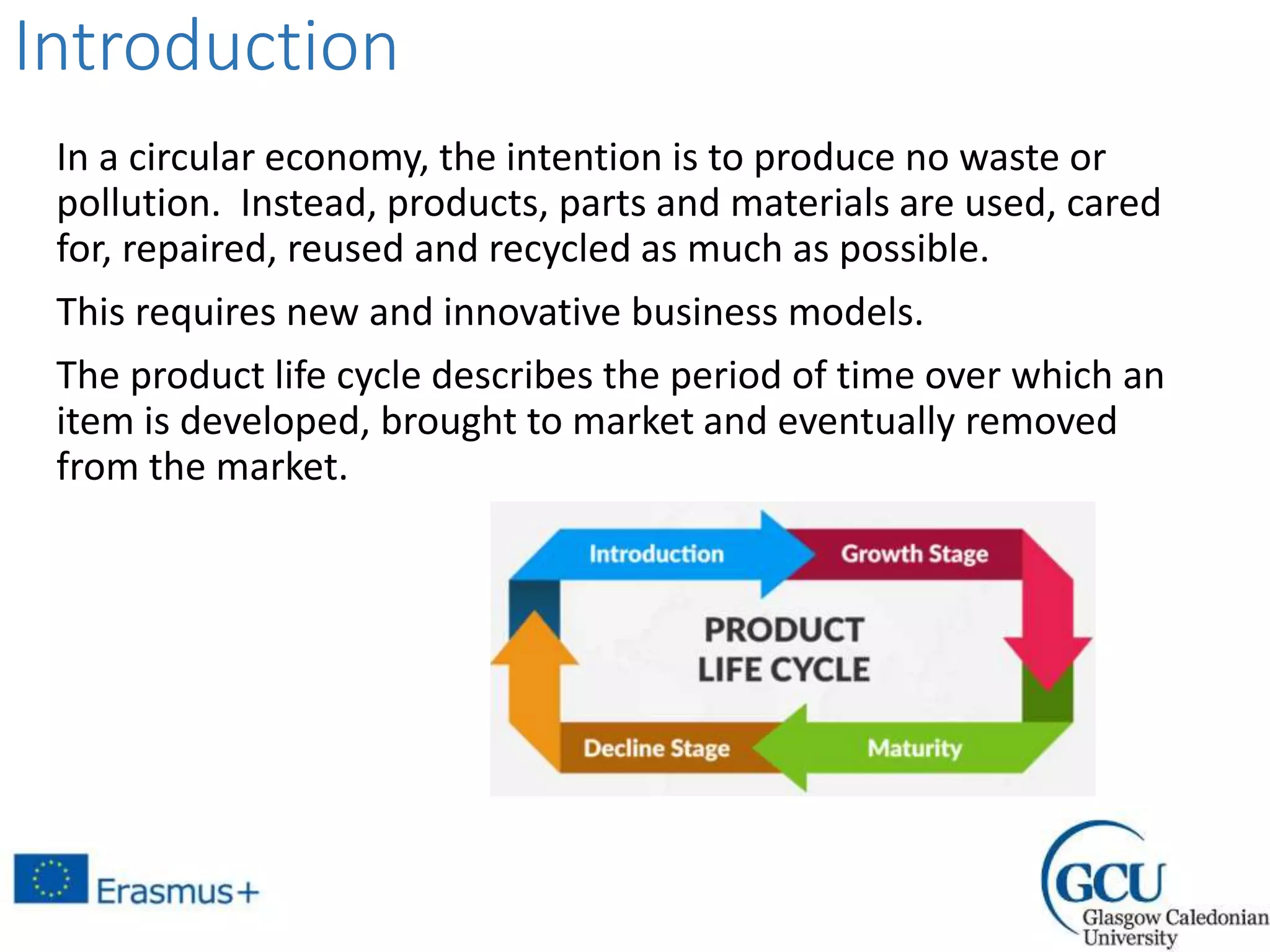
The product life cycle describes the period of time over which an
item is developed, brought to market and eventually removed
from the market.
Product Life Cycle
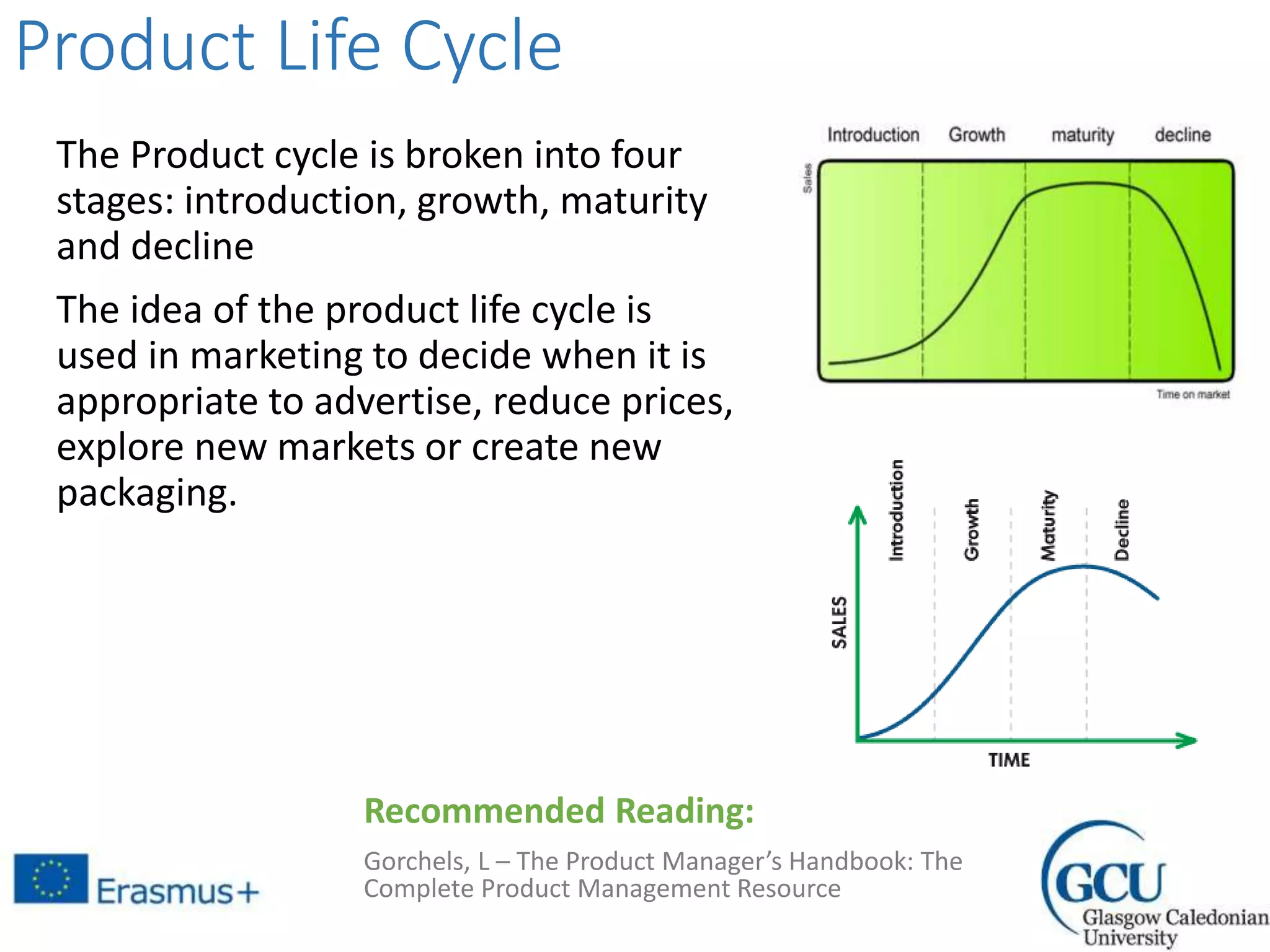
The Product cycle is broken into four
stages: introduction, growth, maturity
and decline
The idea of the product life cycle is
used in marketing to decide when it is
appropriate to advertise, reduce prices,
explore new markets or create new
packaging.
Recommended Reading:
Gorchels, L – The Product Manager’s Handbook: The
Complete Product Management Resource
Product Life Cycle
The main stages of the product life cycle are:
• Introduction – researching, developing and then launching the product
• Growth – when sales are increasing at their fastest rate
• Maturity – sales are near their highest, but the rate of growth is slowing
down, e.g. new competitors in market or saturation
• Decline – final stage of the cycle, when sales begin to fall
For further insight see http://productlifecyclestages.com/
See the following video:
https://youtu.be/5B3Mu8dqXlE
Exercise
• What stages do you think the following products are in?
3D TVs
Digital Video Recorders
DVDs
Video cassettes
Product Life-Cycle Management (PLM)
Understanding the life-cycle of a product
and implementing an effective product
life-cycle management is extremely
important for a successful company.
Product Life-Cycle Management is the
application of different strategies to help
meet these challenges and ensure that,
whatever stage of the cycle a product may
be going through, the manufacturer can
maximize sales and profits for their
product.
Product Life Cycle Management
Understanding the life-cycle of a product and implementing an effective
product life-cycle management is extremely important for a successful
company.
Product Life-Cycle Management is the application of different strategies to help
meet these challenges and ensure that, whatever stage of the cycle a product
may be going through, the manufacturer can maximize sales and profits for
their product.
To effectively manage the product life-cycle,
organisations need to have a very strong focus
on a number of key business areas:
• Development
• Financing:
• Marketing
• Manufacturing
• Information
Exercise
The following report provides a number of examples where companies have
recognised the product life cycle and responded to it
https://hbr.org/1965/11/exploit-the-product-life-cycle
Can you think of any companies/entrepreneurs who analysed/took these fields
into account?
Influencing the product life cycle
General factors
• Population income increase, acting in the sense of reducing the product life
cycle. (Together with the income increase, people are tempted to spend
more... they will change their cars, furniture, white appliances, etc. more
frequently).
• Technical and scientific development, acting in the sense of reducing the
product life cycle. (As new products appear, having better, higher
characteristics compared to the existing ones, people are willing to try them,
so they will give up the old models in favour of the new ones).
Influencing the product life cycle
Specific factors
• Product nature. (Certain products have a very short life cycle, subject to
trends and fashion, such as the garments, while others have a very long life
cycle, such as milk and bread).
• Assortment range size. (If the product is part of a wider assortment range,
chances are that the life cycle be shorter due to the direct competition by the
other products in the range).
• Product capacity to be assigned new uses. (If the product is assigned new
uses, chances are that its life cycle might increase).
• Legislation regarding the product. (In case a product is, for instance,
forbidden, its life cycle is reduced).
• Level of product novelty at the time of the launch. (The higher the novelty
level of the product is, the longer its life cycle will be).
Exercise
Which of the following factors apply to general or
specific?
Type General factors Specific factors
Product nature
Population increase
Legislation regarding the
product
Product novelty
Technical and Scientific
development
Product capacity to be
assigned new uses
Assortment
range/variety
Exploiting the Product Life Cycle
Products typically undergo the following stages throughout their life-cycle:
• Raw material extraction
• Product design
• Manufacturing & Assembly
• Use & Servicing
• Disposal/Recycling
Companies should ensure that the circular economy considerations are
integrated into the product design and development in the early stage design
activities, along with the problem exploration and brief development, with the
aim of improving circularity and reducing the impacts of the product or service
throughout the life-cycle.
Product
as a
Service
Product
Life
Extension
Sharing
Platforms
Resource
Recovery
Circular
Supplies
Exploiting the Product Life Cycle
The EU recommends/encourages design improvements that will increase the durability,
recyclability and reusability of products. The EU proposes to develop indicators in order to
assess the environmental performance throughout the product lifecycle
Product Life Cycle Extension
Circular supplies
Supply fully renewable recyclable, or biodegradable
resource inputs to support circular production.
At the moment, we are witnessing two inspiring
approaches for recycling, namely tackling the big waste
streams and closing the loops.
Resource Recovery (Re-using Waste)
Eliminate material leakage and maximize economic
value of product return flows
Resource recovery is a key part of making an economy
circular. There are two main ways to think about this:
Preventing Material Leakage and Creating a Closed-
Loop System
Circular
Supplies
Resource
Recovery
Product Life Cycle Extension
Circular supplies
Supply fully renewable recyclable, or biodegradable
resource inputs to support circular production.
At the moment, we are witnessing two inspiring
approaches for recycling, namely tackling the big waste
streams and closing the loops.
Resource Recovery (Re-using Waste)
Eliminate material leakage and maximize economic
value of product return flows
Resource recovery is a key part of making an economy
circular. There are two main ways to think about this:
Preventing Material Leakage and Creating a Closed-
Loop System
Circular
Supplies
Resource
Recovery
Product Life Cycle Extension
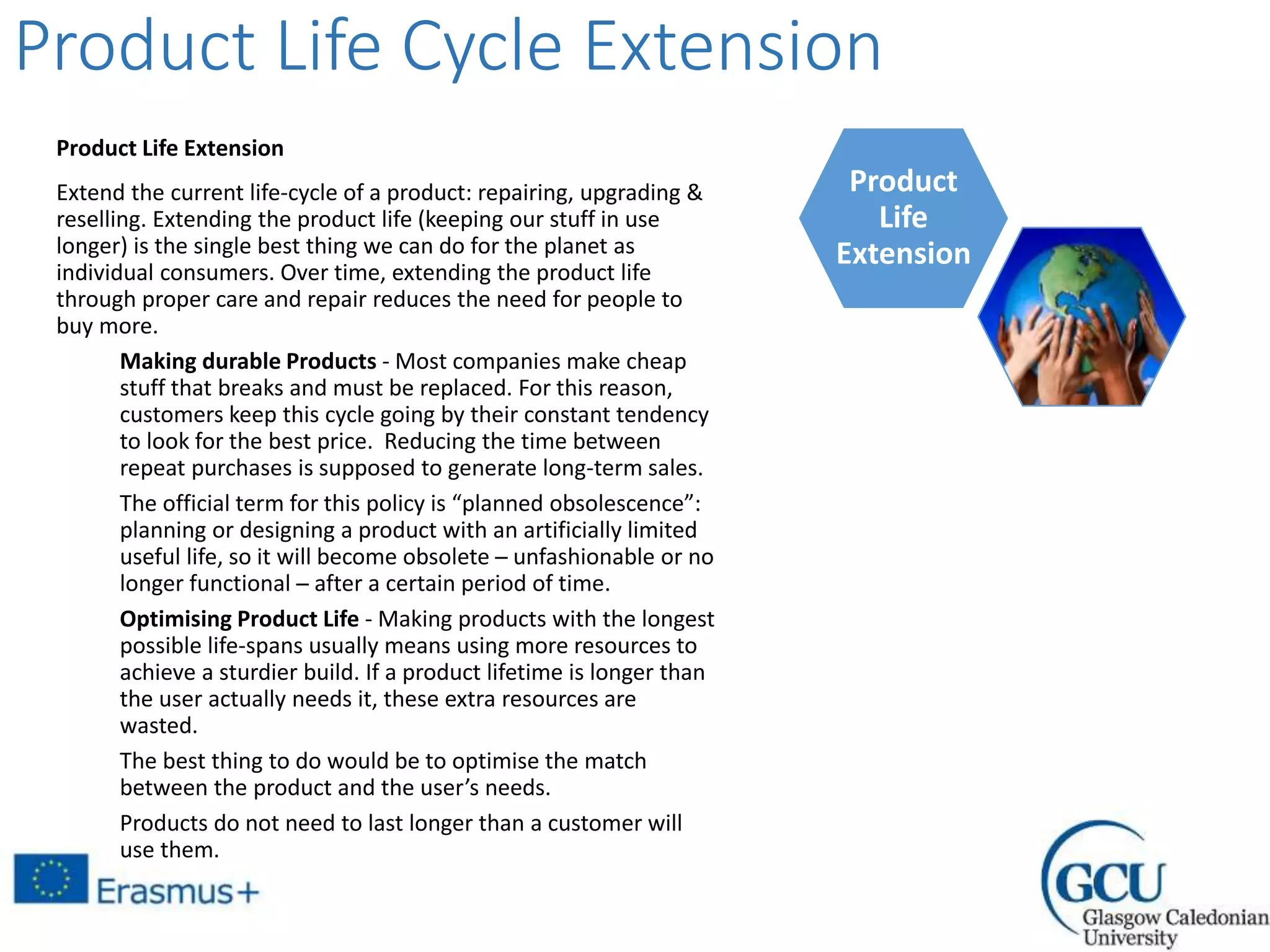
Product Life Extension
Extend the current life-cycle of a product: repairing, upgrading &
reselling. Extending the product life (keeping our stuff in use
longer) is the single best thing we can do for the planet as
individual consumers. Over time, extending the product life
through proper care and repair reduces the need for people to
buy more.
Making durable Products - Most companies make cheap
stuff that breaks and must be replaced. For this reason,
customers keep this cycle going by their constant tendency
to look for the best price. Reducing the time between
repeat purchases is supposed to generate long-term sales.
The official term for this policy is “planned obsolescence”:
planning or designing a product with an artificially limited
useful life, so it will become obsolete ─ unfashionable or no
longer functional ─ after a certain period of time.
Optimising Product Life - Making products with the longest
possible life-spans usually means using more resources to
achieve a sturdier build. If a product lifetime is longer than
the user actually needs it, these extra resources are
wasted.
The best thing to do would be to optimise the match
between the product and the user’s needs.
Products do not need to last longer than a customer will
use them.
Product
Life
Extension
Product Life Cycle Extension
Sharing platforms Stimulating collaboration among product
users
An interesting strategy is making better use of products by
sharing them - to make sure they are used more often and by
more people. This approach could even lead to new business
models for companies, for instance by providing products
through an online platform instead of selling them to one
person. That way, products can be used by multiple people.
Products as a service Products are used by one or many
customers by means of a lease or pay for use arrangement
One idea is to shift from offering physical products to offering
services, or a combination of the two.
Introducing a product-as-a-service approach is a very clever
circular economy strategy. This approach focuses on
switching from physical products to providing a service, and it
is therefore the best way to avoid using and recycling
materials.
Sharing
Platforms
Product
as a
Service
Exercise
Look at the above diagram. Can you identify which
activities are extending the product life cycle?
Product Life Cycle Extension
Circularity should be balanced against market, technical,
cost and other considerations. It is important to take
account of the overall circular economy objectives of the
organization (e.g. reuse, recycling, remanufacturing,
reconditioning) at the design and development phase in
order to balance the overall goals with the life extension
of products, components and materials.
Outline
Unit Aims
& ObjectivesProduct Life Cycle Extension
Circularity should be balanced against market, technical, cost and
other considerations. It is important to take account of the overall
circular economy objectives of the organization (e.g. reuse,
recycling, remanufacturing, reconditioning) at the design and
development phase in order to balance the overall goals with the
life extension of products, components and materials.
Summary
• Product life-cycle – definition & stages
• Extending the product life-cycle and its impact on the
circular economy
Key links
• European Circular Economy (http://ec.europa.eu)
• Product Life Cycle Stages (http://productlifecyclestages.com)
• Harvard Business Report- Exploit the Product Life Cycle (https://hbr.org/1965/11/exploit-the-product-life-cycle)
• Product life extension (www.pre-sustainability.com)
• The circular economy (https://youtu.be/R56o2g2TO1I)

Unit 2.4 - Extended Product Life Cycle

  • 1.
    Module 2 Unit 2.4Extended Product Life
  • 2.
    Learning Objectives The aimof this unit is to introduce participants to the concepts and principles of product life-cycle, on the factors influencing the life-cycle, and on how the product life-cycle can be extended. Once you have completed this unit you will be able to: Learning objectives • Describe the Product Life Cycle • Identify/recognize the factors influencing the product life-cycle • Know the ways to extend the product life-cycle • Elaborate case studies (based on their own experience) on the extension of product life-cycle. EQF Levels: This Content is mainly suitable for EQF level 5
  • 3.
    Introduction In a circulareconomy, the intention is to produce no waste or pollution. Instead, products, parts and materials are used, cared for, repaired, reused and recycled as much as possible. This requires new and innovative business models. The product life cycle describes the period of time over which an item is developed, brought to market and eventually removed from the market.
  • 4.
    Product Life Cycle TheProduct cycle is broken into four stages: introduction, growth, maturity and decline The idea of the product life cycle is used in marketing to decide when it is appropriate to advertise, reduce prices, explore new markets or create new packaging. Recommended Reading: Gorchels, L – The Product Manager’s Handbook: The Complete Product Management Resource
  • 5.
    Product Life Cycle Themain stages of the product life cycle are: • Introduction – researching, developing and then launching the product • Growth – when sales are increasing at their fastest rate • Maturity – sales are near their highest, but the rate of growth is slowing down, e.g. new competitors in market or saturation • Decline – final stage of the cycle, when sales begin to fall For further insight see http://productlifecyclestages.com/ See the following video: https://youtu.be/5B3Mu8dqXlE
  • 6.
    Exercise • What stagesdo you think the following products are in? 3D TVs Digital Video Recorders DVDs Video cassettes
  • 7.
    Product Life-Cycle Management(PLM) Understanding the life-cycle of a product and implementing an effective product life-cycle management is extremely important for a successful company. Product Life-Cycle Management is the application of different strategies to help meet these challenges and ensure that, whatever stage of the cycle a product may be going through, the manufacturer can maximize sales and profits for their product.
  • 8.
    Product Life CycleManagement Understanding the life-cycle of a product and implementing an effective product life-cycle management is extremely important for a successful company. Product Life-Cycle Management is the application of different strategies to help meet these challenges and ensure that, whatever stage of the cycle a product may be going through, the manufacturer can maximize sales and profits for their product. To effectively manage the product life-cycle, organisations need to have a very strong focus on a number of key business areas: • Development • Financing: • Marketing • Manufacturing • Information
  • 9.
    Exercise The following reportprovides a number of examples where companies have recognised the product life cycle and responded to it https://hbr.org/1965/11/exploit-the-product-life-cycle Can you think of any companies/entrepreneurs who analysed/took these fields into account?
  • 10.
    Influencing the productlife cycle General factors • Population income increase, acting in the sense of reducing the product life cycle. (Together with the income increase, people are tempted to spend more... they will change their cars, furniture, white appliances, etc. more frequently). • Technical and scientific development, acting in the sense of reducing the product life cycle. (As new products appear, having better, higher characteristics compared to the existing ones, people are willing to try them, so they will give up the old models in favour of the new ones).
  • 11.
    Influencing the productlife cycle Specific factors • Product nature. (Certain products have a very short life cycle, subject to trends and fashion, such as the garments, while others have a very long life cycle, such as milk and bread). • Assortment range size. (If the product is part of a wider assortment range, chances are that the life cycle be shorter due to the direct competition by the other products in the range). • Product capacity to be assigned new uses. (If the product is assigned new uses, chances are that its life cycle might increase). • Legislation regarding the product. (In case a product is, for instance, forbidden, its life cycle is reduced). • Level of product novelty at the time of the launch. (The higher the novelty level of the product is, the longer its life cycle will be).
  • 12.
    Exercise Which of thefollowing factors apply to general or specific? Type General factors Specific factors Product nature Population increase Legislation regarding the product Product novelty Technical and Scientific development Product capacity to be assigned new uses Assortment range/variety
  • 13.
    Exploiting the ProductLife Cycle Products typically undergo the following stages throughout their life-cycle: • Raw material extraction • Product design • Manufacturing & Assembly • Use & Servicing • Disposal/Recycling Companies should ensure that the circular economy considerations are integrated into the product design and development in the early stage design activities, along with the problem exploration and brief development, with the aim of improving circularity and reducing the impacts of the product or service throughout the life-cycle.
  • 14.
    Product as a Service Product Life Extension Sharing Platforms Resource Recovery Circular Supplies Exploiting theProduct Life Cycle The EU recommends/encourages design improvements that will increase the durability, recyclability and reusability of products. The EU proposes to develop indicators in order to assess the environmental performance throughout the product lifecycle
  • 15.
    Product Life CycleExtension Circular supplies Supply fully renewable recyclable, or biodegradable resource inputs to support circular production. At the moment, we are witnessing two inspiring approaches for recycling, namely tackling the big waste streams and closing the loops. Resource Recovery (Re-using Waste) Eliminate material leakage and maximize economic value of product return flows Resource recovery is a key part of making an economy circular. There are two main ways to think about this: Preventing Material Leakage and Creating a Closed- Loop System Circular Supplies Resource Recovery
  • 16.
    Product Life CycleExtension Circular supplies Supply fully renewable recyclable, or biodegradable resource inputs to support circular production. At the moment, we are witnessing two inspiring approaches for recycling, namely tackling the big waste streams and closing the loops. Resource Recovery (Re-using Waste) Eliminate material leakage and maximize economic value of product return flows Resource recovery is a key part of making an economy circular. There are two main ways to think about this: Preventing Material Leakage and Creating a Closed- Loop System Circular Supplies Resource Recovery
  • 17.
    Product Life CycleExtension Product Life Extension Extend the current life-cycle of a product: repairing, upgrading & reselling. Extending the product life (keeping our stuff in use longer) is the single best thing we can do for the planet as individual consumers. Over time, extending the product life through proper care and repair reduces the need for people to buy more. Making durable Products - Most companies make cheap stuff that breaks and must be replaced. For this reason, customers keep this cycle going by their constant tendency to look for the best price. Reducing the time between repeat purchases is supposed to generate long-term sales. The official term for this policy is “planned obsolescence”: planning or designing a product with an artificially limited useful life, so it will become obsolete ─ unfashionable or no longer functional ─ after a certain period of time. Optimising Product Life - Making products with the longest possible life-spans usually means using more resources to achieve a sturdier build. If a product lifetime is longer than the user actually needs it, these extra resources are wasted. The best thing to do would be to optimise the match between the product and the user’s needs. Products do not need to last longer than a customer will use them. Product Life Extension
  • 18.
    Product Life CycleExtension Sharing platforms Stimulating collaboration among product users An interesting strategy is making better use of products by sharing them - to make sure they are used more often and by more people. This approach could even lead to new business models for companies, for instance by providing products through an online platform instead of selling them to one person. That way, products can be used by multiple people. Products as a service Products are used by one or many customers by means of a lease or pay for use arrangement One idea is to shift from offering physical products to offering services, or a combination of the two. Introducing a product-as-a-service approach is a very clever circular economy strategy. This approach focuses on switching from physical products to providing a service, and it is therefore the best way to avoid using and recycling materials. Sharing Platforms Product as a Service
  • 19.
    Exercise Look at theabove diagram. Can you identify which activities are extending the product life cycle?
  • 20.
    Product Life CycleExtension Circularity should be balanced against market, technical, cost and other considerations. It is important to take account of the overall circular economy objectives of the organization (e.g. reuse, recycling, remanufacturing, reconditioning) at the design and development phase in order to balance the overall goals with the life extension of products, components and materials.
  • 21.
    Outline Unit Aims & ObjectivesProductLife Cycle Extension Circularity should be balanced against market, technical, cost and other considerations. It is important to take account of the overall circular economy objectives of the organization (e.g. reuse, recycling, remanufacturing, reconditioning) at the design and development phase in order to balance the overall goals with the life extension of products, components and materials.
  • 22.
    Summary • Product life-cycle– definition & stages • Extending the product life-cycle and its impact on the circular economy Key links • European Circular Economy (http://ec.europa.eu) • Product Life Cycle Stages (http://productlifecyclestages.com) • Harvard Business Report- Exploit the Product Life Cycle (https://hbr.org/1965/11/exploit-the-product-life-cycle) • Product life extension (www.pre-sustainability.com) • The circular economy (https://youtu.be/R56o2g2TO1I)