Roshan Gnyawali
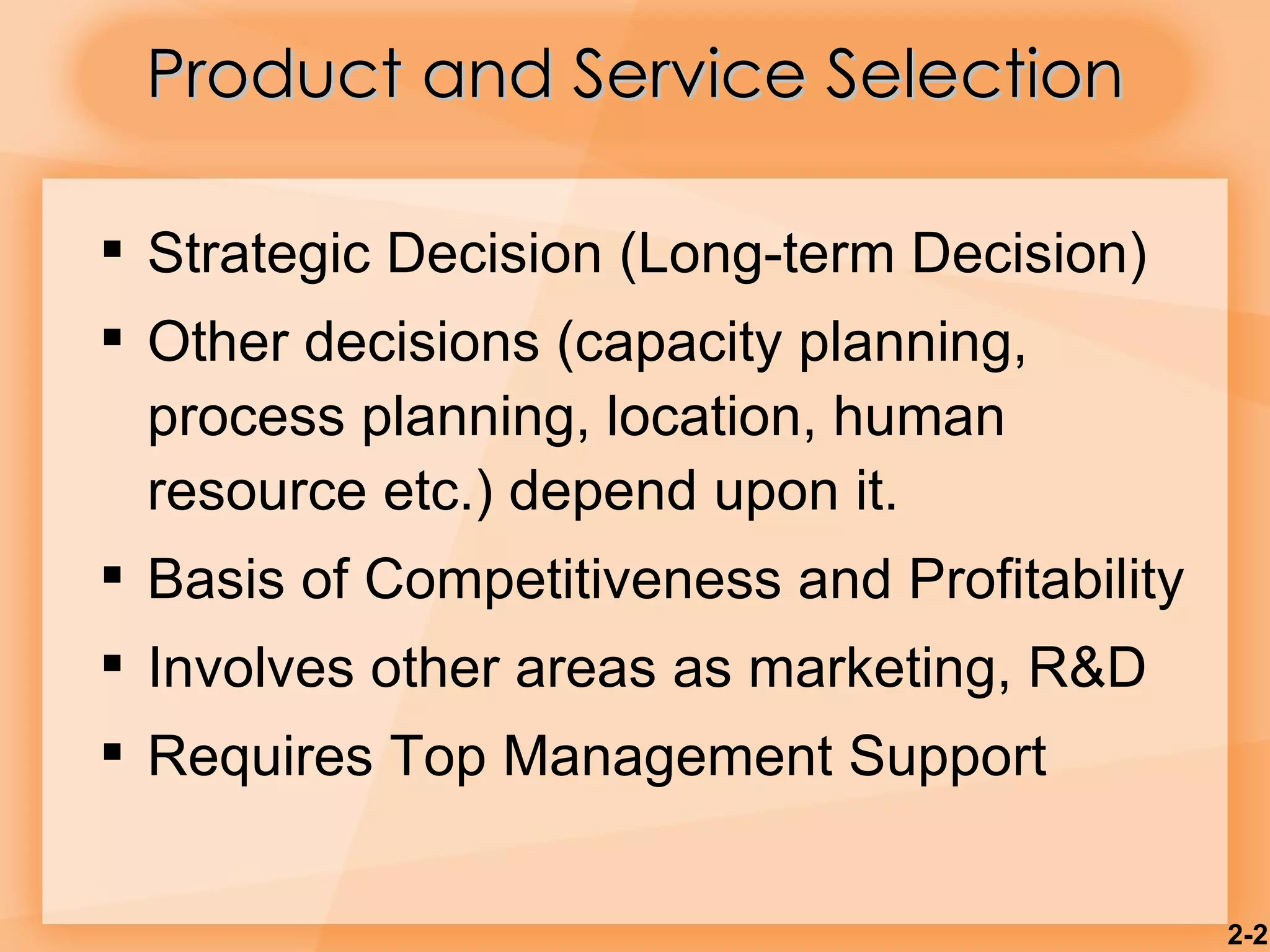
Strategic Decision (Long-term Decision) Other decisions (capacity planning, process planning, location, human resource etc.) depend upon it. Basis of Competitiveness and Profitability Involves other areas as marketing, R&D Requires Top Management Support 2- Product and Service Selection
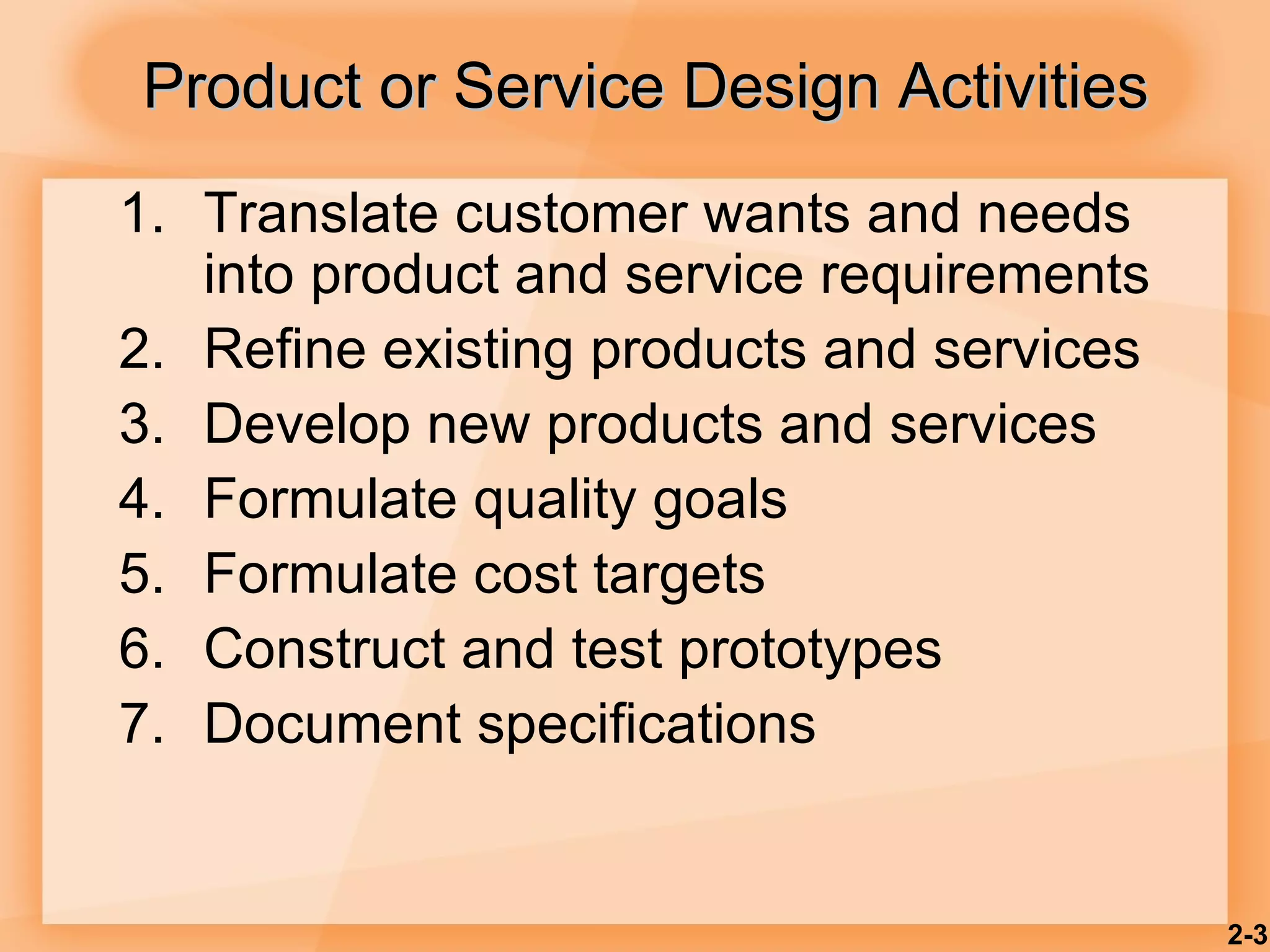
Translate customer wants and needs into product and service requirements Refine existing products and services Develop new products and services Formulate quality goals Formulate cost targets Construct and test prototypes Document specifications Product or Service Design Activities 2-
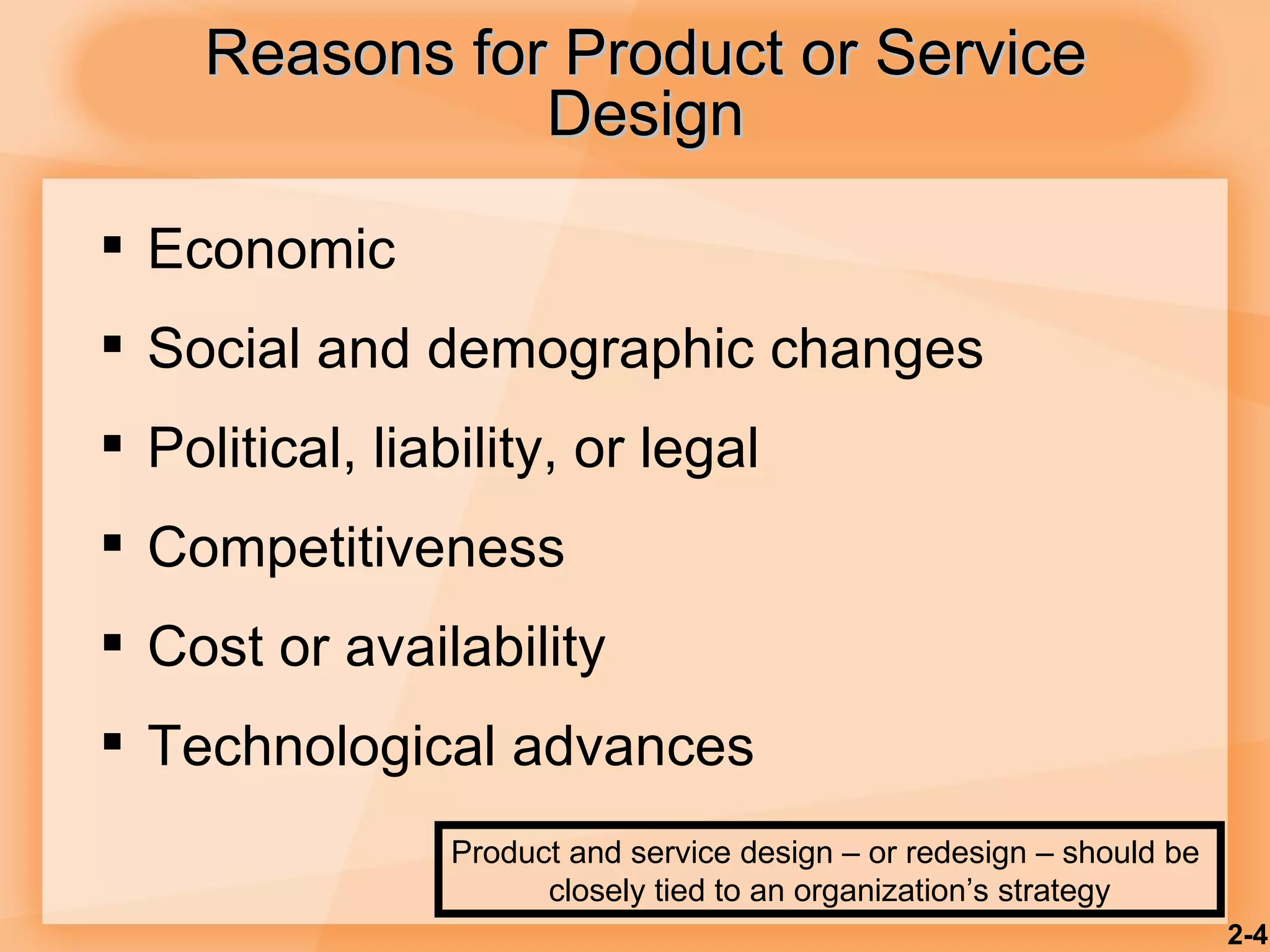
Reasons for Product or Service Design Economic Social and demographic changes Political, liability, or legal Competitiveness Cost or availability Technological advances 2- Product and service design – or redesign – should be  closely tied to an organization’s strategy
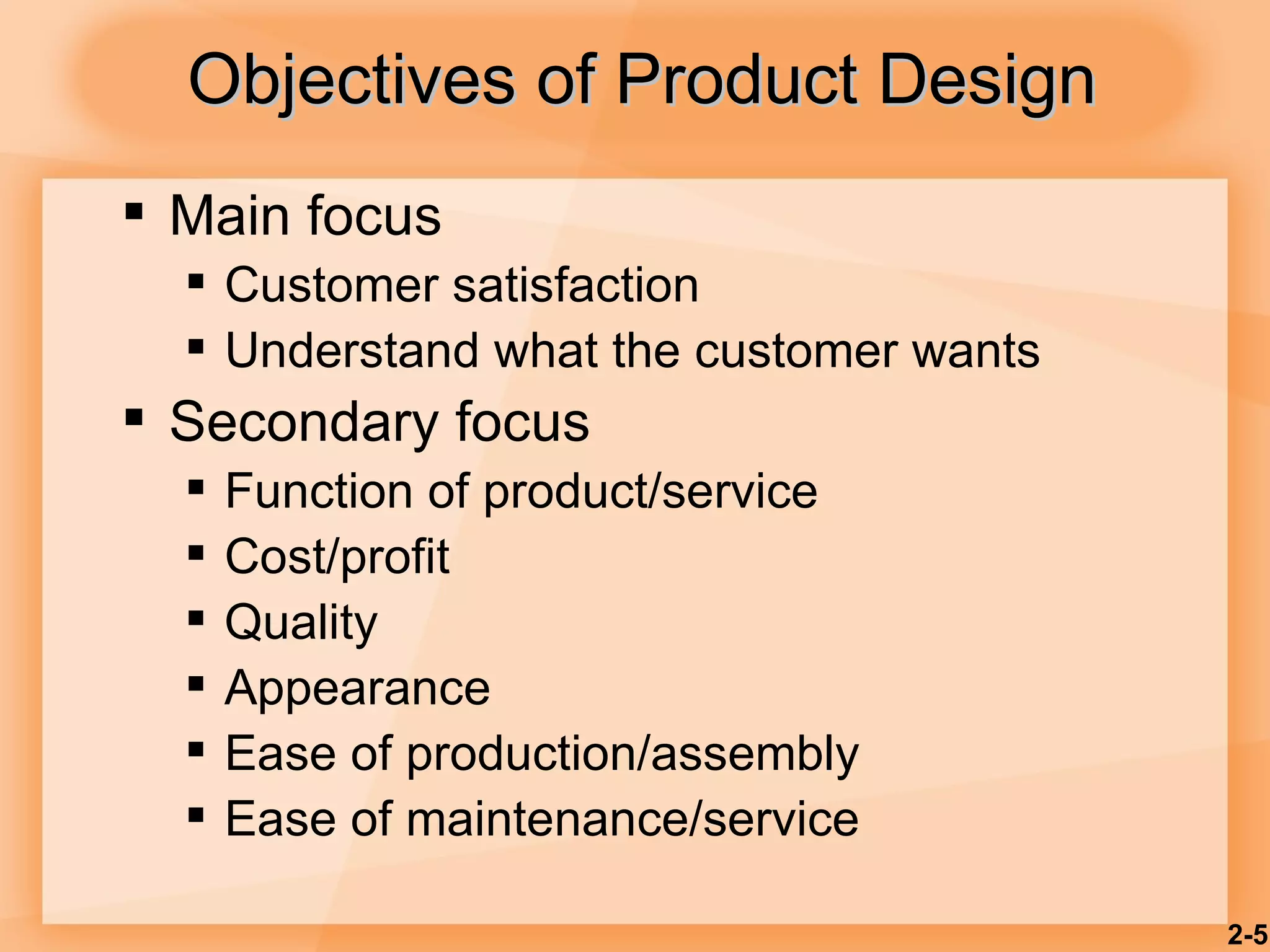
Objectives of Product Design Main focus Customer satisfaction Understand what the customer wants Secondary focus Function of product/service Cost/profit Quality Appearance Ease of production/assembly Ease of maintenance/service 2-
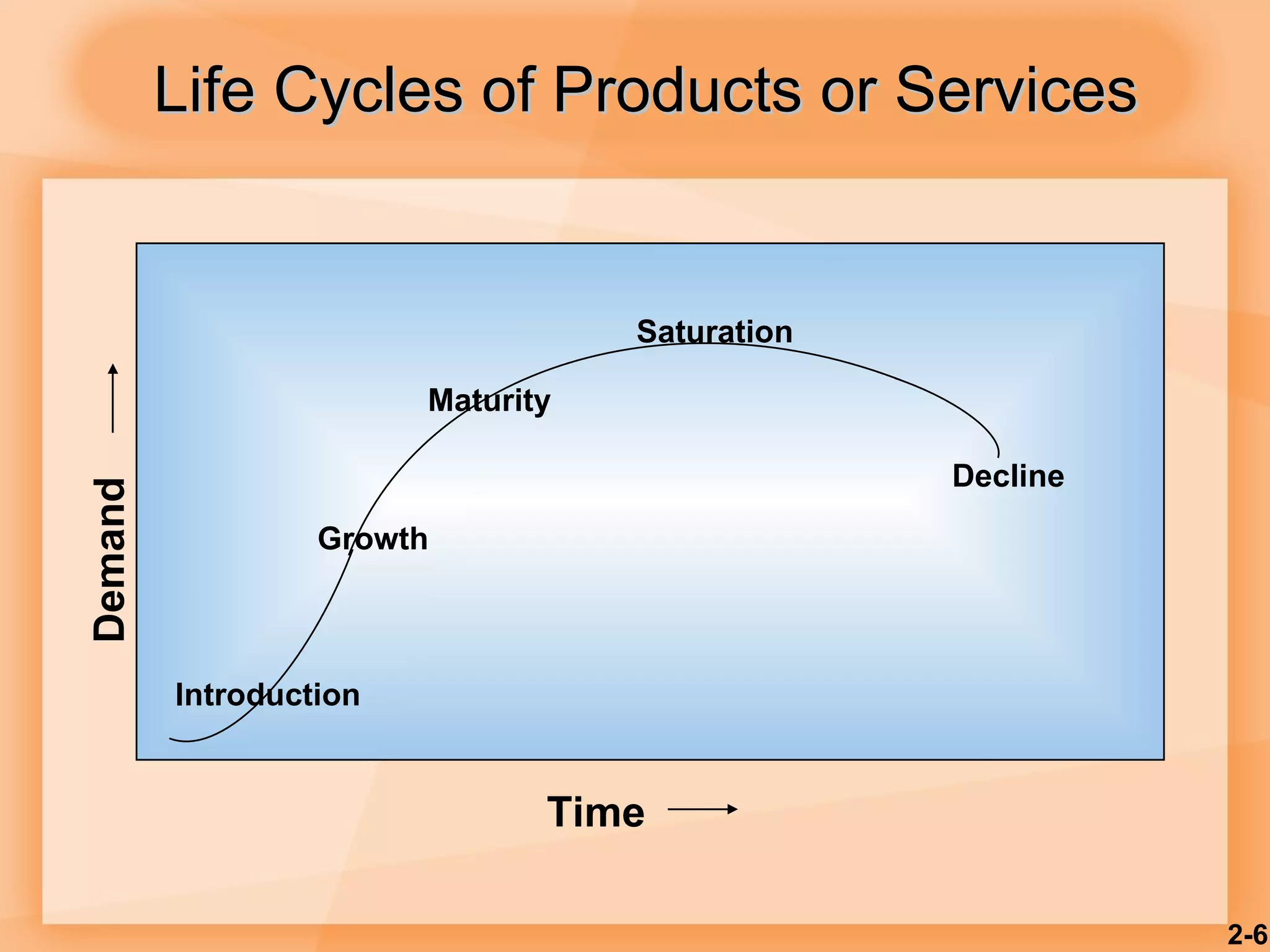
Life Cycles of Products or Services 2- Time Introduction Growth Maturity Saturation Decline Demand
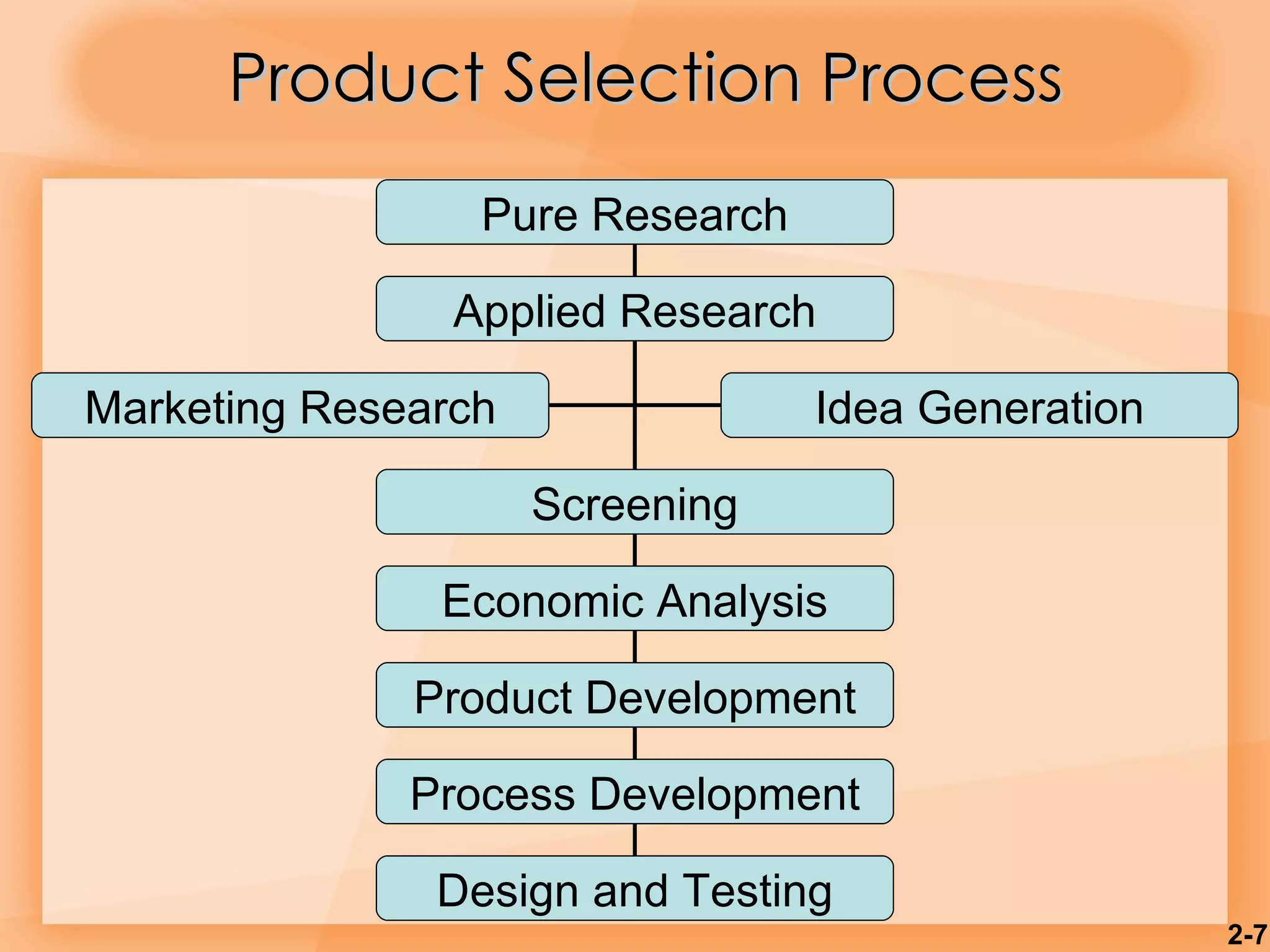
Product Selection Process 2- Pure Research Applied Research Screening Economic Analysis Product Development Process Development Design and Testing Marketing Research Idea Generation
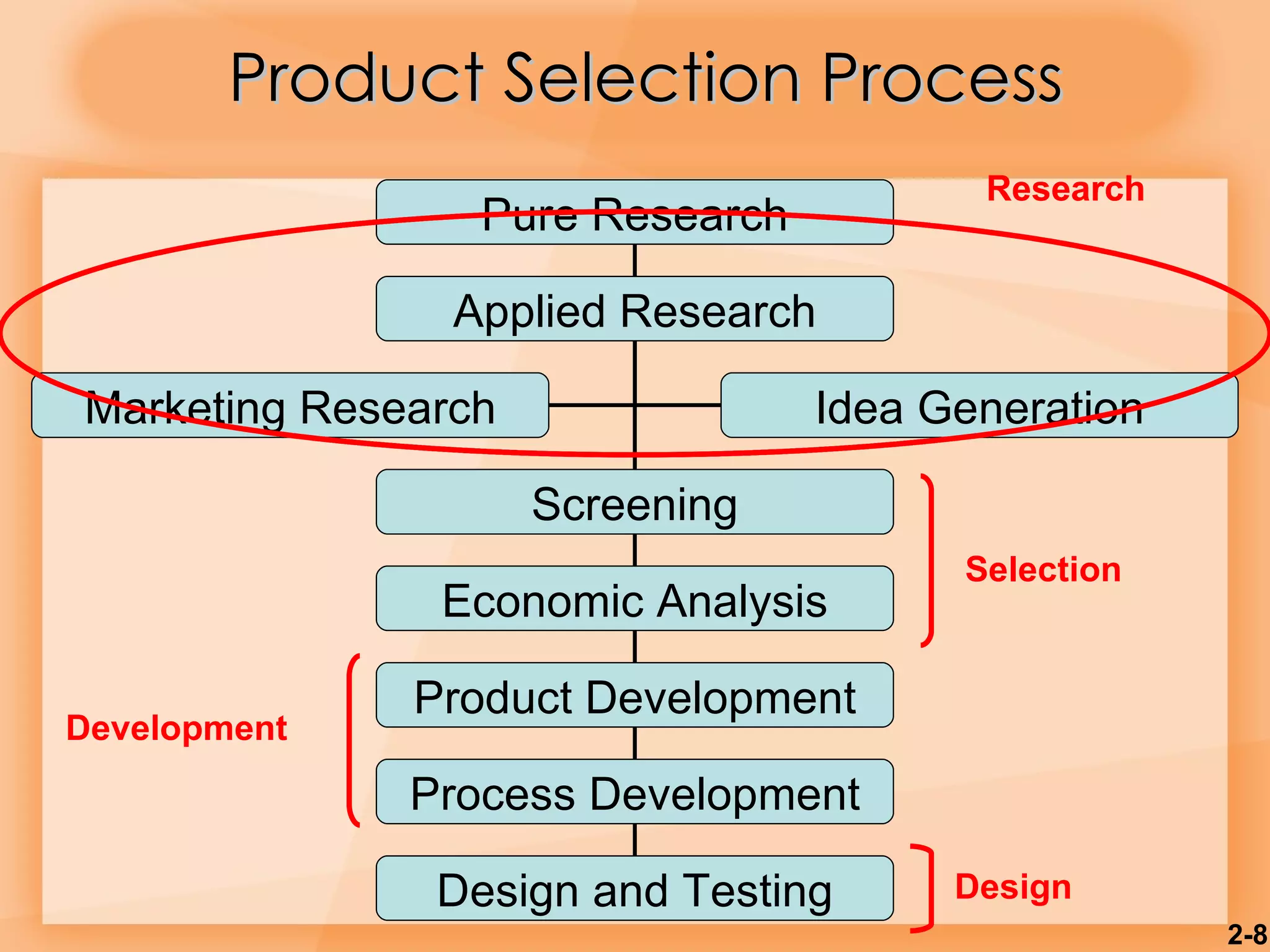
Product Selection Process 2- Development Design Selection Research Research Pure Research Applied Research Screening Economic Analysis Product Development Process Development Design and Testing Marketing Research Idea Generation
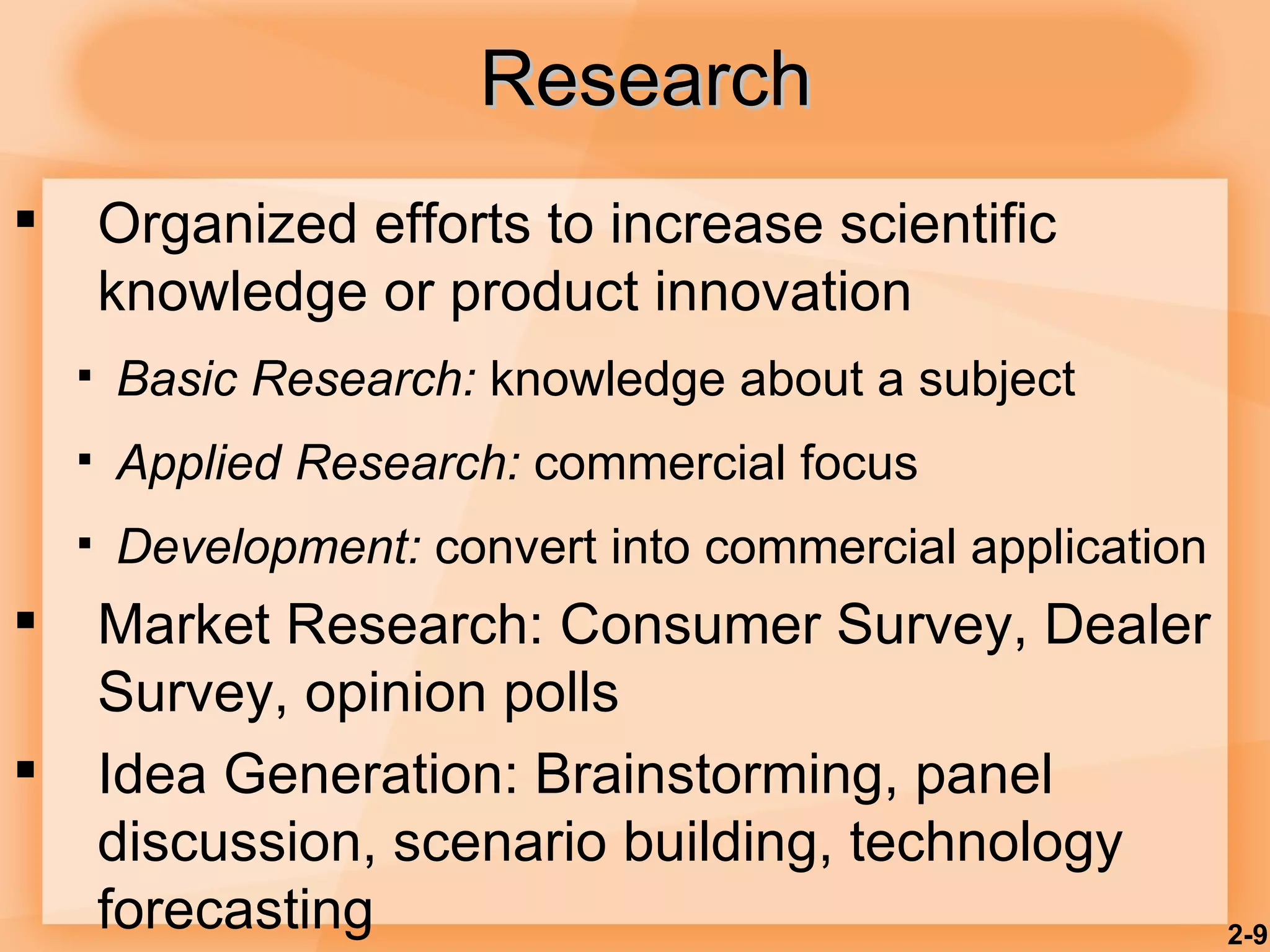
Research Organized efforts to increase scientific knowledge or product innovation Basic Research:  knowledge about a subject Applied Research:  commercial focus Development:  convert into commercial application Market Research: Consumer Survey, Dealer Survey, opinion polls Idea Generation: Brainstorming, panel discussion, scenario building, technology forecasting 2-
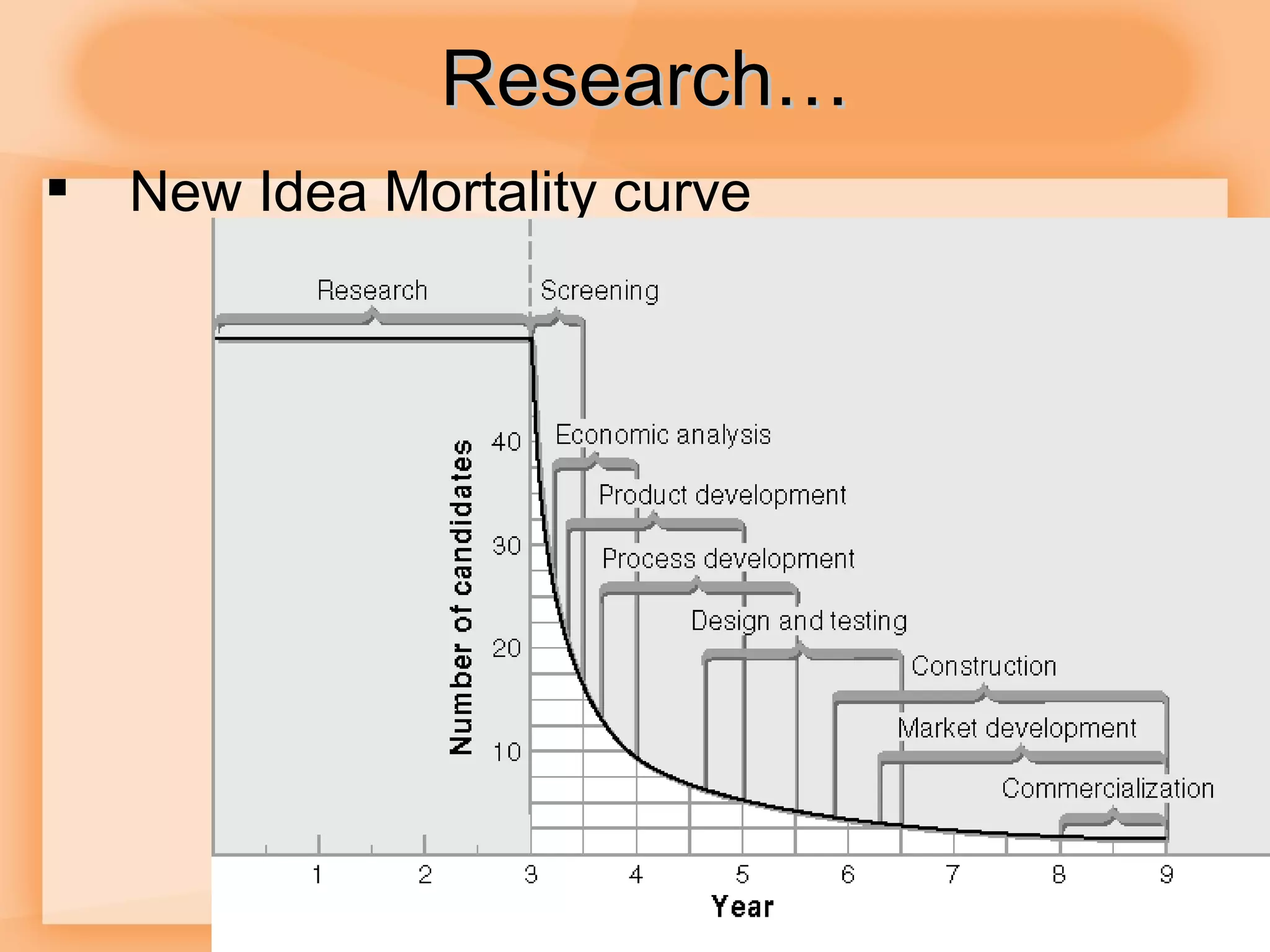
Research… New Idea Mortality curve 2-
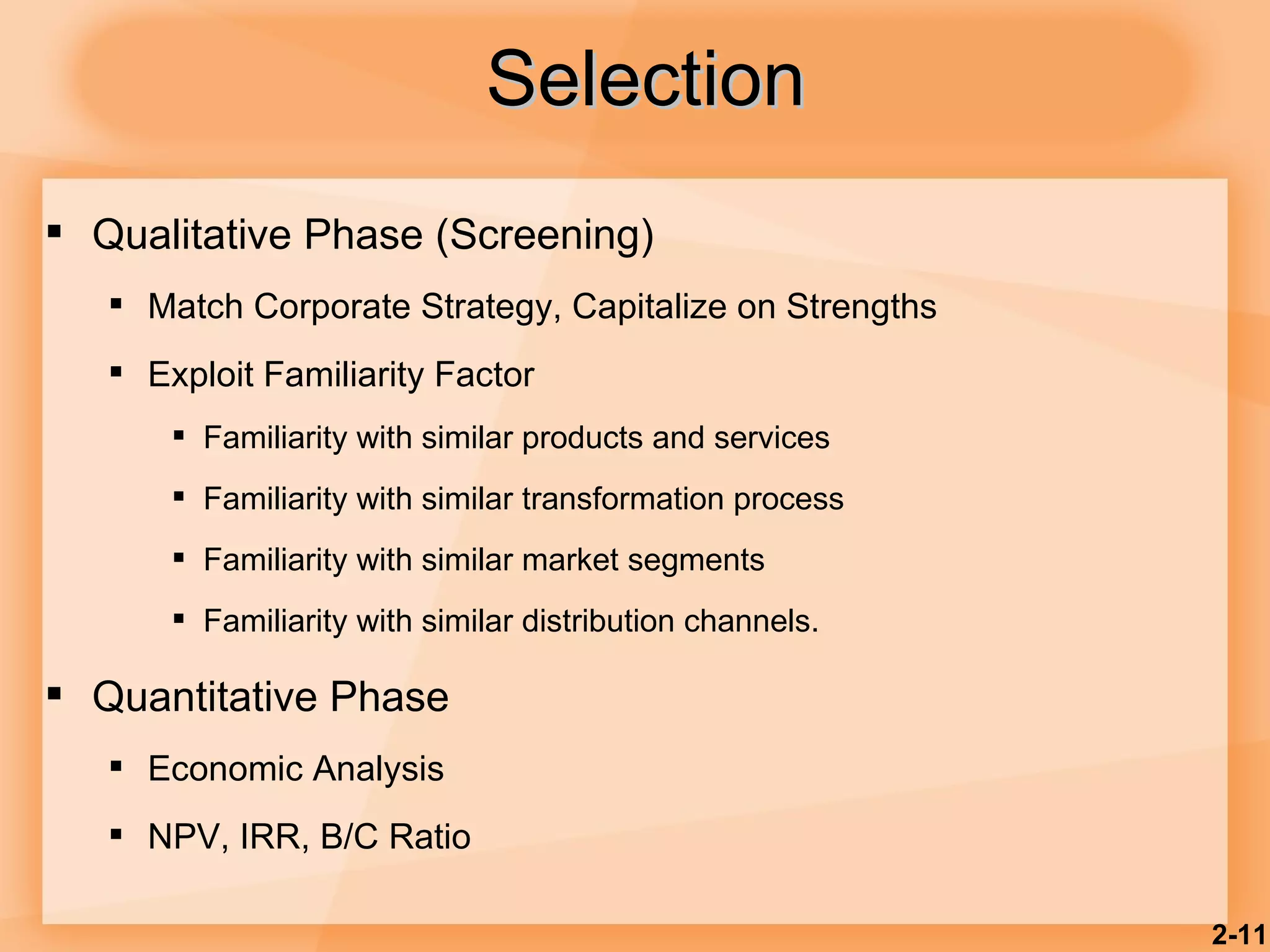
Selection Qualitative Phase (Screening) Match Corporate Strategy, Capitalize on Strengths Exploit Familiarity Factor Familiarity with similar products and services Familiarity with similar transformation process Familiarity with similar market segments Familiarity with similar distribution channels. Quantitative Phase Economic Analysis NPV, IRR, B/C Ratio 2-
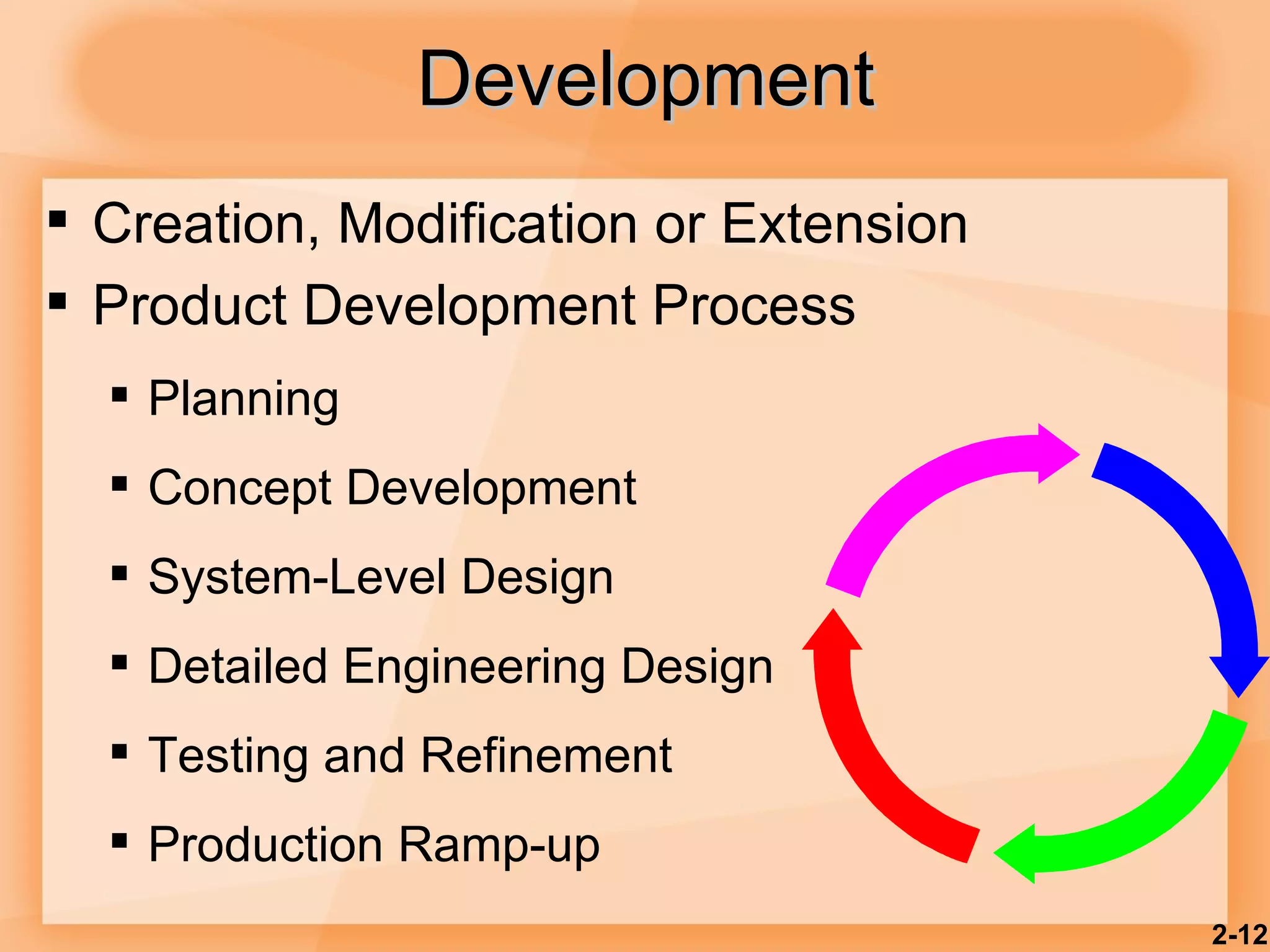
Development Creation, Modification or Extension Product Development Process Planning Concept Development System-Level Design Detailed Engineering Design Testing and Refinement Production Ramp-up 2-
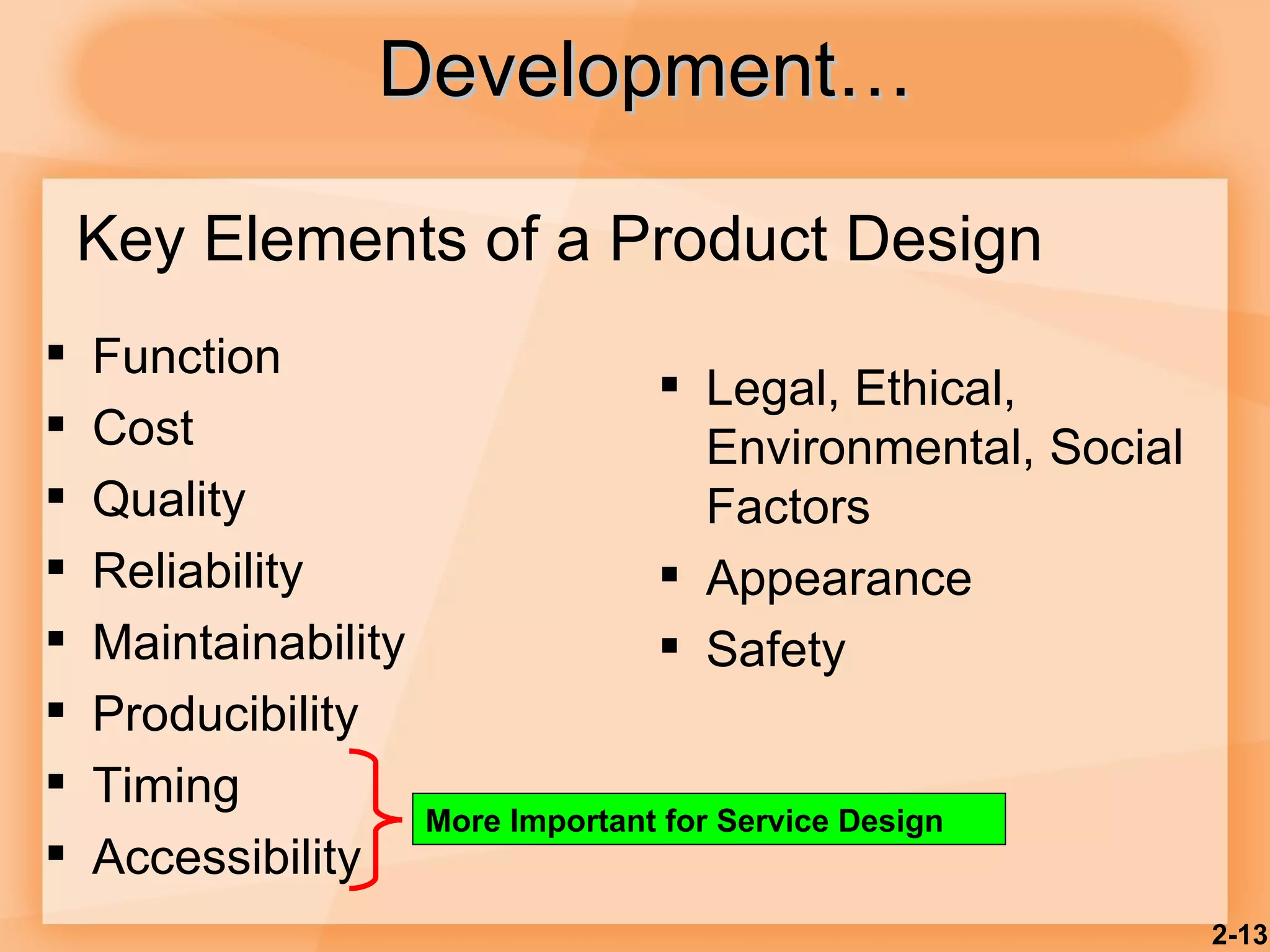
Development… Function Cost Quality Reliability Maintainability Producibility Timing Accessibility Legal, Ethical, Environmental, Social Factors Appearance Safety 2- More Important for Service Design Key Elements of a Product Design
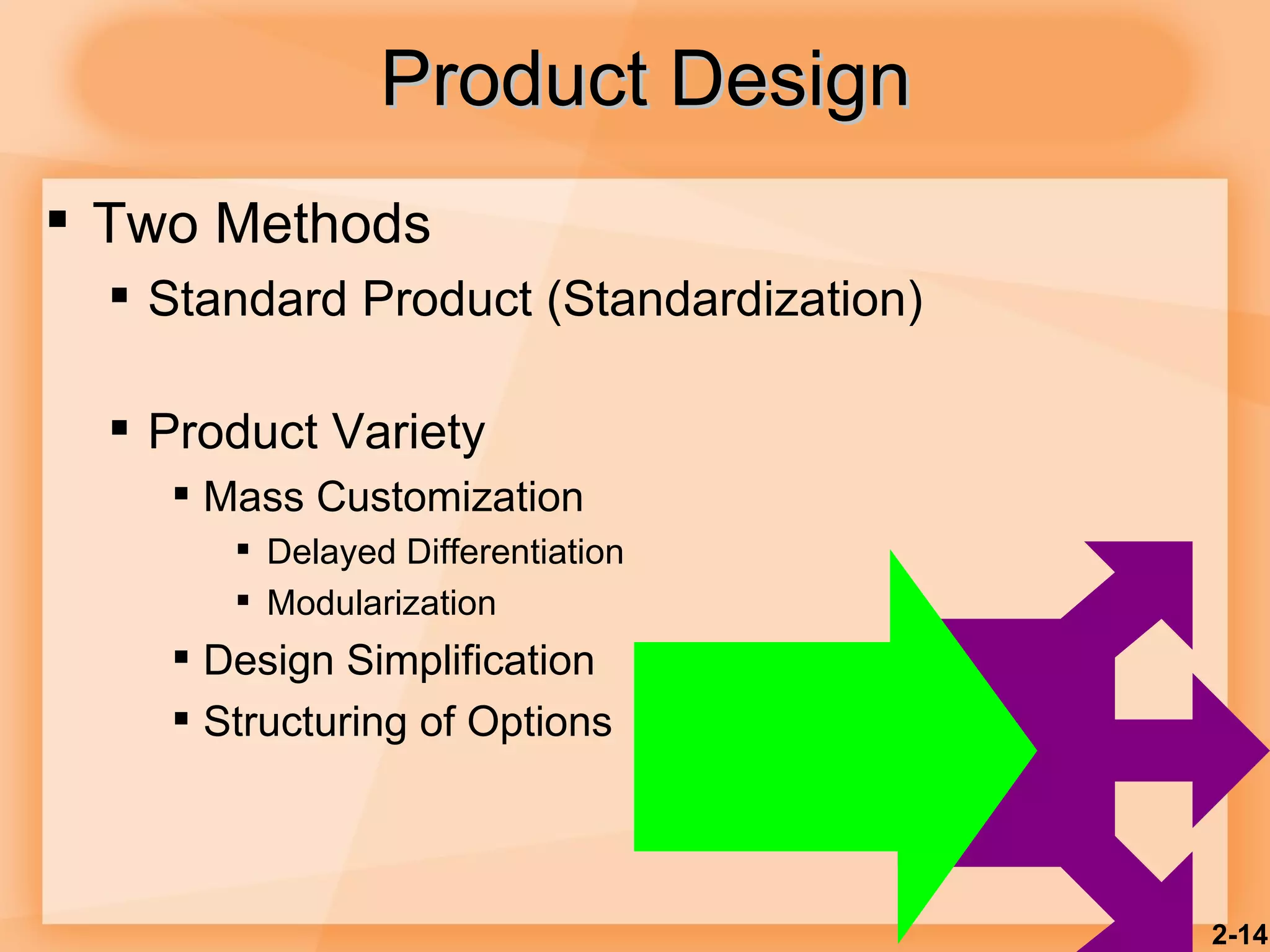
Product Design Two Methods Standard Product (Standardization) Product Variety Mass Customization Delayed Differentiation Modularization Design Simplification Structuring of Options 2-
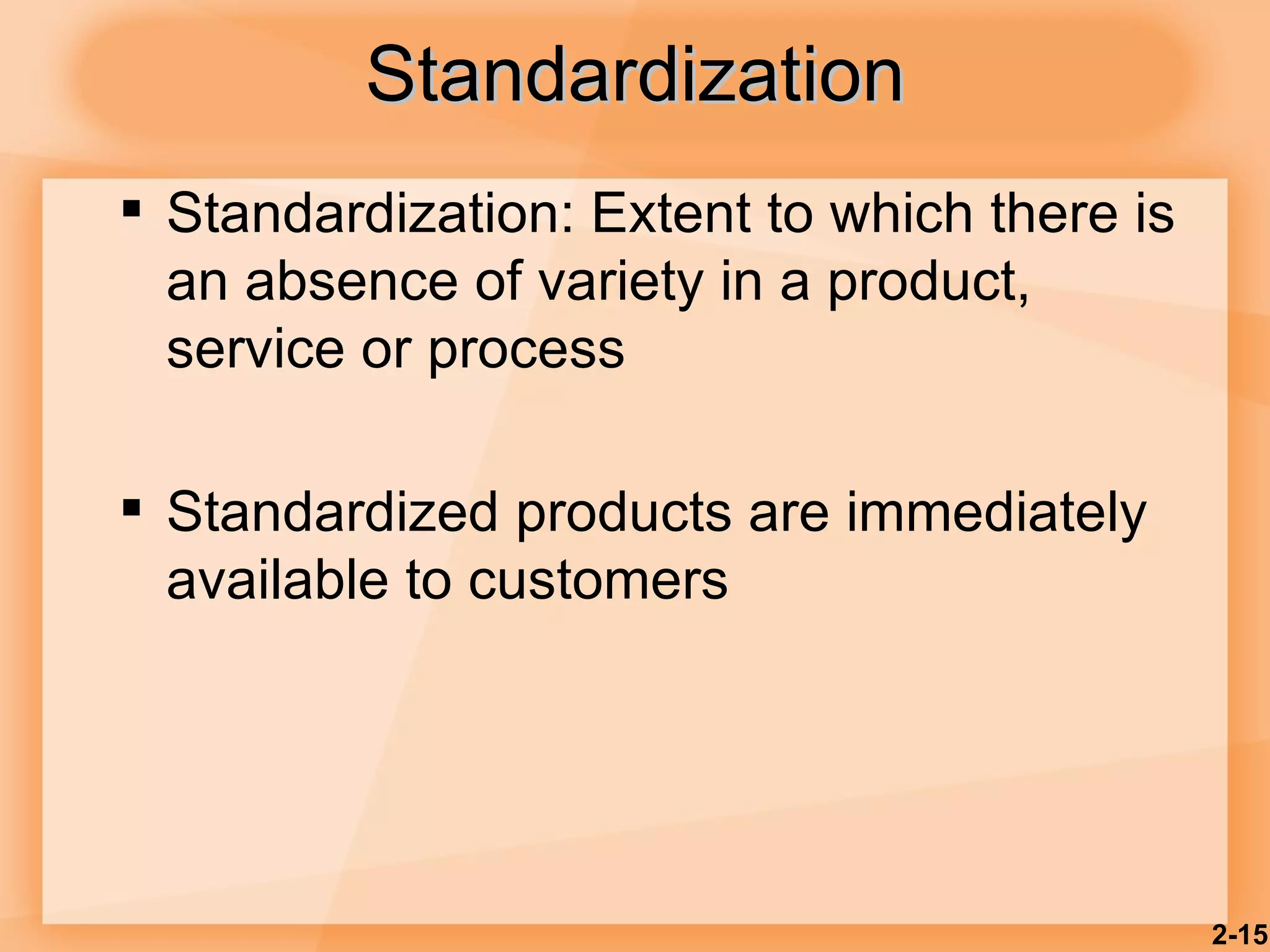
Standardization Standardization: Extent to which there is an absence of variety in a product, service or process Standardized products are immediately available to customers 2-
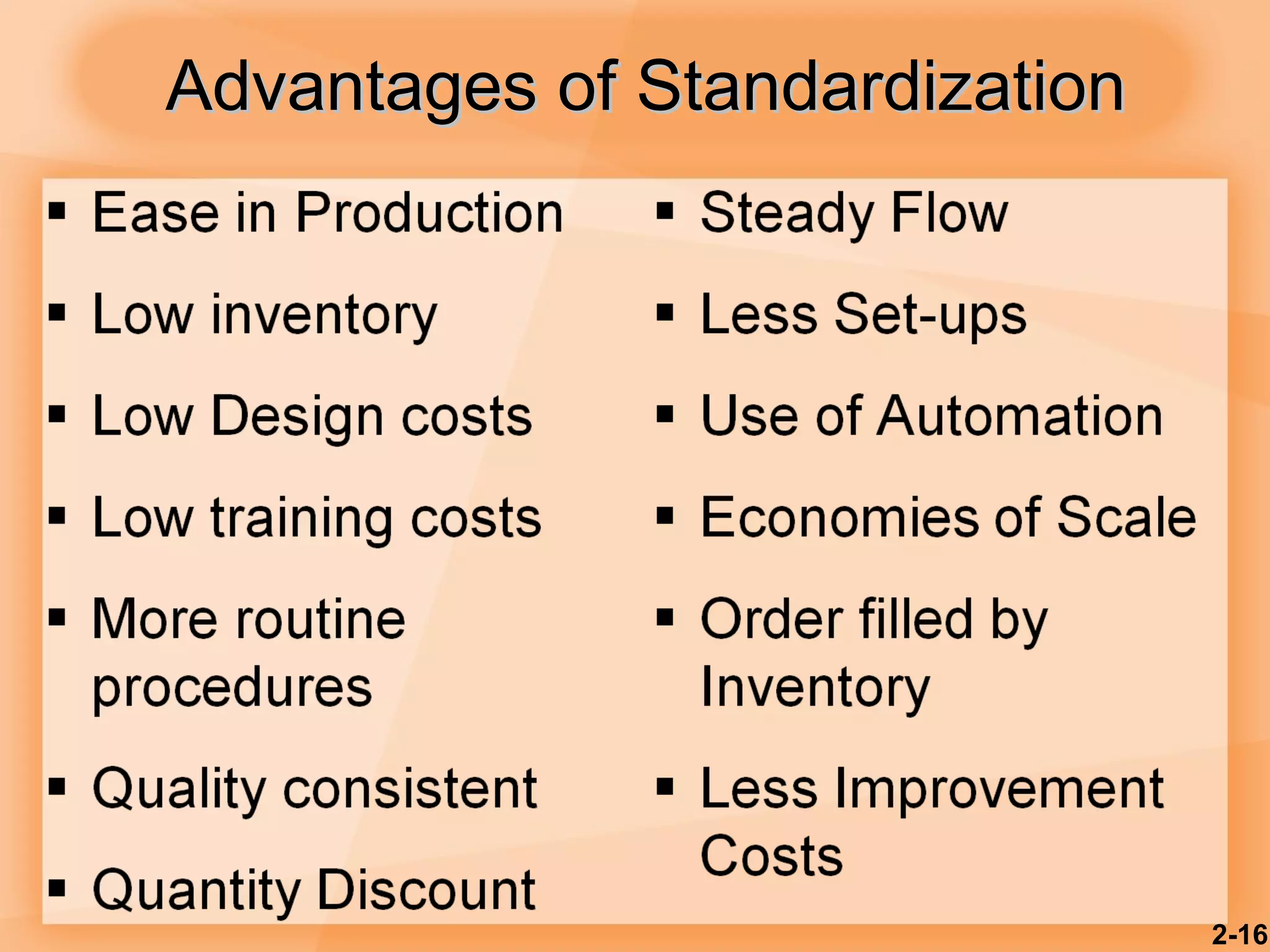
Advantages of Standardization 2-
Disadvantages of Standardization   Designs may be frozen with too many imperfections remaining. High cost of design changes increases resistance to improvements. Decreased variety results in less consumer appeal. 2-
Mass customization: A strategy of producing standardized goods or services, but incorporating some degree of customization Delayed differentiation Modular design Mass Customization 2-
Delayed differentiation is a postponement tactic Producing but not quite completing a product or service until customer preferences or specifications are known Delayed Differentiation 2-
Modular Design Modular design  is a form of standardization in which component parts are subdivided into modules that are easily replaced or interchanged. It allows: easier diagnosis and remedy of failures easier repair and replacement  simplification of manufacturing and assembly   2-
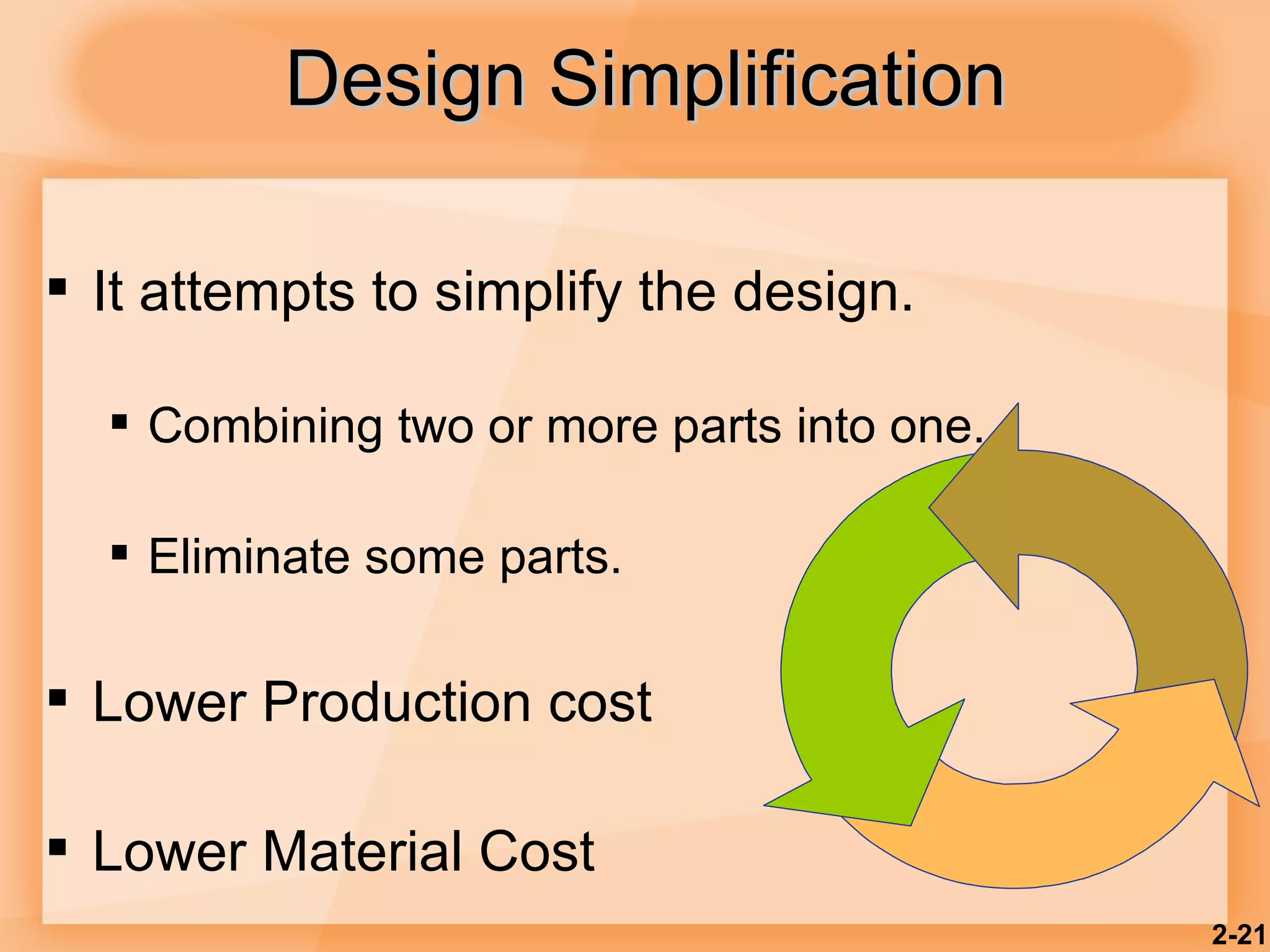
Design Simplification It attempts to simplify the design. Combining two or more parts into one. Eliminate some parts. Lower Production cost Lower Material Cost 2-
Options Provide variety to product Increased Attractiveness Broad Range of Customers Pricing can be complicated 2-
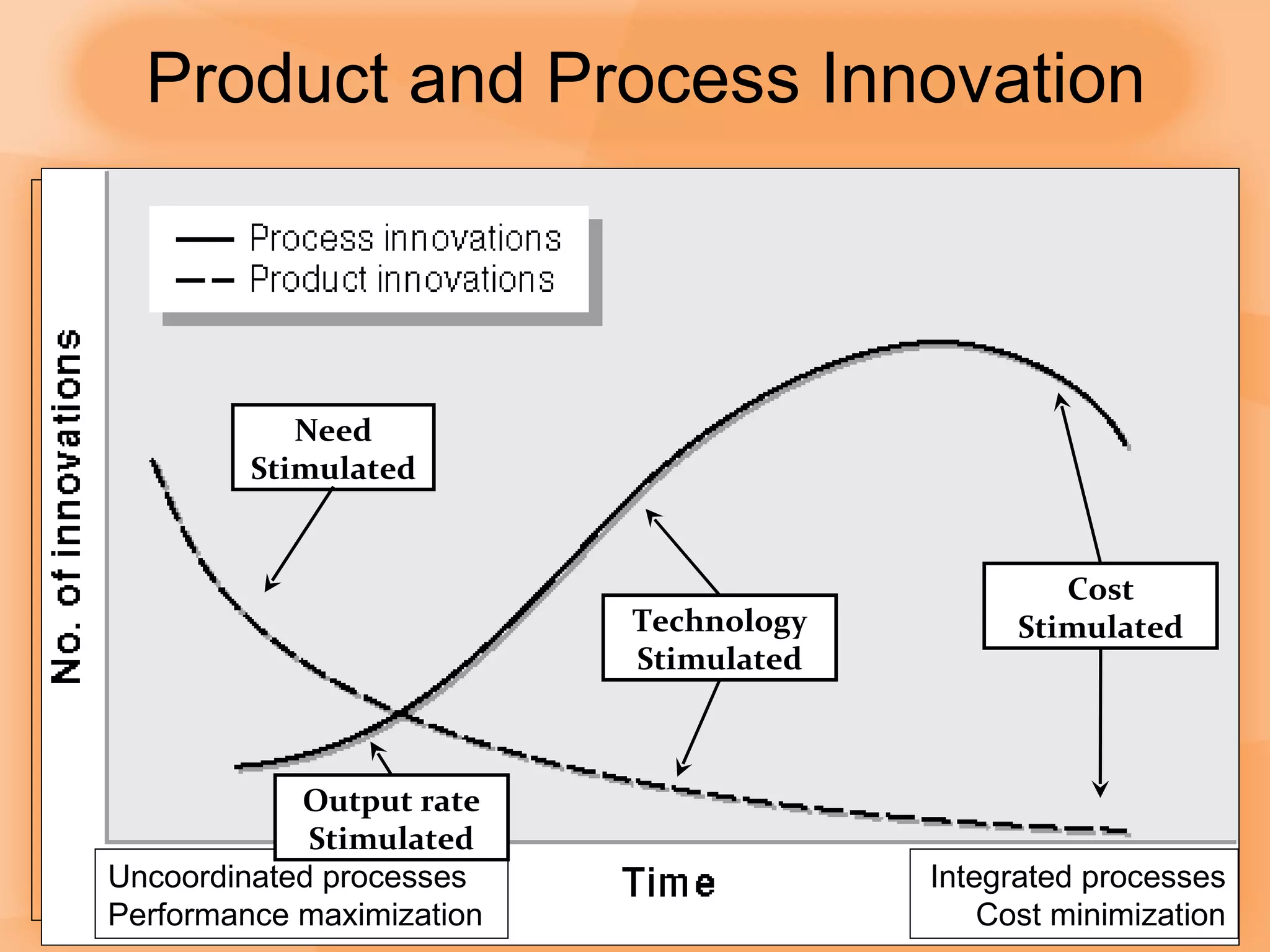
Product and Process Innovation Uncoordinated processes Performance maximization Integrated processes Cost minimization Need Stimulated Output rate Stimulated Technology Stimulated Cost Stimulated
Computer-Aided Design Computer-Aided Design (CAD)  is product design using computer graphics. increases productivity of designers, 3 to 10 times creates a database for manufacturing information on product specifications provides possibility of engineering and cost analysis on proposed designs 2-
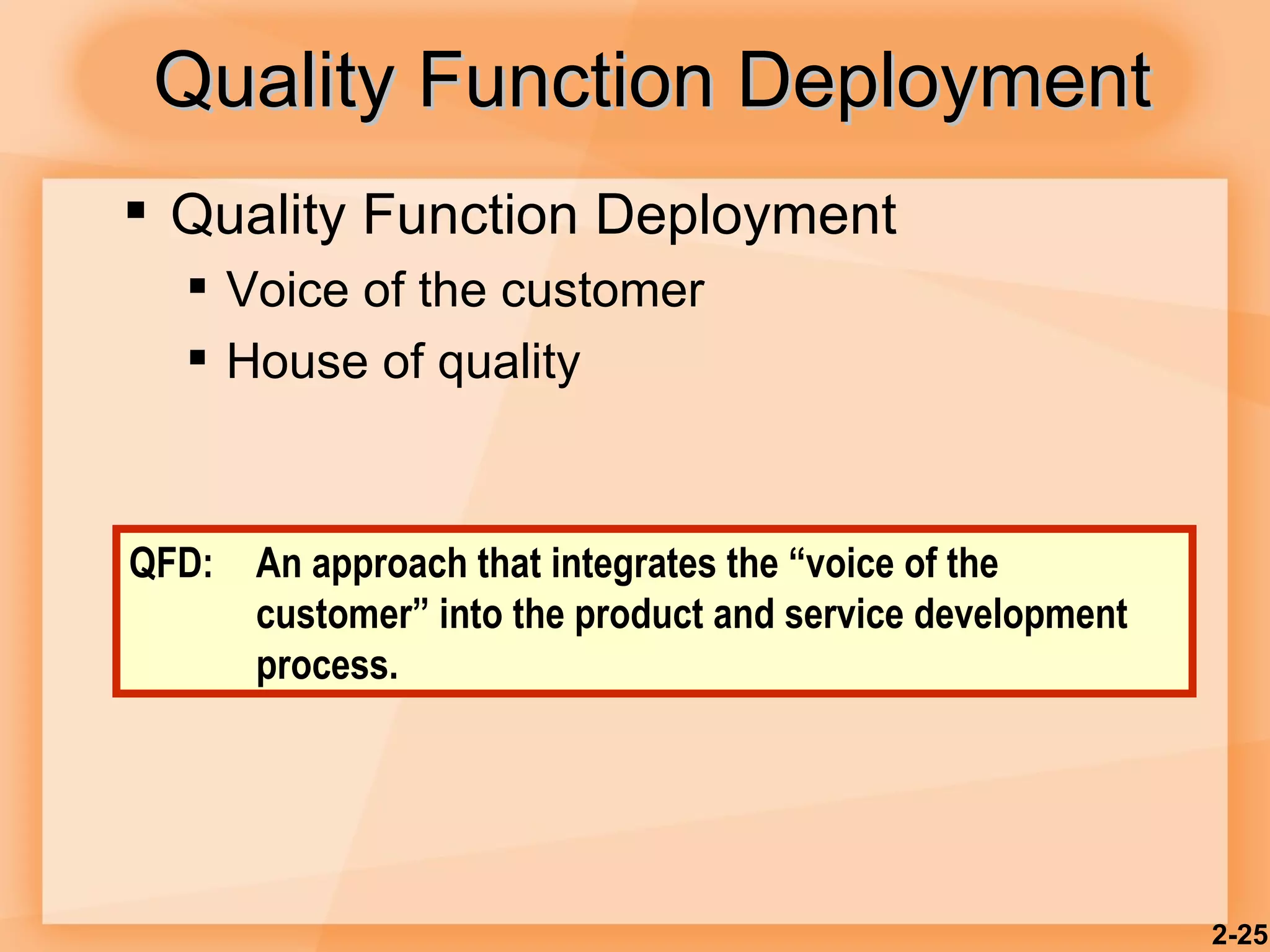
Quality Function Deployment Voice of the customer House of quality Quality Function Deployment 2- QFD:  An approach that integrates the “voice of the customer” into the product and service development process.
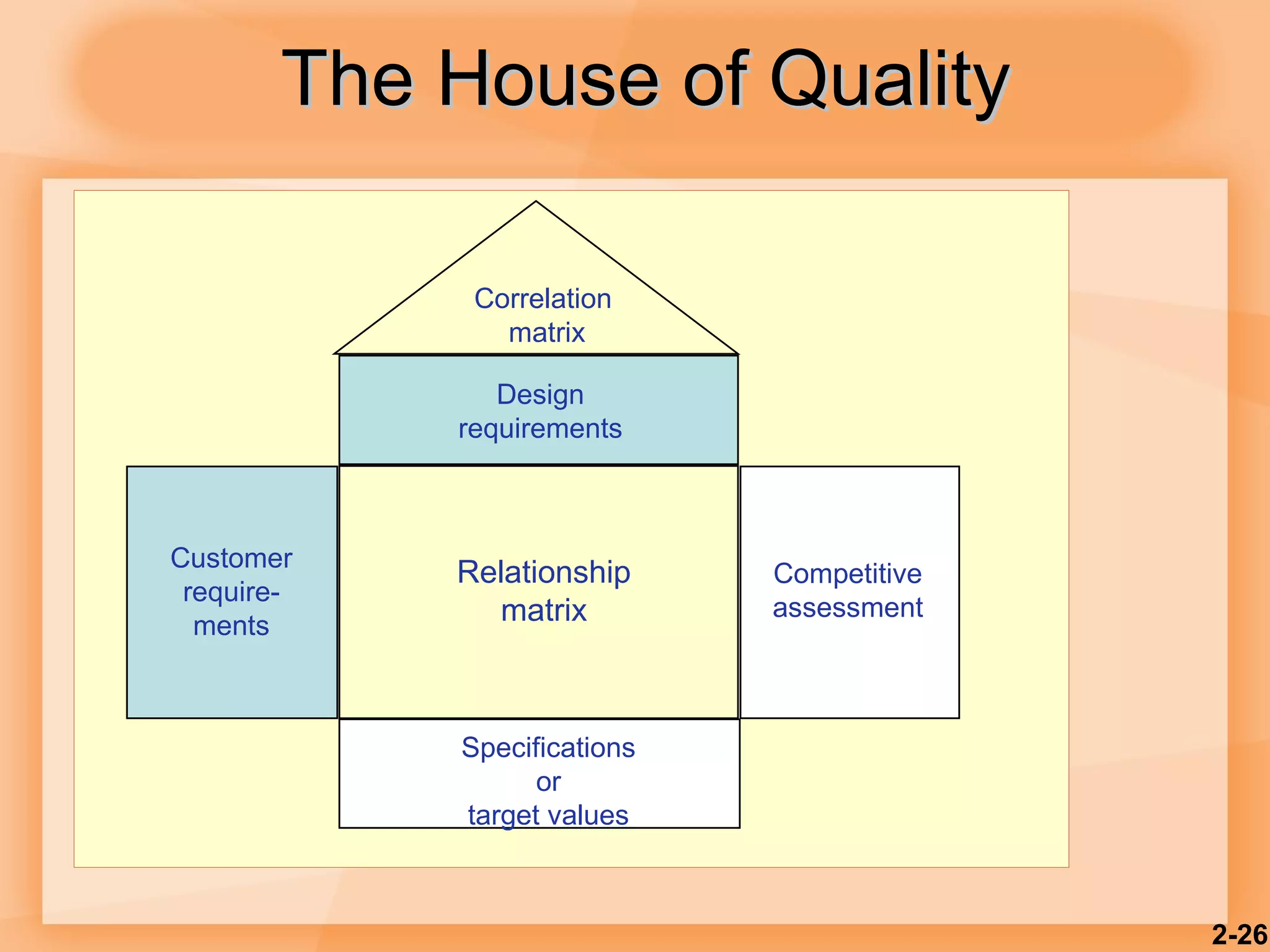
The House of Quality 2- Correlation  matrix Design requirements Customer require- ments Competitive assessment Relationship matrix Specifications or target values
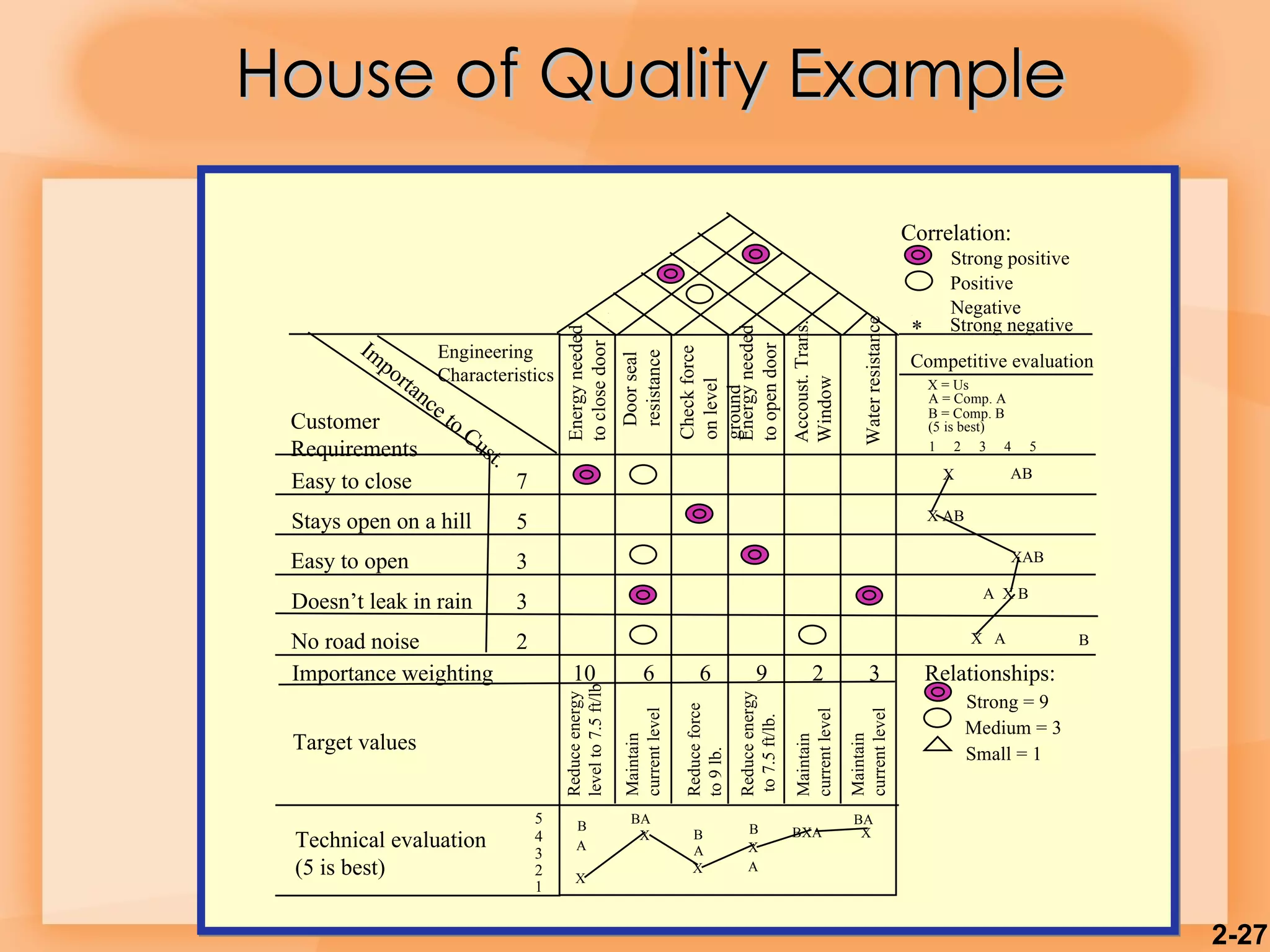
2- House of Quality Example Customer  Requirements Importance to Cust. Easy to close Stays open on a hill Easy to open Doesn’t leak in rain No road noise Importance weighting Engineering Characteristics Energy needed  to close door Check force on level ground Energy needed  to open door Water resistance 10 6 6 9 2 3 7 5 3 3 2 X X X X X Correlation: Strong positive Positive Negative Strong negative X * Competitive evaluation X = Us A = Comp. A B = Comp. B (5 is best) 1  2  3  4  5 X AB X AB XAB A  X B X  A B Relationships: Strong = 9 Medium = 3 Small = 1 Target values Reduce energy  level to 7.5 ft/lb Reduce force to 9 lb. Reduce energy to 7.5 ft/lb. Maintain current level Technical evaluation (5 is best) 5 4 3 2 1 B A X BA X B A X B X A BXA BA X Door seal  resistance Accoust. Trans. Window Maintain current level Maintain current level
Discussion Questions Describe the product selection process with the help of an example of a new small car. Give two examples for each of a service and manufacturing firm, of the impact of technology in service and product design. Discuss with suitable examples, the process of launching a new product in the market. Explain with the help of suitable examples. What do you mean by “Product Life Cycle”? State the different stages of a product life cycle and also the factors affecting the decisions at each stage of product life cycle.
Discussion Questions What are the factors that cause organizations to redesign their products or services? Describe some of the ways a product designer can use CAD. Some suggest that customer expectation is the key to service success. Give an example from your own experience to support or refute this assertion.
End of Unit 2 UNIT 3: Process Selection

Unit2

  • 1.
  • 2.
    Strategic Decision (Long-termDecision) Other decisions (capacity planning, process planning, location, human resource etc.) depend upon it. Basis of Competitiveness and Profitability Involves other areas as marketing, R&D Requires Top Management Support 2- Product and Service Selection
  • 3.
    Translate customer wantsand needs into product and service requirements Refine existing products and services Develop new products and services Formulate quality goals Formulate cost targets Construct and test prototypes Document specifications Product or Service Design Activities 2-
  • 4.
    Reasons for Productor Service Design Economic Social and demographic changes Political, liability, or legal Competitiveness Cost or availability Technological advances 2- Product and service design – or redesign – should be closely tied to an organization’s strategy
  • 5.
    Objectives of ProductDesign Main focus Customer satisfaction Understand what the customer wants Secondary focus Function of product/service Cost/profit Quality Appearance Ease of production/assembly Ease of maintenance/service 2-
  • 6.
    Life Cycles ofProducts or Services 2- Time Introduction Growth Maturity Saturation Decline Demand
  • 7.
    Product Selection Process2- Pure Research Applied Research Screening Economic Analysis Product Development Process Development Design and Testing Marketing Research Idea Generation
  • 8.
    Product Selection Process2- Development Design Selection Research Research Pure Research Applied Research Screening Economic Analysis Product Development Process Development Design and Testing Marketing Research Idea Generation
  • 9.
    Research Organized effortsto increase scientific knowledge or product innovation Basic Research: knowledge about a subject Applied Research: commercial focus Development: convert into commercial application Market Research: Consumer Survey, Dealer Survey, opinion polls Idea Generation: Brainstorming, panel discussion, scenario building, technology forecasting 2-
  • 10.
    Research… New IdeaMortality curve 2-
  • 11.
    Selection Qualitative Phase(Screening) Match Corporate Strategy, Capitalize on Strengths Exploit Familiarity Factor Familiarity with similar products and services Familiarity with similar transformation process Familiarity with similar market segments Familiarity with similar distribution channels. Quantitative Phase Economic Analysis NPV, IRR, B/C Ratio 2-
  • 12.
    Development Creation, Modificationor Extension Product Development Process Planning Concept Development System-Level Design Detailed Engineering Design Testing and Refinement Production Ramp-up 2-
  • 13.
    Development… Function CostQuality Reliability Maintainability Producibility Timing Accessibility Legal, Ethical, Environmental, Social Factors Appearance Safety 2- More Important for Service Design Key Elements of a Product Design
  • 14.
    Product Design TwoMethods Standard Product (Standardization) Product Variety Mass Customization Delayed Differentiation Modularization Design Simplification Structuring of Options 2-
  • 15.
    Standardization Standardization: Extentto which there is an absence of variety in a product, service or process Standardized products are immediately available to customers 2-
  • 16.
  • 17.
    Disadvantages of Standardization Designs may be frozen with too many imperfections remaining. High cost of design changes increases resistance to improvements. Decreased variety results in less consumer appeal. 2-
  • 18.
    Mass customization: Astrategy of producing standardized goods or services, but incorporating some degree of customization Delayed differentiation Modular design Mass Customization 2-
  • 19.
    Delayed differentiation isa postponement tactic Producing but not quite completing a product or service until customer preferences or specifications are known Delayed Differentiation 2-
  • 20.
    Modular Design Modulardesign is a form of standardization in which component parts are subdivided into modules that are easily replaced or interchanged. It allows: easier diagnosis and remedy of failures easier repair and replacement simplification of manufacturing and assembly 2-
  • 21.
    Design Simplification Itattempts to simplify the design. Combining two or more parts into one. Eliminate some parts. Lower Production cost Lower Material Cost 2-
  • 22.
    Options Provide varietyto product Increased Attractiveness Broad Range of Customers Pricing can be complicated 2-
  • 23.
    Product and ProcessInnovation Uncoordinated processes Performance maximization Integrated processes Cost minimization Need Stimulated Output rate Stimulated Technology Stimulated Cost Stimulated
  • 24.
    Computer-Aided Design Computer-AidedDesign (CAD) is product design using computer graphics. increases productivity of designers, 3 to 10 times creates a database for manufacturing information on product specifications provides possibility of engineering and cost analysis on proposed designs 2-
  • 25.
    Quality Function DeploymentVoice of the customer House of quality Quality Function Deployment 2- QFD: An approach that integrates the “voice of the customer” into the product and service development process.
  • 26.
    The House ofQuality 2- Correlation matrix Design requirements Customer require- ments Competitive assessment Relationship matrix Specifications or target values
  • 27.
    2- House ofQuality Example Customer Requirements Importance to Cust. Easy to close Stays open on a hill Easy to open Doesn’t leak in rain No road noise Importance weighting Engineering Characteristics Energy needed to close door Check force on level ground Energy needed to open door Water resistance 10 6 6 9 2 3 7 5 3 3 2 X X X X X Correlation: Strong positive Positive Negative Strong negative X * Competitive evaluation X = Us A = Comp. A B = Comp. B (5 is best) 1 2 3 4 5 X AB X AB XAB A X B X A B Relationships: Strong = 9 Medium = 3 Small = 1 Target values Reduce energy level to 7.5 ft/lb Reduce force to 9 lb. Reduce energy to 7.5 ft/lb. Maintain current level Technical evaluation (5 is best) 5 4 3 2 1 B A X BA X B A X B X A BXA BA X Door seal resistance Accoust. Trans. Window Maintain current level Maintain current level
  • 28.
    Discussion Questions Describethe product selection process with the help of an example of a new small car. Give two examples for each of a service and manufacturing firm, of the impact of technology in service and product design. Discuss with suitable examples, the process of launching a new product in the market. Explain with the help of suitable examples. What do you mean by “Product Life Cycle”? State the different stages of a product life cycle and also the factors affecting the decisions at each stage of product life cycle.
  • 29.
    Discussion Questions Whatare the factors that cause organizations to redesign their products or services? Describe some of the ways a product designer can use CAD. Some suggest that customer expectation is the key to service success. Give an example from your own experience to support or refute this assertion.
  • 30.
    End of Unit2 UNIT 3: Process Selection

Editor's Notes

  • #8 These steps can be grouped as Research Selection Development Design Market Research: Consumer Survey, Dealer Survey, opinion polls Idea Generation: Brainstorming, panel discussion, scenario building, technology forecasting.
  • #9 These steps can be grouped as Research Selection Development Design Market Research: Consumer Survey, Dealer Survey, opinion polls Idea Generation: Brainstorming, panel discussion, scenario building, technology forecasting.