The Design Process
Prof.Dr.S.Kathirrvelu
TPRIC, EITEX, BDU.
I MSc FT- Product Engineering 1
• Design Council was asked to conduct a study of
the design processes used in leading global
companies. The remit of the study was to
understand the design processes used by
leading corporate users of design, what
elements they involve, and how these processes
take a product or service from an idea through
to implementation and launch.
I MSc FT- Product Engineering 2
The key aim of this design process study was to seek the
answers to five questions:
— What is the design process used in leading corporate
users of design?
— How is the process managed?
— What benefits does it bring?
— What are the similarities and differences among these
companies’ design processes?
— Are there activities or methods among the design
processes observed that could constitute best practice?
I MSc FT- Product Engineering 3
• Different designers manage the process of
design in different ways. But when we studied
the design process in eleven leading
companies, we found striking similarities and
shared approaches among the designers we
talked to. In this section, we show one way of
mapping the design process, and give more
detail on the key activities in each of the
process's four stages.
I MSc FT- Product Engineering 4
Delivering competitive advantage through
Design
Design plays a fundamental role in the success of
many of the world’s leading companies. But how
do those firms ensure that they are getting the
best return on their investment in design?
I MSc FT- Product Engineering 5
The 'double diamond' design process model
• The double diamond diagram was developed
through in-house research at the Design Council as
a simple graphical way of describing the design
process.
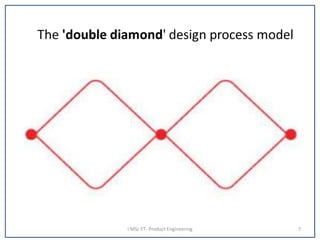
• Divided into four distinct phases, Discover, Define,
Develop and Deliver, it maps the divergent and
convergent stages of the design process, showing
the different modes of thinking that designers use.
I MSc FT- Product Engineering 6
I MSc FT- Product Engineering 7
Discover The first quarter of the double diamond
model marks the start of the project. This begins with
an initial idea or inspiration, often sourced from a
discovery phase in which user needs are identified.
These include:
— Market research
— User research
— Managing information
— Design research groups.
I MSc FT- Product Engineering 8
• Define The second quarter of the double
diamond model represents the definition stage,
in which interpretation and alignment of these
needs to business objectives is achieved. Key
activities during the Define stage are:
• — Project development
• — Project management
• — Project sign-off.
I MSc FT- Product Engineering 9
Develop The third quarter marks a period of
development where design-led solutions are
developed, iterated and tested within the company.
Key activities and objectives during the Develop stage
are:
— Multi-disciplinary working
— Visual management
— Development methods
— Testing.
I MSc FT- Product Engineering 10
• Deliver The final quarter of the double diamond
model represents the delivery stage, where the
resulting product or service is finalised and
launched in the relevant market. The key
activities and objectives during this stage are:
• — Final testing, approval and launch
• — Targets, evaluation and feedback loops
I MSc FT- Product Engineering 11
Discover
• The start of a project is marked by an initial idea or
inspiration, often sourced from the Discover phase.
• The objective of the Discover stage is to act as a ‘phase of
divergent thought’, where the designers and other project
team members keep their perspectives wide to allow for a
broad range of ideas and influences. In this stage of the
design process, the company is asking a question, posing a
hypothesis or identifying a problem by analysing market
data, trends and other information sources.
I MSc FT- Product Engineering 12
Initial influences and inspiration
• Companies begin the design process when they want to
develop a new product or service, or refine an existing one.
The initial influence or inspiration for this can be triggered in a
variety of ways. It may involve picking up on social or
environmental trends, the launch of a competitor product or
service, or tapping into the ideas of staff or networks.
• Within the company, the originator of an idea or suggestion
could be a product manager, CEO, designer, user research, or
even a customer.
I MSc FT- Product Engineering 13
• Wherever the initial idea comes from, the design process in
general and the Discover stage in particular provides a
framework within which to process the initial ideas or
inspiration.
• The Discover stage helps to identify the problem, opportunity
or user need that should be addressed, and introduces the
space within which design can provide a solution – the playing
field for design. It is important that the design process used in
the company allows for ideas to be captured and developed in
this way, and fosters this type of creative environment among
designers and other staff.
I MSc FT- Product Engineering 14
• However, the design process most commonly
begins with teams finding their initial inspiration
in information about user behaviour. Indeed, the
most formalized sources of inspiration and
information are the outcomes and interpretation
of market research and data, observation,
primary research or ideas that have been
generated in formal or informal settings by
members of the team.
I MSc FT- Product Engineering 15
This often takes the form of three key sources of
information:
— Use of market research
— Generating user research (such as ethnography
and observation)
— The involvement of a bespoke design research
group
I MSc FT- Product Engineering 16
• Market research
• One source of information that can lead to the
development of new products and services is
market and research data. This can mean the
outputs from companies’ own internal
marketing, consumer insight or research
teams, who commission and manage regular
information and data from key target
customer groups.
I MSc FT- Product Engineering 17
• It involves tracking perceptions and attitudes
related to the company, its products and
services, brand perceptions and customer
satisfaction, and is also likely to include
competitor analysis, and gathering feedback on
the commissioning company’s performance and
reception in contrast to that of their
competitors.
I MSc FT- Product Engineering 18
User research
The emphasis on user needs and experiences in the
companies we visited means that user research features
heavily in the design process.
User research is used to identify:
— How users are accessing current products and services
— Areas for improvements or innovation
— Opportunities for new products and services that will
address a user need
I MSc FT- Product Engineering 19
• The benefits of involving the designers closely in user research
are broadly that:
• — Designers bring particular creative skills or idea generation to
the analysis of research-based information, and these skills help
to identify problems and solutions emerging from the data
• — Having designers involved directly with other teams in the
analysis of data and research involves multi-disciplinary working
and thus gives other teams an insight into the skills that
designers bring to the process
• — This kind of collaboration helps to clarify project objectives at
an early stage.
I MSc FT- Product Engineering 20
• Planning with information - Using the design
process to plan the flow of information
through the development phase and manage
the interaction with designers and other
teams throughout
• Designer involvement in user research -
Ensuring that designers are contributing to
and taking part in research with users
themselves.
I MSc FT- Product Engineering 21
Define
• The Define stage should be thought of as a filter
where the review, selection and discarding of
ideas takes place. This is where findings from
the Discover stage are analysed, defined and
refined as problems, and ideas for solutions are
pitched and prototyped.
I MSc FT- Product Engineering 22
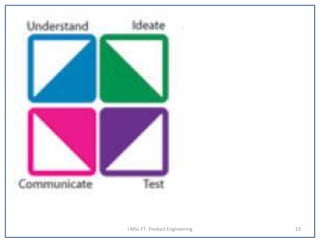
I MSc FT- Product Engineering 23
• During the initial Discover stage of the design process, the
design team and its partners must keep a broad
perspective and open mind in order to identify a problem -
a user need or an opportunity that needs to be addressed
and channelled into a design-led product or service
development process.
• At the Define stage, a combination of the ideas or
directions identified during the Discover stage are analysed
and synthesised into a brief with actionable tasks related
to new and existing product or service development.I MSc FT- Product Engineering 24
• The Define stage ends with a clear definition of the
problem(s) and a plan for how to address this through a
design-led product or service. In practice, the Define
stage ends in a project go-ahead through corporate level
sign-off.
• Key activities during the Define stage are:
• — The generation of initial ideas and project
development
• — Ongoing project management
• — Corporate objectives agreed and project sign-off.
I MSc FT- Product Engineering 25
• Project development
• Having defined the problem in the Discover
stage, the Define stage covers the initial
development of project ideas and
components needed to solve the problem at
hand.
I MSc FT- Product Engineering 26
• During the Define stage a designer must engage with
and understand the wider context in which this
problem or opportunity sits, both within and beyond
the company. This might include considering the
company’s own financial situation and the extent to
which it is able to invest in a project, the recent launch
of a competitive product with similar features, or social
and economic contexts which require a certain
approach or sensitivity, such as an awareness of
sustainability issues.
I MSc FT- Product Engineering 27
• Secondly, the designer must equally keep in mind what is
feasible within the company’s technological or
production capabilities. A clear understanding of details
such as materials, logistics, time-to-market and other
influencers is a key part of understanding the wider
corporate ability to develop a design solution.
• This enquiry is not as detailed during the Define stage as
during the Develop stage, but rather serves as a filter that
allows designers to identify which idea has legs and
should be pursued and developed.
I MSc FT- Product Engineering 28
• Develop
• At the Develop stage the project has been
taken through a formal sign-off, which has
given the corporate and financial backing to
the development of one or more concepts
that have addressed the initial problem.
I MSc FT- Product Engineering 29
• Key activities and objectives during the
Develop stage are:
• — Multi-disciplinary working and
dependencies with other departments
• — Visual management
• — Development methods
• — Testing
I MSc FT- Product Engineering 30
• Multi-disciplinary working
• Multi-disciplinary teams are a key feature of the
design processes observed in the companies
that took part in this study. And multi-
disciplinary teams are a feature strongly in the
Develop stage, where input and advice from
other areas of expertise are essential to
finalising the product or service at this stage.I MSc FT- Product Engineering 31
• Key to this is the way in which the design
process aims to break down walls and silos
internally, for example between design and
manufacturing. The benefits of doing this
include speeding up problem-solving during
the project, as potential issues and bottle-
necks are identified early on, and potential
delays are addressed.
I MSc FT- Product Engineering 32
• Visual management techniques
• During the Develop stage of the design process,
project management is carried out in much the
same way as during the Define stage.
• Visual management techniques allow internal
stakeholders to track progress on the design
project and see different phases and iterations of
sketches, prototypes, and other design work on
the product or service concept.
I MSc FT- Product Engineering 33
• Development methods
• Whatever a company is designing, the principle
of the Development phase is to prototype and
iterate the concept to get it as close to an end
product or service as possible. Lessons from
each round of development are fed back in
through formal and informal communications
within the project team and with its
stakeholders.
I MSc FT- Product Engineering 34
• In order to reduce costs and development time,
companies are increasingly turning to virtual
prototyping methods during the early phases of
design development. Such methods can range
from sketches and renderings to detailed 3D
computer models of potential designs. Visual
representations are supplemented by physical
models made using rapid prototyping equipment
or traditional model-making skills.
I MSc FT- Product Engineering 35
• Testing
• The testing of concepts and prototypes form a major part
of the Develop stage.
• The basic methodology consists of a number of steps that
are aimed at checking that the design is consistent with user
needs and corporate strategy, checking product capabilities,
requirements and the ability to meet these, and optimising
the design to combine these two. In fact, the Six Sigma
process overall can be said to include a lot of what happens
in general during the Develop stage, not just the testing
phase.
I MSc FT- Product Engineering 36
• Deliver
• The Deliver stage of the double diamond design
process is where the final concept is taken through final
testing, signed-off, produced and launched.
• It will result in a product or service that successfully
addresses the problem identified during the Discover
stage. It will also include processes for feeding back
lessons from the full design process to inform future
projects, including methods, ways of working and
relevant information .
I MSc FT- Product Engineering 37
• Final testing, approval and launch
• This final stage of the process is designed to
identify any final constraints or problems
before manufacture and is when the product or
service is checked against standards and
regulations, and undergoes damage testing and
compatibility testing.
I MSc FT- Product Engineering 38
• Launching the product or service
• At this point in the design process the product
or service is launched, and the process now
includes liaison with appropriate internal
teams in areas such as marketing,
communications, packaging and brand.
I MSc FT- Product Engineering 39
• Targets, evaluation and feedback
• Most of the companies we spoke to are required
to report back on the success of the launched
product or service. The common aim in doing
this is to prove the impact of good design on the
success of the product or service. Being able to
prove that design contributed to business
success helps to gain buy-in for design and
maintains the team’s credibility and perceived
value to the organisation.
I MSc FT- Product Engineering 40
• Measuring the impact of the product or
service is done by collecting data from a
number of sources. For example, companies
use their internal consumer insight, research
or marketing functions to carry out customer
satisfaction tracking surveys and link changes
in satisfaction to the introduction of products
or services.
I MSc FT- Product Engineering 41
• Design has helped many of these eleven companies
respond better to common business challenges:
• — Good design makes products more competitive. It
keeps production costs down but allows higher prices
in the shops
• — Good design keeps users happy, making them come
back again and encouraging them to recommend
things to their friends
• — Design applies the power of the brand. A strong
brand identity encourages customers to trust existing
products and to try new onesI MSc FT- Product Engineering 42
• Making products more competitive
• Good design makes products more competitive, better, quicker and
cheaper. It keeps production costs down but allows companies to
charge higher prices.
• Many of the companies in the Eleven Lessons study use design as a
tool to ensure that their products can meet increasingly demanding
cost and quality constraints. These organisations are not simply making
use of design to add a little extra value at the end of the product
development process: they demand that their design teams squeeze
every drop they can from initial idea to final recycling.
I MSc FT- Product Engineering 43
• Design for happy users
• Good design is a way to exceed user expectations, keep them happy,
make them come back again and encourage them to recommend things
to their friends
• For several of the companies in the survey, use of design allowed them
to position their products apart from many of their competitors. By
applying good design to products in categories where users have low
expectations for visual appeal, functionality or usability, design helps to
create entirely new market niches and even new product categories. By
delighting users who merely expect to have their functional
requirements fulfilled, these companies are using to design to help breed
customer loyalty. I MSc FT- Product Engineering 44
• Managing the impact of the brand
• Design applies the power of the brand. A strong brand
identity encourages customers to trust existing products
and to try new ones.
• The company brand has a significant impact on the design
process. This is particularly the case in companies where
the brand sees customer experience as a key value
enhancer. In these, the design process reflects the need
for design to be used as a mechanism by which a
consistent message about the company and its products
and services is delivered to the end user.
I MSc FT- Product Engineering 45
• Integration
• Design can't be treated in isolation from other business
processes: designers have always needed to interact with
commercial functions, with manufacturing and with product or
service support. Multi-disciplinary teams and working processes
are a key feature in many of the companies from our study
• While these interactions are an essential part of the design
process, they can be carried out in many different ways. For every
company in our survey, managing the interactions between the
design function and other parts of the organisation was a key
concern. I MSc FT- Product Engineering 46
• Senior management support
• Corporate and senior management support for design
is beneficial. The success of the design process in a
business is augmented when there is buy-in from –
and acceptance of its value by – senior management.
• The three primary drivers for top management support
of design.
• — Design’s role as a value creator
• — A new focus on user needs
• — Design as a tool to deliver the brand
I MSc FT- Product Engineering 47
• Tools of the trade and methods
• The companies we visited use some key tools and techniques in order
to manage their design processes in an effective and consistent
manner.
• Design methods such as sketching, prototyping, and storyboards are all
used throughout the design process to develop and demonstrate the
potential of a product or service. Several of the participating
companies’ design processes included the practice of documenting
design methods in a central resource. For some, this resource
constituted the only formalised element of a design process, whereas
for others it was just one key component.
I MSc FT- Product Engineering 48

Design process

  • 1.
    The Design Process Prof.Dr.S.Kathirrvelu TPRIC,EITEX, BDU. I MSc FT- Product Engineering 1
  • 2.
    • Design Councilwas asked to conduct a study of the design processes used in leading global companies. The remit of the study was to understand the design processes used by leading corporate users of design, what elements they involve, and how these processes take a product or service from an idea through to implementation and launch. I MSc FT- Product Engineering 2
  • 3.
    The key aimof this design process study was to seek the answers to five questions: — What is the design process used in leading corporate users of design? — How is the process managed? — What benefits does it bring? — What are the similarities and differences among these companies’ design processes? — Are there activities or methods among the design processes observed that could constitute best practice? I MSc FT- Product Engineering 3
  • 4.
    • Different designersmanage the process of design in different ways. But when we studied the design process in eleven leading companies, we found striking similarities and shared approaches among the designers we talked to. In this section, we show one way of mapping the design process, and give more detail on the key activities in each of the process's four stages. I MSc FT- Product Engineering 4
  • 5.
    Delivering competitive advantagethrough Design Design plays a fundamental role in the success of many of the world’s leading companies. But how do those firms ensure that they are getting the best return on their investment in design? I MSc FT- Product Engineering 5
  • 6.
    The 'double diamond'design process model • The double diamond diagram was developed through in-house research at the Design Council as a simple graphical way of describing the design process. • Divided into four distinct phases, Discover, Define, Develop and Deliver, it maps the divergent and convergent stages of the design process, showing the different modes of thinking that designers use. I MSc FT- Product Engineering 6
  • 7.
    I MSc FT-Product Engineering 7
  • 8.
    Discover The firstquarter of the double diamond model marks the start of the project. This begins with an initial idea or inspiration, often sourced from a discovery phase in which user needs are identified. These include: — Market research — User research — Managing information — Design research groups. I MSc FT- Product Engineering 8
  • 9.
    • Define Thesecond quarter of the double diamond model represents the definition stage, in which interpretation and alignment of these needs to business objectives is achieved. Key activities during the Define stage are: • — Project development • — Project management • — Project sign-off. I MSc FT- Product Engineering 9
  • 10.
    Develop The thirdquarter marks a period of development where design-led solutions are developed, iterated and tested within the company. Key activities and objectives during the Develop stage are: — Multi-disciplinary working — Visual management — Development methods — Testing. I MSc FT- Product Engineering 10
  • 11.
    • Deliver Thefinal quarter of the double diamond model represents the delivery stage, where the resulting product or service is finalised and launched in the relevant market. The key activities and objectives during this stage are: • — Final testing, approval and launch • — Targets, evaluation and feedback loops I MSc FT- Product Engineering 11
  • 12.
    Discover • The startof a project is marked by an initial idea or inspiration, often sourced from the Discover phase. • The objective of the Discover stage is to act as a ‘phase of divergent thought’, where the designers and other project team members keep their perspectives wide to allow for a broad range of ideas and influences. In this stage of the design process, the company is asking a question, posing a hypothesis or identifying a problem by analysing market data, trends and other information sources. I MSc FT- Product Engineering 12
  • 13.
    Initial influences andinspiration • Companies begin the design process when they want to develop a new product or service, or refine an existing one. The initial influence or inspiration for this can be triggered in a variety of ways. It may involve picking up on social or environmental trends, the launch of a competitor product or service, or tapping into the ideas of staff or networks. • Within the company, the originator of an idea or suggestion could be a product manager, CEO, designer, user research, or even a customer. I MSc FT- Product Engineering 13
  • 14.
    • Wherever theinitial idea comes from, the design process in general and the Discover stage in particular provides a framework within which to process the initial ideas or inspiration. • The Discover stage helps to identify the problem, opportunity or user need that should be addressed, and introduces the space within which design can provide a solution – the playing field for design. It is important that the design process used in the company allows for ideas to be captured and developed in this way, and fosters this type of creative environment among designers and other staff. I MSc FT- Product Engineering 14
  • 15.
    • However, thedesign process most commonly begins with teams finding their initial inspiration in information about user behaviour. Indeed, the most formalized sources of inspiration and information are the outcomes and interpretation of market research and data, observation, primary research or ideas that have been generated in formal or informal settings by members of the team. I MSc FT- Product Engineering 15
  • 16.
    This often takesthe form of three key sources of information: — Use of market research — Generating user research (such as ethnography and observation) — The involvement of a bespoke design research group I MSc FT- Product Engineering 16
  • 17.
    • Market research •One source of information that can lead to the development of new products and services is market and research data. This can mean the outputs from companies’ own internal marketing, consumer insight or research teams, who commission and manage regular information and data from key target customer groups. I MSc FT- Product Engineering 17
  • 18.
    • It involvestracking perceptions and attitudes related to the company, its products and services, brand perceptions and customer satisfaction, and is also likely to include competitor analysis, and gathering feedback on the commissioning company’s performance and reception in contrast to that of their competitors. I MSc FT- Product Engineering 18
  • 19.
    User research The emphasison user needs and experiences in the companies we visited means that user research features heavily in the design process. User research is used to identify: — How users are accessing current products and services — Areas for improvements or innovation — Opportunities for new products and services that will address a user need I MSc FT- Product Engineering 19
  • 20.
    • The benefitsof involving the designers closely in user research are broadly that: • — Designers bring particular creative skills or idea generation to the analysis of research-based information, and these skills help to identify problems and solutions emerging from the data • — Having designers involved directly with other teams in the analysis of data and research involves multi-disciplinary working and thus gives other teams an insight into the skills that designers bring to the process • — This kind of collaboration helps to clarify project objectives at an early stage. I MSc FT- Product Engineering 20
  • 21.
    • Planning withinformation - Using the design process to plan the flow of information through the development phase and manage the interaction with designers and other teams throughout • Designer involvement in user research - Ensuring that designers are contributing to and taking part in research with users themselves. I MSc FT- Product Engineering 21
  • 22.
    Define • The Definestage should be thought of as a filter where the review, selection and discarding of ideas takes place. This is where findings from the Discover stage are analysed, defined and refined as problems, and ideas for solutions are pitched and prototyped. I MSc FT- Product Engineering 22
  • 23.
    I MSc FT-Product Engineering 23
  • 24.
    • During theinitial Discover stage of the design process, the design team and its partners must keep a broad perspective and open mind in order to identify a problem - a user need or an opportunity that needs to be addressed and channelled into a design-led product or service development process. • At the Define stage, a combination of the ideas or directions identified during the Discover stage are analysed and synthesised into a brief with actionable tasks related to new and existing product or service development.I MSc FT- Product Engineering 24
  • 25.
    • The Definestage ends with a clear definition of the problem(s) and a plan for how to address this through a design-led product or service. In practice, the Define stage ends in a project go-ahead through corporate level sign-off. • Key activities during the Define stage are: • — The generation of initial ideas and project development • — Ongoing project management • — Corporate objectives agreed and project sign-off. I MSc FT- Product Engineering 25
  • 26.
    • Project development •Having defined the problem in the Discover stage, the Define stage covers the initial development of project ideas and components needed to solve the problem at hand. I MSc FT- Product Engineering 26
  • 27.
    • During theDefine stage a designer must engage with and understand the wider context in which this problem or opportunity sits, both within and beyond the company. This might include considering the company’s own financial situation and the extent to which it is able to invest in a project, the recent launch of a competitive product with similar features, or social and economic contexts which require a certain approach or sensitivity, such as an awareness of sustainability issues. I MSc FT- Product Engineering 27
  • 28.
    • Secondly, thedesigner must equally keep in mind what is feasible within the company’s technological or production capabilities. A clear understanding of details such as materials, logistics, time-to-market and other influencers is a key part of understanding the wider corporate ability to develop a design solution. • This enquiry is not as detailed during the Define stage as during the Develop stage, but rather serves as a filter that allows designers to identify which idea has legs and should be pursued and developed. I MSc FT- Product Engineering 28
  • 29.
    • Develop • Atthe Develop stage the project has been taken through a formal sign-off, which has given the corporate and financial backing to the development of one or more concepts that have addressed the initial problem. I MSc FT- Product Engineering 29
  • 30.
    • Key activitiesand objectives during the Develop stage are: • — Multi-disciplinary working and dependencies with other departments • — Visual management • — Development methods • — Testing I MSc FT- Product Engineering 30
  • 31.
    • Multi-disciplinary working •Multi-disciplinary teams are a key feature of the design processes observed in the companies that took part in this study. And multi- disciplinary teams are a feature strongly in the Develop stage, where input and advice from other areas of expertise are essential to finalising the product or service at this stage.I MSc FT- Product Engineering 31
  • 32.
    • Key tothis is the way in which the design process aims to break down walls and silos internally, for example between design and manufacturing. The benefits of doing this include speeding up problem-solving during the project, as potential issues and bottle- necks are identified early on, and potential delays are addressed. I MSc FT- Product Engineering 32
  • 33.
    • Visual managementtechniques • During the Develop stage of the design process, project management is carried out in much the same way as during the Define stage. • Visual management techniques allow internal stakeholders to track progress on the design project and see different phases and iterations of sketches, prototypes, and other design work on the product or service concept. I MSc FT- Product Engineering 33
  • 34.
    • Development methods •Whatever a company is designing, the principle of the Development phase is to prototype and iterate the concept to get it as close to an end product or service as possible. Lessons from each round of development are fed back in through formal and informal communications within the project team and with its stakeholders. I MSc FT- Product Engineering 34
  • 35.
    • In orderto reduce costs and development time, companies are increasingly turning to virtual prototyping methods during the early phases of design development. Such methods can range from sketches and renderings to detailed 3D computer models of potential designs. Visual representations are supplemented by physical models made using rapid prototyping equipment or traditional model-making skills. I MSc FT- Product Engineering 35
  • 36.
    • Testing • Thetesting of concepts and prototypes form a major part of the Develop stage. • The basic methodology consists of a number of steps that are aimed at checking that the design is consistent with user needs and corporate strategy, checking product capabilities, requirements and the ability to meet these, and optimising the design to combine these two. In fact, the Six Sigma process overall can be said to include a lot of what happens in general during the Develop stage, not just the testing phase. I MSc FT- Product Engineering 36
  • 37.
    • Deliver • TheDeliver stage of the double diamond design process is where the final concept is taken through final testing, signed-off, produced and launched. • It will result in a product or service that successfully addresses the problem identified during the Discover stage. It will also include processes for feeding back lessons from the full design process to inform future projects, including methods, ways of working and relevant information . I MSc FT- Product Engineering 37
  • 38.
    • Final testing,approval and launch • This final stage of the process is designed to identify any final constraints or problems before manufacture and is when the product or service is checked against standards and regulations, and undergoes damage testing and compatibility testing. I MSc FT- Product Engineering 38
  • 39.
    • Launching theproduct or service • At this point in the design process the product or service is launched, and the process now includes liaison with appropriate internal teams in areas such as marketing, communications, packaging and brand. I MSc FT- Product Engineering 39
  • 40.
    • Targets, evaluationand feedback • Most of the companies we spoke to are required to report back on the success of the launched product or service. The common aim in doing this is to prove the impact of good design on the success of the product or service. Being able to prove that design contributed to business success helps to gain buy-in for design and maintains the team’s credibility and perceived value to the organisation. I MSc FT- Product Engineering 40
  • 41.
    • Measuring theimpact of the product or service is done by collecting data from a number of sources. For example, companies use their internal consumer insight, research or marketing functions to carry out customer satisfaction tracking surveys and link changes in satisfaction to the introduction of products or services. I MSc FT- Product Engineering 41
  • 42.
    • Design hashelped many of these eleven companies respond better to common business challenges: • — Good design makes products more competitive. It keeps production costs down but allows higher prices in the shops • — Good design keeps users happy, making them come back again and encouraging them to recommend things to their friends • — Design applies the power of the brand. A strong brand identity encourages customers to trust existing products and to try new onesI MSc FT- Product Engineering 42
  • 43.
    • Making productsmore competitive • Good design makes products more competitive, better, quicker and cheaper. It keeps production costs down but allows companies to charge higher prices. • Many of the companies in the Eleven Lessons study use design as a tool to ensure that their products can meet increasingly demanding cost and quality constraints. These organisations are not simply making use of design to add a little extra value at the end of the product development process: they demand that their design teams squeeze every drop they can from initial idea to final recycling. I MSc FT- Product Engineering 43
  • 44.
    • Design forhappy users • Good design is a way to exceed user expectations, keep them happy, make them come back again and encourage them to recommend things to their friends • For several of the companies in the survey, use of design allowed them to position their products apart from many of their competitors. By applying good design to products in categories where users have low expectations for visual appeal, functionality or usability, design helps to create entirely new market niches and even new product categories. By delighting users who merely expect to have their functional requirements fulfilled, these companies are using to design to help breed customer loyalty. I MSc FT- Product Engineering 44
  • 45.
    • Managing theimpact of the brand • Design applies the power of the brand. A strong brand identity encourages customers to trust existing products and to try new ones. • The company brand has a significant impact on the design process. This is particularly the case in companies where the brand sees customer experience as a key value enhancer. In these, the design process reflects the need for design to be used as a mechanism by which a consistent message about the company and its products and services is delivered to the end user. I MSc FT- Product Engineering 45
  • 46.
    • Integration • Designcan't be treated in isolation from other business processes: designers have always needed to interact with commercial functions, with manufacturing and with product or service support. Multi-disciplinary teams and working processes are a key feature in many of the companies from our study • While these interactions are an essential part of the design process, they can be carried out in many different ways. For every company in our survey, managing the interactions between the design function and other parts of the organisation was a key concern. I MSc FT- Product Engineering 46
  • 47.
    • Senior managementsupport • Corporate and senior management support for design is beneficial. The success of the design process in a business is augmented when there is buy-in from – and acceptance of its value by – senior management. • The three primary drivers for top management support of design. • — Design’s role as a value creator • — A new focus on user needs • — Design as a tool to deliver the brand I MSc FT- Product Engineering 47
  • 48.
    • Tools ofthe trade and methods • The companies we visited use some key tools and techniques in order to manage their design processes in an effective and consistent manner. • Design methods such as sketching, prototyping, and storyboards are all used throughout the design process to develop and demonstrate the potential of a product or service. Several of the participating companies’ design processes included the practice of documenting design methods in a central resource. For some, this resource constituted the only formalised element of a design process, whereas for others it was just one key component. I MSc FT- Product Engineering 48