Working Capital, Credit and Accounts Receivable Management Reference: ETM Chapter 6 & 7 STFM Chapter 5 & 6
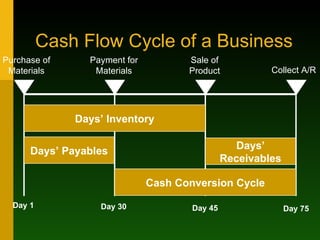
Cash Flow Cycle of a Business Purchase of Materials Payment for Materials Sale of Product Collect A/R Days’ Inventory Cash Conversion Cycle Days’ Receivables Days’ Payables Day 1 Day 30 Day 45 Day 75
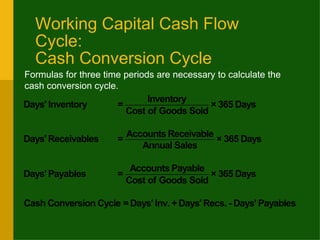
Working Capital Cash Flow Cycle:  Cash Conversion Cycle Formulas for three time periods are necessary to calculate the cash conversion cycle.
Credit Policy and Collections Order   Order   Sale   Cash  Placed   Received     Received Accounts   Collection < Inventory >  <  Receivable   >  <  Float  > Time ==> Accounts  Disbursement  <  Payable  >  <  Float  > Invoice  Payment  Cash Received  Sent  Paid
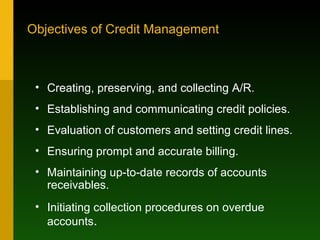
Objectives of Credit Management Creating, preserving, and collecting A/R. Establishing and communicating credit policies. Evaluation of customers and setting credit lines. Ensuring prompt and accurate billing. Maintaining up-to-date records of accounts receivables. Initiating collection procedures on overdue accounts .
Reasons to Offer Credit Competition Market Share Promotion Credit Availability to Customers Customer Convenience Profit
Credit and A/R Management: Fit Into the Financial Organization A credit manager or a captive finance company is the administrator of credit policies. Credit policies and collections will impact cash flows so credit and cash managers must work together. Reasons for credit and cash manager interaction include the accuracy of cash flow forecast, banking network management, and accounts receivable updating.
Cost Associated With a  Credit Policy Credit Department Costs Credit Evaluation Costs A/R Carrying Cost Discounted Payments Selling and Production Cost Collection Expenses Bad Debts
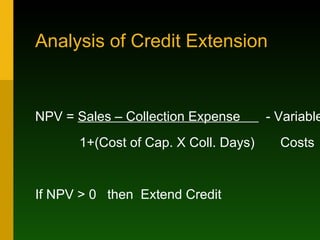
Analysis of Credit Extension NPV =  Sales – Collection Expense  - Variable 1+(Cost of Cap. X Coll. Days)  Costs If NPV > 0  then  Extend Credit
Forms of Credit Extension Installment Credit Revolving Credit Letters of Credit Open Account
Common Terms of Sales Cash Before Delivery (CBD) Cash on Delivery (COD) Cash Terms Net Terms Discount Terms Monthly Billing Bill of Lading or Documentary Collection Seasonal Dating Consignment
The Five C’s of Credit Character Capacity Capital Collateral Conditions
Cost of Trade Credit From a seller’s viewpoint, the cost of the discount must be weighted against the benefit of receiving early payment. From buyer’s viewpoint, the cost of trade credit is an opportunity cost. A buyer should take the discount if its cost of borrowing is less than the cost of foregoing the discount. Alternatively, a buyer should forego the discount if investment rates are higher than the cost of foregoing the discount.
Cost of Trade Credit Cost of Trade Credit = Early Payment Discount  x  365 ---------------------------------  --------------------------------- (1 – Early Payment Discount)  (Net Payment Period  - Discount Payment Period)
Annualized Cost of Trade Credit  Example   Assuming terms of 2/10, net 45, the cost of not taking the discount can be determined as follows: If the company can borrow  at less than 21.28% , it should do so and use the borrowed funds to pay early and take the discount.
Account Receivable Monitoring and Control Monitoring and control is the responsibility of the credit manager. Receivables turnover least favored technique Monitoring conducted on individual accounts through  aging schedules . Monitoring conducted at the aggregate level using  days’ sales outstanding  (DSO).
DSO Can give an indication of overall collection efficiency. Changes in sales volume, payment patterns, or strong seasonablity in sales can distort DSO.
Days’ Sales Outstanding (DSO)  Assume that a company has outstanding receivables of $350,000 at the end of the first quarter and credit sales of $425,000 for the quarter. Using a 90-day averaging period, the DSO for this company can be computed as follows: If the company’s credit terms are net 60, the average past due is computed as follows:
Aging Schedule Is a list of the percentage and/or amounts of outstanding A/R classified as current or past due. Used primarily to identify past due accounts. Can be prepared at the aggregate level or customer-by-customer. Subject to distortions due to sales variations.
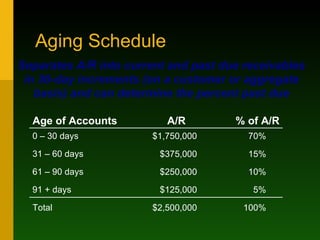
Aging Schedule Separates A/R into current and past due receivables in 30-day increments (on a customer or aggregate basis) and can determine the percent past due Age of Accounts A/R % of A/R 0  – 30 days 31  – 60 days 61  – 90 days 91 +  days Total $1,750,000 $375,000 $250,000 $125,000 $2,500,000 70% 15% 10% 5% 100%
A/R Balance Pattern Gives the percent of credit sales in a time period that remains oustanding at the end of each time period. Based on aging schedules. It is not directly affected by sales variations. A useful tool in cash flow forecasting because it can be used to project A/R levels and collections.
A/R Balance Pattern The total outstanding A/R balance at the end of March is: $595,000 = ($50,000 + $165,000 + $380,000) The estimate of cash inflows for April = 5% of April sales + 40% of March sales + 35% of February sales + 20% of January sales: Month Sales Sales Remaining A/R  from Month Sales  at End of March February January March April $250,000 $300,000 $400,000 $500,000 20% 55% 95% Remaining A/R as a % of  Month Sales $50,000 $165,000 $380,000 Estimated April inflows = (0.05 x $500,000) + (0.40 x $400,000) + (0.35 x $300,000) + (0.20 x $250,000) = $340,000
A/R Financing Unsecured Bank Borrowing Secured Bank Borrowing Captive Finance Company Third Party Financing Institutions Credit Card Factoring Private Label Financing
Evaluate Changes in Credit Policy Credit term change decision variables effect on dollar profits sales effect receivables effect return on investment effect default probability credit limits opportunity cost of funds invested in receivables company’s overall cost of capital
Cash Application Cash application  is the process of matching and applying a customer’s payment against accounts receivable. Done via an  Open Item  or a  Balance Forward  system.
Open Item System Used in commercial transactions. Each invoice is recorded separately in an account receivable file. Payments are matched to the particular invoice in the file.
Balance Forward System Used in retail applications. Credit limits are established for each individual. As purchases are made, A/R increase. Payments are applied against the aggregate A/R outstanding.
Collection Procedures Typical collection effort initial contact within 10 days of delinquency then reminder letter followed by phone call sales force notified last resort, reference to collection agency/legal action Collection agency Phase 1 - computer generated collection letter, when accounts are 45 to 90 days past due Phase 2 - commissioned collectors used
Collection Procedures Companies tend to be more aggressive the larger the receivables balance Companies understand the good-will tradeoff when selecting collection methods
International Credit Management Credit policy analysis lengthening terms increases exchange rate risk also increases default risk harder to get D&B reports harder to get bank credit information Modifying monitoring and collections legal remedies for late payment or nonpayment differ by country
Legislation Affecting Credit  and Collections Robison-Patman Act (1936) Usuary Laws Truth in Lending Act (1969) Fair Credit Reporting Act (1971) Fair Credit Billing Act (1975) Equal Credit Opportunity Act (1975) Fair Debt Collection Practice Act (1978)

Working capital, credit & ar management

  • 1.
    Working Capital, Creditand Accounts Receivable Management Reference: ETM Chapter 6 & 7 STFM Chapter 5 & 6
  • 2.
    Cash Flow Cycleof a Business Purchase of Materials Payment for Materials Sale of Product Collect A/R Days’ Inventory Cash Conversion Cycle Days’ Receivables Days’ Payables Day 1 Day 30 Day 45 Day 75
  • 3.
    Working Capital CashFlow Cycle: Cash Conversion Cycle Formulas for three time periods are necessary to calculate the cash conversion cycle.
  • 4.
    Credit Policy andCollections Order Order Sale Cash Placed Received Received Accounts Collection < Inventory > < Receivable > < Float > Time ==> Accounts Disbursement < Payable > < Float > Invoice Payment Cash Received Sent Paid
  • 5.
    Objectives of CreditManagement Creating, preserving, and collecting A/R. Establishing and communicating credit policies. Evaluation of customers and setting credit lines. Ensuring prompt and accurate billing. Maintaining up-to-date records of accounts receivables. Initiating collection procedures on overdue accounts .
  • 6.
    Reasons to OfferCredit Competition Market Share Promotion Credit Availability to Customers Customer Convenience Profit
  • 7.
    Credit and A/RManagement: Fit Into the Financial Organization A credit manager or a captive finance company is the administrator of credit policies. Credit policies and collections will impact cash flows so credit and cash managers must work together. Reasons for credit and cash manager interaction include the accuracy of cash flow forecast, banking network management, and accounts receivable updating.
  • 8.
    Cost Associated Witha Credit Policy Credit Department Costs Credit Evaluation Costs A/R Carrying Cost Discounted Payments Selling and Production Cost Collection Expenses Bad Debts
  • 9.
    Analysis of CreditExtension NPV = Sales – Collection Expense - Variable 1+(Cost of Cap. X Coll. Days) Costs If NPV > 0 then Extend Credit
  • 10.
    Forms of CreditExtension Installment Credit Revolving Credit Letters of Credit Open Account
  • 11.
    Common Terms ofSales Cash Before Delivery (CBD) Cash on Delivery (COD) Cash Terms Net Terms Discount Terms Monthly Billing Bill of Lading or Documentary Collection Seasonal Dating Consignment
  • 12.
    The Five C’sof Credit Character Capacity Capital Collateral Conditions
  • 13.
    Cost of TradeCredit From a seller’s viewpoint, the cost of the discount must be weighted against the benefit of receiving early payment. From buyer’s viewpoint, the cost of trade credit is an opportunity cost. A buyer should take the discount if its cost of borrowing is less than the cost of foregoing the discount. Alternatively, a buyer should forego the discount if investment rates are higher than the cost of foregoing the discount.
  • 14.
    Cost of TradeCredit Cost of Trade Credit = Early Payment Discount x 365 --------------------------------- --------------------------------- (1 – Early Payment Discount) (Net Payment Period - Discount Payment Period)
  • 15.
    Annualized Cost ofTrade Credit Example   Assuming terms of 2/10, net 45, the cost of not taking the discount can be determined as follows: If the company can borrow at less than 21.28% , it should do so and use the borrowed funds to pay early and take the discount.
  • 16.
    Account Receivable Monitoringand Control Monitoring and control is the responsibility of the credit manager. Receivables turnover least favored technique Monitoring conducted on individual accounts through aging schedules . Monitoring conducted at the aggregate level using days’ sales outstanding (DSO).
  • 17.
    DSO Can givean indication of overall collection efficiency. Changes in sales volume, payment patterns, or strong seasonablity in sales can distort DSO.
  • 18.
    Days’ Sales Outstanding(DSO) Assume that a company has outstanding receivables of $350,000 at the end of the first quarter and credit sales of $425,000 for the quarter. Using a 90-day averaging period, the DSO for this company can be computed as follows: If the company’s credit terms are net 60, the average past due is computed as follows:
  • 19.
    Aging Schedule Isa list of the percentage and/or amounts of outstanding A/R classified as current or past due. Used primarily to identify past due accounts. Can be prepared at the aggregate level or customer-by-customer. Subject to distortions due to sales variations.
  • 20.
    Aging Schedule SeparatesA/R into current and past due receivables in 30-day increments (on a customer or aggregate basis) and can determine the percent past due Age of Accounts A/R % of A/R 0 – 30 days 31 – 60 days 61 – 90 days 91 + days Total $1,750,000 $375,000 $250,000 $125,000 $2,500,000 70% 15% 10% 5% 100%
  • 21.
    A/R Balance PatternGives the percent of credit sales in a time period that remains oustanding at the end of each time period. Based on aging schedules. It is not directly affected by sales variations. A useful tool in cash flow forecasting because it can be used to project A/R levels and collections.
  • 22.
    A/R Balance PatternThe total outstanding A/R balance at the end of March is: $595,000 = ($50,000 + $165,000 + $380,000) The estimate of cash inflows for April = 5% of April sales + 40% of March sales + 35% of February sales + 20% of January sales: Month Sales Sales Remaining A/R from Month Sales at End of March February January March April $250,000 $300,000 $400,000 $500,000 20% 55% 95% Remaining A/R as a % of Month Sales $50,000 $165,000 $380,000 Estimated April inflows = (0.05 x $500,000) + (0.40 x $400,000) + (0.35 x $300,000) + (0.20 x $250,000) = $340,000
  • 23.
    A/R Financing UnsecuredBank Borrowing Secured Bank Borrowing Captive Finance Company Third Party Financing Institutions Credit Card Factoring Private Label Financing
  • 24.
    Evaluate Changes inCredit Policy Credit term change decision variables effect on dollar profits sales effect receivables effect return on investment effect default probability credit limits opportunity cost of funds invested in receivables company’s overall cost of capital
  • 25.
    Cash Application Cashapplication is the process of matching and applying a customer’s payment against accounts receivable. Done via an Open Item or a Balance Forward system.
  • 26.
    Open Item SystemUsed in commercial transactions. Each invoice is recorded separately in an account receivable file. Payments are matched to the particular invoice in the file.
  • 27.
    Balance Forward SystemUsed in retail applications. Credit limits are established for each individual. As purchases are made, A/R increase. Payments are applied against the aggregate A/R outstanding.
  • 28.
    Collection Procedures Typicalcollection effort initial contact within 10 days of delinquency then reminder letter followed by phone call sales force notified last resort, reference to collection agency/legal action Collection agency Phase 1 - computer generated collection letter, when accounts are 45 to 90 days past due Phase 2 - commissioned collectors used
  • 29.
    Collection Procedures Companiestend to be more aggressive the larger the receivables balance Companies understand the good-will tradeoff when selecting collection methods
  • 30.
    International Credit ManagementCredit policy analysis lengthening terms increases exchange rate risk also increases default risk harder to get D&B reports harder to get bank credit information Modifying monitoring and collections legal remedies for late payment or nonpayment differ by country
  • 31.
    Legislation Affecting Credit and Collections Robison-Patman Act (1936) Usuary Laws Truth in Lending Act (1969) Fair Credit Reporting Act (1971) Fair Credit Billing Act (1975) Equal Credit Opportunity Act (1975) Fair Debt Collection Practice Act (1978)