Impact of Cash Flow on your
       Workspace Company


              Josh Miller
Agenda
• Introduction
  –   Intro
  –   What we’re going to discuss:
  –   Statistics
  –   Cash Flow Woes
  –   Managing Cash Flow 101
  –   Take a look at your DSO
  –   Measures to improve DSO
       • Take advantage of technology, products, and services.
       • You’re not alone, talk to people in your industry
       • Contact Info – landing page
Pole?
• On a scale from 1 to 10, how comfortable are
  you with the condition of cash flow for your
  business?

ie. Chart of real time polling – (Possible?)
Alarming Statistics
• Businesses planning out cash flow once a year have a
  36% survival rate over 5 years
• Businesses planning out cash flow monthly have an
  80% survival rate over 5 years.
• 70% of businesses that go bankrupt are profitable!
• Out of 2,200 small businesses studied, 68%
  performed no cash flow analysis at all

        - Study Completed by the Geneva Business Bank
Growth is good thing, right?

• One of the biggest threats to cash flow for successful
  companies is growth!
• Don’t confuse profit with positive cash flow.
Zappos Case Study (2008)
• Key Take-a-ways
  – 1 billion in sales
  – Relied on a $100 million line of credit
  – Lending agreements required them to hit
    projected revenues and profitability targets each
    month
  – At any time if they missed numbers the banks
    could walk away resulting in bankruptcy.
Zappos Continued
• Their line of credit was also “asset backed,” meaning they
  could borrow 50-60% of their inventory.
       • Value of inventory was based on what they paid.
       • The appraised value fell due to the economy
       • If sales fell, they wouldn’t have enough cash to buy inventory
• Operating and inventory expenses surpassed incoming cash
  flow
• Their negative cash flow had them on the verge of bankruptcy
• Decided to sell to Amazon
• Don’t confuse profit with cash flow
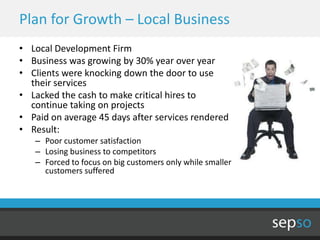
Plan for Growth – Local Business
• Local Development Firm
• Business was growing by 30% year over year
• Clients were knocking down the door to use
  their services
• Lacked the cash to make critical hires to
  continue taking on projects
• Paid on average 45 days after services rendered
• Result:
   – Poor customer satisfaction
   – Losing business to competitors
   – Forced to focus on big customers only while smaller
     customers suffered
Cash Flow
• Ideal Scenario - a business will experience a
  consistently positive cash flow (Cash coming in is
  more than cash going out)
• Positive Cash Flows allows a business to:
   – Build up cash reserves
   – Expand with new offerings, products, marketing
     spend, employees..
   – Take advantage of seasonal buying opportunities
   – Reassure lenders/vendors/clients that the business is
     healthy
   – The lists goes on….
Cash Flow
• Concern – cash outflows and cash inflows
  rarely happen at the same time with inflows
  usually lagging behind
• Fix - speed up inflows and slow down outflows
  to close cash flow gap
• Easier said than done….
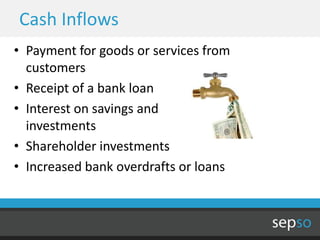
Cash Inflows
• Payment for goods or services from
  customers
• Receipt of a bank loan
• Interest on savings and
  investments
• Shareholder investments
• Increased bank overdrafts or loans
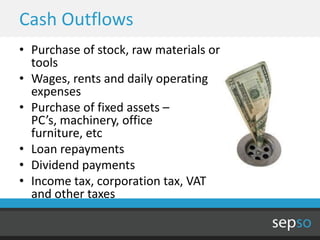
Cash Outflows
• Purchase of stock, raw materials or
  tools
• Wages, rents and daily operating
  expenses
• Purchase of fixed assets –
  PC’s, machinery, office
  furniture, etc
• Loan repayments
• Dividend payments
• Income tax, corporation tax, VAT
  and other taxes
Slow the flow
• Sometimes we have to borrow money:
  – Negotiate fixed loan payments to coincide with your company’s
    cash flow cycle. Many banks allow businesses to structure loans
    so that they can skip specific payments when their cash flow
    gets to its lowest point, example… winter time.
  – Negotiate longer payment terms with vendors/suppliers
     • Typically standard is Net 30 terms
     • However often time you can get Net 60, even Net 90 day
        terms
     • It doesn’t hurt to push a little harder when negotiating these
        terms. The vendor will still want your business.
Good Cash Flow Management
•   Identify where cash is tied up
•   Spot bottlenecks
•   Helps you plan ahead
•   Reduces dependency on borrowing
•   Keeps you in control of your business to make
    informed decisions for future development
    and expansion
Ask the right questions..
• How much cash does do I have on hand?
• How much cash does my business generate?
• When should I get the cash?
• When, from experience, do I get it?
• How much cash does my business need to
  operate?
• When is it needed?
• How do my income and expenses affect my
  capability to expand my business?
Pole
• Off the top of your head, could you tell me
  what your DSO is?

• Possible answers:
  – Yes
  – No
  – What’s DSO?
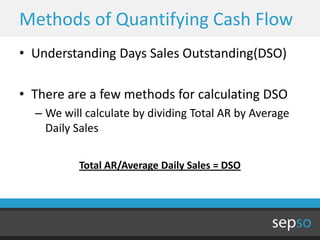
Methods of Quantifying Cash Flow
• Understanding Days Sales Outstanding(DSO)

• There are a few methods for calculating DSO
  – We will calculate by dividing Total AR by Average
    Daily Sales

          Total AR/Average Daily Sales = DSO
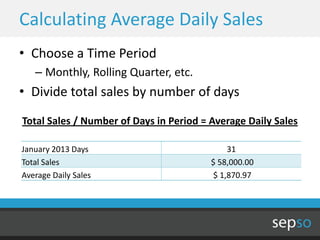
Calculating Average Daily Sales
• Choose a Time Period
   – Monthly, Rolling Quarter, etc.
• Divide total sales by number of days
Total Sales / Number of Days in Period = Average Daily Sales

January 2013 Days                            31
Total Sales                              $ 58,000.00
Average Daily Sales                      $ 1,870.97
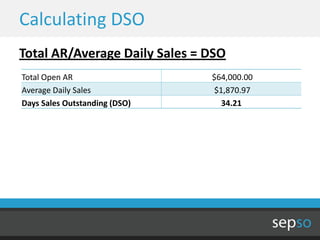
Calculating DSO
Total AR/Average Daily Sales = DSO
Total Open AR                  $64,000.00
Average Daily Sales            $1,870.97
Days Sales Outstanding (DSO)     34.21
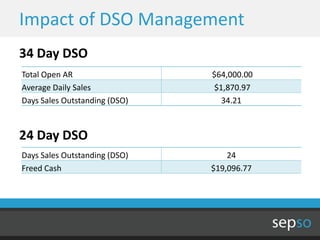
Impact of DSO Management
34 Day DSO
Total Open AR                  $64,000.00
Average Daily Sales            $1,870.97
Days Sales Outstanding (DSO)     34.21


24 Day DSO
Days Sales Outstanding (DSO)       24
Freed Cash                     $19,096.77
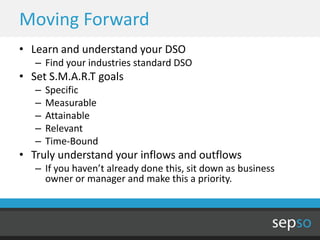
Moving Forward
• Learn and understand your DSO
   – Find your industries standard DSO
• Set S.M.A.R.T goals
   –   Specific
   –   Measurable
   –   Attainable
   –   Relevant
   –   Time-Bound
• Truly understand your inflows and outflows
   – If you haven’t already done this, sit down as business
     owner or manager and make this a priority.
Planning a Positive Cash Flow
• You must have a sound plan
• Diversify your sources for cash
   – Some experts suggest having no more than 25% of your cash
     come from one source. (Depends on Industry, Offerings, etc)
• Cash reserves can be increased by:
   –   Collection of Receivables
   –   Tightened credit requirements
   –   Price of products
   –   Loans
   –   Increased sales
   –   Identify the top 20% of your customers by sales volume and
       create a separate file system for them and monitor them closely
A few tips…
• Project and meet cash flow needs
  – Plan for growth!
     • Anticipate payroll twelve months in advance.
        – Do you have seasonal Highs and Lows?
     • Anticipate outstanding debt payments
     • Set money aside for expansion, emergencies and
       opportunity purchases
Accelerating Cash Flow Through…
• Taking advantage of technology
  – Invoicing
  – Payment acceptance options
  – Make it easy for your customers to pay
  – The easier it is to pay, the faster you collect your
    cash
Invoicing
• Questions to ask
  – What percentage of your customers are late?
  – Why are they late?
  – How much time does your staff spend collecting
    invoices?
  – What does it cost to produce a paper invoice?
Increase Collections Effectiveness
• Invoice promptly
• Make your payment and credit policies clear from
  the beginning
• Get deposits in advance
  • Prevents midnight movers
• Electronic Invoicing
  • Cuts down on cost of invoicing
  • Get the invoice to the customer quicker
Payment Acceptance
• Accept all forms of payments
   – Accept credit cards
      • Not only will your sales increase, multiple studies have proven that
        consumers spend more on cards than cash or check
   – Improved cash flow
      • Funds can be deposited within 24-48 hours
   – Increased customer satisfaction
      • Customers appreciate when they have choices on how to pay, and
        translates into improved customer loyalty
   – Improves operational efficiency
      • Reduces time it takes to manage and reconcile payments
   – Reduce midnight movers and/or problem tenants by
     receiving payment immediately
Payment Acceptance Cont.
• Nearly $40 of every $100 spent worldwide is
  with a card.
• Whether you are a new business or an
  established enterprise, card acceptance will
  have a big impact on your bottom line
Payment Technology
• Integration in to CRM platforms, accounting
  software and websites
• Multiple cards on file
• Billing and taking payments online
   – Studies show up to 40% of consumers pay the same
     day they receive an invoice in their email with the
     option to pay online
• Recurring payments
• Business rules to rollover to back-up cards in the
  event the main card is declined
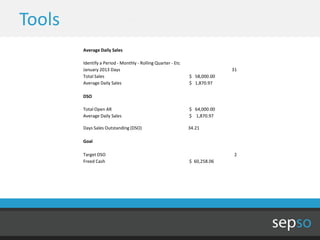
Tools
        Average Daily Sales

        Identify a Period - Monthly - Rolling Quarter - Etc
        January 2013 Days                                                   31
        Total Sales                                           $ 58,000.00
        Average Daily Sales                                   $ 1,870.97

        DSO

        Total Open AR                                         $ 64,000.00
        Average Daily Sales                                   $ 1,870.97

        Days Sales Outstanding (DSO)                          34.21

        Goal

        Target DSO                                                           2
        Freed Cash                                            $ 60,258.06
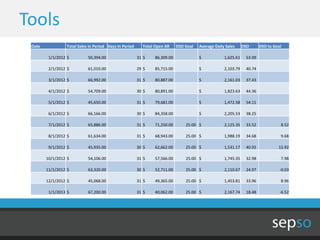
Tools
 Date            Total Sales in Period Days In Period     Total Open AR    DSO Goal   Average Daily Sales     DSO      DSO to Goal

         1/1/2012 $         50,394.00                   31 $   86,309.00              $            1,625.61    53.09

         2/1/2012 $         61,010.00                   29 $   85,715.00              $            2,103.79    40.74

         3/1/2012 $         66,992.00                   31 $   80,887.00              $            2,161.03    37.43

         4/1/2012 $         54,709.00                   30 $   80,891.00              $            1,823.63    44.36

         5/1/2012 $         45,650.00                   31 $   79,681.00              $            1,472.58    54.11

         6/1/2012 $         66,166.00                   30 $   84,358.00              $            2,205.53    38.25

         7/1/2012 $         65,886.00                   31 $   71,250.00       25.00 $             2,125.35    33.52             8.52

         8/1/2012 $         61,634.00                   31 $   68,943.00       25.00 $             1,988.19    34.68             9.68

         9/1/2012 $         45,935.00                   30 $   62,662.00       25.00 $             1,531.17    40.92            15.92

        10/1/2012 $         54,106.00                   31 $   57,566.00       25.00 $             1,745.35    32.98             7.98

        11/1/2012 $         63,320.00                   30 $   52,711.00       25.00 $             2,110.67    24.97             -0.03

        12/1/2012 $         45,068.00                   31 $   49,365.00       25.00 $             1,453.81    33.96             8.96

         1/1/2013 $         67,200.00                   31 $   40,062.00       25.00 $             2,167.74    18.48             -6.52
Questions?

Gwa presentation final

  • 1.
    Impact of CashFlow on your Workspace Company Josh Miller
  • 2.
    Agenda • Introduction – Intro – What we’re going to discuss: – Statistics – Cash Flow Woes – Managing Cash Flow 101 – Take a look at your DSO – Measures to improve DSO • Take advantage of technology, products, and services. • You’re not alone, talk to people in your industry • Contact Info – landing page
  • 3.
    Pole? • On ascale from 1 to 10, how comfortable are you with the condition of cash flow for your business? ie. Chart of real time polling – (Possible?)
  • 4.
    Alarming Statistics • Businessesplanning out cash flow once a year have a 36% survival rate over 5 years • Businesses planning out cash flow monthly have an 80% survival rate over 5 years. • 70% of businesses that go bankrupt are profitable! • Out of 2,200 small businesses studied, 68% performed no cash flow analysis at all - Study Completed by the Geneva Business Bank
  • 5.
    Growth is goodthing, right? • One of the biggest threats to cash flow for successful companies is growth! • Don’t confuse profit with positive cash flow.
  • 6.
    Zappos Case Study(2008) • Key Take-a-ways – 1 billion in sales – Relied on a $100 million line of credit – Lending agreements required them to hit projected revenues and profitability targets each month – At any time if they missed numbers the banks could walk away resulting in bankruptcy.
  • 7.
    Zappos Continued • Theirline of credit was also “asset backed,” meaning they could borrow 50-60% of their inventory. • Value of inventory was based on what they paid. • The appraised value fell due to the economy • If sales fell, they wouldn’t have enough cash to buy inventory • Operating and inventory expenses surpassed incoming cash flow • Their negative cash flow had them on the verge of bankruptcy • Decided to sell to Amazon • Don’t confuse profit with cash flow
  • 8.
    Plan for Growth– Local Business • Local Development Firm • Business was growing by 30% year over year • Clients were knocking down the door to use their services • Lacked the cash to make critical hires to continue taking on projects • Paid on average 45 days after services rendered • Result: – Poor customer satisfaction – Losing business to competitors – Forced to focus on big customers only while smaller customers suffered
  • 9.
    Cash Flow • IdealScenario - a business will experience a consistently positive cash flow (Cash coming in is more than cash going out) • Positive Cash Flows allows a business to: – Build up cash reserves – Expand with new offerings, products, marketing spend, employees.. – Take advantage of seasonal buying opportunities – Reassure lenders/vendors/clients that the business is healthy – The lists goes on….
  • 10.
    Cash Flow • Concern– cash outflows and cash inflows rarely happen at the same time with inflows usually lagging behind • Fix - speed up inflows and slow down outflows to close cash flow gap • Easier said than done….
  • 11.
    Cash Inflows • Paymentfor goods or services from customers • Receipt of a bank loan • Interest on savings and investments • Shareholder investments • Increased bank overdrafts or loans
  • 12.
    Cash Outflows • Purchaseof stock, raw materials or tools • Wages, rents and daily operating expenses • Purchase of fixed assets – PC’s, machinery, office furniture, etc • Loan repayments • Dividend payments • Income tax, corporation tax, VAT and other taxes
  • 13.
    Slow the flow •Sometimes we have to borrow money: – Negotiate fixed loan payments to coincide with your company’s cash flow cycle. Many banks allow businesses to structure loans so that they can skip specific payments when their cash flow gets to its lowest point, example… winter time. – Negotiate longer payment terms with vendors/suppliers • Typically standard is Net 30 terms • However often time you can get Net 60, even Net 90 day terms • It doesn’t hurt to push a little harder when negotiating these terms. The vendor will still want your business.
  • 14.
    Good Cash FlowManagement • Identify where cash is tied up • Spot bottlenecks • Helps you plan ahead • Reduces dependency on borrowing • Keeps you in control of your business to make informed decisions for future development and expansion
  • 15.
    Ask the rightquestions.. • How much cash does do I have on hand? • How much cash does my business generate? • When should I get the cash? • When, from experience, do I get it? • How much cash does my business need to operate? • When is it needed? • How do my income and expenses affect my capability to expand my business?
  • 16.
    Pole • Off thetop of your head, could you tell me what your DSO is? • Possible answers: – Yes – No – What’s DSO?
  • 17.
    Methods of QuantifyingCash Flow • Understanding Days Sales Outstanding(DSO) • There are a few methods for calculating DSO – We will calculate by dividing Total AR by Average Daily Sales Total AR/Average Daily Sales = DSO
  • 18.
    Calculating Average DailySales • Choose a Time Period – Monthly, Rolling Quarter, etc. • Divide total sales by number of days Total Sales / Number of Days in Period = Average Daily Sales January 2013 Days 31 Total Sales $ 58,000.00 Average Daily Sales $ 1,870.97
  • 19.
    Calculating DSO Total AR/AverageDaily Sales = DSO Total Open AR $64,000.00 Average Daily Sales $1,870.97 Days Sales Outstanding (DSO) 34.21
  • 20.
    Impact of DSOManagement 34 Day DSO Total Open AR $64,000.00 Average Daily Sales $1,870.97 Days Sales Outstanding (DSO) 34.21 24 Day DSO Days Sales Outstanding (DSO) 24 Freed Cash $19,096.77
  • 21.
    Moving Forward • Learnand understand your DSO – Find your industries standard DSO • Set S.M.A.R.T goals – Specific – Measurable – Attainable – Relevant – Time-Bound • Truly understand your inflows and outflows – If you haven’t already done this, sit down as business owner or manager and make this a priority.
  • 22.
    Planning a PositiveCash Flow • You must have a sound plan • Diversify your sources for cash – Some experts suggest having no more than 25% of your cash come from one source. (Depends on Industry, Offerings, etc) • Cash reserves can be increased by: – Collection of Receivables – Tightened credit requirements – Price of products – Loans – Increased sales – Identify the top 20% of your customers by sales volume and create a separate file system for them and monitor them closely
  • 23.
    A few tips… •Project and meet cash flow needs – Plan for growth! • Anticipate payroll twelve months in advance. – Do you have seasonal Highs and Lows? • Anticipate outstanding debt payments • Set money aside for expansion, emergencies and opportunity purchases
  • 24.
    Accelerating Cash FlowThrough… • Taking advantage of technology – Invoicing – Payment acceptance options – Make it easy for your customers to pay – The easier it is to pay, the faster you collect your cash
  • 25.
    Invoicing • Questions toask – What percentage of your customers are late? – Why are they late? – How much time does your staff spend collecting invoices? – What does it cost to produce a paper invoice?
  • 26.
    Increase Collections Effectiveness •Invoice promptly • Make your payment and credit policies clear from the beginning • Get deposits in advance • Prevents midnight movers • Electronic Invoicing • Cuts down on cost of invoicing • Get the invoice to the customer quicker
  • 27.
    Payment Acceptance • Acceptall forms of payments – Accept credit cards • Not only will your sales increase, multiple studies have proven that consumers spend more on cards than cash or check – Improved cash flow • Funds can be deposited within 24-48 hours – Increased customer satisfaction • Customers appreciate when they have choices on how to pay, and translates into improved customer loyalty – Improves operational efficiency • Reduces time it takes to manage and reconcile payments – Reduce midnight movers and/or problem tenants by receiving payment immediately
  • 28.
    Payment Acceptance Cont. •Nearly $40 of every $100 spent worldwide is with a card. • Whether you are a new business or an established enterprise, card acceptance will have a big impact on your bottom line
  • 29.
    Payment Technology • Integrationin to CRM platforms, accounting software and websites • Multiple cards on file • Billing and taking payments online – Studies show up to 40% of consumers pay the same day they receive an invoice in their email with the option to pay online • Recurring payments • Business rules to rollover to back-up cards in the event the main card is declined
  • 30.
    Tools Average Daily Sales Identify a Period - Monthly - Rolling Quarter - Etc January 2013 Days 31 Total Sales $ 58,000.00 Average Daily Sales $ 1,870.97 DSO Total Open AR $ 64,000.00 Average Daily Sales $ 1,870.97 Days Sales Outstanding (DSO) 34.21 Goal Target DSO 2 Freed Cash $ 60,258.06
  • 31.
    Tools Date Total Sales in Period Days In Period Total Open AR DSO Goal Average Daily Sales DSO DSO to Goal 1/1/2012 $ 50,394.00 31 $ 86,309.00 $ 1,625.61 53.09 2/1/2012 $ 61,010.00 29 $ 85,715.00 $ 2,103.79 40.74 3/1/2012 $ 66,992.00 31 $ 80,887.00 $ 2,161.03 37.43 4/1/2012 $ 54,709.00 30 $ 80,891.00 $ 1,823.63 44.36 5/1/2012 $ 45,650.00 31 $ 79,681.00 $ 1,472.58 54.11 6/1/2012 $ 66,166.00 30 $ 84,358.00 $ 2,205.53 38.25 7/1/2012 $ 65,886.00 31 $ 71,250.00 25.00 $ 2,125.35 33.52 8.52 8/1/2012 $ 61,634.00 31 $ 68,943.00 25.00 $ 1,988.19 34.68 9.68 9/1/2012 $ 45,935.00 30 $ 62,662.00 25.00 $ 1,531.17 40.92 15.92 10/1/2012 $ 54,106.00 31 $ 57,566.00 25.00 $ 1,745.35 32.98 7.98 11/1/2012 $ 63,320.00 30 $ 52,711.00 25.00 $ 2,110.67 24.97 -0.03 12/1/2012 $ 45,068.00 31 $ 49,365.00 25.00 $ 1,453.81 33.96 8.96 1/1/2013 $ 67,200.00 31 $ 40,062.00 25.00 $ 2,167.74 18.48 -6.52
  • 33.

Editor's Notes

  • #6 Many small business owners do not engage in cash planning and out of 2,200 small businesses studied, 68% performed no cash flow analysis at all. The result is that many successful, growing and profitable businesses fail because they become insolvent as they do not have adequate cash to meet the needs of their growing business with a booming sales volume.
  • #7 Having a 100 million revolving credit usually means that they were not netting the 100 million revolving credit otherwise they would be able to pay off and use their own cash to finance
  • #9 ???
  • #11 Easier said than done, Often times we are billing for services that we won’t collect on for 30 - 60days. It’s important to work with vendors and suppliers to negotiate 45-60 day terms. Shorten payment terms for your clients as short as possible. Bill at time of service or prepaid services if at all possible.
  • #12 It typically going to come from one area or the other. Make sure you understand where your cash is coming from and when. 1. It’s important to make disperse your options for cash flow. Make sure you have diverse options. No your limits with generating Cash flow, not only now but for months to come.
  • #13 There are a lot of areas for cash outflows. There are a few named here. Cash flows are extremely important for the growth of your business. Make sure you prioritize your cash outflows. It’s difficult, but do your best to align purchases of products/services with incoming cash. Plan up to 6-12 months out.

  • #14 There’s nothing worse than paying interest expenses, penalties and fines because of poor cash flow management. Being late on these bills is slippery slope to a slow, painful death. No matter your success, with poor cash management will fail!
  • #15 What’s your procedure for identifying where cash is tied up? Is this something you have a solid lock down on? Having the cash available to make sound decisions/investments will build the foundation of your business.
  • #16 Take a look internally. It’s difficult to ask these questions. Sometimes because we don’t like what we see (the truth). It’s funny, sometimes I want to avoid looking at my financial statements because I’m afraid. Afraid that things are going correctly. A great quote from the founder of sound business rules today said “measure quote” How to positively something without first getting a baseline of where you are today. Have you thought of where your business would be today if you able to make all the investments you wanted to make.??? I’m sure all of have to some degree. It’s painful knowing that we have missed out on opportunities due to poor management. Make a solid business plan. Always, Always have a solid business in plan. Make sure your checking it reguraly. If you are, or even not hitting your goals… ask the questions. Come up with your own questions that are important to your specific situation.
  • #18 Basic fundamentals of managing cash flow. Start by looking at your DSO. I’m sure for the accoutants out there, you’re thinking to your self that this is basic stuff. But for all of the small busness owners and small buisness managers this is something that maybe your accountant handles for you. It’s extremely important to understand how subtle changes to your DSO can have a massive impact on your ability to stay cash flow positive What’s your DSO. 15 days? 30 days? 90 days? Take a look at how long what your DSO is.
  • #19 Let’s walkquicklythrough an example of finding out a DSO. First weneed to figure out whatisourAverage Daily Sales. Choose a period, doesn’t matter what it is. Let’s just choose Monthly for now. Look at your total sales and then divide by the days in the Time Period. In this case we picked monthly, and the month of Jan 2013. We have 31 days, and 58.000 in sales for that time period. We divide 58K by 31 to get $1,875.
  • #20 Now that we know what are DSO is. Take your total open AR and divide by your Average Daily Sales to understand your Days Sales Outstanding.
  • #21 The impact of reducing your DSO can have a massive impact on your cash flow. Again, understanding the value of having cash on hand is endless. Speak to understanding, your goals. Once you understand where you are and where you want to be. Set goals to help get you there. Wether or not that includes improving billing and invoicing. Changing company policy on collections. You can make small changes that will have large impacts on your DSO. Take a good, hard look at your cash flow.
  • #22 Look at your industries DSO, Again, understading your baseline and understading where is you want to be is ½ the battle.
  • #23 Cash discounts…You make take a little less, but are your really? What’s the value of your money for x amount of days…Pre-numbered?
  • #24 It’s difficult to see the unforseeable, so pan, plan, and plan some more. You’ll never know the next time you’ll have that opportunity to take advantage of a great deal. Don’t pass it up because you’re low on cash flow. Often times, we get tunnel vision in the day to day management of our business. We have to plan as much as possible, or we’ll be stuck in position that could lead to the death of our business very quickly.
  • #25 Don’t always except the way things have been done. If you can change and adapt your business you will be left behind by your competition. There are a few options that come to mind. Make sure that you are keeping an eye out for what thought leaders are doing in your space. Be aggressive, but smart about introducing new methods of increasing Cash Flow to your business.
  • #26 Have you ever calculated how much it’s costing you to invoice and collect on customers??? It’s something every business should know.