Copyright © 2015 ScottMadden, Inc. All rights reserved. Report _2014-02_v1
Procure-to-Pay Process Framework
A Key Enabler of Supply Chain Performance
February 2015
Copyright © 2015 by ScottMadden, Inc. All rights reserved.
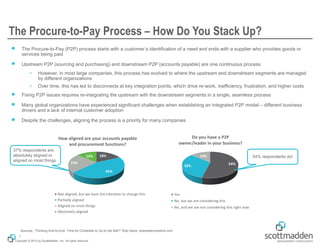
The Procure-to-Pay Process – How Do You Stack Up?
■ The Procure-to-Pay (P2P) process starts with a customer’s identification of a need and ends with a supplier who provides goods or
services being paid
■ Upstream P2P (sourcing and purchasing) and downstream P2P (accounts payable) are one continuous process
• However, in most large companies, this process has evolved to where the upstream and downstream segments are managed
by different organizations
• Over time, this has led to disconnects at key integration points, which drive re-work, inefficiency, frustration, and higher costs
■ Fixing P2P issues requires re-integrating the upstream with the downstream segments in a single, seamless process
■ Many global organizations have experienced significant challenges when establishing an integrated P2P model – different business
drivers and a lack of internal customer adoption
■ Despite the challenges, aligning the process is a priority for many companies
1
Sources: “Thinking End-to-End: Time for Cinderella to Go to the Ball?” Rob Davis, sharedserviceslink.com
18%
45%
23%
14%
How aligned are your accounts payable
and procurement functions?
Not aligned, but we have the intention to change this
Partially aligned
Aligned on most things
Absolutely aligned
54%32%
14%
Do you have a P2P
owner/leader in your business?
Yes
No, but we are considering this
No, and we are not considering this right now
37% respondents are
absolutely aligned or
aligned on most things
54% respondents do!
Copyright © 2015 by ScottMadden, Inc. All rights reserved.
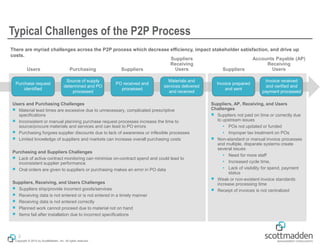
Typical Challenges of the P2P Process
Users Purchasing Suppliers
Suppliers
Receiving
Users Suppliers
Accounts Payable (AP)
Receiving
Users
Purchase request
identified
Source of supply
determined and PO
processed
PO received and
processed
Materials and
services delivered
and received
Invoice prepared
and sent
Invoice received
and verified and
payment processed
Users and Purchasing Challenges
■ Material lead times are excessive due to unnecessary, complicated prescriptive
specifications
■ Inconsistent or manual planning purchase request processes increase the time to
source/procure materials and services and can lead to PO errors
■ Purchasing forgoes supplier discounts due to lack of awareness or inflexible processes
■ Limited knowledge of suppliers and markets can increase overall purchasing costs
Purchasing and Suppliers Challenges
■ Lack of active contract monitoring can minimize on-contract spend and could lead to
inconsistent supplier performance
■ Oral orders are given to suppliers or purchasing makes an error in PO data
Suppliers, Receiving, and Users Challenges
■ Suppliers ship/provide incorrect goods/services
■ Receiving data is not entered or is not entered in a timely manner
■ Receiving data is not entered correctly
■ Planned work cannot proceed due to material not on hand
■ Items fail after installation due to incorrect specifications
Suppliers, AP, Receiving, and Users
Challenges
■ Suppliers not paid on time or correctly due
to upstream issues
 POs not updated or funded
 Improper tax treatment on POs
■ Non-standard or manual invoice processes
and multiple, disparate systems create
several issues
 Need for more staff
 Increased cycle time,
 Lack of visibility for spend, payment
status
■ Weak or non-existent invoice standards
increase processing time
■ Receipt of invoices is not centralized
There are myriad challenges across the P2P process which decrease efficiency, impact stakeholder satisfaction, and drive up
costs.
2
Copyright © 2015 by ScottMadden, Inc. All rights reserved.
P2P Process Leading Practices
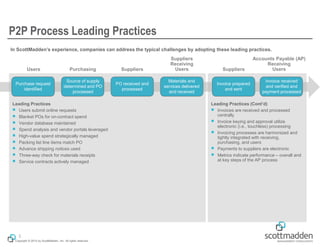
In ScottMadden’s experience, companies can address the typical challenges by adopting these leading practices.
Leading Practices
■ Users submit online requests
■ Blanket POs for on-contract spend
■ Vendor database maintained
■ Spend analysis and vendor portals leveraged
■ High-value spend strategically managed
■ Packing list line items match PO
■ Advance shipping notices used
■ Three-way check for materials receipts
■ Service contracts actively managed
Leading Practices (Cont’d)
■ Invoices are received and processed
centrally
■ Invoice keying and approval utilize
electronic (i.e., touchless) processing
■ Invoicing processes are harmonized and
tightly integrated with receiving,
purchasing, and users
■ Payments to suppliers are electronic
■ Metrics indicate performance – overall and
at key steps of the AP process
Users Purchasing Suppliers
Suppliers
Receiving
Users Suppliers
Accounts Payable (AP)
Receiving
Users
Purchase request
identified
Source of supply
determined and PO
processed
PO received and
processed
Materials and
services delivered
and received
Invoice prepared
and sent
Invoice received
and verified and
payment processed
3
Copyright © 2015 by ScottMadden, Inc. All rights reserved.
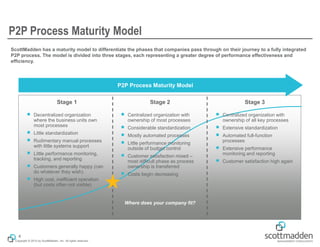
P2P Process Maturity Model
ScottMadden has a maturity model to differentiate the phases that companies pass through on their journey to a fully integrated
P2P process. The model is divided into three stages, each representing a greater degree of performance effectiveness and
efficiency.
4
Stage 3Stage 2Stage 1
Where does your company fit?
P2P Process Maturity Model
■ Centralized organization with
ownership of all key processes
■ Extensive standardization
■ Automated full-function
processes
■ Extensive performance
monitoring and reporting
■ Customer satisfaction high again
■ Centralized organization with
ownership of most processes
■ Considerable standardization
■ Mostly automated processes
■ Little performance monitoring
outside of budget control
■ Customer satisfaction mixed –
most difficult phase as process
ownership is transferred
■ Costs begin decreasing
■ Decentralized organization
where the business units own
most processes
■ Little standardization
■ Rudimentary manual processes
with little systems support
■ Little performance monitoring,
tracking, and reporting
■ Customers generally happy (can
do whatever they wish)
■ High cost, inefficient operation
(but costs often not visible)
Copyright © 2015 by ScottMadden, Inc. All rights reserved.
How ScottMadden Can Help
ScottMadden provides a number of services to help organizations improve their P2P processes
■ P2P strategy and governance
■ Leading practice assessment
■ Feasibility analysis and business case development
■ Organization design
Building P2P process maturity provides significant benefits
■ Reduced staffing levels
■ Improved liquidity
■ Managed payment terms and discounts
■ Cash recovery from aged credit notes, incorrect payments, debit balances, etc.
■ Savings through improved use of approved vendors
■ Greatly improved supplier service levels and relationships
■ Better tracking of vendor timeliness, quality, and delivery accuracy
■ Reduction of user/management time spent on transaction administration and approval
■ Improved internal control and audit traceability
■ Process redesign
■ Performance metric definition
■ Technology design, selection, and implementation
5
Copyright © 2015 by ScottMadden, Inc. All rights reserved.
T. L. "Trey" Robinson, III
Partner
ScottMadden, Inc.
2626 Glenwood Avenue
Suite 480
Raleigh, NC 27608
treyrobinson@scottmadden.com
O: 919-781-4191 M: 919-522-1740
Andy Flores
Partner
ScottMadden, Inc.
3495 Piedmont Road
Building 10, Suite 805
Atlanta, GA 30305
aeflores@scottmadden.com
O: 404-814-0020 M: 678-428-1789
Jordan Gillis
Director
ScottMadden, Inc.
3495 Piedmont Road
Building 10, Suite 805
Atlanta, GA 30305
jordangillis@scottmadden.com
O: 404-814-0020 M: 404-805-8477
Jason G. Davis
Director
ScottMadden, Inc.
3495 Piedmont Road
Building 10, Suite 805
Atlanta, GA 30305
jgdavis@scottmadden.com
O: 404-814-0020 M: 678-361-5420
For more information on improving P2P performance, please contact us.
Contact Us
6

Procure-to-Pay Process Framework

  • 1.
    Copyright © 2015ScottMadden, Inc. All rights reserved. Report _2014-02_v1 Procure-to-Pay Process Framework A Key Enabler of Supply Chain Performance February 2015
  • 2.
    Copyright © 2015by ScottMadden, Inc. All rights reserved. The Procure-to-Pay Process – How Do You Stack Up? ■ The Procure-to-Pay (P2P) process starts with a customer’s identification of a need and ends with a supplier who provides goods or services being paid ■ Upstream P2P (sourcing and purchasing) and downstream P2P (accounts payable) are one continuous process • However, in most large companies, this process has evolved to where the upstream and downstream segments are managed by different organizations • Over time, this has led to disconnects at key integration points, which drive re-work, inefficiency, frustration, and higher costs ■ Fixing P2P issues requires re-integrating the upstream with the downstream segments in a single, seamless process ■ Many global organizations have experienced significant challenges when establishing an integrated P2P model – different business drivers and a lack of internal customer adoption ■ Despite the challenges, aligning the process is a priority for many companies 1 Sources: “Thinking End-to-End: Time for Cinderella to Go to the Ball?” Rob Davis, sharedserviceslink.com 18% 45% 23% 14% How aligned are your accounts payable and procurement functions? Not aligned, but we have the intention to change this Partially aligned Aligned on most things Absolutely aligned 54%32% 14% Do you have a P2P owner/leader in your business? Yes No, but we are considering this No, and we are not considering this right now 37% respondents are absolutely aligned or aligned on most things 54% respondents do!
  • 3.
    Copyright © 2015by ScottMadden, Inc. All rights reserved. Typical Challenges of the P2P Process Users Purchasing Suppliers Suppliers Receiving Users Suppliers Accounts Payable (AP) Receiving Users Purchase request identified Source of supply determined and PO processed PO received and processed Materials and services delivered and received Invoice prepared and sent Invoice received and verified and payment processed Users and Purchasing Challenges ■ Material lead times are excessive due to unnecessary, complicated prescriptive specifications ■ Inconsistent or manual planning purchase request processes increase the time to source/procure materials and services and can lead to PO errors ■ Purchasing forgoes supplier discounts due to lack of awareness or inflexible processes ■ Limited knowledge of suppliers and markets can increase overall purchasing costs Purchasing and Suppliers Challenges ■ Lack of active contract monitoring can minimize on-contract spend and could lead to inconsistent supplier performance ■ Oral orders are given to suppliers or purchasing makes an error in PO data Suppliers, Receiving, and Users Challenges ■ Suppliers ship/provide incorrect goods/services ■ Receiving data is not entered or is not entered in a timely manner ■ Receiving data is not entered correctly ■ Planned work cannot proceed due to material not on hand ■ Items fail after installation due to incorrect specifications Suppliers, AP, Receiving, and Users Challenges ■ Suppliers not paid on time or correctly due to upstream issues  POs not updated or funded  Improper tax treatment on POs ■ Non-standard or manual invoice processes and multiple, disparate systems create several issues  Need for more staff  Increased cycle time,  Lack of visibility for spend, payment status ■ Weak or non-existent invoice standards increase processing time ■ Receipt of invoices is not centralized There are myriad challenges across the P2P process which decrease efficiency, impact stakeholder satisfaction, and drive up costs. 2
  • 4.
    Copyright © 2015by ScottMadden, Inc. All rights reserved. P2P Process Leading Practices In ScottMadden’s experience, companies can address the typical challenges by adopting these leading practices. Leading Practices ■ Users submit online requests ■ Blanket POs for on-contract spend ■ Vendor database maintained ■ Spend analysis and vendor portals leveraged ■ High-value spend strategically managed ■ Packing list line items match PO ■ Advance shipping notices used ■ Three-way check for materials receipts ■ Service contracts actively managed Leading Practices (Cont’d) ■ Invoices are received and processed centrally ■ Invoice keying and approval utilize electronic (i.e., touchless) processing ■ Invoicing processes are harmonized and tightly integrated with receiving, purchasing, and users ■ Payments to suppliers are electronic ■ Metrics indicate performance – overall and at key steps of the AP process Users Purchasing Suppliers Suppliers Receiving Users Suppliers Accounts Payable (AP) Receiving Users Purchase request identified Source of supply determined and PO processed PO received and processed Materials and services delivered and received Invoice prepared and sent Invoice received and verified and payment processed 3
  • 5.
    Copyright © 2015by ScottMadden, Inc. All rights reserved. P2P Process Maturity Model ScottMadden has a maturity model to differentiate the phases that companies pass through on their journey to a fully integrated P2P process. The model is divided into three stages, each representing a greater degree of performance effectiveness and efficiency. 4 Stage 3Stage 2Stage 1 Where does your company fit? P2P Process Maturity Model ■ Centralized organization with ownership of all key processes ■ Extensive standardization ■ Automated full-function processes ■ Extensive performance monitoring and reporting ■ Customer satisfaction high again ■ Centralized organization with ownership of most processes ■ Considerable standardization ■ Mostly automated processes ■ Little performance monitoring outside of budget control ■ Customer satisfaction mixed – most difficult phase as process ownership is transferred ■ Costs begin decreasing ■ Decentralized organization where the business units own most processes ■ Little standardization ■ Rudimentary manual processes with little systems support ■ Little performance monitoring, tracking, and reporting ■ Customers generally happy (can do whatever they wish) ■ High cost, inefficient operation (but costs often not visible)
  • 6.
    Copyright © 2015by ScottMadden, Inc. All rights reserved. How ScottMadden Can Help ScottMadden provides a number of services to help organizations improve their P2P processes ■ P2P strategy and governance ■ Leading practice assessment ■ Feasibility analysis and business case development ■ Organization design Building P2P process maturity provides significant benefits ■ Reduced staffing levels ■ Improved liquidity ■ Managed payment terms and discounts ■ Cash recovery from aged credit notes, incorrect payments, debit balances, etc. ■ Savings through improved use of approved vendors ■ Greatly improved supplier service levels and relationships ■ Better tracking of vendor timeliness, quality, and delivery accuracy ■ Reduction of user/management time spent on transaction administration and approval ■ Improved internal control and audit traceability ■ Process redesign ■ Performance metric definition ■ Technology design, selection, and implementation 5
  • 7.
    Copyright © 2015by ScottMadden, Inc. All rights reserved. T. L. "Trey" Robinson, III Partner ScottMadden, Inc. 2626 Glenwood Avenue Suite 480 Raleigh, NC 27608 treyrobinson@scottmadden.com O: 919-781-4191 M: 919-522-1740 Andy Flores Partner ScottMadden, Inc. 3495 Piedmont Road Building 10, Suite 805 Atlanta, GA 30305 aeflores@scottmadden.com O: 404-814-0020 M: 678-428-1789 Jordan Gillis Director ScottMadden, Inc. 3495 Piedmont Road Building 10, Suite 805 Atlanta, GA 30305 jordangillis@scottmadden.com O: 404-814-0020 M: 404-805-8477 Jason G. Davis Director ScottMadden, Inc. 3495 Piedmont Road Building 10, Suite 805 Atlanta, GA 30305 jgdavis@scottmadden.com O: 404-814-0020 M: 678-361-5420 For more information on improving P2P performance, please contact us. Contact Us 6