March 11, 2014
Henry Ijams – Managing Director
PayStream Advisors, Inc.
1
Trends in Procure to Pay:
The Coming Revolution and You
Session Overview
• Current State of AP & P2P
• PPT & The Perfect Process
• Lessons from the innovators
2
• Networking: Turn to your neighbor
and introduce yourself
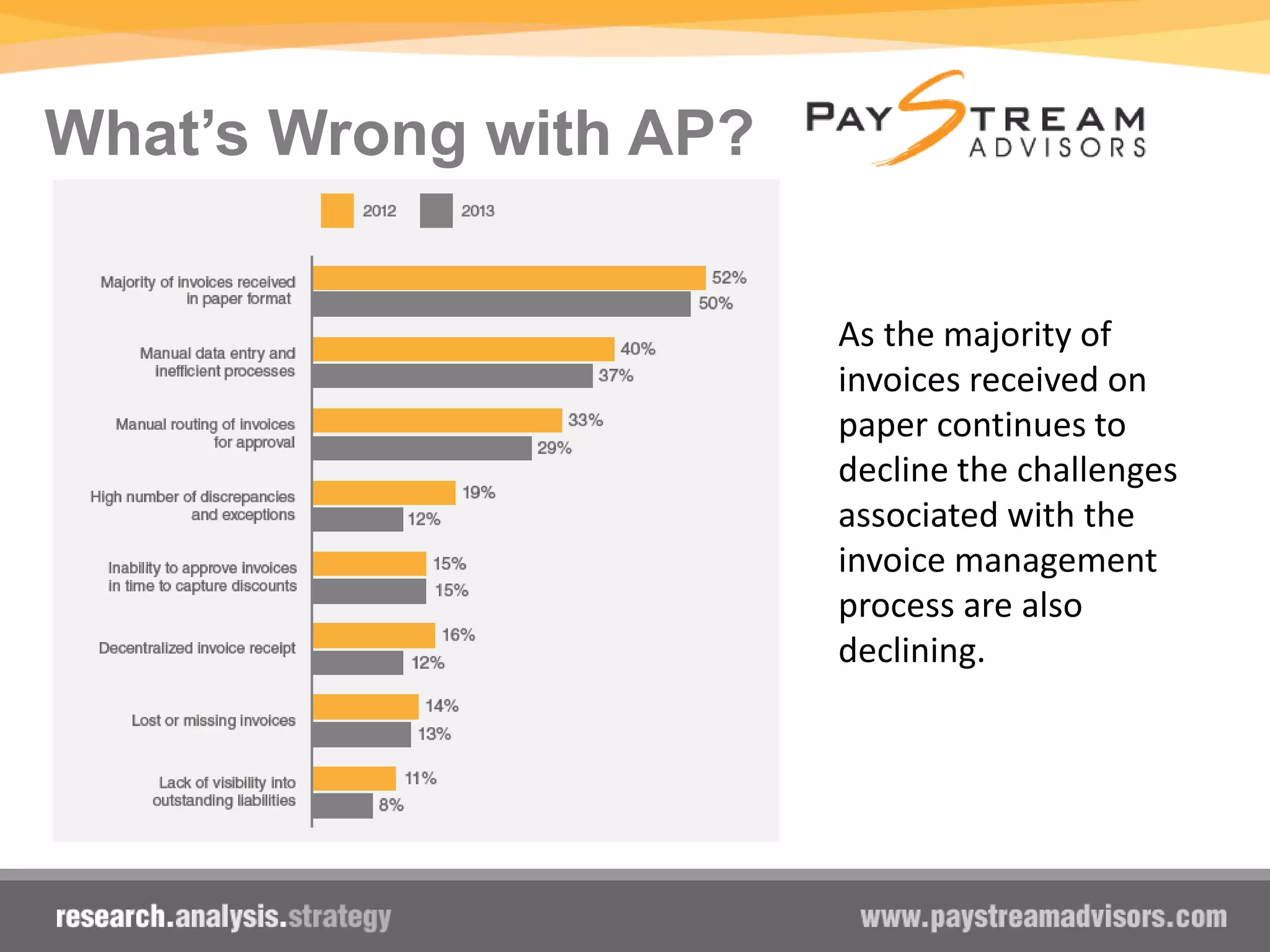
What’s Wrong with AP?
As the majority of
invoices received on
paper continues to
decline the challenges
associated with the
invoice management
process are also
declining.
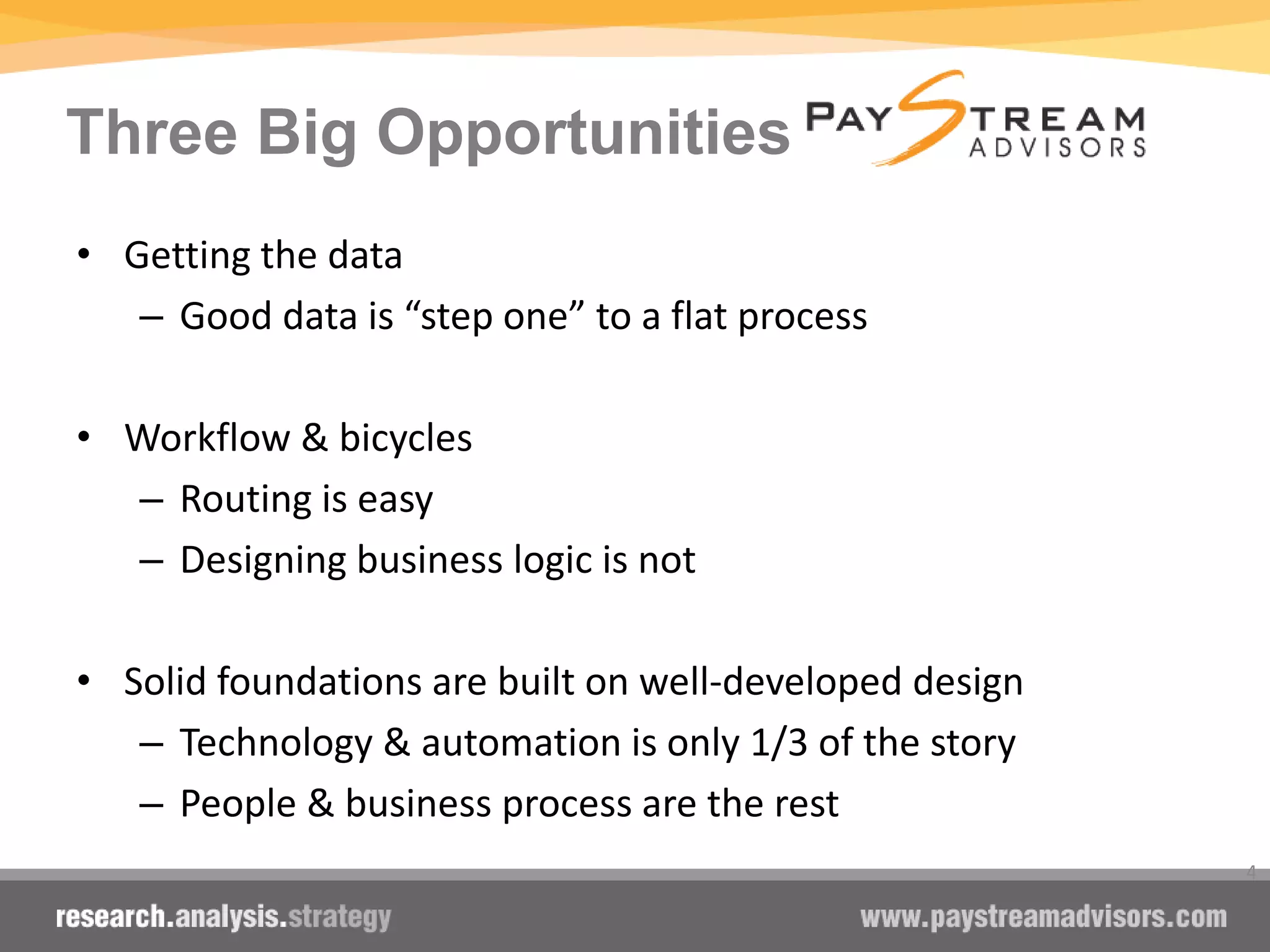
Three Big Opportunities
• Getting the data
– Good data is “step one” to a flat process
• Workflow & bicycles
– Routing is easy
– Designing business logic is not
• Solid foundations are built on well-developed design
– Technology & automation is only 1/3 of the story
– People & business process are the rest
4
1
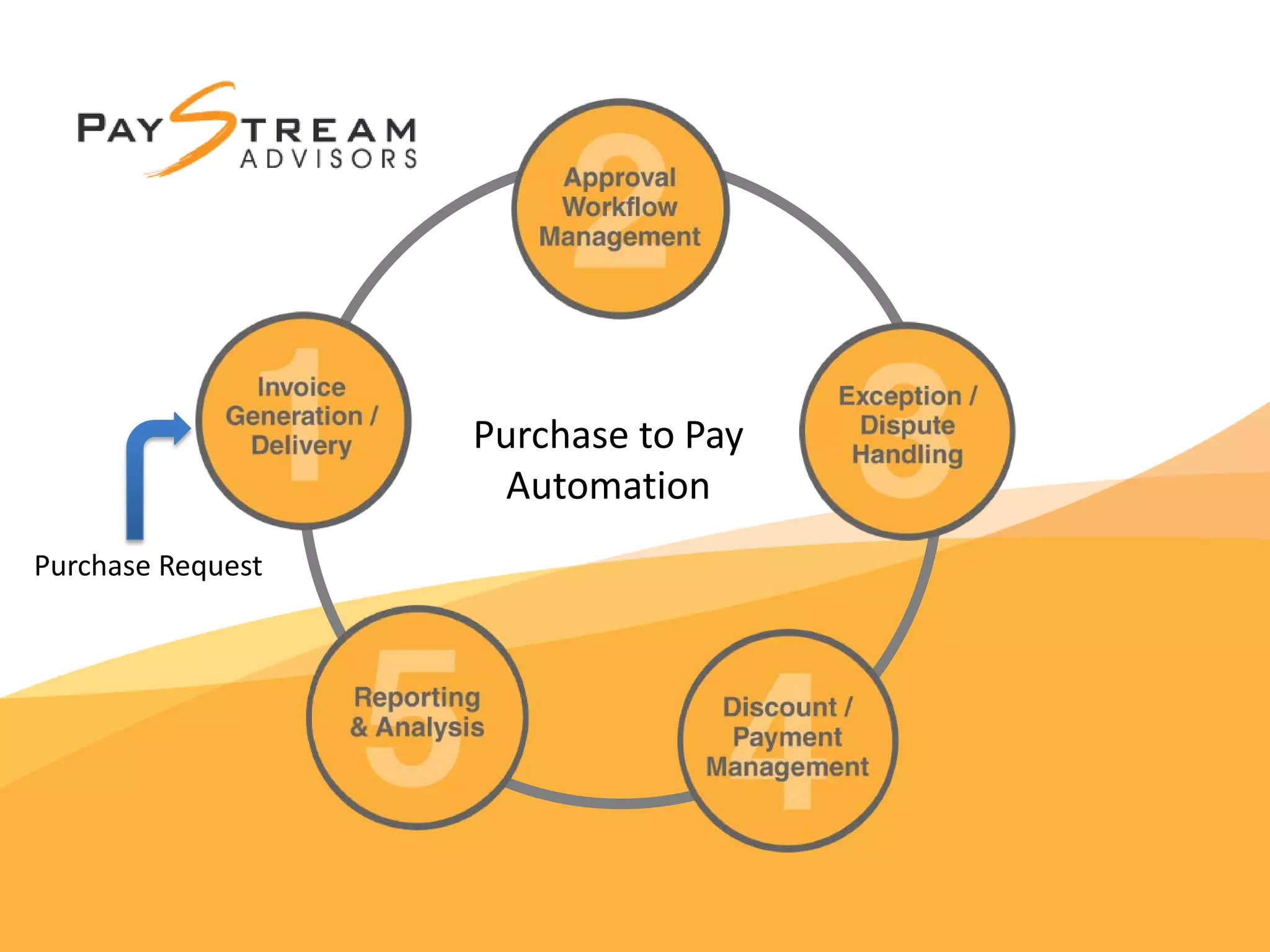
Purchase to Pay
Automation
Purchase Request
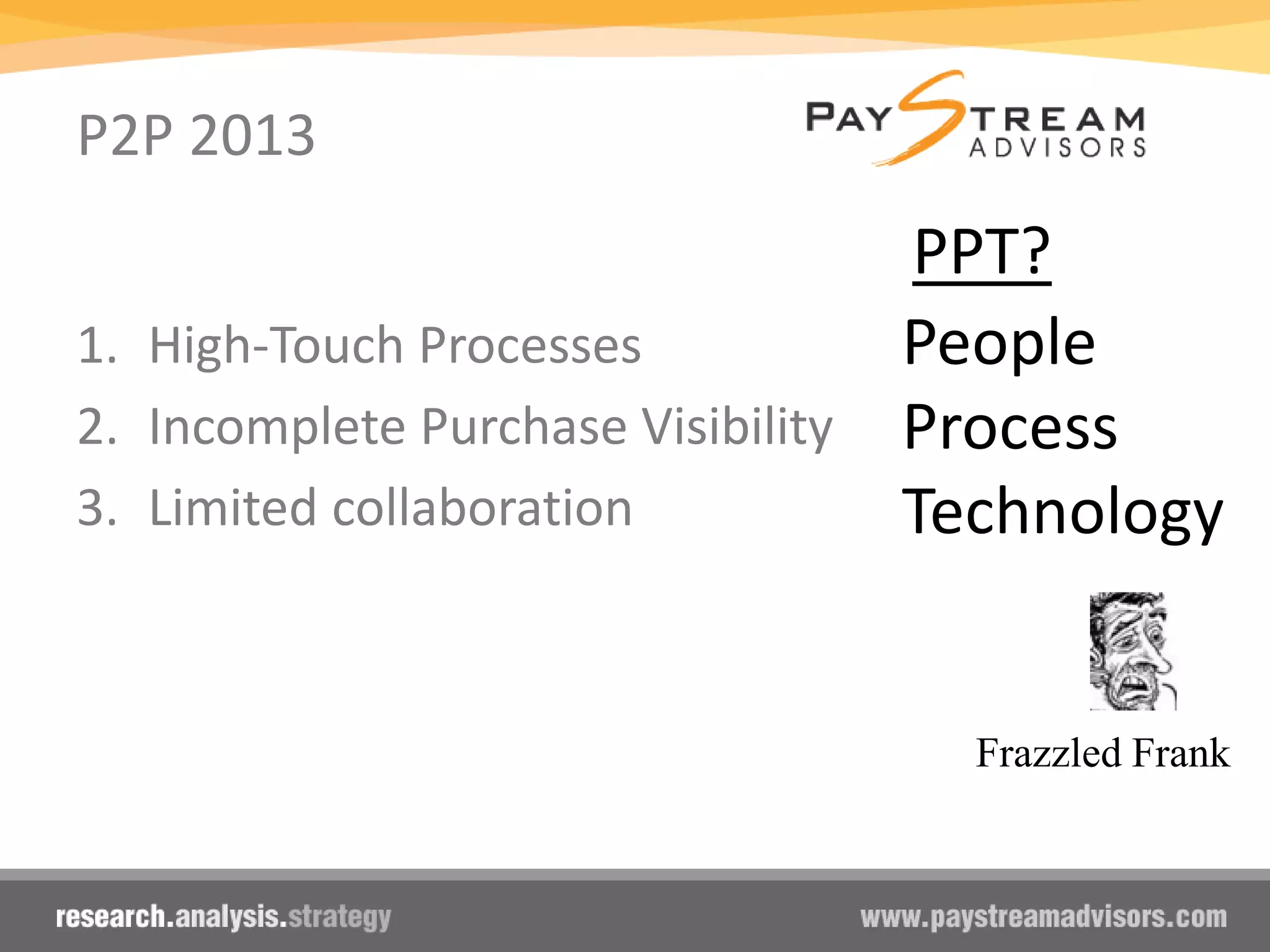
P2P 2013
1. High-Touch Processes
2. Incomplete Purchase Visibility
3. Limited collaboration
Frazzled Frank
People
Process
Technology
PPT?
7
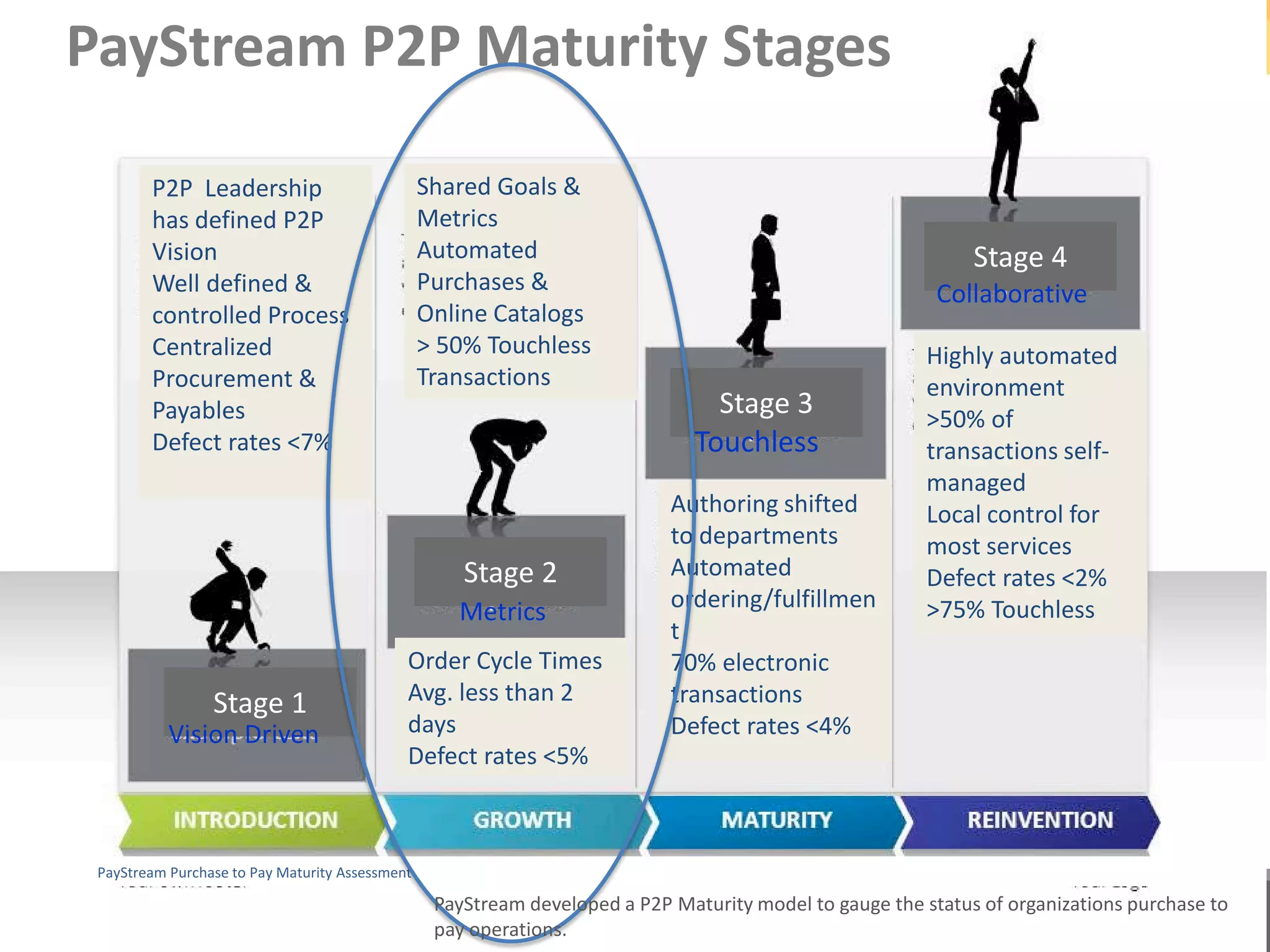
Stage 1
Stage 2
Stage 3
Stage 4
P2P Leadership
has defined P2P
Vision
Well defined &
controlled Process
Centralized
Procurement &
Payables
Defect rates <7%
Shared Goals &
Metrics
Automated
Purchases &
Online Catalogs
> 50% Touchless
Transactions
Authoring shifted
to departments
Automated
ordering/fulfillmen
t
70% electronic
transactions
Defect rates <4%
Highly automated
environment
>50% of
transactions self-
managed
Local control for
most services
Defect rates <2%
>75% Touchless
PayStream P2P Maturity Stages
Order Cycle Times
Avg. less than 2
days
Defect rates <5%
PayStream Purchase to Pay Maturity Assessment
Metrics
Touchless
Collaborative
Vision Driven
PayStream developed a P2P Maturity model to gauge the status of organizations purchase to
pay operations.
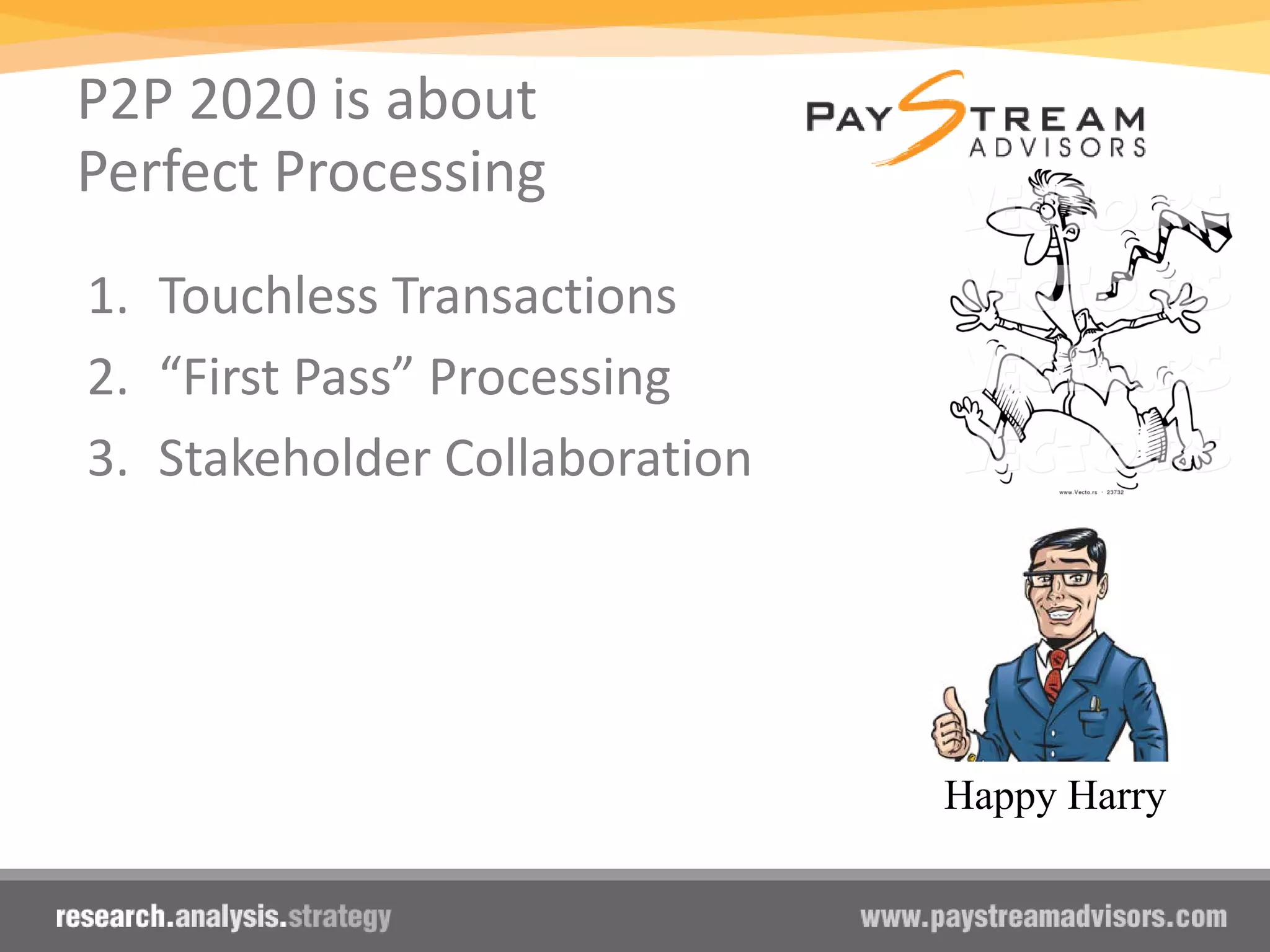
P2P 2020 is about
Perfect Processing
1. Touchless Transactions
2. “First Pass” Processing
3. Stakeholder Collaboration
Happy Harry
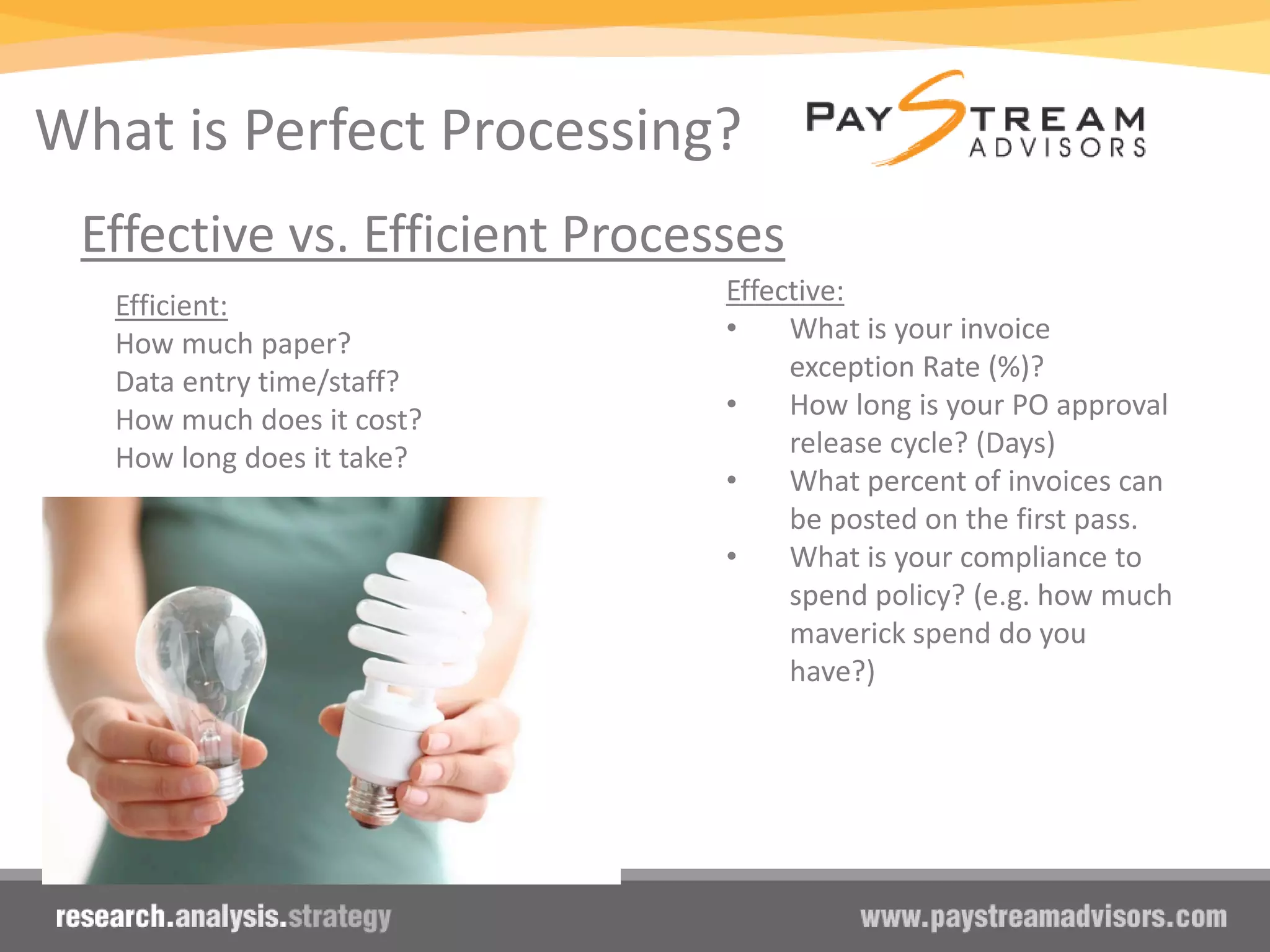
What is Perfect Processing?
Effective vs. Efficient Processes
Effective:
• What is your invoice
exception Rate (%)?
• How long is your PO approval
release cycle? (Days)
• What percent of invoices can
be posted on the first pass.
• What is your compliance to
spend policy? (e.g. how much
maverick spend do you
have?)
Efficient:
How much paper?
Data entry time/staff?
How much does it cost?
How long does it take?
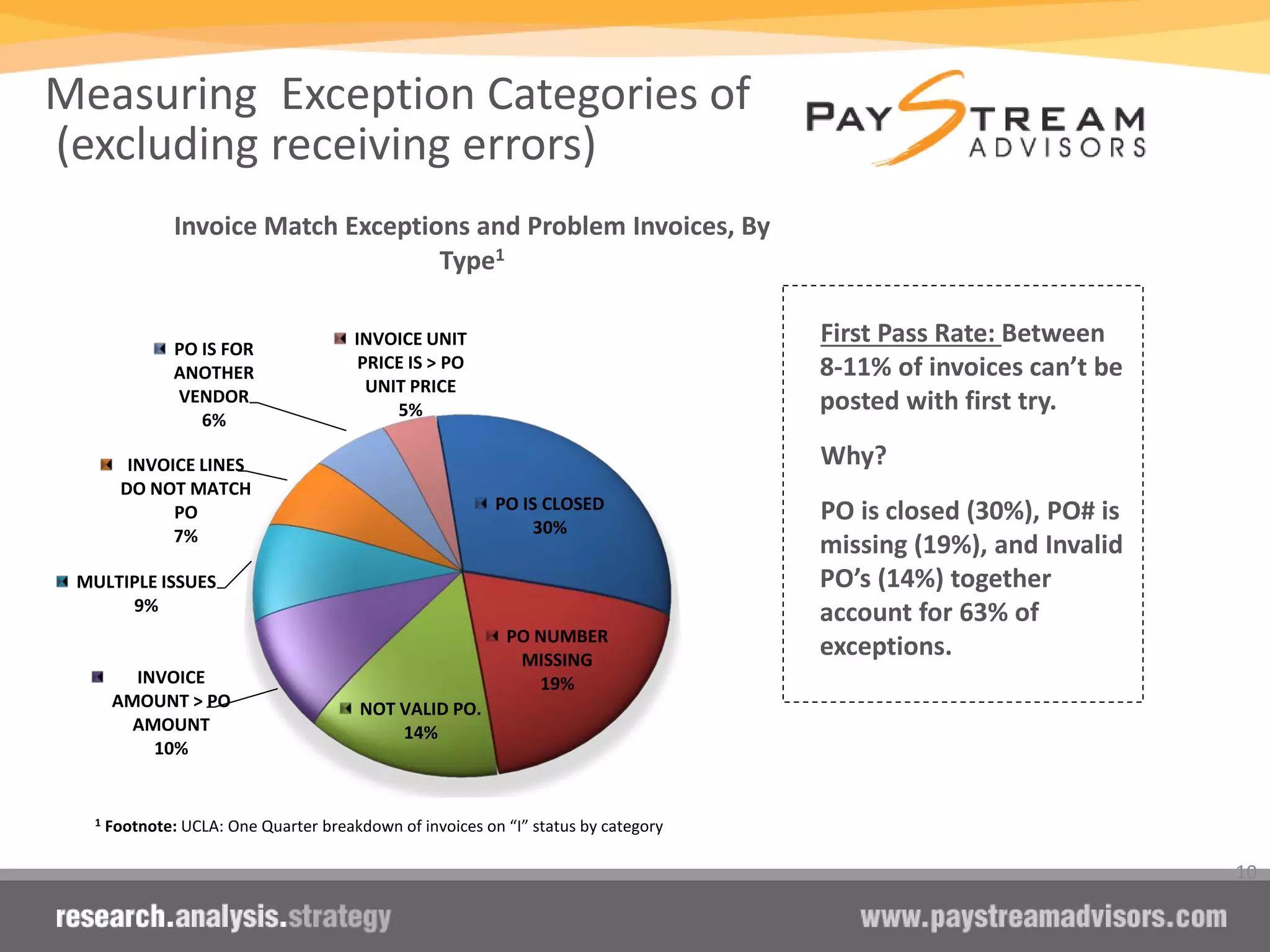
Measuring Exception Categories of
(excluding receiving errors)
10
First Pass Rate: Between
8-11% of invoices can’t be
posted with first try.
Why?
PO is closed (30%), PO# is
missing (19%), and Invalid
PO’s (14%) together
account for 63% of
exceptions.
1 Footnote: UCLA: One Quarter breakdown of invoices on “I” status by category
PO IS CLOSED
30%
PO NUMBER
MISSING
19%
NOT VALID PO.
14%
INVOICE
AMOUNT > PO
AMOUNT
10%
MULTIPLE ISSUES
9%
INVOICE LINES
DO NOT MATCH
PO
7%
PO IS FOR
ANOTHER
VENDOR
6%
INVOICE UNIT
PRICE IS > PO
UNIT PRICE
5%
Invoice Match Exceptions and Problem Invoices, By
Type1
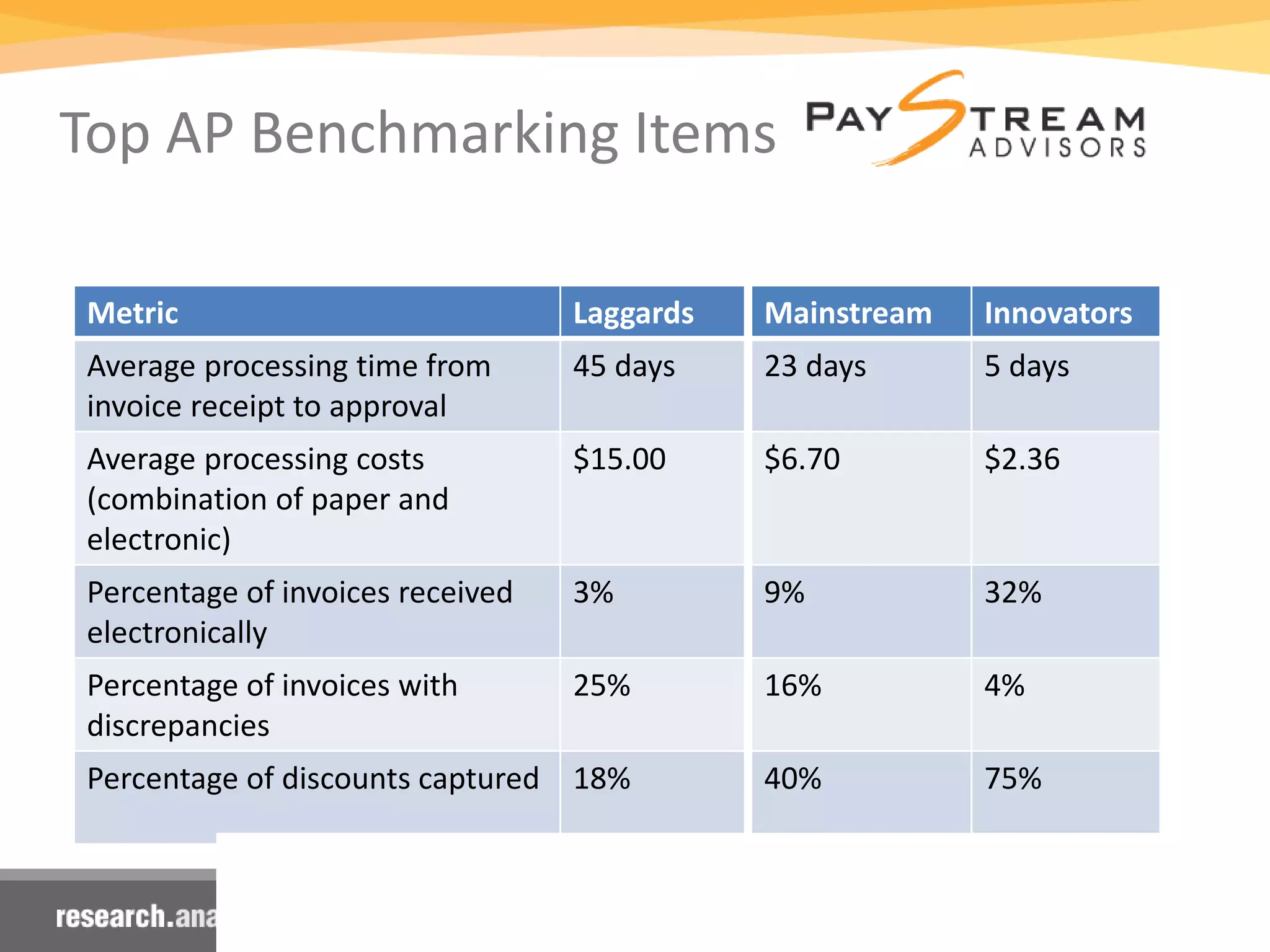
Top AP Benchmarking Items
Metric Laggards
Average processing time from
invoice receipt to approval
45 days
Average processing costs
(combination of paper and
electronic)
$15.00
Percentage of invoices received
electronically
3%
Percentage of invoices with
discrepancies
25%
Percentage of discounts captured 18%
Mainstream Innovators
23 days 5 days
$6.70 $2.36
9% 32%
16% 4%
40% 75%
Purchase to Pay Change is
Accelerating
Why?
1. Need for Speed
2. Consumer Tech Pull
3. Labor Challenges
Need for Speed
1. Increasing Value of Big Data
2. Efficiency yields to better
purchasing decisions
- Saving a dollar per PO
vs.
- Purchasing
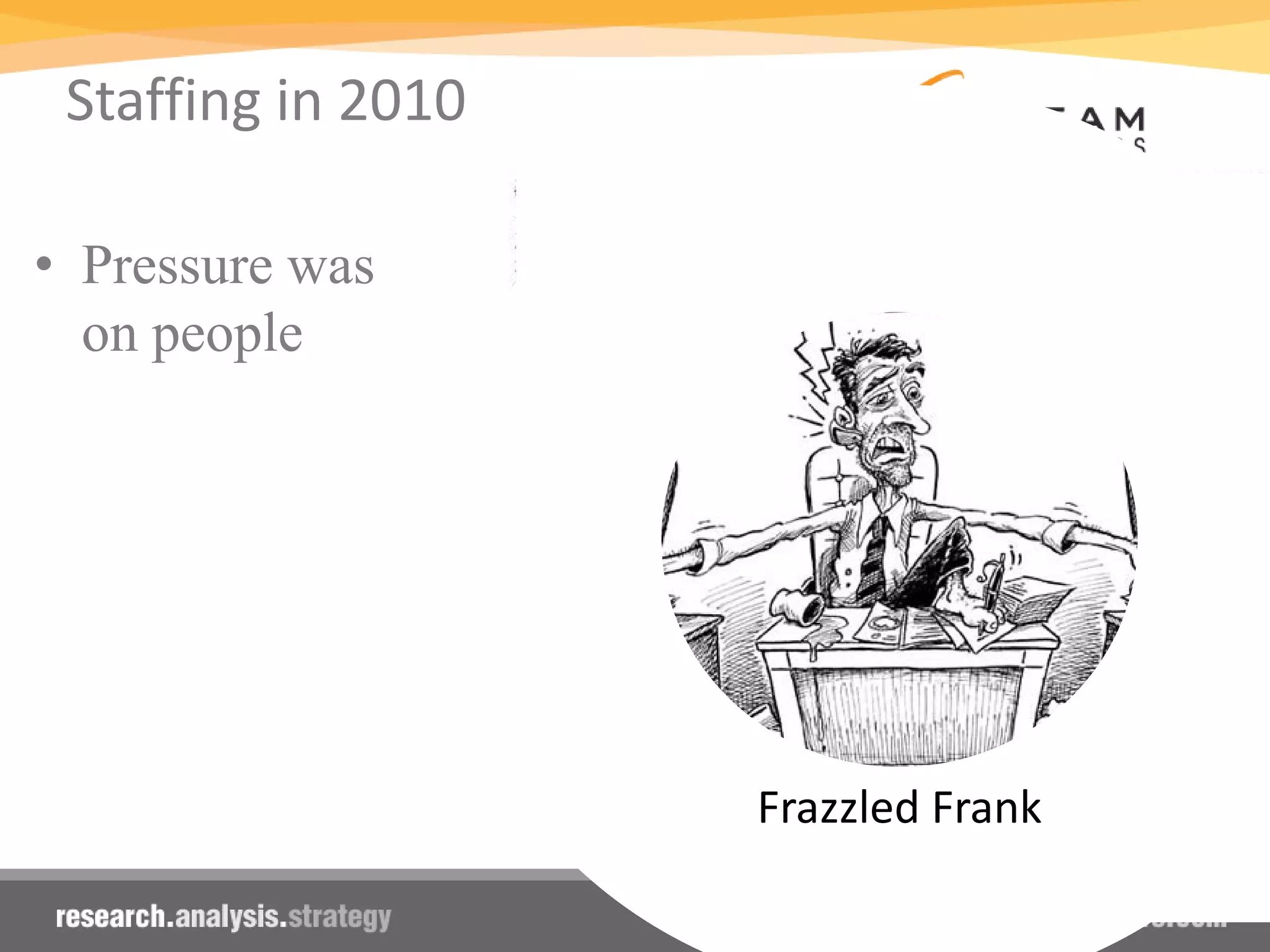
Staffing in 2010
• Pressure was
on people
Frazzled Frank
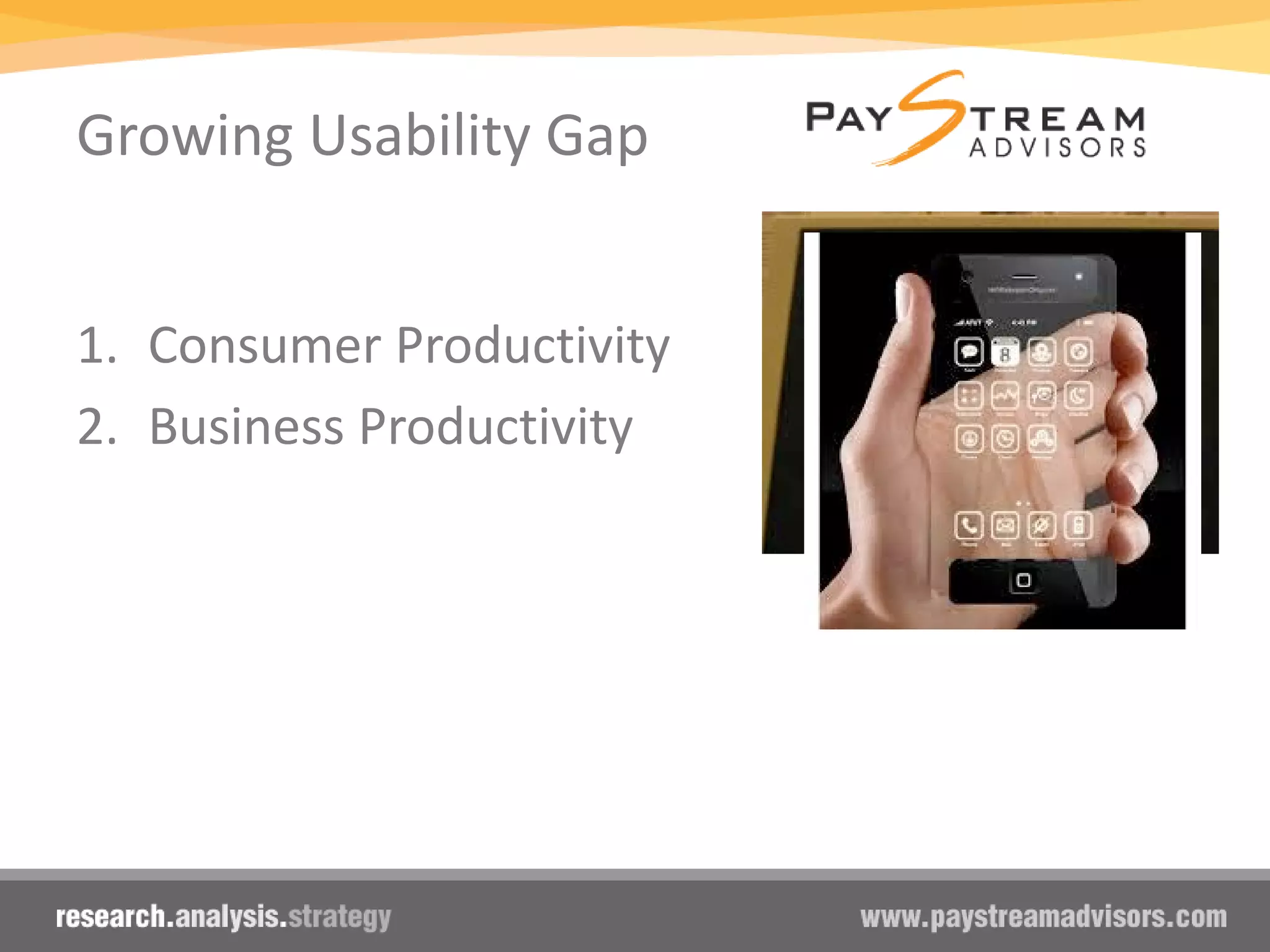
Growing Usability Gap
1. Consumer Productivity
2. Business Productivity
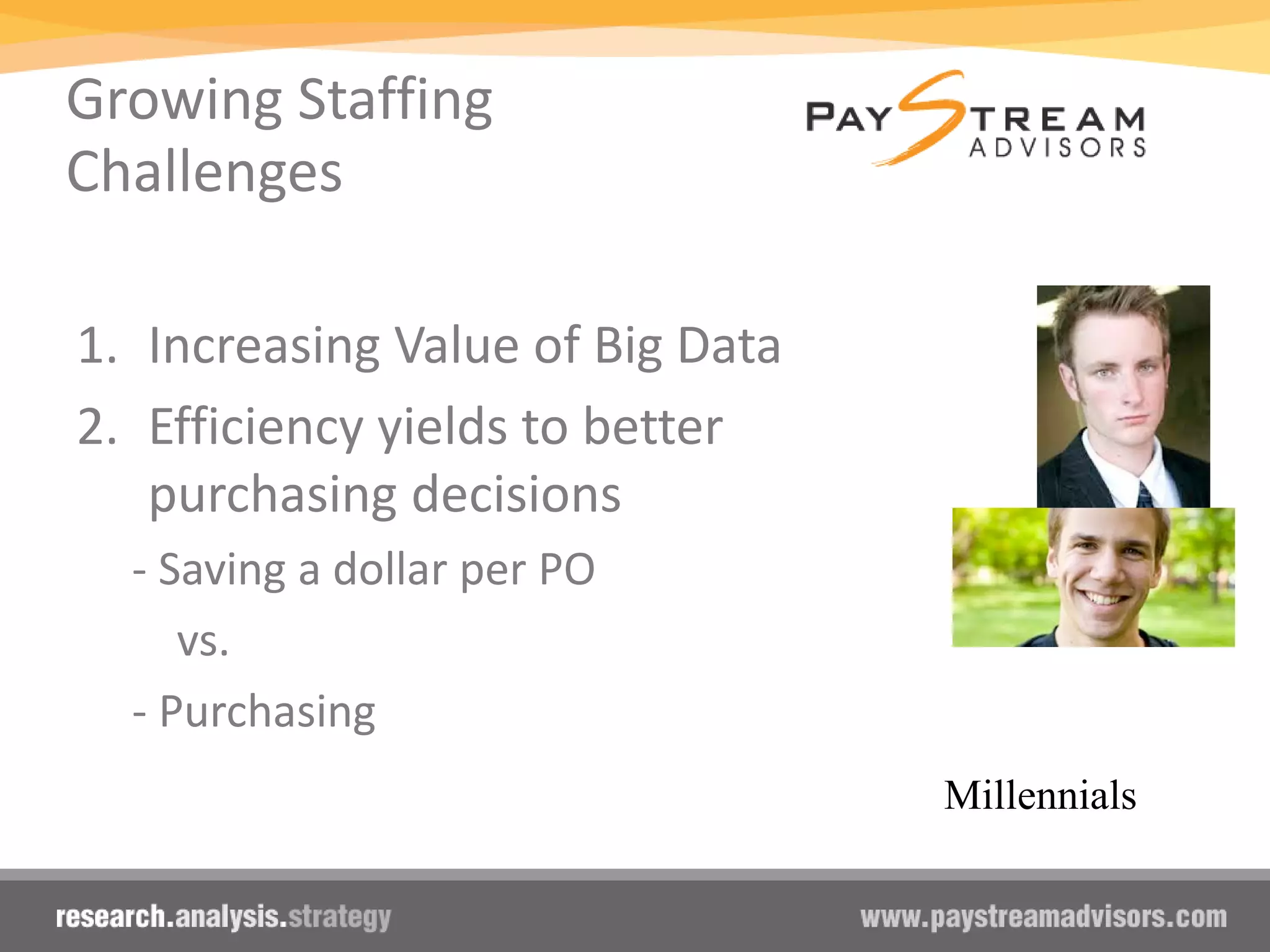
Growing Staffing
Challenges
1. Increasing Value of Big Data
2. Efficiency yields to better
purchasing decisions
- Saving a dollar per PO
vs.
- Purchasing
Millennials
P2P Academy Research
1. Long term transformation plan
2. Cohesive coalition
3. Metrics to define success
4. A Leader to drive the vision
Four Common Success Factors
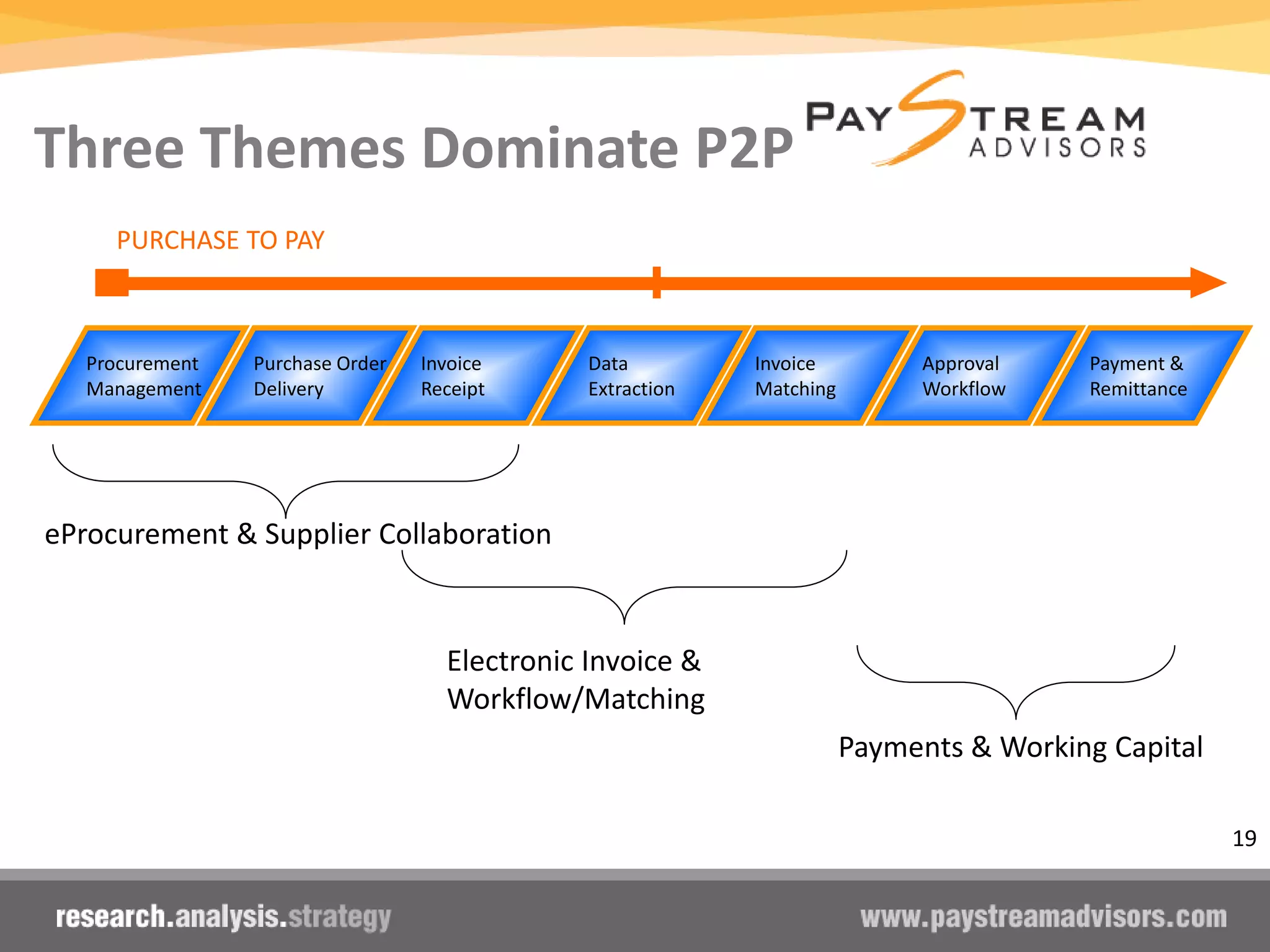
Three Themes Dominate P2P
Purchase Order
Delivery
Invoice
Receipt
Data
Extraction
Invoice
Matching
Procurement
Management
Approval
Workflow
Payment &
Remittance
PURCHASE TO PAY
Payments & Working Capital
Electronic Invoice &
Workflow/Matching
eProcurement & Supplier Collaboration
19
What are the Innovators doing?
What’s behind the curtain?
Automation Adoption
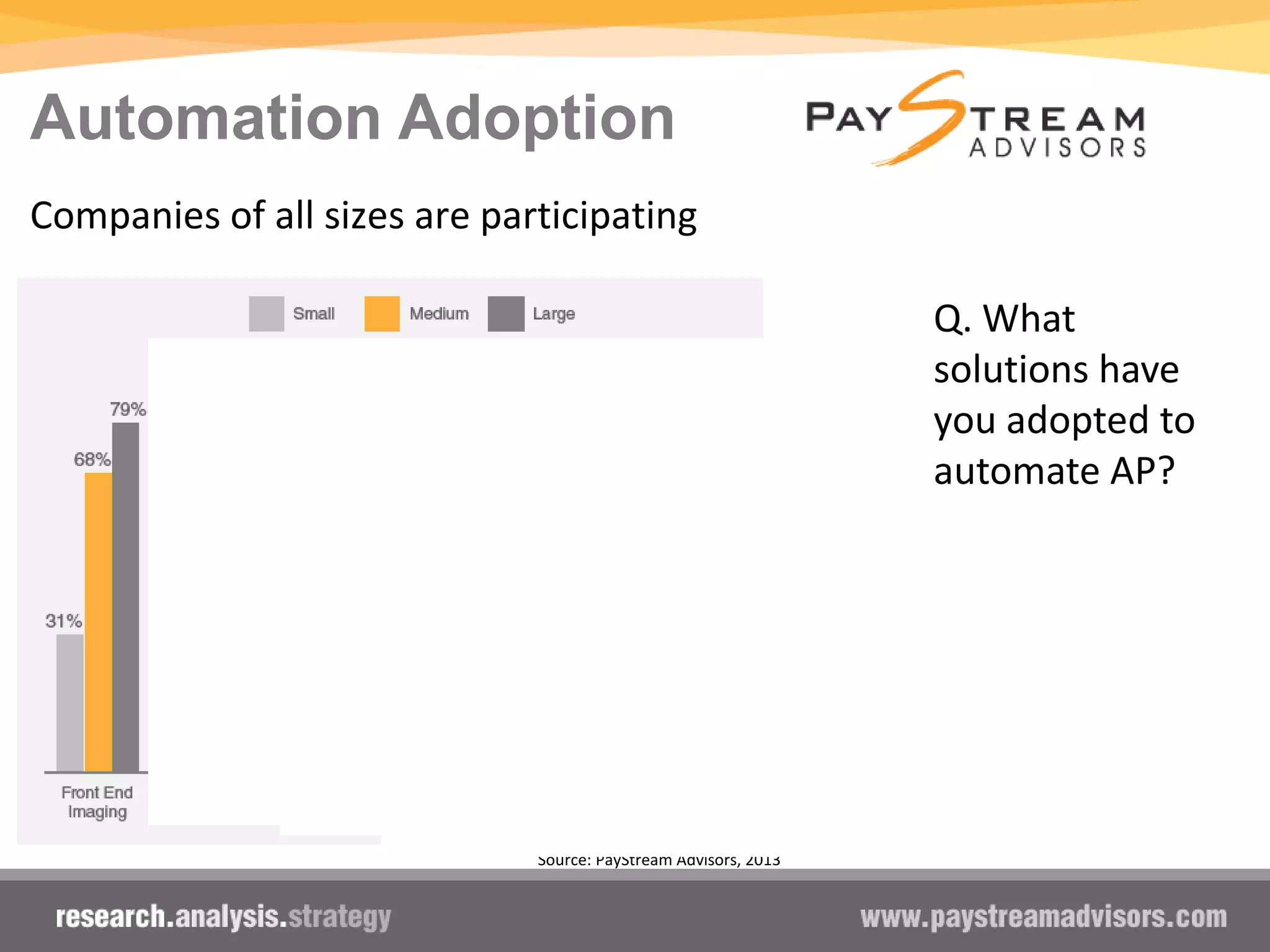
Companies of all sizes are participating
Source: PayStream Advisors, 2013
Q. What
solutions have
you adopted to
automate AP?
UPMC Case Study
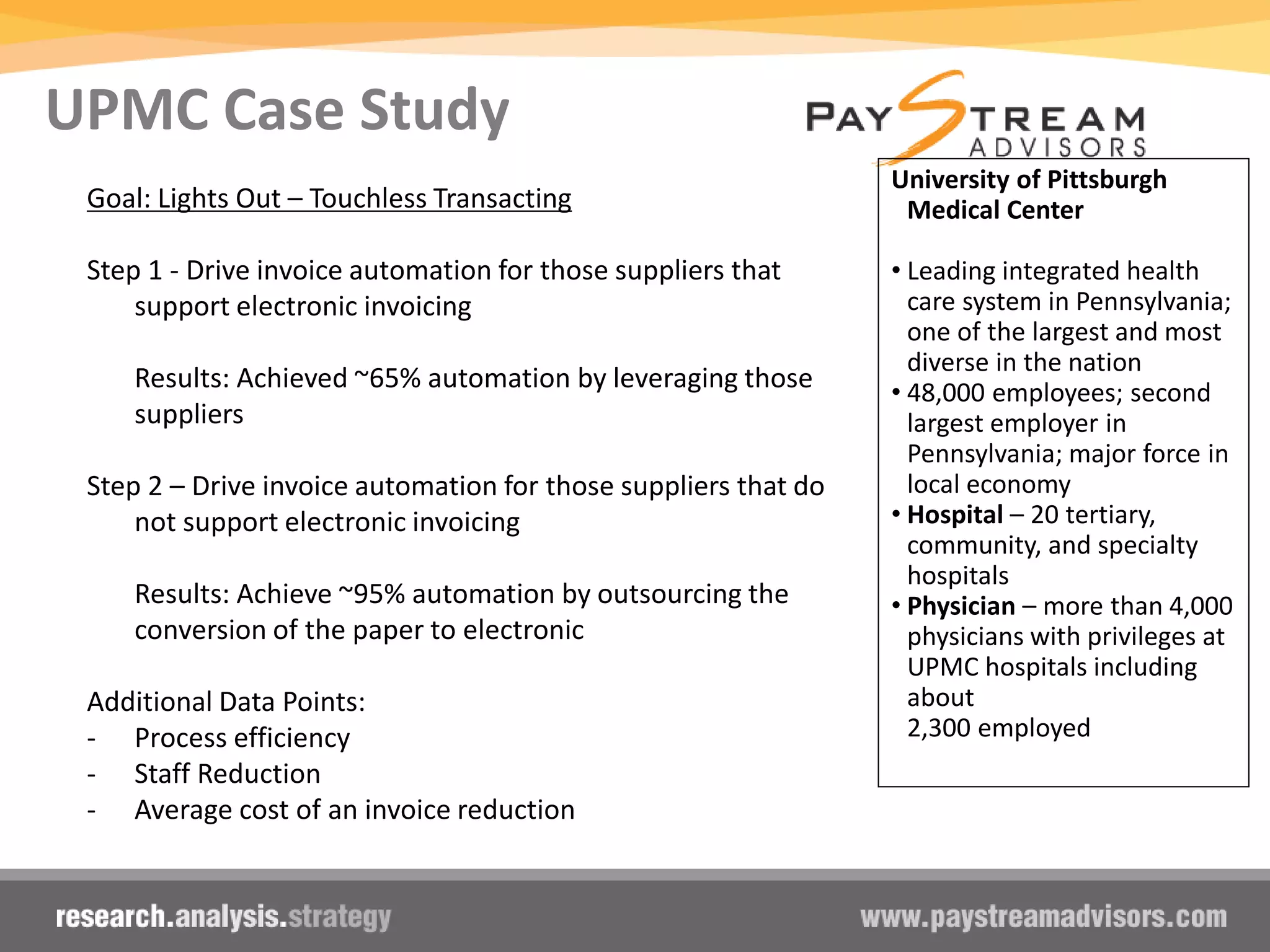
Goal: Lights Out – Touchless Transacting
Step 1 - Drive invoice automation for those suppliers that
support electronic invoicing
Results: Achieved ~65% automation by leveraging those
suppliers
Step 2 – Drive invoice automation for those suppliers that do
not support electronic invoicing
Results: Achieve ~95% automation by outsourcing the
conversion of the paper to electronic
Additional Data Points:
- Process efficiency
- Staff Reduction
- Average cost of an invoice reduction
University of Pittsburgh
Medical Center
• Leading integrated health
care system in Pennsylvania;
one of the largest and most
diverse in the nation
• 48,000 employees; second
largest employer in
Pennsylvania; major force in
local economy
• Hospital – 20 tertiary,
community, and specialty
hospitals
• Physician – more than 4,000
physicians with privileges at
UPMC hospitals including
about
2,300 employed
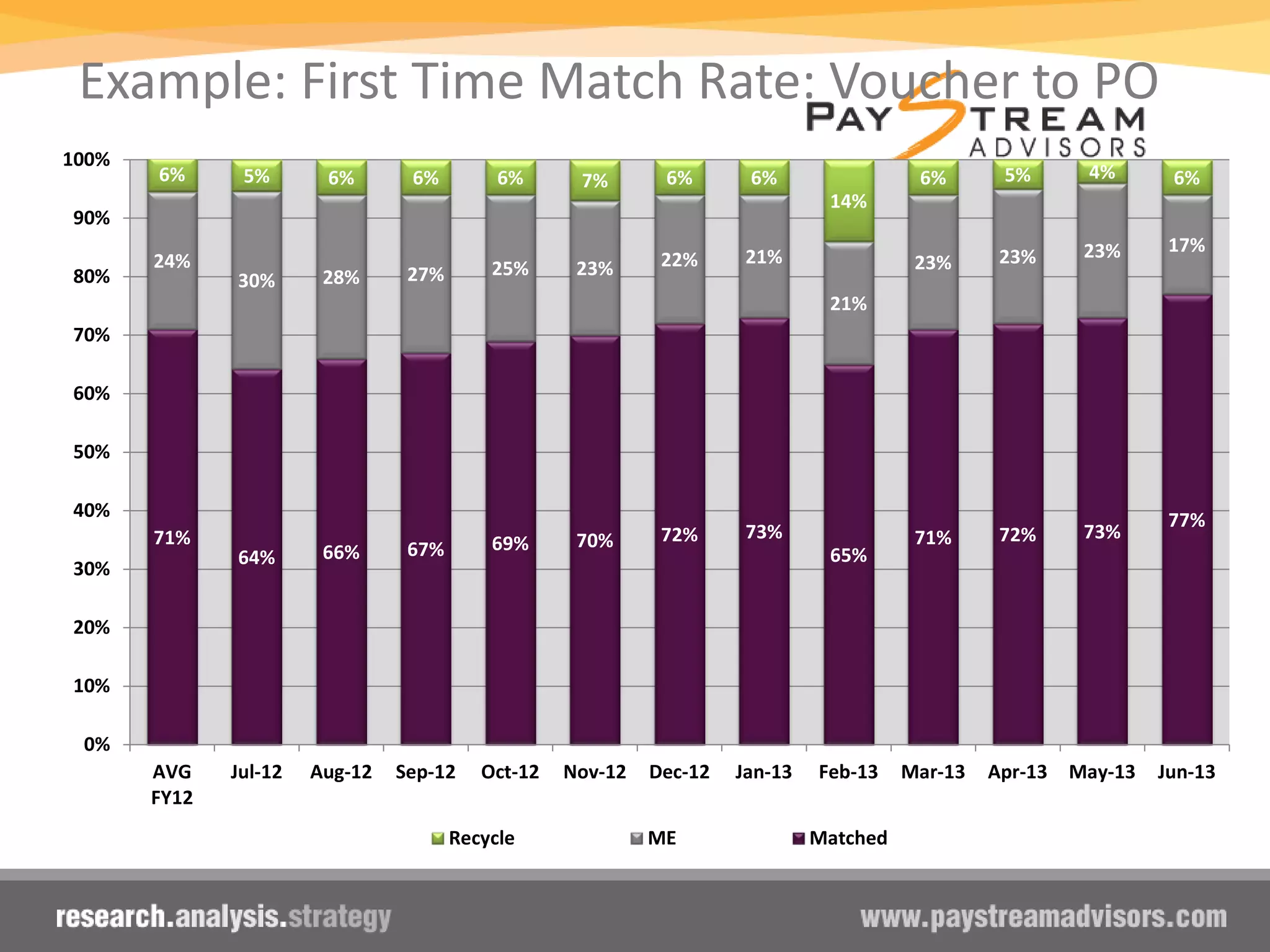
Example: First Time Match Rate: Voucher to PO
71%
64% 66% 67% 69% 70% 72% 73%
65%
71% 72% 73%
77%
24%
30% 28% 27% 25% 23% 22% 21%
21%
23% 23% 23% 17%
6% 5% 6% 6% 6% 7% 6% 6%
14%
6% 5% 4% 6%
0%
10%
20%
30%
40%
50%
60%
70%
80%
90%
100%
AVG
FY12
Jul-12 Aug-12 Sep-12 Oct-12 Nov-12 Dec-12 Jan-13 Feb-13 Mar-13 Apr-13 May-13 Jun-13
Recycle ME Matched
Exception Management
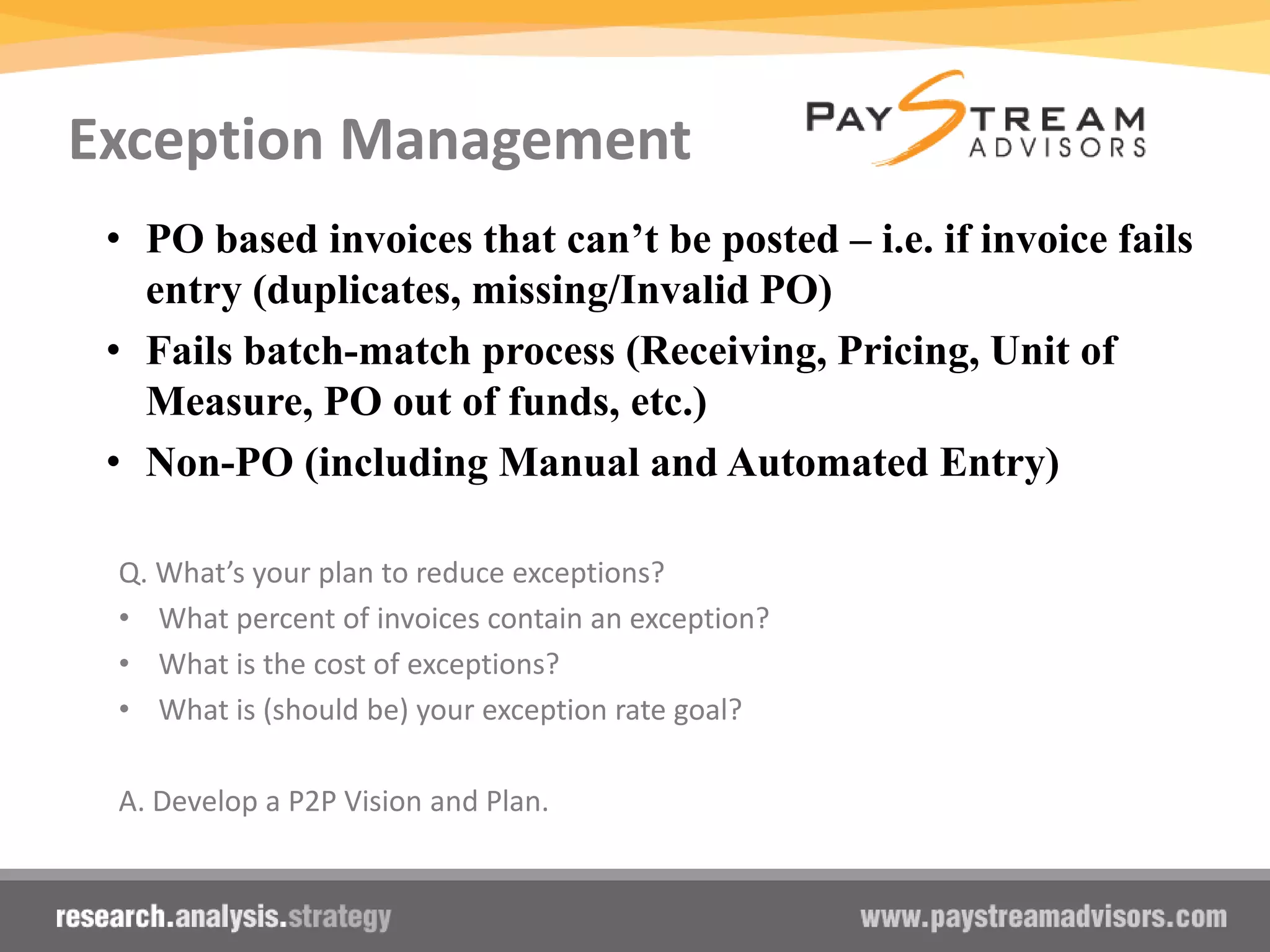
Q. What’s your plan to reduce exceptions?
• What percent of invoices contain an exception?
• What is the cost of exceptions?
• What is (should be) your exception rate goal?
A. Develop a P2P Vision and Plan.
• PO based invoices that can’t be posted – i.e. if invoice fails
entry (duplicates, missing/Invalid PO)
• Fails batch-match process (Receiving, Pricing, Unit of
Measure, PO out of funds, etc.)
• Non-PO (including Manual and Automated Entry)
• The 5 Why’s
• 8 Wastes
• Value Stream
Analysis
25
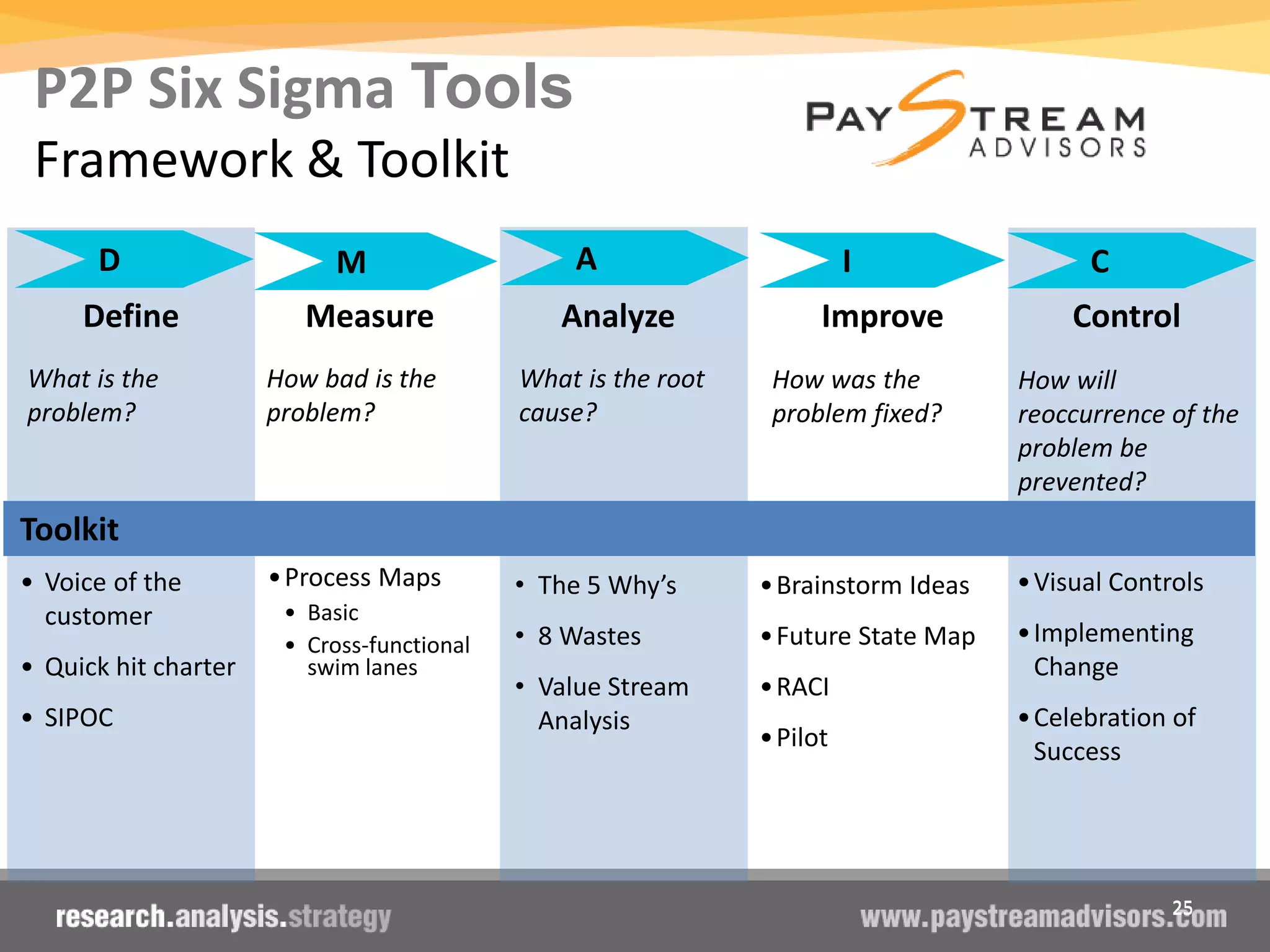
P2P Six Sigma Tools
Framework & Toolkit
• Voice of the
customer
• Quick hit charter
• SIPOC
Toolkit
•Brainstorm Ideas
•Future State Map
•RACI
•Pilot
•Visual Controls
•Implementing
Change
•Celebration of
Success
•Process Maps
• Basic
• Cross-functional
swim lanes
D
Define
M
Measure
A
Analyze
I
Improve
C
Control
What is the
problem?
How bad is the
problem?
What is the root
cause?
How was the
problem fixed?
How will
reoccurrence of the
problem be
prevented?
25
Achieving Perfection
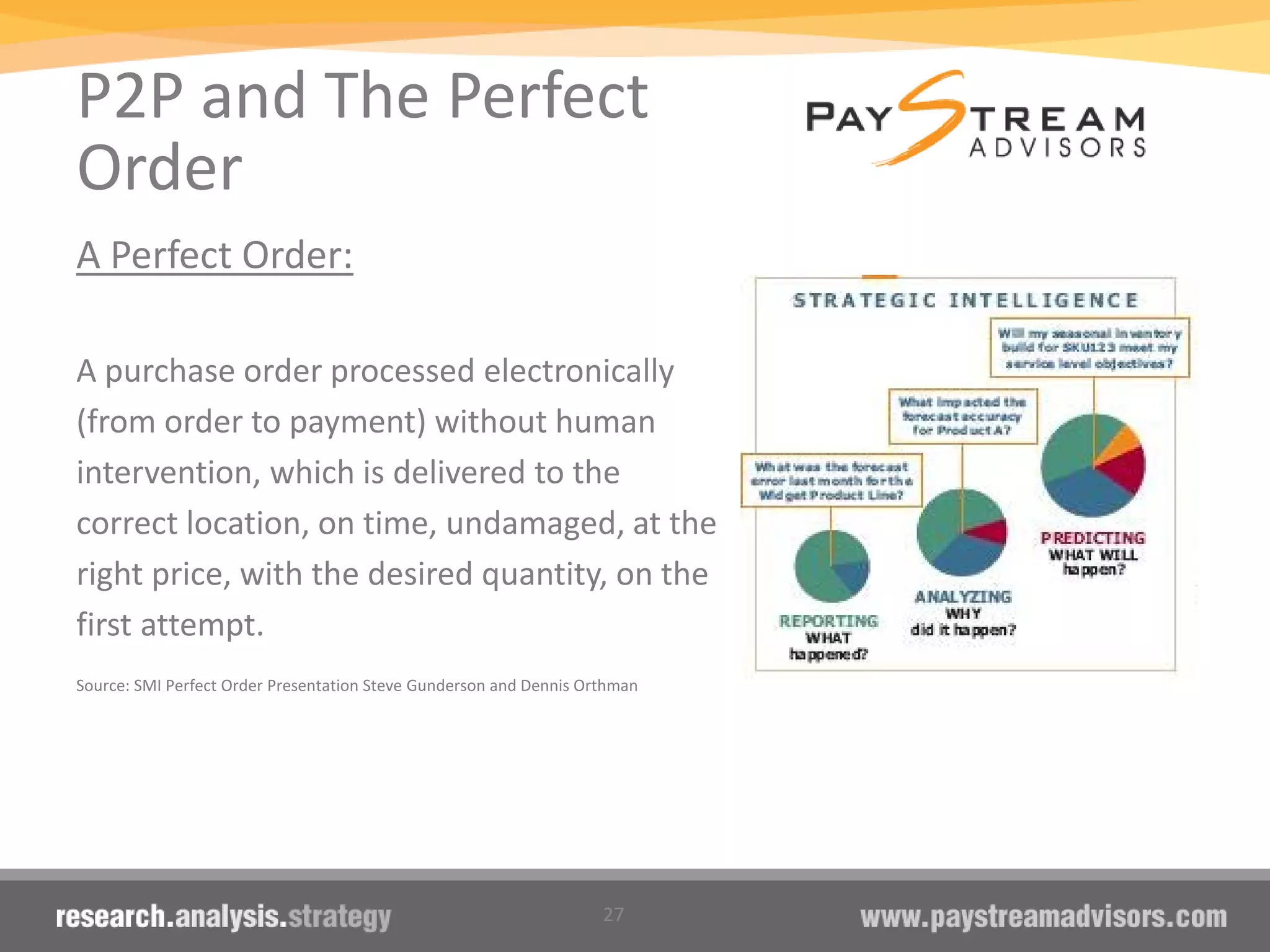
P2P and The Perfect
Order
A Perfect Order:
A purchase order processed electronically
(from order to payment) without human
intervention, which is delivered to the
correct location, on time, undamaged, at the
right price, with the desired quantity, on the
first attempt.
Source: SMI Perfect Order Presentation Steve Gunderson and Dennis Orthman
27
The Perfect Payment?
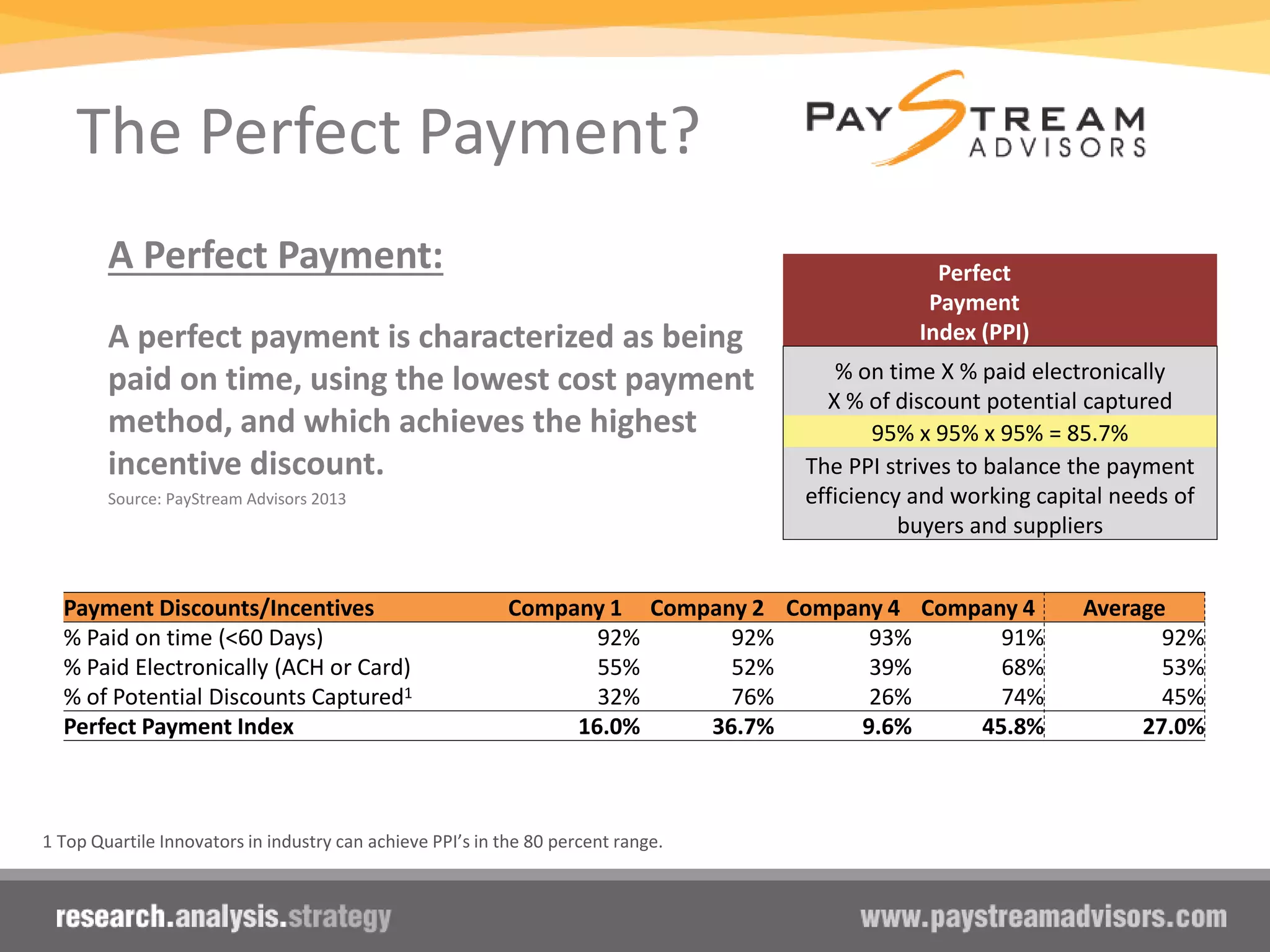
A Perfect Payment:
A perfect payment is characterized as being
paid on time, using the lowest cost payment
method, and which achieves the highest
incentive discount.
Source: PayStream Advisors 2013
Perfect
Payment
Index (PPI)
% on time X % paid electronically
X % of discount potential captured
95% x 95% x 95% = 85.7%
The PPI strives to balance the payment
efficiency and working capital needs of
buyers and suppliers
1 Top Quartile Innovators in industry can achieve PPI’s in the 80 percent range.
Payment Discounts/Incentives Company 1 Company 2 Company 4 Company 4 Average
% Paid on time (<60 Days) 92% 92% 93% 91% 92%
% Paid Electronically (ACH or Card) 55% 52% 39% 68% 53%
% of Potential Discounts Captured1 32% 76% 26% 74% 45%
Perfect Payment Index 16.0% 36.7% 9.6% 45.8% 27.0%
29Purchase to Pay Academy
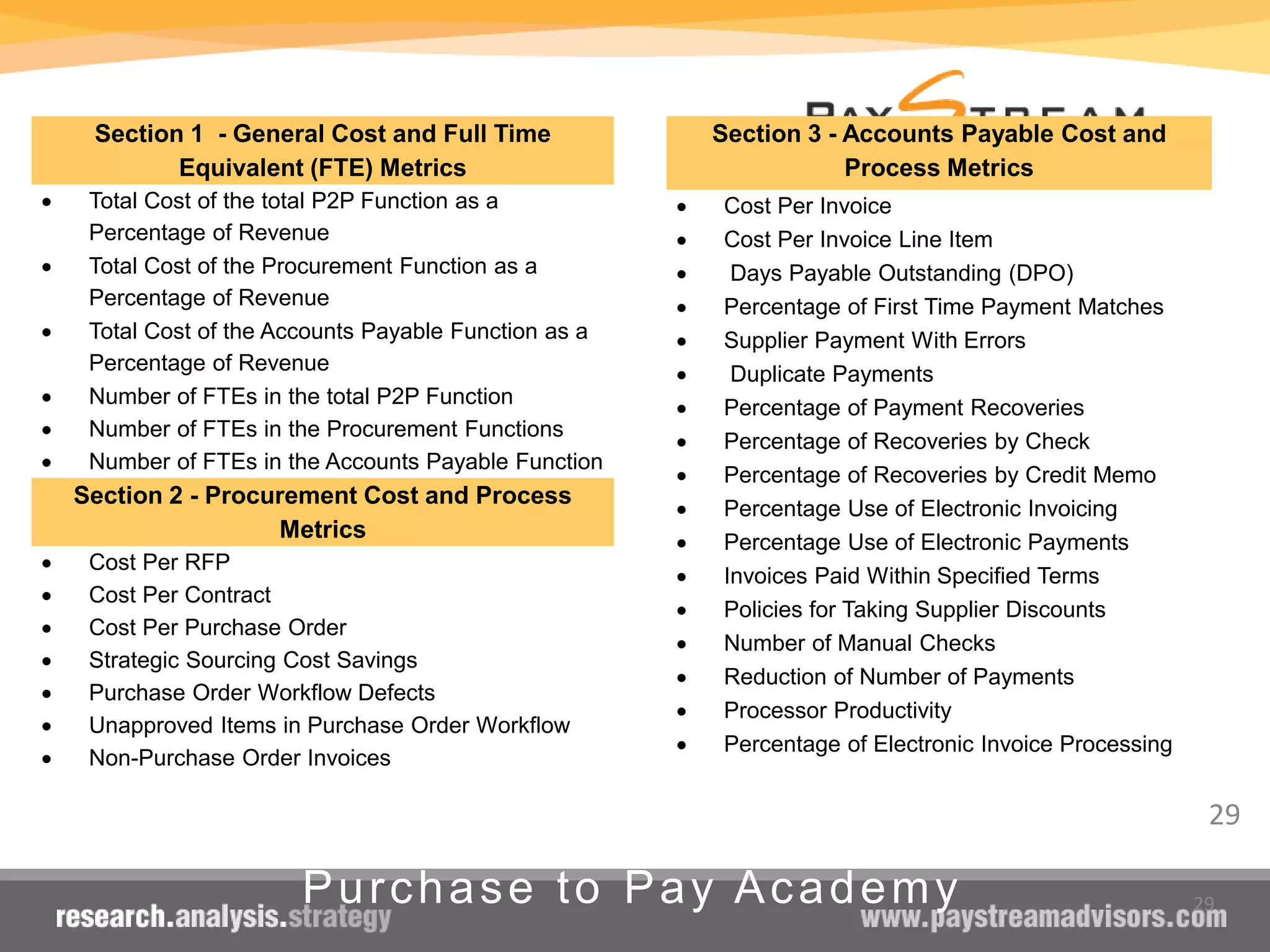
Section 1 - General Cost and Full Time
Equivalent (FTE) Metrics
• Total Cost of the total P2P Function as a
Percentage of Revenue
• Total Cost of the Procurement Function as a
Percentage of Revenue
• Total Cost of the Accounts Payable Function as a
Percentage of Revenue
• Number of FTEs in the total P2P Function
• Number of FTEs in the Procurement Functions
• Number of FTEs in the Accounts Payable Function
Section 2 - Procurement Cost and Process
Metrics
• Cost Per RFP
• Cost Per Contract
• Cost Per Purchase Order
• Strategic Sourcing Cost Savings
• Purchase Order Workflow Defects
• Unapproved Items in Purchase Order Workflow
• Non-Purchase Order Invoices
Section 3 - Accounts Payable Cost and
Process Metrics
• Cost Per Invoice
• Cost Per Invoice Line Item
• Days Payable Outstanding (DPO)
• Percentage of First Time Payment Matches
• Supplier Payment With Errors
• Duplicate Payments
• Percentage of Payment Recoveries
• Percentage of Recoveries by Check
• Percentage of Recoveries by Credit Memo
• Percentage Use of Electronic Invoicing
• Percentage Use of Electronic Payments
• Invoices Paid Within Specified Terms
• Policies for Taking Supplier Discounts
• Number of Manual Checks
• Reduction of Number of Payments
• Processor Productivity
• Percentage of Electronic Invoice Processing
29
Purchase to Pay Academy
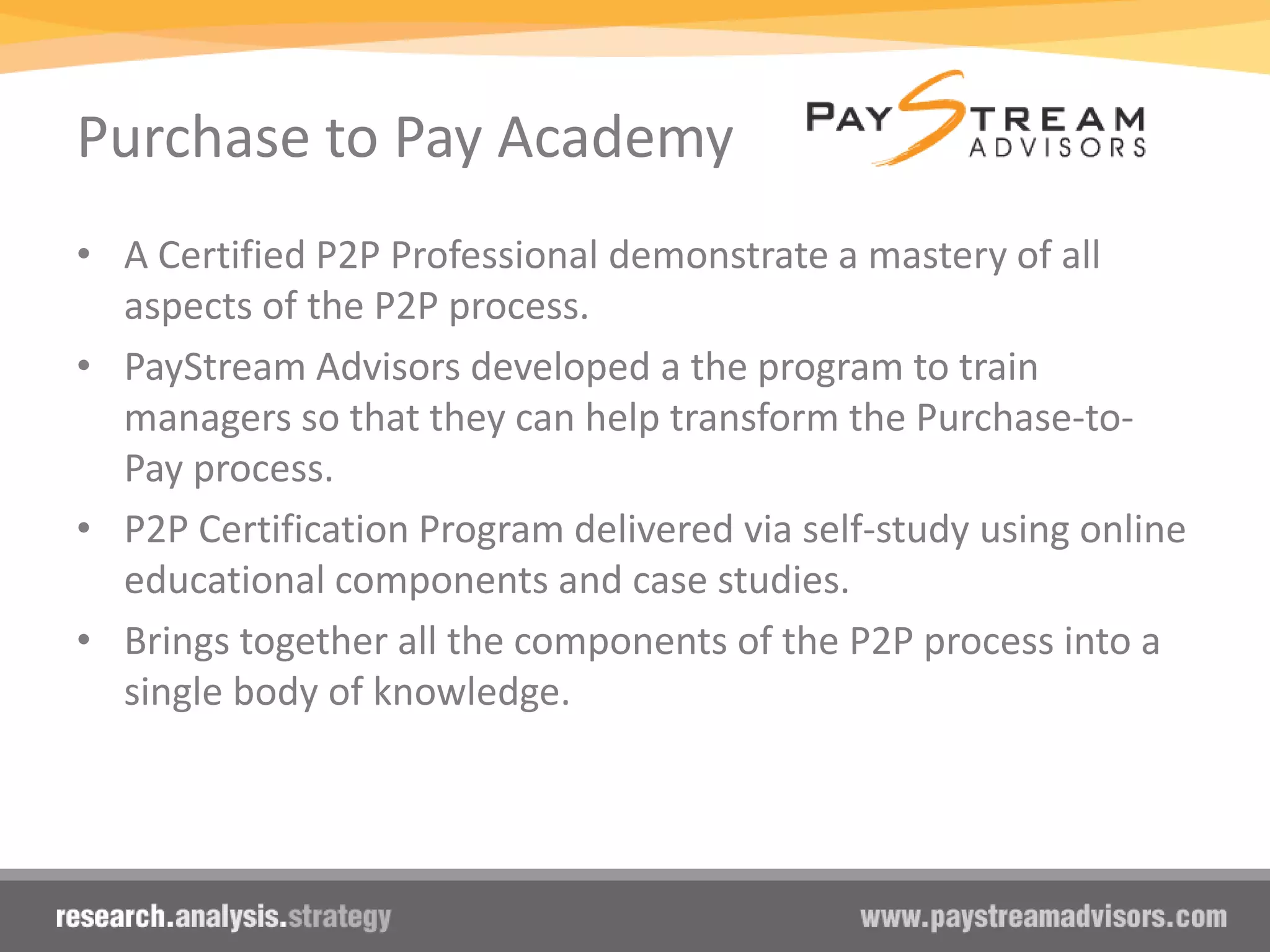
• A Certified P2P Professional demonstrate a mastery of all
aspects of the P2P process.
• PayStream Advisors developed a the program to train
managers so that they can help transform the Purchase-to-
Pay process.
• P2P Certification Program delivered via self-study using online
educational components and case studies.
• Brings together all the components of the P2P process into a
single body of knowledge.
Winning Over Your
Partners
• Engage Your approvers
and Suppliers
• Influence Change
• Collaborative
Solutions
• Getting to “YES!”
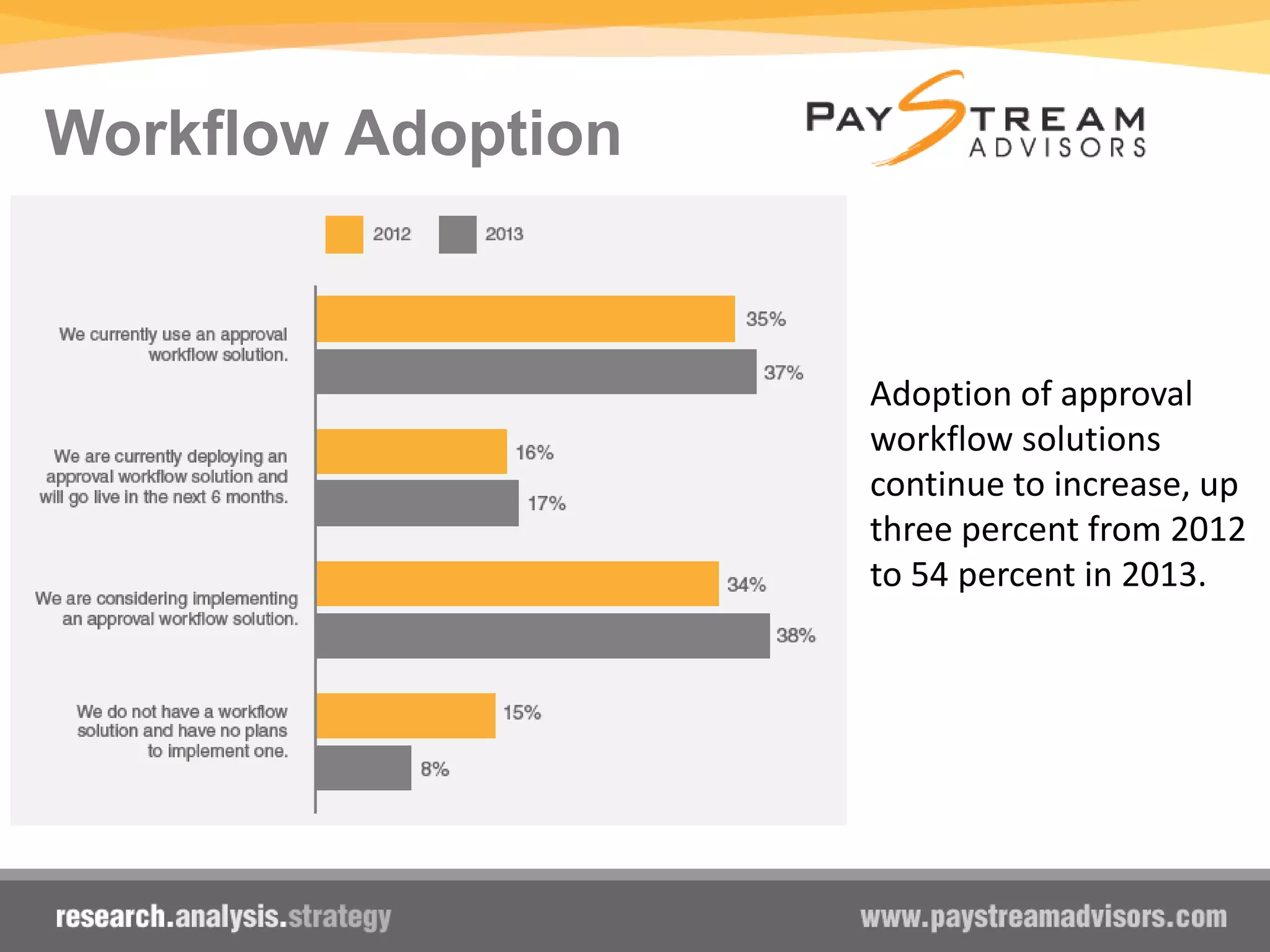
Workflow Adoption
Adoption of approval
workflow solutions
continue to increase, up
three percent from 2012
to 54 percent in 2013.
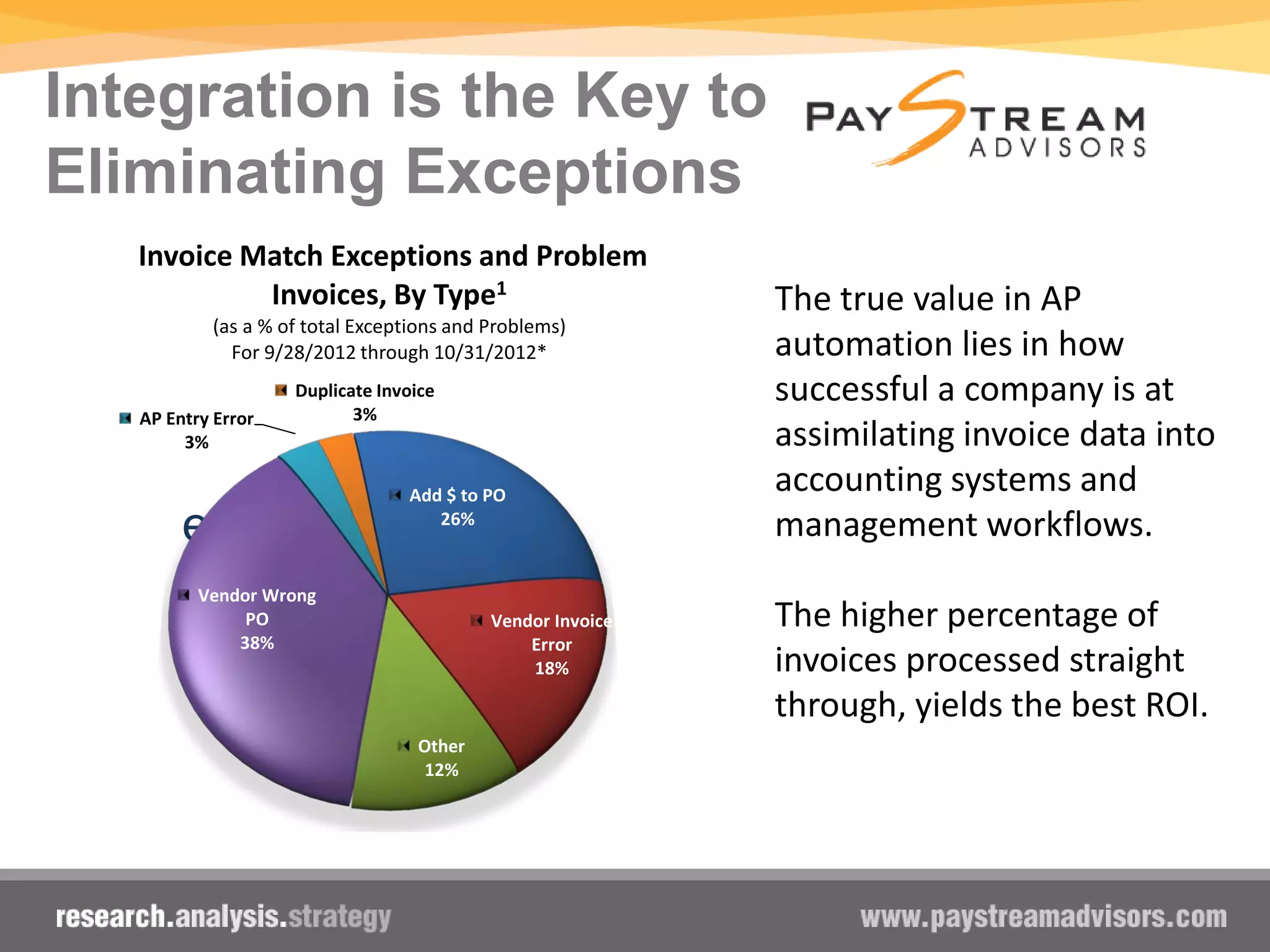
Integration is the Key to
Eliminating Exceptions
The true value in AP
automation lies in how
successful a company is at
assimilating invoice data into
accounting systems and
management workflows.
The higher percentage of
invoices processed straight
through, yields the best ROI.
eInvoicing
Add $ to PO
26%
Vendor Invoice
Error
18%
Other
12%
Vendor Wrong
PO
38%
AP Entry Error
3%
Duplicate Invoice
3%
Invoice Match Exceptions and Problem
Invoices, By Type1
(as a % of total Exceptions and Problems)
For 9/28/2012 through 10/31/2012*
Purchase to Pay Academy
• A Certified P2P Professional demonstrate a mastery of all
aspects of the P2P process.
• PayStream Advisors developed a the program to train
managers so that they can help transform the Purchase-to-
Pay process.
• P2P Certification Program delivered via self-study using online
educational components and case studies.
• Brings together all the components of the P2P process into a
single body of knowledge.
Quick Tips to
Stay Current In AP & P2P
• Stay tuned for PayStream’s White Paper “Electronic Invoice
Management”
• Take advantage of complementary resources such as
PayStream’s Cost Per Invoice Calculator
• Utilize PayStream’s Business Case Builder to get your project
moving
• Get involved! PayStream’s 2014 INNOVATE Conference is
September 8-10, 2014 in San Antonio, TX
Henry Ijams, Managing Director
PayStream Advisors
henry.ijams@paystreamadvisors.com
36
Questions
Henry Ijams
Art Sarno
PayStream INNOVATE 2014
The Purchase to Pay Summit
September 8-10
San Antonio, Texas
Hyatt Regency Riverwalk
• Targeted focus on automation and
process improvement
• 18 case study workshops facilitated by
leaders at the most innovative
organizations
• Network with your peers in AP,
Procurement, Finance and Supply
Chain
• More Information
Contact:
Brad Josephson
Brad.Josephson@paystreamadvisors.com
704-926-3921

Transform 2014: Trends in Procure to Pay

  • 1.
    March 11, 2014 HenryIjams – Managing Director PayStream Advisors, Inc. 1 Trends in Procure to Pay: The Coming Revolution and You
  • 2.
    Session Overview • CurrentState of AP & P2P • PPT & The Perfect Process • Lessons from the innovators 2 • Networking: Turn to your neighbor and introduce yourself
  • 3.
    What’s Wrong withAP? As the majority of invoices received on paper continues to decline the challenges associated with the invoice management process are also declining.
  • 4.
    Three Big Opportunities •Getting the data – Good data is “step one” to a flat process • Workflow & bicycles – Routing is easy – Designing business logic is not • Solid foundations are built on well-developed design – Technology & automation is only 1/3 of the story – People & business process are the rest 4
  • 5.
  • 6.
    P2P 2013 1. High-TouchProcesses 2. Incomplete Purchase Visibility 3. Limited collaboration Frazzled Frank People Process Technology PPT?
  • 7.
    7 Stage 1 Stage 2 Stage3 Stage 4 P2P Leadership has defined P2P Vision Well defined & controlled Process Centralized Procurement & Payables Defect rates <7% Shared Goals & Metrics Automated Purchases & Online Catalogs > 50% Touchless Transactions Authoring shifted to departments Automated ordering/fulfillmen t 70% electronic transactions Defect rates <4% Highly automated environment >50% of transactions self- managed Local control for most services Defect rates <2% >75% Touchless PayStream P2P Maturity Stages Order Cycle Times Avg. less than 2 days Defect rates <5% PayStream Purchase to Pay Maturity Assessment Metrics Touchless Collaborative Vision Driven PayStream developed a P2P Maturity model to gauge the status of organizations purchase to pay operations.
  • 8.
    P2P 2020 isabout Perfect Processing 1. Touchless Transactions 2. “First Pass” Processing 3. Stakeholder Collaboration Happy Harry
  • 9.
    What is PerfectProcessing? Effective vs. Efficient Processes Effective: • What is your invoice exception Rate (%)? • How long is your PO approval release cycle? (Days) • What percent of invoices can be posted on the first pass. • What is your compliance to spend policy? (e.g. how much maverick spend do you have?) Efficient: How much paper? Data entry time/staff? How much does it cost? How long does it take?
  • 10.
    Measuring Exception Categoriesof (excluding receiving errors) 10 First Pass Rate: Between 8-11% of invoices can’t be posted with first try. Why? PO is closed (30%), PO# is missing (19%), and Invalid PO’s (14%) together account for 63% of exceptions. 1 Footnote: UCLA: One Quarter breakdown of invoices on “I” status by category PO IS CLOSED 30% PO NUMBER MISSING 19% NOT VALID PO. 14% INVOICE AMOUNT > PO AMOUNT 10% MULTIPLE ISSUES 9% INVOICE LINES DO NOT MATCH PO 7% PO IS FOR ANOTHER VENDOR 6% INVOICE UNIT PRICE IS > PO UNIT PRICE 5% Invoice Match Exceptions and Problem Invoices, By Type1
  • 11.
    Top AP BenchmarkingItems Metric Laggards Average processing time from invoice receipt to approval 45 days Average processing costs (combination of paper and electronic) $15.00 Percentage of invoices received electronically 3% Percentage of invoices with discrepancies 25% Percentage of discounts captured 18% Mainstream Innovators 23 days 5 days $6.70 $2.36 9% 32% 16% 4% 40% 75%
  • 12.
    Purchase to PayChange is Accelerating Why? 1. Need for Speed 2. Consumer Tech Pull 3. Labor Challenges
  • 13.
    Need for Speed 1.Increasing Value of Big Data 2. Efficiency yields to better purchasing decisions - Saving a dollar per PO vs. - Purchasing
  • 14.
    Staffing in 2010 •Pressure was on people Frazzled Frank
  • 15.
    Growing Usability Gap 1.Consumer Productivity 2. Business Productivity
  • 16.
    Growing Staffing Challenges 1. IncreasingValue of Big Data 2. Efficiency yields to better purchasing decisions - Saving a dollar per PO vs. - Purchasing Millennials
  • 17.
    P2P Academy Research 1.Long term transformation plan 2. Cohesive coalition 3. Metrics to define success 4. A Leader to drive the vision Four Common Success Factors
  • 18.
    Three Themes DominateP2P Purchase Order Delivery Invoice Receipt Data Extraction Invoice Matching Procurement Management Approval Workflow Payment & Remittance PURCHASE TO PAY Payments & Working Capital Electronic Invoice & Workflow/Matching eProcurement & Supplier Collaboration 19
  • 19.
    What are theInnovators doing?
  • 20.
  • 21.
    Automation Adoption Companies ofall sizes are participating Source: PayStream Advisors, 2013 Q. What solutions have you adopted to automate AP?
  • 22.
    UPMC Case Study Goal:Lights Out – Touchless Transacting Step 1 - Drive invoice automation for those suppliers that support electronic invoicing Results: Achieved ~65% automation by leveraging those suppliers Step 2 – Drive invoice automation for those suppliers that do not support electronic invoicing Results: Achieve ~95% automation by outsourcing the conversion of the paper to electronic Additional Data Points: - Process efficiency - Staff Reduction - Average cost of an invoice reduction University of Pittsburgh Medical Center • Leading integrated health care system in Pennsylvania; one of the largest and most diverse in the nation • 48,000 employees; second largest employer in Pennsylvania; major force in local economy • Hospital – 20 tertiary, community, and specialty hospitals • Physician – more than 4,000 physicians with privileges at UPMC hospitals including about 2,300 employed
  • 23.
    Example: First TimeMatch Rate: Voucher to PO 71% 64% 66% 67% 69% 70% 72% 73% 65% 71% 72% 73% 77% 24% 30% 28% 27% 25% 23% 22% 21% 21% 23% 23% 23% 17% 6% 5% 6% 6% 6% 7% 6% 6% 14% 6% 5% 4% 6% 0% 10% 20% 30% 40% 50% 60% 70% 80% 90% 100% AVG FY12 Jul-12 Aug-12 Sep-12 Oct-12 Nov-12 Dec-12 Jan-13 Feb-13 Mar-13 Apr-13 May-13 Jun-13 Recycle ME Matched
  • 24.
    Exception Management Q. What’syour plan to reduce exceptions? • What percent of invoices contain an exception? • What is the cost of exceptions? • What is (should be) your exception rate goal? A. Develop a P2P Vision and Plan. • PO based invoices that can’t be posted – i.e. if invoice fails entry (duplicates, missing/Invalid PO) • Fails batch-match process (Receiving, Pricing, Unit of Measure, PO out of funds, etc.) • Non-PO (including Manual and Automated Entry)
  • 25.
    • The 5Why’s • 8 Wastes • Value Stream Analysis 25 P2P Six Sigma Tools Framework & Toolkit • Voice of the customer • Quick hit charter • SIPOC Toolkit •Brainstorm Ideas •Future State Map •RACI •Pilot •Visual Controls •Implementing Change •Celebration of Success •Process Maps • Basic • Cross-functional swim lanes D Define M Measure A Analyze I Improve C Control What is the problem? How bad is the problem? What is the root cause? How was the problem fixed? How will reoccurrence of the problem be prevented? 25
  • 26.
  • 27.
    P2P and ThePerfect Order A Perfect Order: A purchase order processed electronically (from order to payment) without human intervention, which is delivered to the correct location, on time, undamaged, at the right price, with the desired quantity, on the first attempt. Source: SMI Perfect Order Presentation Steve Gunderson and Dennis Orthman 27
  • 28.
    The Perfect Payment? APerfect Payment: A perfect payment is characterized as being paid on time, using the lowest cost payment method, and which achieves the highest incentive discount. Source: PayStream Advisors 2013 Perfect Payment Index (PPI) % on time X % paid electronically X % of discount potential captured 95% x 95% x 95% = 85.7% The PPI strives to balance the payment efficiency and working capital needs of buyers and suppliers 1 Top Quartile Innovators in industry can achieve PPI’s in the 80 percent range. Payment Discounts/Incentives Company 1 Company 2 Company 4 Company 4 Average % Paid on time (<60 Days) 92% 92% 93% 91% 92% % Paid Electronically (ACH or Card) 55% 52% 39% 68% 53% % of Potential Discounts Captured1 32% 76% 26% 74% 45% Perfect Payment Index 16.0% 36.7% 9.6% 45.8% 27.0%
  • 29.
    29Purchase to PayAcademy Section 1 - General Cost and Full Time Equivalent (FTE) Metrics • Total Cost of the total P2P Function as a Percentage of Revenue • Total Cost of the Procurement Function as a Percentage of Revenue • Total Cost of the Accounts Payable Function as a Percentage of Revenue • Number of FTEs in the total P2P Function • Number of FTEs in the Procurement Functions • Number of FTEs in the Accounts Payable Function Section 2 - Procurement Cost and Process Metrics • Cost Per RFP • Cost Per Contract • Cost Per Purchase Order • Strategic Sourcing Cost Savings • Purchase Order Workflow Defects • Unapproved Items in Purchase Order Workflow • Non-Purchase Order Invoices Section 3 - Accounts Payable Cost and Process Metrics • Cost Per Invoice • Cost Per Invoice Line Item • Days Payable Outstanding (DPO) • Percentage of First Time Payment Matches • Supplier Payment With Errors • Duplicate Payments • Percentage of Payment Recoveries • Percentage of Recoveries by Check • Percentage of Recoveries by Credit Memo • Percentage Use of Electronic Invoicing • Percentage Use of Electronic Payments • Invoices Paid Within Specified Terms • Policies for Taking Supplier Discounts • Number of Manual Checks • Reduction of Number of Payments • Processor Productivity • Percentage of Electronic Invoice Processing 29
  • 30.
    Purchase to PayAcademy • A Certified P2P Professional demonstrate a mastery of all aspects of the P2P process. • PayStream Advisors developed a the program to train managers so that they can help transform the Purchase-to- Pay process. • P2P Certification Program delivered via self-study using online educational components and case studies. • Brings together all the components of the P2P process into a single body of knowledge.
  • 31.
    Winning Over Your Partners •Engage Your approvers and Suppliers • Influence Change • Collaborative Solutions • Getting to “YES!”
  • 32.
    Workflow Adoption Adoption ofapproval workflow solutions continue to increase, up three percent from 2012 to 54 percent in 2013.
  • 33.
    Integration is theKey to Eliminating Exceptions The true value in AP automation lies in how successful a company is at assimilating invoice data into accounting systems and management workflows. The higher percentage of invoices processed straight through, yields the best ROI. eInvoicing Add $ to PO 26% Vendor Invoice Error 18% Other 12% Vendor Wrong PO 38% AP Entry Error 3% Duplicate Invoice 3% Invoice Match Exceptions and Problem Invoices, By Type1 (as a % of total Exceptions and Problems) For 9/28/2012 through 10/31/2012*
  • 34.
    Purchase to PayAcademy • A Certified P2P Professional demonstrate a mastery of all aspects of the P2P process. • PayStream Advisors developed a the program to train managers so that they can help transform the Purchase-to- Pay process. • P2P Certification Program delivered via self-study using online educational components and case studies. • Brings together all the components of the P2P process into a single body of knowledge.
  • 35.
    Quick Tips to StayCurrent In AP & P2P • Stay tuned for PayStream’s White Paper “Electronic Invoice Management” • Take advantage of complementary resources such as PayStream’s Cost Per Invoice Calculator • Utilize PayStream’s Business Case Builder to get your project moving • Get involved! PayStream’s 2014 INNOVATE Conference is September 8-10, 2014 in San Antonio, TX
  • 36.
    Henry Ijams, ManagingDirector PayStream Advisors henry.ijams@paystreamadvisors.com 36 Questions Henry Ijams Art Sarno
  • 37.
    PayStream INNOVATE 2014 ThePurchase to Pay Summit September 8-10 San Antonio, Texas Hyatt Regency Riverwalk • Targeted focus on automation and process improvement • 18 case study workshops facilitated by leaders at the most innovative organizations • Network with your peers in AP, Procurement, Finance and Supply Chain • More Information Contact: Brad Josephson Brad.Josephson@paystreamadvisors.com 704-926-3921