Presenting your speakers
Susie West
Founder and CEO
sharedserviceslink
Chris Jablonski
Director of Content &
Communications
Tradeshift
Amy Fong
Purchase-To-Pay Program
Leader and Senior
Procurement Advisor
The Hackett Group
Questions
• Send me your question early
• Use this opportunity to get the answers/info you seek
• The sooner you send me the question, the more likely it
will be asked
• Remember to stay on for Q&A in the last 10 minutes of
the show
Agenda
• Context
• Introduction to Tradeshift and The Hackett Group
• Best practices and metrics for next generation P2P
• Questions
Context
• The value of a high performing P2P department
• Lower barriers to entry are changing the use of
P2P technology
• Understanding what top performance looks like
Poll question
• Do you invoice electronically?
- Yes we have e-invoicing and are happy with our
program
- We have e-invoicing but are looking to improve
or expand
- We are looking to roll out e-invoicing in the next
18 months
- We use scanning / OCR and email PDFs, but
not e-invoicing
- We are highly manual
All Your Suppliers.
All in One Place.
Streamline your supplier interactions
with a platform built for business-to-
business collaboration.
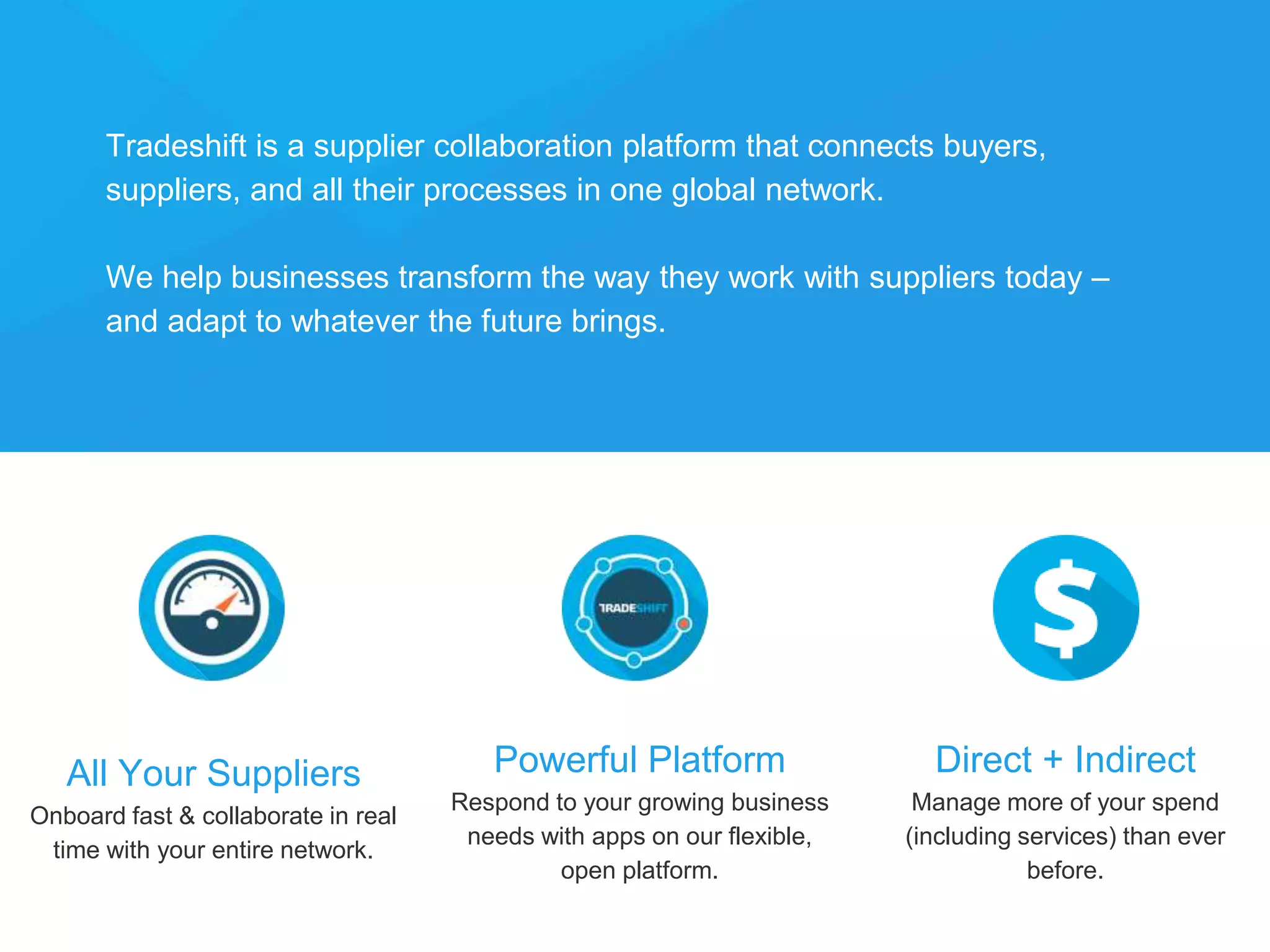
Tradeshift is a supplier collaboration platform that connects buyers,
suppliers, and all their processes in one global network.
We help businesses transform the way they work with suppliers today –
and adapt to whatever the future brings.
All Your Suppliers
Onboard fast & collaborate in real
time with your entire network.
Powerful Platform
Respond to your growing business
needs with apps on our flexible,
open platform.
Direct + Indirect
Manage more of your spend
(including services) than ever
before.
May 19th, 2015
Amy Fong
P2P Program Leader
Best practices and metrics for
next generation P2P
Sponsored By
11© 2015 The Hackett Group, Inc. All rights reserved. Reproduction of this document or any portion thereof without prior written consent is prohibited.
Agenda
 Hackett Group
Introduction
 Top Performance
Defined
 Key Capability
Enablers
 Summary
12© 2015 The Hackett Group, Inc. All rights reserved. Reproduction of this document or any portion thereof without prior written consent is prohibited.
The Hackett Group – Introduction
Lifecycle support bringing intellectual capital and seasoned practitioners to yield sustainable
benefits
 We are the global leader in operations
improvement strategies, implementation know-
how, and G&A agility
 We address both efficiency and effectiveness
improvements to enable strategic business
objectives
 Our insights are fact based, from over 7,500
performance improvement consulting
engagements
 Our Best Practices Intelligence Center™ is a
significant differentiator and enabler. It contains:
– 20,000+ performance metrics updated annually
– 1,500+ best practices across 95 business processes
– 1,000+ best practice-based process maps,
requirements and configuration guides
– 1,000+ case studies, implementation examples and
research
 We deliver results through a global team of senior
practitioners using a consistent methodology and
best practice-based toolset
Hackett Value Grid™
We help companies
establish and implement
business performance
improvements.
13© 2015 The Hackett Group, Inc. All rights reserved. Reproduction of this document or any portion thereof without prior written consent is prohibited.
Enabling World-Class: Hackett’s Solution Portfolio
Benchmarking, Advisory, Business Transformation
Membership Advisory
Insight into World-Class Performance
Benchmarking
Assess World-Class Performance
Business Transformation Consulting
Transforms Performance
Deliverables
 Peer & world-class comparison
performance metrics
 Detailed analysis
 Stakeholder survey
 Executive presentation
Benefits
 Objective comparison to peer
group and world-class performers
 Quantify performance gaps
 Uncover hidden costs
 Prioritization of improvement
initiatives
Deliverables
 Strategic direction
 Detailed business case
 Initiative plans & detailed
designs
 Implementation of best practices
Benefits
 Reduced cost
 Working capital optimization
 Enhanced service delivery
 Business insight
 Sustainable benefits
 Speed of solution delivery
 Merger integration
 Risk mitigation
Deliverables
 Best practice research
 Advisor access
 Best Practice Intelligence Center
 Peer interaction
 World-Class Progress Report
Benefits
 Identify the strategies and
practices employed by Leaders
 Validation of current initiatives
 Determining what’s possible
(World-Class Performance
Metrics)
 Process implementation support
 Continuous best practice
adoption
14© 2015 The Hackett Group, Inc. All rights reserved. Reproduction of this document or any portion thereof without prior written consent is prohibited.
Agenda
 Hackett Group
Introduction
 Top Performance
Defined
 Key Capability
Enablers
 Summary
15© 2015 The Hackett Group, Inc. All rights reserved. Reproduction of this document or any portion thereof without prior written consent is prohibited.
The Purchase to Pay Process is often under appreciated as a
source of business value by both Finance and Procurement
Hackett Purchase to Pay Value Grid™
Example of Effectiveness Drivers
 First Pass Match Rate
 On Time Payment Rate
 Level of Spend Visibility
 Streamlined Transaction
Strategy
 Level of Centralization
 Training Investment
 Compliance to Preferred
Suppliers
 Guided Buying Effectiveness
 Supply Base Consolidation
Example of Efficiency Drivers
 Cost per Transaction
 Transactions per FTE
 Span of Control
 Order Cycle Time
 Invoice Processing Cycle
Time
 Percent of Electronic
Transactions
 Level of Automation
Supplier
Master Mgmt
Verification
and Approval
Invoice
Pre-
Processing
Invoice
Processing
Discrepancy
Resolution
Supplier
Payment
Customer
Inquiry and
Response
File, Store, &
Retrieve
Reconciliation,
Accrual and
Compliance
Purchasing Operations
Accounts Payable
End-to-End Purchase to Pay Process
Requisition &
PO
Processing
Supplier
Scheduling
Receipt
Processing
Item Master/
Content Mgmt
Catalog Mgmt
Contract
Master Mgmt
Pcard
Management
16© 2015 The Hackett Group, Inc. All rights reserved. Reproduction of this document or any portion thereof without prior written consent is prohibited.
AP Top Performers have 62% lower costs per invoice, and are
significantly more productive in processing invoices
$3.85
$1.46
$1.20
$0.35
$0.49
$0.24
Total Cost ($) per Invoice
Other
Technology
Process Costs*
$ 5.54
$ 2.06
Peer Top Performer
*Process Costs include Labor and Outsourcing Costs
Cycle time for PO Invoices
(from receipt to approval)
7
5
Peer Top Performer
*Cycle time for Non-PO invoices is 10 days for Peers and 7
days for Top Performers
Source: Hackett P2P Study
17© 2015 The Hackett Group, Inc. All rights reserved. Reproduction of this document or any portion thereof without prior written consent is prohibited.
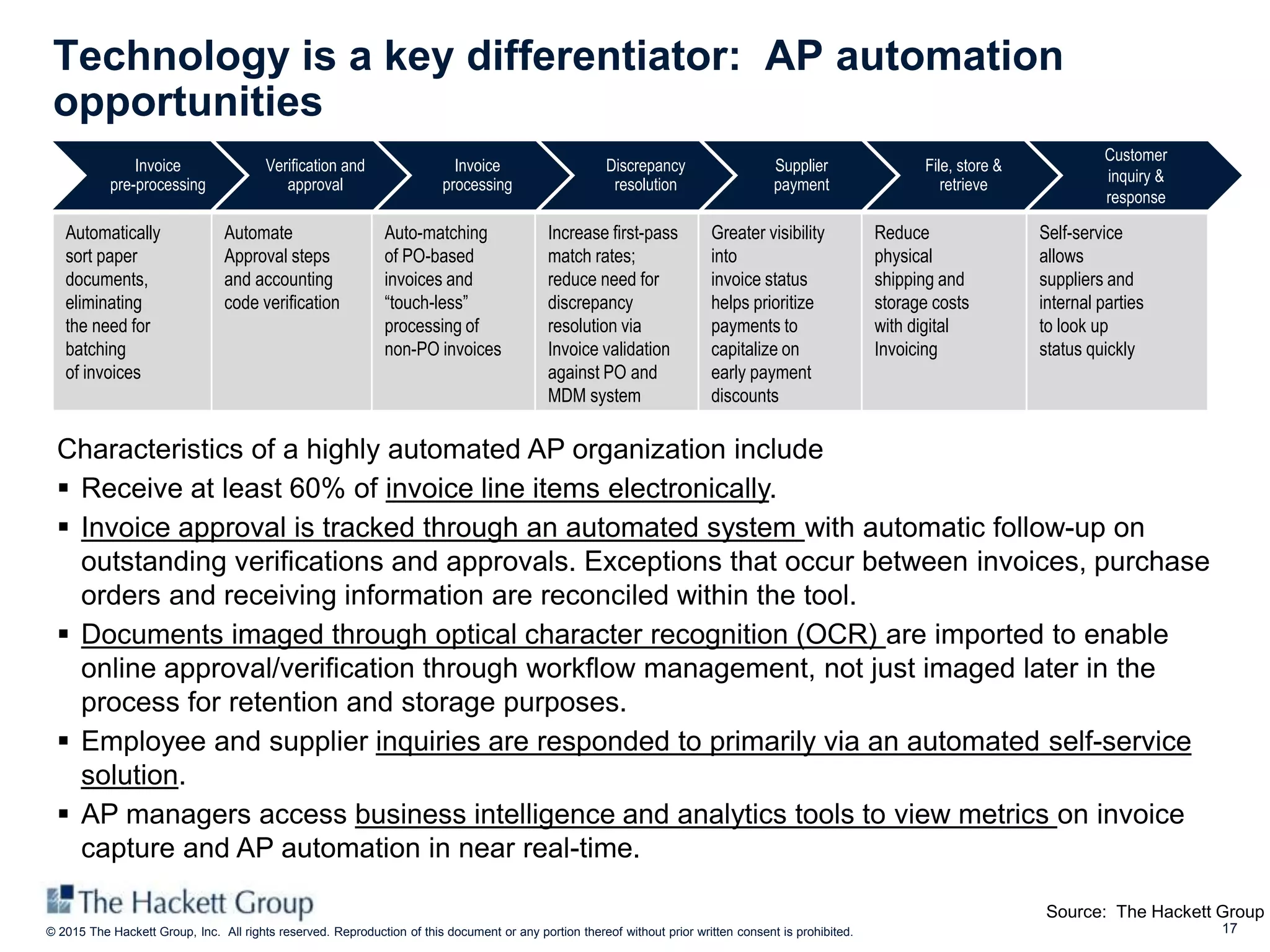
Invoice
pre-processing
Verification and
approval
Invoice
processing
Discrepancy
resolution
Supplier
payment
File, store &
retrieve
Customer
inquiry &
response
Automatically
sort paper
documents,
eliminating
the need for
batching
of invoices
Automate
Approval steps
and accounting
code verification
Auto-matching
of PO-based
invoices and
“touch-less”
processing of
non-PO invoices
Increase first-pass
match rates;
reduce need for
discrepancy
resolution via
Invoice validation
against PO and
MDM system
Greater visibility
into
invoice status
helps prioritize
payments to
capitalize on
early payment
discounts
Reduce
physical
shipping and
storage costs
with digital
Invoicing
Self-service
allows
suppliers and
internal parties
to look up
status quickly
Source: The Hackett Group
Technology is a key differentiator: AP automation
opportunities
Characteristics of a highly automated AP organization include
 Receive at least 60% of invoice line items electronically.
 Invoice approval is tracked through an automated system with automatic follow-up on
outstanding verifications and approvals. Exceptions that occur between invoices, purchase
orders and receiving information are reconciled within the tool.
 Documents imaged through optical character recognition (OCR) are imported to enable
online approval/verification through workflow management, not just imaged later in the
process for retention and storage purposes.
 Employee and supplier inquiries are responded to primarily via an automated self-service
solution.
 AP managers access business intelligence and analytics tools to view metrics on invoice
capture and AP automation in near real-time.
18© 2015 The Hackett Group, Inc. All rights reserved. Reproduction of this document or any portion thereof without prior written consent is prohibited.
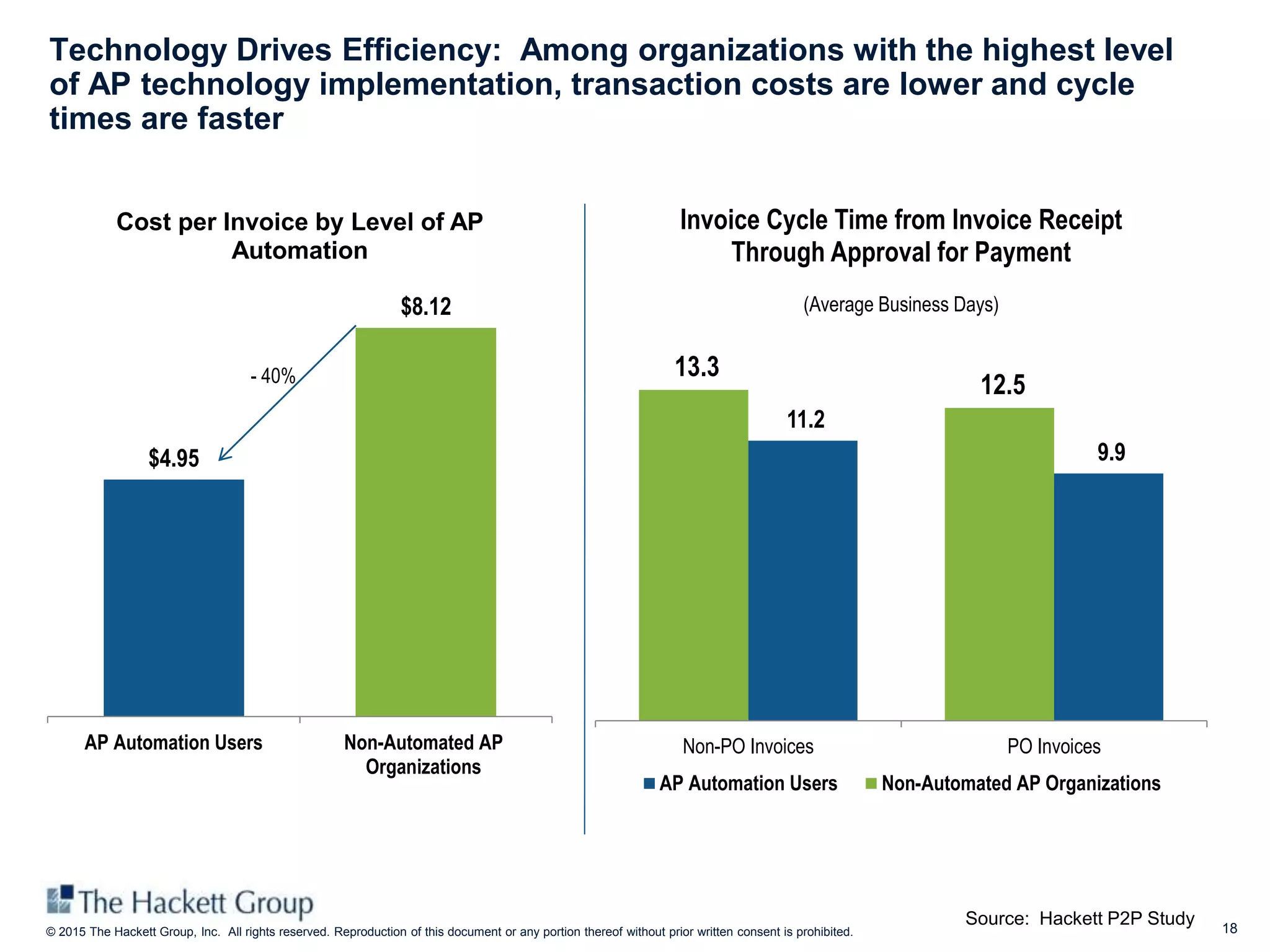
Technology Drives Efficiency: Among organizations with the highest level
of AP technology implementation, transaction costs are lower and cycle
times are faster
$4.95
$8.12
AP Automation Users Non-Automated AP
Organizations
Cost per Invoice by Level of AP
Automation
9.9
11.2
12.5
13.3
PO InvoicesNon-PO Invoices
Invoice Cycle Time from Invoice Receipt
Through Approval for Payment
(Average Business Days)
AP Automation Users Non-Automated AP Organizations
- 40%
Source: Hackett P2P Study
19© 2015 The Hackett Group, Inc. All rights reserved. Reproduction of this document or any portion thereof without prior written consent is prohibited.
Value drivers for Purchase-to-Pay
 Drive greater adoption to preferred supplier contracts
 Reduce supplier non-compliance process errors
 Improve focus on demand management
 Improve strategic sourcing effectiveness through greater spend visibility
 Support working capital objectives through DPO optimization
 Achieve greater early payment discounts
 Drive greater rebates from purchasing card usage
 Improve P2P process efficiency
20© 2015 The Hackett Group, Inc. All rights reserved. Reproduction of this document or any portion thereof without prior written consent is prohibited.
Which
capabilities
differentiate Top
Performers?
 Guiding Requisitioners
 Process Automation
 Spend Visibility
 Supplier Information
Management
Guiding
Requisitioners
22© 2015 The Hackett Group, Inc. All rights reserved. Reproduction of this document or any portion thereof without prior written consent is prohibited.
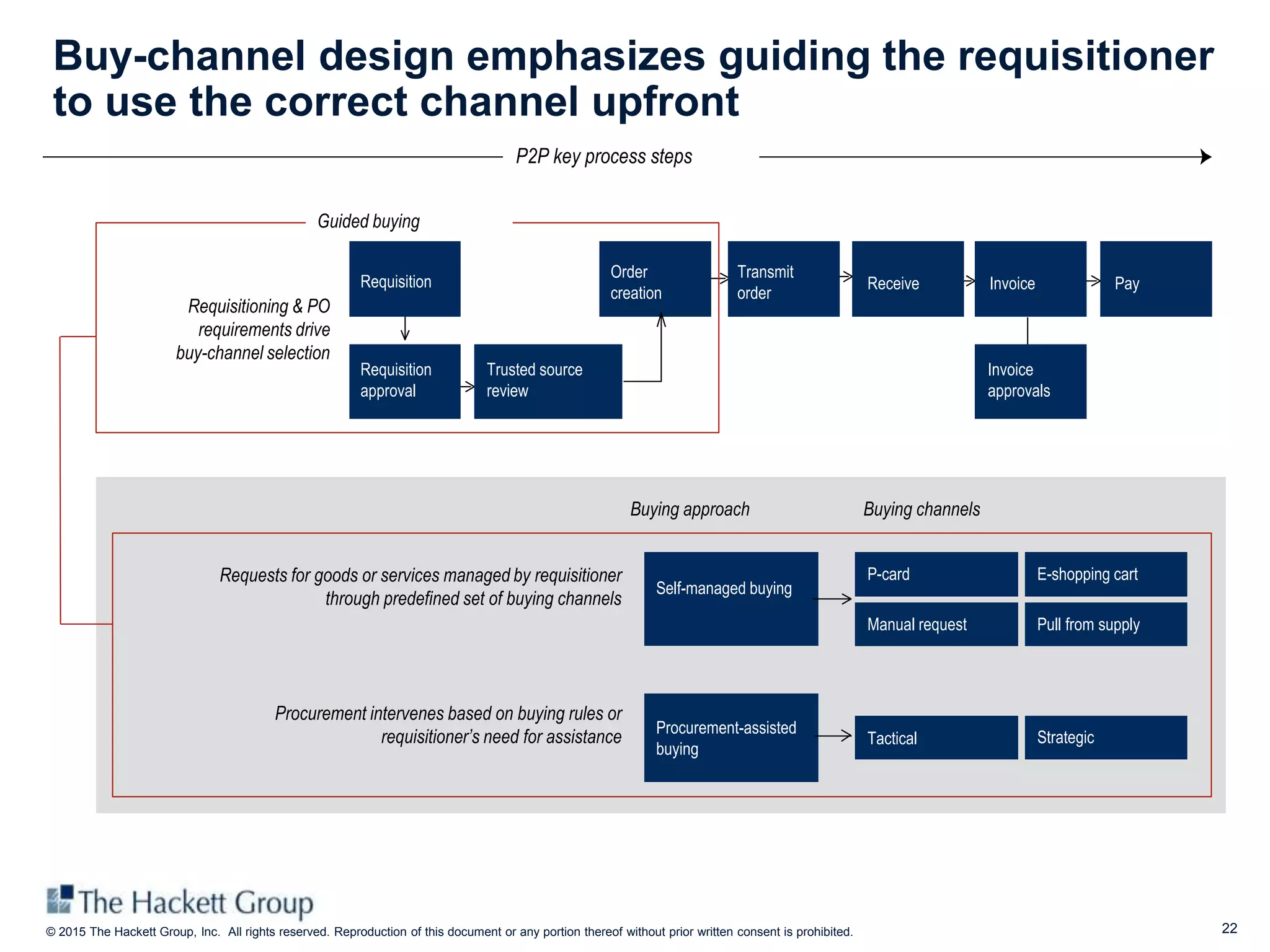
Buy-channel design emphasizes guiding the requisitioner
to use the correct channel upfront
P2P key process steps
Guided buying
Buying approach Buying channels
Requisitioning & PO
requirements drive
buy-channel selection
Requisition
Order
creation
Transmit
order
Receive Invoice Pay
Requisition
approval
Trusted source
review
Invoice
approvals
Self-managed buying
P-card E-shopping cart
Manual request Pull from supply
Procurement-assisted
buying
Tactical Strategic
Requests for goods or services managed by requisitioner
through predefined set of buying channels
Procurement intervenes based on buying rules or
requisitioner’s need for assistance
23© 2015 The Hackett Group, Inc. All rights reserved. Reproduction of this document or any portion thereof without prior written consent is prohibited.
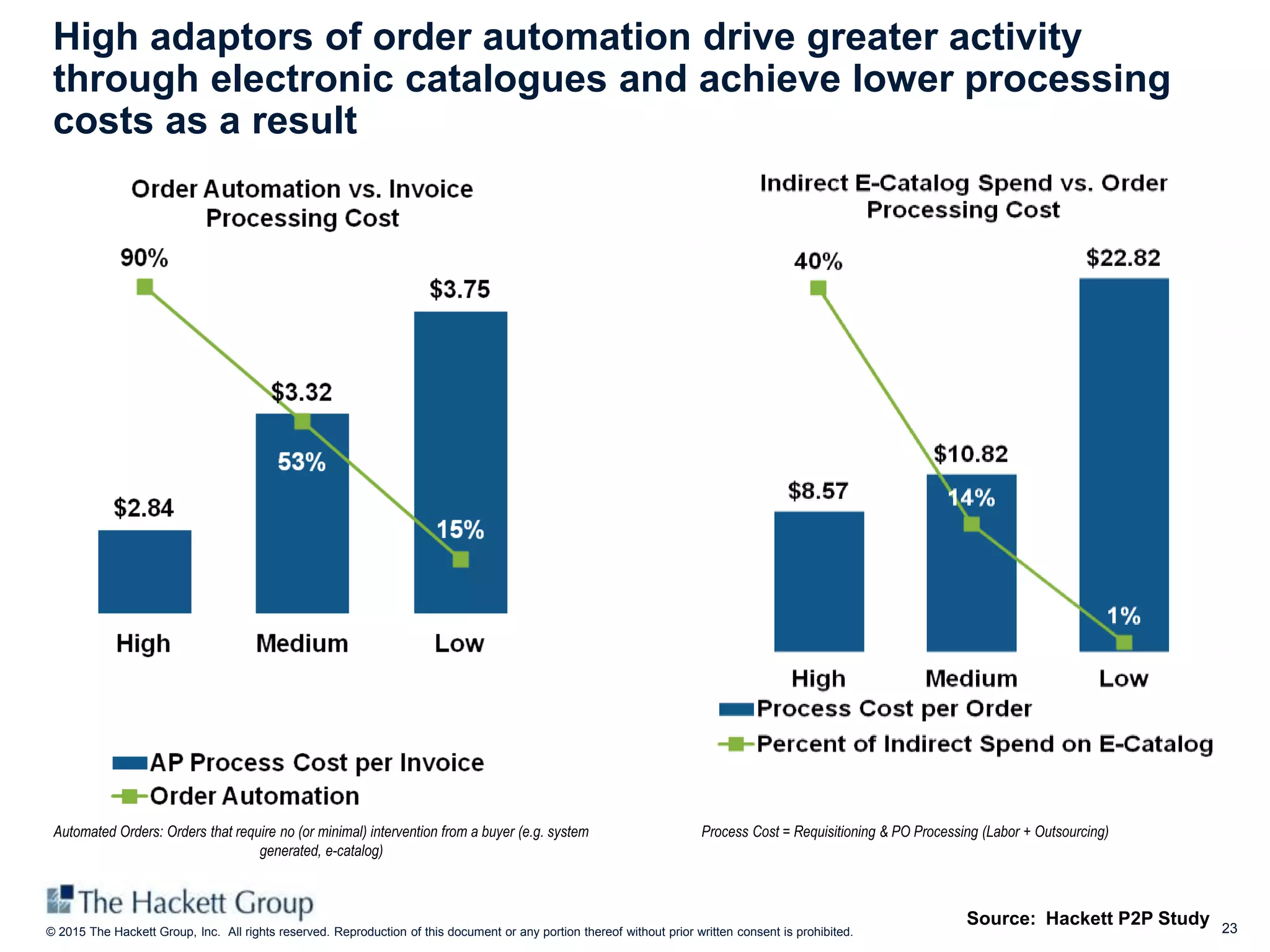
High adaptors of order automation drive greater activity
through electronic catalogues and achieve lower processing
costs as a result
Automated Orders: Orders that require no (or minimal) intervention from a buyer (e.g. system
generated, e-catalog)
Process Cost = Requisitioning & PO Processing (Labor + Outsourcing)
Source: Hackett P2P Study
24© 2015 The Hackett Group, Inc. All rights reserved. Reproduction of this document or any portion thereof without prior written consent is prohibited.
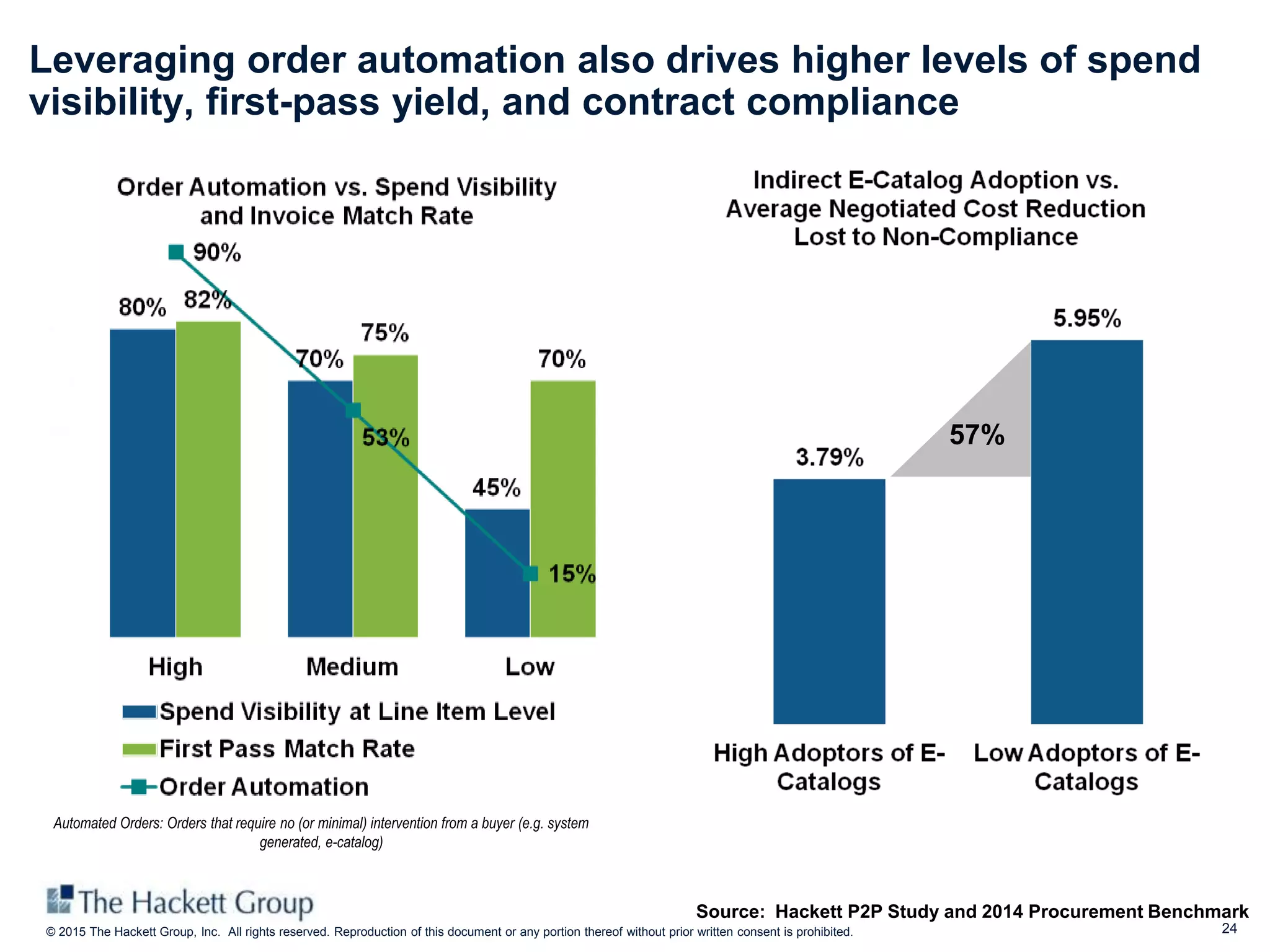
Leveraging order automation also drives higher levels of spend
visibility, first-pass yield, and contract compliance
57%
Automated Orders: Orders that require no (or minimal) intervention from a buyer (e.g. system
generated, e-catalog)
Source: Hackett P2P Study and 2014 Procurement Benchmark
25© 2015 The Hackett Group, Inc. All rights reserved. Reproduction of this document or any portion thereof without prior written consent is prohibited.
Increased catalog use depends heavily on interface
 Develop Easy to Use Interface
– Use friendly means easy to create and submit requisitions in just a few clicks
 Self-guiding search offers targeted results for self-service users
– Advanced search for attribute specific criteria
– Control catalogue access to users based on needs and usage
 Enable productivity enhancement tools to minimize data entry
– Shopping lists (Favorite and Public)
– Saved shopping carts
 Vendor-agnostic search
– Free text searches that cross multiple vendor catalogs are easiest for users
26© 2015 The Hackett Group, Inc. All rights reserved. Reproduction of this document or any portion thereof without prior written consent is prohibited.
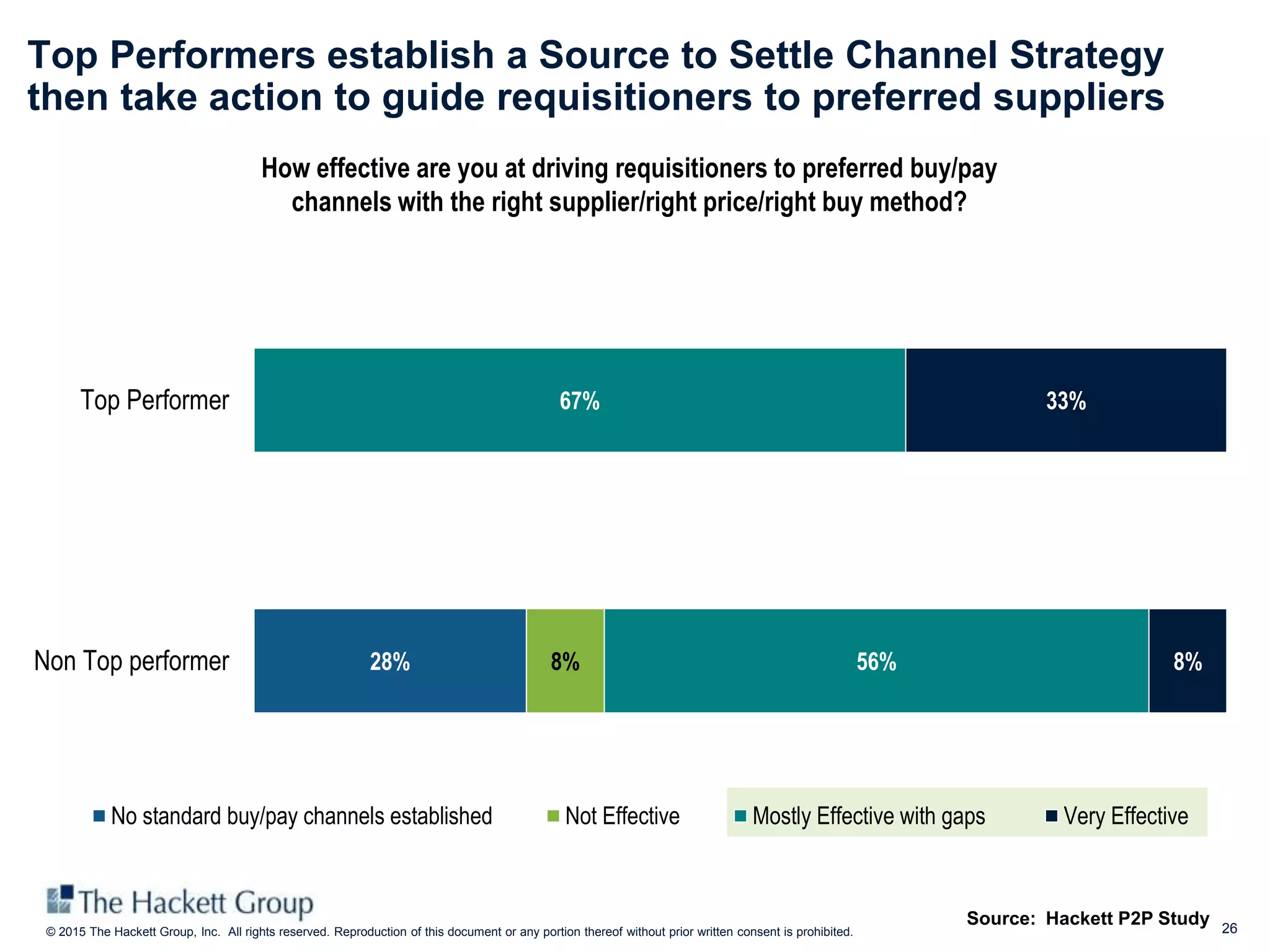
Top Performers establish a Source to Settle Channel Strategy
then take action to guide requisitioners to preferred suppliers
28% 8% 56%
67%
8%
33%
Non Top performer
Top Performer
No standard buy/pay channels established Not Effective Mostly Effective with gaps Very Effective
How effective are you at driving requisitioners to preferred buy/pay
channels with the right supplier/right price/right buy method?
Source: Hackett P2P Study
27© 2015 The Hackett Group, Inc. All rights reserved. Reproduction of this document or any portion thereof without prior written consent is prohibited.
Four required capabilities for enabling guided buying
Source: The Hackett Group
1. Enable self-service buying
 Predefined channels that put buying in the hands of the requisitioner
 Comprehensive company “marketplace” to guide the buying experience
 Procurement-enabled buying capabilities
2. Deploy easy-to-use tools
 Single point of entry to initiate self-managed requisitioning
 Standard, common “shopping cart” experience that streamlines and automates buying
 Decision support tools that guide buying requirements by spend type
3. Build a base of approved, trusted suppliers
 Predefined trusted suppliers for recurring purchases of goods and services
 Automated selection of the right supplier
 Compliant buying enabled and negotiated savings realized
4. Provide professional buyer help when needed
 Easy link to professional buyer via company buying desk
 Automated assistance based on system-managed buying rules
 Automated compliance triggers to help buyer make the correct choice
Invoice Automation
29© 2015 The Hackett Group, Inc. All rights reserved. Reproduction of this document or any portion thereof without prior written consent is prohibited.
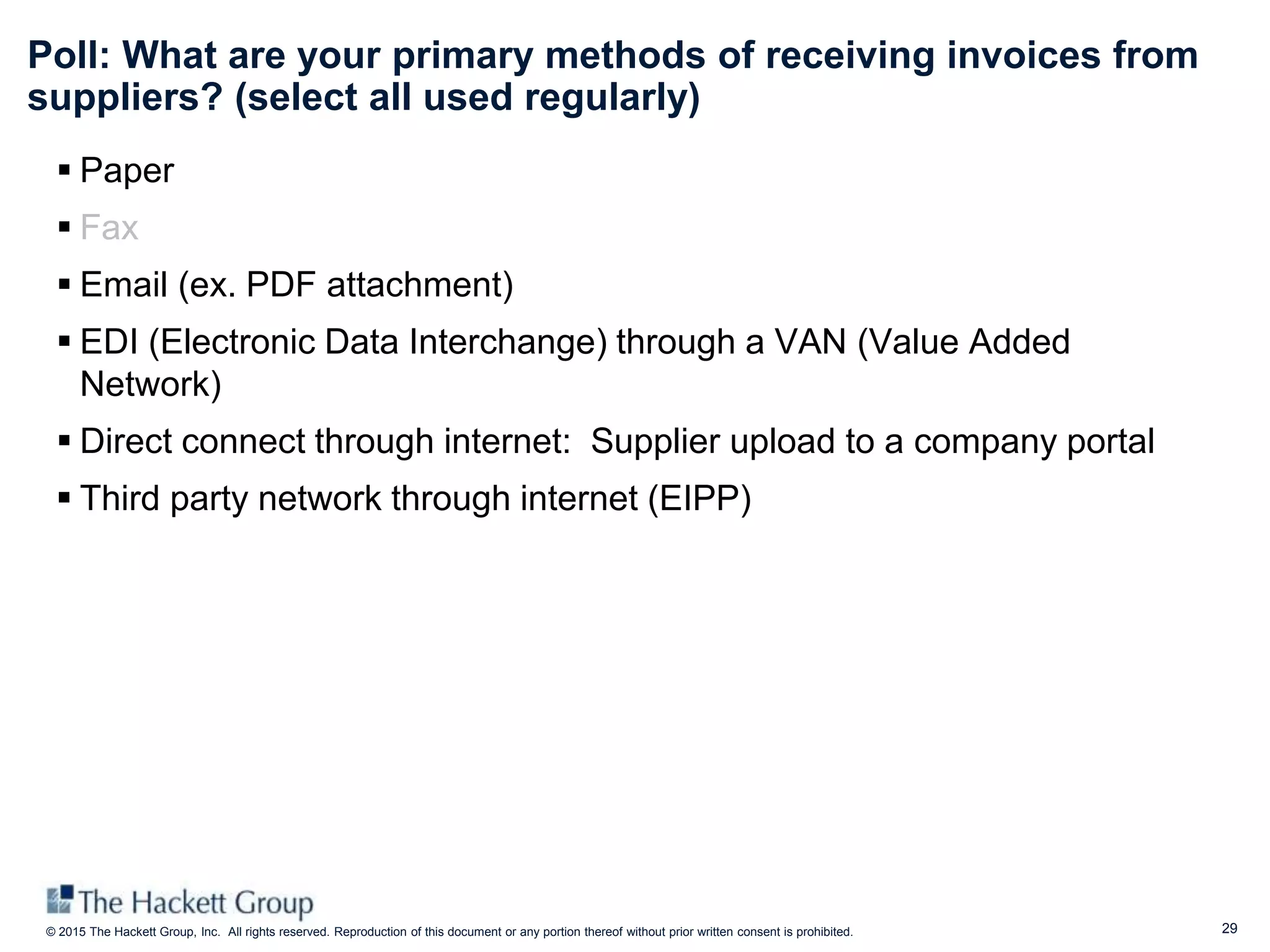
Poll: What are your primary methods of receiving invoices from
suppliers? (select all used regularly)
 Paper
 Fax
 Email (ex. PDF attachment)
 EDI (Electronic Data Interchange) through a VAN (Value Added
Network)
 Direct connect through internet: Supplier upload to a company portal
 Third party network through internet (EIPP)
30© 2015 The Hackett Group, Inc. All rights reserved. Reproduction of this document or any portion thereof without prior written consent is prohibited.
Invoice Automation
Advanced Invoice
Processing
Electronic
Invoicing
Supplier Portal
Third-Party
Network
EDI (via VAN)
File Upload /
Self Entry
PO Flip
Invoice Capture
Scan-based
Fax-based
Email-based
Invoice Elimination
Evaluated Receipt
Settlement (ERS)
Purchasing Card
(P-card)
"Invoice automation" can refer to any solution that is designed to
mitigate the inefficiency of traditional paper invoice processing.
Invoice is received in an
electronic format from
the supplier enabling
automated data entry
Invoice is not received from the
supplier
Invoice is received in
a non-electronic
format and/or requires
manual intervention
for data entry
 In practice, nearly 60% of all invoice line-items are still
received on paper
 The latest generation of imaging technology is
sometimes referred to as intelligent data capture (IDC),
advanced recognition (AR) or intelligent document
recognition (IDR) in Hackett research and elsewhere.
 Invoice capture includes imaging of a physical document
(transmitted via mail, fax, email), enhanced recognition of
the image, extraction and validation of digital
information, and workflow connectivity with downstream
systems
31© 2015 The Hackett Group, Inc. All rights reserved. Reproduction of this document or any portion thereof without prior written consent is prohibited.
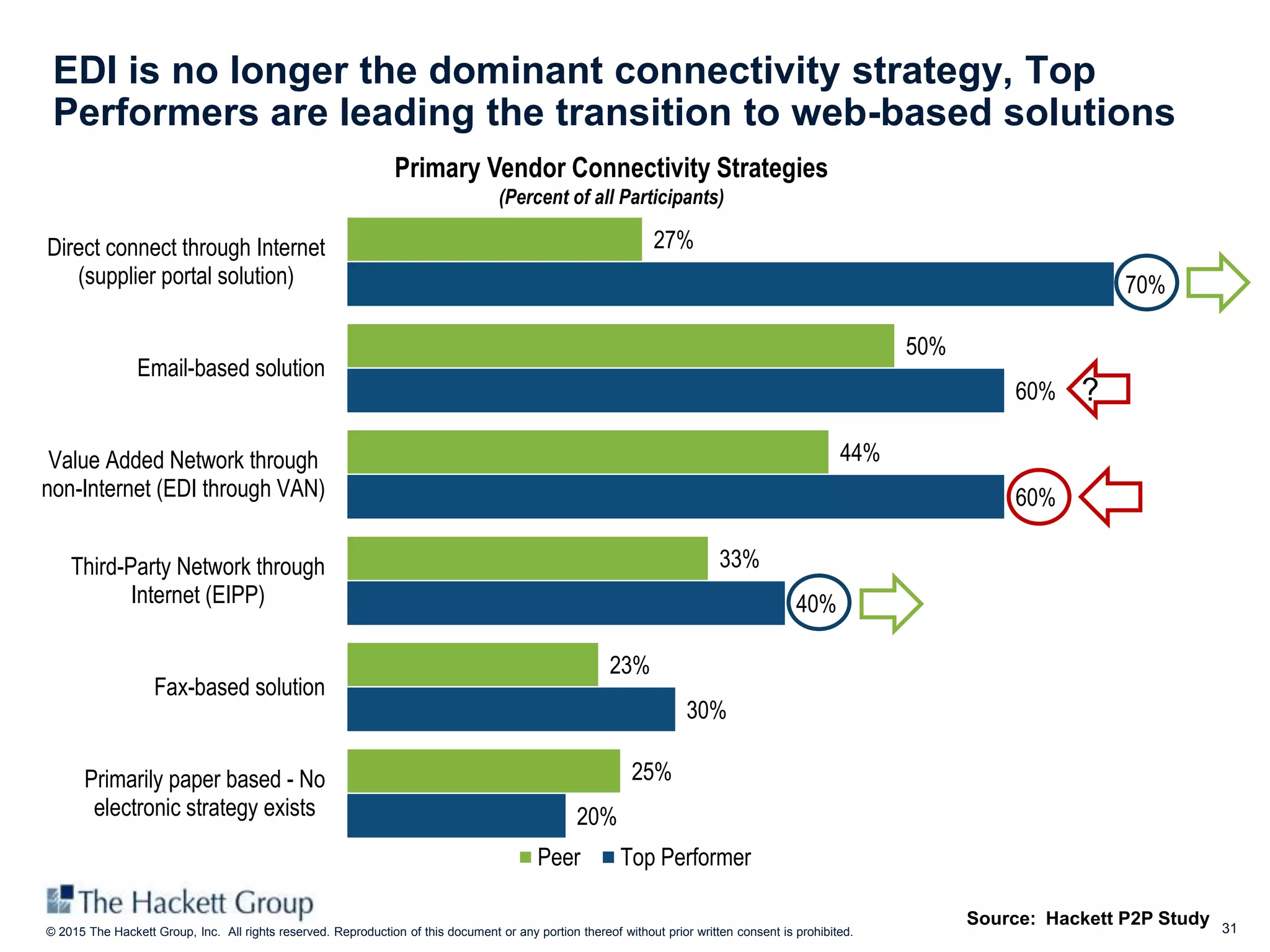
27%
50%
44%
33%
23%
25%
70%
60%
60%
40%
30%
20%
Direct connect through Internet
(supplier portal solution)
Email-based solution
Value Added Network through
non-Internet (EDI through VAN)
Third-Party Network through
Internet (EIPP)
Fax-based solution
Primarily paper based - No
electronic strategy exists
Peer Top Performer
EDI is no longer the dominant connectivity strategy, Top
Performers are leading the transition to web-based solutions
Primary Vendor Connectivity Strategies
(Percent of all Participants)
Source: Hackett P2P Study
?
32© 2015 The Hackett Group, Inc. All rights reserved. Reproduction of this document or any portion thereof without prior written consent is prohibited.
Organizations benefit significantly from e-Invoicing - in efficiency
and effectiveness
Invoice per Accounts Payable FTE
1 Based on organizations with high percentage of transactions through dominate strategy
20,314
9,484
7,459
E-invoicing Invoice Capture and Imaging
& Workflow
Paper
Difficulty of Enablement
Source: Hackett P2P Study
33© 2015 The Hackett Group, Inc. All rights reserved. Reproduction of this document or any portion thereof without prior written consent is prohibited.
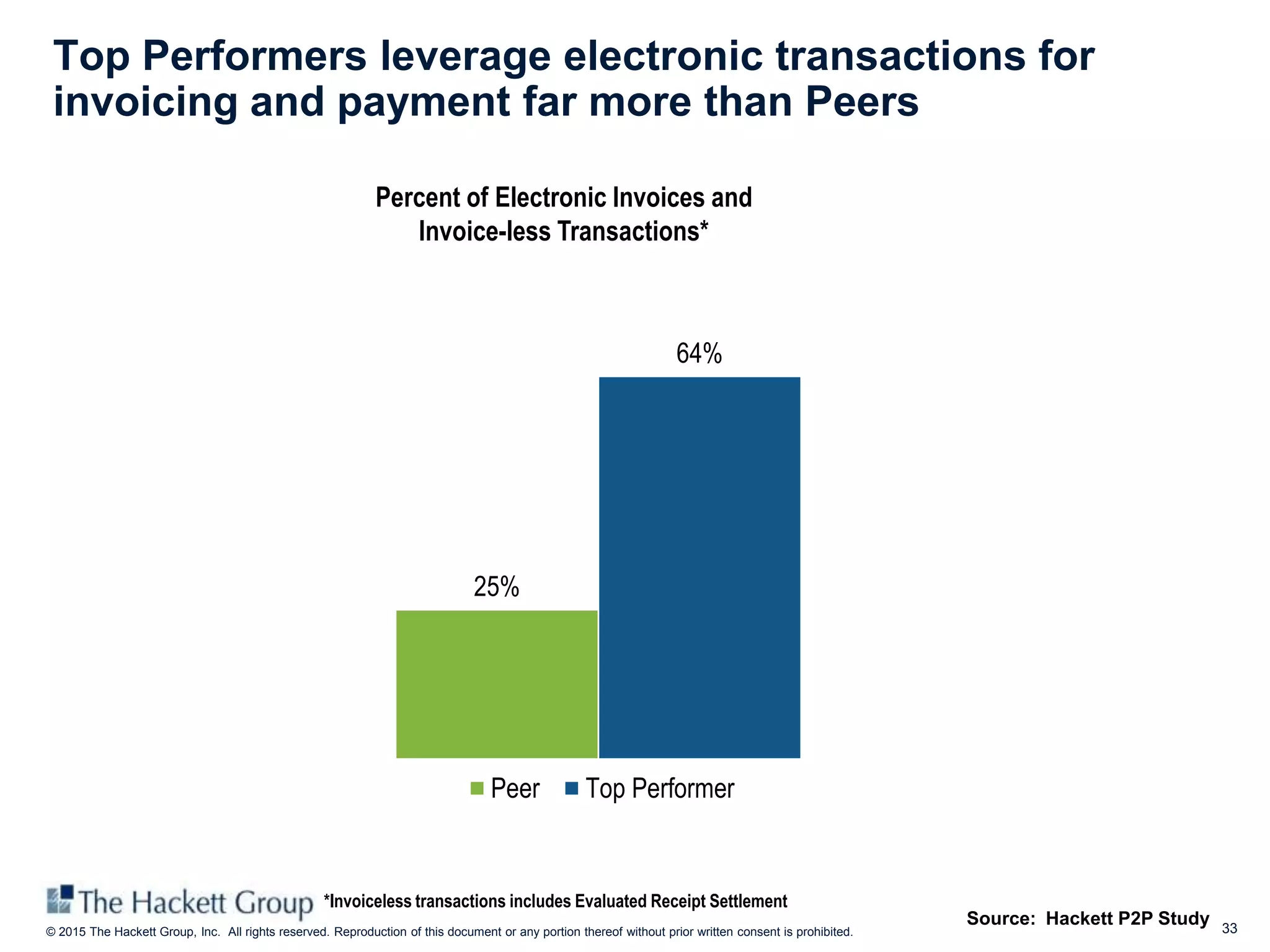
Top Performers leverage electronic transactions for
invoicing and payment far more than Peers
Percent of Electronic Invoices and
Invoice-less Transactions*
25%
64%
Peer Top Performer
*Invoiceless transactions includes Evaluated Receipt Settlement
Source: Hackett P2P Study
Spend Visibility
35© 2015 The Hackett Group, Inc. All rights reserved. Reproduction of this document or any portion thereof without prior written consent is prohibited.
Poll: For what percent of spend do you have complete visibility
to supplier, spend category and line item level detail
 0-20%
 21-40%
 41-60%
 61-80%
 81-100%
36© 2015 The Hackett Group, Inc. All rights reserved. Reproduction of this document or any portion thereof without prior written consent is prohibited.
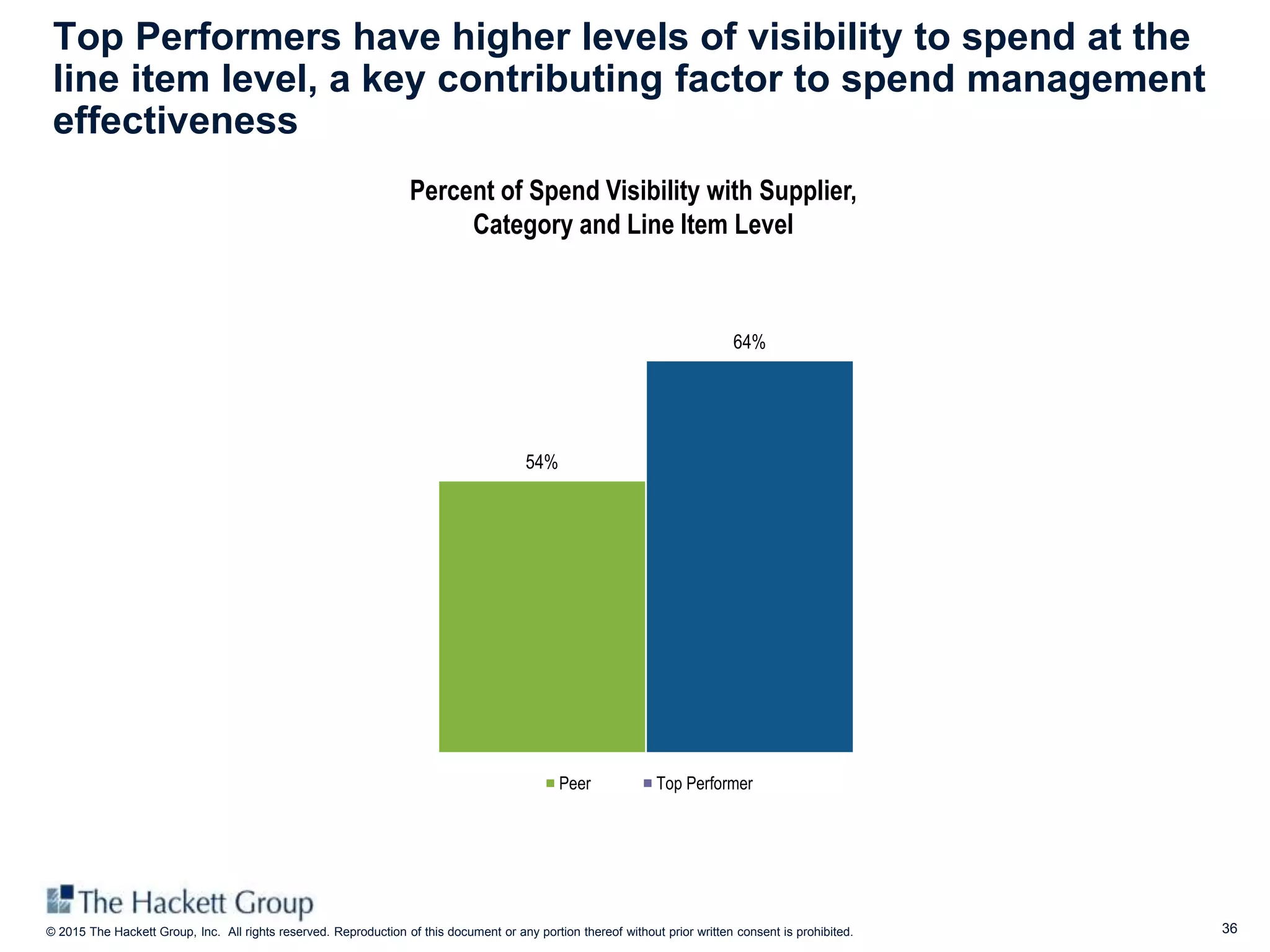
Top Performers have higher levels of visibility to spend at the
line item level, a key contributing factor to spend management
effectiveness
Percent of Spend Visibility with Supplier,
Category and Line Item Level
54%
64%
Peer Top Performer
37© 2015 The Hackett Group, Inc. All rights reserved. Reproduction of this document or any portion thereof without prior written consent is prohibited.
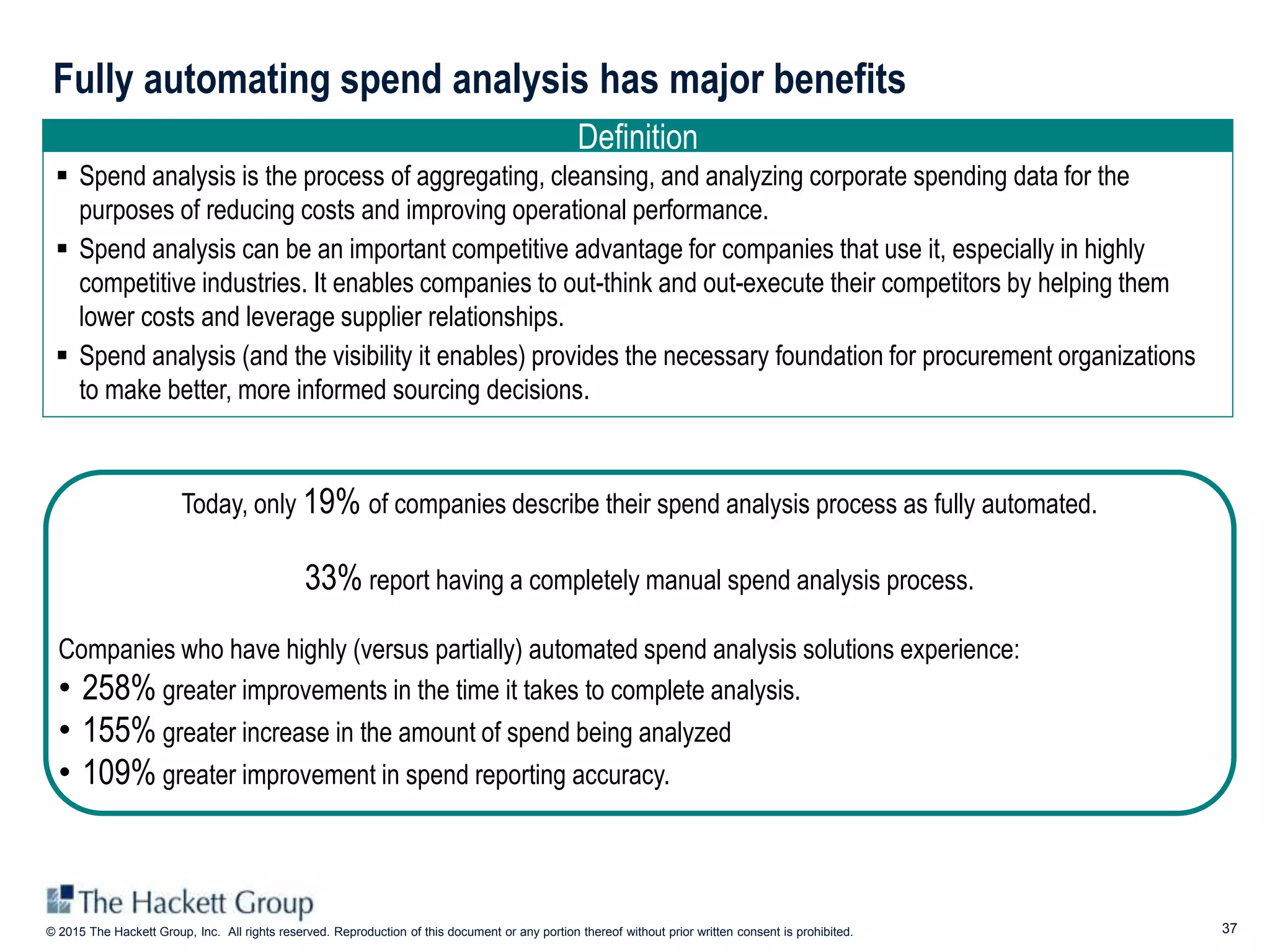
Fully automating spend analysis has major benefits
Today, only 19% of companies describe their spend analysis process as fully automated.
33% report having a completely manual spend analysis process.
Companies who have highly (versus partially) automated spend analysis solutions experience:
• 258% greater improvements in the time it takes to complete analysis.
• 155% greater increase in the amount of spend being analyzed
• 109% greater improvement in spend reporting accuracy.
 Spend analysis is the process of aggregating, cleansing, and analyzing corporate spending data for the
purposes of reducing costs and improving operational performance.
 Spend analysis can be an important competitive advantage for companies that use it, especially in highly
competitive industries. It enables companies to out-think and out-execute their competitors by helping them
lower costs and leverage supplier relationships.
 Spend analysis (and the visibility it enables) provides the necessary foundation for procurement organizations
to make better, more informed sourcing decisions.
Definition
38© 2015 The Hackett Group, Inc. All rights reserved. Reproduction of this document or any portion thereof without prior written consent is prohibited.
Requisition
1
Order
2
Receive
3
 Complete purchase order form
(either paper or electronic)
based on approved Requisition
 Route PO to appropriate
management authority for
approval (Requestor should be
different from individual
ordering)
 Route order to supplier (either
electronically via EDI or via fax)
 Confirm receipt of PO with
supplier
 Process received goods
or acknowledge
completion of services
 Communicate receipt of
goods or services to AP
for processing
 Complete requisition
form (either paper or
electronic)
 Route requisition form to
appropriate management
level for approval
 Route requisition to
Procurement for
processing
Pay
4
 Receive invoice from
supplier
 Check invoice for
accuracy
 Perform match (either
two-way or three-way)
 Take discount
 Send payment to
suppliers either
electronically or via paper
check
Manage
5
 Conduct spend analysis
to check contract
compliance and
continuous sourcing
 Review supplier
performance
 Manage discounts and
rebates
 Assess overall contract
compliance
Spend Visibility Benefits to the Procure to Pay Process
Effective spend analysis creates improvements at almost every stage of the procure-to-pay process:
Introduction
 Results in list of
approved vendors
which streamlines
requisition process
 Identify and reduce
non-compliant or
“maverick” spend
 Reduces financial
savings leakage by
driving compliance to
negotiated contracts
 Increased visibility into
enterprise-wide spend
and improvements in
reporting capabilities
Visibility into spend enables the management of expenditures and ongoing spend efficiencies
Benefits of spend analysis
39© 2015 The Hackett Group, Inc. All rights reserved. Reproduction of this document or any portion thereof without prior written consent is prohibited.
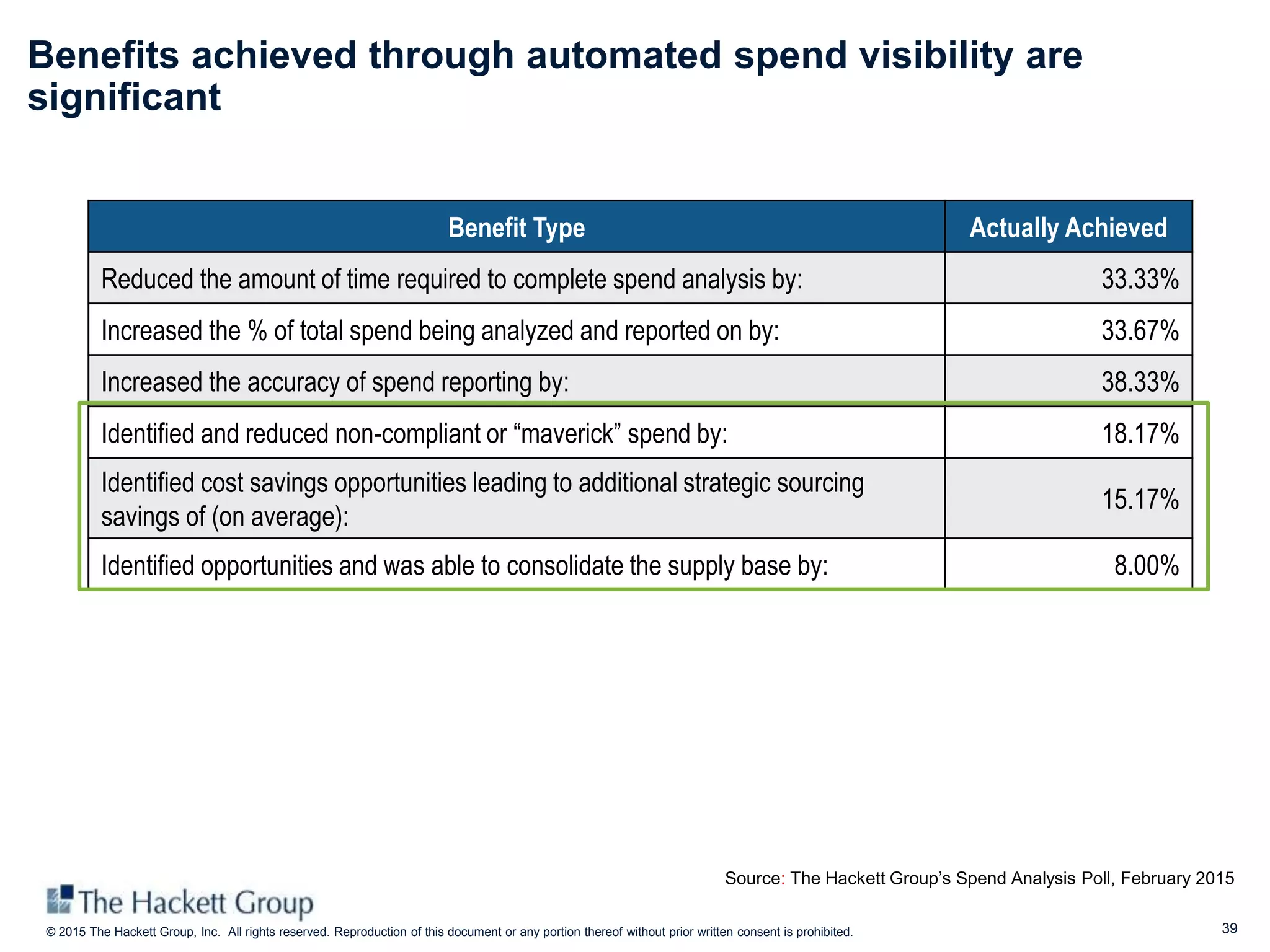
Benefits achieved through automated spend visibility are
significant
Benefit Type Actually Achieved
Reduced the amount of time required to complete spend analysis by: 33.33%
Increased the % of total spend being analyzed and reported on by: 33.67%
Increased the accuracy of spend reporting by: 38.33%
Identified and reduced non-compliant or “maverick” spend by: 18.17%
Identified cost savings opportunities leading to additional strategic sourcing
savings of (on average):
15.17%
Identified opportunities and was able to consolidate the supply base by: 8.00%
Source: The Hackett Group’s Spend Analysis Poll, February 2015
40© 2015 The Hackett Group, Inc. All rights reserved. Reproduction of this document or any portion thereof without prior written consent is prohibited.
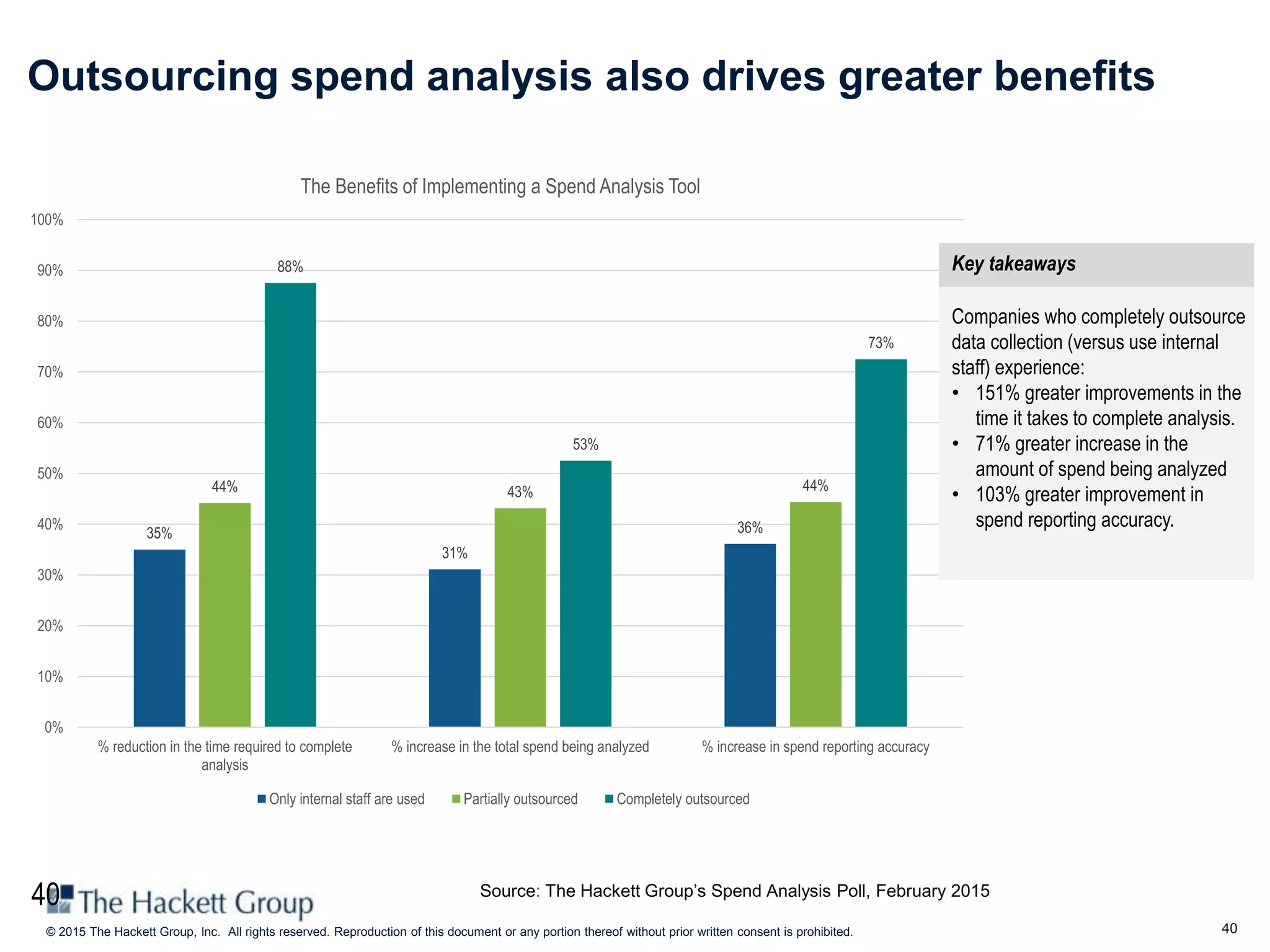
Outsourcing spend analysis also drives greater benefits
40
35%
31%
36%
44% 43% 44%
88%
53%
73%
0%
10%
20%
30%
40%
50%
60%
70%
80%
90%
100%
% reduction in the time required to complete
analysis
% increase in the total spend being analyzed % increase in spend reporting accuracy
The Benefits of Implementing a Spend Analysis Tool
Only internal staff are used Partially outsourced Completely outsourced
Key takeaways
Companies who completely outsource
data collection (versus use internal
staff) experience:
• 151% greater improvements in the
time it takes to complete analysis.
• 71% greater increase in the
amount of spend being analyzed
• 103% greater improvement in
spend reporting accuracy.
Source: The Hackett Group’s Spend Analysis Poll, February 2015
Supplier Information
Management
42© 2015 The Hackett Group, Inc. All rights reserved. Reproduction of this document or any portion thereof without prior written consent is prohibited.
Poll: Which of the following supplier facing activities does your
current technology infrastructure support?
 Setup of supplier payment data
 Setup of supplier terms and conditions
 Supplier financial screenings
 Tracking of supply chain locations
 Automated checks against third party databases (ex. FCPA, OFAC)
 Pre-qualification of new suppliers
 Performance management
 Risk management
43© 2015 The Hackett Group, Inc. All rights reserved. Reproduction of this document or any portion thereof without prior written consent is prohibited.
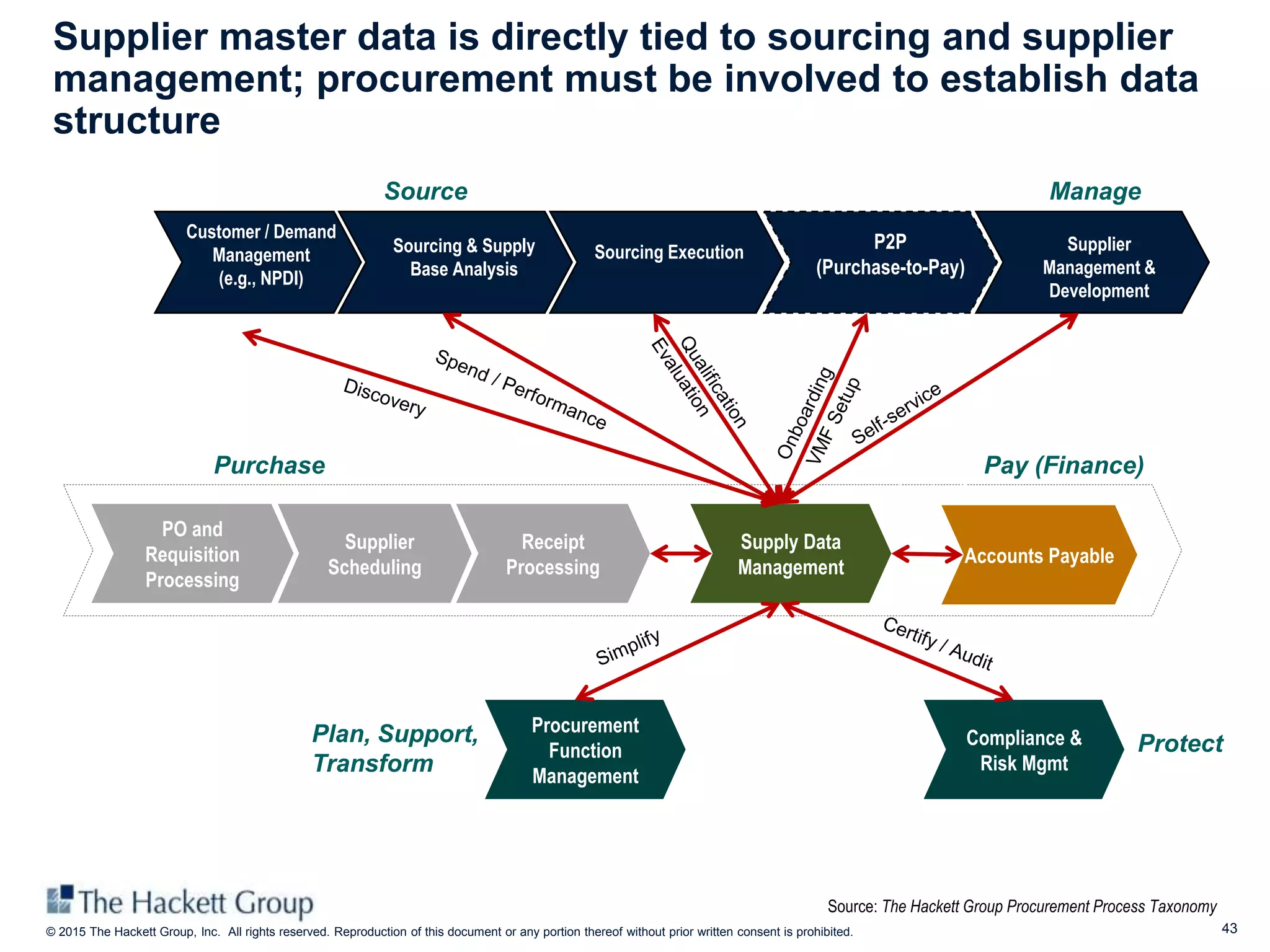
Supplier master data is directly tied to sourcing and supplier
management; procurement must be involved to establish data
structure
Sourcing & Supply
Base Analysis
Invoice &
Payment
ProcessingPO and
Requisition
Processing
Supplier
Scheduling
Supply Data
Management
Receipt
Processing
Accounts Payable
Sourcing Execution Supplier
Management &
Development
Customer / Demand
Management
(e.g., NPDI)
Procurement
Function
Management
Compliance &
Risk Mgmt
P2P
(Purchase-to-Pay)
Pay (Finance)Purchase
Source Manage
Plan, Support,
Transform
Protect
Source: The Hackett Group Procurement Process Taxonomy
44© 2015 The Hackett Group, Inc. All rights reserved. Reproduction of this document or any portion thereof without prior written consent is prohibited.
Leaders are Evolving their SIM Capabilities
Vendor Master File
Focused primarily on
ERP/e-Procurement
fields needed to place
POs, pay invoices, and
analyze spend
Supplier Information
Management (SIM)
Organizing and managing
all key supplier
information more
efficiently and effectively.
Supplier Lifecycle
Management (SIM
2.0)
Tying information into
knowledge, intelligence,
and analytics
 AP and Purchasing Ops
biased
 Data governance (who can
do what to which fields)
 Data integration (e.g.,
across multiple VMFs)
 Data quality for spend
analysis
 “Virtual Supplier Master”
 Starts earlier in lifecycle
(e.g., pre-registration via
supplier portal)
 Focus on hosted supplier
self-service
 Inclusion of document-
based and/or external
content
 SIM application vendors:
“SIM Platform”
 Increasing level of bi-
directional MDM integration
 Workflows driven by custom
supplier attributes and other
rules (process, regulatory) to
support:
 Supplier Performance
Measurement
 Regulatory Compliance
 Supply Risk Management
 Intelligence from “Supplier
Network”
 Integrating supplier data to
analytics (e.g., supply base
segmentation analysis)
45© 2015 The Hackett Group, Inc. All rights reserved. Reproduction of this document or any portion thereof without prior written consent is prohibited.
Supply Information Mgmt is foundational to Supply Analytics &
Intelligence, a core Procurement capability
46© 2015 The Hackett Group, Inc. All rights reserved. Reproduction of this document or any portion thereof without prior written consent is prohibited.
Agenda
 Hackett Group
Introduction
 Top Performance
Defined
 Key Capability
Enablers
 Summary
47© 2015 The Hackett Group, Inc. All rights reserved. Reproduction of this document or any portion thereof without prior written consent is prohibited.
Summary of Leading P2P Capabilities
Master Data Management
 P2P process captures a level of spend visibility useful for spend analytics and compliance
 Supplier validation and onboarding process is formalized and standardized
 Formal supplier master file maintenance program with well defined accountability
 One time suppliers are set up using one-time vendor functionality within the ERP
Governance and Talent
 Single End-to-end P2P process accountability at an enterprise level
 Skill levels of resources are consistently high
 Resources and budget more focused on planning and strategy than transaction processing
Service Delivery Strategy
 Activity is centralized across the enterprise
 Appropriate use of Center of Excellence and Shared Service models
 Processes have been segmented, transformed, and appropriately outsourced and offshored
Enabling Technology
 Easy to use, cross searchable catalogs for goods and services
 Automated invoice routing and approval workflow
 Self-service solutions for supplier data updates, inquiries, and dynamic discounting
 Imaging technology for storage and retrieval of invoices and related documents
Process Design
 Invoice receipt is centralized
 Optimized supplier payment strategy
 Refined P2P Chanel Strategy supported by clear requisitioner guidance
 Channel strategy leverages 2 way match where feasible
 Utilize automated solutions to settle payments with third party suppliers.
48© 2015 The Hackett Group, Inc. All rights reserved. Reproduction of this document or any portion thereof without prior written consent is prohibited.
Amsterdam | Atlanta | Chicago | Frankfurt | Hyderabad | London | Miami
Montevideo | New York | Paris | Philadelphia | San Francisco | Sydney | Vancouver
Contact information
Amy M. Fong
P2P Advisory Program Leader
+408 887 7335| m
afong@thehackettgroup.com
Next on sharedserviceslink.com
Webinar programme
Next on sharedserviceslink.com
Conference programme
Thank you
Download this and other excellent webinar slides and
videos at:
sharedserviceslink.com/webinars
Become a free member at:
sharedserviceslink.com

Hackett tradeshift webinar final

  • 2.
    Presenting your speakers SusieWest Founder and CEO sharedserviceslink Chris Jablonski Director of Content & Communications Tradeshift Amy Fong Purchase-To-Pay Program Leader and Senior Procurement Advisor The Hackett Group
  • 3.
    Questions • Send meyour question early • Use this opportunity to get the answers/info you seek • The sooner you send me the question, the more likely it will be asked • Remember to stay on for Q&A in the last 10 minutes of the show
  • 4.
    Agenda • Context • Introductionto Tradeshift and The Hackett Group • Best practices and metrics for next generation P2P • Questions
  • 5.
    Context • The valueof a high performing P2P department • Lower barriers to entry are changing the use of P2P technology • Understanding what top performance looks like
  • 6.
    Poll question • Doyou invoice electronically? - Yes we have e-invoicing and are happy with our program - We have e-invoicing but are looking to improve or expand - We are looking to roll out e-invoicing in the next 18 months - We use scanning / OCR and email PDFs, but not e-invoicing - We are highly manual
  • 7.
    All Your Suppliers. Allin One Place. Streamline your supplier interactions with a platform built for business-to- business collaboration.
  • 8.
    Tradeshift is asupplier collaboration platform that connects buyers, suppliers, and all their processes in one global network. We help businesses transform the way they work with suppliers today – and adapt to whatever the future brings. All Your Suppliers Onboard fast & collaborate in real time with your entire network. Powerful Platform Respond to your growing business needs with apps on our flexible, open platform. Direct + Indirect Manage more of your spend (including services) than ever before.
  • 10.
    May 19th, 2015 AmyFong P2P Program Leader Best practices and metrics for next generation P2P Sponsored By
  • 11.
    11© 2015 TheHackett Group, Inc. All rights reserved. Reproduction of this document or any portion thereof without prior written consent is prohibited. Agenda  Hackett Group Introduction  Top Performance Defined  Key Capability Enablers  Summary
  • 12.
    12© 2015 TheHackett Group, Inc. All rights reserved. Reproduction of this document or any portion thereof without prior written consent is prohibited. The Hackett Group – Introduction Lifecycle support bringing intellectual capital and seasoned practitioners to yield sustainable benefits  We are the global leader in operations improvement strategies, implementation know- how, and G&A agility  We address both efficiency and effectiveness improvements to enable strategic business objectives  Our insights are fact based, from over 7,500 performance improvement consulting engagements  Our Best Practices Intelligence Center™ is a significant differentiator and enabler. It contains: – 20,000+ performance metrics updated annually – 1,500+ best practices across 95 business processes – 1,000+ best practice-based process maps, requirements and configuration guides – 1,000+ case studies, implementation examples and research  We deliver results through a global team of senior practitioners using a consistent methodology and best practice-based toolset Hackett Value Grid™ We help companies establish and implement business performance improvements.
  • 13.
    13© 2015 TheHackett Group, Inc. All rights reserved. Reproduction of this document or any portion thereof without prior written consent is prohibited. Enabling World-Class: Hackett’s Solution Portfolio Benchmarking, Advisory, Business Transformation Membership Advisory Insight into World-Class Performance Benchmarking Assess World-Class Performance Business Transformation Consulting Transforms Performance Deliverables  Peer & world-class comparison performance metrics  Detailed analysis  Stakeholder survey  Executive presentation Benefits  Objective comparison to peer group and world-class performers  Quantify performance gaps  Uncover hidden costs  Prioritization of improvement initiatives Deliverables  Strategic direction  Detailed business case  Initiative plans & detailed designs  Implementation of best practices Benefits  Reduced cost  Working capital optimization  Enhanced service delivery  Business insight  Sustainable benefits  Speed of solution delivery  Merger integration  Risk mitigation Deliverables  Best practice research  Advisor access  Best Practice Intelligence Center  Peer interaction  World-Class Progress Report Benefits  Identify the strategies and practices employed by Leaders  Validation of current initiatives  Determining what’s possible (World-Class Performance Metrics)  Process implementation support  Continuous best practice adoption
  • 14.
    14© 2015 TheHackett Group, Inc. All rights reserved. Reproduction of this document or any portion thereof without prior written consent is prohibited. Agenda  Hackett Group Introduction  Top Performance Defined  Key Capability Enablers  Summary
  • 15.
    15© 2015 TheHackett Group, Inc. All rights reserved. Reproduction of this document or any portion thereof without prior written consent is prohibited. The Purchase to Pay Process is often under appreciated as a source of business value by both Finance and Procurement Hackett Purchase to Pay Value Grid™ Example of Effectiveness Drivers  First Pass Match Rate  On Time Payment Rate  Level of Spend Visibility  Streamlined Transaction Strategy  Level of Centralization  Training Investment  Compliance to Preferred Suppliers  Guided Buying Effectiveness  Supply Base Consolidation Example of Efficiency Drivers  Cost per Transaction  Transactions per FTE  Span of Control  Order Cycle Time  Invoice Processing Cycle Time  Percent of Electronic Transactions  Level of Automation Supplier Master Mgmt Verification and Approval Invoice Pre- Processing Invoice Processing Discrepancy Resolution Supplier Payment Customer Inquiry and Response File, Store, & Retrieve Reconciliation, Accrual and Compliance Purchasing Operations Accounts Payable End-to-End Purchase to Pay Process Requisition & PO Processing Supplier Scheduling Receipt Processing Item Master/ Content Mgmt Catalog Mgmt Contract Master Mgmt Pcard Management
  • 16.
    16© 2015 TheHackett Group, Inc. All rights reserved. Reproduction of this document or any portion thereof without prior written consent is prohibited. AP Top Performers have 62% lower costs per invoice, and are significantly more productive in processing invoices $3.85 $1.46 $1.20 $0.35 $0.49 $0.24 Total Cost ($) per Invoice Other Technology Process Costs* $ 5.54 $ 2.06 Peer Top Performer *Process Costs include Labor and Outsourcing Costs Cycle time for PO Invoices (from receipt to approval) 7 5 Peer Top Performer *Cycle time for Non-PO invoices is 10 days for Peers and 7 days for Top Performers Source: Hackett P2P Study
  • 17.
    17© 2015 TheHackett Group, Inc. All rights reserved. Reproduction of this document or any portion thereof without prior written consent is prohibited. Invoice pre-processing Verification and approval Invoice processing Discrepancy resolution Supplier payment File, store & retrieve Customer inquiry & response Automatically sort paper documents, eliminating the need for batching of invoices Automate Approval steps and accounting code verification Auto-matching of PO-based invoices and “touch-less” processing of non-PO invoices Increase first-pass match rates; reduce need for discrepancy resolution via Invoice validation against PO and MDM system Greater visibility into invoice status helps prioritize payments to capitalize on early payment discounts Reduce physical shipping and storage costs with digital Invoicing Self-service allows suppliers and internal parties to look up status quickly Source: The Hackett Group Technology is a key differentiator: AP automation opportunities Characteristics of a highly automated AP organization include  Receive at least 60% of invoice line items electronically.  Invoice approval is tracked through an automated system with automatic follow-up on outstanding verifications and approvals. Exceptions that occur between invoices, purchase orders and receiving information are reconciled within the tool.  Documents imaged through optical character recognition (OCR) are imported to enable online approval/verification through workflow management, not just imaged later in the process for retention and storage purposes.  Employee and supplier inquiries are responded to primarily via an automated self-service solution.  AP managers access business intelligence and analytics tools to view metrics on invoice capture and AP automation in near real-time.
  • 18.
    18© 2015 TheHackett Group, Inc. All rights reserved. Reproduction of this document or any portion thereof without prior written consent is prohibited. Technology Drives Efficiency: Among organizations with the highest level of AP technology implementation, transaction costs are lower and cycle times are faster $4.95 $8.12 AP Automation Users Non-Automated AP Organizations Cost per Invoice by Level of AP Automation 9.9 11.2 12.5 13.3 PO InvoicesNon-PO Invoices Invoice Cycle Time from Invoice Receipt Through Approval for Payment (Average Business Days) AP Automation Users Non-Automated AP Organizations - 40% Source: Hackett P2P Study
  • 19.
    19© 2015 TheHackett Group, Inc. All rights reserved. Reproduction of this document or any portion thereof without prior written consent is prohibited. Value drivers for Purchase-to-Pay  Drive greater adoption to preferred supplier contracts  Reduce supplier non-compliance process errors  Improve focus on demand management  Improve strategic sourcing effectiveness through greater spend visibility  Support working capital objectives through DPO optimization  Achieve greater early payment discounts  Drive greater rebates from purchasing card usage  Improve P2P process efficiency
  • 20.
    20© 2015 TheHackett Group, Inc. All rights reserved. Reproduction of this document or any portion thereof without prior written consent is prohibited. Which capabilities differentiate Top Performers?  Guiding Requisitioners  Process Automation  Spend Visibility  Supplier Information Management
  • 21.
  • 22.
    22© 2015 TheHackett Group, Inc. All rights reserved. Reproduction of this document or any portion thereof without prior written consent is prohibited. Buy-channel design emphasizes guiding the requisitioner to use the correct channel upfront P2P key process steps Guided buying Buying approach Buying channels Requisitioning & PO requirements drive buy-channel selection Requisition Order creation Transmit order Receive Invoice Pay Requisition approval Trusted source review Invoice approvals Self-managed buying P-card E-shopping cart Manual request Pull from supply Procurement-assisted buying Tactical Strategic Requests for goods or services managed by requisitioner through predefined set of buying channels Procurement intervenes based on buying rules or requisitioner’s need for assistance
  • 23.
    23© 2015 TheHackett Group, Inc. All rights reserved. Reproduction of this document or any portion thereof without prior written consent is prohibited. High adaptors of order automation drive greater activity through electronic catalogues and achieve lower processing costs as a result Automated Orders: Orders that require no (or minimal) intervention from a buyer (e.g. system generated, e-catalog) Process Cost = Requisitioning & PO Processing (Labor + Outsourcing) Source: Hackett P2P Study
  • 24.
    24© 2015 TheHackett Group, Inc. All rights reserved. Reproduction of this document or any portion thereof without prior written consent is prohibited. Leveraging order automation also drives higher levels of spend visibility, first-pass yield, and contract compliance 57% Automated Orders: Orders that require no (or minimal) intervention from a buyer (e.g. system generated, e-catalog) Source: Hackett P2P Study and 2014 Procurement Benchmark
  • 25.
    25© 2015 TheHackett Group, Inc. All rights reserved. Reproduction of this document or any portion thereof without prior written consent is prohibited. Increased catalog use depends heavily on interface  Develop Easy to Use Interface – Use friendly means easy to create and submit requisitions in just a few clicks  Self-guiding search offers targeted results for self-service users – Advanced search for attribute specific criteria – Control catalogue access to users based on needs and usage  Enable productivity enhancement tools to minimize data entry – Shopping lists (Favorite and Public) – Saved shopping carts  Vendor-agnostic search – Free text searches that cross multiple vendor catalogs are easiest for users
  • 26.
    26© 2015 TheHackett Group, Inc. All rights reserved. Reproduction of this document or any portion thereof without prior written consent is prohibited. Top Performers establish a Source to Settle Channel Strategy then take action to guide requisitioners to preferred suppliers 28% 8% 56% 67% 8% 33% Non Top performer Top Performer No standard buy/pay channels established Not Effective Mostly Effective with gaps Very Effective How effective are you at driving requisitioners to preferred buy/pay channels with the right supplier/right price/right buy method? Source: Hackett P2P Study
  • 27.
    27© 2015 TheHackett Group, Inc. All rights reserved. Reproduction of this document or any portion thereof without prior written consent is prohibited. Four required capabilities for enabling guided buying Source: The Hackett Group 1. Enable self-service buying  Predefined channels that put buying in the hands of the requisitioner  Comprehensive company “marketplace” to guide the buying experience  Procurement-enabled buying capabilities 2. Deploy easy-to-use tools  Single point of entry to initiate self-managed requisitioning  Standard, common “shopping cart” experience that streamlines and automates buying  Decision support tools that guide buying requirements by spend type 3. Build a base of approved, trusted suppliers  Predefined trusted suppliers for recurring purchases of goods and services  Automated selection of the right supplier  Compliant buying enabled and negotiated savings realized 4. Provide professional buyer help when needed  Easy link to professional buyer via company buying desk  Automated assistance based on system-managed buying rules  Automated compliance triggers to help buyer make the correct choice
  • 28.
  • 29.
    29© 2015 TheHackett Group, Inc. All rights reserved. Reproduction of this document or any portion thereof without prior written consent is prohibited. Poll: What are your primary methods of receiving invoices from suppliers? (select all used regularly)  Paper  Fax  Email (ex. PDF attachment)  EDI (Electronic Data Interchange) through a VAN (Value Added Network)  Direct connect through internet: Supplier upload to a company portal  Third party network through internet (EIPP)
  • 30.
    30© 2015 TheHackett Group, Inc. All rights reserved. Reproduction of this document or any portion thereof without prior written consent is prohibited. Invoice Automation Advanced Invoice Processing Electronic Invoicing Supplier Portal Third-Party Network EDI (via VAN) File Upload / Self Entry PO Flip Invoice Capture Scan-based Fax-based Email-based Invoice Elimination Evaluated Receipt Settlement (ERS) Purchasing Card (P-card) "Invoice automation" can refer to any solution that is designed to mitigate the inefficiency of traditional paper invoice processing. Invoice is received in an electronic format from the supplier enabling automated data entry Invoice is not received from the supplier Invoice is received in a non-electronic format and/or requires manual intervention for data entry  In practice, nearly 60% of all invoice line-items are still received on paper  The latest generation of imaging technology is sometimes referred to as intelligent data capture (IDC), advanced recognition (AR) or intelligent document recognition (IDR) in Hackett research and elsewhere.  Invoice capture includes imaging of a physical document (transmitted via mail, fax, email), enhanced recognition of the image, extraction and validation of digital information, and workflow connectivity with downstream systems
  • 31.
    31© 2015 TheHackett Group, Inc. All rights reserved. Reproduction of this document or any portion thereof without prior written consent is prohibited. 27% 50% 44% 33% 23% 25% 70% 60% 60% 40% 30% 20% Direct connect through Internet (supplier portal solution) Email-based solution Value Added Network through non-Internet (EDI through VAN) Third-Party Network through Internet (EIPP) Fax-based solution Primarily paper based - No electronic strategy exists Peer Top Performer EDI is no longer the dominant connectivity strategy, Top Performers are leading the transition to web-based solutions Primary Vendor Connectivity Strategies (Percent of all Participants) Source: Hackett P2P Study ?
  • 32.
    32© 2015 TheHackett Group, Inc. All rights reserved. Reproduction of this document or any portion thereof without prior written consent is prohibited. Organizations benefit significantly from e-Invoicing - in efficiency and effectiveness Invoice per Accounts Payable FTE 1 Based on organizations with high percentage of transactions through dominate strategy 20,314 9,484 7,459 E-invoicing Invoice Capture and Imaging & Workflow Paper Difficulty of Enablement Source: Hackett P2P Study
  • 33.
    33© 2015 TheHackett Group, Inc. All rights reserved. Reproduction of this document or any portion thereof without prior written consent is prohibited. Top Performers leverage electronic transactions for invoicing and payment far more than Peers Percent of Electronic Invoices and Invoice-less Transactions* 25% 64% Peer Top Performer *Invoiceless transactions includes Evaluated Receipt Settlement Source: Hackett P2P Study
  • 34.
  • 35.
    35© 2015 TheHackett Group, Inc. All rights reserved. Reproduction of this document or any portion thereof without prior written consent is prohibited. Poll: For what percent of spend do you have complete visibility to supplier, spend category and line item level detail  0-20%  21-40%  41-60%  61-80%  81-100%
  • 36.
    36© 2015 TheHackett Group, Inc. All rights reserved. Reproduction of this document or any portion thereof without prior written consent is prohibited. Top Performers have higher levels of visibility to spend at the line item level, a key contributing factor to spend management effectiveness Percent of Spend Visibility with Supplier, Category and Line Item Level 54% 64% Peer Top Performer
  • 37.
    37© 2015 TheHackett Group, Inc. All rights reserved. Reproduction of this document or any portion thereof without prior written consent is prohibited. Fully automating spend analysis has major benefits Today, only 19% of companies describe their spend analysis process as fully automated. 33% report having a completely manual spend analysis process. Companies who have highly (versus partially) automated spend analysis solutions experience: • 258% greater improvements in the time it takes to complete analysis. • 155% greater increase in the amount of spend being analyzed • 109% greater improvement in spend reporting accuracy.  Spend analysis is the process of aggregating, cleansing, and analyzing corporate spending data for the purposes of reducing costs and improving operational performance.  Spend analysis can be an important competitive advantage for companies that use it, especially in highly competitive industries. It enables companies to out-think and out-execute their competitors by helping them lower costs and leverage supplier relationships.  Spend analysis (and the visibility it enables) provides the necessary foundation for procurement organizations to make better, more informed sourcing decisions. Definition
  • 38.
    38© 2015 TheHackett Group, Inc. All rights reserved. Reproduction of this document or any portion thereof without prior written consent is prohibited. Requisition 1 Order 2 Receive 3  Complete purchase order form (either paper or electronic) based on approved Requisition  Route PO to appropriate management authority for approval (Requestor should be different from individual ordering)  Route order to supplier (either electronically via EDI or via fax)  Confirm receipt of PO with supplier  Process received goods or acknowledge completion of services  Communicate receipt of goods or services to AP for processing  Complete requisition form (either paper or electronic)  Route requisition form to appropriate management level for approval  Route requisition to Procurement for processing Pay 4  Receive invoice from supplier  Check invoice for accuracy  Perform match (either two-way or three-way)  Take discount  Send payment to suppliers either electronically or via paper check Manage 5  Conduct spend analysis to check contract compliance and continuous sourcing  Review supplier performance  Manage discounts and rebates  Assess overall contract compliance Spend Visibility Benefits to the Procure to Pay Process Effective spend analysis creates improvements at almost every stage of the procure-to-pay process: Introduction  Results in list of approved vendors which streamlines requisition process  Identify and reduce non-compliant or “maverick” spend  Reduces financial savings leakage by driving compliance to negotiated contracts  Increased visibility into enterprise-wide spend and improvements in reporting capabilities Visibility into spend enables the management of expenditures and ongoing spend efficiencies Benefits of spend analysis
  • 39.
    39© 2015 TheHackett Group, Inc. All rights reserved. Reproduction of this document or any portion thereof without prior written consent is prohibited. Benefits achieved through automated spend visibility are significant Benefit Type Actually Achieved Reduced the amount of time required to complete spend analysis by: 33.33% Increased the % of total spend being analyzed and reported on by: 33.67% Increased the accuracy of spend reporting by: 38.33% Identified and reduced non-compliant or “maverick” spend by: 18.17% Identified cost savings opportunities leading to additional strategic sourcing savings of (on average): 15.17% Identified opportunities and was able to consolidate the supply base by: 8.00% Source: The Hackett Group’s Spend Analysis Poll, February 2015
  • 40.
    40© 2015 TheHackett Group, Inc. All rights reserved. Reproduction of this document or any portion thereof without prior written consent is prohibited. Outsourcing spend analysis also drives greater benefits 40 35% 31% 36% 44% 43% 44% 88% 53% 73% 0% 10% 20% 30% 40% 50% 60% 70% 80% 90% 100% % reduction in the time required to complete analysis % increase in the total spend being analyzed % increase in spend reporting accuracy The Benefits of Implementing a Spend Analysis Tool Only internal staff are used Partially outsourced Completely outsourced Key takeaways Companies who completely outsource data collection (versus use internal staff) experience: • 151% greater improvements in the time it takes to complete analysis. • 71% greater increase in the amount of spend being analyzed • 103% greater improvement in spend reporting accuracy. Source: The Hackett Group’s Spend Analysis Poll, February 2015
  • 41.
  • 42.
    42© 2015 TheHackett Group, Inc. All rights reserved. Reproduction of this document or any portion thereof without prior written consent is prohibited. Poll: Which of the following supplier facing activities does your current technology infrastructure support?  Setup of supplier payment data  Setup of supplier terms and conditions  Supplier financial screenings  Tracking of supply chain locations  Automated checks against third party databases (ex. FCPA, OFAC)  Pre-qualification of new suppliers  Performance management  Risk management
  • 43.
    43© 2015 TheHackett Group, Inc. All rights reserved. Reproduction of this document or any portion thereof without prior written consent is prohibited. Supplier master data is directly tied to sourcing and supplier management; procurement must be involved to establish data structure Sourcing & Supply Base Analysis Invoice & Payment ProcessingPO and Requisition Processing Supplier Scheduling Supply Data Management Receipt Processing Accounts Payable Sourcing Execution Supplier Management & Development Customer / Demand Management (e.g., NPDI) Procurement Function Management Compliance & Risk Mgmt P2P (Purchase-to-Pay) Pay (Finance)Purchase Source Manage Plan, Support, Transform Protect Source: The Hackett Group Procurement Process Taxonomy
  • 44.
    44© 2015 TheHackett Group, Inc. All rights reserved. Reproduction of this document or any portion thereof without prior written consent is prohibited. Leaders are Evolving their SIM Capabilities Vendor Master File Focused primarily on ERP/e-Procurement fields needed to place POs, pay invoices, and analyze spend Supplier Information Management (SIM) Organizing and managing all key supplier information more efficiently and effectively. Supplier Lifecycle Management (SIM 2.0) Tying information into knowledge, intelligence, and analytics  AP and Purchasing Ops biased  Data governance (who can do what to which fields)  Data integration (e.g., across multiple VMFs)  Data quality for spend analysis  “Virtual Supplier Master”  Starts earlier in lifecycle (e.g., pre-registration via supplier portal)  Focus on hosted supplier self-service  Inclusion of document- based and/or external content  SIM application vendors: “SIM Platform”  Increasing level of bi- directional MDM integration  Workflows driven by custom supplier attributes and other rules (process, regulatory) to support:  Supplier Performance Measurement  Regulatory Compliance  Supply Risk Management  Intelligence from “Supplier Network”  Integrating supplier data to analytics (e.g., supply base segmentation analysis)
  • 45.
    45© 2015 TheHackett Group, Inc. All rights reserved. Reproduction of this document or any portion thereof without prior written consent is prohibited. Supply Information Mgmt is foundational to Supply Analytics & Intelligence, a core Procurement capability
  • 46.
    46© 2015 TheHackett Group, Inc. All rights reserved. Reproduction of this document or any portion thereof without prior written consent is prohibited. Agenda  Hackett Group Introduction  Top Performance Defined  Key Capability Enablers  Summary
  • 47.
    47© 2015 TheHackett Group, Inc. All rights reserved. Reproduction of this document or any portion thereof without prior written consent is prohibited. Summary of Leading P2P Capabilities Master Data Management  P2P process captures a level of spend visibility useful for spend analytics and compliance  Supplier validation and onboarding process is formalized and standardized  Formal supplier master file maintenance program with well defined accountability  One time suppliers are set up using one-time vendor functionality within the ERP Governance and Talent  Single End-to-end P2P process accountability at an enterprise level  Skill levels of resources are consistently high  Resources and budget more focused on planning and strategy than transaction processing Service Delivery Strategy  Activity is centralized across the enterprise  Appropriate use of Center of Excellence and Shared Service models  Processes have been segmented, transformed, and appropriately outsourced and offshored Enabling Technology  Easy to use, cross searchable catalogs for goods and services  Automated invoice routing and approval workflow  Self-service solutions for supplier data updates, inquiries, and dynamic discounting  Imaging technology for storage and retrieval of invoices and related documents Process Design  Invoice receipt is centralized  Optimized supplier payment strategy  Refined P2P Chanel Strategy supported by clear requisitioner guidance  Channel strategy leverages 2 way match where feasible  Utilize automated solutions to settle payments with third party suppliers.
  • 48.
    48© 2015 TheHackett Group, Inc. All rights reserved. Reproduction of this document or any portion thereof without prior written consent is prohibited. Amsterdam | Atlanta | Chicago | Frankfurt | Hyderabad | London | Miami Montevideo | New York | Paris | Philadelphia | San Francisco | Sydney | Vancouver Contact information Amy M. Fong P2P Advisory Program Leader +408 887 7335| m afong@thehackettgroup.com
  • 49.
  • 50.
  • 51.
    Thank you Download thisand other excellent webinar slides and videos at: sharedserviceslink.com/webinars Become a free member at: sharedserviceslink.com