1
While automation is widely adopted across the Procure-to-Pay (P2P) process, many companies are
not leveraging technology to the full extent, and therefore not capturing the full range of benefits.
There is one area in particular where organizations are missing important opportunities. When it
comes to working capital management, many still follow traditional approaches that don’t leverage
digital innovation for business advantage.
This report will examine where companies are falling short and how to make the most of your
investment in your P2P process.
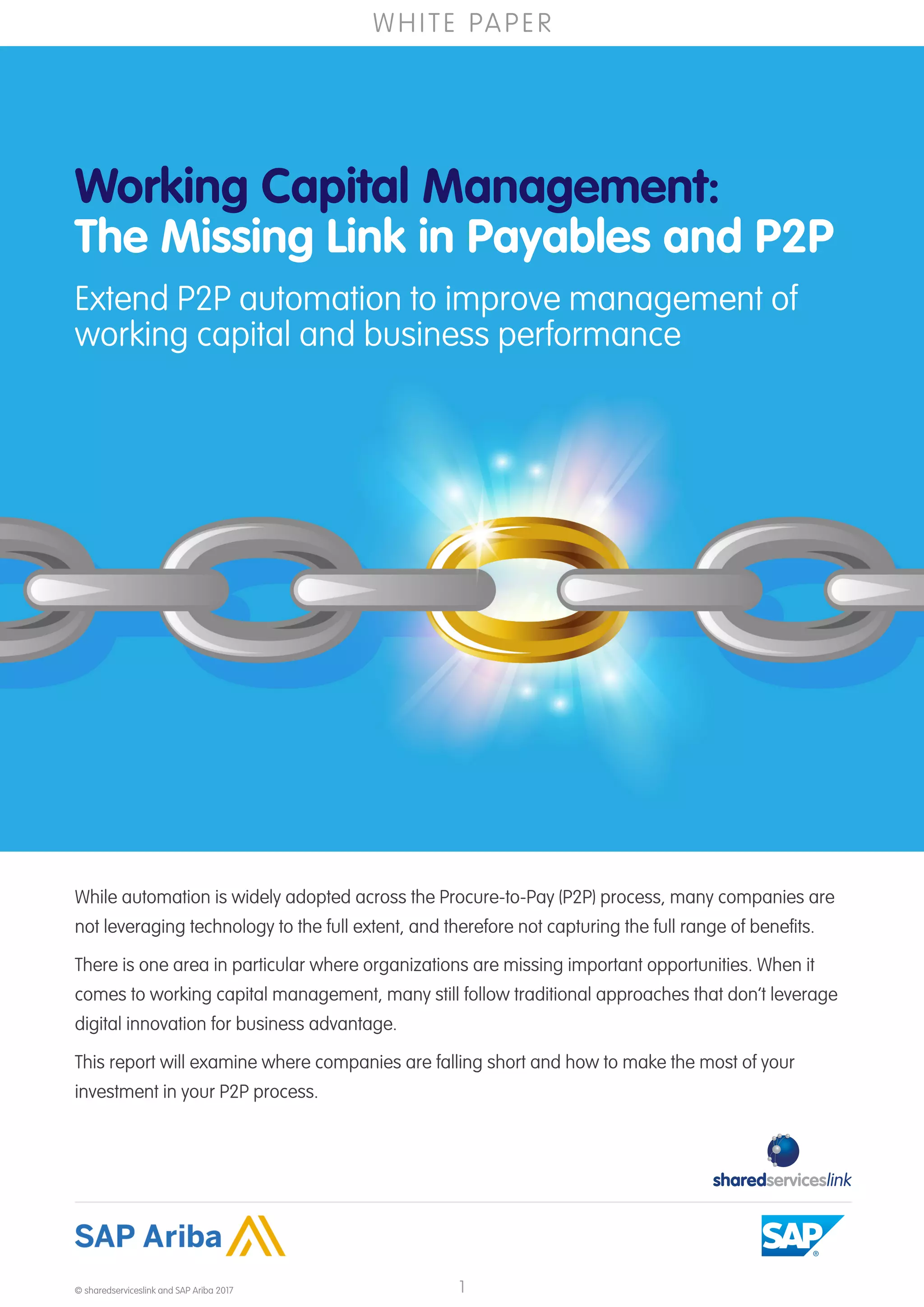
Working Capital Management:
The Missing Link in Payables and P2P
Extend P2P automation to improve management of
working capital and business performance
WHITE PAPER
© sharedserviceslink and SAP Ariba 2017
2
Introduction
Nearly every large company has automated the P2P process to some extent. Approaches range
from driving orders from electronic catalogs to scanning invoices or processing invoices electronically.
Companies using P2P technology are reaping efficiency savings, and are able to deliver better
business intelligence and insight than ever before.
However, one area where organizations are missing important opportunities is in working capital
management. Some companies still use traditional strategies that don’t leverage the developments
in automation and digitization. Many are still stretching out payment terms, without also considering
a dynamic discounting or supply chain finance program.
This report will examine the missing links in working capital management – and how you can take
action to address them and further extend the impact of P2P automation.
About our survey
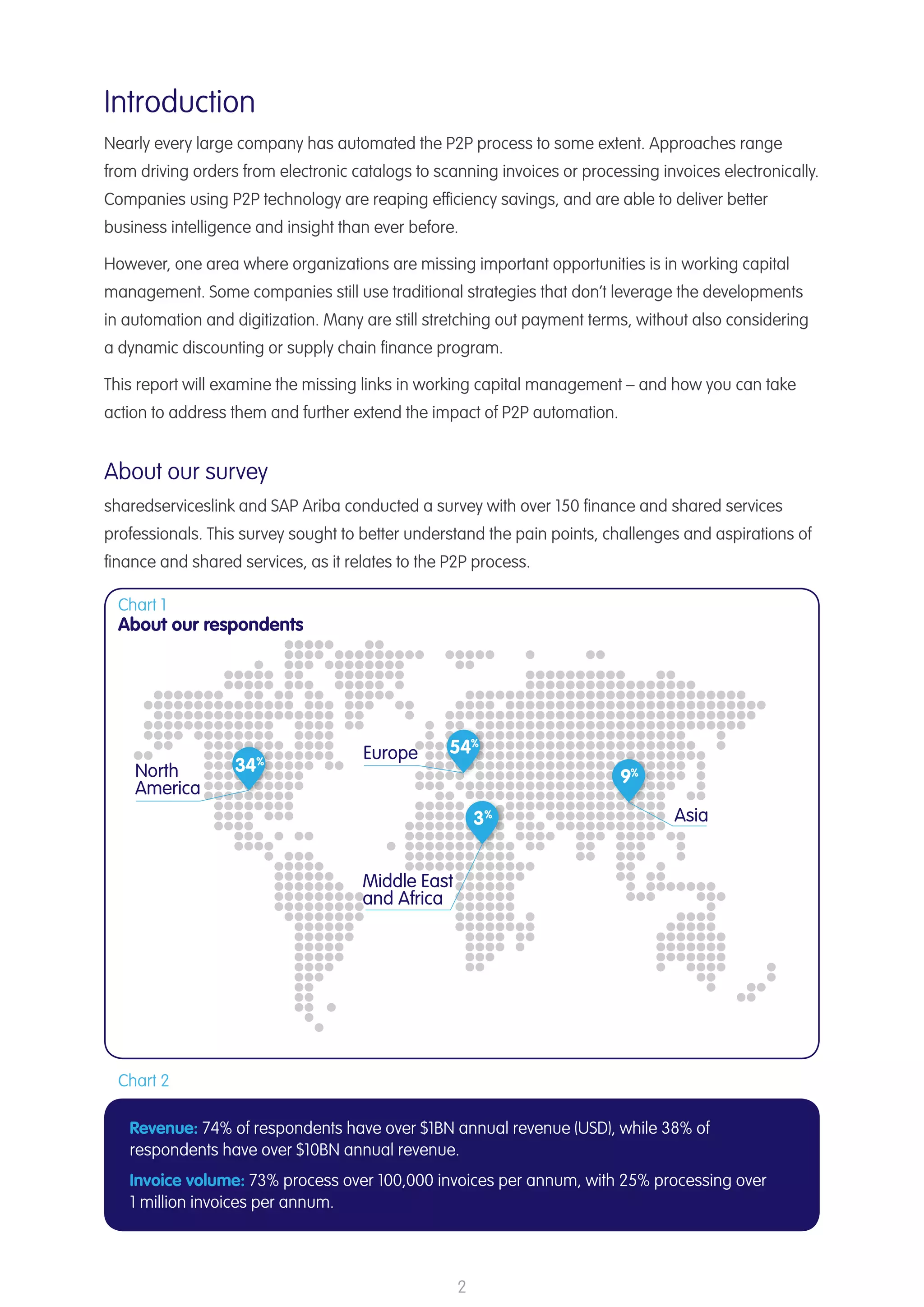
sharedserviceslink and SAP Ariba conducted a survey with over 150 finance and shared services
professionals. This survey sought to better understand the pain points, challenges and aspirations of
finance and shared services, as it relates to the P2P process.
Middle East
and Africa
Asia
Europe
North
America
9%
3%
54%
34%
Revenue: 74% of respondents have over $1BN annual revenue (USD), while 38% of
respondents have over $10BN annual revenue.
Invoice volume: 73% process over 100,000 invoices per annum, with 25% processing over
1 million invoices per annum.
Chart 2
Chart 1
About our respondents
3
Companies are leveraging enabling technology,
but not to its full extent
Many companies are still highly manual
Despite the large invoice volume of companies taking part in this survey, many still have a highly
manual payables process.
While 31% of respondents rate their payables process as ‘Good’ or ‘Excellent’, 69% see room for
improvement in all or part of the payables process. [Chart 3]
Among all respondents, 69% of invoices on average arrive via paper or PDF/email, and only 17% give
suppliers visibility into invoice status (e-invoicing, EDI, or supplier portal). Even for organizations that
receive invoices electronically, only 23% of invoices arrive, on average, via an e-invoicing network,
and only 36% give suppliers visibility into invoice status (e-invoicing, EDI or supplier portal). [Chart 4]
Fair
The payables
process is
adequate, but
there are
some
problems that
we need to
address
Excellent
We are highly efficient
with excellent visibility
Good
We are relatively
efficient with
decent visibility
Mixed
There is a good
process in some areas
of the business, but
not in others
Poor
We have significant probems in
our payables process
23%
29%
2%
5%
41%
Chart 3
How would you rate your current payables process?
Chart 4
What percentage of your invoices are coming in through the following methods?
% Paper 27%
38%
% PDF/email 25%
31%
% Scanned 12%
14%
% E-invoicing
network
23%
9%
% EDI 9%
6%
% Supplier
portal
4%
2%
Those with e-invoicing
All
4
However there is broad interest in improving invoice processing
Invoice automation is a priority for finance and shared services professionals.
89% of respondents say that either P2P automation, rolling out e-invoicing or improving an existing
e-invoicing program was one of their top 3 priorities for the next 12-18 months.
81% of respondents want to improve how they process invoices – 35% have already secured the
budget to do so. [Chart 5]
Lack of automation causes many preventable problems
High rates of manual invoicing processing leads to a number of predictable pain points. The most
common pain points felt by respondents are:
•	 High rates of invoice exceptions. 80% of respondents say this is one of their main pain points
in the P2P process. Invoice exceptions (any invoice issue that requires human intervention) can
significantly extend invoice cycle times and increase processing costs. The most common causes
of invoice exceptions relate to problems with purchase orders (such as a missing or wrong PO
number) or price-quantity errors.
•	 Poor PO Compliance. Those with manual processes often have lower rates of compliance with
purchase order policies. POs are sometimes not generated, then have to be chased, or they
are generated retrospectively. PO problems lead to both high levels of manual intervention and
reduced spend visibility. Of our respondents, 59% have fewer than 80% of invoices linked to POs.
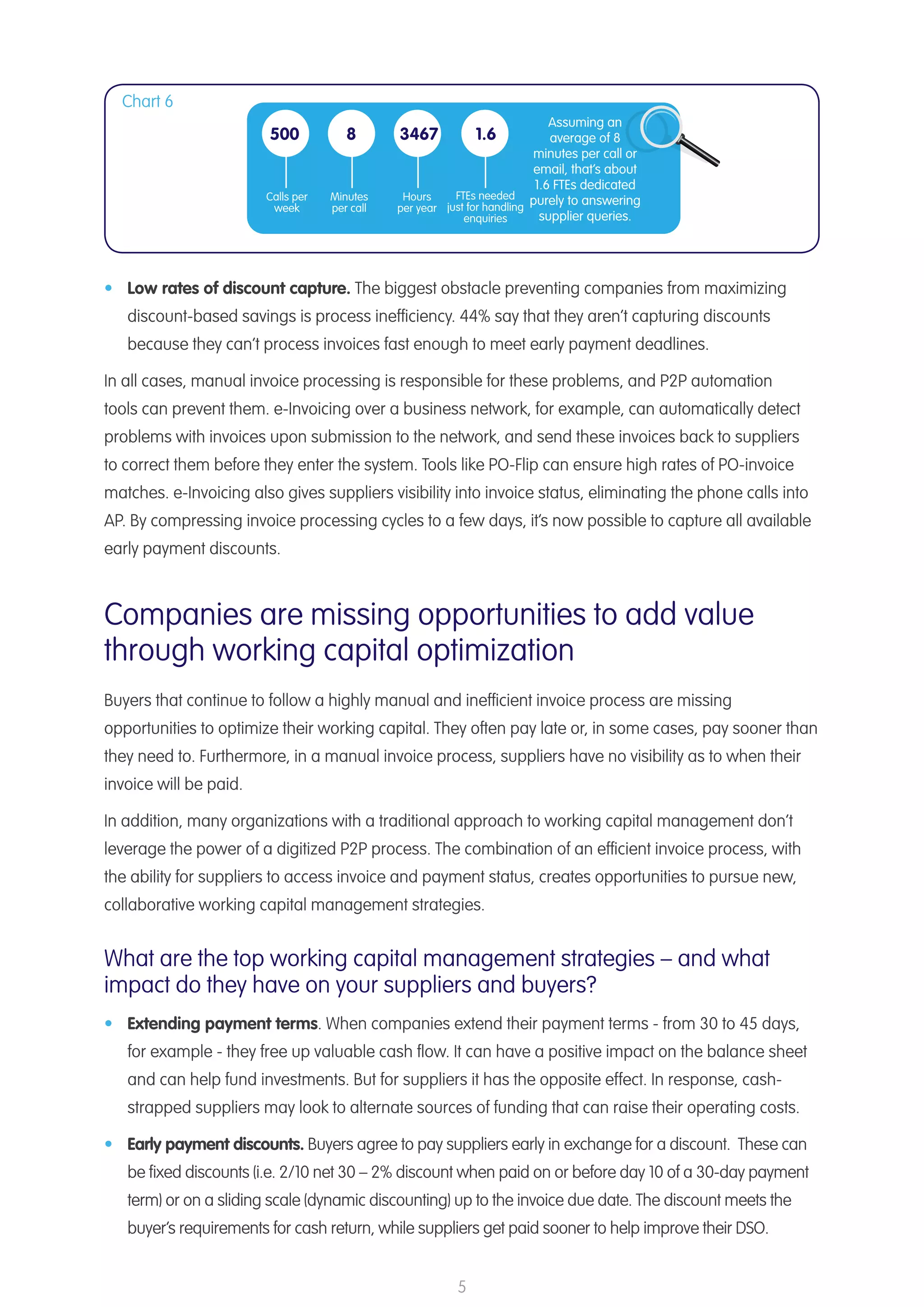
•	 High volume of calls from suppliers. 57% of respondents say they struggle with the high volume
of calls from suppliers. 37% say their AP team receives over 100 calls and emails a week from
suppliers asking when they will be paid or confirming whether invoices were received. Some
respondents cited 500 calls a week or higher. Assuming it takes 8 minutes to handle each query
(answering the call, researching the issue, communicating back to the supplier), that adds up to
3,467 hours per year, or 1.6 FTEs solely dedicated to answering supplier queries. [Chart 6]
Chart 5
Are you actively looking to
improve your invoice processing?
We want to
improve, but don’t
yet have budget
We are looking to improve
our invoice processing,
and have budget to do so
Our invoice processing is
high quality and we aren’t
looking to change it
11%
Improving invoice
processing isn’t a
priority right now
8%
46%
35%
5
Companies are missing opportunities to add value
through working capital optimization
Buyers that continue to follow a highly manual and inefficient invoice process are missing
opportunities to optimize their working capital. They often pay late or, in some cases, pay sooner than
they need to. Furthermore, in a manual invoice process, suppliers have no visibility as to when their
invoice will be paid.
In addition, many organizations with a traditional approach to working capital management don’t
leverage the power of a digitized P2P process. The combination of an efficient invoice process, with
the ability for suppliers to access invoice and payment status, creates opportunities to pursue new,
collaborative working capital management strategies.
What are the top working capital management strategies – and what
impact do they have on your suppliers and buyers?
•	 Extending payment terms. When companies extend their payment terms - from 30 to 45 days,
for example - they free up valuable cash flow. It can have a positive impact on the balance sheet
and can help fund investments. But for suppliers it has the opposite effect. In response, cash-
strapped suppliers may look to alternate sources of funding that can raise their operating costs.
•	 Early payment discounts. Buyers agree to pay suppliers early in exchange for a discount. These can
be fixed discounts (i.e. 2/10 net 30 – 2% discount when paid on or before day 10 of a 30-day payment
term) or on a sliding scale (dynamic discounting) up to the invoice due date. The discount meets the
buyer’s requirements for cash return, while suppliers get paid sooner to help improve their DSO.
•	 Low rates of discount capture. The biggest obstacle preventing companies from maximizing
discount-based savings is process inefficiency. 44% say that they aren’t capturing discounts
because they can’t process invoices fast enough to meet early payment deadlines.
In all cases, manual invoice processing is responsible for these problems, and P2P automation
tools can prevent them. e-Invoicing over a business network, for example, can automatically detect
problems with invoices upon submission to the network, and send these invoices back to suppliers
to correct them before they enter the system. Tools like PO-Flip can ensure high rates of PO-invoice
matches. e-Invoicing also gives suppliers visibility into invoice status, eliminating the phone calls into
AP. By compressing invoice processing cycles to a few days, it’s now possible to capture all available
early payment discounts.
Chart 6
Calls per
week
500
Minutes
per call
8
Hours
per year
3467 1.6
FTEs needed
just for handling
enquiries
Assuming an
average of 8
minutes per call or
email, that’s about
1.6 FTEs dedicated
purely to answering
supplier queries.
6
The cost of borrowing and the impact on the supply chain
The health of your supply chain relies on the health of your suppliers’ finances. For many suppliers,
cash flow and the cost of borrowing present significant problems. Poor cash flow is a leading cause
of insolvency for small businesses. Long payment terms may lead many suppliers to seek loans
or factor their receivables (where a supplier sells outstanding invoices to a third party to get an
immediate cash payment). Suppliers’ cash flow crunches can directly impact your supply chain.
Payment terms are an important factor in the financial health of your supply chain. Companies need
a balanced value proposition between buyers and suppliers. Ideally, organizations should strive to
achieve a discount rate that is fair to suppliers while, as buyers, enjoy many times greater return than
they can earn today in short-term investments.
When combined with payment terms extension, early payment discount and supply chain financing
programs provide options for suppliers to get paid sooner if needed to meet their cash flow requirements.
49%
of respondents say that taking cost out of the supply chain is important.
(Slightly important for 37% and very important for 12%)
Chart 7
Please rank the payables-based working capital program priorities for your company:
40%
No.1 No.2 No.3 No.4 N/A
22%
12%
27%
14%
10%
37%
14%
17%
10%
37%
24%
10%
4%
22%Payment Terms
Extension
Early Payment
Discounts
Supply Chain
Financing
•	 Supply chain finance. Using a third-party funder (a bank or other financial institution), the supplier
is paid early, taking advantage of the buyer’s lower cost of capital, and the funder is paid a cut
of the transaction. The supplier benefits from the early payment, while the buyer benefits from
holding onto cash until the full payment term.
Survey respondents rank payment terms extension as both the most important working capital
management program, as well as the most widely used. 78% of organizations use payment terms
extension and 40% rate it as their highest priority when it comes to working capital management.
63% take advantage of early payment discounts and supply chain finance. 22% rate early payment
discounts as their top priority working capital management program and 12% rate supply chain
financing as their top working capital management program. [Chart 7]
7
Chart 8
Early payment discounts.
Do you offer your suppliers
early payment discounts?
Yes, and we capture
discounts from over
20% of our suppliers
Yes, but we capture
discounts from less than
20% of our suppliers
No, but we are actively
looking into it
No, it is not something
we are considering
Unsure
Yes, we do, but our
suppliers haven’t taken
up the discounts
4%
29%
6%
14%
41%
6%
The missed opportunity for discounts
Despite the benefits for both trading partners, current use of early payment discount programs is low.
Only 39% of surveyed organizations offer an early payment discount program, and only 4% capture
discounts from more than 20% of suppliers.
Many organizations (41%) aren’t looking at early payment discount programs yet, so they are missing
this opportunity altogether. [Chart 8]
However the savings from early payment discount programs are significant. On average, companies
with successful early payment discount programs are capturing between $1M - $1.5M in discount
savings per $1BN in targeted spend. These savings can easily exceed the operational cost savings
from a more efficient invoice process.
The key issue holding organizations back is an inefficient P2P process
The major obstacle keeping respondents from capturing more discounts is an inefficient P2P process.
44% said they aren’t capturing more discounts because they can’t process invoices fast enough to
meet early payment cut-offs.
The key to capturing these savings is a streamlined, automated P2P process, with e-invoicing as a
key component. e-Invoicing eliminates the many errors and processing delays from paper-based
invoicing, while offering suppliers visibility into when they will get paid. Fixing a broken invoice
management process with e-invoicing can help get supplier support for payment terms extension
programs, especially when combined with options for early payment discounts.
Bottom line: A streamlined, electronic process transforms payables management by turning
invoices into assets, offering benefits to both trading partners.
8
Chart 9
45%
of companies that are well
aligned (‘mostly aligned’ or ‘very
aligned’) have end-to-end process
owners.
25%
of those that are not
well aligned (‘rarely aligned’ or
‘not aligned’) have end-to-end
process owners.
How to realize the savings and benefits from working
capital management
A fully digital P2P process accelerates invoice processing, improves collaboration with suppliers, and
helps you and your suppliers better manage cash and working capital.
Here are three practical steps you can take to reap the benefits.
1. Align the key stakeholders
Get program support from leaders in Procurement, Finance, and Treasury.
•	 Procurement is essential to engage early on, as working capital management strategies will
have an impact on your suppliers. Communication from the Chief Procurement Officer or other
procurement executive to your supplier base, educating suppliers on the value of transacting
electronically, can drive high rates of adoption.
•	 Treasury must be involved early on as well, as they need to understand the new world of
collaborative finance, where you can expand discounts and maintain or extend DPO. Treasury
maintains control over rates of return and the amount of cash to apply to discount programs. To
preserve cash, supply chain finance is another option for helping suppliers with cash flow.
•	 Finance must have at their disposal a streamlined and efficient payables process, where invoices
can be processed straight through, suppliers have visibility into payment status, and early
payment discounts are the norm, not the exception.
Aligning finance and procurement is key to success; however, for most organizations, finance and
procurement are not sufficiently aligned. Only 20% of respondents are “mostly aligned” on goals and
KPIs, and a mere 5% are “very aligned” and actually share goals and KPIs.
Global Process Owners can be valuable resources to drive alignment. While only 34% of respondents
have end-to-end global process owners, they can help drive alignment between departments.
Our survey shows a correlation between having end-to-end process owners and finance and
procurement being well-aligned. [Chart 9]
Having shared KPIs that apply to all three departments is also an important step in ensuring
that the activities and goals of these stakeholders are aligned.
9
2. Prioritize PO compliance and e-invoicing
PO compliance and rates of e-invoicing are building blocks for a strong working capital
management program.
•	 PO compliance is crucial to help ensure your spend is effectively managed. It’s also a key
indicator of a standardized process, ensuring alignment between Finance and Procurement.
Getting the process right on the front end, with the PO, goes a long way to driving straight through
processing of invoices on the back end.
•	 e-Invoicing drives collaboration, improves efficiency, promotes first-time PO and invoice matches,
and lays the foundation for better management of cash and working capital, for both trading
partners. Fast, efficient invoice processing is key to making any discounting program work, and
the ability to collaborate with suppliers over invoices and payments creates collaborative finance
opportunities that can’t occur with manual, paper-based processing.
While rates of PO compliance and e-invoicing are valuable KPIs, don’t ignore other metrics such as %
of discounts captured and DPO. These, too, can help you optimize business performance, returns on
cash, and working capital.
3. Leverage end-to-end P2P solutions
Standardizing and digitizing your process from procurement through to payment will promote
straight-through invoice processing and improve control. Additionally, this will free up resources to
tackle more strategic activities such as improving cash flow and working capital metrics.
•	 Close the loop. To effectively align Finance and Procurement, make sure your processes are as
’closed loop’ as possible. When your suppliers can invoice directly off POs (as in PO-Flip), or from a
contract without a PO, you have more control over spending.
•	 e-Invoicing lowers costs from a transactional perspective, and enables you to secure early
payment discounts, where the cost savings can be much larger than the operational savings.
When e-invoicing is delivered as part of a larger procure-to-pay suite, it can simplify management
of the broader process.
•	 A business network is another key component that drives buyer-supplier collaboration and real-
time transaction management. The more effective your collaboration with suppliers, the greater
results you will achieve from your P2P-working capital management program.
Conclusion: The next phase
While many shared services organizations are moving in the right direction with process
standardization, technology and alignment, our survey shows that when you drill deeper, most
organizations aren’t taking P2P programs far enough to realize all the benefits.
Companies that move to the next phase are dramatically improving how they manage cash and
working capital. You can too, by balancing payment terms extension program with early payment
10
discounts, maintaining or extending DPO while supporting the cash flow requirements of your supply
chain. You can also add supply chain financing as a complement to a comprehensive working capital
management program.
However, you can’t achieve best-in-class results without fixing the gaps in your P2P process. Connect
electronically to your suppliers, link POs to invoices, and let automation manage the transactions and
drive straight-through processing. By following this approach, shared services organizations will have
more resources available to focus on strategic activities that strengthen their income statement and
balance sheet.
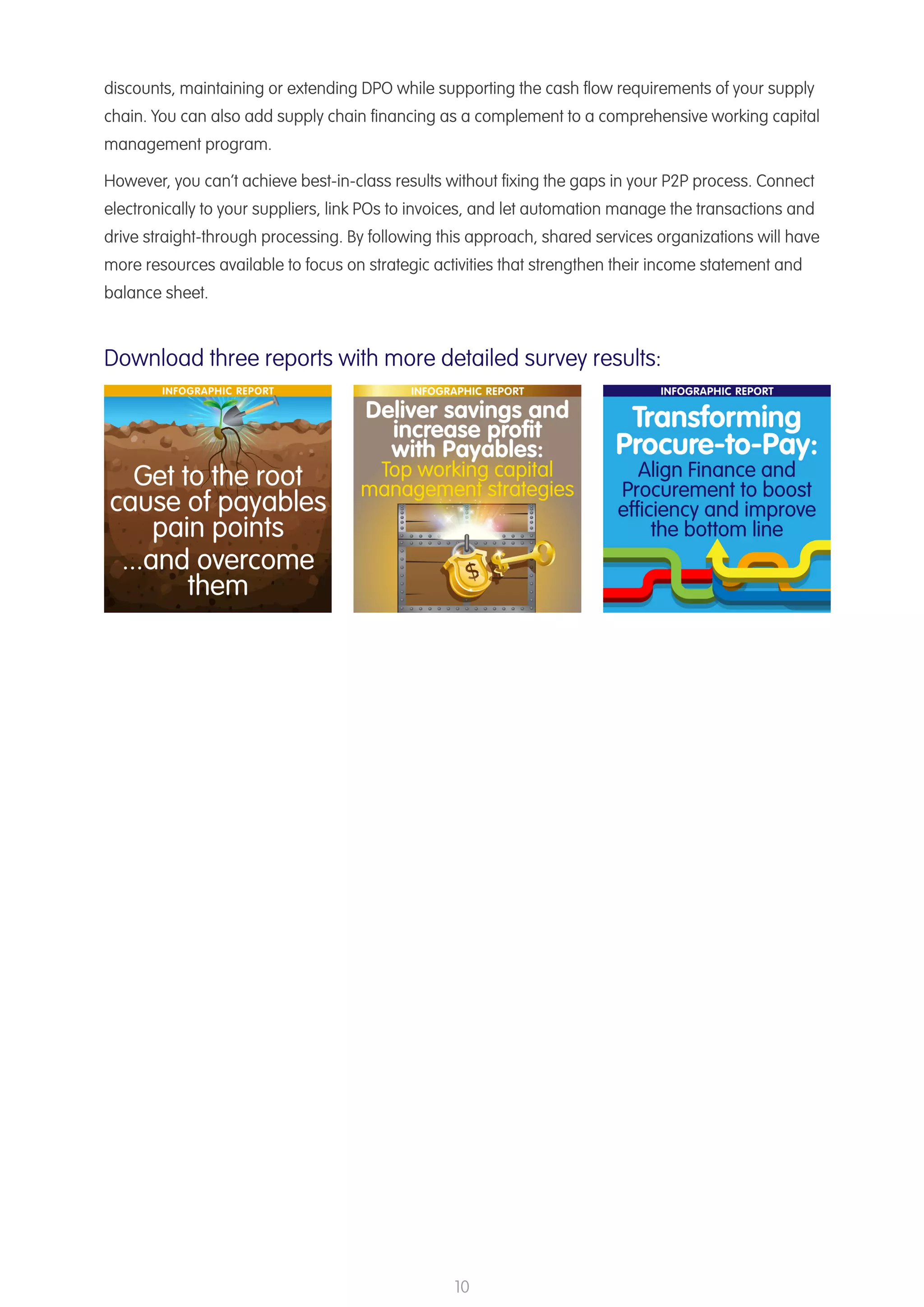
Download three reports with more detailed survey results:
11
How SAP Ariba can help you improve procure-to-pay
and working capital management
At SAP Ariba, we work closely with organizations like yours to digitize procure-to-pay processing. We
support you with best practices, services, and solutions that redefine the way you manage business
commerce. We help you collaborate electronically with suppliers and automate procure-to-pay
operations, so you can process invoices quickly, manage cash better, and optimize working capital.
New areas of opportunity include early payment discounts and supply chain finance. Early payment
discounts offer risk-free, double-digit cash returns that are especially attractive in a low interest rate
environment. For organizations that don’t want to apply excess cash to discounts or desire instead to
focus primarily on extending terms while holding onto cash, you can take advantage of supply chain
finance. Here, a bank or third-party financial institution will fund the discount as you extend payment
terms to increase DPO and unlock valuable working capital.
P2P automation and early payment discounts in practice
•	 American Electric Power (AEP) emphasized early payment discounts in its e-payables transformation
and, in its first year, realized a substantial increase in early payment discount savings. Using SAP
Ariba Working Capital Management Services team, the utility discovered that it had more than
150 distinct payment terms and that it was paying suppliers faster than its peers. By standardizing
payment terms, they were able to extend DPO to conform to its industry average. They also found
that the cost savings from the discounts would fund the larger procure-to-pay project.
•	 Another US utility realized even greater savings, earning close to $3 million in discounts for every
billion dollars of spend, while achieving a discount capture rate close to 100%. According to the
project lead, “With the results that we’ve seen, the investment in one person for this program and
for SAP Ariba solutions has come back to us hundreds of times over.”​
•	 A retailer’s suppliers were interested in accelerating their cash flow. Using SAP Ariba’s technology,
they recognized the opportunity for discounts on merchandise spend, not normally a candidate
for early payment discounts. But early payment discounts proved to be a good fit for a group of
suppliers, and they were able to secure savings after identifying a mutually acceptable discount rate.
Maximize your return on investment
Double-digit cash returns and freed up cash flow aren’t always associated with a P2P automation
initiative, but they should be. While the 60 to 80 percent cost savings from PO and invoice automation
are impressive, even greater savings come from the opportunity P2P automation creates: defining
a program that combines early payment discounts with payment terms extension enabled by
supply chain finance to extend DPO, freeing up working capital and increasing free cash flow. Yet
additional savings come from improved contract compliance. According to procure-to-pay industry
studies and SAP Ariba customer results, the savings from automating these business processes are
conservatively estimated to be $10 million per billion in spend.
Depending on the state of your procure-to-pay operations, the returns on a P2P automation initiative could
be much higher. With the potential impact to your business, this is an opportunity worth a closer look.
For more information about SAP Ariba solutions and services please visit here.
12
© sharedserviceslink.com Ltd and SAP Ariba 2017. No copy or visual can be used in part, as a phrase or in whole without the written permission of sharedserviceslink.com Ltd. The
concept of this product belongs tosharedserviceslink.com Ltd and cannot be re-created by a third party for the purpose of an event, article, report or any other written product, without
written consent made available by sharedserviceslink.com Ltd.
About SAP Ariba
SAP Ariba is how companies connect to get business done. On the Ariba Network, buyers and
suppliers from more than two million companies and 190 countries discover new opportunities,
collaborate on transactions and grow their relationships. Buyers can manage the entire purchasing
process, while controlling spending, finding new sources of savings and building a healthy supply
chain. And suppliers can connect with profitable customers and efficiently scale existing relationships
– simplifying sales cycles and improving cash control along the way. The result is a dynamic, digital
marketplace, where more than $1 trillion in commerce gets done every year.
To learn more about SAP Ariba, visit www.ariba.com
About SAP
As market leader in enterprise application software, SAP (NYSE: SAP) helps companies of all sizes
and industries run better. From back office to boardroom, warehouse to storefront, desktop to mobile
device – SAP empowers people and organizations to work together more efficiently and use business
About sharedserviceslink
sharedserviceslink’s mission is to connect the world’s shared services professionals to allow them to
be more productive and successful. Our services are designed to connect you to other professionals
to meet online, exchange ideas and content, learn and be part of a network of trusted relationships.
We also provide benchmark tools and a huge amount of content to help you in your day to day work.
www.sharedserviceslink.com
sharespace, our social networking site, connects you to shared services
professionals, suppliers, documents and tools. All the resources you need
to be world class are here, in one place. www.sharespace.digital

Working Capital Management: The Missing Link in Payables and P2P

  • 1.
    1 While automation iswidely adopted across the Procure-to-Pay (P2P) process, many companies are not leveraging technology to the full extent, and therefore not capturing the full range of benefits. There is one area in particular where organizations are missing important opportunities. When it comes to working capital management, many still follow traditional approaches that don’t leverage digital innovation for business advantage. This report will examine where companies are falling short and how to make the most of your investment in your P2P process. Working Capital Management: The Missing Link in Payables and P2P Extend P2P automation to improve management of working capital and business performance WHITE PAPER © sharedserviceslink and SAP Ariba 2017
  • 2.
    2 Introduction Nearly every largecompany has automated the P2P process to some extent. Approaches range from driving orders from electronic catalogs to scanning invoices or processing invoices electronically. Companies using P2P technology are reaping efficiency savings, and are able to deliver better business intelligence and insight than ever before. However, one area where organizations are missing important opportunities is in working capital management. Some companies still use traditional strategies that don’t leverage the developments in automation and digitization. Many are still stretching out payment terms, without also considering a dynamic discounting or supply chain finance program. This report will examine the missing links in working capital management – and how you can take action to address them and further extend the impact of P2P automation. About our survey sharedserviceslink and SAP Ariba conducted a survey with over 150 finance and shared services professionals. This survey sought to better understand the pain points, challenges and aspirations of finance and shared services, as it relates to the P2P process. Middle East and Africa Asia Europe North America 9% 3% 54% 34% Revenue: 74% of respondents have over $1BN annual revenue (USD), while 38% of respondents have over $10BN annual revenue. Invoice volume: 73% process over 100,000 invoices per annum, with 25% processing over 1 million invoices per annum. Chart 2 Chart 1 About our respondents
  • 3.
    3 Companies are leveragingenabling technology, but not to its full extent Many companies are still highly manual Despite the large invoice volume of companies taking part in this survey, many still have a highly manual payables process. While 31% of respondents rate their payables process as ‘Good’ or ‘Excellent’, 69% see room for improvement in all or part of the payables process. [Chart 3] Among all respondents, 69% of invoices on average arrive via paper or PDF/email, and only 17% give suppliers visibility into invoice status (e-invoicing, EDI, or supplier portal). Even for organizations that receive invoices electronically, only 23% of invoices arrive, on average, via an e-invoicing network, and only 36% give suppliers visibility into invoice status (e-invoicing, EDI or supplier portal). [Chart 4] Fair The payables process is adequate, but there are some problems that we need to address Excellent We are highly efficient with excellent visibility Good We are relatively efficient with decent visibility Mixed There is a good process in some areas of the business, but not in others Poor We have significant probems in our payables process 23% 29% 2% 5% 41% Chart 3 How would you rate your current payables process? Chart 4 What percentage of your invoices are coming in through the following methods? % Paper 27% 38% % PDF/email 25% 31% % Scanned 12% 14% % E-invoicing network 23% 9% % EDI 9% 6% % Supplier portal 4% 2% Those with e-invoicing All
  • 4.
    4 However there isbroad interest in improving invoice processing Invoice automation is a priority for finance and shared services professionals. 89% of respondents say that either P2P automation, rolling out e-invoicing or improving an existing e-invoicing program was one of their top 3 priorities for the next 12-18 months. 81% of respondents want to improve how they process invoices – 35% have already secured the budget to do so. [Chart 5] Lack of automation causes many preventable problems High rates of manual invoicing processing leads to a number of predictable pain points. The most common pain points felt by respondents are: • High rates of invoice exceptions. 80% of respondents say this is one of their main pain points in the P2P process. Invoice exceptions (any invoice issue that requires human intervention) can significantly extend invoice cycle times and increase processing costs. The most common causes of invoice exceptions relate to problems with purchase orders (such as a missing or wrong PO number) or price-quantity errors. • Poor PO Compliance. Those with manual processes often have lower rates of compliance with purchase order policies. POs are sometimes not generated, then have to be chased, or they are generated retrospectively. PO problems lead to both high levels of manual intervention and reduced spend visibility. Of our respondents, 59% have fewer than 80% of invoices linked to POs. • High volume of calls from suppliers. 57% of respondents say they struggle with the high volume of calls from suppliers. 37% say their AP team receives over 100 calls and emails a week from suppliers asking when they will be paid or confirming whether invoices were received. Some respondents cited 500 calls a week or higher. Assuming it takes 8 minutes to handle each query (answering the call, researching the issue, communicating back to the supplier), that adds up to 3,467 hours per year, or 1.6 FTEs solely dedicated to answering supplier queries. [Chart 6] Chart 5 Are you actively looking to improve your invoice processing? We want to improve, but don’t yet have budget We are looking to improve our invoice processing, and have budget to do so Our invoice processing is high quality and we aren’t looking to change it 11% Improving invoice processing isn’t a priority right now 8% 46% 35%
  • 5.
    5 Companies are missingopportunities to add value through working capital optimization Buyers that continue to follow a highly manual and inefficient invoice process are missing opportunities to optimize their working capital. They often pay late or, in some cases, pay sooner than they need to. Furthermore, in a manual invoice process, suppliers have no visibility as to when their invoice will be paid. In addition, many organizations with a traditional approach to working capital management don’t leverage the power of a digitized P2P process. The combination of an efficient invoice process, with the ability for suppliers to access invoice and payment status, creates opportunities to pursue new, collaborative working capital management strategies. What are the top working capital management strategies – and what impact do they have on your suppliers and buyers? • Extending payment terms. When companies extend their payment terms - from 30 to 45 days, for example - they free up valuable cash flow. It can have a positive impact on the balance sheet and can help fund investments. But for suppliers it has the opposite effect. In response, cash- strapped suppliers may look to alternate sources of funding that can raise their operating costs. • Early payment discounts. Buyers agree to pay suppliers early in exchange for a discount. These can be fixed discounts (i.e. 2/10 net 30 – 2% discount when paid on or before day 10 of a 30-day payment term) or on a sliding scale (dynamic discounting) up to the invoice due date. The discount meets the buyer’s requirements for cash return, while suppliers get paid sooner to help improve their DSO. • Low rates of discount capture. The biggest obstacle preventing companies from maximizing discount-based savings is process inefficiency. 44% say that they aren’t capturing discounts because they can’t process invoices fast enough to meet early payment deadlines. In all cases, manual invoice processing is responsible for these problems, and P2P automation tools can prevent them. e-Invoicing over a business network, for example, can automatically detect problems with invoices upon submission to the network, and send these invoices back to suppliers to correct them before they enter the system. Tools like PO-Flip can ensure high rates of PO-invoice matches. e-Invoicing also gives suppliers visibility into invoice status, eliminating the phone calls into AP. By compressing invoice processing cycles to a few days, it’s now possible to capture all available early payment discounts. Chart 6 Calls per week 500 Minutes per call 8 Hours per year 3467 1.6 FTEs needed just for handling enquiries Assuming an average of 8 minutes per call or email, that’s about 1.6 FTEs dedicated purely to answering supplier queries.
  • 6.
    6 The cost ofborrowing and the impact on the supply chain The health of your supply chain relies on the health of your suppliers’ finances. For many suppliers, cash flow and the cost of borrowing present significant problems. Poor cash flow is a leading cause of insolvency for small businesses. Long payment terms may lead many suppliers to seek loans or factor their receivables (where a supplier sells outstanding invoices to a third party to get an immediate cash payment). Suppliers’ cash flow crunches can directly impact your supply chain. Payment terms are an important factor in the financial health of your supply chain. Companies need a balanced value proposition between buyers and suppliers. Ideally, organizations should strive to achieve a discount rate that is fair to suppliers while, as buyers, enjoy many times greater return than they can earn today in short-term investments. When combined with payment terms extension, early payment discount and supply chain financing programs provide options for suppliers to get paid sooner if needed to meet their cash flow requirements. 49% of respondents say that taking cost out of the supply chain is important. (Slightly important for 37% and very important for 12%) Chart 7 Please rank the payables-based working capital program priorities for your company: 40% No.1 No.2 No.3 No.4 N/A 22% 12% 27% 14% 10% 37% 14% 17% 10% 37% 24% 10% 4% 22%Payment Terms Extension Early Payment Discounts Supply Chain Financing • Supply chain finance. Using a third-party funder (a bank or other financial institution), the supplier is paid early, taking advantage of the buyer’s lower cost of capital, and the funder is paid a cut of the transaction. The supplier benefits from the early payment, while the buyer benefits from holding onto cash until the full payment term. Survey respondents rank payment terms extension as both the most important working capital management program, as well as the most widely used. 78% of organizations use payment terms extension and 40% rate it as their highest priority when it comes to working capital management. 63% take advantage of early payment discounts and supply chain finance. 22% rate early payment discounts as their top priority working capital management program and 12% rate supply chain financing as their top working capital management program. [Chart 7]
  • 7.
    7 Chart 8 Early paymentdiscounts. Do you offer your suppliers early payment discounts? Yes, and we capture discounts from over 20% of our suppliers Yes, but we capture discounts from less than 20% of our suppliers No, but we are actively looking into it No, it is not something we are considering Unsure Yes, we do, but our suppliers haven’t taken up the discounts 4% 29% 6% 14% 41% 6% The missed opportunity for discounts Despite the benefits for both trading partners, current use of early payment discount programs is low. Only 39% of surveyed organizations offer an early payment discount program, and only 4% capture discounts from more than 20% of suppliers. Many organizations (41%) aren’t looking at early payment discount programs yet, so they are missing this opportunity altogether. [Chart 8] However the savings from early payment discount programs are significant. On average, companies with successful early payment discount programs are capturing between $1M - $1.5M in discount savings per $1BN in targeted spend. These savings can easily exceed the operational cost savings from a more efficient invoice process. The key issue holding organizations back is an inefficient P2P process The major obstacle keeping respondents from capturing more discounts is an inefficient P2P process. 44% said they aren’t capturing more discounts because they can’t process invoices fast enough to meet early payment cut-offs. The key to capturing these savings is a streamlined, automated P2P process, with e-invoicing as a key component. e-Invoicing eliminates the many errors and processing delays from paper-based invoicing, while offering suppliers visibility into when they will get paid. Fixing a broken invoice management process with e-invoicing can help get supplier support for payment terms extension programs, especially when combined with options for early payment discounts. Bottom line: A streamlined, electronic process transforms payables management by turning invoices into assets, offering benefits to both trading partners.
  • 8.
    8 Chart 9 45% of companiesthat are well aligned (‘mostly aligned’ or ‘very aligned’) have end-to-end process owners. 25% of those that are not well aligned (‘rarely aligned’ or ‘not aligned’) have end-to-end process owners. How to realize the savings and benefits from working capital management A fully digital P2P process accelerates invoice processing, improves collaboration with suppliers, and helps you and your suppliers better manage cash and working capital. Here are three practical steps you can take to reap the benefits. 1. Align the key stakeholders Get program support from leaders in Procurement, Finance, and Treasury. • Procurement is essential to engage early on, as working capital management strategies will have an impact on your suppliers. Communication from the Chief Procurement Officer or other procurement executive to your supplier base, educating suppliers on the value of transacting electronically, can drive high rates of adoption. • Treasury must be involved early on as well, as they need to understand the new world of collaborative finance, where you can expand discounts and maintain or extend DPO. Treasury maintains control over rates of return and the amount of cash to apply to discount programs. To preserve cash, supply chain finance is another option for helping suppliers with cash flow. • Finance must have at their disposal a streamlined and efficient payables process, where invoices can be processed straight through, suppliers have visibility into payment status, and early payment discounts are the norm, not the exception. Aligning finance and procurement is key to success; however, for most organizations, finance and procurement are not sufficiently aligned. Only 20% of respondents are “mostly aligned” on goals and KPIs, and a mere 5% are “very aligned” and actually share goals and KPIs. Global Process Owners can be valuable resources to drive alignment. While only 34% of respondents have end-to-end global process owners, they can help drive alignment between departments. Our survey shows a correlation between having end-to-end process owners and finance and procurement being well-aligned. [Chart 9] Having shared KPIs that apply to all three departments is also an important step in ensuring that the activities and goals of these stakeholders are aligned.
  • 9.
    9 2. Prioritize POcompliance and e-invoicing PO compliance and rates of e-invoicing are building blocks for a strong working capital management program. • PO compliance is crucial to help ensure your spend is effectively managed. It’s also a key indicator of a standardized process, ensuring alignment between Finance and Procurement. Getting the process right on the front end, with the PO, goes a long way to driving straight through processing of invoices on the back end. • e-Invoicing drives collaboration, improves efficiency, promotes first-time PO and invoice matches, and lays the foundation for better management of cash and working capital, for both trading partners. Fast, efficient invoice processing is key to making any discounting program work, and the ability to collaborate with suppliers over invoices and payments creates collaborative finance opportunities that can’t occur with manual, paper-based processing. While rates of PO compliance and e-invoicing are valuable KPIs, don’t ignore other metrics such as % of discounts captured and DPO. These, too, can help you optimize business performance, returns on cash, and working capital. 3. Leverage end-to-end P2P solutions Standardizing and digitizing your process from procurement through to payment will promote straight-through invoice processing and improve control. Additionally, this will free up resources to tackle more strategic activities such as improving cash flow and working capital metrics. • Close the loop. To effectively align Finance and Procurement, make sure your processes are as ’closed loop’ as possible. When your suppliers can invoice directly off POs (as in PO-Flip), or from a contract without a PO, you have more control over spending. • e-Invoicing lowers costs from a transactional perspective, and enables you to secure early payment discounts, where the cost savings can be much larger than the operational savings. When e-invoicing is delivered as part of a larger procure-to-pay suite, it can simplify management of the broader process. • A business network is another key component that drives buyer-supplier collaboration and real- time transaction management. The more effective your collaboration with suppliers, the greater results you will achieve from your P2P-working capital management program. Conclusion: The next phase While many shared services organizations are moving in the right direction with process standardization, technology and alignment, our survey shows that when you drill deeper, most organizations aren’t taking P2P programs far enough to realize all the benefits. Companies that move to the next phase are dramatically improving how they manage cash and working capital. You can too, by balancing payment terms extension program with early payment
  • 10.
    10 discounts, maintaining orextending DPO while supporting the cash flow requirements of your supply chain. You can also add supply chain financing as a complement to a comprehensive working capital management program. However, you can’t achieve best-in-class results without fixing the gaps in your P2P process. Connect electronically to your suppliers, link POs to invoices, and let automation manage the transactions and drive straight-through processing. By following this approach, shared services organizations will have more resources available to focus on strategic activities that strengthen their income statement and balance sheet. Download three reports with more detailed survey results:
  • 11.
    11 How SAP Aribacan help you improve procure-to-pay and working capital management At SAP Ariba, we work closely with organizations like yours to digitize procure-to-pay processing. We support you with best practices, services, and solutions that redefine the way you manage business commerce. We help you collaborate electronically with suppliers and automate procure-to-pay operations, so you can process invoices quickly, manage cash better, and optimize working capital. New areas of opportunity include early payment discounts and supply chain finance. Early payment discounts offer risk-free, double-digit cash returns that are especially attractive in a low interest rate environment. For organizations that don’t want to apply excess cash to discounts or desire instead to focus primarily on extending terms while holding onto cash, you can take advantage of supply chain finance. Here, a bank or third-party financial institution will fund the discount as you extend payment terms to increase DPO and unlock valuable working capital. P2P automation and early payment discounts in practice • American Electric Power (AEP) emphasized early payment discounts in its e-payables transformation and, in its first year, realized a substantial increase in early payment discount savings. Using SAP Ariba Working Capital Management Services team, the utility discovered that it had more than 150 distinct payment terms and that it was paying suppliers faster than its peers. By standardizing payment terms, they were able to extend DPO to conform to its industry average. They also found that the cost savings from the discounts would fund the larger procure-to-pay project. • Another US utility realized even greater savings, earning close to $3 million in discounts for every billion dollars of spend, while achieving a discount capture rate close to 100%. According to the project lead, “With the results that we’ve seen, the investment in one person for this program and for SAP Ariba solutions has come back to us hundreds of times over.”​ • A retailer’s suppliers were interested in accelerating their cash flow. Using SAP Ariba’s technology, they recognized the opportunity for discounts on merchandise spend, not normally a candidate for early payment discounts. But early payment discounts proved to be a good fit for a group of suppliers, and they were able to secure savings after identifying a mutually acceptable discount rate. Maximize your return on investment Double-digit cash returns and freed up cash flow aren’t always associated with a P2P automation initiative, but they should be. While the 60 to 80 percent cost savings from PO and invoice automation are impressive, even greater savings come from the opportunity P2P automation creates: defining a program that combines early payment discounts with payment terms extension enabled by supply chain finance to extend DPO, freeing up working capital and increasing free cash flow. Yet additional savings come from improved contract compliance. According to procure-to-pay industry studies and SAP Ariba customer results, the savings from automating these business processes are conservatively estimated to be $10 million per billion in spend. Depending on the state of your procure-to-pay operations, the returns on a P2P automation initiative could be much higher. With the potential impact to your business, this is an opportunity worth a closer look. For more information about SAP Ariba solutions and services please visit here.
  • 12.
    12 © sharedserviceslink.com Ltdand SAP Ariba 2017. No copy or visual can be used in part, as a phrase or in whole without the written permission of sharedserviceslink.com Ltd. The concept of this product belongs tosharedserviceslink.com Ltd and cannot be re-created by a third party for the purpose of an event, article, report or any other written product, without written consent made available by sharedserviceslink.com Ltd. About SAP Ariba SAP Ariba is how companies connect to get business done. On the Ariba Network, buyers and suppliers from more than two million companies and 190 countries discover new opportunities, collaborate on transactions and grow their relationships. Buyers can manage the entire purchasing process, while controlling spending, finding new sources of savings and building a healthy supply chain. And suppliers can connect with profitable customers and efficiently scale existing relationships – simplifying sales cycles and improving cash control along the way. The result is a dynamic, digital marketplace, where more than $1 trillion in commerce gets done every year. To learn more about SAP Ariba, visit www.ariba.com About SAP As market leader in enterprise application software, SAP (NYSE: SAP) helps companies of all sizes and industries run better. From back office to boardroom, warehouse to storefront, desktop to mobile device – SAP empowers people and organizations to work together more efficiently and use business About sharedserviceslink sharedserviceslink’s mission is to connect the world’s shared services professionals to allow them to be more productive and successful. Our services are designed to connect you to other professionals to meet online, exchange ideas and content, learn and be part of a network of trusted relationships. We also provide benchmark tools and a huge amount of content to help you in your day to day work. www.sharedserviceslink.com sharespace, our social networking site, connects you to shared services professionals, suppliers, documents and tools. All the resources you need to be world class are here, in one place. www.sharespace.digital