AI in Procure-to-Pay_ Scope, Integration, Use Cases, Challenges and Trends.pdf
The future of AI in P2P lies in hyper-automation, predictive procurement, and AI-powered spend analysis. Businesses adopting AI-driven P2P solutions will achieve greater efficiency, cost control, and strategic procurement
AI in Procure-to-Pay_ Scope, Integration, Use Cases, Challenges and Trends.pdf
1.
Scope, Integration, UseCases, Challenges and Trends
zbrain.ai/ai-in-procure-to-pay
AI in procure-to-pay processes: Scope, integration, use cases,
challenges and future outlook
Talk to our Consultant
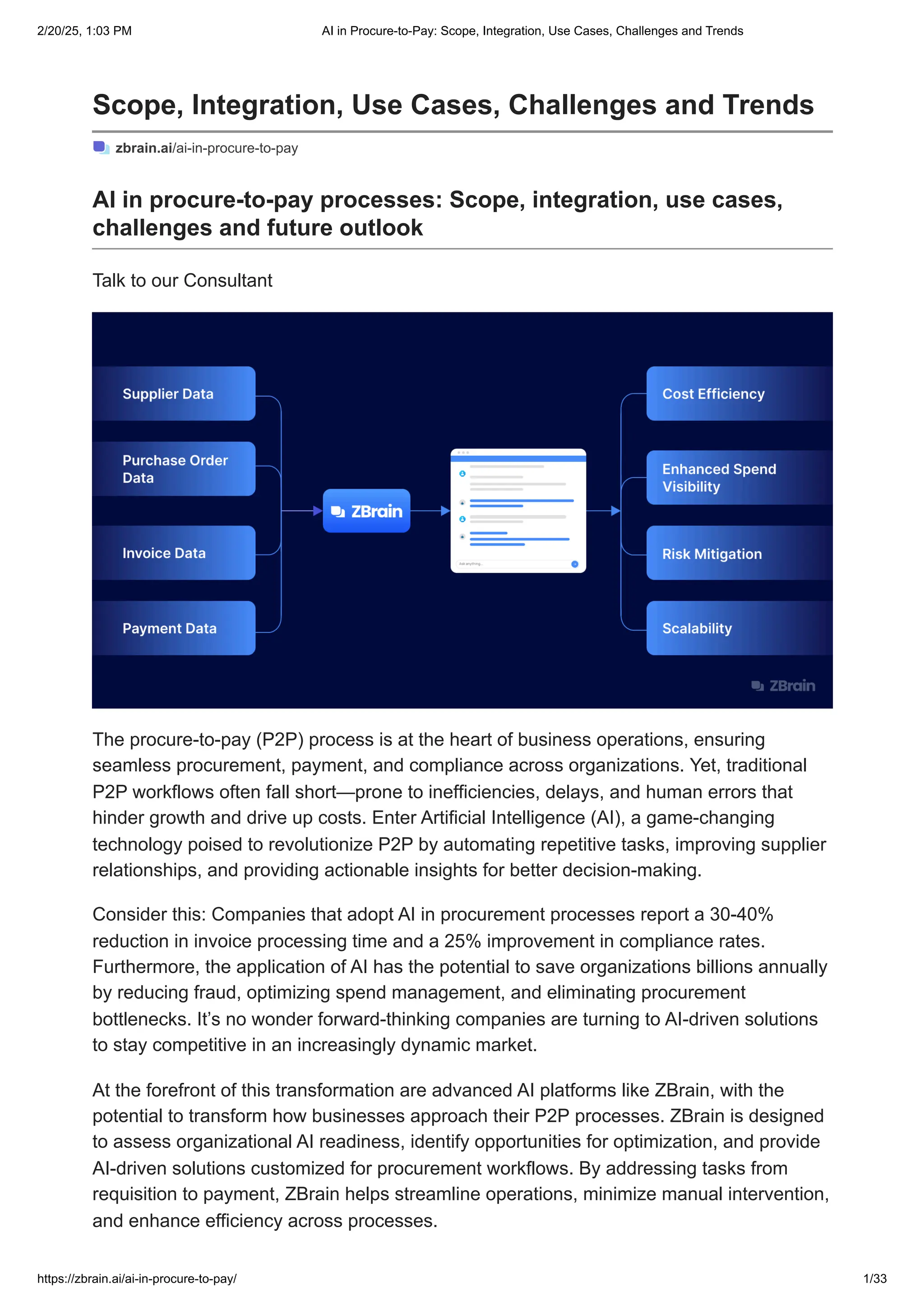
The procure-to-pay (P2P) process is at the heart of business operations, ensuring
seamless procurement, payment, and compliance across organizations. Yet, traditional
P2P workflows often fall short—prone to inefficiencies, delays, and human errors that
hinder growth and drive up costs. Enter Artificial Intelligence (AI), a game-changing
technology poised to revolutionize P2P by automating repetitive tasks, improving supplier
relationships, and providing actionable insights for better decision-making.
Consider this: Companies that adopt AI in procurement processes report a 30-40%
reduction in invoice processing time and a 25% improvement in compliance rates.
Furthermore, the application of AI has the potential to save organizations billions annually
by reducing fraud, optimizing spend management, and eliminating procurement
bottlenecks. It’s no wonder forward-thinking companies are turning to AI-driven solutions
to stay competitive in an increasingly dynamic market.
At the forefront of this transformation are advanced AI platforms like ZBrain, with the
potential to transform how businesses approach their P2P processes. ZBrain is designed
to assess organizational AI readiness, identify opportunities for optimization, and provide
AI-driven solutions customized for procurement workflows. By addressing tasks from
requisition to payment, ZBrain helps streamline operations, minimize manual intervention,
and enhance efficiency across processes.
2/20/25, 1:03 PM AI in Procure-to-Pay: Scope, Integration, Use Cases, Challenges and Trends
https://zbrain.ai/ai-in-procure-to-pay/ 1/33
2.
As the adoptionof AI in procurement accelerates, businesses that embrace AI will not
only optimize their P2P processes but also future-proof their operations against an ever-
changing business landscape. This article explores how AI transforms the P2P lifecycle,
uncovers its most impactful use cases, and highlights why platforms like ZBrain are
valuable for organizations seeking to stay ahead of the curve.
What is procure-to-pay (P2P)?
Procure-to-pay (P2P) refers to the end-to-end process that organizations use to obtain
goods and services, encompassing all stages from initial requisitioning and supplier
selection to final payment. This workflow includes creating purchase requisitions,
identifying and engaging suppliers, issuing purchase orders, receiving goods, and
processing invoices. By integrating procurement, finance, and accounts payable
functions, the P2P process fosters a seamless and efficient workflow while ensuring
adherence to organizational policies.
Although P2P serves as a framework rather than a technology, its implementation can be
significantly enhanced through automation using ERP systems and specialized software.
These tools reduce manual tasks, decrease errors, and provide real-time insights into
procurement activities. Automated P2P workflows not only improve operational efficiency
but also help maintain compliance and support better decision-making. This, in turn,
enables businesses to manage costs effectively and strengthen supplier relationships.
Effectively managing the P2P process allows organizations to streamline their
procurement activities, optimize resource utilization, and nurture stronger supplier
partnerships. This contributes to greater operational efficiency and a sustainable
approach to supply chain management.
Why is P2P important?
The procure-to-pay process is crucial for organizations because it provides a structured
and integrated approach to managing procurement and financial operations. Centralizing
procurement data enables businesses to make informed purchasing decisions, prevent
unauthorized spending, and maintain alignment with budgets and policies. This structured
approach helps mitigate financial risks and ensures that procurement aligns with strategic
goals.
A well-implemented P2P system standardizes essential tasks such as generating
purchase orders, reconciling invoices, and handling payments. This not only accelerates
procurement cycles but also enhances the accuracy of transactions. Timely and accurate
payments further strengthen supplier relationships, fostering improved service delivery
and supply chain performance.
Additionally, P2P offers organizations greater visibility into financial commitments and
critical performance metrics. This transparency allows businesses to analyze spending
patterns, negotiate favorable supplier terms, and identify cost-saving opportunities. By
2/20/25, 1:03 PM AI in Procure-to-Pay: Scope, Integration, Use Cases, Challenges and Trends
https://zbrain.ai/ai-in-procure-to-pay/ 2/33
3.
optimizing the P2Pprocess, organizations can achieve better financial management,
enhanced reporting accuracy, and more strategic decision-making.
Understanding the procure-to-pay (P2P) lifecycle
Organizations tailor their procure-to-pay (P2P) processes to meet specific operational
needs and align with broader business goals such as cost control, supplier relationship
management, and operational efficiency. Each organization customizes its procurement
strategy based on factors like availability, sustainability, and quality. Understanding the
key stages of the P2P cycle is essential for optimizing the process and ensuring smooth,
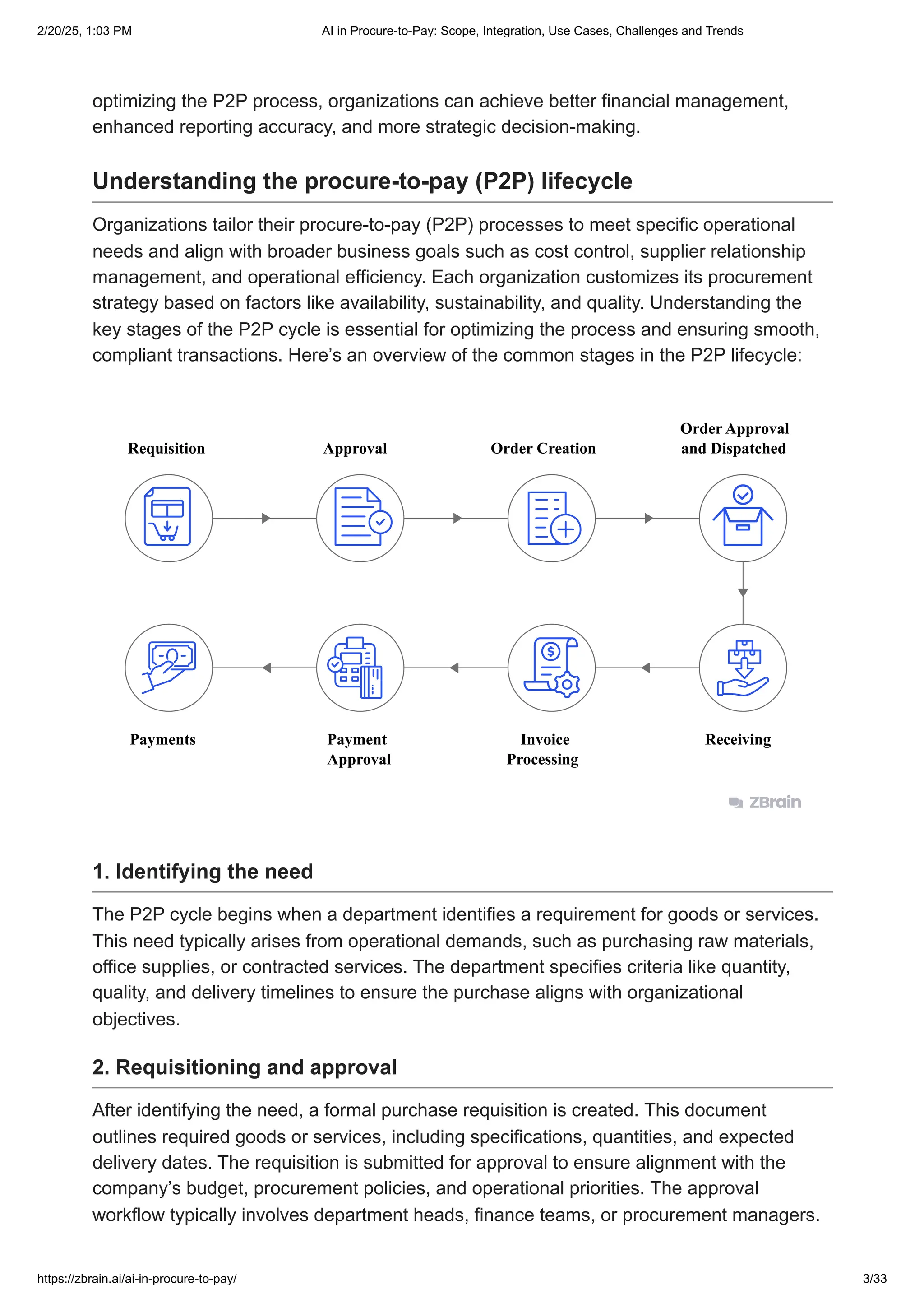
compliant transactions. Here’s an overview of the common stages in the P2P lifecycle:
Requisition Approval Order Creation
Invoice
Processing
Receiving
Payment
Approval
Payments
Order Approval
and Dispatched
1. Identifying the need
The P2P cycle begins when a department identifies a requirement for goods or services.
This need typically arises from operational demands, such as purchasing raw materials,
office supplies, or contracted services. The department specifies criteria like quantity,
quality, and delivery timelines to ensure the purchase aligns with organizational
objectives.
2. Requisitioning and approval
After identifying the need, a formal purchase requisition is created. This document
outlines required goods or services, including specifications, quantities, and expected
delivery dates. The requisition is submitted for approval to ensure alignment with the
company’s budget, procurement policies, and operational priorities. The approval
workflow typically involves department heads, finance teams, or procurement managers.
2/20/25, 1:03 PM AI in Procure-to-Pay: Scope, Integration, Use Cases, Challenges and Trends
https://zbrain.ai/ai-in-procure-to-pay/ 3/33
4.
3. Sourcing
Once approved,the sourcing stage begins. This involves identifying potential suppliers,
obtaining quotes or bids, and evaluating them based on factors like price, quality, delivery
timelines, and reliability. The procurement team assesses supplier capabilities to ensure
compliance with the organization’s needs and standards. This stage may also involve
negotiations to secure favorable terms or bulk discounts. Key performance indicators
(KPIs) are used to measure supplier effectiveness.
4. Purchase order (PO) creation
Once a supplier is selected, a formal purchase order (PO) is created and sent to the
supplier. The PO serves as a legally binding agreement that specifies details like quantity,
price, payment terms, delivery dates, and other conditions. It aligns both parties on the
transaction details, ensuring mutual understanding and expectations.
5. Receiving
Upon delivery, the receiving department verifies the goods or services against the
purchase order. This step includes checking for accuracy in quantity, quality, and
condition. Any discrepancies, such as damaged goods or incorrect quantities, are flagged
for resolution. Proper inspection ensures the organization receives exactly what was
ordered, preventing invoicing or payment issues later.
6. Invoicing and matching
Once goods or services are received, the supplier submits an invoice. The invoice is
matched with the purchase order and receiving report in a three-way match. This step
confirms that the correct items were received, the invoice amount is accurate, and there
are no discrepancies. This matching process helps prevent billing errors and ensures that
only validated invoices are approved for payment.
7. Payment
After verifying the invoice and resolving any discrepancies, payment is processed as per
the agreed-upon terms. This final step involves issuing payment to the supplier and
completing the procurement transaction. Timely, accurate payments are critical to
maintaining strong supplier relationships and ensuring the smooth flow of goods v and
services within the supply chain.
Transforming procure-to-pay: How AI solves traditional challenges
P2P processes are critical for smooth business operations, but traditional methods often
suffer inefficiencies, delays, and risks that can significantly affect performance. Issues
such as manual data entry, lack of real-time visibility, invoice discrepancies, and
2/20/25, 1:03 PM AI in Procure-to-Pay: Scope, Integration, Use Cases, Challenges and Trends
https://zbrain.ai/ai-in-procure-to-pay/ 4/33
5.
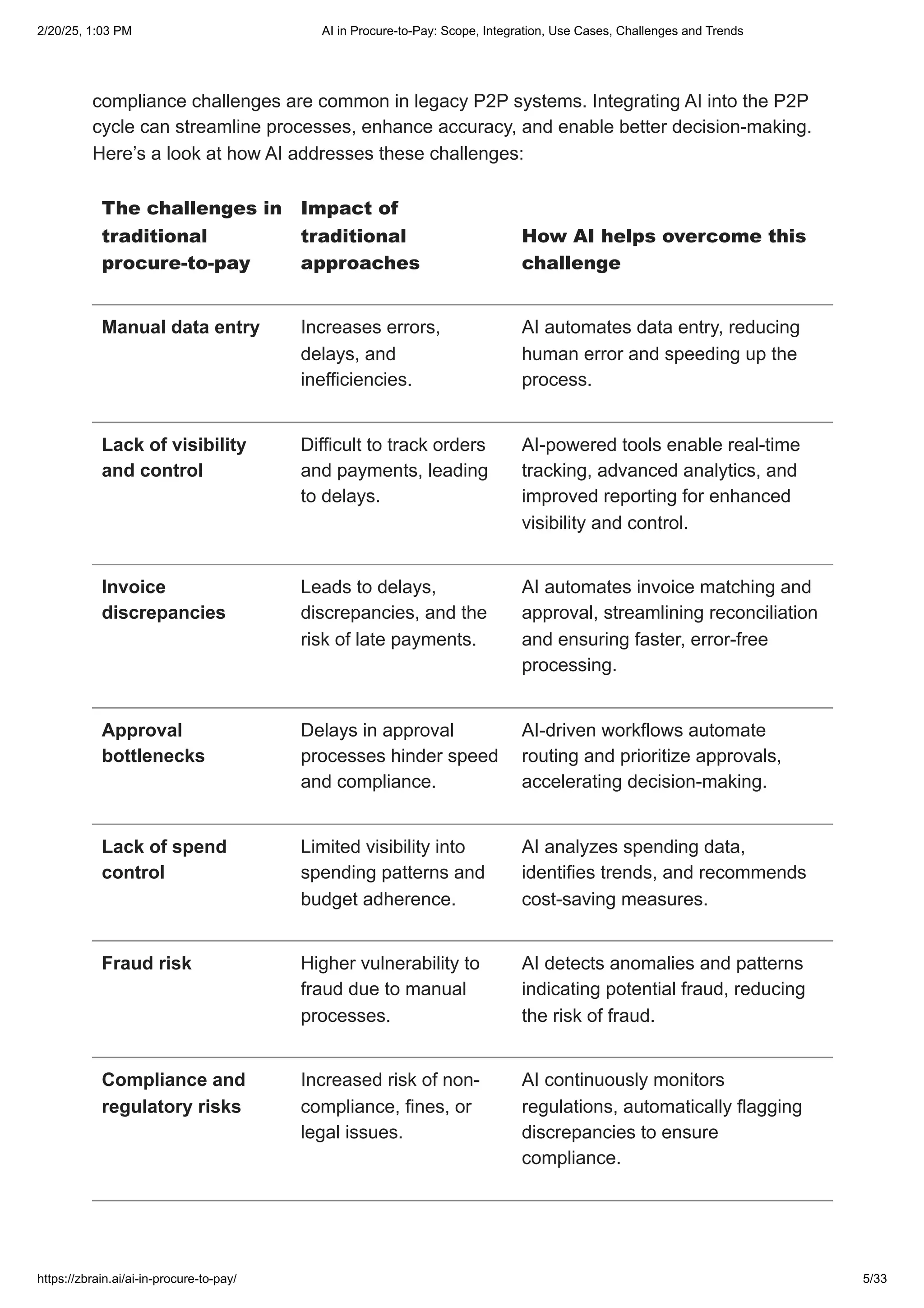
compliance challenges arecommon in legacy P2P systems. Integrating AI into the P2P
cycle can streamline processes, enhance accuracy, and enable better decision-making.
Here’s a look at how AI addresses these challenges:
The challenges in
traditional
procure-to-pay
Impact of
traditional
approaches
How AI helps overcome this
challenge
Manual data entry Increases errors,
delays, and
inefficiencies.
AI automates data entry, reducing
human error and speeding up the
process.
Lack of visibility
and control
Difficult to track orders
and payments, leading
to delays.
AI-powered tools enable real-time
tracking, advanced analytics, and
improved reporting for enhanced
visibility and control.
Invoice
discrepancies
Leads to delays,
discrepancies, and the
risk of late payments.
AI automates invoice matching and
approval, streamlining reconciliation
and ensuring faster, error-free
processing.
Approval
bottlenecks
Delays in approval
processes hinder speed
and compliance.
AI-driven workflows automate
routing and prioritize approvals,
accelerating decision-making.
Lack of spend
control
Limited visibility into
spending patterns and
budget adherence.
AI analyzes spending data,
identifies trends, and recommends
cost-saving measures.
Fraud risk Higher vulnerability to
fraud due to manual
processes.
AI detects anomalies and patterns
indicating potential fraud, reducing
the risk of fraud.
Compliance and
regulatory risks
Increased risk of non-
compliance, fines, or
legal issues.
AI continuously monitors
regulations, automatically flagging
discrepancies to ensure
compliance.
2/20/25, 1:03 PM AI in Procure-to-Pay: Scope, Integration, Use Cases, Challenges and Trends
https://zbrain.ai/ai-in-procure-to-pay/ 5/33
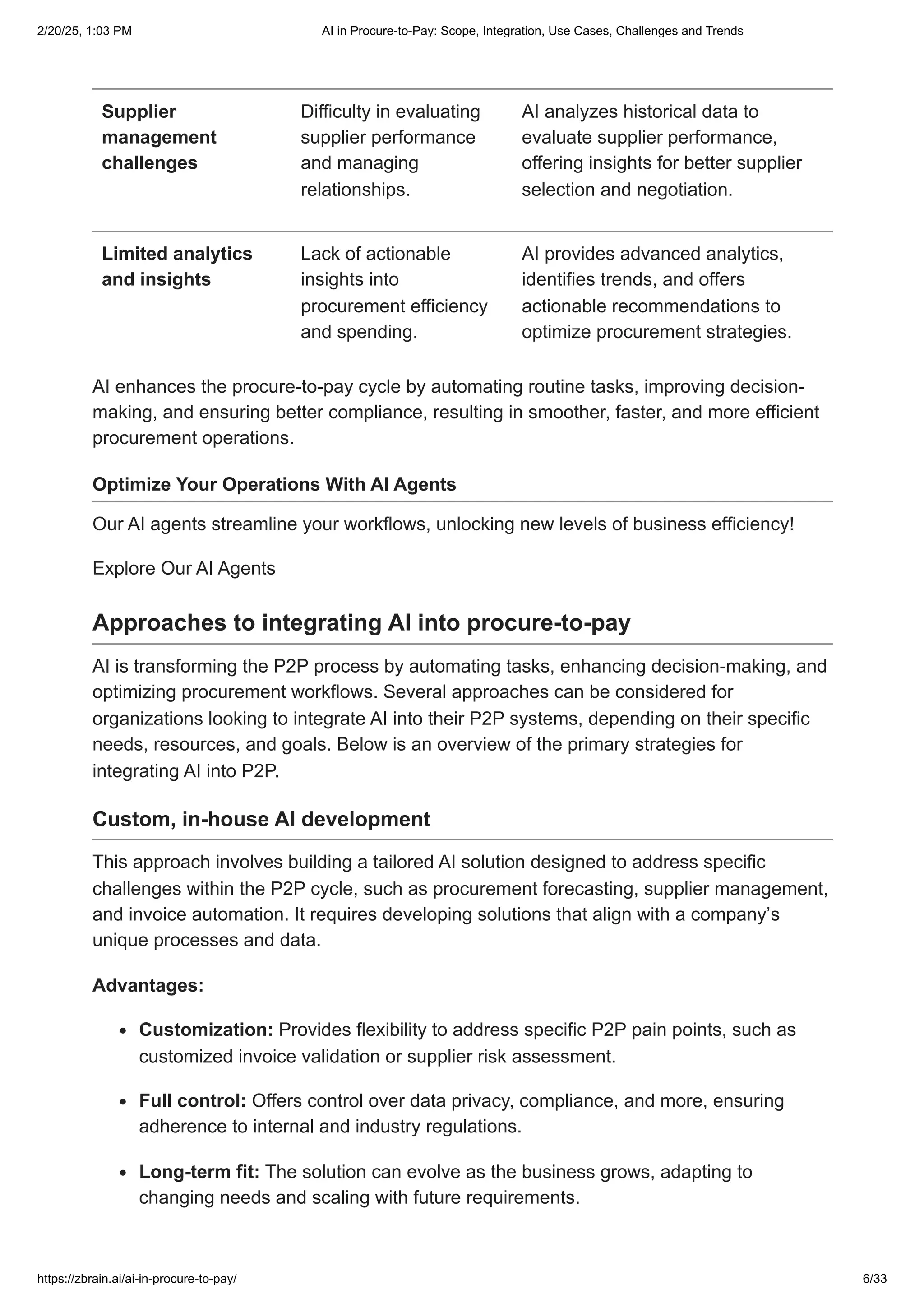
6.
Supplier
management
challenges
Difficulty in evaluating
supplierperformance
and managing
relationships.
AI analyzes historical data to
evaluate supplier performance,
offering insights for better supplier
selection and negotiation.
Limited analytics
and insights
Lack of actionable
insights into
procurement efficiency
and spending.
AI provides advanced analytics,
identifies trends, and offers
actionable recommendations to
optimize procurement strategies.
AI enhances the procure-to-pay cycle by automating routine tasks, improving decision-
making, and ensuring better compliance, resulting in smoother, faster, and more efficient
procurement operations.
Optimize Your Operations With AI Agents
Our AI agents streamline your workflows, unlocking new levels of business efficiency!
Explore Our AI Agents
Approaches to integrating AI into procure-to-pay
AI is transforming the P2P process by automating tasks, enhancing decision-making, and
optimizing procurement workflows. Several approaches can be considered for
organizations looking to integrate AI into their P2P systems, depending on their specific
needs, resources, and goals. Below is an overview of the primary strategies for
integrating AI into P2P.
Custom, in-house AI development
This approach involves building a tailored AI solution designed to address specific
challenges within the P2P cycle, such as procurement forecasting, supplier management,
and invoice automation. It requires developing solutions that align with a company’s
unique processes and data.
Advantages:
Customization: Provides flexibility to address specific P2P pain points, such as
customized invoice validation or supplier risk assessment.
Full control: Offers control over data privacy, compliance, and more, ensuring
adherence to internal and industry regulations.
Long-term fit: The solution can evolve as the business grows, adapting to
changing needs and scaling with future requirements.
2/20/25, 1:03 PM AI in Procure-to-Pay: Scope, Integration, Use Cases, Challenges and Trends
https://zbrain.ai/ai-in-procure-to-pay/ 6/33
7.
Using AI pointsolutions
This approach leverages pre-built, off-the-shelf AI applications designed to address
specific tasks within the P2P process, such as automated invoice processing, supplier
selection, or spend analysis.
Advantages:
Quick deployment: AI point solutions can be deployed rapidly, offering immediate
improvements to specific parts of the P2P process.
Cost-effective: These solutions typically require fewer resources to implement and
are less costly than developing custom solutions from scratch.
Ease of use: These tools are easy to configure and integrate into existing
workflows.
Adopting a comprehensive AI platform
A comprehensive AI platform integrates multiple AI capabilities into a unified environment,
offering solutions across the entire P2P cycle. Such platforms, like ZBrain, often combine
AI models, data management tools, and application-building frameworks to build solutions
that can automate and optimize processes like spend analysis, invoice reconciliation, and
supplier relationship management.
Advantages:
Centralized data and governance: Provides centralized control over data and
processes, improving compliance with regulatory standards and ensuring data
security.
End-to-end approach: Serves a seamless and comprehensive solution for
enterprises to build, deploy, and manage AI applications without the need for
extensive coding.
Scalability and flexibility: Easily scalable to address increasing procurement
needs.
Efficiency: Automates complex tasks, reducing manual intervention and increasing
process efficiency.
Choosing the right approach
The best approach for integrating AI into your P2P systems will depend on several
factors:
1. Specific business needs: Identify which parts of the P2P cycle require AI
intervention, such as supplier management, invoice automation, or spend analysis.
2/20/25, 1:03 PM AI in Procure-to-Pay: Scope, Integration, Use Cases, Challenges and Trends
https://zbrain.ai/ai-in-procure-to-pay/ 7/33
8.
2. Resources andexpertise: Consider the availability of internal expertise, budget for
development, and technical infrastructure.
3. Compliance and security requirements: Ensure that any AI solution complies
with industry regulations and adheres to data security standards.
4. Scalability and long-term goals: Choose an AI integration strategy that can grow
with your business and align with broader strategic objectives.
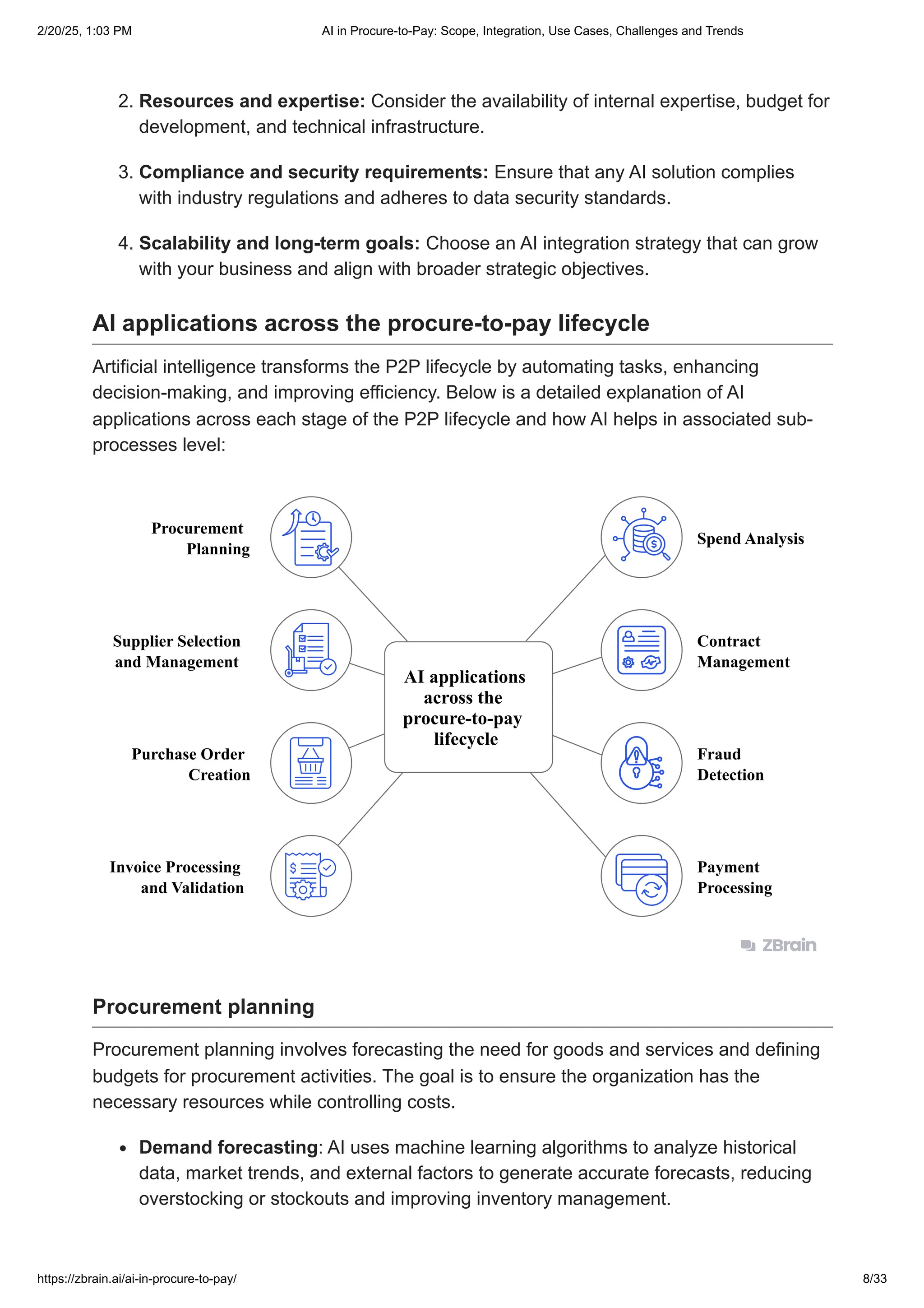
AI applications across the procure-to-pay lifecycle
Artificial intelligence transforms the P2P lifecycle by automating tasks, enhancing
decision-making, and improving efficiency. Below is a detailed explanation of AI
applications across each stage of the P2P lifecycle and how AI helps in associated sub-
processes level:
AI applications
across the
procure-to-pay
lifecycle
Procurement
Planning
Spend Analysis
Supplier Selection
and Management
Contract
Management
Purchase Order
Creation
Fraud
Detection
Invoice Processing
and Validation
Payment
Processing
Procurement planning
Procurement planning involves forecasting the need for goods and services and defining
budgets for procurement activities. The goal is to ensure the organization has the
necessary resources while controlling costs.
Demand forecasting: AI uses machine learning algorithms to analyze historical
data, market trends, and external factors to generate accurate forecasts, reducing
overstocking or stockouts and improving inventory management.
2/20/25, 1:03 PM AI in Procure-to-Pay: Scope, Integration, Use Cases, Challenges and Trends
https://zbrain.ai/ai-in-procure-to-pay/ 8/33
9.
Budgeting and spendallocation: AI-driven tools analyze past spending patterns
and suggest optimized budget allocations based on projected needs, reducing
overspending or underspending.
Strategic sourcing: AI can evaluate supplier performance and historical data to
recommend the most suitable suppliers based on cost, quality, delivery time, and
other factors, enabling better strategic sourcing decisions.
Supplier selection and management
This stage involves evaluating potential suppliers, managing supplier relationships, and
mitigating risks.
Supplier evaluation: AI tools can analyze vast amounts of supplier data, including
performance metrics such as quality, delivery speed, and compliance, to rank and
identify the best suppliers.
Supplier risk management: AI can monitor external data, such as financial reports,
news, and social media, for early signs of potential risks associated with suppliers,
enabling proactive management.
Supplier negotiation: AI can assist procurement teams by analyzing previous
negotiations and providing optimal negotiation strategies based on market trends,
supplier performance, and historical pricing data.
Purchase order creation
This stage involves the creation of purchase orders (POs), ensuring that orders are
accurate and meet organizational needs.
Purchase requisition management: AI automatically routes requisitions for
approval based on predefined rules, reducing manual review times and ensuring
that requisitions are properly justified.
Purchase order generation: AI generates purchase orders by extracting relevant
data from requisitions and supplier catalogs, ensuring the orders are accurate and
complete.
Approval workflow: AI expedites the approval process by routing orders to the
correct approvers, flagging discrepancies, and ensuring compliance with
organizational policies.
Invoice processing and validation
This stage involves receiving, validating, and processing invoices from suppliers to
ensure they are accurate and ready for payment.
2/20/25, 1:03 PM AI in Procure-to-Pay: Scope, Integration, Use Cases, Challenges and Trends
https://zbrain.ai/ai-in-procure-to-pay/ 9/33
10.
Invoice receipt: AI-poweredOCR (optical character recognition) can extract
relevant data from invoices, reducing manual data entry and improving processing
speed.
Invoice matching: AI can compare invoice data against purchase orders and
delivery receipts to detect discrepancies, ensuring accurate validation and reducing
errors.
Approval and payment authorization: AI can flag duplicate or fraudulent invoices,
streamlining the approval process and ensuring only legitimate invoices are
processed.
Spend analysis
Spend analysis involves evaluating procurement data to identify trends, opportunities for
cost savings, and efficiency improvements.
Data collection: AI can gather and integrate procurement data from multiple
systems, offering a consolidated view for more effective analysis.
Spend categorization: Machine learning algorithms can automatically categorize
procurement spend based on historical data, improving the accuracy of spend
reports.
Spend visibility: AI can generate actionable insights from procurement data,
highlighting inefficiencies, identifying cost-saving opportunities, and enabling more
strategic decision-making.
Contract management
Contract management involves the creation, monitoring, and compliance tracking of
contracts with suppliers.
Contract creation: AI can automate contract creation by pulling in standardized
clauses and terms, ensuring contracts are legally sound and aligned with policies.
Contract monitoring: AI can monitor contract performance and deadlines, sending
automated alerts for renewals and flagging non-compliance issues.
Contract renewal and termination: AI can predict renewal dates, track
performance against agreed terms, and alert teams for renegotiation or termination.
Fraud detection
Fraud detection prevents activities such as duplicate payments, incorrect invoicing, or
fraudulent suppliers.
2/20/25, 1:03 PM AI in Procure-to-Pay: Scope, Integration, Use Cases, Challenges and Trends
https://zbrain.ai/ai-in-procure-to-pay/ 10/33
11.
Transaction monitoring: Machinelearning can be used to monitor procurement
transactions in real time, identifying anomalies or suspicious behavior.
Duplicate invoice detection: AI can flag duplicate invoices by comparing invoice
numbers, amounts, and vendor details, reducing the risk of duplicate payments.
Anomaly detection: AI models can detect irregularities, such as unusually high
pricing or abnormal order quantities, which may indicate fraud.
Payment processing
Payment processing ensures that approved payments are executed efficiently and
suppliers are paid on time.
Payment authorization: AI can review and authorize payments by checking invoice
details, payment terms, and available funds, ensuring accurate payments.
Payment execution: AI can automate payment scheduling, ensuring timely
payments and leveraging early payment discounts.
Reconciliation: AI can compare payment records with invoices and purchase
orders, identifying discrepancies for manual review and ensuring accurate records.
Compliance and governance
Compliance and governance ensure adherence to regulatory and internal policies
throughout the procurement process.
Regulatory compliance monitoring: AI can track changing regulations and ensure
procurement activities comply with legal and industry standards, reducing risks.
Policy adherence: AI can enforce organizational procurement policies by flagging
non-compliant actions, such as unauthorized spending or contract deviations.
Audit readiness: AI can automate the collection and organization of procurement
records, ensuring accurate documentation for audits and reducing preparation time.
Reporting and analytics
Reporting and analytics enable organizations to track performance and make informed
decisions based on procurement data.
Data collection and aggregation: AI can integrate data from different sources into
a unified platform, making data easily accessible and actionable.
Performance analysis: AI can evaluate procurement performance by analyzing key
metrics such as cost savings, supplier reliability, and delivery performance.
2/20/25, 1:03 PM AI in Procure-to-Pay: Scope, Integration, Use Cases, Challenges and Trends
https://zbrain.ai/ai-in-procure-to-pay/ 11/33
12.
Reporting: AI canautomate report generation, providing real-time insights that
enable more informed, data-driven decisions.
Supplier communication and support
This stage involves maintaining effective communication with suppliers and providing
ongoing support.
Supplier query resolution: AI-powered chatbots can automatically respond to
supplier queries regarding order status, payments, or other inquiries.
Order updates: AI can send order updates, delivery status, or changes to suppliers,
enhancing communication and reducing delays.
Payment status: AI can notify suppliers about payment status, ensuring
transparency and reducing follow-up queries.
By integrating AI across these processes, organizations can streamline the procure-to-
pay lifecycle, enhance efficiency, reduce errors, and make more data-driven decisions.
AI’s ability to automate tasks, predict trends, and optimize processes offers significant
benefits across the procurement journey.
How ZBrain addresses procure-to-pay use cases with AI-powered
solutions
ZBrain is a generative AI orchestration platform for building solutions to streamline,
optimize, and automate various procure-to-pay (P2P) use cases. Through its components
—ZBrain XPLR for AI readiness assessment and ZBrain Builder for the development and
deployment of custom AI agents—ZBrain can enhance organizational efficiency and drive
cost savings by addressing P2P challenges. Below is a table showcasing how ZBrain
helps organizations streamline, optimize, and automate key P2P use cases, driving
efficiency, and process improvements through tailored AI-powered solutions:
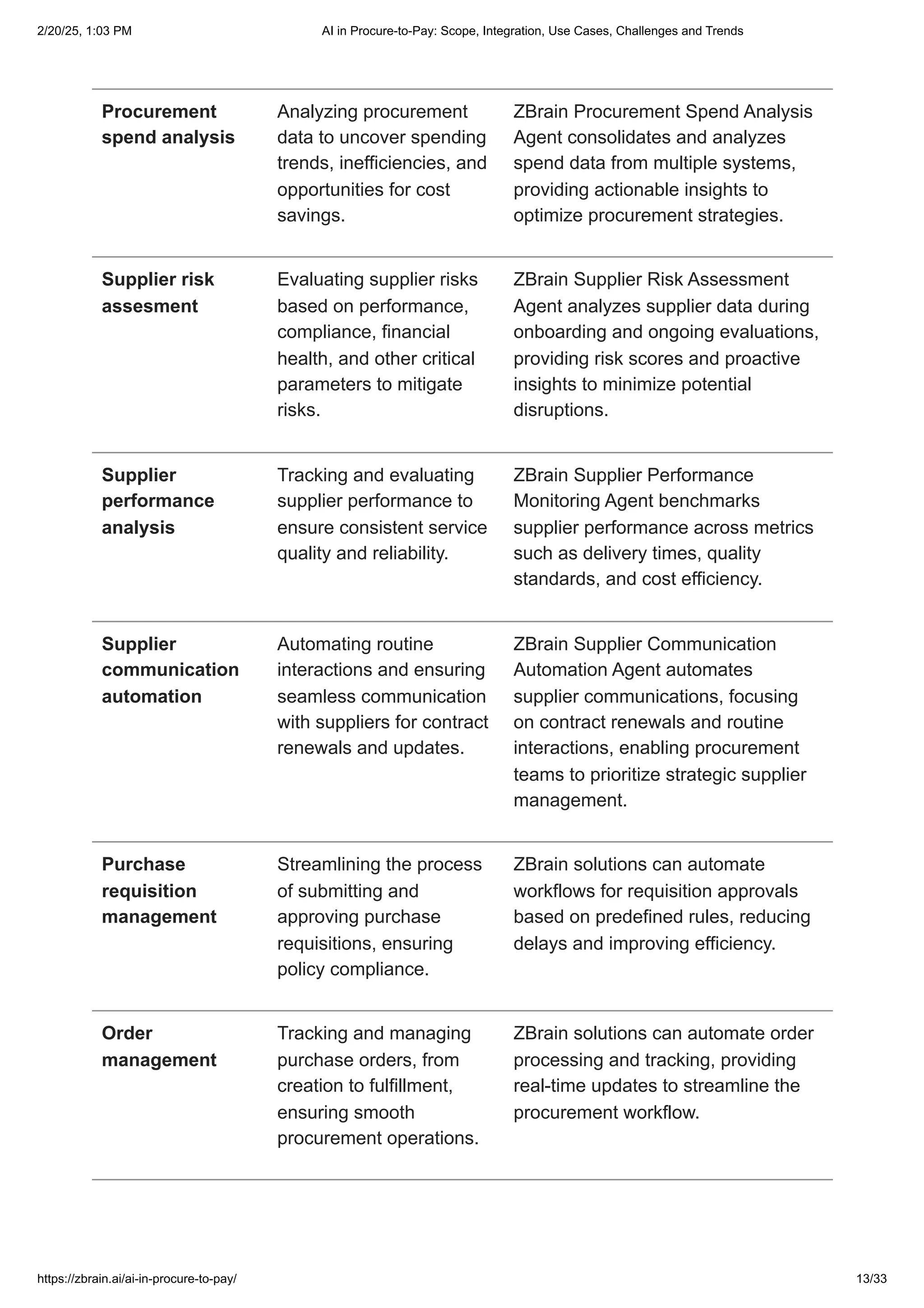
P2P use case Description How ZBrain helps
Budget allocation
and management
Allocating and monitoring
budgets for procurement
activities to ensure
financial discipline.
ZBrain Procurement Budget
Allocation Agent enables
organizations to allocate
procurement budgets effectively.
2/20/25, 1:03 PM AI in Procure-to-Pay: Scope, Integration, Use Cases, Challenges and Trends
https://zbrain.ai/ai-in-procure-to-pay/ 12/33
13.
Procurement
spend analysis
Analyzing procurement
datato uncover spending
trends, inefficiencies, and
opportunities for cost
savings.
ZBrain Procurement Spend Analysis
Agent consolidates and analyzes
spend data from multiple systems,
providing actionable insights to
optimize procurement strategies.
Supplier risk
assesment
Evaluating supplier risks
based on performance,
compliance, financial
health, and other critical
parameters to mitigate
risks.
ZBrain Supplier Risk Assessment
Agent analyzes supplier data during
onboarding and ongoing evaluations,
providing risk scores and proactive
insights to minimize potential
disruptions.
Supplier
performance
analysis
Tracking and evaluating
supplier performance to
ensure consistent service
quality and reliability.
ZBrain Supplier Performance
Monitoring Agent benchmarks
supplier performance across metrics
such as delivery times, quality
standards, and cost efficiency.
Supplier
communication
automation
Automating routine
interactions and ensuring
seamless communication
with suppliers for contract
renewals and updates.
ZBrain Supplier Communication
Automation Agent automates
supplier communications, focusing
on contract renewals and routine
interactions, enabling procurement
teams to prioritize strategic supplier
management.
Purchase
requisition
management
Streamlining the process
of submitting and
approving purchase
requisitions, ensuring
policy compliance.
ZBrain solutions can automate
workflows for requisition approvals
based on predefined rules, reducing
delays and improving efficiency.
Order
management
Tracking and managing
purchase orders, from
creation to fulfillment,
ensuring smooth
procurement operations.
ZBrain solutions can automate order
processing and tracking, providing
real-time updates to streamline the
procurement workflow.
2/20/25, 1:03 PM AI in Procure-to-Pay: Scope, Integration, Use Cases, Challenges and Trends
https://zbrain.ai/ai-in-procure-to-pay/ 13/33
14.
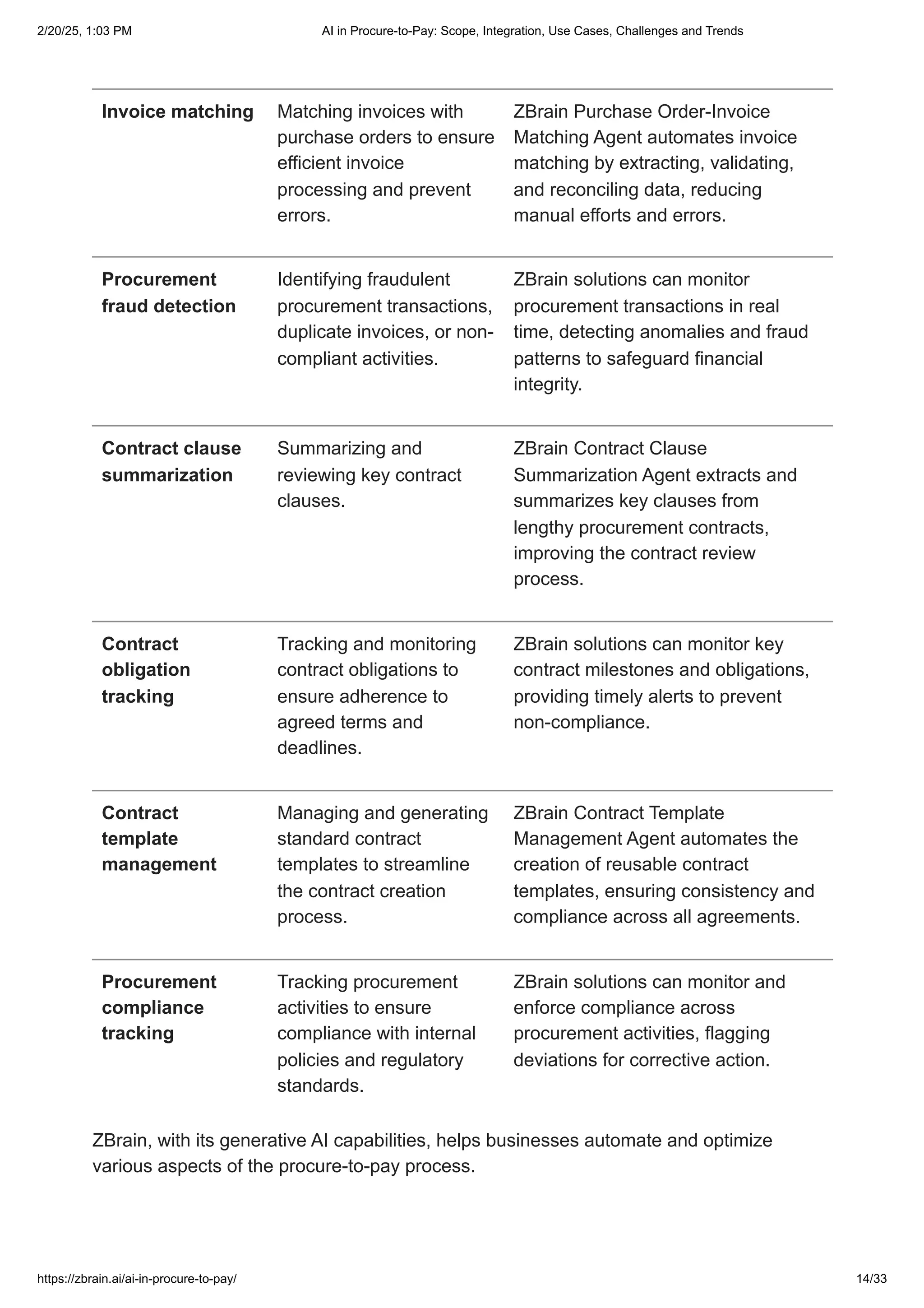
Invoice matching Matchinginvoices with
purchase orders to ensure
efficient invoice
processing and prevent
errors.
ZBrain Purchase Order-Invoice
Matching Agent automates invoice
matching by extracting, validating,
and reconciling data, reducing
manual efforts and errors.
Procurement
fraud detection
Identifying fraudulent
procurement transactions,
duplicate invoices, or non-
compliant activities.
ZBrain solutions can monitor
procurement transactions in real
time, detecting anomalies and fraud
patterns to safeguard financial
integrity.
Contract clause
summarization
Summarizing and
reviewing key contract
clauses.
ZBrain Contract Clause
Summarization Agent extracts and
summarizes key clauses from
lengthy procurement contracts,
improving the contract review
process.
Contract
obligation
tracking
Tracking and monitoring
contract obligations to
ensure adherence to
agreed terms and
deadlines.
ZBrain solutions can monitor key
contract milestones and obligations,
providing timely alerts to prevent
non-compliance.
Contract
template
management
Managing and generating
standard contract
templates to streamline
the contract creation
process.
ZBrain Contract Template
Management Agent automates the
creation of reusable contract
templates, ensuring consistency and
compliance across all agreements.
Procurement
compliance
tracking
Tracking procurement
activities to ensure
compliance with internal
policies and regulatory
standards.
ZBrain solutions can monitor and
enforce compliance across
procurement activities, flagging
deviations for corrective action.
ZBrain, with its generative AI capabilities, helps businesses automate and optimize
various aspects of the procure-to-pay process.
2/20/25, 1:03 PM AI in Procure-to-Pay: Scope, Integration, Use Cases, Challenges and Trends
https://zbrain.ai/ai-in-procure-to-pay/ 14/33
15.
Optimize Your OperationsWith AI Agents
Our AI agents streamline your workflows, unlocking new levels of business efficiency!
Explore Our AI Agents
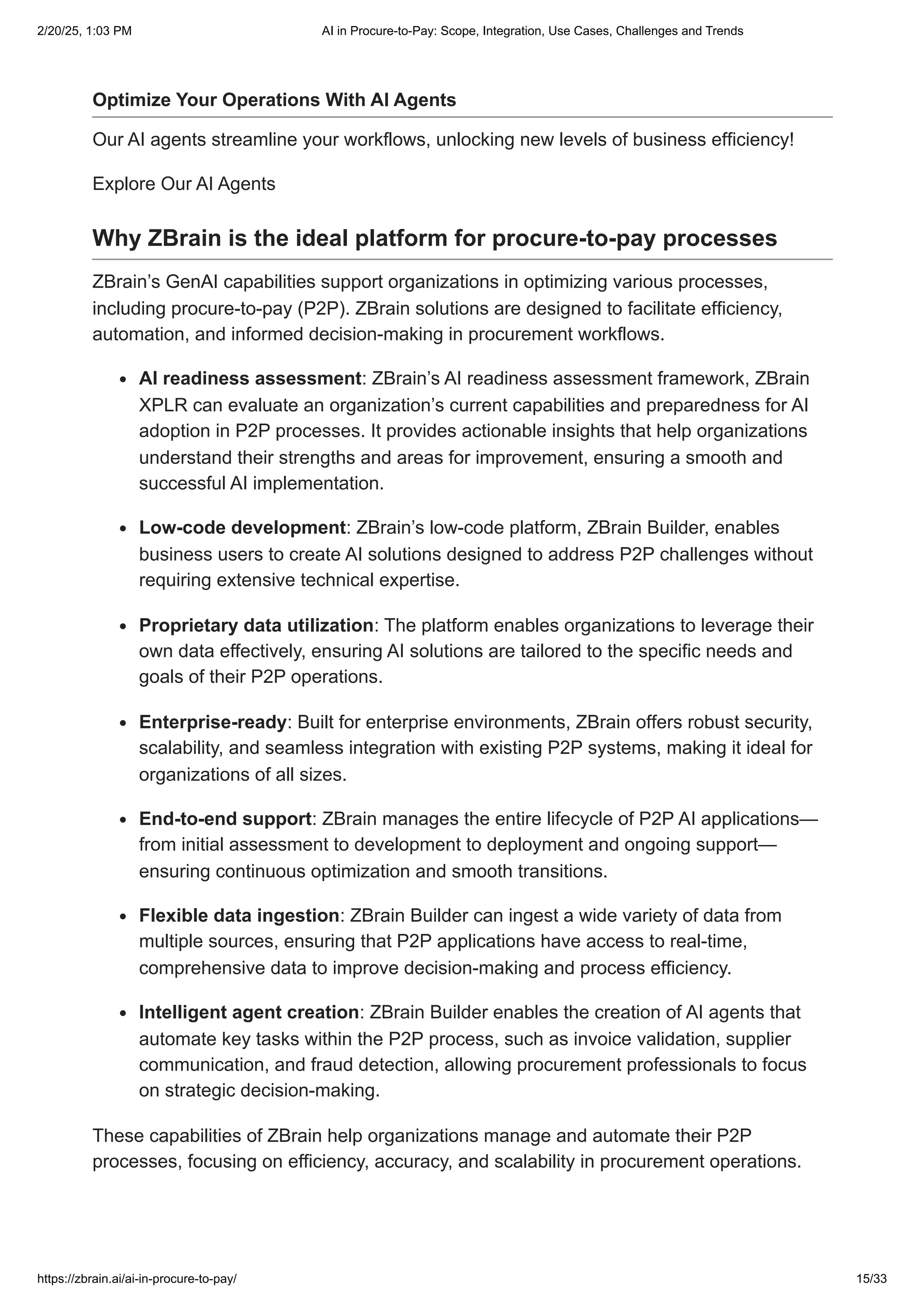
Why ZBrain is the ideal platform for procure-to-pay processes
ZBrain’s GenAI capabilities support organizations in optimizing various processes,
including procure-to-pay (P2P). ZBrain solutions are designed to facilitate efficiency,
automation, and informed decision-making in procurement workflows.
AI readiness assessment: ZBrain’s AI readiness assessment framework, ZBrain
XPLR can evaluate an organization’s current capabilities and preparedness for AI
adoption in P2P processes. It provides actionable insights that help organizations
understand their strengths and areas for improvement, ensuring a smooth and
successful AI implementation.
Low-code development: ZBrain’s low-code platform, ZBrain Builder, enables
business users to create AI solutions designed to address P2P challenges without
requiring extensive technical expertise.
Proprietary data utilization: The platform enables organizations to leverage their
own data effectively, ensuring AI solutions are tailored to the specific needs and
goals of their P2P operations.
Enterprise-ready: Built for enterprise environments, ZBrain offers robust security,
scalability, and seamless integration with existing P2P systems, making it ideal for
organizations of all sizes.
End-to-end support: ZBrain manages the entire lifecycle of P2P AI applications—
from initial assessment to development to deployment and ongoing support—
ensuring continuous optimization and smooth transitions.
Flexible data ingestion: ZBrain Builder can ingest a wide variety of data from
multiple sources, ensuring that P2P applications have access to real-time,
comprehensive data to improve decision-making and process efficiency.
Intelligent agent creation: ZBrain Builder enables the creation of AI agents that
automate key tasks within the P2P process, such as invoice validation, supplier
communication, and fraud detection, allowing procurement professionals to focus
on strategic decision-making.
These capabilities of ZBrain help organizations manage and automate their P2P
processes, focusing on efficiency, accuracy, and scalability in procurement operations.
2/20/25, 1:03 PM AI in Procure-to-Pay: Scope, Integration, Use Cases, Challenges and Trends
https://zbrain.ai/ai-in-procure-to-pay/ 15/33
16.
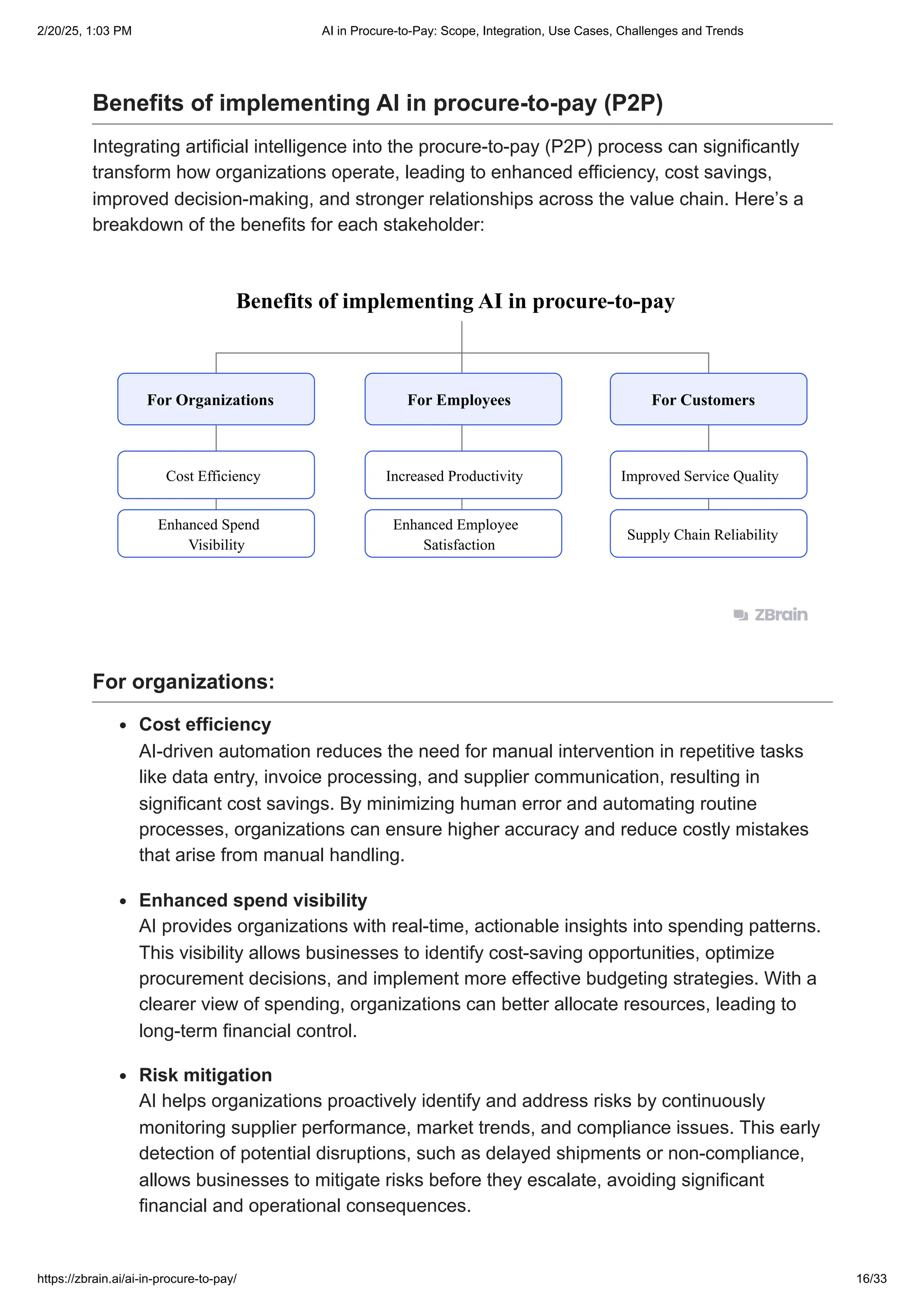
Benefits of implementingAI in procure-to-pay (P2P)
Integrating artificial intelligence into the procure-to-pay (P2P) process can significantly
transform how organizations operate, leading to enhanced efficiency, cost savings,
improved decision-making, and stronger relationships across the value chain. Here’s a
breakdown of the benefits for each stakeholder:
Benefits of implementing AI in procure-to-pay
For Organizations
Cost Efficiency Increased Productivity Improved Service Quality
Enhanced Spend
Visibility
Enhanced Employee
Satisfaction
Supply Chain Reliability
For Employees For Customers
For organizations:
Cost efficiency
AI-driven automation reduces the need for manual intervention in repetitive tasks
like data entry, invoice processing, and supplier communication, resulting in
significant cost savings. By minimizing human error and automating routine
processes, organizations can ensure higher accuracy and reduce costly mistakes
that arise from manual handling.
Enhanced spend visibility
AI provides organizations with real-time, actionable insights into spending patterns.
This visibility allows businesses to identify cost-saving opportunities, optimize
procurement decisions, and implement more effective budgeting strategies. With a
clearer view of spending, organizations can better allocate resources, leading to
long-term financial control.
Risk mitigation
AI helps organizations proactively identify and address risks by continuously
monitoring supplier performance, market trends, and compliance issues. This early
detection of potential disruptions, such as delayed shipments or non-compliance,
allows businesses to mitigate risks before they escalate, avoiding significant
financial and operational consequences.
2/20/25, 1:03 PM AI in Procure-to-Pay: Scope, Integration, Use Cases, Challenges and Trends
https://zbrain.ai/ai-in-procure-to-pay/ 16/33
17.
Scalability
AI solutions scaleeffortlessly with business growth. As procurement volumes
increase, AI can manage higher workloads without requiring additional manual labor
or administrative staff. This scalability ensures operational efficiency even as an
organization expands its operations, allowing procurement to keep pace with
growth.
Data-driven decision making
AI empowers businesses with insights derived from data, enabling smarter, more
informed decisions in sourcing, procurement strategies, and supplier negotiations.
With AI providing actionable data, organizations can align procurement processes
with broader strategic goals, optimizing their approach to supplier management and
contract negotiations.
Increased operational efficiency
By automating manual tasks, AI accelerates the P2P cycle, reduces delays, and
enhances processing times. Automation ensures quicker decision-making, enabling
businesses to respond faster to changing needs and maintain an agile, efficient
procurement process.
For employees:
Increased productivity
AI automates repetitive and time-consuming tasks, freeing up employees to focus
on higher-value activities like strategic decision-making and supplier negotiations.
This boosts overall productivity, allowing employees to concentrate on tasks that
directly contribute to business growth and innovation.
Enhanced employee satisfaction
By removing monotonous, manual tasks, AI enhances job satisfaction, offering
employees the opportunity to engage in more fulfilling, impactful work. This not only
improves morale but also increases employee engagement, resulting in a more
motivated and satisfied workforce.
Skill development opportunities
With AI handling routine tasks, employees have the chance to develop new skills,
particularly in data analysis, strategic decision-making, and the use of AI
technologies. This fosters continuous professional growth, equipping teams with the
skills required to tackle future challenges and leverage emerging technologies.
Improved collaboration
AI facilitates better communication and collaboration across departments by
creating smoother workflows and providing insights into supplier performance,
purchasing trends, and spend patterns. This improved transparency leads to better
cross-functional decision-making, fostering a more efficient and cohesive working
environment.
2/20/25, 1:03 PM AI in Procure-to-Pay: Scope, Integration, Use Cases, Challenges and Trends
https://zbrain.ai/ai-in-procure-to-pay/ 17/33
18.
For customers:
Improved servicequality
The automation and efficiencies introduced by AI in P2P directly improve customer
experiences. Faster order processing, accurate inventory management, and timely
payments ensure that customers receive their products and services promptly,
enhancing the overall reliability and quality of the service.
Supply chain reliability
AI-driven supplier monitoring enables businesses to proactively manage supplier
performance and identify potential risks, ensuring the smooth flow of goods and
services. This increased reliability helps businesses meet customer demand
consistently, reduce disruptions, and maintain customer trust.
Faster response to market changes
AI streamlines procurement processes, enabling businesses to make quicker
decisions and adapt more swiftly to market changes. With AI-enabled agility,
companies can respond to shifts in customer needs, trends, and market conditions,
ensuring they remain competitive and relevant.
Cost savings passed to customers
By optimizing procurement processes and identifying cost-saving opportunities,
businesses can pass these savings on to customers in the form of competitive
pricing. This strengthens the value proposition, improves customer satisfaction, and
enhances long-term customer loyalty.
Enhanced compliance and transparency
AI ensures that procurement processes adhere to regulatory standards and internal
policies by automating compliance monitoring. This not only helps businesses
maintain transparency but also fosters greater trust with customers, ensuring that
organizations meet both customer and regulatory expectations.
Implementing AI in the procure-to-pay process drives efficiency and cost savings and
enhances decision-making and customer satisfaction. By leveraging AI, organizations can
future-proof their procurement functions, fostering long-term growth and resilience in an
ever-evolving marketplace.
Measuring the ROI of AI for procure-to-pay
In procure-to-pay (P2P) processes, the return on investment (ROI) for AI can be
assessed by evaluating direct cost savings, efficiency improvements, and enhanced
decision-making. By implementing ZBrain, organizations can streamline procurement
workflows, reduce manual intervention, and optimize supplier relationships, resulting in
significant financial and operational benefits. ROI is determined by comparing automation
and process optimization savings against the investment. Here’s a closer look at how
ZBrain enhances ROI across key P2P use cases:
2/20/25, 1:03 PM AI in Procure-to-Pay: Scope, Integration, Use Cases, Challenges and Trends
https://zbrain.ai/ai-in-procure-to-pay/ 18/33
19.
ZBrain implementation inprocure-to-pay processes: Key ROI indicators
1. Automated invoice processing
Use case: Automating data extraction, validation, and recording of invoices
into the financial system.
ROI metrics:
Reduced invoice processing costs.
Faster payment cycle times.
Lower error rates in invoice validation.
Example: ZBrain agents can streamline invoice processing by automating the
extraction, validation, and recording of invoice data. By integrating with
enterprise financial systems, these agents can ensure accurate and efficient
processing, reduce manual intervention, minimize payment delays, and
enable opportunities for early payment discounts, ultimately enhancing
financial operations and supplier relationships.
2. Supplier management and risk assessment
Use case: Monitoring supplier performance and assessing risks proactively.
ROI metrics:
Improved supplier compliance.
Reduction in supplier risk incidents.
Enhanced contract performance.
Example: ZBrain agents enhance supplier management by leveraging AI to
analyze supplier data, assess risks, and recommend actionable insights. By
integrating with supplier management systems, these agents enable
organizations to create detailed risk profiles, identify potential issues
proactively, and strengthen supplier relationships, ensuring a resilient and
efficient supply chain.
2/20/25, 1:03 PM AI in Procure-to-Pay: Scope, Integration, Use Cases, Challenges and Trends
https://zbrain.ai/ai-in-procure-to-pay/ 19/33
20.
3. Spend analysis
Usecase: Consolidating and analyzing procurement spend data across
multiple categories.
ROI metrics:
Better spend visibility and control.
Higher cost savings through supplier negotiations.
Reduction in maverick spending.
Example: ZBrain agents can streamline spend analysis by integrating AI to
deliver real-time insights into spending patterns and procurement categories.
These agents empower procurement teams with actionable data, enabling
more informed decision-making and effective supplier negotiations, ultimately
driving cost efficiency and strategic purchasing.
4. Contract management
Use case: Automating contract lifecycle management, including drafting,
tracking, and compliance monitoring.
ROI metrics:
Reduced time for contract creation and approval.
Increased contract compliance rates.
Lower contract-related disputes.
Example: ZBrain agents can simplify contract management by leveraging AI
to generate standard contracts and monitor compliance with contractual
terms. These agents ensure timely renewals, reduce legal risks and enhance
the efficiency of contract administration processes.
2/20/25, 1:03 PM AI in Procure-to-Pay: Scope, Integration, Use Cases, Challenges and Trends
https://zbrain.ai/ai-in-procure-to-pay/ 20/33
21.
5. Fraud detection
Usecase: Identifying anomalies in procurement transactions to prevent fraud.
ROI metrics:
Decreased instances of fraud.
Faster detection of irregularities.
Reduced financial losses due to fraud.
Example: ZBrain agents can enhance fraud detection by utilizing advanced AI
models to analyze transaction patterns, identify anomalies, and flag unusual
activities. These agents can provide actionable insights to prevent
procurement fraud, ensuring secure and transparent procurement processes.
6. Order processing and validation
Use case: Streamlining order requisition, validation, and tracking processes.
ROI metrics:
Shortened order cycle times.
Increased accuracy in order fulfillment.
Reduced manual intervention.
Example: ZBrain agents can streamline order processing by automating
workflows to validate and route orders accurately. These agents can ensure
timely order fulfillment, minimize delays, and reduce errors, enhancing overall
procurement efficiency.
7. Automated approval workflows
2/20/25, 1:03 PM AI in Procure-to-Pay: Scope, Integration, Use Cases, Challenges and Trends
https://zbrain.ai/ai-in-procure-to-pay/ 21/33
22.
8. Use case:Simplifying the routing and approval of purchase orders and invoices.
ROI metrics:
Faster approvals and reduced bottlenecks.
Lower administrative overhead.
Higher compliance with approval policies.
Example: ZBrain agents can streamline approval workflows by automating the
routing of documents through the appropriate channels. These agents can
reduce manual effort, ensure accurate approvals, and maintain timeliness,
enhancing the efficiency of the procurement process.
9. Supplier communication automation
Use case: Automating routine communication with suppliers for updates,
inquiries, and feedback.
ROI metrics:
Improved supplier response times.
Reduced manual communication effort.
Stronger supplier relationships.
Example: ZBrain agents can automate supplier communications by delivering
timely updates and notifications, minimizing manual effort and streamlining the
communication process. This enhances collaboration and improves the
efficiency of supplier interactions within procurement workflows.
These examples demonstrate the tangible benefits of AI in reducing costs, enhancing
operational efficiency, and improving processes within procurement workflows. By
measuring and reporting on these outcomes, organizations can validate the value of their
AI investments and identify opportunities for further AI-driven optimization across various
stages of the procure-to-pay process.
Challenges and considerations in adopting AI for procure-to-pay
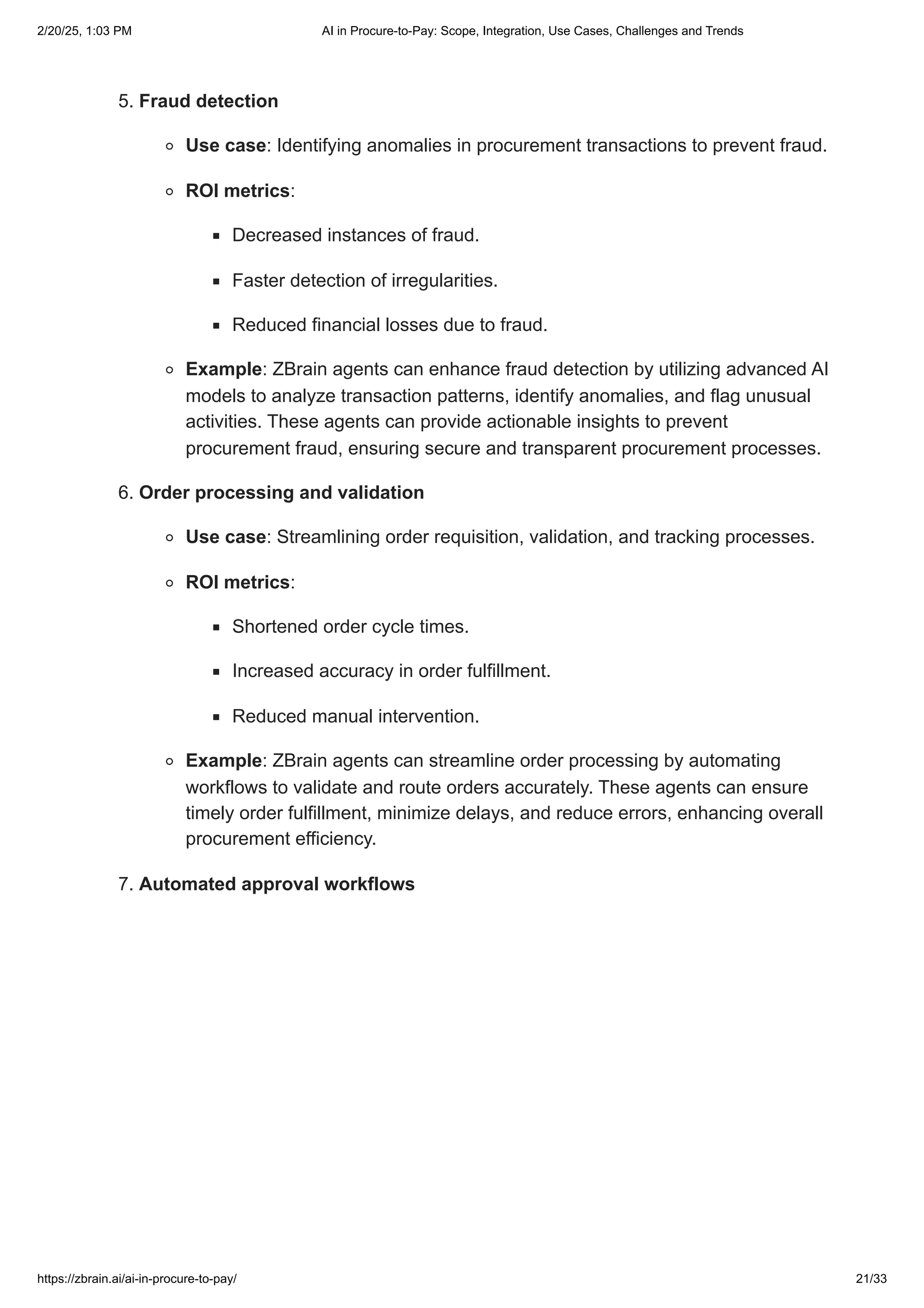
Adopting AI in procure-to-pay (P2P) processes can significantly improve efficiency,
reduce costs, and enhance decision-making. However, several challenges need to be
addressed to ensure a successful implementation. The following table outlines these
challenges and how ZBrain addresses each one:
2/20/25, 1:03 PM AI in Procure-to-Pay: Scope, Integration, Use Cases, Challenges and Trends
https://zbrain.ai/ai-in-procure-to-pay/ 22/33
23.
Challenges
Of P2P
Data Quality
andIntegration
Compliance
and Security
Customization
and Flexibility
Resistance To Change
Workflow
Automation
Aspect Challenge
How ZBrain addresses these
challenges
Data quality
and integration
Fragmented data sources
and legacy systems can
hinder seamless
integration and data
consistency for AI.
ZBrain Builder supports seamless data
integration with existing P2P systems,
ensuring data quality through
preprocessing and normalization and
making it easier to leverage AI
effectively.
Workflow
automation
Identifying which tasks to
automate and managing
exceptions can be
complex, leading to
inefficient processes.
ZBrain’s XPLR framework, combined
with its low-code orchestration platform
ZBrain Builder, can enable users to
precisely identify automation
opportunities and build solutions.
2/20/25, 1:03 PM AI in Procure-to-Pay: Scope, Integration, Use Cases, Challenges and Trends
https://zbrain.ai/ai-in-procure-to-pay/ 23/33
24.
Resistance to
change
Employees mayresist
adopting AI technologies
due to fear of job
displacement or
unfamiliarity with the
tools.
ZBrain ensures smooth user adoption
with AI solutions that are easy to
integrate and use.
Compliance
and security
Ensuring AI systems
comply with regulations
and protecting data
privacy is critical for legal
and ethical reasons.
ZBrain ensures compliance and data
security by implementing robust data
protection measures, adhering to
industry standards and regulations,
and continuously monitoring systems
to safeguard sensitive information.
AI readiness
assessment
Organizations must
assess their AI maturity
before integrating AI-
driven solutions, which is
time- and resource-
intensive.
ZBrain XPLR assesses readiness to
integrate AI into procure-to-pay (P2P)
processes, identifying opportunities for
efficiency and strategic alignment. It
helps maximize ROI and minimize risks
by ensuring AI initiatives support
business goals.
Customization
and flexibility
Standard AI tools may not
address unique P2P
process requirements,
requiring extensive
customization.
ZBrain provides a high level of
customization, allowing businesses to
tailor workflows, data inputs, and AI
models to suit specific P2P challenges
and organizational needs.
Optimize Your Operations With AI Agents
Our AI agents streamline your workflows, unlocking new levels of business efficiency!
Explore Our AI Agents
Best practices for implementing AI in procure-to-pay
Implementing AI in procure-to-pay (P2P) processes offers a significant opportunity to
optimize efficiency, reduce manual errors, and drive better decision-making. However, the
successful adoption of AI requires thoughtful planning, stakeholder engagement, and
strategic execution. Here are some best practices for implementing AI in P2P processes:
2/20/25, 1:03 PM AI in Procure-to-Pay: Scope, Integration, Use Cases, Challenges and Trends
https://zbrain.ai/ai-in-procure-to-pay/ 24/33
25.
1. Assess processreadiness for AI integration
Before diving into AI adoption, it’s essential to evaluate the current state of your P2P
workflows to identify opportunities for improvement.
Map existing workflows: Conduct a comprehensive process discovery to
document and understand the current P2P processes. Identify key pain points,
bottlenecks, and areas where automation can drive the most value, such as invoice
processing or supplier management.
Assess data quality and infrastructure: AI thrives on data, so ensuring your
organization has access to clean, structured, and well-organized data is crucial.
Conduct an audit of your data infrastructure to ensure it can support AI tools
effectively.
Gauge change readiness: Gauge the readiness of your organization for AI
adoption by engaging stakeholders through surveys, focus groups, or interviews.
Understanding their concerns and expectations will help in addressing potential
resistance and aligning goals.
Define clear goals and metrics: Set specific, measurable objectives for your AI
implementation, such as improving supplier relationship management, reducing
invoice cycle time, or enhancing payment accuracy. Define success metrics that
align with broader business goals.
2. Leverage the right AI technology for P2P automation
AI offers several advanced technologies that can significantly enhance P2P processes.
Selecting the right tools for the job will ensure maximum impact.
Machine learning (ML) for predictive analytics: Use ML models to predict trends
such as supplier performance, demand forecasting, or potential payment delays. By
analyzing historical transaction data, AI can provide insights that drive smarter
decisions in procurement and payment processes.
Natural Language Processing (NLP): Implement NLP for automating document
scanning and data extraction from invoices, purchase orders, and contracts. This
reduces manual data entry and errors while streamlining document processing.
OCR and data extraction: Use Optical Character Recognition (OCR) to digitize
and extract relevant data from paper invoices and receipts. This enables faster
processing and integration with digital systems.
Dashboards and reporting tools: Implement AI-driven reporting tools that provide
real-time visibility into key metrics, such as payment status, supplier performance,
and spend analysis. These dashboards allow for better decision-making and
proactive issue resolution.
2/20/25, 1:03 PM AI in Procure-to-Pay: Scope, Integration, Use Cases, Challenges and Trends
https://zbrain.ai/ai-in-procure-to-pay/ 25/33
26.
3. Engage stakeholdersand manage change effectively
AI adoption is not just about technology; it’s also about people. Managing the cultural shift
is a key factor in ensuring successful implementation.
Communicate the AI strategy: Clearly communicate the purpose and benefits of
AI to all stakeholders, emphasizing how it will enhance their roles and simplify their
tasks. Address any concerns about job displacement and reinforce the idea that AI
will enable employees to focus on more strategic, value-added activities.
Provide training and upskilling: Equip employees with the knowledge and skills
needed to operate AI tools and interpret their outputs. Training should be ongoing,
with a focus on upskilling staff on new systems and technologies.
Involve stakeholders early: Involve key stakeholders from procurement, finance,
and IT departments early in the AI integration process. Their input and buy-in are
crucial for the smooth implementation of AI systems.
Pilot and gradual rollout: Consider starting with a pilot phase where AI-driven P2P
processes run in parallel with existing manual processes. This allows teams to
become comfortable with the new system and address any challenges before full-
scale deployment.
Monitor adoption and address resistance: Regularly track adoption rates and
measure the success of AI-driven processes. Address any resistance or challenges
by engaging change agents and offering ongoing support to ensure smooth
integration.
4. Ensure scalability and flexibility for long-term success
The P2P landscape is dynamic, and AI implementations should be flexible enough to
adapt to evolving business needs.
Scalability: Ensure that the AI tools and systems you implement can scale as your
business grows. AI solutions should accommodate increased transaction volumes,
expanded supplier networks, and more complex workflows without requiring
significant rework.
Continuous improvement: AI systems should be continuously fine-tuned and
optimized based on new data, evolving business objectives, and industry trends.
Regularly evaluate the system’s performance and make improvements to maintain
optimal efficiency.
Interoperability: Choose AI solutions that seamlessly integrate with existing
enterprise systems, such as ERP platforms, to create a unified, streamlined
workflow across the entire P2P process. This minimizes disruption and ensures
smooth data flow between systems.
2/20/25, 1:03 PM AI in Procure-to-Pay: Scope, Integration, Use Cases, Challenges and Trends
https://zbrain.ai/ai-in-procure-to-pay/ 26/33
27.
The future ofAI in procure-to-pay
The future of AI in procure-to-pay (P2P) will bring significant advancements in various
aspects of the procurement process. Key improvements and emerging technologies
include:
1. Advanced predictive analytics
AI-driven predictive models will enable procurement teams to anticipate demand
fluctuations, optimize inventory levels, and better manage supplier relationships. By
analyzing historical data, market conditions, and trends, AI can predict price changes,
potential disruptions, and demand surges, empowering procurement managers to make
proactive decisions, minimize costs, and avoid stockouts or overstocking.
2. Self-learning AI systems
AI systems that continuously adapt and improve by learning from changing
procurement patterns, market conditions, and supplier dynamics could become
mainstream. This continuous learning will make AI solutions more personalized,
accurate, and effective, reducing manual intervention and enhancing decision-
making.
3. Blockchain integration for transparency and security
AI integration with blockchain technology enhances data integrity, transparency, and
security in P2P transactions. Blockchain technology will enhance the security of
procurement activities, such as payments, contract executions, and supplier
interactions. At the same time, AI will analyze the data stored on the blockchain to
verify compliance with regulations, detect potential fraud by identifying suspicious
activities, and monitor governance to ensure that procurement operations follow
established rules and standards.
4. Sustainability optimization
AI will help organizations align procurement decisions with sustainability objectives
by analyzing environmental impact, social practices, and supplier sustainability
certifications. This future capability will enable AI to recommend suppliers and
products that meet sustainability criteria and track the lifecycle of products to reduce
waste and optimize resource usage, supporting corporate social responsibility
(CSR) goals.
2/20/25, 1:03 PM AI in Procure-to-Pay: Scope, Integration, Use Cases, Challenges and Trends
https://zbrain.ai/ai-in-procure-to-pay/ 27/33
28.
5. Real-time decision-makingand process optimization:
AI enables real-time decision-making by analyzing up-to-the-minute data on
inventory, supplier performance, and market conditions. Future AI advancements
will optimize workflows such as purchase orders, supplier sourcing, and stock
replenishment, offering instant insights into the best course of action based on real-
time information and automatically recommending process adjustments.
These advancements in AI will further transform P2P processes, enhancing agility,
compliance, sustainability, and operational efficiency.
Transform procure-to-pay operations with ZBrain
ZBrain is a comprehensive AI platform designed to assist organizations in identifying
automation opportunities and managing workflows within their procure-to-pay (P2P)
operations. It supports the P2P lifecycle—from requisition to payment—by offering
intelligent, customizable AI solutions aligned with business goals.
ZBrain XPLR empowers businesses by assessing their AI readiness, preparing them for
successful AI integration. The comprehensive assessment uncovers areas for
improvement and helps align AI strategies with business objectives, ensuring a smooth
transition to AI-driven solutions and minimizing potential risks.
ZBrain Builder provides a suite of tools, pre-built components, and an intuitive interface to
help users leverage AI agents for automating tasks within P2P processes. These agents
can handle activities such as supplier communications, invoice validation, compliance,
and spend analysis, all aimed at supporting and streamlining procurement operations.
By integrating seamlessly with existing systems, offering scalability, and ensuring security,
ZBrain can help organizations transform their P2P operations, improve efficiency, and
stay competitive in today’s rapidly changing business environment.
Endnote
The integration of AI into procure-to-pay (P2P) operations is reshaping the way
organizations manage procurement processes. AI brings significant improvements across
the entire P2P lifecycle, automating repetitive tasks, optimizing workflows, and providing
actionable insights that enhance decision-making. This shift allows organizations to
operate more efficiently, reduce manual effort, and achieve better alignment with business
goals.
As AI continues to evolve, its role in optimizing procurement operations will only grow.
ZBrain equips organizations to leverage AI effectively, streamlining procurement
processes, enhancing operational efficiency, and positioning businesses for sustained
success. Embracing AI with the support of platforms like ZBrain is crucial for
organizations that want to lead in today’s dynamic and competitive business environment.
2/20/25, 1:03 PM AI in Procure-to-Pay: Scope, Integration, Use Cases, Challenges and Trends
https://zbrain.ai/ai-in-procure-to-pay/ 28/33
29.
Ready to transformyour procurement process with AI? Unlock the full potential of your
P2P operations with ZBrain’s intelligent automation, driving efficiency, cost savings, and
smarter decision-making across your supply chain!
Listen to the article
Author’s Bio
Akash Takyar
CEO LeewayHertz
Akash Takyar, the founder and CEO of LeewayHertz and ZBrain, is a pioneer in
enterprise technology and AI-driven solutions. With a proven track record of
conceptualizing and delivering more than 100 scalable, user-centric digital products,
Akash has earned the trust of Fortune 500 companies, including Siemens, 3M, P&G, and
Hershey’s.
An early adopter of emerging technologies, Akash leads innovation in AI, driving
transformative solutions that enhance business operations. With his entrepreneurial spirit,
technical acumen and passion for AI, Akash continues to explore new horizons,
empowering businesses with solutions that enable seamless automation, intelligent
decision-making, and next-generation digital experiences.
Table of content
Frequently Asked Questions
What is ZBrain, and how can it transform the procure-to-pay (P2P) process with AI?
ZBrain is a comprehensive, full-stack AI platform designed to streamline the AI readiness
assessment, use case identification, development and deployment of AI agents to
automate the procure-to-pay (P2P) processes. From data integration and model
customization to deployment and continuous optimization, ZBrain provides end-to-end
support for AI implementation in P2P workflows.
Here’s how ZBrain enhances P2P processes:
2/20/25, 1:03 PM AI in Procure-to-Pay: Scope, Integration, Use Cases, Challenges and Trends
https://zbrain.ai/ai-in-procure-to-pay/ 29/33
30.
AI readiness assessmentwith ZBrain XPLR: ZBrain XPLR provides a
comprehensive AI readiness assessment, helping organizations evaluate their
current state and identify key opportunities for AI adoption in P2P processes. It
analyzes existing workflows, data quality, and system integration capabilities to
ensure smooth AI integration. ZBrain XPLR guides businesses toward informed,
strategic AI adoption for enhanced procurement operations by assessing AI maturity
and highlighting automation possibilities.
Seamless data ingestion and integration: ZBrain Builder connects with multiple
data sources, including procurement systems, supplier databases, and financial
tools. This allows the platform to ingest structured and unstructured data efficiently,
creating a unified data pipeline that ensures accurate and real-time insights.
Low-code development environment: ZBrain Builder provides a low-code
interface, empowering procurement teams to build AI applications without extensive
programming knowledge. This reduces development cycles and allows quicker
deployment of AI tools tailored to specific P2P needs.
Cloud and model flexibility: ZBrain supports various AI models, such as GPT-4
and LLaMA, as well as cloud environments like AWS, Azure, and GCP. This
flexibility ensures organizations can select the optimal infrastructure and models for
their P2P processes, balancing performance and cost.
Enhanced compliance and governance: ZBrain’s AI capabilities assist in
monitoring regulatory compliance and internal governance policies, flagging
potential risks and ensuring audit readiness throughout the P2P lifecycle.
By offering a flexible, low-code platform combined with robust data handling and
customization options, ZBrain empowers organizations to automate, optimize, and
innovate across the entire procure-to-pay process.
How does ZBrain ensure the security and privacy of sensitive data in procure-to-pay (P2P) processes?
Can ZBrain agents be integrated with existing procure-to-pay (P2P) systems?
What kind of P2P applications can be built on ZBrain?
How does ZBrain cater to diverse procurement needs across different industries?
How can we measure the ROI of ZBrain in our procure-to-pay (P2P) processes?
How can I get started with ZBrain for my procure-to-pay (P2P) processes?
Insights
2/20/25, 1:03 PM AI in Procure-to-Pay: Scope, Integration, Use Cases, Challenges and Trends
https://zbrain.ai/ai-in-procure-to-pay/ 30/33
31.
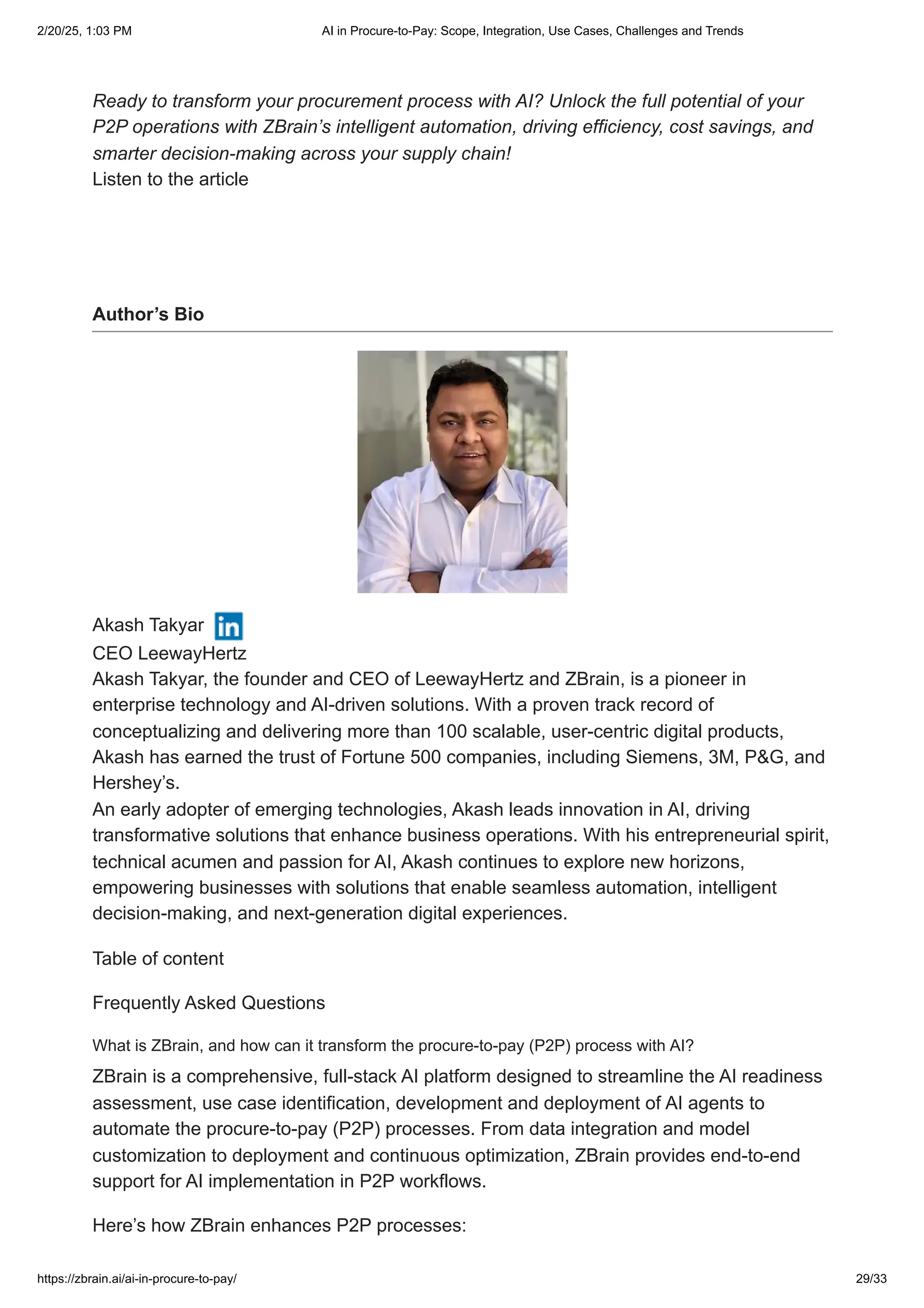
CUA models
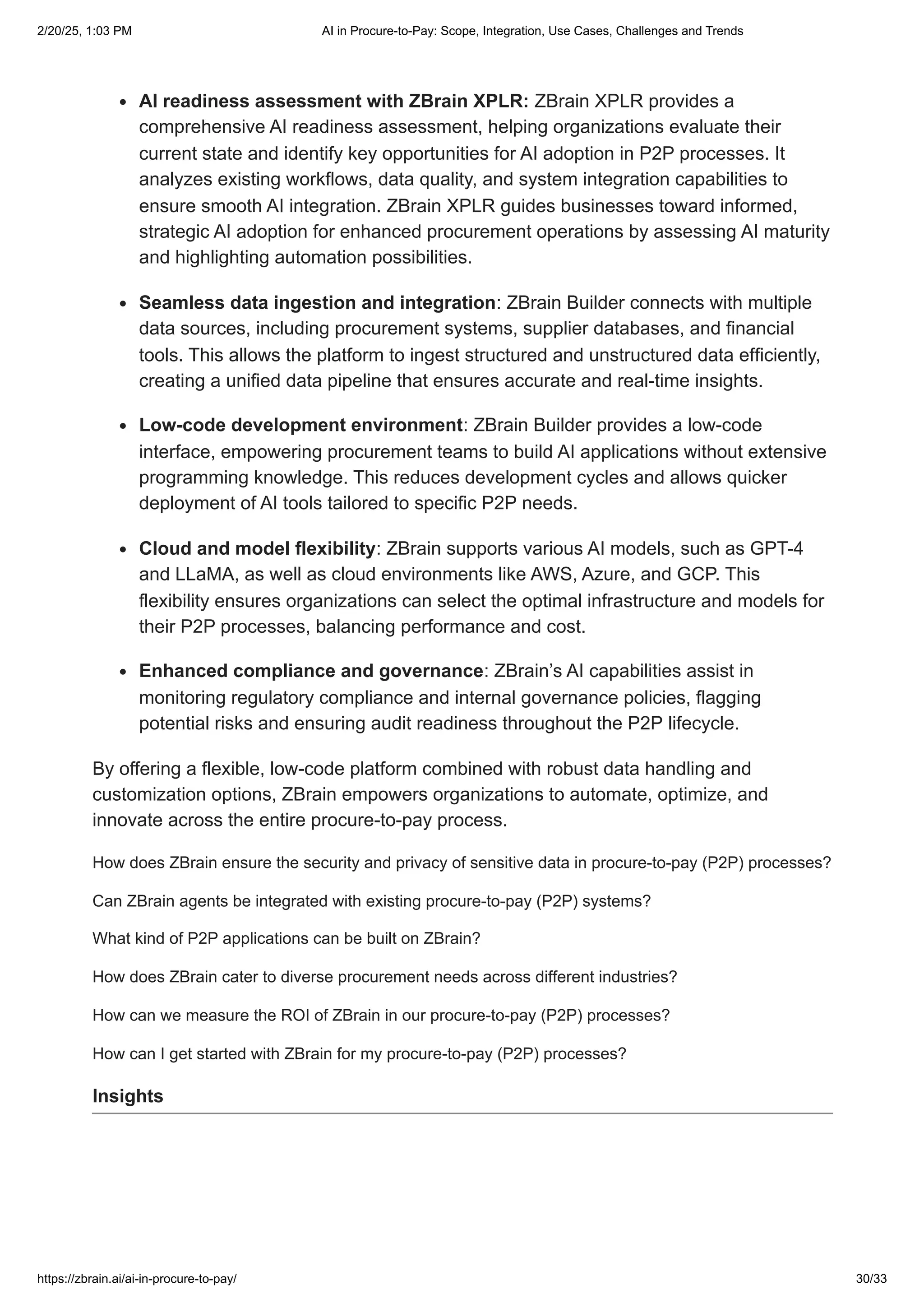
AI inaccount-to-report
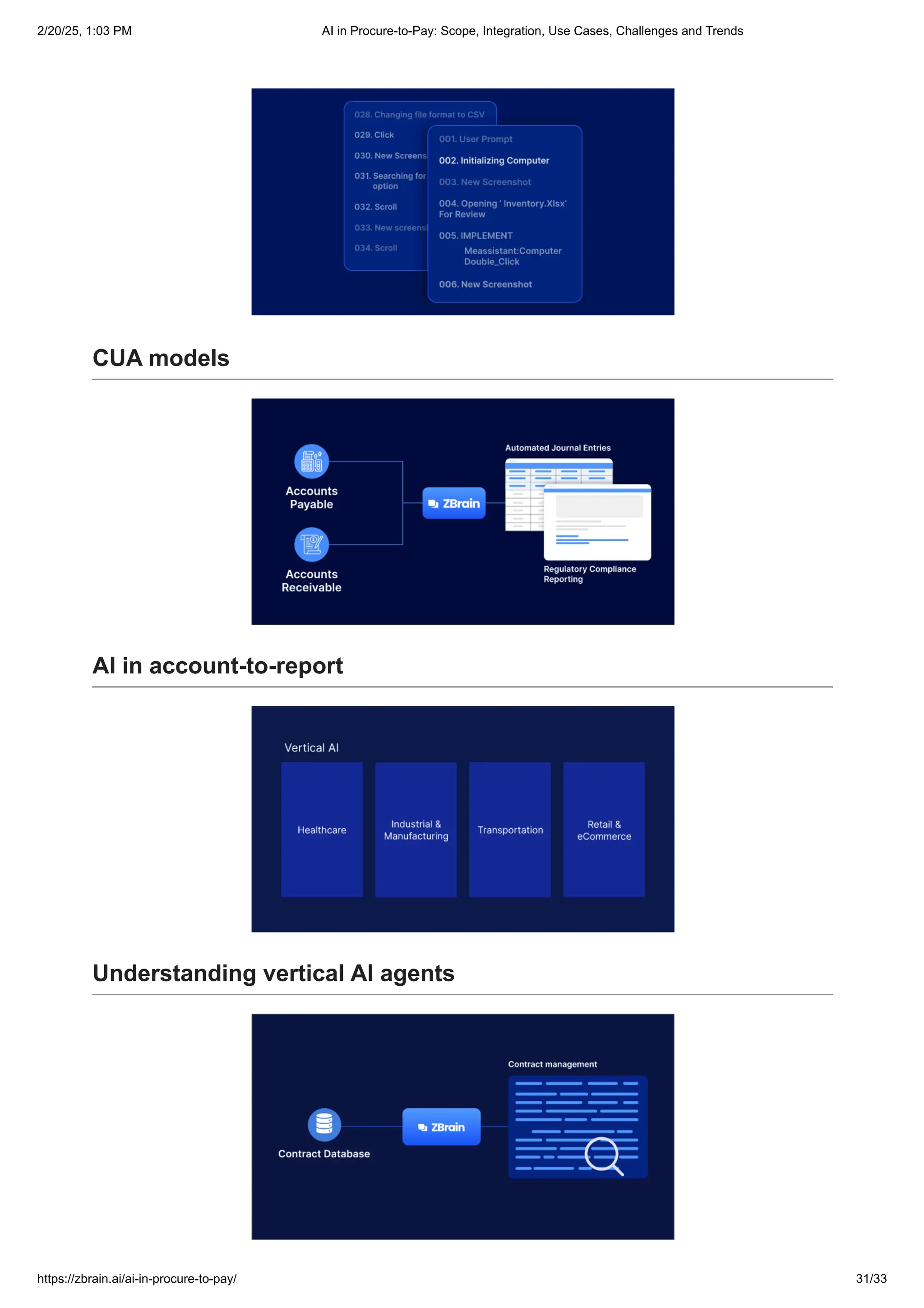
Understanding vertical AI agents
2/20/25, 1:03 PM AI in Procure-to-Pay: Scope, Integration, Use Cases, Challenges and Trends
https://zbrain.ai/ai-in-procure-to-pay/ 31/33
32.
Generative AI forcontracts management
Generative AI in manufacturing
Generative AI in customer service
Generative AI for regulatory compliance
2/20/25, 1:03 PM AI in Procure-to-Pay: Scope, Integration, Use Cases, Challenges and Trends
https://zbrain.ai/ai-in-procure-to-pay/ 32/33
33.
Generative AI indue diligence
Generative AI in logistics
2/20/25, 1:03 PM AI in Procure-to-Pay: Scope, Integration, Use Cases, Challenges and Trends
https://zbrain.ai/ai-in-procure-to-pay/ 33/33