PASIA Conference
November 8 and 9 2016
Manila Philippines
Presented by
Bill Kohnen
Purchasing and Accounts Payable Future
Relationship: What Opportunities and Challenges will
arise with the blurring of traditional lines between
Purchasing and Accounts Payable
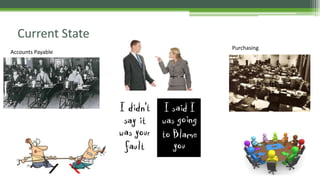
Current State
Accounts Payable
Purchasing
• The lines between traditional Purchasing and Accounts Payable are blurring
and in some organizations have already been eliminated.
• As a result there are organizational changes as well as changes in skills
needed
• Drivers for this have been technology, Procure to Pay approach, globalization
and focus on electronic payments
• In some respects transformation has been significant but still areas of
traditional practice. However, speed of change with increase.
Introduction
• Traditional Roles
• Emerging Roles
• Shared Metrics - Examples
• Procure to Pay
• Technology Impact
• Skills Needed
Overview
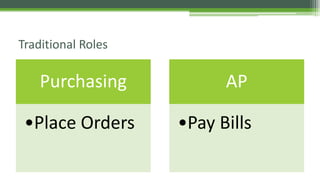
Traditional Roles
Purchasing
•Place Orders
AP
•Pay Bills
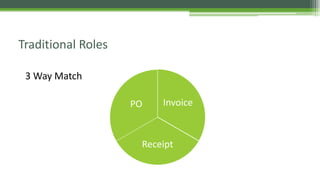
Traditional Roles
Invoice
Receipt
PO
3 Way Match
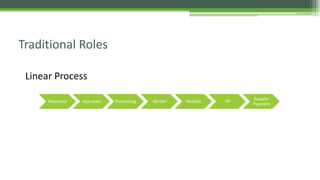
Traditional Roles
Linear Process
Requestor Approvals Purchasing Vendor Receipt AP
Supplier
Payment
• Inconsistent supplier master data setup
• Poor communication to resolve issues
• Frustrating invoice errors
• Overlapping AP and purchasing roles that create conflict
• Late payments to suppliers that dilute discounts negotiated by
purchasing
• Off the record purchases off the purchasing radar
Traditional Issues
Policy
• Adopt a “no PO, no pay” policy: This will be challenging. It can also be impractical at first, but the benefits of implementing policies this serious will payoff in the future. Proper
planning is required as well as employee/vendor education campaigns, discipline and executive sponsorship.
• Block buyer access to invoices / Block AP from issuing POs: Do NOT allow buyers to approve invoices or issue payments for purchases ordered. Flip the coin and the situation is the
same, you cannot have AP place orders they can quickly approve on their own.
• POs must be accurate and complete: The purchasing group must be held accountable for bad data on the PO. Most invoice errors can be tracked back to an incorrect or incomplete
PO, and holding your purchasers to a higher standard can eliminate this problem.
• Align purchasing activities with cash flow goals: Take a prudent purchasing approach depending on cash flow. For example, revert to smaller incremental purchases at higher unit
price when cash is tight, even if demand is high.
• Resolve pricing and receiving discrepancies through purchasing: Requesters, buyers and receivers are better positioned to track down discrepancy facts. Having this group resolve
these issues is much more efficient and can save time. AP should only mediate as needed.
Process
• AP to hold their purchasing related questions till day's end: This works naturally great in centralized purchasing environments, and can be made to work in a decentralized one using
tools to properly dispatch questions. Enforce a 24-hour turnaround. This ensures AP gets their answers without causing distractions and irritations in purchasing.
• AP should inform purchasing of payment holds and invoices past due ASAP: Purchasing generally owns supplier relationships and needs reasonable heads up to proactively take the
news to the supplier and do damage control as necessary. The last thing a buyer wants is to be caught off guard by a vendor call asking for payment.
• AP should inform purchasing of spend outside vendor contracts: This is also known as maverick spending. AP should report all non-PO to purchasing, reimbursable and P-card activity
by vendor, item category and line-item details if available. Identifying and addressing these will put more spend under control and help negotiate more favorable contracts with
suppliers.
• Share monthly reports with executives on key metrics: Don't assume everything is going well if management is not asking for these reports. Agree on key metrics to report on, keep
executives informed of departmental performance and looming issues.
• Agree on a process for setting up new vendors: AP and purchasing must work from a unified, agreed upon vendor master list, free from duplicates, and always up to date. AP can take
ownership of maintaining that list, and hold purchasing and business unit managers accountable for adhering to it
Traditional Solutions
“Aligning Accounts Payable and Purchasing” Hadi Chemaly, 26, 2014 on Spend Matters
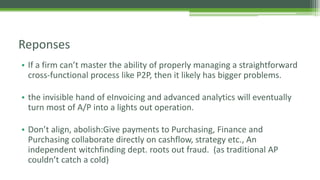
• If a firm can’t master the ability of properly managing a straightforward
cross-functional process like P2P, then it likely has bigger problems.
• the invisible hand of eInvoicing and advanced analytics will eventually
turn most of A/P into a lights out operation.
• Don’t align, abolish:Give payments to Purchasing, Finance and
Purchasing collaborate directly on cashflow, strategy etc., An
independent witchfinding dept. roots out fraud. (as traditional AP
couldn’t catch a cold)
Reponses
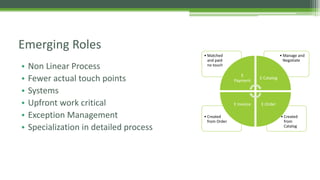
• Non Linear Process
• Fewer actual touch points
• Systems
• Upfront work critical
• Exception Management
• Specialization in detailed process
Emerging Roles
• Created
from
Catalog
• Created
from Order
• Manage and
Negotiate
• Matched
and paid
no touch
E
Payment
E Catalog
E OrderE Invoice
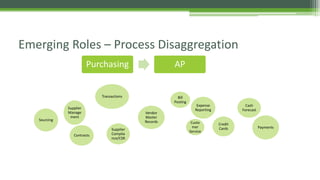
Emerging Roles – Process Disaggregation
Purchasing AP
Sourcing
Vendor
Master
Records
Supplier
Manage
ment
Contracts
Transactions
Supplier
Complia
nce/CSR
Bill
Posting
Expense
Reporting
Custo
mer
Service
Credit
Cards
Cash
Forecast
Payments
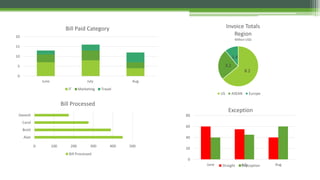
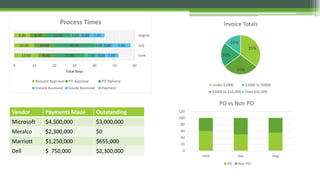
• Shared Process = Shared Metrics
• Finally answer to spend analytics?
• Purchasing people will be pleased with treasure trove of data in AP
• Total Spend, Who, What, When all there however format may need
work to be more actionable.
• Expense Reports For Example
▫ Often just high level description Hotel but no requirement to say which one
other than on receipt
Shared Metrics
0
5
10
15
20
June July Aug
Bill Paid Category
IT Marketing Travel
8.2
3.2
1.4
Invoice Totals
Region
Million USD
US ASEAN Europe
0 100 200 300 400 500
Alan
Brett
Carol
Danesh
Bill Processed
Bill Processed
0
20
40
60
80
June July Aug
Exception
Straight Expception
12.00
10.00
8.00
8.00
10.00
8.00
15.00
20.00
12.00
7.00
4.00
5.00
3.00
5.00
5.00
7.00
9.00
7.00
0 10 20 30 40 50 60
June
July
August
Total Days
Process Times
Request Approval PO Approval PO Delivery
Invoice Received Goods Received Payment
35%
30%
20%
15%
Invoice Totals
Under $1000 $1000 to $5000
$5000 to $10,000 Over $10,000
Vendor Payments Made Outstanding
Microsoft $4,500,000 $3,000,000
Meralco $2,300,000 $0
Marriott $1,250,000 $655,000
Dell $ 750,000 $2,300,000 0
20
40
60
80
100
120
June July Aug
PO vs Non PO
PO Non PO
• Cloud
• Touchless Processing
• Smart Systems
• E Payments
• Traditional ERP systems evolving
▫ Invesetments in IoT
▫ 4 generation manufacturing
▫ Cloud
Technology Impact
• Master Data Management
• Systems and Technology
• Data Analytics
• Project Management
• Negotiation
• Specialization
Skills Needed
• A Single Process from request to pay
• Integrated Process
• System Focus
• Problem Solving and Customer Support
• Even mature R2P typically requires 40% or more exception processing
Procure to Pay (P2P)
Request to Pay (R2P)
• Traditional Process and Operations will exist maybe for one more “work
generation”
▫ Lower end industries
▫ Family owned
▫ Where regional constraints require traditional process
▫ Risk of being near potentially corrupt systems
▫ Viable source of employment however, limited opportunity, pay
Summary
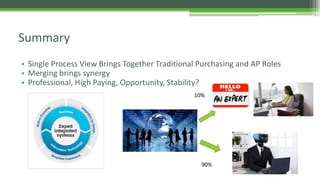
• Single Process View Brings Together Traditional Purchasing and AP Roles
• Merging brings synergy
• Professional, High Paying, Opportunity, Stability?
Summary
10%
90%

Purchasing and Accounts Payable Future Relationship

  • 1.
    PASIA Conference November 8and 9 2016 Manila Philippines Presented by Bill Kohnen Purchasing and Accounts Payable Future Relationship: What Opportunities and Challenges will arise with the blurring of traditional lines between Purchasing and Accounts Payable
  • 2.
  • 3.
    • The linesbetween traditional Purchasing and Accounts Payable are blurring and in some organizations have already been eliminated. • As a result there are organizational changes as well as changes in skills needed • Drivers for this have been technology, Procure to Pay approach, globalization and focus on electronic payments • In some respects transformation has been significant but still areas of traditional practice. However, speed of change with increase. Introduction
  • 4.
    • Traditional Roles •Emerging Roles • Shared Metrics - Examples • Procure to Pay • Technology Impact • Skills Needed Overview
  • 5.
  • 6.
  • 7.
    Traditional Roles Linear Process RequestorApprovals Purchasing Vendor Receipt AP Supplier Payment
  • 8.
    • Inconsistent suppliermaster data setup • Poor communication to resolve issues • Frustrating invoice errors • Overlapping AP and purchasing roles that create conflict • Late payments to suppliers that dilute discounts negotiated by purchasing • Off the record purchases off the purchasing radar Traditional Issues
  • 9.
    Policy • Adopt a“no PO, no pay” policy: This will be challenging. It can also be impractical at first, but the benefits of implementing policies this serious will payoff in the future. Proper planning is required as well as employee/vendor education campaigns, discipline and executive sponsorship. • Block buyer access to invoices / Block AP from issuing POs: Do NOT allow buyers to approve invoices or issue payments for purchases ordered. Flip the coin and the situation is the same, you cannot have AP place orders they can quickly approve on their own. • POs must be accurate and complete: The purchasing group must be held accountable for bad data on the PO. Most invoice errors can be tracked back to an incorrect or incomplete PO, and holding your purchasers to a higher standard can eliminate this problem. • Align purchasing activities with cash flow goals: Take a prudent purchasing approach depending on cash flow. For example, revert to smaller incremental purchases at higher unit price when cash is tight, even if demand is high. • Resolve pricing and receiving discrepancies through purchasing: Requesters, buyers and receivers are better positioned to track down discrepancy facts. Having this group resolve these issues is much more efficient and can save time. AP should only mediate as needed. Process • AP to hold their purchasing related questions till day's end: This works naturally great in centralized purchasing environments, and can be made to work in a decentralized one using tools to properly dispatch questions. Enforce a 24-hour turnaround. This ensures AP gets their answers without causing distractions and irritations in purchasing. • AP should inform purchasing of payment holds and invoices past due ASAP: Purchasing generally owns supplier relationships and needs reasonable heads up to proactively take the news to the supplier and do damage control as necessary. The last thing a buyer wants is to be caught off guard by a vendor call asking for payment. • AP should inform purchasing of spend outside vendor contracts: This is also known as maverick spending. AP should report all non-PO to purchasing, reimbursable and P-card activity by vendor, item category and line-item details if available. Identifying and addressing these will put more spend under control and help negotiate more favorable contracts with suppliers. • Share monthly reports with executives on key metrics: Don't assume everything is going well if management is not asking for these reports. Agree on key metrics to report on, keep executives informed of departmental performance and looming issues. • Agree on a process for setting up new vendors: AP and purchasing must work from a unified, agreed upon vendor master list, free from duplicates, and always up to date. AP can take ownership of maintaining that list, and hold purchasing and business unit managers accountable for adhering to it Traditional Solutions “Aligning Accounts Payable and Purchasing” Hadi Chemaly, 26, 2014 on Spend Matters
  • 10.
    • If afirm can’t master the ability of properly managing a straightforward cross-functional process like P2P, then it likely has bigger problems. • the invisible hand of eInvoicing and advanced analytics will eventually turn most of A/P into a lights out operation. • Don’t align, abolish:Give payments to Purchasing, Finance and Purchasing collaborate directly on cashflow, strategy etc., An independent witchfinding dept. roots out fraud. (as traditional AP couldn’t catch a cold) Reponses
  • 11.
    • Non LinearProcess • Fewer actual touch points • Systems • Upfront work critical • Exception Management • Specialization in detailed process Emerging Roles • Created from Catalog • Created from Order • Manage and Negotiate • Matched and paid no touch E Payment E Catalog E OrderE Invoice
  • 12.
    Emerging Roles –Process Disaggregation Purchasing AP Sourcing Vendor Master Records Supplier Manage ment Contracts Transactions Supplier Complia nce/CSR Bill Posting Expense Reporting Custo mer Service Credit Cards Cash Forecast Payments
  • 13.
    • Shared Process= Shared Metrics • Finally answer to spend analytics? • Purchasing people will be pleased with treasure trove of data in AP • Total Spend, Who, What, When all there however format may need work to be more actionable. • Expense Reports For Example ▫ Often just high level description Hotel but no requirement to say which one other than on receipt Shared Metrics
  • 14.
    0 5 10 15 20 June July Aug BillPaid Category IT Marketing Travel 8.2 3.2 1.4 Invoice Totals Region Million USD US ASEAN Europe 0 100 200 300 400 500 Alan Brett Carol Danesh Bill Processed Bill Processed 0 20 40 60 80 June July Aug Exception Straight Expception
  • 15.
    12.00 10.00 8.00 8.00 10.00 8.00 15.00 20.00 12.00 7.00 4.00 5.00 3.00 5.00 5.00 7.00 9.00 7.00 0 10 2030 40 50 60 June July August Total Days Process Times Request Approval PO Approval PO Delivery Invoice Received Goods Received Payment 35% 30% 20% 15% Invoice Totals Under $1000 $1000 to $5000 $5000 to $10,000 Over $10,000 Vendor Payments Made Outstanding Microsoft $4,500,000 $3,000,000 Meralco $2,300,000 $0 Marriott $1,250,000 $655,000 Dell $ 750,000 $2,300,000 0 20 40 60 80 100 120 June July Aug PO vs Non PO PO Non PO
  • 16.
    • Cloud • TouchlessProcessing • Smart Systems • E Payments • Traditional ERP systems evolving ▫ Invesetments in IoT ▫ 4 generation manufacturing ▫ Cloud Technology Impact
  • 17.
    • Master DataManagement • Systems and Technology • Data Analytics • Project Management • Negotiation • Specialization Skills Needed
  • 18.
    • A SingleProcess from request to pay • Integrated Process • System Focus • Problem Solving and Customer Support • Even mature R2P typically requires 40% or more exception processing Procure to Pay (P2P) Request to Pay (R2P)
  • 19.
    • Traditional Processand Operations will exist maybe for one more “work generation” ▫ Lower end industries ▫ Family owned ▫ Where regional constraints require traditional process ▫ Risk of being near potentially corrupt systems ▫ Viable source of employment however, limited opportunity, pay Summary
  • 20.
    • Single ProcessView Brings Together Traditional Purchasing and AP Roles • Merging brings synergy • Professional, High Paying, Opportunity, Stability? Summary 10% 90%

Editor's Notes

  • #4 How presentation will benefit audience: Adult learners are more interested in a subject if they know how or why it is important to them. Presenter’s level of expertise in the subject: Briefly state your credentials in this area, or explain why participants should listen to you.
  • #5 Lesson descriptions should be brief.
  • #6 Example objectives At the end of this lesson, you will be able to: Save files to the team Web server. Move files to different locations on the team Web server. Share files on the team Web server.
  • #7 Example objectives At the end of this lesson, you will be able to: Save files to the team Web server. Move files to different locations on the team Web server. Share files on the team Web server.
  • #8 Example objectives At the end of this lesson, you will be able to: Save files to the team Web server. Move files to different locations on the team Web server. Share files on the team Web server.