Marketing Capabilities
Case Study
Overview
• History
• Brands
• Case Analysis
• Organizational
Structure
• Objectives
• Conclusion
• Disclaimer
History of
Procter & Gamble
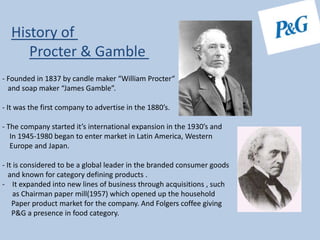
- Founded in 1837 by candle maker “William Procter“
and soap maker “James Gamble”.
- It was the first company to advertise in the 1880’s.
- The company started it’s international expansion in the 1930’s and
In 1945-1980 began to enter market in Latin America, Western
Europe and Japan.
- It is considered to be a global leader in the branded consumer goods
and known for category defining products .
- It expanded into new lines of business through acquisitions , such
as Chairman paper mill(1957) which opened up the household
Paper product market for the company. And Folgers coffee giving
P&G a presence in food category.
Brands
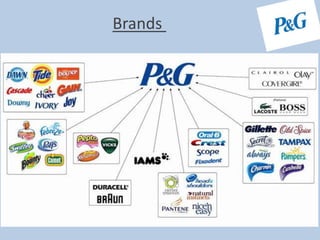
- Innovation helped round out the company portfolio: disposal diapers
(Pampers), first marketed in the early 60’s.
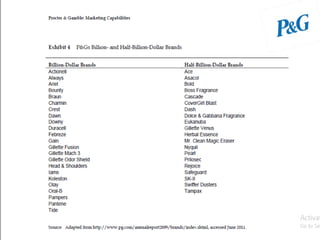
- In the 1980’s , P&G ramped up its global expansion and developed its first global brands
including Always, Pringles , and Pantene.
- The $57 billion acquisition of Gillete in 2005 made P&G the top consumer goods company
Gillete business drag on P&G’s top line ,most of the senior manager left and stock lagged.
- In terms of product they specifically focuses on three choices: to grow P&G ‘s core brands
and categories with an unrelenting focus on innovation; To build our business with unserved
and undeserved consumers; and to continue to grow and develop faster growing, higher
margin business with global leadership potential.
Case Analysis….
0%
5%
10%
15%
20%
25%
30%
Beauty Grooming
% of Net
sales
% of Net
Earning
0%
5%
10%
15%
20%
Health
Care
Snacks
and Pet
Care
% of Net
Sales
% of Net
Earning
Organizational Structure
Source: Procter and Gamble 2010 Annual Report
0%
10%
20%
30%
40%
Fabric Care and
Home Care
Baby Care and
Family Care
% of Net sales
% of Net
Earning
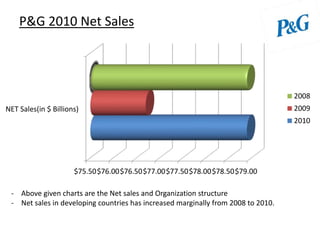
P&G 2010 Net Sales
$75.50$76.00$76.50$77.00$77.50$78.00$78.50$79.00
NET Sales(in $ Billions)
2008
2009
2010
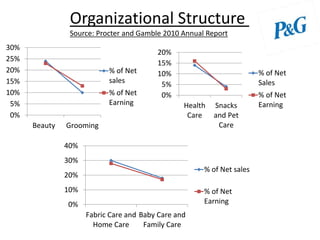
- Above given charts are the Net sales and Organization structure
- Net sales in developing countries has increased marginally from 2008 to 2010.
-The company has a firm belief in innovating and constantly improving
their product’s and their brand.
-The company aim to serve 5 billions consumer’s worldwide.
-The company has very great brand portfolio and also great application
of brand extension.
-P&G is a company with good background and is also the market
leader in the fast moving consumer goods(FMCG)
- North America represented 42% of net sales, western Europe
represented % of net sales , Asia 15%, Central and Eastern Europe
and Middle East and Africa 13% and Latin America 9%
- Developed countries represent 66% of total net sales in 2010.
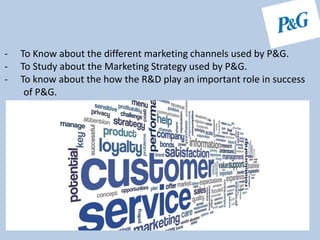
- To Know about the different marketing channels used by P&G.
- To Study about the Marketing Strategy used by P&G.
- To know about the how the R&D play an important role in success
of P&G.
Innovation and R&D: P&G Marketing Secret Sauce
- P&G recognized to boost growth after net sales allowed to 2.6% growth from the previous
year.
- Seven global Business unit(GBUs) based on product categories replaced the company’s
geographic business unit. P&G felt that the GBUs would help with global product
development team focused on innovating in existence categories.
- Overall ,the new structure and approach to innovation ,called “connect-and-develop”,
Identified proven, Technologies , packages and product’s that P&G could improve, scale up
and market on its own or through partnerships.
- 50% of innovations come from labs and 50% of innovations came through the labs partnership
and connection with non- P&G Scientists.
- However the firm struggle to control costs and its stock slids from $118 to $52 over 18 months
- The influx of design had a strong impact on product development of P&G.
- P&G used design as an compliment helping consumers recognize, understand
even if they try to imagine to figure out the given product.
- Jim Stengel as chief marketing officer of P&G created a new design unit and
named it as “Claudia Kotchka” as vice president for design innovation and
strategy and decision making responsibility equal to CMO and head of R&D.
- “Claudia Kotchka” introduced a culture of design such as-
- Design Tasting feature design case study for P&G ‘s top 200 marketing
executives.
- Creation of “clay street” project bringing cross functional teams to create
new Brands based on design.
Marketing Strategy: P&G Focus on Design
Multi Brand Strategy & Brand Extension
- The firm is well known for marketing several brands in the same products category.
- Some examples- are Head & Shoulder and Pantene, Oral B and Crest, Tide and Ariel etc.
- They are also known for producing brands in several sizes and forms and launching of
new brands under the name of parent brand.
- They also used emotional branding which is evident from “Thank You Mom” Campaign .
- P&G mostly relied on commercial, dramas, and opera to sell their products.
- The ads were based on their product superiority and clear functional benefits
of the product.
- P&G with the help of other agencies tried to develop the media neutral ideas that
could be translated across the range of media.
- The firm aimed to shift their advertisement towards more design and emotion driven
advertising
- P&G involved in many Sponsorship activities.
- The firm was the US team sponsor in the 2010 games also sponsored in 2012 games,
also sponsored in 2012 winter gams of Russia
- This helped the firm to increase its visibility
- They also tied up with play 60 initiatives
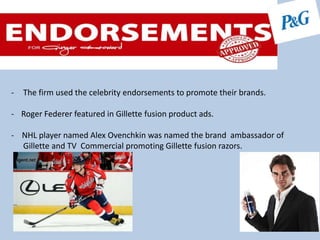
- The firm used the celebrity endorsements to promote their brands.
- Roger Federer featured in Gillette fusion product ads.
- NHL player named Alex Ovenchkin was named the brand ambassador of
Gillette and TV Commercial promoting Gillette fusion razors.
- Digital Marketing enabled a raft of niche segmentation targeted to specific consumers
including several online serials, video games and YouTube channels for various products.
- P&G also used mobile marketing campaign to publicize crest whitening plus toothpaste in
2006.
- The firm launched websites such as Pampers.com , Womensofthehouse.com, which
provide product information and also served as interacting forum.
- In terms of Social Media Facebook is used as marketing supplement.
- P&G need for identifying the needs of their consumers and providing an alternative for it
an example of this is manofthehouse.com.
- P&G maintained its marketing budget despite the recession in 2009.
Conclusion: Point need to be focus by P&G,
P&G should more active in social media and work out on more effective ways .
- They should also develop their websites and keep updating the current scenario.
- They should also keep eyes on their competitors and just be ready to answer their any move.
This Presentation is made by Arunav Pratap Shandeelya, IIIT Bhubaneswar ‘ under the
Guidance of Prof. Sameer Mathur , IIM Lucknow, durning internship of Marketing
Management

P&g marketing capabilities hbs case study

  • 1.
  • 2.
    Overview • History • Brands •Case Analysis • Organizational Structure • Objectives • Conclusion • Disclaimer
  • 3.
    History of Procter &Gamble - Founded in 1837 by candle maker “William Procter“ and soap maker “James Gamble”. - It was the first company to advertise in the 1880’s. - The company started it’s international expansion in the 1930’s and In 1945-1980 began to enter market in Latin America, Western Europe and Japan. - It is considered to be a global leader in the branded consumer goods and known for category defining products . - It expanded into new lines of business through acquisitions , such as Chairman paper mill(1957) which opened up the household Paper product market for the company. And Folgers coffee giving P&G a presence in food category.
  • 4.
  • 5.
    - Innovation helpedround out the company portfolio: disposal diapers (Pampers), first marketed in the early 60’s. - In the 1980’s , P&G ramped up its global expansion and developed its first global brands including Always, Pringles , and Pantene. - The $57 billion acquisition of Gillete in 2005 made P&G the top consumer goods company Gillete business drag on P&G’s top line ,most of the senior manager left and stock lagged. - In terms of product they specifically focuses on three choices: to grow P&G ‘s core brands and categories with an unrelenting focus on innovation; To build our business with unserved and undeserved consumers; and to continue to grow and develop faster growing, higher margin business with global leadership potential.
  • 7.
  • 8.
    0% 5% 10% 15% 20% 25% 30% Beauty Grooming % ofNet sales % of Net Earning 0% 5% 10% 15% 20% Health Care Snacks and Pet Care % of Net Sales % of Net Earning Organizational Structure Source: Procter and Gamble 2010 Annual Report 0% 10% 20% 30% 40% Fabric Care and Home Care Baby Care and Family Care % of Net sales % of Net Earning
  • 9.
    P&G 2010 NetSales $75.50$76.00$76.50$77.00$77.50$78.00$78.50$79.00 NET Sales(in $ Billions) 2008 2009 2010 - Above given charts are the Net sales and Organization structure - Net sales in developing countries has increased marginally from 2008 to 2010.
  • 10.
    -The company hasa firm belief in innovating and constantly improving their product’s and their brand. -The company aim to serve 5 billions consumer’s worldwide. -The company has very great brand portfolio and also great application of brand extension. -P&G is a company with good background and is also the market leader in the fast moving consumer goods(FMCG) - North America represented 42% of net sales, western Europe represented % of net sales , Asia 15%, Central and Eastern Europe and Middle East and Africa 13% and Latin America 9% - Developed countries represent 66% of total net sales in 2010.
  • 12.
    - To Knowabout the different marketing channels used by P&G. - To Study about the Marketing Strategy used by P&G. - To know about the how the R&D play an important role in success of P&G.
  • 13.
    Innovation and R&D:P&G Marketing Secret Sauce - P&G recognized to boost growth after net sales allowed to 2.6% growth from the previous year. - Seven global Business unit(GBUs) based on product categories replaced the company’s geographic business unit. P&G felt that the GBUs would help with global product development team focused on innovating in existence categories. - Overall ,the new structure and approach to innovation ,called “connect-and-develop”, Identified proven, Technologies , packages and product’s that P&G could improve, scale up and market on its own or through partnerships. - 50% of innovations come from labs and 50% of innovations came through the labs partnership and connection with non- P&G Scientists. - However the firm struggle to control costs and its stock slids from $118 to $52 over 18 months
  • 15.
    - The influxof design had a strong impact on product development of P&G. - P&G used design as an compliment helping consumers recognize, understand even if they try to imagine to figure out the given product. - Jim Stengel as chief marketing officer of P&G created a new design unit and named it as “Claudia Kotchka” as vice president for design innovation and strategy and decision making responsibility equal to CMO and head of R&D. - “Claudia Kotchka” introduced a culture of design such as- - Design Tasting feature design case study for P&G ‘s top 200 marketing executives. - Creation of “clay street” project bringing cross functional teams to create new Brands based on design. Marketing Strategy: P&G Focus on Design
  • 16.
    Multi Brand Strategy& Brand Extension - The firm is well known for marketing several brands in the same products category. - Some examples- are Head & Shoulder and Pantene, Oral B and Crest, Tide and Ariel etc. - They are also known for producing brands in several sizes and forms and launching of new brands under the name of parent brand. - They also used emotional branding which is evident from “Thank You Mom” Campaign .
  • 18.
    - P&G mostlyrelied on commercial, dramas, and opera to sell their products. - The ads were based on their product superiority and clear functional benefits of the product. - P&G with the help of other agencies tried to develop the media neutral ideas that could be translated across the range of media. - The firm aimed to shift their advertisement towards more design and emotion driven advertising
  • 19.
    - P&G involvedin many Sponsorship activities. - The firm was the US team sponsor in the 2010 games also sponsored in 2012 games, also sponsored in 2012 winter gams of Russia - This helped the firm to increase its visibility - They also tied up with play 60 initiatives
  • 20.
    - The firmused the celebrity endorsements to promote their brands. - Roger Federer featured in Gillette fusion product ads. - NHL player named Alex Ovenchkin was named the brand ambassador of Gillette and TV Commercial promoting Gillette fusion razors.
  • 22.
    - Digital Marketingenabled a raft of niche segmentation targeted to specific consumers including several online serials, video games and YouTube channels for various products. - P&G also used mobile marketing campaign to publicize crest whitening plus toothpaste in 2006. - The firm launched websites such as Pampers.com , Womensofthehouse.com, which provide product information and also served as interacting forum. - In terms of Social Media Facebook is used as marketing supplement. - P&G need for identifying the needs of their consumers and providing an alternative for it an example of this is manofthehouse.com. - P&G maintained its marketing budget despite the recession in 2009.
  • 23.
    Conclusion: Point needto be focus by P&G, P&G should more active in social media and work out on more effective ways . - They should also develop their websites and keep updating the current scenario. - They should also keep eyes on their competitors and just be ready to answer their any move.
  • 25.
    This Presentation ismade by Arunav Pratap Shandeelya, IIIT Bhubaneswar ‘ under the Guidance of Prof. Sameer Mathur , IIM Lucknow, durning internship of Marketing Management