The MAANZ MXpress Program
New Product Development
Dr Brian Monger
Copyright May 2013.
This Power Point program and the associated documents remain the intellectual property and the
copyright of the author and of The Marketing Association of Australia and New Zealand Inc. These
notes may be used only for personal study associated with in the above referenced course and not in any
education or training program. Persons and/or corporations wishing to use these notes for any other purpose
should contact MAANZ for written permission.
MAANZ International
• MAANZ International, is a Not for Profit, 
internet based professional and educational 
institute which has operated for over 25 years.
• MAANZ International offers Professional 
Memberships;
• Marketing Courses (Formal and Short)
• And Marketing Publications
• www.marketing.org.au 
2
Dr. Brian Monger
• Brian Monger is the CEO of MAANZ International and a 
Professional marketer and consultant with over 40 years 
experience.
Marketing In Black and White 3
4
New Product Development
Given changes in consumer tastes, 
technology and competition, organisations 
must develop new products if they are to 
remain competitive.
5
The Need for New Offers
• The Value Offer Cycle Model (or more commonly 
known as the Product Life Cycle) shows that all 
products have a finite life in their market. 
• New offer development is risky. Many new 
products don’t succeed. 
• This presentation looks at the management of 
new value offer development.
6
What Is A ‘New’ Offer?
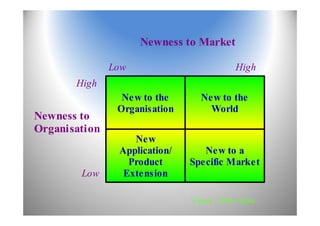
•There are typically four ways to classify a new 
offer:
•New to the world;
•New to a specific market; 
•New to the organisation 
•A new application of an existing offer.
New to the
Organisation
New to the
World
New to a
Specific Market
New
Application/
Product
Extension
Newness to Market
Low High
Newness to
Organisation
High
Low
Figure 1 Offer Types
8
What Drives New Offer Development?
• There are basically three distinct but 
interacting factors that drive an organisation 
to develop new offerings:
• The culture of the organisation .
• Stakeholder pressure. 
• Market pressure. 
9
Sources Of Ideas For New Offerings 
• Externally
• customers’ needs
• competitors
• technology advances
• Internally
• employees
• market research
• consultants.
10
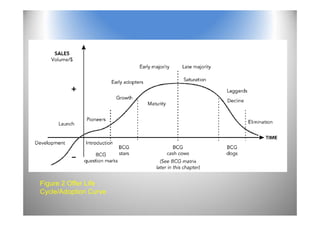
The Offer Life Cycle
• The Offer Value Life Cycle Curve is shown in 
Figure 2. 
• Its stages are outlined below.
• Stage one: Development
• Stage two: Launch and introduction
• Stage three: Growth
• Stage four: Maturity
The Offer Life Cycle
• Stage five: Saturation
• Stage six: Decline ‐ introduction of alternative 
value offers
• Stage seven: Elimination
Figure 2 Offer Life
Cycle/Adoption Curve
13
Why New Product Offers Fail
• Some of the reasons new products fail are:
• overestimated demand
• lack of real organisation support
• poor design/technology
• lack of effective research
• poor marketing execution
• lack of distribution
• high development costs
• strong competitive reaction
14
Some of the reasons new products fail 
are:
•fragmented markets
•social and governmental constraints
•cost
•capital shortage
•need for speed
•shorter product life cycles.
15
Managing the Development Process
• Because so many new product offerings fail, 
organisations are anxious to learn how to 
improve their odds of new product success. 
• There are many elements involved in 
developing successful new products. 
• However, to create them, an organisation 
must understand its consumers, markets and 
competitors, and develop products that 
deliver superior value to customers.
16
Predictors of New Offering Success
• For an offer to succeed it must:
• meet the needs of the market better than 
competitive offerings (perceptually)
• be technically superior
• offer better perceived value
• be interesting ‐ provide a perception of 
change/newness
• provide strategic synergy ‐ fit well with the 
organisation’s directions (vision, goals and objectives)
• provide cultural synergy ‐ fit well with the 
organisation’s current culture
17
For an offer to succeed it must:
• have a better‐managed development process
• have a better marketing synergy ‐ fit into the 
existing marketing experience and skills of the 
organisation
• have good technical synergy ‐ fit into the existing 
technological experience and skills of the 
organisation
• be introduced to the market at the right time
• have better new product launch management
• survive better competitive responsiveness.
18
New Concept Development Model
• This model consists of three parts:
• 1. Identifying the uncontrollable influencing factors
• 2. Identifying the controllable activities
• 3. Proceeding through five activity elements:
• opportunity identification
• opportunity analysis
• idea generation and enrichment
• idea selection
• concept definition.
19
New Product Development or New 
Market?
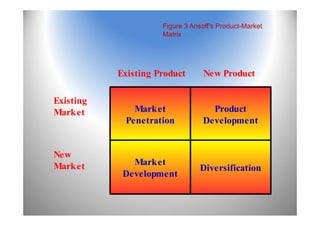
•Igor Ansoff developed a Product–Market matrix to 
show the options available in deciding on either a 
new product, a new market or some combination of 
both. 
Market
Penetration
Product
Development
Diversification
Market
Development
Existing Product New Product
Existing
Market
New
Market
Figure 3 Ansoff’s Product-Market
Matrix
21
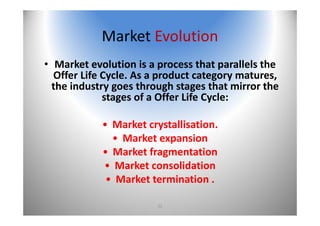
Market Evolution
• Market evolution is a process that parallels the 
Offer Life Cycle. As a product category matures, 
the industry goes through stages that mirror the 
stages of a Offer Life Cycle:
• Market crystallisation.
• Market expansion 
• Market fragmentation 
• Market consolidation 
• Market termination .
22
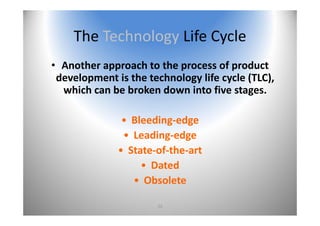
The Technology Life Cycle
• Another approach to the process of product 
development is the technology life cycle (TLC), 
which can be broken down into five stages.
• Bleeding‐edge
• Leading‐edge 
• State‐of‐the‐art
• Dated
• Obsolete
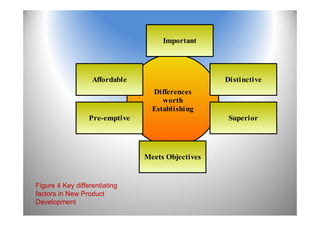
Differences
worth
Establishing
Distinctive
Pre-emptive Superior
Important
Affordable
Meets Objectives
Figure 4 Key differentiating
factors in New Product
Development
24
Models Of Innovation/Product 
Diffusion
• There are several theories that try to explain 
the mechanics of new product offer diffusion 
into the marketplace:
• 1. The Two‐step Hypothesis 
• 2. The Trickle‐down Theory
25
Diffusion of Innovations Theory
• 3. The Everett Roger’s Diffusion of 
Innovations Theory  ‐ there are five 
categories of product adopters:
• Innovators
• Early adopters.
• Early majority .
• Late majority .
• Laggards 
• 4. Technology‐driven models 
26
Rate of Product Diffusion
• The rate of diffusion is influenced by:
• the product’s perceived advantage or benefit to the 
buyer
• perceived riskiness of purchase
• ease or complexity of product use; simplicity or 
complexity of the product
• immediacy of benefits to the buyer; how quickly 
benefits will be obtained
• observability of the value offered by the product
• trialability of the value offer
27
Rate of Product Diffusion
• perceived value (buyer investment compared 
with perceived value)
• extent of changes required to purchase and 
use (including behavioural changes)
• return on investment in the case of 
organisational (B2B) products.
28
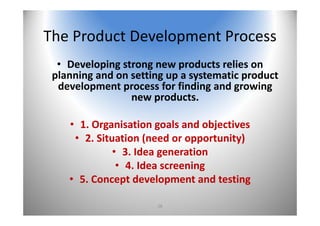
The Product Development Process
• Developing strong new products relies on 
planning and on setting up a systematic product 
development process for finding and growing 
new products. 
• 1. Organisation goals and objectives
• 2. Situation (need or opportunity)
• 3. Idea generation
• 4. Idea screening
• 5. Concept development and testing
29
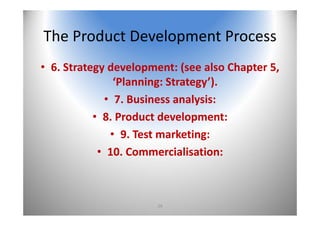
The Product Development Process
• 6. Strategy development: (see also Chapter 5, 
‘Planning: Strategy’).
• 7. Business analysis: 
• 8. Product development: 
• 9. Test marketing: 
• 10. Commercialisation: 
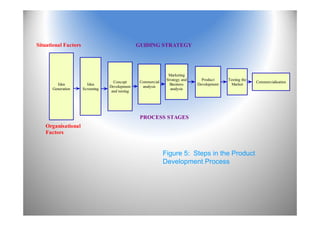
Idea
Generation
Idea
Screening
Concept
Development
and testing
Marketing
Strategy and
Business
analysis
Product
Development
Testing the
Market
Commercialisation
GUIDING STRATEGY
PROCESS STAGES
Commercial
analysis
Situational Factors
Organisational
Factors
Figure 5: Steps in the Product
Development Process
31
Things That Drive Successful and Innovative 
Organisations
• Desire to be the best.
• Effective values are practised and demonstrated 
by all.
• The organisational culture fosters employee 
empowerment and involvement.
• Excellence is viewed not as a destination, but 
rather as a continuous journey.
• The organisation is solution‐focused.
• There is a high level of employee engagement.
32
Things That Drive Successful and Innovative 
Organisations
• Perpetual innovation in products.
• Perpetual innovation in the way you think. 
• Perpetual innovation in the way you lead.
• Goals are set for both leaders and staff that measure 
adherence to employee satisfaction, customer service 
and effective leadership.
• There is ongoing learning from the ‘Best Practices’ of 
top‐performing companies but you discover your own 
best practices and build on them.
• Dynamic leadership is displayed and continuously 
reinforced.
33
Things That Drive Successful and Innovative 
Organisations
• Individuals in all roles look for every opportunity 
to help the sales force/business development 
group.
• All individuals are committed to exhibiting 
behaviours that help to retain customers and 
breed customer loyalty.
• All individuals recognise they are ‘ambassadors’ 
who must project a positive image of their 
company.
• Every effort to exceed expectations is made.
34
Things That Drive Successful and Innovative 
Organisations
• People work together as a team with a 
shared vision for a common goal for the 
betterment of their company.
• People take ownership of their role, and 
strive to find new ways to be better 
contributors.
• Individuals answer not only to management 
but also to each other for their attitudes and 
performance.
35
Commercial Development of New 
Products
• New products need to appeal to both consumer 
and channel customers.  In a new product the 
supplier needs to consider the following:
• clear objectives
• a simple, effective message
• a big idea
• ability to achieve the objectives and benefits of 
consumer and channel customer.
• a compelling idea
36
What Does The Customer Want?
• Choice
• Convenience
• Customisation
• Health and wellbeing
• Value for investment
• Indulgence
37
What Does The Distributor Want?
• Differentiation
• Increased traffic
• Increased sales
• Category objectives
• Thought/category leadership
• Rewards for store team
• Promotional assistance
38
In assessing the product, the supplier needs to 
consider:
• Maintaining brand identity ‐ ensure the new 
product is in line with existing brand(s) focus:
• Will the new product maintain consistency
across all existing brand touch‐points? Will the 
new product leverage and/or reinforce the 
brand?
• Cannibalisation ‐ How will the new product 
affect the existing product line ?
• Category growth ‐ Will the new product create 
additional growth in its category ?
39
Things That Drive Successful and Innovative 
Organisations
• Store space availability ‐ there is only so much shelf or floor space 
available in retail stores. Will something need to be removed?
• Wear‐out factor ‐ At what point will a campaign lose its 
effectiveness due to overplay ?
• Production/supply timelines ‐ How quickly can we come to 
market? Can we meet demand, or more demand than expected?
• Training ‐ What is required to train salespeople and retail 
salespeople ?
• Relationship building: segment needs/channel needs ‐ Will this 
product aid in building better relationships with distributors and 
end users ?
• For more information about MAANZ International and articles 
about Marketing, visit:
• www.marketing.org.au
• http://smartamarketing.wordpress.com
• http://smartamarketing2.wordpress.com
• .  http://www.linkedin.com/groups/MAANZ‐
SmartaMarketing‐Group‐2650856/about
• Email: info@marketing.org.au
• Link to this site ‐ ‐ http://www.slideshare.net/bmonger for 
further presentations
Marketing In Black and White 40
41
END
MAANZ International
• MAANZ International, is a Not for Profit, 
internet based professional and educational 
institute which has operated for over 25 years.
• MAANZ International offers Professional 
Memberships;
• Marketing Courses (Formal and Short)
• And Marketing Publications
• www.marketing.org.au 
Marketing In Black and White 42
Dr. Brian Monger
• Brian Monger is the CEO of MAANZ International and a 
Professional marketer and consultant with over 40 years 
experience.
Marketing In Black and White 43
• For more information about MAANZ International and articles 
about Marketing, visit:
• www.marketing.org.au
• http://smartamarketing.wordpress.com
• http://smartamarketing2.wordpress.com
• .  http://www.linkedin.com/groups/MAANZ‐
SmartaMarketing‐Group‐2650856/about
• Email: info@marketing.org.au
• Link to this site ‐ ‐ http://www.slideshare.net/bmonger for 
further presentations
Marketing In Black and White 44
45
END
MAANZ MXPress Program

New Product Development