

Oral Radilogy
Dr. Rawand Samy Mohamed Abu Nahla
Oral Medicine, periodontology& oral Radiology Department.
Dr. Haydar. A. Shafy Faculty Of Dentistry.Dr. Haydar. A. Shafy Faculty Of Dentistry.
El Azhar University.El Azhar University.
Lecture 7:Processing
Radiographs
Introduction
• Film-processing procedures have a direct effect
on the quality of a radiograph.
Latent Image Formation
• When the radiation interacts with the silver halide
crystals in the film emulsion, the image on the film
is produced.
• The image, which is not visible before processing,
is called the latent image.
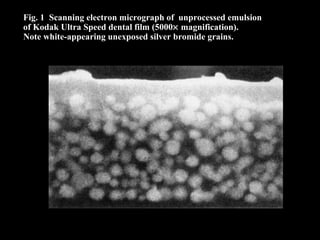
Fig. 1 Scanning electron micrograph of unprocessed emulsion
of Kodak Ultra Speed dental film (5000× magnification).
Note white-appearing unexposed silver bromide grains.
Learning Objectives
• Describe the care and maintenance of the processing
solutions, equipment, and equipment accessories
used in manual and automatic film processing.
• Discuss the requirements necessary for the
darkroom.
• List and identify the component parts of an
automatic film processor.
• Describe common time and temperature errors
during film processing.
Learning Objectives
• Describe chemical-contamination errors made
during film processing.
• Describe film-handling errors that can occur during
film processing.
• Describe some common lighting errors made during
film processing.
Dental X-Ray Film Processing
• Processing is a series of steps that changes the latent
image on the exposed film into a radiograph by
producing a visible image on the film.
• Proper processing is just as important as exposure technique
in producing diagnostic-quality radiographs.
• Radiographs that are non diagnostic because of poor
processing techniques must be retaken, exposing the patient
to unnecessary radiation.
• In many practices intraoral films are processed in an
automatic processor; however, it is still necessary to know
how to process the film manually.
The Five Steps in Processing
Dental Radiographs
• Development
• Rinsing
• Fixation
• Washing
• Drying
Developing
• Developing is the first step in processing films.
• A chemical solution called the developer is used.
• The purpose of the developer is to chemically
reduce the exposed silver halide crystals to black
metallic silver.
• The developer solution also softens the film
emulsion during this process.
Rinsing
• Rinsing of the films is necessary to remove the
developer from the film so that the development
process stops.
• Usually, agitating the film rack for 20 seconds is
sufficient.
• This must be done under safelight conditions.
Fixing
• The acidic fixing solution removes the unexposed silver
halide crystals from the film emulsion.
• The fixer also hardens the film emulsion during this process.
• For permanent fixation, the film is kept in the fixer for a
minimum of 10 minutes.
• However, films may be removed from the fixing solution
after 3 minutes for viewing.
• Films that are not properly fixed will fade and turn brown in
a short time.
• Leaving films in the fixer for a long time can remove the
image from the film.
Washing
• After fixation, a water bath is used to wash the film.
• The washing step requires about 20 minutes to
thoroughly remove all excess chemicals from the
emulsion.
Drying
• The final step in film processing is the drying of the
films.
• Films may be air-dried at room temperature in a
dust-free area or placed in a heated drying cabinet.
• Films must be completely dried before they can be
handled for mounting and viewing.
Film-Processing Solutions
• Film-processing solutions are available in the
following forms:
• Powder
• Ready-to-use liquid
• Liquid concentrate
PROCESSING UNIT Chemistry „
Developer – 20 – 25 sec.
Reducing agents
• electron donor (continues latent image formation process)
• Phenidone - rapidly produces fine detail shades of gray
• Hydroquinone - slowly produces heavy densities
Activator - sodium carbonate, produces alkaline pH for
other chemicals to function, swells gelatin
Restrainer - potassium bromide, decreases reducing agent
activity, prevents chemical fog
Preservative - sodium sulfite, controls oxidation,
buffering agent
Hardener -glutaraldehyde, controls gelatin swelling
to minimize risk of physical damage
Solvent - water, dissolves chemicals and dilutes them
to proper concentration
„Fixer - 20 sec.
Clearing agent - ammonium thiosulfate, removes
undeveloped silver halides from emulsion
Activator - acetic acid, provides acidic pH for other
chemicals to function, stops reduction
Hardener - potassium alum, hardens emulsion to
minimize risk of physical damage
Preservative - sodium sulfite, maintains pH
Solvent - water, dissolves chemicals and dilutes to
proper concentration
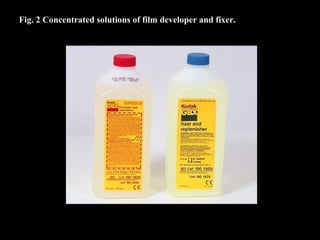
Fig. 2 Concentrated solutions of film developer and fixer.
The Darkroom
• The term “light-tight” is often used to describe the
darkroom.
• To be light-tight, no light leaks can be present.
• When you are in the darkroom with the light turned
off, no white light should be visible.
• X-ray film is extremely sensitive to visible white
light.
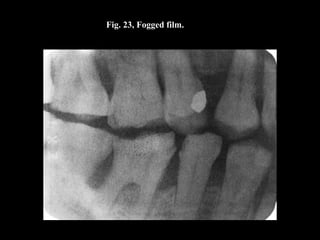
• Any leakage of white light can cause film fog. A
fogged film appears dull gray, lacks contrast, and is
nondiagnostic.
Types of Darkroom Lighting
• Room lighting: An overhead white light provides
adequate lighting for tasks such as cleaning,
restocking of materials, and mixing of chemicals.
• Safelighting: A safelight is a low-intensity light in
the red-orange spectrum. Safelighting provides
enough illumination in the darkroom to process
films safely without exposure of or damage to the
film.
Types of Darkroom Lighting
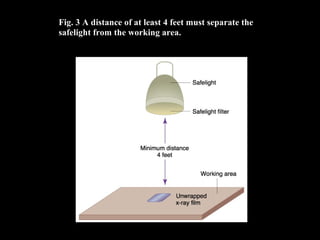
• There must be a a safe distance between the light
and the working area, and the person developing the
film must work quickly to keep the exposure to the
safelight as short as possible.
• Unwrapped films that are left too close to the
safelight or exposed to the safelight for more than 2
to 3 minutes appear fogged.
• A safelight must be placed a minimum of 4 feet
away from the film and working area.
Fig. 3 A distance of at least 4 feet must separate the
safelight from the working area.
The Processing Tank
• Manual processing is a method that is used to
develop, rinse, fix, and wash dental x-ray films.
• The essential piece of equipment required for
manual processing is a processing tank.
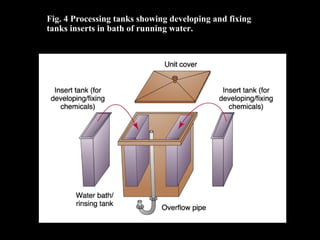
• The processing tank is divided into compartments to
hold the developer solution, water bath, and fixer
solution.
• A processing tank has two insert tanks and one
master tank.
Fig. 4 Processing tanks showing developing and fixing
tanks inserts in bath of running water.
Requirements for a Darkroom
• Cleanliness at all times
• Infection-control items (e.g., gloves, disinfectant
spray, paper towels)
• Container, labeled with a biohazard label, for
contaminated film packets or barriers
• Recycle container for pieces of lead foil pieces,
which should not be thrown in the trash
• Light-tightness
• Processing tanks for the developer and fixer solution
and a circulating-water bath
• Running water with mixing valves to adjust the temperature
• Both a safelight and a source of white (normal) light
• Accurate timer
• Accurate floating thermometer
• Stirring rods or paddles to mix the chemicals and equalize
the temperatures of the solutions
• Safe storage space for chemicals
• Film hangers
• Film-drying rack and film dryer
The Automatic Processor
• Automatic film processing is a fast and simple
method used to process dental x-ray films.
• Other than opening the film packet, all steps of film
processing are handled by the automatic processor.
• Automatic film processing requires only 4 to 6
minutes for the development, fixing, washing, and
drying of a film, whereas manual processing
techniques require approximately 1 hour.
• The automatic processor maintains the correct
temperature of the solutions and adjusts the
processing time.
• Proper maintenance of the automatic processor
reduces the chance of errors during film processing.
• Many dental offices that have automatic processors
still maintain manual processing equipment as a
standby if the automatic processor malfunctions.
Components of the Automatic
Processor
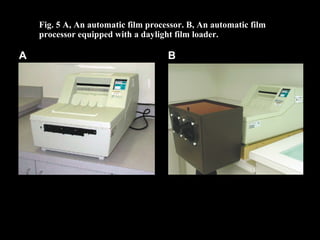
• The processor housing covers all of the component parts.
• The film feed slot is for the unwrapped films to be inserted
into the automatic processor.
• The roller film transporter is a system of rollers that rapidly
moves the film through the compartments.
• The developer and fixer compartments holds the solutions.
The film is transported directly from the developer into the
fixer without a rinsing step.
• The water compartment holds circulating water.
• The drying chamber holds heated air and dries the wet film.
Fig. 5 A, An automatic film processor. B, An automatic film
processor equipped with a daylight film loader.
A B
Advantages of Automatic Film
Processing
• Less processing time is required.
• Time and temperature are automatically controlled.
• Less equipment is used.
• Less space is required.
Processing Errors
• Processing errors may occur for a variety of
reasons, including:
• Time and temperature errors
• Chemical-contamination errors
• Film-handling errors
• Lighting errors
• The dental assistant must be able to recognize the
appearance of common processing errors and know what
to do to prevent such problems from occurring again.
 The following photographs illustrate common
examples of technical errors that can occur during
film processing.
 Such errors result in radiographs that are not
diagnostic, thus requiring retakes and
additional exposure to the patient.
Examples of Common Processing Errors
Fig. 6, Overdevelopment.
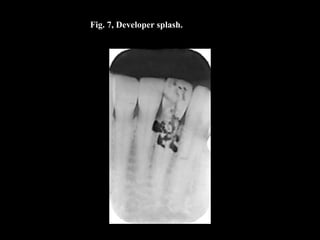
Fig. 7, Developer splash.
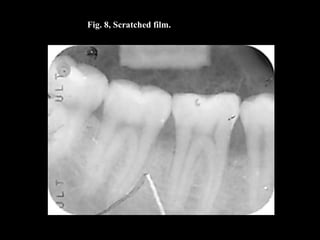
Fig. 8, Scratched film.
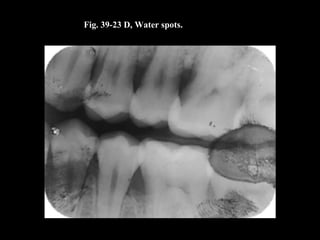
Fig. 39-23 D, Water spots.
Fig. 9, Solution too low.
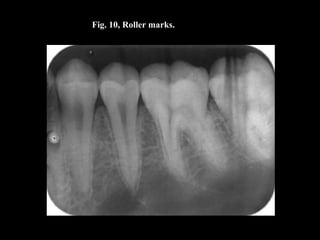
Fig. 10, Roller marks.
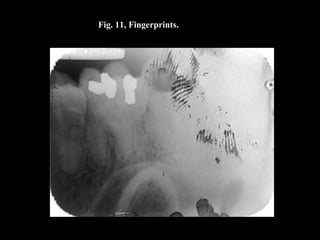
Fig. 11, Fingerprints.
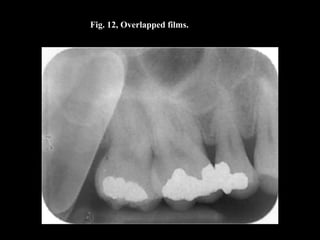
Fig. 12, Overlapped films.
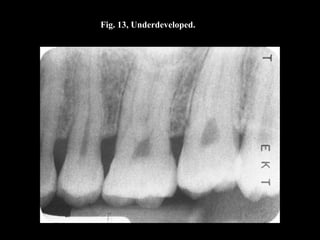
Fig. 13, Underdeveloped.
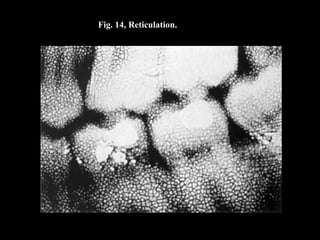
Fig. 14, Reticulation.
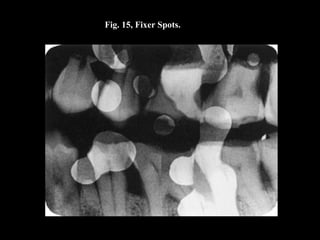
Fig. 15, Fixer Spots.
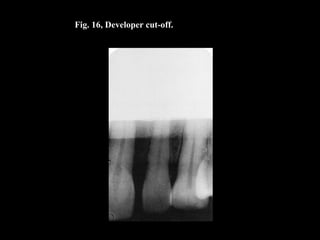
Fig. 16, Developer cut-off.
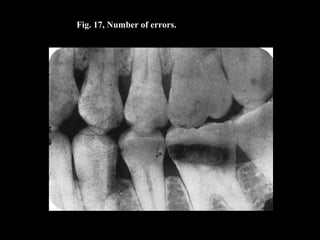
Fig. 17, Number of errors.
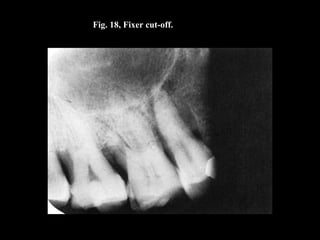
Fig. 18, Fixer cut-off.
Fig. 19, Air bubbles.
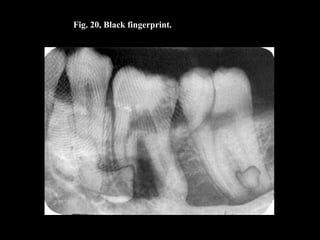
Fig. 20, Black fingerprint.
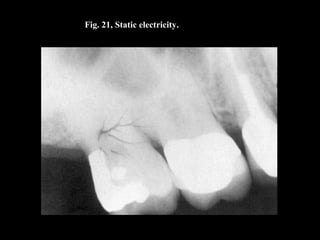
Fig. 21, Static electricity.
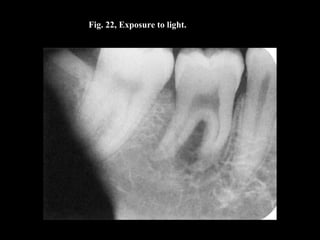
Fig. 22, Exposure to light.
Fig. 23, Fogged film.
Thank you

Lecture 7 dental x ray film, processing and processing errors lecture 7

  • 1.
    Oral Radilogy Dr. RawandSamy Mohamed Abu Nahla Oral Medicine, periodontology& oral Radiology Department. Dr. Haydar. A. Shafy Faculty Of Dentistry.Dr. Haydar. A. Shafy Faculty Of Dentistry. El Azhar University.El Azhar University.
  • 2.
  • 3.
    Introduction • Film-processing procedureshave a direct effect on the quality of a radiograph. Latent Image Formation • When the radiation interacts with the silver halide crystals in the film emulsion, the image on the film is produced. • The image, which is not visible before processing, is called the latent image.
  • 4.
    Fig. 1 Scanningelectron micrograph of unprocessed emulsion of Kodak Ultra Speed dental film (5000× magnification). Note white-appearing unexposed silver bromide grains.
  • 5.
    Learning Objectives • Describethe care and maintenance of the processing solutions, equipment, and equipment accessories used in manual and automatic film processing. • Discuss the requirements necessary for the darkroom. • List and identify the component parts of an automatic film processor. • Describe common time and temperature errors during film processing.
  • 6.
    Learning Objectives • Describechemical-contamination errors made during film processing. • Describe film-handling errors that can occur during film processing. • Describe some common lighting errors made during film processing.
  • 7.
    Dental X-Ray FilmProcessing • Processing is a series of steps that changes the latent image on the exposed film into a radiograph by producing a visible image on the film. • Proper processing is just as important as exposure technique in producing diagnostic-quality radiographs. • Radiographs that are non diagnostic because of poor processing techniques must be retaken, exposing the patient to unnecessary radiation. • In many practices intraoral films are processed in an automatic processor; however, it is still necessary to know how to process the film manually.
  • 8.
    The Five Stepsin Processing Dental Radiographs • Development • Rinsing • Fixation • Washing • Drying
  • 9.
    Developing • Developing isthe first step in processing films. • A chemical solution called the developer is used. • The purpose of the developer is to chemically reduce the exposed silver halide crystals to black metallic silver. • The developer solution also softens the film emulsion during this process.
  • 10.
    Rinsing • Rinsing ofthe films is necessary to remove the developer from the film so that the development process stops. • Usually, agitating the film rack for 20 seconds is sufficient. • This must be done under safelight conditions.
  • 11.
    Fixing • The acidicfixing solution removes the unexposed silver halide crystals from the film emulsion. • The fixer also hardens the film emulsion during this process. • For permanent fixation, the film is kept in the fixer for a minimum of 10 minutes. • However, films may be removed from the fixing solution after 3 minutes for viewing. • Films that are not properly fixed will fade and turn brown in a short time. • Leaving films in the fixer for a long time can remove the image from the film.
  • 12.
    Washing • After fixation,a water bath is used to wash the film. • The washing step requires about 20 minutes to thoroughly remove all excess chemicals from the emulsion.
  • 13.
    Drying • The finalstep in film processing is the drying of the films. • Films may be air-dried at room temperature in a dust-free area or placed in a heated drying cabinet. • Films must be completely dried before they can be handled for mounting and viewing.
  • 14.
    Film-Processing Solutions • Film-processingsolutions are available in the following forms: • Powder • Ready-to-use liquid • Liquid concentrate
  • 15.
    PROCESSING UNIT Chemistry„ Developer – 20 – 25 sec. Reducing agents • electron donor (continues latent image formation process) • Phenidone - rapidly produces fine detail shades of gray • Hydroquinone - slowly produces heavy densities Activator - sodium carbonate, produces alkaline pH for other chemicals to function, swells gelatin Restrainer - potassium bromide, decreases reducing agent activity, prevents chemical fog
  • 16.
    Preservative - sodiumsulfite, controls oxidation, buffering agent Hardener -glutaraldehyde, controls gelatin swelling to minimize risk of physical damage Solvent - water, dissolves chemicals and dilutes them to proper concentration
  • 17.
    „Fixer - 20sec. Clearing agent - ammonium thiosulfate, removes undeveloped silver halides from emulsion Activator - acetic acid, provides acidic pH for other chemicals to function, stops reduction Hardener - potassium alum, hardens emulsion to minimize risk of physical damage Preservative - sodium sulfite, maintains pH Solvent - water, dissolves chemicals and dilutes to proper concentration
  • 18.
    Fig. 2 Concentratedsolutions of film developer and fixer.
  • 19.
    The Darkroom • Theterm “light-tight” is often used to describe the darkroom. • To be light-tight, no light leaks can be present. • When you are in the darkroom with the light turned off, no white light should be visible. • X-ray film is extremely sensitive to visible white light. • Any leakage of white light can cause film fog. A fogged film appears dull gray, lacks contrast, and is nondiagnostic.
  • 20.
    Types of DarkroomLighting • Room lighting: An overhead white light provides adequate lighting for tasks such as cleaning, restocking of materials, and mixing of chemicals. • Safelighting: A safelight is a low-intensity light in the red-orange spectrum. Safelighting provides enough illumination in the darkroom to process films safely without exposure of or damage to the film.
  • 21.
    Types of DarkroomLighting • There must be a a safe distance between the light and the working area, and the person developing the film must work quickly to keep the exposure to the safelight as short as possible. • Unwrapped films that are left too close to the safelight or exposed to the safelight for more than 2 to 3 minutes appear fogged. • A safelight must be placed a minimum of 4 feet away from the film and working area.
  • 22.
    Fig. 3 Adistance of at least 4 feet must separate the safelight from the working area.
  • 23.
    The Processing Tank •Manual processing is a method that is used to develop, rinse, fix, and wash dental x-ray films. • The essential piece of equipment required for manual processing is a processing tank. • The processing tank is divided into compartments to hold the developer solution, water bath, and fixer solution. • A processing tank has two insert tanks and one master tank.
  • 24.
    Fig. 4 Processingtanks showing developing and fixing tanks inserts in bath of running water.
  • 25.
    Requirements for aDarkroom • Cleanliness at all times • Infection-control items (e.g., gloves, disinfectant spray, paper towels) • Container, labeled with a biohazard label, for contaminated film packets or barriers • Recycle container for pieces of lead foil pieces, which should not be thrown in the trash • Light-tightness • Processing tanks for the developer and fixer solution and a circulating-water bath
  • 26.
    • Running waterwith mixing valves to adjust the temperature • Both a safelight and a source of white (normal) light • Accurate timer • Accurate floating thermometer • Stirring rods or paddles to mix the chemicals and equalize the temperatures of the solutions • Safe storage space for chemicals • Film hangers • Film-drying rack and film dryer
  • 27.
    The Automatic Processor •Automatic film processing is a fast and simple method used to process dental x-ray films. • Other than opening the film packet, all steps of film processing are handled by the automatic processor. • Automatic film processing requires only 4 to 6 minutes for the development, fixing, washing, and drying of a film, whereas manual processing techniques require approximately 1 hour.
  • 28.
    • The automaticprocessor maintains the correct temperature of the solutions and adjusts the processing time. • Proper maintenance of the automatic processor reduces the chance of errors during film processing. • Many dental offices that have automatic processors still maintain manual processing equipment as a standby if the automatic processor malfunctions.
  • 29.
    Components of theAutomatic Processor • The processor housing covers all of the component parts. • The film feed slot is for the unwrapped films to be inserted into the automatic processor. • The roller film transporter is a system of rollers that rapidly moves the film through the compartments. • The developer and fixer compartments holds the solutions. The film is transported directly from the developer into the fixer without a rinsing step. • The water compartment holds circulating water. • The drying chamber holds heated air and dries the wet film.
  • 30.
    Fig. 5 A,An automatic film processor. B, An automatic film processor equipped with a daylight film loader. A B
  • 31.
    Advantages of AutomaticFilm Processing • Less processing time is required. • Time and temperature are automatically controlled. • Less equipment is used. • Less space is required.
  • 32.
    Processing Errors • Processingerrors may occur for a variety of reasons, including: • Time and temperature errors • Chemical-contamination errors • Film-handling errors • Lighting errors • The dental assistant must be able to recognize the appearance of common processing errors and know what to do to prevent such problems from occurring again.
  • 33.
     The followingphotographs illustrate common examples of technical errors that can occur during film processing.  Such errors result in radiographs that are not diagnostic, thus requiring retakes and additional exposure to the patient. Examples of Common Processing Errors
  • 34.
  • 35.
  • 36.
  • 37.
    Fig. 39-23 D,Water spots.
  • 38.
  • 39.
  • 40.
  • 41.
  • 42.
  • 43.
  • 44.
  • 45.
  • 46.
    Fig. 17, Numberof errors.
  • 47.
  • 48.
    Fig. 19, Airbubbles.
  • 49.
    Fig. 20, Blackfingerprint.
  • 50.
    Fig. 21, Staticelectricity.
  • 51.
  • 52.
  • 53.

Editor's Notes

  • #4 Who is most often responsible for processing film? (The dental assistant.)