Seminar Presentation
On
PROCESS MANAGEMENT
Submitted By:-
Sohil Sundaram
BCA – 1st SEM
Roll No. 66
Submitted To:-
Mrs. Lata Nautiyal
Sohil Sundaram, 66
OPERATING SYSTEM
 Program to manage Computer Hardware.
 Provide base for Application programs.
 Acts as an intermediary between user and hardware.
 Supports Complex games, business applications, etc. .
Sohil Sundaram, 66
Process - Definition
 Is simply a Program in Execution.
 Unit of work in most system.
 Consist of collection of processes like Word processing, System task etc.
 Processes executes concurrently.
Sohil Sundaram, 66
NEED OF
PROCESS MANAGEMENT
 Manage the processes of OS
 Integral part of modern day OS.
 Multitasking – Multiple task at single time.
Sohil Sundaram, 66
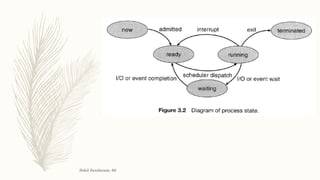
Process State
 New – Process is being created.
 Running – Instruction are being executed.
 Waiting – Waiting for some event to occur.
 Ready – Process is ready to be assigned to a processor.
 Blocked - Due to Exhausting CPU time allocation.
 Terminated – After completion of execution.
Sohil Sundaram, 66
Sohil Sundaram, 66
Process Control Block
Contains many pieces of information associated with a specific process
 Process Identification Data : include unique identifier for the process.
 Processor State Data : Defines the status of process.
 Process control data : Used by OS to manage the process itself.
 Threads : Smallest sequence of programmed instructions.
Sohil Sundaram, 66
Process Scheduling
Activity of process manager that handles the removal of the running process from
CPU.
 Scheduling Queues : Consist of all processes.
 Schedulers : Migrate between various Scheduling Queues.
 Context Switch : Stopping of one and starting of another process.
Sohil Sundaram, 66
THREADS
 Smallest sequence of programmed instructions.
 Called a Lightweight Process.
 Basic unit of CPU Utilization.
 Basic component of process.
Sohil Sundaram, 66
Multithreading Models
 Many-to-one Model : Maps many user level thread to one kernel thread.
 One-to-one Model : Maps each user thread to kernel thread.
 Many-to-many Model : Maps many user level thread to smaller or equal
Number of kernel thread.
Sohil Sundaram, 66
Scheduling Algorithm
This defines the schedules for Processes to be executed in which manner.
These are of four types :
 FCFS : First-Come First-Serve basis.
 SJF : Shortest Job First
 Priority Scheduling
 Round-Robin Scheduling
Sohil Sundaram, 66
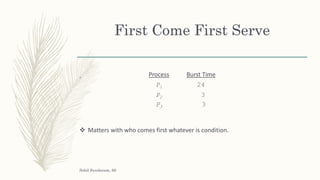
First Come First Serve
Process Burst Time
P1 24
P2 3
P3 3
 Matters with who comes first whatever is condition.
Sohil Sundaram, 66
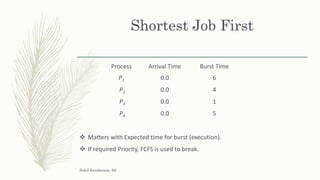
Shortest Job First
Process Arrival Time Burst Time
P1 0.0 6
P2 0.0 4
P3 0.0 1
P4 0.0 5
 Matters with Expected time for burst (execution).
 If required Priority, FCFS is used to break.
Sohil Sundaram, 66
Priority Scheduling
 Works according to Priority.
 Highest priority executes first.
 Equal priority scheduled in FCFS order.
Sohil Sundaram, 66
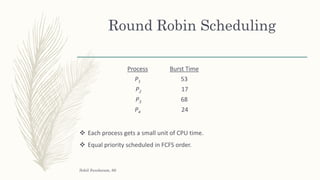
Round Robin Scheduling
Process Burst Time
P1 53
P2 17
P3 68
P4 24
 Each process gets a small unit of CPU time.
 Equal priority scheduled in FCFS order.
Sohil Sundaram, 66
Deadlocks
Several Process compete for resources. If resource is available, it goes for execution
if it is unavailable, it enters in wait state. Waiting process never change state as
requested resources are held by other waiting processes, this situation is Called
Deadlock.
Sohil Sundaram, 66
Sohil Sundaram, 66
!!! THANKS !!!

Process management

  • 1.
    Seminar Presentation On PROCESS MANAGEMENT SubmittedBy:- Sohil Sundaram BCA – 1st SEM Roll No. 66 Submitted To:- Mrs. Lata Nautiyal Sohil Sundaram, 66
  • 2.
    OPERATING SYSTEM  Programto manage Computer Hardware.  Provide base for Application programs.  Acts as an intermediary between user and hardware.  Supports Complex games, business applications, etc. . Sohil Sundaram, 66
  • 3.
    Process - Definition Is simply a Program in Execution.  Unit of work in most system.  Consist of collection of processes like Word processing, System task etc.  Processes executes concurrently. Sohil Sundaram, 66
  • 4.
    NEED OF PROCESS MANAGEMENT Manage the processes of OS  Integral part of modern day OS.  Multitasking – Multiple task at single time. Sohil Sundaram, 66
  • 5.
    Process State  New– Process is being created.  Running – Instruction are being executed.  Waiting – Waiting for some event to occur.  Ready – Process is ready to be assigned to a processor.  Blocked - Due to Exhausting CPU time allocation.  Terminated – After completion of execution. Sohil Sundaram, 66
  • 6.
  • 7.
    Process Control Block Containsmany pieces of information associated with a specific process  Process Identification Data : include unique identifier for the process.  Processor State Data : Defines the status of process.  Process control data : Used by OS to manage the process itself.  Threads : Smallest sequence of programmed instructions. Sohil Sundaram, 66
  • 8.
    Process Scheduling Activity ofprocess manager that handles the removal of the running process from CPU.  Scheduling Queues : Consist of all processes.  Schedulers : Migrate between various Scheduling Queues.  Context Switch : Stopping of one and starting of another process. Sohil Sundaram, 66
  • 9.
    THREADS  Smallest sequenceof programmed instructions.  Called a Lightweight Process.  Basic unit of CPU Utilization.  Basic component of process. Sohil Sundaram, 66
  • 10.
    Multithreading Models  Many-to-oneModel : Maps many user level thread to one kernel thread.  One-to-one Model : Maps each user thread to kernel thread.  Many-to-many Model : Maps many user level thread to smaller or equal Number of kernel thread. Sohil Sundaram, 66
  • 11.
    Scheduling Algorithm This definesthe schedules for Processes to be executed in which manner. These are of four types :  FCFS : First-Come First-Serve basis.  SJF : Shortest Job First  Priority Scheduling  Round-Robin Scheduling Sohil Sundaram, 66
  • 12.
    First Come FirstServe Process Burst Time P1 24 P2 3 P3 3  Matters with who comes first whatever is condition. Sohil Sundaram, 66
  • 13.
    Shortest Job First ProcessArrival Time Burst Time P1 0.0 6 P2 0.0 4 P3 0.0 1 P4 0.0 5  Matters with Expected time for burst (execution).  If required Priority, FCFS is used to break. Sohil Sundaram, 66
  • 14.
    Priority Scheduling  Worksaccording to Priority.  Highest priority executes first.  Equal priority scheduled in FCFS order. Sohil Sundaram, 66
  • 15.
    Round Robin Scheduling ProcessBurst Time P1 53 P2 17 P3 68 P4 24  Each process gets a small unit of CPU time.  Equal priority scheduled in FCFS order. Sohil Sundaram, 66
  • 16.
    Deadlocks Several Process competefor resources. If resource is available, it goes for execution if it is unavailable, it enters in wait state. Waiting process never change state as requested resources are held by other waiting processes, this situation is Called Deadlock. Sohil Sundaram, 66
  • 17.